>

Martyred for the Gospel

Martyred for the Gospel
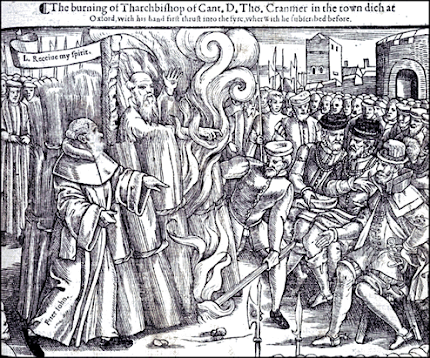
The burning of Tharchbishop of Cant. D. Tho. Cranmer in the town dich at Oxford, with his hand first thrust into the fyre, wherwith he subscribed before. [Click on the picture to see Cranmer's last words.]

Daily Bible Verse

Showing posts with label Reprobation. Show all posts

Tuesday, March 22, 2016

Does God Tempt Elect Believers or Reprobate Unbelievers?

"But notwithstanding this, God may when he sees fit deliver us to Satan, abandon us to a reprobate mind and lustful concupiscence, and in this manner ‘lead us into temptation’ by a righteous judgment as a punishment of our sinful self-indulgence . . ."  W. G. T. Shedd

"But though I should confess a hundred times that God is the author of it—which is very true—yet they do not promptly cleanse away the guilt that, engraved upon their consciences, repeatedly meets their eyes."  John Calvin

". . . so for curious and carnal persons, lacking the Spirit of Christ, to have continually before their eyes the sentence of God's Predestination is a most dangerous downfall, whereby the devil doth thrust them either into desperation or into wretchlessness of most unclean living no less perilous than desperation."  Archbishop Thomas Cranmer.  39 Articles of Religion:  Article 17:  Of Predestination and Election.


2 Thessalonians 2:11–12 (NKJV)
11 And for this reason God will send them strong delusion, that they should believe the lie, 12 that they all may be condemned who did not believe the truth but had pleasure in unrighteousness.


I am the first to admit that I have often erred in my past theological views and my understanding of the Bible.  I was an Arminian for many years.  On my blog I have tried not to delete past articles where I have erred or made erroneous statements.  Instead I have posted addendums with dates to show that I have corrected my errors.  Understanding the system of propositional revelation in the Bible can be difficult when we neglect to compare Scripture with Scripture and to think systematically.  It is to be noted that all the parts, all the verses of Scripture fit together into a system of theologically consistent truth.  None of the verses of Scripture can be isolated into stand alone aggregates or pebbles of truth.  All Scripture is inspired of God and all the Scriptures are profitable for doctrine (2 Timothy 3:16).  Furthermore, the Scriptures cannot be broken (John 10:35).

Having said that, it is often stated that God is not the author of man's sins.  This is in fact what the Westminster Confession of Faith clearly states:

Chapter V.  Of Providence

4.      The almighty power, unsearchable wisdom, and infinite goodness of God so far manifest themselves in His providence, that it extendeth itself even to the first fall, and all other sins of angels and men; (Rom. 11:32–34, 2 Sam. 24:1, 1 Chron. 21:1, 1 Kings 22:22–23, 1 Chron. 10:4, 13–14, 2 Sam. 16:10, Acts 2:23) and that not by a bare permission, (Acts 14:16) but such as hath joined with it a most wise and powerful bounding, (Ps. 76:10, 2 Kings 19:28) and otherwise ordering, and governing of them, in a manifold dispensation, to His own holy ends; (Gen. 50:20, Isa. 10:6–7, 12) yet so, as the sinfulness thereof proceedeth only from the creature, and not from God, who, being most holy and righteous, neither is nor can be the author or approver of sin. (James 1:13–14, 17, 1 John 2:16, Ps. 50:21)

The Westminster Confession of Faith (Oak Harbor, WA: Logos Research Systems, Inc., 1996).

But notice that not only does the WCF say that God is not the author or approver of sins but that "providence extendeth itself even to the first fall, and all other sins of angels and men."  In short, the idea that God loves the reprobate is absolutely refuted by the Westminster Confession.  The neo-Calvinist doctrines of common grace, the well meant offer of salvation, and the free offer of the Gospel are refuted by the system of truth revealed in Scripture and summarized in the Westminster Confession of Faith.  God so orders and governs all things such that all things work for the damnation of the reprobate.  This is clear because  providence works to the destruction of the reprobate.  We can deduce this from the fact that providence extendeth itself to all sins of men.    That would include the sin of unbelief and refusing to obey the Gospel, which inevitably results in eternal condemnation and eternal judgment (2 Thess. 1:8; 1 Pet. 4:17; 1 Peter 2:8; Romans 2:8; Isaiah 66:15; Matthew 25:41).

It should not be a strange thing to understand that it is our own depravity that causes us to sin.  Both the elect and the reprobate do sin.  Even after regeneration and conversion elect believers will sin, though not habitually.  Our habits are changed.  When we do sin, we are completely and entirely responsible and accountable to God for our sins and we are the direct cause of our own sins.  However, that does not mean that God is not the ultimate cause of all things, including all the sins of angels and men.  That's because God has only one eternally unchanging will.  His eternal decrees are secret to us until they are brought to pass in real time (Deuteronomy 29:29).  But we are not excused from obeying God's revealed precepts in the moral law and the Holy Scriptures simply because we do not know what God has purposed from all eternity in His divine decree.  God knows the end from the beginning and has ordained all things that come to pass (Isaiah 46:9-11; Ephesians 1:11).

Some will accuse me of hyper-Calvinism because of what I have said here.  But if so, then I am in good company with a host of Reformed theologians, including W. G. T. Shedd who said:

“The temptations of God are widely different from those of Satan. Satan tempts to overthrow, condemn, confound, and destroy. But God that, by proving his people, he may make a trial of their sincerity, to confirm their strength by exercising it, to mortify, purify, and refine their flesh, which without such restraints would run into the greatest excesses. [sic]. Besides, Satan attacks persons unarmed and unprepared, to overwhelm the unwary. ‘God, with the temptation, always makes a way to escape, that they may be able to bear’ whatever he brings upon them (1 Cor. 10:13). To some there appears a difficulty in our petition to God that he will not lead us into temptation, whereas, according to James, it is contrary to his nature for him to tempt us (James 1:13-14). But this objection has already been partly answered, because our own lust is properly the cause of all the temptations that seduce and overcome us. Nor does James intend any other than to assert the injustice of transferring to God the tempting concupiscence which we are bound to impute to ourselves because we are conscious of being guilty of it. But notwithstanding this, God may when he sees fit deliver us to Satan, abandon us to a reprobate mind and lustful concupiscence, and in this manner ‘lead us into temptation’ by a righteous judgment as a punishment of our sinful self-indulgence (Rom. 1:24,26, 28).”

Shedd, William G. (2011-07-19). Dogmatic Theology (Kindle Locations 21270-21279). P&R Publishing. Kindle Edition.

  Dr. Gordon H. Clark in his commentary on 1 Corinthians 10:13 says the following:

Some people wish to say that God does not "make" or send the temptation; He only "permits" it:  what He "makes" is the way to escape.  The motivation in distinguishing permission from making is to avoid compromising God's holiness.  Somehow the idea of God's permitting evil without decreeing it seems to absolve God from the charge that He is the "author" of sin, but one must be careful, both with respect to the logic of the argument and to the full scriptural data.  God "permitted" Satan to afllict Job; but since Satan could not have done so without God's approval, the idea of permission hardly exonerates God.  Is perfect holiness any more compatible with approving and permitting Satanic evil?  If God could have prevented, not only Job's trials, but all the other sins and temptations to which mankind is subject--is He less reprehensible than if He positively decreed them?  If a man could save a baby from a burning house, but decided to "permit" the baby to burn, who would dare say that he was morally perfect in so deciding?  Furthermore, the present verse says, "God will make with the temptation also the way of escape."  It is clear therefore that God makes both.  The term "permission" is nothing more than a literary device for describing God's use of created agents.  Otherwise, there is no difference between a permit and a decree. 

Gordon H. Clark,  First Corinthinans:  A Contemporary Commentary.  1975.  Second Edition.  (Jefferson:  Trinity Foundation, 1991).  Pp. 156-157.

God is not the direct author of sin just as He is not the author of what I am writing here in this blog.  I am its author and I am writing this.  But ultimately it is God who is the author of all things, including my existence, my thoughts, and my words.  I am not here claiming that what I write is divinely inspired or that I am infallible.  I am not a robot since I am not a biological machine or puppet.  I am a body and a spirit that together constitutes a soul.  And since God is the cause of all things, whatever I have said or done in my life is ultimately caused by God by His divine decree.  We are all capable of genuine choices because we have the natural ability through the intellect and the will to think and decide to do nor not do certain things.  God holds us accountable for our sins and for our obedience.  We do cooperate with God's grace in sanctification but even this is caused by God (Philippians 2:11-12).

Now, permission may distinguish an indirect causation from a direct causation, but permission as a substitute for decree does not solve the problem of maintaining God's holiness.  Calvin's Institutes III xxiii 8 is far more satisfactory.  Calvin preserves the idea of God's sovereignty.  He makes it clear that God is the Creator and therefore the first cause of all things that exist, that He governs all His creatures and all their actions.  Calvin repudiates the permissive theologians' idea of a finite deity.  Thus, if God is infinite, any decree He makes is holy for the simple reason that He, the sovereign, makes it. 

Gordon H. Clark, Ibid.  P. 158.

God is not a man.  He is the Creator.  Whatever God does is right for the simple reason that He is an infinitely holy God.  Therefore, even when God ordains the fall and all other sins that proceed from the fall, He remains a holy God.  To accuse God of wrong doing is blasphemy of the Holy Spirit.  To say that God could do nothing about the sins of angels and men is to make God a finite being and by definition not the God revealed in Holy Scripture.  [See also Calvin's Institutes III xxiii 3].

It is difficult to see how the purveyors of paradox and apparent contradictions can fail to understand that Calvin advocates a logically consistent system of theology and that the Westminster divines were equally consistent:

Calvin's Institutes:  Book III xxiii 8

8. No distinction between God’s will and God’s permission!

Here they have recourse to the distinction between will and permission. By this they would maintain that the wicked perish because God permits it, not because he so wills. But why shall we say “permission” unless it is because God so wills? Still, it is not in itself likely that man brought destruction upon himself through himself, by God’s mere permission and without any ordaining. As if God did not establish the condition in which he wills the chief of his creatures to be! I shall not hesitate, then, simply to confess with Augustine that “the will of God is the necessity of things,” and that what he has willed will of necessity come to pass, as those things which he has foreseen will truly come to pass. Now if either the Pelagians, or Manichees, or Anabaptists, or Epicureans (for on this issue we have to deal with these four sects) in excuse for themselves and for the wicked, raise by way of objection the necessity by which they are constrained because of divine predestination, they advance no argument applicable to the cause. For if predestination is nothing but the meting out of divine justice—secret, indeed, but blameless—because it is certain that they were not unworthy to be predestined to this condition, it is equally certain that the destruction they undergo by predestination is also most just. Besides, their perdition depends upon the predestination of God in such a way that the cause and occasion of it are found in themselves. For the first man fell because the Lord had judged it to be expedient; why he so judged is hidden from us. Yet it is certain that he so judged because he saw that thereby the glory of his name is duly revealed.


John Calvin, Institutes of the Christian Religion & 2, ed. John T. McNeill, trans. Ford Lewis Battles, vol. 1, The Library of Christian Classics (Louisville, KY: Westminster John Knox Press, 2011), 956–957.

It should be further noted that Calvin does say that God is the "author" of sin because God is the ultimate cause of the fall of angels and man and all sins that proceed from the fall:

Calvin's Institutes III xxiii 3

Let all the sons of Adam come forward; let them quarrel and argue with their Creator that they were by his eternal providence bound over before their begetting to everlasting calamity. What clamor can they raise against this defense when God, on the contrary, will call them to their account before him? If all are drawn from a corrupt mass, no wonder they are subject to condemnation! Let them not accuse God of injustice if they are destined by his eternal judgment to death, to which they feel—whether they will or not—that they are led by their own nature of itself. How perverse is their disposition to protest is apparent from the fact that they deliberately suppress the cause of condemnation, which they are compelled to recognize in themselves, in order to free themselves by blaming God. But though I should confess a hundred times that God is the author of it—which is very true—yet they do not promptly cleanse away the guilt that, engraved upon their consciences, repeatedly meets their eyes.

John Calvin, Institutes of the Christian Religion & 2, ed. John T. McNeill, trans. Ford Lewis Battles, vol. 1, The Library of Christian Classics (Louisville, KY: Westminster John Knox Press, 2011), 950–951.


Wednesday, October 16, 2013

My Comments at Triablogue


Scroll down after you read the article at Triablogue.  You will see my comments there.  The original article was written in regards to William Lane Craig's Molinist views.  Unfortunately, the so-called "Calvinist" actually endorses Craig's misuse of Romans 9:11-13!  Click here to see my comments.

Monday, July 15, 2013

Sunday, March 10, 2013

Calvin on the Hardening of Pharaoh

[The following quote proves that Calvin did not view Exodus as teaching that Pharaoh was punished for hardening his heart by having God further harden Pharaoh's heart.  No, the truth is that God had predetermined beforehand to harden Pharaoh's heart.  Not only does the text say this but Calvin himself says the same thing.]


But nothing can be clearer than the many passages which declare, that he blinds the minds of men, and smites them with giddiness, intoxicates them with a spirit of stupor, renders them infatuated, and hardens their hearts. Even these expressions many would confine to permissions as if, by deserting the reprobate, he allowed them to be blinded by Satan. But since the Holy Spirit distinctly says, that the blindness and infatuation are inflicted by the just Judgment of God, the solution is altogether inadmissible. He is said to have hardened the heart of Pharaoh, to have hardened it yet more, and confirmed it. Some evade these forms of expression by a silly cavil, because Pharaoh is elsewhere said to have hardened his own heart, thus making his will the cause of hardening it; as if the two things did not perfectly agree with each other, though in different senses—viz. that man, though acted upon by God, at the same time also acts. But I retort the objection on those who make it. If to harden means only bare permission, the contumacy will not properly belong to Pharaoh. Now, could any thing be more feeble and insipid than to interpret as if Pharaoh had only allowed himself to be hardened? We may add, that Scripture cuts off all handle for such cavils: “I,” saith the Lord, “will harden his heart,” ( [Exod. 4:21] ). So also, Moses says of the inhabitants of the land of Canaan, that they went forth to battle because the Lord had hardened their hearts ( [Josh. 11:20] ). The same thing is repeated by another prophet, “He turned their hearts to hate his people,” ( [Psalm 105:25] ). In like manner, in Isaiah, he says of the Assyrian, “I will send him against a hypocritical nation, and against the people of my wrath will I give him a charge to take the spoil, and to take the prey,” ( [Isaiah 10:6] ); not that he intends to teach wicked and obstinate man to obey spontaneously, but because he bends them to execute his Judgments, just as if they carried their orders engraven on their minds. And hence it appears that they are impelled by the sure appointment of God.  I admit, indeed, that God often acts in the reprobate by interposing the agency of Satan; but in such a manner, that Satan himself performs his part, just as he is impelled, and succeeds only in so far as he is permitted. The evil spirit that troubled Saul is said to be from the Lord ( [1 Sam. 16:14] ), to intimate that Saul’s madness was a just punishment from God. Satan is also said to blind the minds of those who believe not ( [2 Cor. 4:4] ). But how so, unless that a spirit of error is sent from God himself, making those who refuse to obey the truth to believe a lie? According to the former view, it is said, “If the prophet be deceived when he has spoken a thing, I the Lord have deceived that prophet,” ( [Ezek. 14:9] ). According to the latter view, he is said to have given men over to a reprobate mind ( [Rom. 1:28] ), because he is the special author of his own just vengeance; whereas Satan is only his minister (see Calv. in [Ps. 141:4] ). But as in the Second Book (Chap. 4 sec. 3, 4), in discussing the question of man’s freedom, this subject will again be considered, the little that has now been said seems to be all that the occasion requires. The sum of the whole is this,—since the will of God is said to be the cause of all things, all the counsels and actions of men must be held to be governed by his providence; so that he not only exerts his power in the elect, who are guided by the Holy Spirit, but also forces the reprobate to do him service.  


Which Came First: Did Pharaoh Harden His Heart First or Did God Harden Pharaoh's Heart?

NKJ Exodus 4:21  And the LORD said to Moses, "When you go back to Egypt, see that you do all those wonders before Pharaoh which I have put in your hand. But I will harden his heart, so that he will not let the people go.

I was surprised recently to hear a Reformed pastor from the pulpit make the claim that Pharaoh first hardened his heart and then God punished Pharaoh by hardening Pharaoh's heart.  But is this what the Bible text says?  According to the biblical text in Exodus, God prophesied that he would harden Pharaoh's heart and then God brought it about that it happened just as God predicted.  Why?  Because it was the set plan and foreknowledge of God and the hardening of Pharaoh's heart was God's decree long before it happened.  Romans 9 makes this clear:

For the Scripture says to Pharaoh, "For this very purpose I have raised you up, that I may show My power in you, and that My name may be declared in all the earth." (Romans 9:17 NKJ)

We know what happened to Pharaoh.  He and his army were drowned in the Red Sea.  This was God's purpose all along, according to Romans 9:17.  In fact, God raised up Pharaoh so that he could harden Pharaoh's heart and show a great deliverance of the people of Israel.  Paul answers the objections of the Arminians and the promoters of the free offer and common grace:

Therefore He has mercy on whom He wills, and whom He wills He hardens. 19 You will say to me then, "Why does He still find fault? For who has resisted His will?" 20 But indeed, O man, who are you to reply against God? Will the thing formed say to him who formed it, "Why have you made me like this?" 21  Does not the potter have power over the clay, from the same lump to make one vessel for honor and another for dishonor? (Romans 9:18-21 NKJ)

There was never any contingency in the matter before God.  Men often want to play fast and loose with God's word to appease those who question God's sovereignty.  This is ironic since it is the Arminians who use rationalism to explain away the plain teaching of God's Word.  

It is fairly easy to show that God planned to harden Pharaoh's heart and that God first hardened Pharaoh's heart, not the other way around:

NKJ Exodus 4:21  And the LORD said to Moses, "When you go back to Egypt, see that you do all those wonders before Pharaoh which I have put in your hand. But I will harden his heart, so that he will not let the people go.

NKJ Exodus 7:3  "And I will harden Pharaoh's heart, and multiply My signs and My wonders in the land of Egypt.

 As you can see there are clearly two verses that predict that God will harden Pharaoh's heart prior to any mentioning of Pharaoh hardening his own heart.  The Arminians get this wrong but it is disappointing to see a Reformed pastor repeating the same error.


NKJ Exodus 8:15  But when Pharaoh saw that there was relief, he hardened his heart and did not heed them, as the LORD had said.
NKJ Exodus 8:32  But Pharaoh hardened his heart at this time also; neither would he let the people go.
NKJ Exodus 9:12  But the LORD hardened the heart of Pharaoh; and he did not heed them, just as the LORD had spoken to Moses.
NKJ Exodus 9:34  And when Pharaoh saw that the rain, the hail, and the thunder had ceased, he sinned yet more; and he hardened his heart, he and his servants.
NKJ Exodus 10:1  Now the LORD said to Moses, "Go in to Pharaoh; for I have hardened his heart and the hearts of his servants, that I may show these signs of Mine before him,
NKJ Exodus 10:20  But the LORD hardened Pharaoh's heart, and he did not let the children of Israel go.
NKJ Exodus 10:27  But the LORD hardened Pharaoh's heart, and he would not let them go.
NKJ Exodus 11:10  So Moses and Aaron did all these wonders before Pharaoh; and the LORD hardened Pharaoh's heart, and he did not let the children of Israel go out of his land.
NKJ Exodus 14:4  "Then I will harden Pharaoh's heart, so that he will pursue them; and I will gain honor over Pharaoh and over all his army, that the Egyptians may know that I am the LORD." And they did so.
NKJ Exodus 14:8  And the LORD hardened the heart of Pharaoh king of Egypt, and he pursued the children of Israel; and the children of Israel went out with boldness.
NKJ Exodus 14:17  "And I indeed will harden the hearts of the Egyptians, and they shall follow them. So I will gain honor over Pharaoh and over all his army, his chariots, and his horsemen.

NKJ John 12:40  "He has blinded their eyes and hardened their hearts, Lest they should see with their eyes, Lest they should understand with their hearts and turn, So that I should heal them."

Thursday, March 07, 2013

Blame Who?


Obviously, this is meant to criticize the idea that homosexuality is a choice.  Although it is a choice, it is also true that gays are unable to obey God's moral law.  To say otherwise is just Pelagianism rehashed.  

But Calvinism is the only biblically consistent answer to the idea that homosexuality is predetermined before birth.  (Romans 9:11-13; 1 Peter 2:8; Romans 1:18-32). Unfortunately, the liberals are not going to like the answer given.  Basically, before Adam ever rebelled God had already decreed the fall of Adam and Eve and every event in human history down to the most minute detail.  That would mean even reprobation is a decree of God.  (Romans 9:14-22; Romans 11:7-10).

If you're going to object to that idea, you would need object even more to Martin Luther's view:

THIS, therefore, is also essentially necessary and wholesome for Christians to know: That God foreknows nothing by contingency, but that He foresees, purposes, and does all things according to His immutable, eternal, and infallible will. By this thunderbolt, "Free-will" is thrown prostrate, and utterly dashed to pieces. Those, therefore, who would assert "Free-will," must either deny this thunderbolt, or pretend not to see it, or push it from them.  But, however, before I establish this point by any arguments of my own, and by the authority of Scripture, I will first set it forth in your words.


Are you not then the person, friend Erasmus, who just now asserted, that God is by nature just, and by nature most merciful? If this be true, does it not follow that He is immutably just and merciful? That, as His nature is not changed to all eternity, so neither His justice nor His mercy? And what is said concerning His justice and His mercy, must be said also concerning His knowledge, His wisdom, His goodness, His will, and His other Attributes. If therefore these things are asserted religiously, piously, and wholesomely concerning God, as you say yourself, what has come to you, that, contrary to your own self, you now assert, that it is irreligious, curious, and vain, to say, that God foreknows of necessity? You openly declare that the immutable will of God is to be known, but you forbid the knowledge of His immutable prescience. Do you believe that He foreknows against His will, or that He wills in ignorance? If then, He foreknows, willing, His will is eternal and immovable, because His nature is so: and, if He wills, foreknowing, His knowledge is eternal and immovable, because His nature is so. 

From which it follows unalterably, that all things which we do, although they may appear to us to be done mutably and contingently, and even may be done thus contingently by us, are yet, in reality, done necessarily and immutably, with respect to the will of God. For the will of God is effective and cannot be hindered; because the very power of God is natural to Him, and His wisdom is such that He cannot be deceived.  (From:  The Bondage of the Will:  Section 9, The Sovereignty of God).

Luther's Bondage of the Will asserts that there was no libertarian free will prior to the fall of Adam.  Of course, before the fall there was no bondage to sin.  There can be no contingency with God since God is immutable and whatever He foresees is therefore unchangeable, including the fall.  After the fall the situation is worse because now there is original sin and a total corruption of the divine image and likeness in humankind.

Even more to the point, the idea that God created the universe and left it to run itself is irrational.  Even moral evil, including the fall of Adam, must have been predetermined or else what you have is a mutable God or a God who is overpowered by human moral evil.  According to Luther, this would be impossible:
And as His will cannot be hindered, the work itself cannot be hindered from being done in the place, at the time, in the measure, and by whom He foresees and wills. If the will of God were such, that, when the work was done, the work remained but the will ceased, (as is the case with the will of men, which, when the house is built which they wished to build, ceases to will, as though it ended by death) then, indeed, it might be said, that things are done by contingency and mutability. But here, the case is the contrary; the work ceases, and the will remains. So far is it from possibility, that the doing of the work or its remaining, can be said to be from contingency or mutability. But, (that we may not be deceived in terms) being done by contingency, does not, in the Latin language, signify that the work itself which is done is contingent, but that it is done according to a contingent and mutable will—such a will as is not to be found in God! Moreover, a work cannot be called contingent, unless it be done by us unawares, by contingency, and, as it were, by chance; that is, by our will or hand catching at it, as presented by chance, we thinking nothing of it, nor willing any thing about it before.   (Luther, Sovereignty of God).
Now, it should be pointed out here that moral inability does not leave homosexuals or any other reprobate sinner an excuse for their disobedience or rebellion against God.  This is easily proved from Scripture since the moral accountability of man is established in many passages:

  "Again, when a wicked man turns away from the wickedness which he committed, and does what is lawful and right, he preserves himself alive. 28 "Because he considers and turns away from all the transgressions which he committed, he shall surely live; he shall not die. 29 "Yet the house of Israel says,`The way of the Lord is not fair.' O house of Israel, is it not My ways which are fair, and your ways which are not fair? 30 "Therefore I will judge you, O house of Israel, every one according to his ways," says the Lord GOD. "Repent, and turn from all your transgressions, so that iniquity will not be your ruin. (Ezekiel 18:27-30 NKJ)

 For the wrath of God is revealed from heaven against all ungodliness and unrighteousness of men, who suppress the truth in unrighteousness, 19 because what may be known of God is manifest in them, for God has shown it to them. 20 For since the creation of the world His invisible attributes are clearly seen, being understood by the things that are made, even His eternal power and Godhead, so that they are without excuse, 21 because, although they knew God, they did not glorify Him as God, nor were thankful, but became futile in their thoughts, and their foolish hearts were darkened. (Romans 1:18-21 NKJ)

On the other hand, the total inability of humankind to obey is likewise asserted many times over in Scripture:

Because the carnal mind is enmity against God; for it is not subject to the law of God, nor indeed can be. (Romans 8:7 NKJ)

As it is written: "There is none righteous, no, not one; 11 There is none who understands; There is none who seeks after God. 12 They have all turned aside; They have together become unprofitable; There is none who does good, no, not one." (Romans 3:10-12 NKJ)

for all have sinned and fall short of the glory of God, (Romans 3:23 NKJ)

The fool has said in his heart, "There is no God." They are corrupt, and have done abominable iniquity; There is none who does good. (Psalm 53:1 NKJ)

And even as they did not like to retain God in their knowledge, God gave them over to a debased mind, to do those things which are not fitting; (Romans 1:28 NKJ)
Those who complain that predestination to reprobation is unfair should take up their complaint with God, who is the ultimate good.  Obviously whatever God does is right, including His decision to create the world just as it is.  (Romans 9:21).  Those who would complain against God put themselves in the place of God:

Certainly not! Indeed, let God be true but every man a liar. As it is written: "That You may be justified in Your words, And may overcome when You are judged." 5 But if our unrighteousness demonstrates the righteousness of God, what shall we say? Is God unjust who inflicts wrath? (I speak as a man.) 6 Certainly not! For then how will God judge the world? 7 For if the truth of God has increased through my lie to His glory, why am I also still judged as a sinner? 8 And why not say, "Let us do evil that good may come "?-- as we are slanderously reported and as some affirm that we say. Their condemnation is just. (Romans 3:4-8 NKJ)

Therefore He has mercy on whom He wills, and whom He wills He hardens. 19 You will say to me then, "Why does He still find fault? For who has resisted His will?" 20 But indeed, O man, who are you to reply against God? Will the thing formed say to him who formed it, "Why have you made me like this?" (Romans 9:18-20 NKJ)
Those who say that double predestination is not fair should consider that God is incomprehensible.  We do not know the purposes He had in making His decrees to election (Ephesians 1:4) and reprobation (1 Peter 2:8; Romans 9:13).  But we know that God could have justly damned the entire human race simply because He is God and whatever He decrees is right.  Infralapsarians will say that God made the decree to reprobation based on the previous decree to "permit" the fall.  However, even the fall is not by "mere" permission but is in fact predetermined by the decree itself.  The emphasis on the infralapsarian view of the logical order of the decrees, therefore, does not solve the problem of evil.  Evil exists because God predetermined it to be so.  If evil exists apart from God's control then you have dualism.  Evil and good would then be equal forces, meaning that God could not overcome evil by His power.

For whatever reason, God has determined humankind to both election and reprobation.  But we know that we are morally accountable to God for all our moral choices (Deuteronomy 29:29).   Those who dare to rebel against God are in essence committing idolatry (Romans 1:25).

The bottom line here is that God works all things for good for His elect (Romans 8:28).  God does not force evil people to do moral evil.  He is not the author of sin (James 1:13-14, 17; 1 John 1:5).  But He does predetermine everything that happens through secondary causes, and He does so in such a way that everything comes to pass just as He predetermined them to happen by His decrees before the creation of the world (Ephesians 1:11).

While it might be true that homosexuals are born with a predisposition to their sexual perversion, it is not true that this gives them a moral excuse.  Simply because God creates vessels of wrath does not lessen their condemnation or their destruction (Job 21:30; Proverbs 16:4).  God does not change, but from our perspective below we do not know who is elect or reprobate in any absolute sense.  He is always waiting for the homosexual to repent (Malachi 3:6).  The fact that most refuse to do so only proves that God has hardened the politically correct crowd to accept perversion.  He does so for His own glory.

The Arminian objection to God's sovereignty and Erasmus' argument for free will was devastated by Luther and the other Reformers.  It is difficult to understand why so many Americans believe in "free will" when anyone with any understanding at all can see that predetermination is the only logical way to understand the Bible and life in general.  Even homosexuals argue that they were predetermined at birth.

Moreover, the Anglican Formularies teach the doctrine of double predestination.  This is nothing new.  It only seems "new" because most Evangelicals are existentialists, Arminians, and anti-intellectualists.  They have no knowledge of doctrine, theology, or church history.  Article 17 of the Thirty-nine Articles of Religion clearly teaches double predestination (Article 17).

Charlie J. Ray, M. Div.

Wednesday, December 29, 2010

Friday, December 03, 2010

Prying into the Mystery of Reprobation

If, therefore, we are taught, and if we believe, that we ought not to know the necessary prescience of God, and the necessity of the things that are to take place, Christian faith is utterly destroyed, and the promises of God and the whole Gospel entirely fall to the ground; for the greatest and only consolation of Christians in their adversities, is the knowing that God lies not, but does all things immutably, and that His will cannot be resisted, changed, or hindered.   --Martin Luther


This mystery of his will God discovered to but a small number under the Old Testament; under the New, (the distinction between various peoples having been removed), he reveals himself to many, without any distinction of people. The cause of this dispensation is not to be ascribed to the superior worth of one nation above another, nor to their making a better use of the light of nature, but results wholly from the sovereign good pleasure and unmerited love of God. Hence they, to whom so great and so gracious a blessing is communicated, above their desert, or rather notwithstanding their demerits, are bound to acknowledge it with humble and grateful hearts, and with the apostle to adore, not curiously to pry into the severity and justice of God's judgments displayed to others, to whom this grace is not given. Canons of Dordt, 3rd & 4th Heads of Doctrine, Article Seven


The above is from the Canons of Dordt, The Third and Fourth Heads of Doctrine, Article Seven. I find the wording of this article particularly interesting, especially considering the objections to double predestination which are frequently raised by modern Lutherans, Amyraldian Anglicans, modern Arminians, and various other theological parties which are sympathetic to semi-pelagianism.

Their usual objection goes something like this: "God elects those who come to faith but we shouldn't preach double predestination because it might cause people to question God's goodness. It's better to leave some things to the theologians rather than preaching this from the pulpit." (See also, Deuteronomy 29:29). Unfortunately, that is not the view of the Dutch divines or even of the English divines. The 39 Articles of Religion clearly and explicitly teach double predestination in Article 17:

Article XVII
Of Predestination and Election

Predestination to life is the everlasting purpose of God, whereby, before the foundations of the world were laid, He hath constantly decreed by His counsel secret to us, to deliver from curse and damnation those whom He hath chosen in Christ out of mankind, and to bring them by Christ to everlasting salvation as vessels made to honour. Wherefore they which be endued with so excellent a benefit of God be called according to God's purpose by His Spirit working in due season; they through grace obey the calling; they be justified freely; they be made sons of God by adoption; they be made like the image of His only-begotten Son Jesus Christ; they walk religiously in good works; and at length by God's mercy they attain to everlasting felicity.

As the godly consideration of Predestination and our Election in Christ is full of sweet, pleasant, and unspeakable comfort to godly persons and such as feel in themselves the working of the Spirit of Christ, mortifying the works of the flesh and their earthly members and drawing up their mind to high and heavenly things, as well because it doth greatly establish and confirm their faith of eternal salvation to be enjoyed through Christ, as because it doth fervently kindle their love towards God: so for curious and carnal persons, lacking the Spirit of Christ, to have continually before their eyes the sentence of God's Predestination is a most dangerous downfall, whereby the devil doth thrust them either into desperation or into wretchlessness of most unclean living no less perilous than desperation.

Furthermore, we must receive God's promises in such wise as they be generally set forth in Holy Scripture; and in our doings that will of God is to be followed which we have expressly declared unto us in the word of God.

While it is true that the focus of the Scriptures and of Article 17 is divine election, it cannot be overlooked that Scripture and Article 17, in agreement with Scripture, teaches that God decrees reprobation. In fact the Article clearly says that reprobation is a "sentence" passed by God:

so for curious and carnal persons, lacking the Spirit of Christ, to have continually before their eyes the sentence of God's Predestination is a most dangerous downfall, whereby the devil doth thrust them either into desperation or into wretchlessness of most unclean living no less perilous than desperation.

There is no avoiding of the fact that the English divines, including Archbishop Thomas Cranmer who was a complete Augustinian and the author of the substance of these articles, said that reprobation is a "sentence" passed by God. There is no other reason for the wording of the article except to understand that this is a deliberate decree on God's part. And notice as well that the decree precedes the outworking of that decree. Those who refuse to repent understand that God has predetermined them to reprobation and to be damned. Although God is not thereby responsible for their rebellion, the fact that they refuse to repent shows clearly that God has hardened their hearts and decreed them to damnation. This is why it is a "sentence" and not merely a foreseen allowance.

The weight of Scripture favors election but Scripture does teach the decree to reprobation, which the English divines follow. To argue that Scripture allows other views is to attack not only Scripture but the Articles which follow Scriptural teaching on this point. To argue that the Articles are ambivalent is equivalent to arguing that the Scriptures are unclear and ambivalent, which in turn leads to theological liberalism.

That Scripture teaches the doctrine of a divine decree to reprobation is beyond dispute:

and "A stone of stumbling, and a rock of offense." They stumble because they disobey the word, as they were destined to do. (1 Peter 2:8 ESV)

What if God, desiring to show his wrath and to make known his power, has endured with much patience vessels of wrath prepared for destruction, (Romans 9:22 ESV)

For certain people have crept in unnoticed who long ago were designated for this condemnation, ungodly people, who pervert the grace of our God into sensuality and deny our only Master and Lord, Jesus Christ. (Jude 1:4 ESV)

though they were not yet born and had done nothing either good or bad--in order that God's purpose of election might continue, not because of works but because of him who calls-- 12 she was told, "The older will serve the younger." 13 As it is written, "Jacob I loved, but Esau I hated." (Romans 9:11-13 ESV)

The semi-pelagians think that somehow it is dishonoring to God and brings reproach on the Gospel to acknowledge from the pulpit and in public that God in fact has predetermined and decreed before the creation of the world that a huge mass of human beings would be reprobated and condemned to eternal hell--and all before they were born! But Paul answers that objection well:

As it is written, "Jacob I loved, but Esau I hated." 14 What shall we say then? Is there injustice on God's part? By no means! 15 For he says to Moses, "I will have mercy on whom I have mercy, and I will have compassion on whom I have compassion." 16 So then it depends not on human will or exertion, but on God, who has mercy. 17 For the Scripture says to Pharaoh, "For this very purpose I have raised you up, that I might show my power in you, and that my name might be proclaimed in all the earth." 18 So then he has mercy on whomever he wills, and he hardens whomever he wills. 19 You will say to me then, "Why does he still find fault? For who can resist his will?" 20 But who are you, O man, to answer back to God? Will what is molded say to its molder, "Why have you made me like this?" 21 Has the potter no right over the clay, to make out of the same lump one vessel for honorable use and another for dishonorable use? 22 What if God, desiring to show his wrath and to make known his power, has endured with much patience vessels of wrath prepared for destruction, 23 in order to make known the riches of his glory for vessels of mercy, which he has prepared beforehand for glory-- (Romans 9:13-23 ESV)

One is forced to ask what sort of god is it who does not know the future; has no control over the past, present or the future; cannot supernaturally intervene in the natural world (deism); and who is open to learn from what happens in history (open theism). Those who advocate some sort of compromise to soften God's absolute sovereignty over both natural calamities and human choices (Isaiah 45:7; Proverbs 21:1) unwittingly open the door to an idolatrous theology from below that focuses on man and this world rather than the eternal realm of a sovereign God who answers to no one (Daniel 4:35).

As much as many Evangelicals would like to compromise God's providence for the sake of evangelism, watering down God's word to persuade the wicked reprobate (Romans 9:13) is like trying to give medicine to a dead man. Dead men will not believe no matter how hard we try to persuade them. Even the venerable Martin Luther had sense enough to see that there is no free will and apart from God's irresistible grace no one will believe in the first place:

Sect. 9.—THIS, therefore, is also essentially necessary and wholesome for Christians to know: That God foreknows nothing by contingency, but that He foresees, purposes, and does all things according to His immutable, eternal, and infallible will. By this thunderbolt, "Free-will" is thrown prostrate, and utterly dashed to pieces. Those, therefore, who would assert "Free-will," must either deny this thunderbolt, or pretend not to see it, or push it from them. . . .

. . . You openly declare that the immutable will of God is to be known, but you forbid the knowledge of His immutable prescience. Do you believe that He foreknows against His will, or that He wills in ignorance? If then, He foreknows, willing, His will is eternal and immovable, because His nature is so: and, if He wills, foreknowing, His knowledge is eternal and immovable, because His nature is so.

From which it follows unalterably, that all things which we do, although they may appear to us to be done mutably and contingently, and even may be done thus contingently by us, are yet, in reality, done necessarily and immutably, with respect to the will of God. For the will of God is effective and cannot be hindered; because the very power of God is natural to Him, and His wisdom is such that He cannot be deceived. And as His will cannot be hindered, the work itself cannot be hindered from being done in the place, at the time, in the measure, and by whom He foresees and wills. If the will of God were such, that, when the work was done, the work remained but the will ceased, (as is the case with the will of men, which, when the house is built which they wished to build, ceases to will, as though it ended by death) then, indeed, it might be said, that things are done by contingency and mutability. But here, the case is the contrary; the work ceases, and the will remains. [From: The Bondage of the Will: The Sovereignty of God.

For Anglicans to argue that the 39 Articles leave open the question of divine decrees to election and reprobation is essentially a semi-pelagian argument which would deny in toto Articles 9-18. As even Luther saw, there is no such thing as free will and to attempt to base one's apologetics or evangelism on the persuasion of determined dead men is basically a waste of time. Odd how many Evangelicals side with Erasmus and against Luther on the issue of free will! I remember debating a former professor of mine online by the name of Lawson Stone. Lawson is an Old Testament professor at Asbury Theological Seminary. I objected to his essentially neo-orthodox doctrine of Genesis 1-11 and its irrationality, to which Lawson responded that it must have been predestined that he would make the error of which I was accusing him--along with the hyper-Arminianism of Asbury's holiness theology. I could not help but smile because although Lawson intended the remark to be a jab at predestination he actually spoke the truth. Although God does not violate the will of sinful man or force man to sin, it is equally true that God is in absolute control of all that happens. (See Westminster Confession, Of God's Eternal Decree). The Scriptures teach this plainly enough. (See 1 Kings 22:19-23, 30-35). It goes without saying that the current state of apostasy in the Anglican Communion around the world has also been decreed for God's own purposes (Romans 9:17-18). Those who reject the plain teaching of Scripture and exalt fallen reason above God's revelation have "before their eyes" only "the sentence of God's Predestination" to their "most dangerous downfall".

That the Anglican divines of Cranmer's time were Augustinian and not semi-pelagian is plain enough from the fact that we find no explicit statements advocating Arminianism or Amyraldianism in any of the confessions of faith of that time period. However, we have at least two documents in addition to the 39 Articles that explicitly teach the sovereignty of God and the bondage of the will, being the Lambeth Articles of 1595 and the Irish Articles of Religion.

Objectors to the doctrine of reprobation try to twist it around and say that we should not preach the decrees of God because it will hurt the Gospel message. But that is not how Luther saw it and it certainly was not how the Anglican divines saw it or how the Dutch divines saw it. What they said instead was preach the doctrine and do not question what the Scriptures say about the decree to reprobation! It is irreverent to place the concerns of sinful rebels above the truths clearly taught in the Holy Scriptures, including the doctrine of reprobation. Although we from below do not know who is elect or who is reprobate with any certainty until that person has died either in the faith or outside the faith, we are no less responsible to preach the entirety of the Scriptures in expositional form. That would include ALL Scripture from Genesis to Revelation. We cannot offer our people a Readers Digest version of the Bible for to do so would in fact be teaching only a partial counsel from God's will and not the full revelation. The Bible absolutely says that all Scripture is inspired of God and not just the parts that agree with our particular theological biases (2 Timothy 3:16-17; 2 Timothy 2:15; 2 Peter 1:19-21). We cannot offer our people an expurgated Bible or sermon series.

Luther put it well when he rebuked Erasmus:

Wherefore, their ridiculous play upon words, that all things take place from the necessity of the consequence, but not from the necessity of the thing consequent, amounts to nothing more than this—all things take place of necessity, but all the things that do take place are not God Himself. But what need was there to tell us this? As though there were any fear of our asserting, that the things done were God Himself, or possessed divine or necessary nature. This asserted truth, therefore, stands and remains invincible—that all things take place according to the immutable will of God! which they call the necessity of the consequence. Nor is there here any obscurity or ambiguity. In Isaiah he saith, "My counsel shall stand, and My will shall be done." (Isaiah 46:10) And what schoolboy does not understand the meaning of these expressions, "Counsel," "will," "shall be done," "shall stand?" (Ibid.)

According to Luther, if God does not determine even the reprobation of those who reject the Gospel message, neither can there be any assurance of salvation for any of the elect at all. Such thinking would mean that God's will is contingent and that therefore salvation itself is contingent:

And how can you be certain and secure, unless you are persuaded that He knows and wills certainly, infallibly, immutably, and necessarily, and will perform what He promises? Nor ought we to be certain only that God wills necessarily and immutably, and will perform, but also to glory in the same; as Paul, (Romans 3:4) "Let God be true, but every man a liar." And again, "For the word of God is not without effect." (Romans 9:6) And in another place, "The foundation of God standeth sure, having this seal, the Lord knoweth them that are His." (2 Timothy 2:19) And, "Which God, that cannot lie, promised before the world began." (Titus 1:2) And, "He that cometh, must believe that God is, and that He is a rewarder of them that hope in Him." (Hebrews 11:6)

If, therefore, we are taught, and if we believe, that we ought not to know the necessary prescience of God, and the necessity of the things that are to take place, Christian faith is utterly destroyed, and the promises of God and the whole Gospel entirely fall to the ground; for the greatest and only consolation of Christians in their adversities, is the knowing that God lies not, but does all things immutably, and that His will cannot be resisted, changed, or hindered.  (Ibid.)

Therefore, the true Anglican must stand with Luther, Calvin, Zwingli, Bullinger, Cranmer, Ridley, Hooper and a host of other Reformers on the doctrine of God's absolute sovereignty in salvation. To do otherwise is in fact to undermine the very Gospel itself. Salvation is completely a gift of God's mercy from beginning to end and God owes no one salvation. The whole point of Article 17 is not that we deserve God's grace but that God could have justly damned us from before the creation of the world. The fact that He has given us grace to believe shows that we are not under the sentence of His decree to reprobation. This doctrine should be preached from every Anglican pulpit because it is the very foundation of the Gospel message and the golden chain of salvation (Romans 8:28-30). Those who say that the Gospel is minimalist and why cannot we all get along are really saying that we should preach an expurgated version of the Bible and an expurgated message of the cross, which is no message at all:

For Christ did not send me to baptize but to preach the gospel, and not with words of eloquent wisdom, lest the cross of Christ be emptied of its power. 18 For the word of the cross is folly to those who are perishing, but to us who are being saved it is the power of God. 19 For it is written, "I will destroy the wisdom of the wise, and the discernment of the discerning I will thwart." 20 Where is the one who is wise? Where is the scribe? Where is the debater of this age? Has not God made foolish the wisdom of the world? 21 For since, in the wisdom of God, the world did not know God through wisdom, it pleased God through the folly of what we preach to save those who believe. 22 For Jews demand signs and Greeks seek wisdom, 23 but we preach Christ crucified, a stumbling block to Jews and folly to Gentiles, 24 but to those who are called, both Jews and Greeks, Christ the power of God and the wisdom of God. 25 For the foolishness of God is wiser than men, and the weakness of God is stronger than men. (1 Corinthians 1:17-25 ESV)

Whatsoever comes to pass happens precisely because God has determined it to be that way. That in no way removes personal guilt since God has created man with free moral agency. We are Anglicans because we believe that we are born in original sin and not merely with a clean slate as the Pelagians falsely teach. The only solution to the fall of man in general and the elect in particular is God's particular and irresistible grace:

Predestination to life is the everlasting purpose of God, whereby, before the foundations of the world were laid, He hath constantly decreed by His counsel secret to us, to deliver from curse and damnation those whom He hath chosen in Christ out of mankind, and to bring them by Christ to everlasting salvation as vessels made to honour. (See Romans 9:21-23) Article 17

This is the Gospel. To make man's salvation contingent on his own sinful efforts is to leave man in bondage to his own sin and to doom him to perdition. (See Article 9 and Article 10). If God does not literally elect and save us we will not be saved. This is why the minimalist view of the Anglican Formularies should be soundly rebuked. Essentially,  what they wish to do is to preach another gospel. I would include the Amyraldian position in that assessment since it virtually collapses into Arminianism upon a closer examination.  The fact is, if God chooses some out of fallen mankind  (Ephesians 1:4-5, 11), the obvious implication is God has "decreed" to pass over the reprobate and leave them in their own rebellion by nature (Ephesians 2:3).

May the peace of God be with you. (Romans 5:1-2)


(See also, Double or Nothing: Luther's Doctrine of Predestination.


Support Reasonable Christian Ministries with your generous donation.