>

Martyred for the Gospel

Martyred for the Gospel
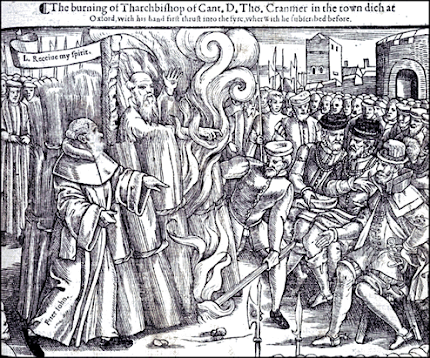
The burning of Tharchbishop of Cant. D. Tho. Cranmer in the town dich at Oxford, with his hand first thrust into the fyre, wherwith he subscribed before. [Click on the picture to see Cranmer's last words.]

Daily Bible Verse

Showing posts with label C. S. Lewis. Show all posts

Wednesday, November 14, 2012

My Reflections On: The Hobbit's Invitation for Teens

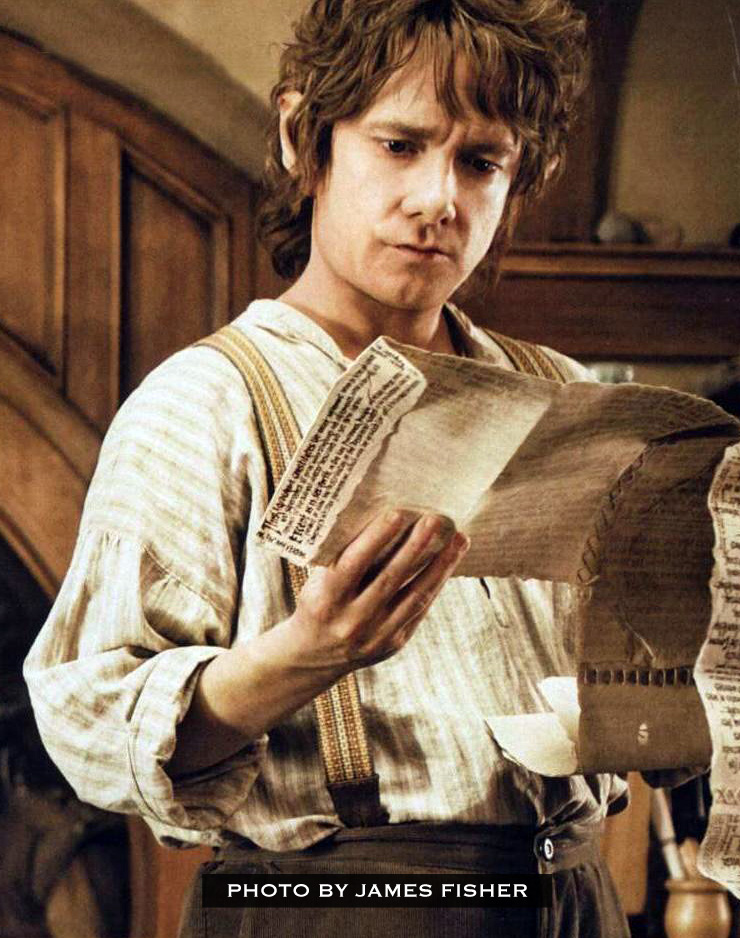
Bilbo Baggins
 

Galatians 3:7 (NKJV) — 7 Therefore know that only those who are of faith are sons of Abraham.


[Click on the title to see the article, The Hobbit's Invitation for Teens.]

Yesterday evening as I was driving to a professional educator's class I happened to flip to the local Moody radio station at WKES 91.1 FM out of Lakeland, Florida.  (See WCIE, 91.1 FM).  At any rate, I was listening to Janet Parshall's radio program, In the Market, which is broadcast via satellite out of Chicago. But I will come back this is a moment.  

Some background of WKES, Lakeland, Florida is in order here.  While the history of the radio station itself would take hours to recount, I will just tell you that it was at one time owned by the now defunct Carpenter's Home Church, a charismatic and pentecostal congregation in Lakeland, Florida.  Unfortunately, though the church was thriving during the mid-1980s, it died after a huge scandal struck.  Pastor Karl Strader's son, Daniel, had fraudulently bilked $3 million dollars from the retirees of the Carpenter's Home Estates retirement community, leaving them without their retirement nest eggs.  That point was the beginning of the debacle of the 10,000 seat sanctuary and a congregation of 5,000 regular attenders.  Moreover, WCIE sold out to Moody Radio.

Which brings me to the point of the article, namely that the theme of The Hobbit and The Lord of the Rings Trilogy, written by the late Roman Catholic, J. R. R. Tolkien, is that ultimate power ultimately corrupts the person who wields it.  Jesus clearly said that whoever would follow him must forsake all and take up their cross and follow Him.  (Cf.  Matthew 16:24, 25).  Given the popularity of the prosperity gospel these days and the false teaching of New Thought and the Word of Faith movement which lies behind those doctrines, Christians would do well to take heed to Tolkien's theme of good versus evil and that evil once taking hold corrupts all who touch it.  (Cf. Luke 22:3-6).

I was introduced to The Hobbit in a 9th grade English class at Hardee High School in Wauchula, Florida, by my teacher, Al Pace.  I will be forever grateful for studying the novel in that class in 1974.  It truly was and is one of my favorite novels of all time.  Afterwards, I read The Lord of the Rings Trilogy.  Those books were and still are burned forever into my psyche.  I particularly enjoyed the underlying Christian themes of the books, something all Christians can and should benefit from apart from the fact that this is great literature.

My problem, however, is that whenever Evangelicals sing the praises of the books and the movies based upon them they conveniently overlook the fact that J. R. R. Tolkien was a devout Roman Catholic.  Many of these same folks talk about Tolkien's friend and colleague, C. S. Lewis, as if he, too, were a flaming evangelist for the Evangelical and Protestant faith.  Unfortunately, nothing could be further from the truth.  (See:  Was C. S. Lewis an Anglo-Catholic?  See also:  Did C. S. Lewis Go to Heaven?)

What particularly upset me about Janet Parshall's program, In the Market, was that she made a remark early in the program about J. R. R. Tolkien being now in the Lord's presence.  I would like to know how a man who was devoutly Roman Catholic and who apparently believed in the idolatries of the Roman Catholic Church and the false gospel of justification by faith plus merits and infused righteousness could possibly be in heaven?  The naivete of Evangelicals these days is for all practical purposes nothing more than an Evangelical version of ecumenical latitudinarianism and theological relativism.

If the Gospel revealed in the Holy Scriptures is not some nebulous, existential encounter with an undefined mystical and cosmic Christ of liberalism, then what is the Gospel?  The Gospel is a series of logical and rational propositions revealed in great detail and precision in the Bible.  Doctrine, in short, is dogmatic and non-negotiable.  If the gospel of Rome is true, then it would be impossible for the biblical Gospel to be at the time true because the two positions are mutually contradictory and exclusive of the other.  There can be no middle ground between Rome and Geneva or between Rome and Canterbury or even Wittenberg.  As Martin Luther said, the crux of the matter is whether or not there is free will or if everything is determined of necessity by God Himself, extending even to men and angels.  In addition to contending earnestly for the absolute sovereignty of God and the bondage of the human will to original sin and inherent sin, Luther contended that the doctrine by which the Gospel stands or falls is the doctrine of justification by faith alone.  (Romans 4:1-8; Galatians 2:14-16).

Because I was disturbed by the confusion on the part of Janet Parshall, I called the toll free number on my cell phone and was surprised to get an immediate answer.  (1-877-548-3675).  Trying to be low key, I mentioned to her that it might be that J. R. R. Tolkien's Roman Catholicism and Evangelicalism were incompatible with each other.  I then asked her if she could mention that on the program and her immediate response was, "No."  Rather than get into a debate on the phone and because I was on the way to a class, I replied politely, "Well, thank-you," and hung up.

When Evangelicalism is so broad that the Gospel gets lost it has crossed over from the truth into compromise.  I can draw no other conclusion.  (John 14:6; Acts 4:10, 12; 2 Corinthians 11:3, 4; Galatians 1:6-9; 3:1-7).

Click here to read the linked article:  The Hobbit's Invitation for Teens

Friday, September 28, 2012

Was C.S. Lewis an Anglo-Catholic? « Johannes Weslianus

Since Johnny Wesley Arminius the Presbyterian (Wes White) has announced that he is going to delete his blog, Johannes Weslianus, I thought I better post this excellent article on C. S. Lewis before it disappears. 


Was C.S. Lewis an Anglo-Catholic?

By Pastor Brian Carpenter


C.S. Lewis has certainly received a warm embrace by almost all sections of Christendom, and by people of all sorts of other stripes. When I was a student at St. Meinrad’s School of Theology and Benedictine Monastery (yes, you read that right) there was a whole section in the bookstore dedicated to Lewis’ writings and writings about Lewis. I bought my own copy of Pilgrim’s Regress there. His books could also be found in the bookstore of the liberal Presbyterian seminary where I studied. And when I attended Bethel Theological Seminary in St. Paul, MN, I also found him prominently featured in the campus bookstore and widely appreciated at the seminary. I have to say that no other (uninspired) author I can think of could be found in those three places. That remarkable fact alone speaks volumes about Lewis’ stature. Lewis even has a following among the Mormons, who find some of his more speculative fictional writings to be congenial with their peculiar views.


But it is somewhat surprising that Lewis has been received so widely among Evangelical Protestants, for Lewis’ views, especially the views he expressed towards the end of his life, were remarkably congruent with Anglo-Catholicism.


What is even more surprising is how many Protestant Evangelicals are unaware of that fact. Mere Christianity, it is true, was written to be “non-partisan” on matters which divided Protestantism from Rome, but that is the only place where he intentionally withheld his own views. In every other place where he thought it relevant, he had no qualms about articulating them.


However, he did not see himself as a belligerent participant, taking sides in a battle of ideas within Christendom, except insofar as some aspect of unbelief had invaded Christendom. Even there, he was courteous. Thus, most of his fire was directed outwards, towards the pervasive unbelief he encountered. So it is true that Lewis stayed away from internecine debates, and in particular the debate between the high and low parties in the Church of England (one friend and biographer remarks that Lewis looked at him as though he had tried to serve him poison when he mentioned it, and said, “We must never speak of that again.”)


Yet his views were clearly congruent with Roman Catholic or Anglo-Catholic theology. Consider, for instance, the theology of the sacraments underlying the following statement from “The Weight of Glory:”

Next to the Blessed Sacrament itself, your neighbor is the holiest object presented to your senses. If he is your Christian neighbour, he is holy in almost the same way, for in him also Christ vere latitat, the glorifier and the glorified, Glory Himself, is truly hidden.

In his essay “Priestesses in the Church?” he argues that women can’t be priests, but not because they can’t preach, à la 1 Tim 2:12, (indeed, he explicitly repudiates the notion that women can’t preach in this essay.) Instead, he grounds it on the concept that the priest must be male in order to represent God to the people. This, of course, is the argument used by Rome to justify an all male priesthood.


In one of his radio addresses during WWII, he said (and note the order):

There are three things that spread the Christ life to us: baptism, belief, and…the Lord’s Supper.

About the Lord’s Supper, he once said:

Here is big medicine and strong magic.

And again he said:

My ideas about the sacrament would probably be called ‘magical’ by a good many modern theologians.

He also credited his wife’s very striking remission from cancer to a private communion service administered by a friend of his who was an Anglican priest.


Lewis professed a belief in purgatory. In Letters To Malcolm, Chiefly on Prayer he wrote:

I believe in Purgatory. Mind you, the Reformers had good reasons for throwing doubt on the ‘Romish doctrine concerning Purgatory’ as that Romish doctrine had then become . . .


. . . The right view returns magnificently in Newman’s DREAM. There, if I remember it rightly, the saved soul, at the very foot of the throne, begs to be taken away and cleansed. It cannot bear for a moment longer “With its darkness to affront that light.” Religion has claimed Purgatory. Our souls demand Purgatory, don’t they? Would it not break the heart if God said to us, “It is true, my son, that your breath smells and your rags drip with mud and slime, but we are charitable here and no one will upbraid you with these things, nor draw away from you. Enter into the joy?” Should we not reply, “With submission, sir, and if there is no objection, I’d rather be cleaned first.” “It may hurt, you know”—”Even so, sir.”


I assume that the process of purification will normally involve suffering. Partly from tradition; partly because most real good that has been done me in this life has involved it. But I don’t think the suffering is the purpose of the purgation. I can well believe that people neither much worse nor much better than I will suffer less than I or more. . . . The treatment given will be the one required, whether it hurts little or much.

My favourite image on this matter comes from the dentist’s chair. I hope that when the tooth of life is drawn and I am “coming round,” a voice will say, “Rinse your mouth out with this.” This will be Purgatory. The rinsing may take longer than I can now imagine. The taste of this may be more fiery and astringent than my present sensibility could endure. But . . . it will [not] be disgusting and unhallowed.


The Newman he mentions is the 19th C Oxford Tractarian who founded Anglo-Catholicism.

Along with that, he believed in praying for the dead. Again, in Letters to Malcolm he writes:


Of course I pray for the dead. The action is so spontaneous, so all but inevitable, that only the most compulsive theological case against it would deter me. And I hardly know how the rest of my prayers would survive if those for the dead were forbidden. At our age, the majority of those we love best are dead. What sort of intercourse with God could I have if what I love best were unmentionable to him?

When his Anglo-Catholic friends thought he was near death, they arranged for him to receive Extreme Unction from an Anglo-Catholic priest, and Lewis accepted it.


It is true that he perhaps said some things from time to time which might allude to Protestant views, but it is equally clear that he had rejected Protestantism at least as consistently as he rejected theological liberalism. Though I obviously think there is benefit to be had in reading Lewis, I think the reader must be discerning. For there is little doubt where his sympathies lay on a great many crucial issues, and those positions are not very congenial to historic Protestant views.


Click here to see the original post:  Was C.S. Lewis an Anglo-Catholic? « Johannes Weslianus

Sunday, August 12, 2012

C.S. Lewis: An Anglo-Catholic Latitudinarian and a Bridge to Rome

"The result is a generic Christianity that suits anyone anywhere who can in any way relate to God. Lewis bent over backwards trying to find common ground with all denominations, omitting any doctrine that may be deemed offensive."  -- J. Saunders


The Berean Beacon has once again made a solid argument against the popular view that C. S. Lewis was somehow an Evangelical.  The truth is Lewis was an advocate of a broad latitudinarianism and Anglo-Catholic theology.  J. Saunders wrote the following article about Lewis.  Here is a brief excerpt:

In 1952, C.S. Lewis published his theological work Mere Christianity, which originally began in 1942 as a three-part BBC radio broadcast. As the title suggests, Lewis focused on the mere or common ground he felt existed in Christianity and tried to restate a theology without controversy. The result is a generic Christianity that suits anyone anywhere who can in any way relate to God. Lewis bent over backwards trying to find common ground with all denominations, omitting any doctrine that may be deemed offensive. For this reason, Tolkien disparagingly labelled his friend “Everyman’s Theologian.” Even Mormons find his writings inoffensive.

“He [Lewis] is widely quoted from tried-and-true defenders of Mormon orthodoxy. It just shows the extraordinary acceptability and the usefulness of C.S. Lewis because, of course, most of what he says is perfectly acceptable to Mormons.” 6
Mere Christianity has long been regarded a classic exposition of the Christian faith, yet oddly enough, not one Bible verse is quoted in the first half of the book and only three partial verses in the latter half with no Bible references in the entire book. How can we present Christianity without its foundation – the Word of God?
To read the entire article click here:  C. S. Lewis: A Bridge to Rome

See also:  The Ruling Elder:  Was C. S. Lewis an Anglo-Catholic?

Monday, February 20, 2012

Was C.S. Lewis an Anglo-Catholic? « Johannes Weslianus

As a reminder I'm reposting this article from Wes White's blog. The only point where I would disagree is in the comments section below the article where Brian Carpenter assumes out of hand that there are no Reformed Anglicans around these days. Church Society, the Anglican Church League, the Sydney Anglicans and other expressions of the Evangelical and Reformed side of Anglicanism do exist today to counter the Arminian/Anglo-Catholic and broad church side of Anglicanism.

Was C.S. Lewis an Evangelical? Obviously not. To read the article at Wes White's blog click here: Was C.S. Lewis an Anglo-Catholic? « Johannes Weslianus


Monday, September 08, 2008

C. S. Lewis and Liberal Theology

In a comment to my article refuting her theology as expressed in a Christianity Today article (note the link in the title), Edith Humphrey cited C. S. Lewis as a justification for her position. Given that modern Evangelicals are often enamored with Lewis, we ought to recognize that Lewis' writings are a mixed bag. I have seen unorthodox views expressed by Lewis that border on pelagianism and others that are outright liberal. Mrs. Humphrey has kindly revealed one of Lewis' unorthodox and heretical positions.

In her comment posted to my article, Humphrey says that salvation is apart from an explicit conversion to Christ and faith in Christ appropriated by individuals: "Aslan tells him that all that he has done, in error, for the sake of Tash, was really done for Aslan."

"This doesn't mean that the young warrior is accepted because of his goodness, but because of Aslan's goodness. But it does mean that our hearts and our actions will, when we see the Lord, match with his mercy."

If C.S. Lewis intended to suggest that unreached people will be saved by some implicit faith they don't know they have, then Lewis is clearly on the liberal side of things. Apparently, this is the view taken by Edith as well. However, the Apostle Paul clearly says that salvation comes only from hearing and hearing by the Word of God by faith. (Romans 1:16-21; Romans 10:10-19).

Jesus Christ is the only way of salvation (John 5:24; 14:6). Without evangelism and world missions those who have not heard the Gospel will most certainly perish. There is no salvation apart from an EXPLICIT conversion to faith in Jesus Christ, not some hidden, unknown faith. This is gnosticism and mysticism, not Christianity!

Support Reasonable Christian Ministries with your generous donation.