>

Martyred for the Gospel

Martyred for the Gospel
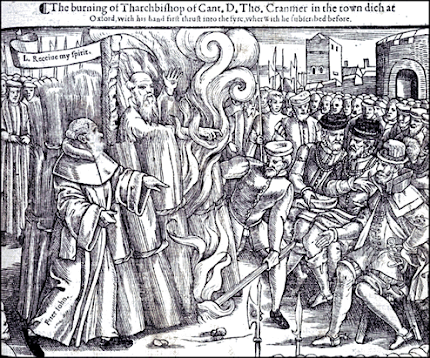
The burning of Tharchbishop of Cant. D. Tho. Cranmer in the town dich at Oxford, with his hand first thrust into the fyre, wherwith he subscribed before. [Click on the picture to see Cranmer's last words.]

Daily Bible Verse

Showing posts with label Roman Catholicism. Show all posts

Monday, February 17, 2025

Should Women Be Ordained to Ministry? Deacons or Otherwise? Part 2


“Calvinistic ethics depends on revelation.  The distinction between right and wrong is not identified by an empirical discovery of natural law, as with Aristotle and Thomas Aquinas, nor by the logical formalism of Kant, and certainly not by utilitarianism’s impossible calculation of the greatest good for the greatest number, but by God’s revelation of the Ten Commandments.  This revelation came first in God’s act of creating man in his own image so that certain basic moral principles were implanted in his heart, later to be vitiated by sin; second, there were some special instructions given to Adam and Noah, which no doubt overlapped and expanded the innate endowment; third, the more comprehensive revelation to Moses; plus, fourth, the various subsidiary precepts in the remainder of the Bible.” 

Dr. Gordon H. Clark.  Essays on Ethics and Politics.  John Robbins, ed.  (Jefferson:  Trinity Foundation, 1992)  Pp. 3-4.


Should Women Be Ordained to Ministry?  Deacons or Otherwise?  Part 2


In this post I will discuss the creation of humanity, or the more accurate term, mankind.  The revisionists are continually trying to rewrite the common English language to reflect their ideological agenda.  Recently, there was a story where a feminist congress woman said that we cannot use the term manufacture because the word has “man” in it.  The ridiculousness of the progressive Marxist movement is out of hand, and it has infiltrated the Evangelical churches through an unbiblical ideology of egalitarianism in the Christian family. 

The first mention of the creation of mankind is in Genesis chapter 1.  However, in chapter 2 of Genesis we have a further particularization of how God created mankind.  In chapter 1 we are told that God created them male and female.  Notice that in chapter 1 the reference to humanity is singular and then plural: 

26 And God said, Let us make man in our image, after our likeness: and let them have dominion over the fish of the sea, and over the fowl of the air, and over the cattle, and over all the earth, and over every creeping thing that creepeth upon the earth. 27 So God created man in his own image, in the image of God created he him; male and female created he them. (Gen. 1:26-27 KJV)

If you doubt that the King James translation is accurate in giving the singular and plural forms of the Hebrew words, you can consult Biblehub.com to check the Biblical Hebrew Interlinear:  Genesis 1:26 and Genesis 1:27.

In chapter one we have two different words that convey God’s creation.  In Genesis 1:1 the word used for God’s creating the heavens and the earth is the Hebrew word “bara”.  This word in verse 1 refers to creation by divine fiat or ex nihilo, out of nothing.  But in Genesis 1:26 the word used for God’s act of creating is the word “asa”, which means to fashion or work.  In other words, mankind is not created out of nothing as was the universe in verse 1, but God creates man and woman out of pre-existing materials that He had already created ex nihilo or by divine fiat.  We also know this from the parallel account of creation in Genesis 2:7, 21-23.  It should be noted, on the other hand, that in Genesis 1:27 the word “bara” is used, not “asa”.  This is because only man of all the animals created is created in God’s image.  Man alone of the animals is the rational and intellectual image of God.  (John 1:1, 9; Genesis 1:27; Genesis 9:6; 1 Corinthians 11:7).

However, in Genesis 1:27 we have a play on words.  Whereas verse 26 uses the word “asa” to make mankind, a qal imperfect cohortative, to show what He is planning to do, the verse says also that God will “make” man (singular) after “our” (plural) image.  Note also that the word for God in Genesis 1:27 is Elohim, the majestic plurality.  Here the verse is clearly referring to mankind as a whole.

Moreover, in chapter 2 we learn that God creates the first man as one person, Adam.  Next, God sees that Adam of all the animals is alone and has no mate or helper.  So out of Adam’s rib God creates Eve, the mother of all humanity.  This is important because the apostle Paul elaborates on this information.   Adam was formed first; then, God formed Eve from Adam’s rib, and Adam called her woman because she was taken out of the man.  (1 Timothy 2:13; 1 Corinthians 11:8; Genesis 2:23).  Liberals will contend that Adam and Eve are not historical persons because the Genesis creation account in chapter 1 and 2 are disparate accounts, not parallel accounts of the same historical events.  The critics also contend that the Hebrew word is not the name of a man but is instead a generic term for mankind as a whole.  Thus, they see chapter 2 as an etiological myth to explain the difference between male and female human beings. 

In contradiction to this, the Bible assigns a name to the woman.  Her name is Eve, the mother of all the living.  (Genesis 3:20).  We can then see that Adam is not just a generic term but the name of the first Adam.  (Genesis 3:9).  This is confirmed in the New Testament as well.  (Romans 5:12-14).  In fact, Adam is called the Son of God, the first man.  (Luke 3:38).  It is no mistake that the Reformed theologians refer to Adam as the federal head of the human race, not Eve.

Modern feminist theologians have tried to re-imagine God as a female.  However, the use of masculine pronouns in reference to God throughout the Old Testament flies in the face of this innovation.

In 1995 during my field training class required to obtain the master of divinity degree from Asbury Theological seminary, I opted to do my field experience by doing one unit of clinical pastor education through Hospice of the Bluegrass in Lexington, Kentucky.  There is another major seminary in the Lexington area which is associated with the Disciples of Christ.  The Disciples of Christ was originally a product of the Second Great Awakening.  The Cane Ridge revivals just north of Lexington produced growth in several denominations in the area, including the Methodists, the Presbyterians and the Baptists.  In order to preserve the fruits of the revival, Charles Finney and others decided to stop emphasizing doctrinal distinctives and reject formal creeds and confessions of faith.  Thus, the saying was that there is no creed but Christ.  Unfortunately, this position has led to the extreme liberalism of the Disciples of Christ as a mainline denomination.

Of the students in the class there was a retired mainline Presbyterian minister who was a member of the Presbyterian Church in the USA, another liberal denomination.  There was a female student from Lexington Theological Seminary, which is the Disciples of Christ school.  And, there was a male student from the Free Methodist Church who had recently graduated from Asbury with the M. Div. degree.  The supervisor of the class was an intern herself.  She was a nun with the Roman Catholic Church.  At the beginning she told us that she would be evaluating us as students, and, that we would be evaluating her to determine if she would become a supervisor in the CPE program.

At the time, I was still a Pentecostal and had no objections to the ordination of women.  I stupidly thought that this would deflect any criticism by the two liberals and the Roman Catholic nun.  I misread the Free Methodist, who was doing another unit of CPE because he was employed by Hospice of the Bluegrass.  I thought the Free Methodist would be immune to any re-imaging of God as a female.  I was wrong.  I was familiar with the re-imaging movement by feminists because at that point in time it was being openly promoted and even affirmed by some progressive Evangelicals.

The fireworks started on day one because the Roman Catholic nun, an elderly lady, insisted that we pray together as a group.  What I did not know is that apparently there was interaction already taking place before I arrived in the class.  When I prayed, I ended my part of the prayer with a traditional ending to most impromptu Pentecostal prayers.  The ending goes something like this: “Father God, thank You for hearing our prayers and petitions.  I thank You and praised you in the wonderful name above all names, our Lord and Savior, Jesus Christ.” 

The next time we met I was immediately called out and challenged by the supervisor, Jean.  This was the beginning of many challenges I had to face during that class, which met at the offices of Hospice of the Bluegrass.  However, early on I decided that I would never compromise my faith to appease papists and theological liberals or even mainline Free Methodists.  The very first thing that happened on the second meeting was that Jean, the Catholic nun, objected to my prayer.   I was confused at first because I did not see that there was anything controversial about it.  Jean said that I should not pray to God as my Father.  Now this really piqued my interest because I had been taught to pray the model prayer since about first grade through the fourth grade in elementary school in Weaver, Alabama.  “Our Father, which art in heaven, hallowed be thy name . . .”  (Matthew 6:9; Luke 11:2).

When I asked why not I was informed that the married female student from Lexington Theological Seminary had been sexually molested as a child by her biological father.  So, my first dilemma is whether to cave to the liberals and the papist, all of whom said that they had no problem praying to God as “mother.”  I decided then and there that there would be no compromise and that no one had the right to tell me what to believe.  The Bible is the final authority for me, and it has never changed.  Unfortunately, there are Pentecostals and Charismatics today who no longer believe that the Bible is the final authority in all matters of faith and practice.  Their Pentecostal experiences trump and override the Bible.

So began a theological debate in which I was put on the defensive by the other three students and the papist nun.  Asked why I refused to compromise, I explained that the Bible is the final authority in all matters of faith and practice because it is the inspired, inerrant and infallible Word of God.  I explained that the Bible determines what I believe and not what any theologian has to say on such matters.  I also explained that Jesus was a male and that He taught us to pray to our Father in heaven, which, I pointed out, even the liturgy of the Roman Catholic Church calls for.  At this point, the papist nun, Jean, stopped me in my statement and informed me that her church did not pray to God the Father.   I argued with her about it and said that I happen to know enough about the Roman Catholic Church to know that whatever her parish was doing was not in line with the official doctrine of the Roman Catholic Church.  She persisted in saying that it was not true, despite the fact that she was obviously equivocating.  She played the victim card, insisting that I should not pray to God as Father.  To which I responded that the molestation of the female student was not my problem and that I would not compromise simply because her biological father had molested her and that she had a problem with imagining God as her Father.

Jean brought up a couple of biblical metaphors where God is said to care for us as a mother nurses her baby.  You can see a few examples of these verses here:  Female Images of God in the Bible.  Apparently, there is a movement within the Roman Catholic Church to push for the ordination of women as priests.  As I said before, at the time I did not object to the ordination of women because of my affiliation with the Assemblies of God.  But the line they wanted me to cross was praying to God by the title of “Mother God.”  I informed the nun that Pentecostals do not pray to Mary as the mother of God.  But she insisted that this was praying not to Mary but to God as the Mother.  I was taken aback to be honest.  The next thing she brought up after I insisted that Jesus was a male and the Son of God was that in the book of Proverbs Jesus is personified as a female, Sophia.  After some study, I did find out that the Septuagint translation of the book of Proverbs does indeed use the Greek word Sophia for the word “wisdom”.  However, I informed her that the Protestant churches do not view the Septuagint as an inspired translation.  The Hebrew word is not Sophia.  In short, there is no reference to any woman named Sophia in the book of Proverbs.  Rather than go into a long detour on the matter, I refer you to the article from “Got Questions?” here:  “Does the Bible teach that Sophia is the goddess of wisdom?”

After I insisted that I would not be changing the way that I prayed, Jean suggested that I was being insensitive to the female who had been molested.  My response was clear and unambiguous.  I would not pray to God as mother because the title that Jesus Himself commanded us to use was God the Father.  Jesus prayed to God as Father many times in the Bible, even saying that He and His Father were one.  (John 10:30, 12:45, 14:7, 14:9, et. al.).  The entire class that session turned into a theological debate.  I held my ground.  At the end, Jean asked me not to pray that way.  To which I responded that I would not. So, she asked me what solution I could offer.  I offered that we should not pray together at all.  This was something of a shocker to me because I had expected the fake Evangelical Free Methodist to back me up.  Instead, he sided with the liberals.  Honestly, I was not comfortable praying with liberals and papists anyway because I did not view them as born again Christians.

In a later attack, they asked me how I felt about homosexuals.  I again stood my ground and said that it was an abomination because the Bible said so.  Then, they played the victim card again.  Turns out that one of the social workers at the hospice was a gay man whose name now escapes me.  Before that session I had gotten along fine with that social worker.  I noticed later that his countenance had changed toward me.  I did not compromise.  I treated him as I would anyone else, not withstanding my objection to the sin of homosexuality.

During the course, I was attacked over and over again and at one point I openly asked Jean if she was planning to fail me for the class because of my commitments to the Bible as my authority.  She refused to answer, implying to me at the time that she was planning to write a bad review.  So, that was a mistake on her part.  I was so incensed by even the thought of my being discriminated against because of my Evangelical faith that I wrote a scathing review of Jean’s handling of the situation.  I said pretty much what I said above and charged her with constantly attacking my faith.  In short, the supposedly tolerant ones were intolerant of my Evangelical faith and my right to the freedom of religion.  No one has the right to tell anyone else what their religious beliefs should be.  (Acts 5:29).

On the final day of the class, we all read our reviews.  The other students all went first.  Jean read her review of me, in which I was surprised to learn that she had not rejected me from passing the evaluation.  I read my review last.  It was a scathing review, as I said before.  I stand by that review because I felt attacked by all four of the others during the entire class.  After I read the review, I was reminded by the other students that Jean needed a good review from all four of us in order to pass her evaluation to become a CPE supervisor.  I told them that I could not lie about what I truthfully thought about her treatment of me in the class.  I got up and left first.

Jesus promised us that when we were called before councils and authorities that God would give us the words to say.  (Luke 12:11-12).  Jesus kept that promise. 


You can read the previous post of this series here:  Should Women Be Ordained to Ministry? Part 1.


Thursday, April 18, 2013

Archbishop’s statement on Pope Francis | Media releases | Sydneyanglicans.net

The Archbishop of the Sydney Diocese of the Anglican Church in Australia issued this statement:


Anglican Church Diocese of Sydney
Media Statement
The Archbishop of Sydney, Dr Peter Jensen today joined other Christian leaders in welcoming the election of the new Pope, saying “The papacy continues to have huge global significance in testing times for humanity.  We join those who pray that Pope Francis will use the office to further the gospel of Jesus Christ for the sake of all humanity.”

14th March, 2013 AD
I suppose the Sydney Anglicans agree with Billy Graham that the false gospel of works preached by Rome is a genuine gospel.  It is not.  In fact, the canons of the Council of Trent from the 16th century continue to condemn all Protestants who knowingly disagree with Rome on gospel.   Mike Horton  of Westminster Seminary, California has said that Rome still "officially" condemns the gospel of Jesus Christ.  What with all the confusing messages in the world today, why are Evangelicals so afraid to divide truth from error?  Does not Dr. Jensen know that saying that Rome has a genuine presentation of the gospel could lead people to join with that false religion?

The Protestant Reformation is not over.  It's time for Protestants to call the kettle black and stand against Rome unless and until the Council of Trent is overturned, idolatry in the form of transubstantiation, prayers to the saints, and other abuses are rejected.  Rome teaches that sins committed after baptism must be paid for both by the cross and by doing penance, which is a form of meriting salvation.  Rome likewise confuses sanctification with justification and denies the doctrine of justification by faith alone.


Archbishop’s statement on Pope Francis | Media releases | Sydneyanglicans.net

Tuesday, April 16, 2013

As pope steps down, disinformation permeates Vatican crackdown on nuns

This is an old story but I have to wonder why Evangelicals and Presbyterians would want to join the Roman Catholic Church?  After all, Rome has its own liberals and progressives.  Vatican II opened the floodgates.

As pope steps down, disinformation permeates Vatican crackdown on nuns

Saturday, March 23, 2013

Gordon H. Clark: Quote of the Day: Rome Teaches the Cross Is Insufficient

. . . Rome teaches that although Christ’s sacrifice is necessary to salvation, it is not sufficient. -- Gordon H. Clark
The Reformed doctrine is that although some sins are more heinous than others, none is “venial,” but all are deadly in that they all deserve the wrath and curse of God. That baptism makes us actually just before God, and that, at least sometimes, we do not sin even venially in our good works, is bad enough. But what is worse, Romanism also teaches that a sinner can do more than God requires of him. These so-called works of supererogation are deposited in the Treasury of the Saints and are later issued, by order of the Pope, to other sinners who have not done enough. In this way Rome teaches that although Christ’s sacrifice is necessary to salvation, it is not sufficient. Additional human merits must be added. The distribution of these extra merits and the forgiveness of sin now depend on the Romish substitute for repentance, namely the sacrament of penance. Canon VI says,

If anyone denieth either that sacramental confession was instituted or is necessary to salvation, of divine right; or saith that the manner of confessing secretly to a priest alone...is alien from the institution and commands of Christ, and is a human invention, let him be anathema.

Gordon H. Clark (2013-03-04T05:00:00+00:00). What Is The Christian Life? (Kindle Locations 367-376). The Trinity Foundation. Kindle Edition.

Tuesday, November 06, 2012

Does the Pope and Rome Contradict Their Stance Against Abortion: The Trinity Foundation - The Roman Catholic Socialist Agenda

By speaking of “human dignity” having been “wounded by sin” and “redeemed by the Lord Jesus Christ in His incarnation, death and resurrection,” the Roman Catholic Church has simply retrofitted its old dogma that “It [original sin] is a deprivation of original holiness and justice, but human nature has not been totally corrupted….”[5] With this new tool – “human dignity…wounded by sin…redeemed…” – the Vatican is now able to accommodate the socialist-statist trends so prevalent in modern secular thinking.  -- Richard Bennett, ex-Catholic priest and Reformed Calvinist.


I wondered by a nun could stand before the Democratic National Convention and praise their idol, Barry Obama, while thousands of supporters cheered the radical abortionist plank and the radical pro-pansexuality plank of the far left.  It would appear that the Roman Catholic Church is a hypocritical advocate of the pro-life position.  Abortion and homosexual rights are tolerated by the papists in the hopes that they will regain secular power in the political realm.  So much for the theonomic and reconstructionist theory of renewal rather than biblical reform.

Click here to read Richard Bennett's article:  The Trinity Foundation - The Roman Catholic Socialist Agenda

Tuesday, October 02, 2012

The Editor at the Christian Classic Ethereal Library Pushes the Synagogue of Satan


-------- Original Message --------
Subject: [Christian Classics Ethereal Library newsletter] The CCEL Times 7.10 (October 1, 2012)
Date: Tue, 02 Oct 2012 03:52:26 -0400
From: Christian Classics Ethereal Library <ccelnews@calvin.edu>
To: Cranmer1959 <cranmer1959@gmail.com>

Andy Hanson, the editor of CCEL makes the outrageous claim that a Roman Catholic theologian of the 16th century was actually in agreement with Calvinism on the issue of the sovereignty of God.  This sort of dissimulation is disturbing to say the least.  The fact of the matter is that Rome's official doctrine does not allow for the absolute sovereignty of God since the official doctrine of Rome is semi-pelagian.  The best way to see this is to read Martin Luther's debate with Disiderus Erasmus in The Bondage of the Will.

What is particularly disturbing about all this is that Wheaton College is supposed to be an Evangelical school.  Arminianism, it would appear, does lead to Rome.  All Evangelicals who agree with Hanson should just become Roman Catholics and Papists.  This is why Arminianism is heresy.  It's also why the high church Arminians in the Anglican church are disengenuous when they "pretend" to not agree with the Anglo-Catholics.  Their real agenda is reunion with Rome, the synagogue of Satan.

While "replies to this address will not be read," replies can and will be made to such nonsense on my blog.  I pray that God will open the eyes of Evangelicals to this sort of deception by the enemy.  (2 Corinthians 4:3-4).  Sadly, even Billy Graham fell prey to this deception by the Roman Catholic Church.

Charlie

You can read Andrew Hanson's remarks in the CCEL newsletter here:


God is sovereign.
God is in charge of everything, including the little things.
Not a hair falls from our heads without God's divine will.
We must rest in God's grace, as we are totally unable to contribute to our salvation.
What word pops into people's minds when they hear Christians making the above statements? Calvinist. Usually these beliefs are associated with those of the Calvinist persuasion. However, Father de Caussade was a Roman Catholic Priest who taught that God is truly sovereign, and therefore our whole lives can be lived in the knowledge that all things are working for our good. We may not understand why God does things the way he does, or how our suffering can ultimately be for our good, but we can trust our benevolent Lord, who has decreed all things, is good and just. Reading Abandonment to Divine Providence will help the reader surrender to God's will. The result? Spiritual peace in the arms of a loving God.
Andy Hanson
CCEL Intern
Note: Abandonment to Divine Providence has recently made it into the top 12 in popularity at the CCEL.
Nota Bene:  Not only does this book have the imprimatur of Rome on the title page but reading the preface we discover that  Jean Pierre de Caussade was a member of the Society of Jesus.  A Jesuit!  Hello!  The Jesuits were in charge of the persecution of Protestants.  Ignatius Loyola was the worst of these Jesuits.  (See:  Roman Catholic and Protestant Martyrs Contrasted). 


--
Glory be to the Father, and to the Son : and to the Holy Ghost; As it was in the beginning, is now, and ever shall be : world without end. Amen. Visit 1662 Book of Common Prayer: Daily Prayer and Reasonable Christian Blog


Sunday, August 12, 2012

C.S. Lewis: An Anglo-Catholic Latitudinarian and a Bridge to Rome

"The result is a generic Christianity that suits anyone anywhere who can in any way relate to God. Lewis bent over backwards trying to find common ground with all denominations, omitting any doctrine that may be deemed offensive."  -- J. Saunders


The Berean Beacon has once again made a solid argument against the popular view that C. S. Lewis was somehow an Evangelical.  The truth is Lewis was an advocate of a broad latitudinarianism and Anglo-Catholic theology.  J. Saunders wrote the following article about Lewis.  Here is a brief excerpt:

In 1952, C.S. Lewis published his theological work Mere Christianity, which originally began in 1942 as a three-part BBC radio broadcast. As the title suggests, Lewis focused on the mere or common ground he felt existed in Christianity and tried to restate a theology without controversy. The result is a generic Christianity that suits anyone anywhere who can in any way relate to God. Lewis bent over backwards trying to find common ground with all denominations, omitting any doctrine that may be deemed offensive. For this reason, Tolkien disparagingly labelled his friend “Everyman’s Theologian.” Even Mormons find his writings inoffensive.

“He [Lewis] is widely quoted from tried-and-true defenders of Mormon orthodoxy. It just shows the extraordinary acceptability and the usefulness of C.S. Lewis because, of course, most of what he says is perfectly acceptable to Mormons.” 6
Mere Christianity has long been regarded a classic exposition of the Christian faith, yet oddly enough, not one Bible verse is quoted in the first half of the book and only three partial verses in the latter half with no Bible references in the entire book. How can we present Christianity without its foundation – the Word of God?
To read the entire article click here:  C. S. Lewis: A Bridge to Rome

See also:  The Ruling Elder:  Was C. S. Lewis an Anglo-Catholic?

Tuesday, May 29, 2012

Message 1, Questions & Answers #1 from Suffering and the Sovereignty of God: 2010 Winter Conference at Ligonier Academy Conference by Various Teachers from Ligonier Ministries


While R. C. Sproul is certainly not perfect, this video of the question and answer session is very much in line with my own views regarding the Gospel and the Evangelicals and Catholics Together and the Manhattan Declaration.  I'm not sure who the other minister is in the session but he seems to be orthodox as well on this point.  Rome and Eastern Orthodoxy are not preaching the Gospel but another gospel.  (Galatians 1:6-9).  In fact, Rome has officially condemned the Gospel.

What the other minister alluded to is that Arminianism is also another Gospel.  Charles Wesley and John Wesley were adamant opponents of Calvinism and said that it was a false gospel.  In fact, the true situation is the other way around.  Arminianism, according to the Synod of Dort 1618-19, is a heresy.  Anyone who endorses any of the five points of the Remonstrandts, including their assertion of univeral atonement rather than particular atonement, is in essence denying a focal point of the Gospel.  Jesus died particularly and only for the elect; otherwise we would have to say that Christ died for the reprobates whose souls were already in hell from the time of creation up to the point of the cross.  (1 Peter 2:8; Romans 9:11-13).  The Old Testament saints were saved by faith in Christ looking forward to the Messiah and His atoning work on the cross for all of God's elect.  (Revelation 13:8; John 10:11, 15).

 Message 1, Questions  Answers #1 from Suffering and the Sovereignty of God: 2010 Winter Conference at Ligonier Academy Conference by Various Teachers from Ligonier Ministries

Friday, February 17, 2012

George Conger: Castro to convert?

Looks like Fidel Castro proves the axiom: "Once a Roman Catholic always a Roman Catholic." After all, the Roman Catholic Church is broad enough that they have something for everyone. Apparently the justification for Castro is liberation theology. Yes, the Roman Catholic Church can syncretize with sociological and Marxist political theories. Unfortunately, the Bible speaks against confusing doctrine with politics. (Daniel 2:44; Luke 17:21; John 6:15; 18:36). According to George Conger, Fidel's reconversion to Roman Catholicism could have political ramifications. What those ramifications might be are not stated.

Click here to read the story:


Castro to convert?: The Church of England Newspaper, February 10, 2012, p 6. « Conger


Sunday, October 17, 2010

Modern Roman Catholicism - ReformedForum.org

Modern Roman Catholicism - ReformedForum.org

This podcast discusses the changes that took place in the Roman Catholic Church after Vatican II and how there are as many factions within Roman Catholicism as there are in the Protestant/Evangelical side of Christianity. Postmodernism seems to be alive and well within the Roman Catholic Church, although theological conservatives in the RCC are not comfortable with this state of affairs. Incidentally, the Protestant Reformation and the Council of Trent are still in effect even though some Evangelicals and some Roman Catholics would try to gloss over the differences.


Tuesday, July 20, 2010

Re: Church authority and Scripture

Spencer said:  "And if you say, 'Because I have determined that their interpretation is in line with the Bible,' then you have set yourself up as the ultimate arbiter of doctrinal orthodoxy, and cannot consistently object to someone in your congregation doing the same and denying the doctrine of the Trinity."

Yes, just as you have set yourself up as the ultimate arbiter of doctrinal orthodoxy by choosing Rome.  The point you're ignoring is YOU are fallible.  So no matter what YOU choose, you are the ultimate arbiter of doctrinal orthodoxy and your choices are subjective.  There is no way around this.

The choice is not between your choice and Rome's choice.   Rather the choice is between two competing truth claims:  1)  Sola Scriptura and 2)  Sola Ecclesia.

If 2 then throw out your Bible and your brain and kiss some Roman Catholic's ass....

If 1 then find a church where the Scriptures are faithfully exegeted and in line with the Protestant Confessions of Faith, whether that be Lutheran or Reformed.

Simply because you "think" Rome is infallible because Rome "claims" to be infallible does not remove the fact that you are fallible and YOU could be wrong.  There is plenty of evidence in fact that Rome is not infallible but is mostly boasting  a false authority based on a mythological apostolic succession that cannot be substantiated in any meaningful way.

When confronted with opposing truth claims I go with the most obvious and the most easily substantiated one.  Since the Bible is readily available to even a common plow boy, I believe God would have us to follow Scripture rather than the traditions of men wearing costumes and who claim to have an authority that I cannot verify for myself.  It is no different from the Pentecostal who claims to have raised the dead.  It is basically an unfalsifiable claim and therefore illogical and irrational.

I suspect that the real reason you e-mailed me is that you are in fact a Roman Catholic who is simply baiting me.  You should be aware that a violation of the 9th commandment is a mortal sin:)

Besides, you totally ignored all the quotes I sent you from the Apostolic Fathers upholding the authority of Scripture:)

Sincerely yours,

Charlie

Reasonable Christian Blog Glory be to the Father, and to the Son : and to the Holy Ghost; Answer. As it was in the beginning, is now, and ever shall be : world without end. Amen. 1662 Book of Common Prayer

On 7/20/2010 4:52 PM, Spencer Hall wrote:
Charlie,

Thank you for the quick and in-depth reply. I appreciate your evident concern for my soul, and assure you that my object in this search is truth; and truth that is sought not merely in research but in prayer. You and I agree, no doubt, that the Lord hears those who call to Him and is "the rewarder of them that diligently seek Him," so I believe that whatever conclusion I come to, provided I continue in seeking Him, will be the truth. Whatever that conclusion is, I am happy to accept it.

I still have not quite found an answer to my question, however, in your explanation of how the Reformed Confessions function. I am aware that they function as THE authoritative doctrinal statements of the church in Reformed circles. Such was not my point; my point was this: "Whence do the Reformed Confessions derive their authority? And if you say, 'From Scripture,' then whose interpretation? And if you say, 'The interpretation of the Reformed churches,' then why choose that interpretation instead of the evangelical Arminian interpretation, or the Anglo-Catholic interpretation? And if you say, 'Because I have determined that their interpretation is in line with the Bible,' then you have set yourself up as the ultimate arbiter of doctrinal orthodoxy, and cannot consistently object to someone in your congregation doing the same and denying the doctrine of the Trinity."
You said that the doctrines of the church are subject to correction by the entire church, not by individuals. But what was the Reformation if not a break-off from the established visible church led by individuals? Martin Luther, John Calvin, and Thomas Cranmer were all popular individual figures who advocated their own personal interpretation of Scripture. The fact that we now have large ecclesiastical bodies backing each of their interpretations--the Lutheran, Presbyterian, and Reformed Anglican churches, respectively--does not change the fact that their theology originated as individual interpretations set against the teaching of the Church. In what principled way does an individual setting his interpretation against that of the Church now differ from an individual setting his interpretation against that of the Church then?

What I have just written above is addressing the point of the first email I sent you, and I believe most of what else you wrote, though helpful in its own way, was irrelevant to my point. However, I appreciate your bringing some of these issues up, because they are some other matters which I have also studied and am glad to hear your opinion on. You asked me a question, so I'll answer as best I can:

But let me ask you a question.  IF Rome "claims" to be an infallible interpreter of the Bible, how does that help YOU as an individual?  You are still fallible and so if someone "claims" to be infallible you have no way of interpreting what they say any more than you can interpret the Bible for yourself.  So what does it solve if you have an infinite line of infallible interpreters upon infallible interpreters to the nth degree?  That does not solve your dilemma as an individual because you have no way to infallibly determine whether they are in fact infallible or not.  All you have is their bare assertion of that.  You might be deceived!

This is a good question, but I would answer thus: Yes, I'm still fallible, and there is still a degree of "interpretation" of whatever information I receive--whether it's the Bible or the canons of the Council of Trent--but the Roman Church gives interpretations of the Bible, and, if necessary, interpretations of its interpretations for clearness. There has been a great deal of debate in Christendom over the meaning of Paul's teaching on justification, right? But where is the great amount of debate in Rome's fold over what Trent meant in stating how a man is justified, or defining the doctrine of transubstantiation? Sure there's debate in Rome over some things, but on the whole, her definitions (whether right or wrong) are quite clear--clearer than Scripture sometimes is.

Thanks for this, as well as your other emails. I would appreciate it though if we could keep the discussion in this exchange reasonably relevant to the two points we're currently discussing.

Pax Christi,

Spencer


On Tue, Jul 20, 2010 at 1:27 PM, Charlie J. Ray <cranmer1959@hotmail.com> wrote:
Spencer,

The Reformed Confessions function as THE authoritative doctrinal statements of the church in Reformed circles.  Anyone who denies the confession is excommunicated.  The difference is that we are HONEST about our church and confession by saying that they "may" have errors in them and are therefore subject to correction by the entire church, NOT by individuals.  Anyone who denies the trinity is excommunicated.  So how is that different from Rome?  They have no power to make people believe.  They can only excommunicate those who do not believe.  How does Rome guarantee orthodoxy?  It cannot since individuals believe what they will regardless.  There is only one who can convert the soul and regenerate a lost sinner--God Almighty!  (Titus 3:5-7; John 3:3-8; John 6:39-40, 44, 65).

But let me ask you a question.  IF Rome "claims" to be an infallible interpreter of the Bible, how does that help YOU as an individual?  You are still fallible and so if someone "claims" to be infallible you have no way of interpreting what they say any more than you can interpret the Bible for yourself.  So what does it solve if you have an infinite line of infallible interpreters upon infallible interpreters to the nth degree?  That does not solve your dilemma as an individual because you have no way to infallibly determine whether they are in fact infallible or not.  All you have is their bare assertion of that.  You might be deceived!  (2 Corinthians 11:13-15).

The LORD saw that the wickedness of man was great in the earth, and that every intention of the thoughts of his heart was only evil continually. 6 And the LORD was sorry that he had made man on the earth, and it grieved him to his heart. 7 So the LORD said, "I will blot out man whom I have created from the face of the land, man and animals and creeping things and birds of the heavens, for I am sorry that I have made them." 8 But Noah found favor in the eyes of the LORD. (Genesis 6:5-8 ESV)

Notice it does not say Noah was righteous in and of himself.  It says, "But Noah found favor in the eyes of the Lord."  Noah and his sons were sinners and as soon as the flood was over sin again takes over the world and Noah and his family sinned just as before--despite the fact that God calls Noah "righteous."  (See Genesis 6:9-22; Genesis 9:20-29).  So how did Noah find favor and why is Noah "righteous"?  It is by faith alone!  (Romans 1:16).

Getting back to your original test of orthodoxy, the real issue is what we can know for sure about the teaching of Jesus and the original apostles.  Oral traditions can be corrupted over time, particularly when sinful men revise and re-interpret them over time.  But what is written down is inspired of God and recorded so that all man hear or read and be without excuse.  The Catholic Church for all practical purposes negates Scripture and invents religion as they go along.  God's Word NEVER changes.  It is forever settled in the heavens.  

 Forever, O LORD, your word is firmly fixed in the heavens. (Psalm 119:89 ESV)

You search the Scriptures because you think that in them you have eternal life; and it is they that bear witness about me, 40 yet you refuse to come to me that you may have life. (John 5:39-40 ESV)
 Subjectivism is still a problem even if you become a Roman Catholic only now you have more to keep up with instead of just the Bible and the church's confession of faith.  Now you have to read the Roman Catholic Catechism, the various Papal Bulls, the exhaustive teaching of the RCC wherever you find it.  On the other hand, to be saved all you need to do is to believe the Bible and find a Gospel preaching church where there is a solid confesson of faith.  Either way, you're on your own.  The bottom line is this, however:  which church is faithful to Scripture?  By its own admission Rome is NOT faithful to Scripture but rather to their own leaders who falsely claim to be in apostolic succession and inspired of God.   There is no way to verify any allleged succession except to believe it by faith on their word.  I would rather trust God than to trust men.

Now, the bottom line here is I cannot elect, regenerate or call you or justify you.  Only God can do that.  However, when you stand before God and you are condemned because you went over to a false church with an antichrist leading it, do not complain to God that you did not know.   You have been warned.

They went out from us, but they were not of us; for if they had been of us, they would have continued with us. But they went out, that it might become plain that they all are not of us. (1 John 2:19 ESV)

 To the teaching and to the testimony! If they will not speak according to this word, it is because they have no dawn. (Isaiah 8:20 ESV)

 Yes, to this day whenever Moses is read a veil lies over their hearts. (2 Corinthians 3:15 ESV)
The only way to spot a counterfeit is to study the real thing.  (Acts 17:11).  In fact, the reason you're asking this question in the first place is that you have forsaken God's word and "opened" yourself up to be deceived.  The only way to know the truth is to know God's word, which is sufficient to save and the only way you can know God's will.  Everything else, including Rome, is subject to correction.

This charge I entrust to you, Timothy, my child, in accordance with the prophecies previously made about you, that by them you may wage the good warfare, 19 holding faith and a good conscience. By rejecting this, some have made shipwreck of their faith, 20 among whom are Hymenaeus and Alexander, whom I have handed over to Satan that they may learn not to blaspheme. (1 Timothy 1:18-20 ESV)

 
Sincerely in Christ,

Charlie


Reasonable Christian Blog Glory be to the Father, and to the Son : and to the Holy Ghost; Answer. As it was in the beginning, is now, and ever shall be : world without end. Amen. 1662 Book of Common Prayer

On 7/20/2010 12:39 PM, Spencer Hall wrote:
Hello Charlie,

I am a Protestant currently considering converting to either the Catholic or Orthodox Church. I have been a reader and commenter at Called to Communion for some time now, and found your blog after you started commenting there a few days ago. I am trying to communicate with both Catholics and Protestants before making a decision, to ensure that I have heard both sides fairly and can judge well between them, and had a question for you pertaining to Church authority and Scripture.

I have looked around on your blog a little bit and am aware that you are a Reformed Anglican, and thus have a confessionalist view of Scripture and the Church. Confessionalism seems to me to be the best form of Protestantism, but it seems to present a difficult dilemma for those who, like yourself, insist on sola scriptura: How would you respond to someone who was a member of your church and began teaching that the Trinity was an unbiblical doctrine, and was just as much a borrowing from Greek philosophy as you believe transubstantiation to be? If you tell him that he is reading Scripture contrary to the Reformed Anglican church's confessional understanding of it, and that he should revise his interpretation so that it fits with that, then how is that different from Rome's demand for doctrinal conformity regardless of one's own reading of Scripture? And since you cannot consider your confessions to be invested with any intrinsic authority, but only to have authority insofar as they conform with Scripture, and since this man is saying that they do not conform with Scripture on this point, then you cannot really appeal to the confessions as having some sort of authority that should regulate his reading of Scripture. But if you tell him that he has a right to private judgment and should come to his own interpretation of Scripture, then you have essentially legitimatized any opinion someone forms based on their reading of Scripture, and that destroys all foundation for orthodoxy. So what would you tell him? How can you insist on confessionalism and yet insist on sola scriptura as well?

Thanks for your time. Pax Christi,

Spencer

The Deceivers of Roman Catholicism

Has the Roman Catholic Church Changed Since Vatican II?

Re: Church authority and Scripture

Spencer,

The Reformed Confessions function as THE authoritative doctrinal statements of the church in Reformed circles.  Anyone who denies the confession is excommunicated.  The difference is that we are HONEST about our church and confession by saying that they "may" have errors in them and are therefore subject to correction by the entire church, NOT by individuals.  Anyone who denies the trinity is excommunicated.  So how is that different from Rome?  They have no power to make people believe.  They can only excommunicate those who do not believe.  How does Rome guarantee orthodoxy?  It cannot since individuals believe what they will regardless.  There is only one who can convert the soul and regenerate a lost sinner--God Almighty!  (Titus 3:5-7; John 3:3-8; John 6:39-40, 44, 65).

But let me ask you a question.  IF Rome "claims" to be an infallible interpreter of the Bible, how does that help YOU as an individual?  You are still fallible and so if someone "claims" to be infallible you have no way of interpreting what they say any more than you can interpret the Bible for yourself.  So what does it solve if you have an infinite line of infallible interpreters upon infallible interpreters to the nth degree?  That does not solve your dilemma as an individual because you have no way to infallibly determine whether they are in fact infallible or not.  All you have is their bare assertion of that.  You might be deceived!  (2 Corinthians 11:13-15).

The LORD saw that the wickedness of man was great in the earth, and that every intention of the thoughts of his heart was only evil continually. 6 And the LORD was sorry that he had made man on the earth, and it grieved him to his heart. 7 So the LORD said, "I will blot out man whom I have created from the face of the land, man and animals and creeping things and birds of the heavens, for I am sorry that I have made them." 8 But Noah found favor in the eyes of the LORD. (Genesis 6:5-8 ESV)

Notice it does not say Noah was righteous in and of himself.  It says, "But Noah found favor in the eyes of the Lord."  Noah and his sons were sinners and as soon as the flood was over sin again takes over the world and Noah and his family sinned just as before--despite the fact that God calls Noah "righteous."  (See Genesis 6:9-22; Genesis 9:20-29).  So how did Noah find favor and why is Noah "righteous"?  It is by faith alone!  (Romans 1:16).

Getting back to your original test of orthodoxy, the real issue is what we can know for sure about the teaching of Jesus and the original apostles.  Oral traditions can be corrupted over time, particularly when sinful men revise and re-interpret them over time.  But what is written down is inspired of God and recorded so that all men  may hear or read and be without excuse.  The Catholic Church for all practical purposes negates Scripture and invents religion as they go along.  God's Word NEVER changes.  It is forever settled in the heavens.  

 Forever, O LORD, your word is firmly fixed in the heavens. (Psalm 119:89 ESV)

You search the Scriptures because you think that in them you have eternal life; and it is they that bear witness about me, 40 yet you refuse to come to me that you may have life. (John 5:39-40 ESV)
Subjectivism is still a problem even if you become a Roman Catholic only now you have more to keep up with instead of just the Bible and the church's confession of faith.  Now you have to read the Roman Catholic Catechism, the various Papal Bulls, the exhaustive teaching of the RCC wherever you find it.  On the other hand, to be saved all you need to do is to believe the Bible and find a Gospel preaching church where there is a solid confesson of faith.  Either way, you're on your own.  The bottom line is this, however:  which church is faithful to Scripture?  By its own admission Rome is NOT faithful to Scripture but rather to their own leaders who falsely claim to be in apostolic succession and inspired of God.   There is no way to verify any allleged succession except to believe it by faith on their word.  I would rather trust God than to trust men.

Now, the bottom line here is I cannot elect, regenerate or call you or justify you.  Only God can do that.  However, when you stand before God and you are condemned because you went over to a false church with an antichrist leading it, do not complain to God that you did not know.   You have been warned.

They went out from us, but they were not of us; for if they had been of us, they would have continued with us. But they went out, that it might become plain that they all are not of us. (1 John 2:19 ESV)

 To the teaching and to the testimony! If they will not speak according to this word, it is because they have no dawn. (Isaiah 8:20 ESV)

 Yes, to this day whenever Moses is read a veil lies over their hearts. (2 Corinthians 3:15 ESV)
The only way to spot a counterfeit is to study the real thing.  (Acts 17:11).  In fact, the reason you're asking this question in the first place is that you have forsaken God's word and "opened" yourself up to be deceived.  The only way to know the truth is to know God's word, which is sufficient to save and the only way you can know God's will.  Everything else, including Rome, is subject to correction.

This charge I entrust to you, Timothy, my child, in accordance with the prophecies previously made about you, that by them you may wage the good warfare, 19 holding faith and a good conscience. By rejecting this, some have made shipwreck of their faith, 20 among whom are Hymenaeus and Alexander, whom I have handed over to Satan that they may learn not to blaspheme. (1 Timothy 1:18-20 ESV)


Sincerely in Christ,

Charlie


Reasonable Christian Blog Glory be to the Father, and to the Son : and to the Holy Ghost; Answer. As it was in the beginning, is now, and ever shall be : world without end. Amen. 1662 Book of Common Prayer

On 7/20/2010 12:39 PM, Spencer Hall wrote:
Hello Charlie,

I am a Protestant currently considering converting to either the Catholic or Orthodox Church. I have been a reader and commenter at Called to Communion for some time now, and found your blog after you started commenting there a few days ago. I am trying to communicate with both Catholics and Protestants before making a decision, to ensure that I have heard both sides fairly and can judge well between them, and had a question for you pertaining to Church authority and Scripture.

I have looked around on your blog a little bit and am aware that you are a Reformed Anglican, and thus have a confessionalist view of Scripture and the Church. Confessionalism seems to me to be the best form of Protestantism, but it seems to present a difficult dilemma for those who, like yourself, insist on sola scriptura: How would you respond to someone who was a member of your church and began teaching that the Trinity was an unbiblical doctrine, and was just as much a borrowing from Greek philosophy as you believe transubstantiation to be? If you tell him that he is reading Scripture contrary to the Reformed Anglican church's confessional understanding of it, and that he should revise his interpretation so that it fits with that, then how is that different from Rome's demand for doctrinal conformity regardless of one's own reading of Scripture? And since you cannot consider your confessions to be invested with any intrinsic authority, but only to have authority insofar as they conform with Scripture, and since this man is saying that they do not conform with Scripture on this point, then you cannot really appeal to the confessions as having some sort of authority that should regulate his reading of Scripture. But if you tell him that he has a right to private judgment and should come to his own interpretation of Scripture, then you have essentially legitimatized any opinion someone forms based on their reading of Scripture, and that destroys all foundation for orthodoxy. So what would you tell him? How can you insist on confessionalism and yet insist on sola scriptura as well?

Thanks for your time. Pax Christi,

Spencer

Support Reasonable Christian Ministries with your generous donation.