>

Martyred for the Gospel

Martyred for the Gospel
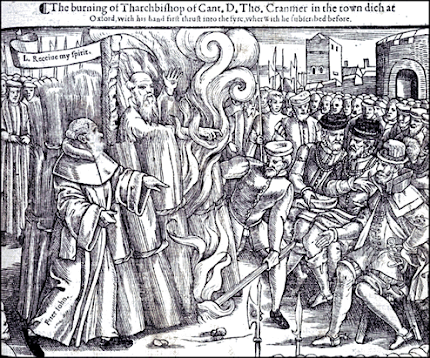
The burning of Tharchbishop of Cant. D. Tho. Cranmer in the town dich at Oxford, with his hand first thrust into the fyre, wherwith he subscribed before. [Click on the picture to see Cranmer's last words.]

Daily Bible Verse

Showing posts with label Semi-Pelagianism. Show all posts

Saturday, May 03, 2014

The Arminians: Influenced by Melanchthonian Lutheranism and Semi-Pelagianism

While the later Lutherans – under Phillip Melanchthon’s compromising spirit, which went so far as to seek reunion with Rome – abandoned many of Luther’s doctrines, it must be remembered that these matters were not in dispute among Luther, Zwingli, and Calvin, nor among Ridley, Cranmer, Latimer, Bucer, Zanchius, and Knox.  --  Gordon H. Clark


According to Dr. Gordon H. Clark, predestination of both the elect and the reprobate, the bondage of the will, and the sovereignty of God were never in dispute among the Reformers, including Martin Luther:
 

Patrick Hamilton’s sentence of death read: “We, James, by the mercy of God, Archbishop of St. Andrews, primate of Scotland, have found Master Patrick Hamilton many ways inflamed with heresy…that man hath no free will.”[15]

 The struggles of these loyal exponents of the Gospel of free grace culminated in the Protestant Reformation. At the Council of Trent, the Roman Church officially repudiated the doctrines that put salvation into the hands of God only. Rome chose free will and human merit. Luther and Calvin continued the apostolic teaching. In our present century of ignorance, one must insist that Luther as well as Calvin rejected the Pelagian-Romish-Arminian view of man. It was Erasmus, the man who drew back from the Reformation and made his peace with Rome, who defended free will. The book that Luther wrote in reply to him is titled The Bondage of the Will. In its Conclusion there is this sentence: “For if we believe it to be true that God foreknows and foreordains all things, that he can neither be deceived nor hindered in his prescience and predestination, and that nothing can take place but according to his will…then there can be no free will in man, in angel, or in any creature.”

While the later Lutherans – under Phillip Melanchthon’s compromising spirit, which went so far as to seek reunion with Rome – abandoned many of Luther’s doctrines, it must be remembered that these matters were not in dispute among Luther, Zwingli, and Calvin, nor among Ridley, Cranmer, Latimer, Bucer, Zanchius, and Knox. The same is true of the victims of Bloody Mary. Richard Woodman, who was burned at the stake with nine other martyrs at Lewes in Sussex, answered his examiners: “If we have free will, then our salvation cometh of ourselves: which is a great blasphemy against God and his Word.” Richard Gibson, examined by the Bishop of London, was called upon to profess that “a man hath by God’s grace a free choice and will in his doing.” Gibson denied the proposition and was burned to death with two others in Smithfield. Thirty-four persons were persecuted and expelled from the towns of Winston and Mendelsham, because “they denied man’s free will and held that the Pope’s church did err.” If more evidence is desired for the Calvinism of the Reformation, there is an abundance of it in the history books and in the original writings of these faithful men.

In the non-Lutheran world the Reformation faith was first adulterated by Arminius, who, influenced by Melanchthonian Lutheranism, rejected the Reformed view of free grace and retreated to a more Romish or semi-Pelagian position. The Synod of Dordt in 1618 condemned Arminius as a corrupter of the faith, though it did not rise to the explicit heights of the Westminster Assembly thirty years later. It is the latter’s Confession that is the highwater mark of Protestantism. No other creed is so detailed and so true to the Scriptures. Therefore the present day reader is requested to give exact attention to a quotation from the Westminster Confession. Though some circumscribed souls may be astonished, this is what Christianity is.

Gordon H. Clark. Religion, Reason and Revelation (Kindle Locations 4749-4779). The Trinity Foundation.

Tuesday, February 26, 2013

Calvin Against the Semi-Pelagians

I am often amused when Van Tilians quote Calvin to refute "rationalists."  I say that because the "rationalists" whom Calvin was refuting were semi-pelagians in the Roman Catholic Church.  Luther's diatribe against Erasmus is a classic example of how the doctrine of predestination and unconditional election has been used to defeat "rationalism."  

What is humorous, however, is when folks like Michael Horton or R. Scott Clark accuse the late Gordon H. Clark or the late Carl F. H. Henry of "rationalism" when they were in fact as Calvinist as you could get.  Calvin clearly says that it is the explaining away of God's decrees by reading human reason into the text that is "prying" into the secret counsel of God:


But before I enter on the subject, I have some remarks to address to two classes of men. The subject of predestination, which in itself is attended with considerable difficulty is rendered very perplexed and hence perilous by human curiosity, which cannot be restrained from wandering into forbidden paths and climbing to the clouds determined if it can that none of the secret things of God shall remain unexplored. When we see many, some of them in other respects not bad men, every where rushing into this audacity and wickedness, it is necessary to remind them of the course of duty in this matter. First, then, when they inquire into predestination, let them remember that they are penetrating into the recesses of the divine wisdom, where he who rushes forward securely and confidently, instead of satisfying his curiosity will enter in inextricable labyrinth.  For it is not right that man should with impunity pry into things which the Lord has been pleased to conceal within himself, and scan that sublime eternal wisdom which it is his pleasure that we should not apprehend but adore, that therein also his perfections may appear. Those secrets of his will, which he has seen it meet to manifest, are revealed in his word—revealed in so far as he knew to be conducive to our interest and welfare.

John Calvin, Institutes of the Christian Religion (Bellingham, WA: Logos Bible Software, 1997).

In other words, if the Bible teaches predestination let us not explain it away with Arminian arguments!  I can easily prove that this is Calvin's view:


NINE years have now elapsed since Albertus Pighius, the Campanian, a man of evidently phrensied audacity, attempted, at the same time, and in the same book, to establish the free-will of man, and to subvert the secret counsel of God, by which He chooses some to salvation and appoints others to eternal destruction. But as he attacked me by name, that he might stab, through my side, holy and sound doctrine, I have deemed it necessary to curb the sacrilegious madness of the man. At that time, however, being distracted by various engagement, I could not embrace, in one short space of time, the discussion of both subjects; but having published my thoughts upon the former, I promised to consider, when an opportunity should be given, the doctrine of predestination. Shortly after my book on free-will appeared, Pighius died. And that I might not insult a dead dog, I turned my attention to other serious matters. And from that time till now I have always found plenty to do. Moreover, as I had already copiously treated of this great point of doctrine, and had set it forth clearly, and confirmed it by solid testimonies of Scripture, this new labour upon it did not seem so absolutely necessary, but that it might safely be suffered to rest for a time.

But since, at the present day, certain maddened and exulting spirits strive, after the example of Pighius with all their might to destroy all that is contained in the Scriptures concerning the free election of the godly and the eternal judgment of the reprobate, I have considered it my duty to prevent this contagion from spreading farther, by collecting and summarily refuting those frivolous objections by which such men delude themselves and others.   (Calvin's Calvinism, Section I).
In short, by the standards of Van Til and his followers, Calvin himself was prying into the secret being of God by affirming that we can have genuine knowledge of unconditional election by what we read in the Scriptures.  We can know we are saved and that God has chosen us simply because of the fact that we have been called out of darkness and into His marvelous light:

But you are a chosen generation, a royal priesthood, a holy nation, His own special people, that you may proclaim the praises of Him who called you out of darkness into His marvelous light; 10 who once were not a people but are now the people of God, who had not obtained mercy but now have obtained mercy. (1 Peter 2:9-10 NKJ)
 

Tuesday, October 02, 2012

The Editor at the Christian Classic Ethereal Library Pushes the Synagogue of Satan


-------- Original Message --------
Subject: [Christian Classics Ethereal Library newsletter] The CCEL Times 7.10 (October 1, 2012)
Date: Tue, 02 Oct 2012 03:52:26 -0400
From: Christian Classics Ethereal Library <ccelnews@calvin.edu>
To: Cranmer1959 <cranmer1959@gmail.com>

Andy Hanson, the editor of CCEL makes the outrageous claim that a Roman Catholic theologian of the 16th century was actually in agreement with Calvinism on the issue of the sovereignty of God.  This sort of dissimulation is disturbing to say the least.  The fact of the matter is that Rome's official doctrine does not allow for the absolute sovereignty of God since the official doctrine of Rome is semi-pelagian.  The best way to see this is to read Martin Luther's debate with Disiderus Erasmus in The Bondage of the Will.

What is particularly disturbing about all this is that Wheaton College is supposed to be an Evangelical school.  Arminianism, it would appear, does lead to Rome.  All Evangelicals who agree with Hanson should just become Roman Catholics and Papists.  This is why Arminianism is heresy.  It's also why the high church Arminians in the Anglican church are disengenuous when they "pretend" to not agree with the Anglo-Catholics.  Their real agenda is reunion with Rome, the synagogue of Satan.

While "replies to this address will not be read," replies can and will be made to such nonsense on my blog.  I pray that God will open the eyes of Evangelicals to this sort of deception by the enemy.  (2 Corinthians 4:3-4).  Sadly, even Billy Graham fell prey to this deception by the Roman Catholic Church.

Charlie

You can read Andrew Hanson's remarks in the CCEL newsletter here:


God is sovereign.
God is in charge of everything, including the little things.
Not a hair falls from our heads without God's divine will.
We must rest in God's grace, as we are totally unable to contribute to our salvation.
What word pops into people's minds when they hear Christians making the above statements? Calvinist. Usually these beliefs are associated with those of the Calvinist persuasion. However, Father de Caussade was a Roman Catholic Priest who taught that God is truly sovereign, and therefore our whole lives can be lived in the knowledge that all things are working for our good. We may not understand why God does things the way he does, or how our suffering can ultimately be for our good, but we can trust our benevolent Lord, who has decreed all things, is good and just. Reading Abandonment to Divine Providence will help the reader surrender to God's will. The result? Spiritual peace in the arms of a loving God.
Andy Hanson
CCEL Intern
Note: Abandonment to Divine Providence has recently made it into the top 12 in popularity at the CCEL.
Nota Bene:  Not only does this book have the imprimatur of Rome on the title page but reading the preface we discover that  Jean Pierre de Caussade was a member of the Society of Jesus.  A Jesuit!  Hello!  The Jesuits were in charge of the persecution of Protestants.  Ignatius Loyola was the worst of these Jesuits.  (See:  Roman Catholic and Protestant Martyrs Contrasted). 


--
Glory be to the Father, and to the Son : and to the Holy Ghost; As it was in the beginning, is now, and ever shall be : world without end. Amen. Visit 1662 Book of Common Prayer: Daily Prayer and Reasonable Christian Blog


Sunday, August 26, 2012

Reasonable Christian: An Open Letter to Bishop Royal Grote

Bishop Royal "Roy" Grote on the left.

This is a letter I wrote to one of the bishops in the Reformed Episcopal Church over the intended merger with the Anglican Province of America.  That merger never happened since the opportunity to merge with the Anglican Church in North America presented itself.  The point of the letter stands, however, since the ACNA is as Anglo-Papist as the APA is.  What is particularly disturbing about all this is that even Evangelical Anglicans refuse to call the Tractarians on their heresies.  Bishop J.C. Ryle would be rolling over in his grave.  Even the Sydney Anglicans and the Anglican Church League think the Gospel and justification by faith ALONE is somehow a matter of adiaphora since the Tractarians and Anglo-Catholics openly deny sola fide, sola gratia and the final authority of Scripture or sola Scriptura.  I have been challenging Dr. Mark Thompson and my former pastor, David Knox on these issues for some time.

I guess they don't get it that I'm quite willing to speak out publicly on these issues and raise a ruckus.  I've been called one who sows discord among the brethren by at least one Presbyterian.   But it would require that the discord is among brethren.  Anglo-Catholics and Arminians are not "brethren".  They are heretics who preach another gospel.

Click here to read the original letter: Reasonable Christian: An Open Letter to Bishop Royal Grote

Wednesday, June 20, 2012

Pelagianism: » The Recent SBC Statement on Salvation: A Point of Concern

It looks like at least one particular Baptist has put his finger on the real issue at stake in the dispute between Arminianism and Calvinism: the denial of the doctrine of the bondage of the will, a key doctrine of the Protestant Reformation and the Holy Scriptures.
In the denial section of article two, the authors write,
We deny that Adam’s sin resulted in the incapacitation of any person’s free will or rendered any person guilty before he has personally sinned.
The assertion about free will is controversial, but in my opinion the statement about guilt that appears at the end of this sentence is more troubling, for it appears to be nothing less than a denial of what Scripture teaches about the doctrine of original sin. The authors of this statement (and those who have signed it) assert that Adamic guilt is not imputed to Adam’s descendants. This is quite a remarkable claim. In the absence of qualification, even Arminius would likely have objected to this assertion. The authors apparently believe that sinners are only guilty for the actual sins which they commit. The net result of this is that humans are not born guilty and liable to condemnation but rather only become such when they actually sin. 

--John Aloisi


Click here to read the whole story:   » The Recent SBC Statement on Salvation: A Point of Concern

Wednesday, June 13, 2012

Bavinck on Semi-Pelagianism

Sorry but I borrowed this extensive quote from another blog:

Herman Bavinck, volume III of Reformed Dogmatics, Part I, Chapter II, pages 90-92.

Pelagianism was condemned by the Christian church. From the outset the church fathers assumed a certain connection between Adam’s sin and that of his descendants. Although this connection was not yet examined in detail, Adam’s trespass did bring about a great moral upheaval in his own life and that of his descendants. The nature of that moral change, however, was viewed in very diverse ways. According to semi-Pelagianism, the consequences of Adam’s fall consisted for him and his descendants, aside from death, primarily in the weakening of moral strength. Though there is actually no real original sin in the sense of guilt, there is a hereditary malady: as a result of Adam’s fall, humanity has become morally sick; the human will has been weakened and is inclined to evil.1 There has originated in humans a conflict between “flesh” and “spirit” that makes it impossible for a person to live without sin; but humans can will the good, and when they do, grace comes to their assistance in accomplishing it.2 This is the position adopted by the Greek church; and although in the West Augustine exerted strong influence, the [Western] church increasingly strayed toward semi-Pelagianism. The Council of Trent taught that though the freedom of the will had diminished, it had not been destroyed3, and that concupiscence as such is not a sin. Totally in agreement with this is the opinion of Anabaptists, Zwingli, the Remonstrants, the Moravian Brethren, the Supernaturalists, and many modern theologians. All agree in believing that Adam’s fall had consequences also for his descendants, because they are physically connected with him. But the moral state that came into being in the human race as a result of Adam’s trespass is not one of sin and guilt but of weakness, lack, sickness. Original sin as such cannot damn humans and at most results in a punishment of the damned [poena damni—the pain of eternal separation from God] without a punishment of the senses (poena sensus). It is an occasion for sin, not sin itself in the true sense of the word. Since the will is in a weakened state, however, it easily yields to the temptations of the flesh; then, when the will agrees and consents to concupiscence, original sin turns into personal sin, which renders a person guilty and deserving of punishment. Materially this theory of original sin completely corresponds to the theory that sin is the product of sensuality and a remnant of humanity’s earlier animal state.

This semi-Pelagian view of original sin, however, is basically not much better than that of Pelagius and is open to the same objections. (1) It denies the character and seriousness of sin. Sin, after all, is lawlessness (ἀνομια). The state in which humans are born either corresponds to God’s law or deviates from it; it is good or evil, sinful or not sinful. There is no third category. That that state is good and agrees in all parts with God’s law, semi-Pelagians dare not assert either. Yet they do not call it sinful in the true sense of the word. So they create an intermediate state and speak of original sin as a disease, a deficiency, an illness that is not a real sin but can only be an occasion for sin.4 Or they separate sin and guilt and say, like Rothe and Kaftan, that though original sin is sin, it is not guilt. (2) This is impossible both ways. Sin and guilt are inseparable (Gal. 3:10; James 2:10; 1 John 5:17). If sin is lawlessness, it is punishable; and, conversely, where there is guilt and punishment, there has to be sin. Original sin, however, is such that death is its consequence (Rom. 5:14), that it makes us unworthy of the fellowship of God and his heaven (Doedes), that it is inherently impure, the occasion and source of many sins, and is presumably therefore itself sin. Otherwise God would be unjust for punishing with death, the wages of sin (Rom. 6:23), that which is no sin and does not deserve death.5 The law would lose its absolute validity, for there would be deviation that did not deserve punishment, fellowship with God would be withheld where there was no guilt. Between heaven and hell, good and evil, light and darkness there would come a state that was neither, a “punishment of the damned” without a “punishment of the senses.” That which engenders all sorts of sins would not itself be sinful. The tree, though good, would still bear bad fruit. The spring, though pure, would produce impure water. (3) The notion that innate sinfulness only becomes sin and guilt when the will consents to it, so far from improving the theory, makes it worse. We have to choose: either the will, as it were, stands above and outside that innate tendency, and then original sin consists in nothing but the innate sensual nature, and the entire [moral] character of sin is lost; or the will is itself more or less affected and weakened by original sin. It is rooted in the sinful nature and arises from it, and then one loses—to precisely the same degree as that to which one allows the will to be weakened—that which the theory was designed to maintain: that there is no sin without a decision of the free will.6
Furthermore, even if one could conceive a will such that it existed in part or in whole outside the inborn sinful nature, it would still not in fact yield what it is intended to yield. The first decisions of the will that consent to innate concupiscence all occur in the early years when the will is still weak and powerless. No persons are aware that with those first decisions of the will, they are incurring such a guilt, that they actually did not fall and become children of wrath until then. Over against those who say this, everyone could excuse himself by saying he did not know better and could not act otherwise, that for such a weighty decision about his eternal weal or woe, he was positioned in most unfavorable circumstances. Indeed, if original sin is not sin, all other later sins, which so readily and so necessarily spring from it, cannot be sin either. Also Schleiermacher, therefore, rejected the notion that original sin cannot be guilt until it breaks out in actual sins, “for the mere circumstance that there has been no opportunity for and no outward incentive to sin cannot enhance the spiritual status of man.” (4) The semi-Pelagian theory not only does not solve the problem present here, but it does not even begin to touch it and even deliberately shuts its eyes to it. The universality of sin is a fact that also semi-Pelagians acknowledge. They reject its explanation in terms of imitation. They accept that an impure, effective, sick, sinful (though nonculpable and nonpunishable) state is anterior to sinful acts.7 They acknowledge that that impure, sick state, in the lives of all without distinction, leads to culpable, punishable deeds, so that the weakened free will actually means very little.8 Now then, how must we explain that appalling phenomenon? How can it be squared with God’s justice that, aside now from the covenant of grace, he permits all humans to be born in such a state, a state that, in any case, for children dying in infancy entails death and exclusion from his fellowship, and for all others eternal ruin? The semi-Pelagian theory fails totally to enter into the problem and contents itself with a superficial and inconsequential doctrine of free will.9

[Frankly, I find it refreshing that Bavinck acknowledges that the children of unbelievers who die in infancy have none of the Gospel promises.  Why would anyone disagree?  Is God unjust for damning infants?  I guess the flood account in Genesis 6-9 records a great injustice on God's part when He wiped out all mankind except for eight souls.  That would include women and children and old folks in the destruction ensuing from the flood.  Also, I have my doubts that Ulrich Zwingli could be considered along with the Anabaptists and Remonstrandts since he wrote strongly in favor of unconditional election and challenged the Catabaptists or Anabaptists.  Perhaps Bavinck is making Zwingli guilty of what some of his later followers did to pervert his theology?  --  Charlie]

Saturday, June 09, 2012

Does Arminianism Teach the Gospel?


Does Arminianism Teach the Gospel? An Assessment of Evangelical Ecumenicalism

Not too long ago Dr. Michael Horton initiated a teaching series called “Christless Christianity”, in which he made the vague assertion that many of the churches in Evangelicalism are actually pelagian rather than Christian. His critique of the church growth movement, Joel Osteen, and many of the television evangelists was well received by most of the Reformed Evangelicals and neo-Calvinists. But is Mike Horton and the White Horse Inn consistent in its accusation that Evangelicalism is infected with pelagianism? That is a matter that is questionable as this article will briefly examine.

First of all, it should be noted that pelagianism as defined by Horton is something along the lines of Charles Finney's theology which denies total depravity, the bondage of the will, and even a Wesleyan Arminian definition of depravity. But is this a sufficient definition of pelagianism? I think not. In fact, the semi-pelagian position is nothing more than pelagianism disguised in a more subtle form. The Wesleyan doctrine of prevenient grace in effect cancels out the doctrine of depravity and defaults back to pelagianism since the deciding factor is not God's irresistible grace but rather “libertarian free will”. In short, the Arminian rationalism defaults to a pelagian definition of “free will”. The famous hymn, “O For a Thousand Tongues”, written by Charles Wesley includes these lines:

He breaks the power of canceled sin,
He sets the prisoner free;
His blood can make the foulest clean,
His blood availed for me.

He speaks, and, listening to His voice,
New life the dead receive,
The mournful, broken hearts rejoice,
The humble poor believe.

Hear Him, ye deaf; His praise, ye dumb,
Your loosened tongues employ;
Ye blind, behold your Savior come,
And leap, ye lame, for joy.

Wesley is not referring to a Calvinist view of “canceled sin” as in a post conversion reversal of the bondage of the will that hinders or prevents the elect from becoming a Christian. No, for Wesley “canceled sin” refers to a general grace given to all mankind so that man is no longer in bondage to sin but only has a “bent toward sinning” that can easily be overcome by the will simply by believing the Gospel in one's own strength and obedience. For Wesley the deaf can make themselves hear and the dead can raise themselves from the grave. The lame can make themselves walk again and prisoners set themselves free by their own free will. But is this what the Bible teaches? 

To give a sampling of the Scriptures on this issue let's take a look at just a few verses in particular:


Can the Ethiopian change his skin or the leopard its spots? Then may you also do good who are accustomed to do evil. (Jeremiah 13:23 NKJ)
Why should you be stricken again? You will revolt more and more. The whole head is sick, And the whole heart faints. (Isaiah 1:5 NKJ)
For though you wash yourself with lye, and use much soap, Yet your iniquity is marked before Me," says the Lord GOD. (Jeremiah 2:22 NKJ)
Who can say, "I have made my heart clean, I am pure from my sin "? (Proverbs 20:9 NKJ)

In short, Wesleyan Arminianism and other forms of Arminianism are nothing more than pelagianism masquerading as biblical Christianity. The Wesleys understood that Arminianism and Calvinism were mutually exclusive gospels and this is precisely why they vociferously attacked Augustus Toplady and other consistent Calvinists in the Church of England during the Second Great Awakening. It is on this point that the Calvinist, George Whitefield, was inconsistent and allowed his friendship with the Wesleys to cloud his judgment and his thinking on this issue. The fact of the matter is that pelagianism and augustinianism are mutually exclusive theologies. This battle between the Gospel of sovereign grace and the gospel of libertarian free will goes all the way back to the fourth century.

What I am saying is that Mike Horton is inconsistent when he invites Arminians like William Willimon to his radio program, The White Horse Inn. Horton also has high praise for the Arminian heretic, Thomas Oden. The problem with Horton and other neo-Calvinists is that they use their Calvinism as a cloak for what is really nothing more than lip service to Calvinism. Horton and other neo-Calvinists are really advocates of irrationalism to the point that there really is no logical consistency in their theology and they have essentially sold out to postmodernism, neo-orthodoxy, and a theology of paradox. In such thinking there is no need for non-contradiction or propositional truth since all that matters is one's subjective experience of what God is doing. In other words, it is God's acts in history rather than God's very words in Holy Scripture that matters most. That is neo-orthodoxy in a nutshell.

It is truly ironic that Horton would advocate a movement toward theological orthodoxy and attack pelagianism in the Evangelical movement when he himself has openly endorsed pelagianism via his approval of Arminianism and even Anglo-Catholic denominations like the Anglican Church in North America. If Arminianism is a damnable heresy as the Canons of Dort clearly indicate, then how can Horton blatantly ignore the doctrinal standards of his own denomination, which standards are the Three Forms of Unity: Belgic Confession, Heidelberg Catechism, Canons of Dort?

Good question!

Sincerely in Christ,

Charlie J. Ray


Sunday, February 26, 2012

The Lutheran Doctrine of Salvation, Charles Hodge

Charles Hodge
[I have no reason to doubt Charles Hodge in his description of the Lutheran position below.  Clearly this idea that there is contingency as to who will be reprobate or elect has more to do with the semi-pelagian view of Rome.  Luther's view, as argued in The Bondage of the Will, is that there is no contingency with God and that everything that happens is God's will.]

"As this system was illogical and contrary to the clear declarations of Scripture, it did not long maintain its ground. Non-resistance to the grace of God, passively yielding to its power, is something good. It is something by which one class is favourably distinguished from another; and therefore the reason why they, rather than others, are saved, is to be referred to themselves and not to God, who gives the same grace to all. The later Lutheran theologians, therefore, have abandoned the ground of the "Form of Concord," and teach that the objects of election are those whom God foresaw would believe and persevere in faith unto the end."  Charles Hodge

You openly declare that the immutable will of God is to be known, but you forbid the knowledge of His immutable prescience. Do you believe that He foreknows against His will, or that He wills in ignorance? If then, He foreknows, willing, His will is eternal and immovable, because His nature is so: and, if He wills, foreknowing, His knowledge is eternal and immovable, because His nature is so. From which it follows unalterably, that all things which we do, although they may appear to us to be done mutably and contingently, and even may be done thus contingently by us, are yet, in reality, done necessarily and immutably, with respect to the will of God. For the will of God is effective and cannot be hindered; because the very power of God is natural to Him, and His wisdom is such that He cannot be deceived. And as His will cannot be hindered, the work itself cannot be hindered from being done in the place, at the time, in the measure, and by whom He foresees and wills.  --Martin Luther, The Bondage of the Will:  The Sovereignty of God.

    It is not easy to give the Lutheran doctrine on this subject, because it is stated in one way in the early symbolical books of that Church, and in a somewhat different way in the "Form of Concord," and in the writings of the standard Lutheran theologians. Luther himself taught the strict Augustinian doctrine, as did also Melancthon in the first edition of his "Loci Communes." In the later editions of that work Melancthon taught that men cooperate with the grace of God in conversion, and that the reason why one man is regenerated and another not is to be found in that cooperation. This gave rise to the protracted and vehement synergistic controversy, which for a long time seriously disturbed the peace of the Lutheran Church. This controversy was for a time authoritatively settled by the "Form of Concord," which was adopted and enjoined as a standard of orthodoxy by the Lutherans. In this document both the doctrine of cooperation and that of absolute predestination were rejected. It taught the entire inability of the natural man for anything spiritually good; and therefore denied that he could either prepare himself for regeneration or cooperate with the grace of God in that work. It refers the regeneration of the sinner exclusively to the supernatural agency of the Holy Spirit. It is the work of God, and in no sense or degree the work of man. But it teaches that the grace of God may be effectually resisted, and that the reason why all who hear the gospel are not saved is that some do thus resist the influence which is brought to bear upon them, and others do not. While, therefore, regeneration is exclusively the work of the Spirit, the failure of salvation is to be referred to the voluntary resistance of offered grace. As this system was illogical and contrary to the clear declarations of Scripture, it did not long maintain its ground. Non-resistance to the grace of God, passively yielding to its power, is something good. It is something by which one class is favourably distinguished from another; and therefore the reason why they, rather than others, are saved, is to be referred to themselves and not to God, who gives the same grace to all. The later Lutheran theologians, therefore, have abandoned the ground of the "Form of Concord," and teach that the objects of election are those whom God foresaw would believe and persevere in faith unto the end. 

    According to this scheme, God, (1.) From general benevolence or love to the fallen race of man, wills their salvation by a sincere purpose and intention. "Benevolentia Dei universalis," says Hollaz, "non est inane votum, non sterilis velleitas, non otiosa complacentia, qua quis rem, quae sibi placet, et quam in se amat, non cupit officere aut consequi adeoque mediis ad hunc finem ducentibus non vult uti; sed est voluntas efficax, qua Deus salutem hominum, ardentissime amatam, etiam efficere atque per media sufficientia et efficacia consequi serio intendit."4 (2.) Te give effect to this general purpose of benevolence and mercy towards men indiscriminately, God determined to send his Son to make a full satisfaction for their sins. (3.) To this follows (in the order of thought) the purpose to give to all men the means of salvation and the power to avail themselves of the offered mercy. This is described as a "destinatio mediorum, juibus tum aeterna salus satisfactione Christi parta, turn vires credendi omnibus hominibus offeruntur, ut satisfactionem Christi ad salutem acceptare et sibi applicare queant."5 (4.) Besides this, voluntas generalis (as relating to all men) and antecedens, as going before any contemplated action of men, there is a voluntas specialis, as relating to certain individual men, and consequens, as following the foresight of their action. This voluntas specialis is defined as that "quae peccatores oblata salutis media amplectentes aeterna salute donare constituit."6 So Hutter7 says, "Quia (Deus) praevidit ac praevidit maximam mundi partem mediis salutis locum minime relicturam ac proinde in Christum non credituram, ideo Deus de illis tantum salvandis fecit decretum, quos actu in Christum credituros praevidit." Hollaz expresses the same view:8 "Electio hominum, peccato corruptorum, ad vitam aeternam a Deo misericordissimo facta est intuitu fidei in Christum ad finem usque vitae perseverantis." Again: "Simpliciter quippe et categorice decrevit Deus hunc, ilium, istum hominem salvare, quia perseverantem ipsius in Christum fidem certo praevidit."9

 
    The Lutheran doctrine, therefore, answers the question, Why one man is saved and another not? by saying, Because the one believes and the other does not. The question, Why God elects some and not others, and predestinates them to eternal life? is answered by saying, Because He foresees that some will believe unto the end, and others will not. If asked, Why one believes and another not? the answer is, Not that one cooperates with the grace of God and the other does not; but that some resist and reject the grace offered to all, and others do not. The difficulty arising from the Lutheran doctrine of the entire corruption of our fallen nature, and the entire inability of the sinner to do anything spiritually good, is met by saying, that the sinner has power to use the means of grace, he can hear the word and receive the sacraments, and as these means of grace are imbued with a divine supernatural power they produce a saving effect upon all who do not voluntarily and persistently resist their influence. Baptism, in the case of infants, is attended by the regeneration of the soul; and therefore all who are baptized in infancy have a principle of grace implanted in them, which, if cherished, or, if not voluntarily quenched, secures their salvation. Predestination in the Lutheran system is confined to the elect. God predestinates those who He foresees will persevere in faith unto salvation. There is no predestination of unbelievers unto death.

Monday, February 06, 2012

Dr. Michael Horton - For or Against Calvinism, Part 1 - Listen to Free Online White Horse Inn Christian Radio Broadcasts


Two episodes of The White Horse Inn are absolutely necessary for every Calvinist and Arminian to hear. Part one is Roger Olson's presentation. In this part, Olson admits that if Scripture says something he disagrees with, then it is OK to reinterpret the plain meaning of the text to fit with his rational presuppositions. Passages like Romans 9, Acts 2:23; 4:27-28; 1 Peter 2:8 cannot possibly support the Calvinist view. Why? Because Olson has presupposed that Scripture cannot possibly teach what it "plainly" teaches!

Basically libertarian free will is a compromise with the semi-pelagianism of the Papists and the Eastern Orthodox. Scripture, for the Reformed position, is the final authority, not reason exalted above Scripture. God is absolutely sovereign. Psalm 115:3.

Click here to hear Part 1: Dr. Michael Horton - For or Against Calvinism, Part 1 - Listen to Free Online White Horse Inn Christian Radio Broadcasts

And here to hear Part 2: Dr. Michael Horton - For or Against Calvinism, Part 2 - Listen to Free Online White Horse Inn Christian Radio Broadcasts

Friday, January 27, 2012

Could Jesus Have Sinned? by R.C. Sproul | Ligonier Ministries Blog


"The best theologians, past and present, have been divided on the question of whether Jesus could have sinned. I believe that since Jesus was fully human, it was possible for him to sin."  R. C. Sproul

[Addendum:  I no longer believe that Dr. Gordon H. Clark committed the Nestorian error.  He simply said that the human person of Christ and the divine Person of the Logos were united in the man Christ Jesus.  Dr. Clark's view is simply a further refining of the Definition of Chalcedon, 451 A.D.]


Like most semi-Calvinists R.C. Sproul makes numerous capitulations to Arminianism, like the three points of common grace, a semi-Amyraldian view of the atonement (i.e. Christ died to purchase common grace for the reprobates and the free offer to the reprobates), and the infralapsarian view of God's decrees (as if God did not plan anything until after He had logically considered the results of the Fall of Adam?). Now we find that Sproul agrees with the Pentecostals that Jesus is not fully divine, but simply avoids sinning by virtue of the fact that He is filled with the Spirit beyond measure. Logically speaking, either way, Jesus has an advantage that we do not enjoy, since "we" do not have the Spirit beyond measure. So the purpose of denying the impeccability of Christ is rendered moot.

The fact is, if we say that Jesus could have sinned in His human nature, and if we concede that the divine nature could not sin, we have an irrational paradox that in effect denies the complete deity of Jesus Christ. This is the same sort of error committed by the otherwise solid Gordon H. Clark when Clark proposed the Nestorian theory of the incarnation.  [Although Clark would never say Christ could sin since Clark's view is that predestination is absolute]. To say that Jesus could have sinned in His human nature would mean that it would be possible to separate the human nature from the divine nature when the two are perfectly united in the one Person of Jesus Christ. It would mean that God's decrees are tentative and that divine predestination is not true! The idea that Christ "could have sinned" is not the Reformed view of the incarnation, mission, sinless life, and the atonement on the cross.  It would mean that these doctrines were all contingencies and that Christ's mission "could have failed"! In short, the idea of Christ being peccable or able to sin is in essence the Arminian or semi-pelagian view, not the Calvinist or Reformed view.

In fact, it was not Luther's view either! Luther plainly said that absolutely nothing happens by contingency and that there is no such thing as libertarian free will--not even in Adam prior to the fall! The Fall was certain to happen because God decreed it to be so. Luther says:

Sect. 9.—THIS, therefore, is also essentially necessary and wholesome for Christians to know: That God foreknows nothing by contingency, but that He foresees, purposes, and does all things according to His immutable, eternal, and infallible will. By this thunderbolt, "Free-will" is thrown prostrate, and utterly dashed to pieces. Those, therefore, who would assert "Free-will," must either deny this thunderbolt, or pretend not to see it, or push it from them. But, however, before I establish this point by any arguments of my own, and by the authority of Scripture, I will first set it forth in your words.

Are you not then the person, friend Erasmus, who just now asserted, that God is by nature just, and by nature most merciful? If this be true, does it not follow that He is immutably just and merciful? That, as His nature is not changed to all eternity, so neither His justice nor His mercy? And what is said concerning His justice and His mercy, must be said also concerning His knowledge, His wisdom, His goodness, His will, and His other Attributes. If therefore these things are asserted religiously, piously, and wholesomely concerning God, as you say yourself, what has come to you, that, contrary to your own self, you now assert, that it is irreligious, curious, and vain, to say, that God foreknows of necessity? You openly declare that the immutable will of God is to be known, but you forbid the knowledge of His immutable prescience. Do you believe that He foreknows against His will, or that He wills in ignorance? If then, He foreknows, willing, His will is eternal and immovable, because His nature is so: and, if He wills, foreknowing, His knowledge is eternal and immovable, because His nature is so.

From which it follows unalterably, that all things which we do, although they may appear to us to be done mutably and contingently, and even may be done thus contingently by us, are yet, in reality, done necessarily and immutably, with respect to the will of God. For the will of God is effective and cannot be hindered; because the very power of God is natural to Him, and His wisdom is such that He cannot be deceived. And as His will cannot be hindered, the work itself cannot be hindered from being done in the place, at the time, in the measure, and by whom He foresees and wills.
The Sovereignty of God: The Bondage of the Will


It seems to me that R. C. Sproul's commitment to reason above Scripture via the "classical" apologetics of Thomas Aquinas has prejudiced him against the plain teaching of Scripture in regards to both the absolute deity of Jesus Christ and the absolute predestination of God and His decrees.

"Men of Israel, hear these words: Jesus of Nazareth, a Man attested by God to you by miracles, wonders, and signs which God did through Him in your midst, as you yourselves also know-- 23 "Him, being delivered by the determined purpose and foreknowledge of God, you have taken by lawless hands, have crucified, and put to death; (Acts 2:22-23 NKJ)

"For truly against Your holy Servant Jesus, whom You anointed, both Herod and Pontius Pilate, with the Gentiles and the people of Israel, were gathered together 28 "to do whatever Your hand and Your purpose determined before to be done. (Acts 4:27-28 NKJ)

"And truly the Son of Man goes as it has been determined, but woe to that man by whom He is betrayed!" (Luke 22:22 NKJ)

Logically speaking if it were possible for Jesus to sin--even in His human nature--it would mean that it is possible for God to not know what the future holds. If it were possible for Jesus to sin in His human nature, then it logically follows that it would be possible for Jesus to become less than fully God, since it is impossible for God to sin. Since it is impossible for God to lie (Hebrews 6:18), it follows that it would be impossible for Jesus to fail to keep God's promise to save the elect (Genesis 3:15; Matthew 1:21). It is truly sad to see someone who claims to be Reformed teaching obviously Arminian doctrines like the peccability of Jesus Christ while He was on earth.

Even J. I. Packer does not make that sort of mistake:


Jesus, being divine, was impeccable (could not sin), but this does not mean he could not be tempted. Satan tempted him to disobey the Father by self-gratification, self-display, and self-aggrandizement (Matt. 4:1-11), and the temptation to retreat from the cross was constant (Luke 22:28, where the Greek for “trials” can be translated “temptations”; Matt. 16:23; and Jesus’ prayer in Gethsemane). Being human, Jesus could not conquer temptation without a struggle, but being divine it was his nature to do his Father’s will (John 5:19, 30), and therefore to resist and fight temptation until he had overcome it. From Gethsemane we may infer that his struggles were sometimes more acute and agonizing than any we ever know. The happy end-result is that “because he himself suffered when he was tempted, he is able to help those who are being tempted” (Heb. 2:18).


Packer, J. I. (1995). Concise theology : A guide to historic Christian beliefs. Wheaton, Ill.: Tyndale House.

Furthermore, the suggestion that Jesus could have sinned ignores the fact that Jesus had an advantage that Adam did not have prior to the Fall. Jesus was and is fully God, and He additionally had the Holy Spirit without measure (John 3:34; John 1:1, 14, 18; Colossians 1:19, 20; Colossians 2:9). Although Jesus suffered in every point like we do, He never sinned and in fact it was destined to be so! (Hebrews 4:15; 1 Peter 2:22; 1 John 3:5). It was never possible that God would fail to keep His promise to save His elect. Jesus is the Lamb slain from before the foundation of the world (Revelation 13:8 NKJV).

To read R. C. Sproul's remarks click here: Could Jesus Have Sinned? by R.C. Sproul | Ligonier Ministries Blog


Tuesday, June 08, 2010

Is the Gospel Coalition on a Downward Spiral: An Endorsement of N. T. Wright

Dr. R. Scott Clark reports that the theology of N. T. Wright is now being openly endorsed by the Gospel Coalition (see Heidelblog: M. Jay Bennett is Reading CJPM). I attended a People Growth/Gospel Growth last February in Chicago. I was not impressed with the conference or the Gospel Coalition. The Coalition is partnered by those who are openly Amyraldian or worse, including Philip Jensen of the Sydney Anglicans. D.A. Carson and Tim Keller are also leaders in the Gospel Coalition. Keller's triperspectivalism has been shown to be problematic already. One has to wonder where the 9 Marks ministry of Mark Dever falls on the five points of Calvinism and the five solas of the Protestant Reformation?

I'm finding that those who are not strict Calvinists in agreement with the Westminster Standards and/or the Three Forms of Unity are more apt to compromise openly with those who attack the Gospel. For example, the Sydney Anglicans are in full communion now with the Anglican Church in North America, which is predominately Anglo-Catholic and openly semi-pelagian and papist in their theology of the sacraments and their soteriology.

I recently had to break fellowship with Christ Church Longwood over what I can only describe as pelagianism. While the pastor, David Paul Knox (son of the late David Broughton Knox), gives lip service to the doctrines of the Reformed faith, he really does not believe any of them due to his unconfessional theology. While he does agree with the 39 Articles as an Evangelical document, Knox rejects all--and I do mean all--the other Reformed confessions of faith. In doing so, he also eisogetes into the 39 Articles his preconceived theology, including a blatant rejection of both Augustinian and Calvinist views on predestination to election and reprobation. Clearly Article 17 includes the doctrine of reprobation, a fact that theological liberals, Arminians and Amyraldians reject. The fact is Amyraldians have more in common with Anglo-Catholics and Arminians on soteriology than they do with the English Reformers or the Swiss Reformers.

It is practically impossible these days to find any Anglican congregation where the pure Gospel is preached or the sacraments are rightly and duly administered. Those congregations which do not use the 1662 Book of Common Prayer are for all practical purposes not Reformed. Most Anglican Evangelicals in the United States have more in common with Anglo-Catholics, Arminians and theological liberals than anything else. Increasingly I am coming to the same conclusion about the Sydney Anglicans since they are much more concerned with being in full fellowship with papists of the conservative variety than they are concerned with preaching the pure Gospel, the doctrines of grace, or rightly administering the sacraments. Likewise, the Sydney Anglicans have started down the path toward liberalism by the ordination of women to the diaconate, an official office of the church ministry. It will not be long before they begin to ordain women as presbyters and bishops, which in turn leads to the ordination of homosexuals.

It seems to me that Reformed believers ought to more concerned about the purity of doctrine than about the catholicity of the church. Too much emphasis on catholicity leads to man-centered theology rather than God-centered theology, which in turn leads to theological liberalism and the social gospel.

The fact that my former pastor, David Knox, has more in common with the Anglo-Catholics than with Reformed believers only proves that my thesis is correct. Sydney Anglicans hate the smells and the bells and ritualism but their soteriology is essentially the same as any Anglo-Catholic, Arminian or Amyraldian. If you want to be saved, you must strive, merit, work your way to heaven. God cannot save you without your cooperation is their view.

I, on the other hand, believe that God and God alone can save a lost sinner. God alone can regenerate a dead soul and God alone can progessively sanctify a saved and elect sinner. All of the glory goes to God and God alone since the biblical teaching is that salvation is a monergistic work of God given to sinners by grace and mercy alone.

Sola Scriptura!

Saturday, June 20, 2009

Augustianism/Calvinism Versus Arminianism/Molinism


For I have not shunned to declare unto you all the counsel of God. (Acts 20:27 KJV)


[The following exchange took place after I contacted the Society of Evangelical Arminians regarding their article satirizing "Stuff Young Calvinists Like." I am at a loss as to how this satirical piece is supposed to demonstrate "love" and an "irenic" spirit as the contact person proposes is the express the purpose of the SEA.]


Ron,

Three things.

1) Dordt and Westminster are not Scripture is absolutely correct. But it also follows from that Arminianism is not Scripture EITHER. It is an "interpretation" of Scripture and therefore fallible. Likewise no visible church on earth is infallible or inerrant. So by your reasoning no doctrine is binding because they are all fallible interpretations of Scripture. That is at least implied in your statement.

That being said, however, the church does have authority to interpret Scripture because it is established by God himself in the very Scriptures you mention. (See 1 Timothy 3:15-16). The church, according to the principles of the Protestant Reformation, should always be reforming itself and thus a common understanding of Scripture must be agreed upon. The principle of sola scriptura and the perspicuity of Scripture applies here.

Since the Dutch "Three Forms of Unity" (Belgic Confession, Heidelberg Catechism, Canons of Dordt) and the Westminster Standards (Westminster Confession, Westminster Larger Catechism, Westminster Shorter Catechism) are summaries of what the church believes the Scriptures infallibly teach, then it follows that they are infallible wherever they are faithful to the infallible Scriptures. Confessional standards are simply more detailed "creeds" which express what Christians "believe." The creeds are prefaced with the words, "I believe..."

Regarding the Synod of Dordt, the Remonstrandts first created the controversy by formulating 5 points of Remonstrance and by attacking the Calvinist doctrines which were at that time binding doctrine in all the Dutch churches. It is a bit silly for Arminians to cry over the Synod of Dordt when in fact the Arminians were in rebellion against biblical doctrine as it had been understood since the Reformation in the Dutch Calvinist churches. The Arminians were in fact challenging the Belgic Confession, which was a binding confession of faith. Confessions of faith are not in and of themselves infallible but they are binding upon the conscience of all members of a local, regional, universal church unless and until it can be proven that the document is unfaithful to Scripture. On this point the Arminians have not proven their case one whit.

"Episcopius was their chief speaker; and with great art and address did he manage their cause. He insisted on being permitted to begin with a refutation of the Calvinistic doctrines, especially that of reprobation, hoping that, by placing his objections to this doctrine in front of all the rest, he might excite such prejudice against the other articles of the system, as to secure the popular voice in his favor. The Synod, however, very properly, reminded him, that they had not convened for the purpose of trying the Confession of Faith of the Belgic Churches, which had been long established and well known; but that, as the Remonstrants were accused of departing from the Reformed faith, they were bound first to justify themselves, by giving Scriptural proof in support of their opinions. The Arminians would not submit to this plan of procedure because it destroyed their whole scheme of argument. However, the Synod firmly refused to make any concessions on this point of order. Day after day they were reasoned with and urged to come and scripturally defend their published doctrines. . . The Arminians would not submit to this course and were thus compelled to withdraw. Upon their departure, the Synod proceeded without them."

2) Molinism cannot be deistic? Molinism is essentially a more philosophically complex form of Arminianism proposing God's natural knowledge, middle knowledge, and free knowledge. However, sophisticated restatements of Arminianism do not solve the problems Molinism claims to solve. In fact, Molinism reinforces the sovereignty of God argument for Calvinists and Augustinians. If Molinism is true, then the Creator God is somehow dependent upon His creation in order to make what is actually existent occur. Thus, Molinism denies the Scriptural truth that God is self-existent and absolutely omnipotent. Any scheme which makes God dependent on creation is therefore either deistic or a capitulation to the open view of theism. (See

Middle Knowledge: A Reformed Critique Travis James Campbell).


3) I did not declare you a heretic. The Synod of Dort declared you and all Arminians as heretics from the Reformed faith and that was an almost unanimous decision of Calvinists all over the world at that time, including those invited to attend from the English church and the Swiss churches. While you may find the term "heretic" uncomfortable, the historical facts stand as they have occurred. We might debate regarding the level of heresy or class of heresy into which Arminianism falls. Are you a primary level heretic on the level of Roman Catholicism and Eastern Orthodoxy? Or are you a secondary heretic in which you remain within the Protestant visible church but with a deficient understanding of the Scriptures and the law and Gospel? I would contend that it is debatable but the evidence toward the primary level of heresy is gaining ground in some Reformed circles.

Confessions of faith are absolutely necessary in determining who is in fellowship or communion within the visible local/regional/universal churches. Otherwise, we would be in communion with everyone in the world who makes any illicit claim to being "Christian." We both know that is not the case. As Paul himself said:

"Do not be unequally yoked with unbelievers. For what partnership has righteousness with lawlessness? Or what fellowship has light with darkness? What accord has Christ with Belial? Or what portion does a believer share with an unbeliever? What agreement has the temple of God with idols? For we are the temple of the living God; as God said, "I will make my dwelling among them and walk among them, and I will be their God, and they shall be my people. Therefore go out from their midst, and be separate from them, says the Lord, and touch no unclean thing; then I will welcome you, and I will be a father to you, and you shall be sons and daughters to me, says the Lord Almighty." " (2 Corinthians 6:14-18, ESV)

As I said earlier in this discussion, Arminianism exalts man above God and is a move back toward the semi-pelagianism of the Roman Catholic system and the Eastern Orthodox system. While some Calvinists have argued that Arminianism is "semi-augustinian" and is faithful to the principles of the Synod of Orange, I would strongly disagree. At best Arminianism is semi-pelagian precisely because it claims that prevenient grace neutralizes total depravity/inability to one degree or another. In short, Arminianism leaves salvation up to capricious and sinful human beings and makes grace of no effect for the vast majority of mankind. A defective grace is pragmatically no different from withholding effectual grace, for the end result is the same. The road to hell is broad, and the way to salvation is narrow. I prefer to stand with the Scriptures in upholding the absolute sovereignty of God even over the free choices of sinful men. God is God and we are merely His creatures. (Romans 3:5-8; Romans 9:18-23).

The weight of Scripture, church history is against the Arminian view no matter how "popular" it may be. Sin is popular as well, but that does not make sin desirable or true. I reiterate that the Protestant Reformation was an Augustinian movement and in no wise was it semi-pelagian or even semi-augustinian. Luther, Calvin, Bullinger, Zwingli, Cranmer and a host of other Reformers were all Augustinians. Surely this too bears heavily against Arminianism, Amyraldianism, Tractarianism/Anglo-Catholicism and a host of other divisive doctrines creating confusion and discord within the visible churches.

I am not nearly so "tolerant" as others since I believe biblical truth is more important than any principle of "tolerance" or "love." In closing, I might point out as well that even William Lane Craig concedes that middle knowledge is not biblical:

Since Scripture does not reflect upon this question, no amount of proof-texting can prove that God's counterfactual knowledge is possessed logically prior to his creative decree. This is a matter for theological-philosophical reflection, not biblical exegesis. Thus, while it is clearly unbiblical to deny that God has simple foreknowledge and even counterfactual knowledge, those who deny middle knowledge cannot be accused of being unbiblical. [Ibid., quoted on page 23].

While you claim that you base your view on exegesis, clearly William Lane Craig says otherwise. The theory of middle knowledge is a philosophical interpolation and not a scriptural argument. Calvinism/Augustinianism, on the other hand, simply takes the Bible as God's word on the matter. Scripture clearly teaches both God's sovereignty and sinful man's accountability for his actions as a free moral agent. While this makes those with a selective reading of Scripture uncomfortable, the bottom line is that Calvinism/Augustinianism/Thomism has the more plain understanding of the entire Bible and is a more complete and systematic exegesis of problem texts for both positions. Your position may make more "common sense" to those who are biblically illiterate in the pews, but for anyone willing to read the Bible from cover to cover, the implications are unequivocally Augustinian/Thomist and, by implication, Calvinist.

Any departure from the law and the Gospel is serious whether it be on the secondary level or on the primary level. Obviously, departures from the very Gospel itself are the most serious. (John 3:18, 36).

The 39 Articles of Religion, which is the "confession of faith" for the Anglican churches clearly sides with Augustinianism over against pelagianism and semi-pelagian views:

Article IX

Of Original or Birth Sin

Original sin standeth not in the following of Adam (as the Pelagians do vainly talk), but it is the fault and corruption of the nature of every man that naturally is engendered of the offspring of Adam, whereby man is very far gone from original righteousness, and is of his own nature inclined to evil, so that the flesh lusteth always contrary to the spirit; and therefore in every person born into this world, it deserveth God's wrath and damnation. And this infection of nature doth remain, yea, in them that are regenerated, whereby the lust of the flesh, called in Greek phronema sarkos (which some do expound the wisdom, some sensuality, some the affection, some the desire of the flesh), is not subject to the law of God. And although there is no condemnation for them that believe and are baptized, yet the Apostle doth confess that concupiscence and lust hath itself the nature of sin.

Article X

Of Free Will

The condition of man after the fall of Adam is such, that he cannot turn and prepare himself, by his own natural strength and good works, to faith and calling upon God. Wherefore we have no power to do good works pleasant and acceptable to God, without the grace of God by Christ preventing us that we may have a good will, and working with us when we have that good will.
It is indeed unfortunate that you do not wish to correspond further. However, I know that God's will shall be done with or without me. I am merely a creature who is temporarily passing through this world. Nothing can thwart God's eternal plans and decrees, of that I am most certain. (See Job 36:23; Isaiah 10:20-23).


Charlie


"For if we go on sinning deliberately after receiving the knowledge of the truth, there no longer remains a sacrifice for sins, but a fearful expectation of judgment, and a fury of fire that will consume the adversaries. Anyone who has set aside the law of Moses dies without mercy on the evidence of two or three witnesses. How much worse punishment, do you think, will be deserved by the one who has spurned the Son of God, and has profaned the blood of the covenant by which he was sanctified, and has outraged the Spirit of grace? For we know him who said, "Vengeance is mine; I will repay." And again, "The Lord will judge his people." It is a fearful thing to fall into the hands of the living God." (Hebrews 10:26-31, ESV)

----- Original Message -----
From: Ron Fay
Sent: Saturday, June 20, 2009 7:05 AM
Subject: RE: [Contact Us] Reasonable Christian

Charlie,

Three things.

1) Dordt and Westminster are not Scripture. Dordt was a horrible parody of a council in which no Arminians were allowed to speak and only 3 were allowed to attend. It compares to the fruitless ecumenical councils that excluded Trinitarians during the days of Constantius. Westminster is a confession and holds no authority either. Both are worthless in conversations.

2) Molinism cannot be deism in any sense since God perfectly and absolutely practices meticulous sovereignty at every step. How is that deism if He is constantly involved at every moment?

3) You declared me a heretic and showed once again that for a Calvinist, or at least you, theology is the gospel instead of Christ crucified. Nowhere in Scripture is your theology called the gospel. I would be very careful about declaring others unsaved. Unless you amend that statement, I will not be further responding to you.

God bless,

- Ron

________________________________________________
Ron C. Fay, PhD
Associate Pastor of Administration and Teaching
Cornerstone Community Church
Wadsworth, IL
roncfay@hotmail.com


Support Reasonable Christian Ministries with your generous donation.