>

Martyred for the Gospel

Martyred for the Gospel
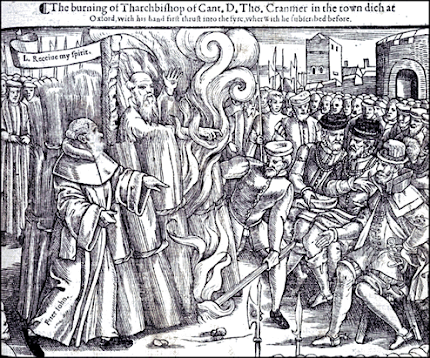
The burning of Tharchbishop of Cant. D. Tho. Cranmer in the town dich at Oxford, with his hand first thrust into the fyre, wherwith he subscribed before. [Click on the picture to see Cranmer's last words.]

Daily Bible Verse

Showing posts with label Tractarianism. Show all posts

Sunday, August 26, 2012

Reasonable Christian: An Open Letter to Bishop Royal Grote

Bishop Royal "Roy" Grote on the left.

This is a letter I wrote to one of the bishops in the Reformed Episcopal Church over the intended merger with the Anglican Province of America.  That merger never happened since the opportunity to merge with the Anglican Church in North America presented itself.  The point of the letter stands, however, since the ACNA is as Anglo-Papist as the APA is.  What is particularly disturbing about all this is that even Evangelical Anglicans refuse to call the Tractarians on their heresies.  Bishop J.C. Ryle would be rolling over in his grave.  Even the Sydney Anglicans and the Anglican Church League think the Gospel and justification by faith ALONE is somehow a matter of adiaphora since the Tractarians and Anglo-Catholics openly deny sola fide, sola gratia and the final authority of Scripture or sola Scriptura.  I have been challenging Dr. Mark Thompson and my former pastor, David Knox on these issues for some time.

I guess they don't get it that I'm quite willing to speak out publicly on these issues and raise a ruckus.  I've been called one who sows discord among the brethren by at least one Presbyterian.   But it would require that the discord is among brethren.  Anglo-Catholics and Arminians are not "brethren".  They are heretics who preach another gospel.

Click here to read the original letter: Reasonable Christian: An Open Letter to Bishop Royal Grote

Saturday, June 09, 2012

Does Arminianism Teach the Gospel?


Does Arminianism Teach the Gospel? An Assessment of Evangelical Ecumenicalism

Not too long ago Dr. Michael Horton initiated a teaching series called “Christless Christianity”, in which he made the vague assertion that many of the churches in Evangelicalism are actually pelagian rather than Christian. His critique of the church growth movement, Joel Osteen, and many of the television evangelists was well received by most of the Reformed Evangelicals and neo-Calvinists. But is Mike Horton and the White Horse Inn consistent in its accusation that Evangelicalism is infected with pelagianism? That is a matter that is questionable as this article will briefly examine.

First of all, it should be noted that pelagianism as defined by Horton is something along the lines of Charles Finney's theology which denies total depravity, the bondage of the will, and even a Wesleyan Arminian definition of depravity. But is this a sufficient definition of pelagianism? I think not. In fact, the semi-pelagian position is nothing more than pelagianism disguised in a more subtle form. The Wesleyan doctrine of prevenient grace in effect cancels out the doctrine of depravity and defaults back to pelagianism since the deciding factor is not God's irresistible grace but rather “libertarian free will”. In short, the Arminian rationalism defaults to a pelagian definition of “free will”. The famous hymn, “O For a Thousand Tongues”, written by Charles Wesley includes these lines:

He breaks the power of canceled sin,
He sets the prisoner free;
His blood can make the foulest clean,
His blood availed for me.

He speaks, and, listening to His voice,
New life the dead receive,
The mournful, broken hearts rejoice,
The humble poor believe.

Hear Him, ye deaf; His praise, ye dumb,
Your loosened tongues employ;
Ye blind, behold your Savior come,
And leap, ye lame, for joy.

Wesley is not referring to a Calvinist view of “canceled sin” as in a post conversion reversal of the bondage of the will that hinders or prevents the elect from becoming a Christian. No, for Wesley “canceled sin” refers to a general grace given to all mankind so that man is no longer in bondage to sin but only has a “bent toward sinning” that can easily be overcome by the will simply by believing the Gospel in one's own strength and obedience. For Wesley the deaf can make themselves hear and the dead can raise themselves from the grave. The lame can make themselves walk again and prisoners set themselves free by their own free will. But is this what the Bible teaches? 

To give a sampling of the Scriptures on this issue let's take a look at just a few verses in particular:


Can the Ethiopian change his skin or the leopard its spots? Then may you also do good who are accustomed to do evil. (Jeremiah 13:23 NKJ)
Why should you be stricken again? You will revolt more and more. The whole head is sick, And the whole heart faints. (Isaiah 1:5 NKJ)
For though you wash yourself with lye, and use much soap, Yet your iniquity is marked before Me," says the Lord GOD. (Jeremiah 2:22 NKJ)
Who can say, "I have made my heart clean, I am pure from my sin "? (Proverbs 20:9 NKJ)

In short, Wesleyan Arminianism and other forms of Arminianism are nothing more than pelagianism masquerading as biblical Christianity. The Wesleys understood that Arminianism and Calvinism were mutually exclusive gospels and this is precisely why they vociferously attacked Augustus Toplady and other consistent Calvinists in the Church of England during the Second Great Awakening. It is on this point that the Calvinist, George Whitefield, was inconsistent and allowed his friendship with the Wesleys to cloud his judgment and his thinking on this issue. The fact of the matter is that pelagianism and augustinianism are mutually exclusive theologies. This battle between the Gospel of sovereign grace and the gospel of libertarian free will goes all the way back to the fourth century.

What I am saying is that Mike Horton is inconsistent when he invites Arminians like William Willimon to his radio program, The White Horse Inn. Horton also has high praise for the Arminian heretic, Thomas Oden. The problem with Horton and other neo-Calvinists is that they use their Calvinism as a cloak for what is really nothing more than lip service to Calvinism. Horton and other neo-Calvinists are really advocates of irrationalism to the point that there really is no logical consistency in their theology and they have essentially sold out to postmodernism, neo-orthodoxy, and a theology of paradox. In such thinking there is no need for non-contradiction or propositional truth since all that matters is one's subjective experience of what God is doing. In other words, it is God's acts in history rather than God's very words in Holy Scripture that matters most. That is neo-orthodoxy in a nutshell.

It is truly ironic that Horton would advocate a movement toward theological orthodoxy and attack pelagianism in the Evangelical movement when he himself has openly endorsed pelagianism via his approval of Arminianism and even Anglo-Catholic denominations like the Anglican Church in North America. If Arminianism is a damnable heresy as the Canons of Dort clearly indicate, then how can Horton blatantly ignore the doctrinal standards of his own denomination, which standards are the Three Forms of Unity: Belgic Confession, Heidelberg Catechism, Canons of Dort?

Good question!

Sincerely in Christ,

Charlie J. Ray


Tuesday, May 29, 2012

Tuininga’s Kingdoms and the Reformed Tradition | The Calvinist International

Brad Littlejohn critiques the two kingdoms theology of Westminster West and East here. Littlejohn is a "Reformed" Anglican who is studying for his Ph.D.

On further examination, however, it would appear that Littlejohn is a closet Federal Visionist and pushes for a Reformed "catholicity".  He also pushes for a "mystical presence" in the Lord's supper, code for Tractarianism.  I wonder how "reformed" his theology really is? 

Click here to read his article: Tuininga’s Kingdoms and the Reformed Tradition | The Calvinist International

Saturday, March 10, 2012

VirtueOnline - News - Exclusives - The Future of Anglicanism - Michael Horton interviews David Virtue

The future of Anglicanism appears to be bleak judging by this interview with David Virtue. Virtue sings the praises of Anglo-Catholicism and the Anglican Church in North America and Mike Horton never once asks the question that Virtue is practically begging to be asked, "Is Anglo-Catholicism a true religion?" My answer, of course, is a solid no. Roman Catholic-lite is still a religion of salvation by works. Only when Horton interviews Bishop C. FitzSimmons Allison (retired Bishop of South Carolina) do we hear anything at all about justification by faith alone as a forensic declaration. Tractarians deny the doctrine of forensic justification as a "legal fiction".

Click here to hear the interview:  VirtueOnline - News - Exclusives - The Future of Anglicanism - Michael Horton interviews David Virtue

Sunday, February 05, 2012

Is Anglo-Catholicism a Via Media? Charles Pettit McIlvaine

Rev. Charles Pettit McIlvaine, Born Again Episcopalian.
[The following quote is from Oxford Divinity Compared with that of the Romish and Anglican Churches, with a Special View to the Illustration of the Doctrine of Justification by Faith, by Charles Pettit McIlvaine.  Click here to see the Google book:  Oxford Divinity Compared.]

"If any  man thirst let him come unto me and drink;" a mode of preaching Christ, that shall ever delight to proclaim to all people a full, perfect and ready salvation to the vilest sinner, whenever, in sickness or health, he turns unto God, truly repenting and believing in Jesus--a salvation which justifies perfectly, and immediately, on the act of a living faith, and which sanctifies perfectly, but progressively, as the necessary fruit of the same faith; a salvation so perfect and free, that, in the words of Hooker, "although in ourselves, we be altogether sinful and unrighteous, yet even that man that is impious in himself, full of iniquity, full of sin, him being found in Christ, through faith, and having his sins remitted through repentance, him God beholdeth with a gracious eye, putteth away his sin by not imputing it, taketh quite away the punishment due thereto by pardoning it, and accepteth him in Jesus Christ, as pefectly righteous as if he had fulfilled all that is commanded him in the Law."  --Charles Pettit McIlvaine.


Chapter II

STATEMENTS PREPARATORY TO THE RIGHT ESTIMATION OF THE OXFORD DOCTRINE OF JUSTIFICATION

Professions of Oxford Divines concerning the conformity of their doctrine with that of the Church of England--Their account of Ultra-Protestantism--Their identity of their system with that of Alexander Knox--The condemnation of the latter, as Romish and dangerous, by certain eminent divines, of diverse schools in the Church of England, before its development, at Oxford, had excited special interest.

Before proceeding any further, it is proper to state that the Divinity which we propose to examine, is loudly proclaimed by its advocates to be the middle path, the Via Media, of the Church of England, "distinct from the by-ways of Ultra-Protestantism on the one side, and neither verging towards, nor losing itself in, Romanism on the other."(1)  The formularies of the Church of England, and the writings of her standard Divines are often and confidently appealed to as exhibiting the precise doctrines of the system.  Now it is the simple question how far these pretensions are true, which we propose to institute.  But in order to estimate this Via Media aright, the first thing is to get a view of the opposing sides between which it proposes to pass.  Of the one side, viz. of Romanism, we are to speak particularly hereafter.  Of the other, ULTRA-PROTESTANTISM, a something which occurs with singular frequency in the works of these writers, what shall we say?  What is Ultra-Protestantism?  We have seen no definition.  But according to the use of Dr. Pusey, and others, the name seems to be applied to whatever is in religion, or relating to it, negatively, or positively, for, or against, only excepting Romanism or Oxfordism; embracing of cause and effect, doctrine and inference; from the case of those clergy of the Church of England, who are, "in the main, orthodox and sound, in spite of the natural tendency of their principles," through Lutheranism and Calvinism, and every grade of unromish dissent and heterodoxy, down to what is considered the result of the common tendency, an entire Rationalism, and Socinianism, ut nec pes, nec caput uni reddatur formae.  One would suppose that a coast so undefined would afford but little guidance in keeping the middle way, except when as mariners, under fear of hidden shoals and currents, on an unseen shore, keep as far away as possible.

Some specimens will help us judge how far the Via Media is really a middle way.

Dr. Pusey describes "a large portion" of the clergy of the Church of England as holding "Justification is not a gift of God through His sacraments, but the result of a certain frame of mind, of a going forth of themselves and resting themselves upon their Saviour; that this is the act whereby they think themselves to have been justified; and so as another would revert to his "baptism and engraffing into Christ, and thus his being in Christ, so do they this act whereby they were justified."  "They sever Justification from Baptism, and make it consist in the act of reliance upon the merits of Christ only; sin, according to them, is forgiven, at once, upon each renewal of this act: and in this they virtually substitute this act for Baptism; a man has no more to do with his past sins than he has with those remitted by baptism;" according to them "when men have been been once brought, in repentance to renounce their sins, and seek reconciliation through the free mercy of Christ--then their sins are done away, they are covered, they can appear no more; the handwriting is blotted out." This "apprehension of Christ's merits is to them a full remission of sins, completely effacing them."  "To revert to past sins is to doubt of Christ's mercy; to bear a painful recollection of it is to be under the bondage of the law; to seek to efface it by repentance is weakness of faith; to do acts of mercy or self-denial, or self-abasement, or to fast with reference to it, is to interfere with 'the freeness and the fulness of the Gospel:'  to insist upon them 'is place repentance in the stead of Christ.'" (2)

It is impossible not to see in this strange caricature, which really applies, in all respects, to no class of the clergy of England, that "the large portion" intended is that which is best known in this country by such names as Robinson, Scott, Venn, the two Milners, Simeon; of whose mode of exhibiting the way of salvation, the writings of such living divines as the present Bishop Wilson, of Calcutta, the two Bishops Sumner, the one of Winchester, the other of Chester, the Rev. G. S. Faber, &c. are fair examples.  True indeed the views of this most honourable and useful body of the English Clergy are very singularly overdrawn; one can hardly recognize them under the strained and warped features for which they are made to be accountable; but without doubt, the Ultra-Protestantism referred to in the above extracts, is intended to be understood as being displayed in the general mode which appears in that class of English divines, of representing "the nature and essence of the medicine whereby Christ cureth our disease, the manner of applying it, and the number and the power of the means."


Of such views, does Dr. Pusey write as follows:  "This abuse of the doctrine of justification by faith sears men's consciences now, as much as the indulgences of the Romish system did before.  It used to be said that 'the Romish was an easy religion to die in,' but even the Romish, in its corruptions, scarely offered terms so easy, at all events made not a boast of the easiness of its terms."  Then follows an evident preference of the Romish system, on the ground that if only "the stale dregs of the system of the ancient Church," it has the dregs--"something of the bitterness of the ancient medicine;" it still teaches men "to make sacrifices for the good of their souls; to accuse and condemn themselves, that so they might find mercy" through Christ--to be "punished in this world, that their souls might be saved in the Day of the Lord."  We are given distinctly to understand that "a large portion" of the English Clergy, is worse than even these stale dregs of the medicine of the ancient Church; because it stifles continually the strong emotions of terror and amazement which God has wrought upon the soul, and by an artificial wrought-up peace, checks the deep and searching agony, whereby God, as in a furnace, purifies the whole man, by the spirit of judgment and the Spirit of burning."  It is "a spurious system, misapplying the promises of the Gospel, usurping the privileges of baptism which it has not to confer, giving peace which it has not to bestow, and going counter to the whole tenor of Scripture, that every man shall be judged according to his works." (3)

The same singularly extravagant and most painful strain of condemnation is found everywhere in Mr. Newman's Lectures on Justification.  The following is a specimen.  He calls the righteousness of Christ imputed to us for Justification as held by the "large portion" of the English Clergy, above referred to, "an unreal righteousness and a real corruption," "bringing us in bondage to shadows"--"another gospel."  "Away then (he says) with this modern, this private, this arbitrary system, which promises liberty conspires against it; which abolishes sacraments; to introduce dead ordinances; and for the real participation of Christ, and justification through His Spirit, would at the very marriage  feast, feed us on shells and husks, who hunger and thirst after righteousness."(4)

It is not the purpose here to say a word, in argument, concerning all these wonderful and melancholy of morbid mind and spiritual discernment.  Whoever has paid any serious attention to the writings of the Clergy, thus professedly displayed, will need no help in estimating the justness of the condemnation.  But where there is no need of argument, there may be propriety in assertion; and sometimes there is a solemn duty in assertion, if only for the purpose of bearing our solemn testimony, whatever it may be worth, to some precious, but despised and reviled portion of the truth as it is in Jesus.  Such testimony, the present writer feels constrained to give, in this place,  after such an afflicting reprobation of what he most solemnly believes to be nothing else than "the glorious Gospel of the blessed God," our Saviour.  Denying entirely the justice of the draft of doctrine laid to the charge of the class of divines professedly described; but perceiving just enough of truth therein to mark distinctly who compose "the large portion" of Clergy whom our Oxford divines have thus represented as teaching for the way of salvation, "another gospel"--a spurious system--"an unreal righteousness and a real corruption,"--worse even than the system of indulgences in the Church of Rome; the author of these pages does earnestly hope that his name may be counted worthy to take part in their condemnation.  If the way here called another gospel, even that of Justification through the obedience and death of Christ, accounted unto us for righteousness, through the instrumental agency of a living faith, be not the only hope of the sinner, then he, for one, has no hope.  He has learned of no other "anchor of the soul sure and steadfast, which entereth to that within the veil."  He does hope that he may ever be identified with that divinity, that way of preaching Christ Jesus the Lord, which instead of a "reserve" in making known the precious doctrine of Atonement, instead of treating salvation by grace, through faith, as "a great secret," and keeping the secret out of the sight of the ungodly for fear of "an indelicate exposure of the sacred mystery," as these writers urge,(5) shall lift up the voice to the perishing and penitent, like the Master and Lord, when to the great multitudes, on the last day of the feast, He cried, "If any  man thirst let him come unto me and drink;" a mode of preaching Christ, that shall ever delight to proclaim to all people a full, perfect and ready salvation to the vilest sinner, whenever, in sickness or health, he turns unto God, truly repenting and believing in Jesus--a salvation which justifies perfectly, and immediately, on the act of a living faith, and which sanctifies perfectly, but progressively, as the necessary fruit of the same faith; a salvation so perfect and free, that, in the words of Hooker, "although in ourselves, we be altogether sinful and unrighteous, yet even that man that is impious in himself, full of iniquity, full of sin, him being found in Christ, through faith, and having his sins remitted through repentance, him God beholdeth with a gracious eye, putteth away his sin by not imputing it, taketh quite away the punishment due thereto by pardoning it, and accepteth him in Jesus Christ, as pefectly righteous as if he had fulfilled all that is commanded him in the Law.  Let it counted folly, or frenzy, or fury, whatsoever; it is our comfort and our wisdom." (6)  So testifies our admirable Hooker--most suredly an Ultra-Protestant, in the matter of Justification,  as branded, as others, with the hot denunication of these Oxford divines.

Click here to see Chapter II of Charles Pettit McIlvaine's book, Oxford Divinity Compared with that of the Romish and Anglican Churches....

[Addendum:  It would appear that the Lordship Salvation view as well as the view of the neo-legalists would be more in line with the Tractarians than with Canterbury or Geneva or Wittenberg on the issue of justification by faith alone.  The neo-legalists would appear to agree with the Tractarians that some sort of good works must be added to faith.  The Reformed view is that justifying faith is a living faith..   Charlie].


Footnotes:

1.  Pusey's Letter, page 14.
2.  Ibid., pp. 74, 8, 54, 5.
3.  Ibid., pp. 56-59.
4.  Lectures on Justification, p. 61.  Extremes meet.  Socinus calls the same doctrine, faeda, execranda, pernitiosa, detestanda.
5.  See No. 80, Tracts for the Times.
6.  Discourse of Justification, Paragraph 6.


--
Reasonable Christian Blog Glory be to the Father, and to the Son : and to the Holy Ghost; Answer. As it was in the beginning, is now, and ever shall be : world without end. Amen. 1662 Book of Common Prayer

Sunday, November 22, 2009

The Charade Continues


The Anglican Church in North America is papist to its core and outright denies the five solas of the Protestant and English Reformation. Yet equivocators like David Virtue would have us believe that he agrees with the statement made by the Church Society that

A proper rejection of theological liberalism should therefore not be accompanied by a turning to the Church of Rome and its unbiblical teachings and practices. Rather, both theological liberalism and the unscriptural teachings and practices of the Church of Rome are contrary to the Bible and to the historic doctrines of the Church of England as a Protestant, Reformed, Evangelical and catholic church.

We grieve that the Church of England, along with our nation, has fallen so low in its spiritual and moral condition. We pray that God would pour out His Spirit on both church and nation, leaders concluded. [From: Church Society Response to Rome].

The truth of the matter is that the Anglican Church in North America is dominated by Tractarians and Anglo-Catholics who have no interest in the ultimate authority of Holy Scripture as the final and only rule of faith in matters of doctrine and morality. It is a fact that when reason trumps Scripture as the final revelation and this is then combined with the idea that bishops and the church are equal in authority to Scripture what happens is not only revisionism of doctrine but of morality. Liberal Anglo-Catholicism is simply the end of the slippery slope. So-called "orthodox" Anglo-Catholicism is merely the precursor to liberalism since the hermeneutics of Tractarianism is in essence revisionist and post modern. In other words, the views of the presiding bishops become the doctrine of the church rather than Scripture being the final authority.

One should not overlook the fact that many of the ministers in the Anglican Church in North America retain a form of theological liberalism which is every bit as liberal as that of The Episcopal Church except they reject homosexual behavior. However, many of them still recommend the ordination of women which erodes the biblical standards and the order of creation, which in turn leads to the idea that homosexuality is normal rather than a perversion of nature and creation. It is simply a matter of time before the ACNA returns like a dog to its own vomit. (Proverbs 26:11; 2 Peter 2:22).

The fact that David Virtue himself endorses transexuals as long as they are celibate is just an open admission that Virtue does not understand biblical authority or God's purposes in creation. (See David Virtue Goes Transexual). God creates men and women as they are and any idea that the mind does not match the body is simply a perversion of God's creation and a rebellion against the divine image and likeness. (Genesis 1:26-27; 3:7, 22-23).

It is popular to distinguish between fundamentalism and evangelicalism. I would not consider myself either since the ultra fundamentalists are essentially pelagian and arminian. Fundamentalists tend to ignore higher theological education and to be anti-intellectual. On the other hand, evangelicalism is a meaningless term these days since everybody and their brother claims to be one--including Anglo-Catholics, left wing "neo-" evangelicals, and even Roman Catholics. I would prefer to identify myself as a conservative neo-fundamentalist Protestant who happens to be Reformed and Calvinist by God's set plan and foreknowledge.

Evangelicalism these days is increasingly influenced by the ecumenical movement and many so-called "evangelicals" are willing to sacrifice doctrinal truth and propositional truth for the sake of the amalgamation of denominations. This is nothing new since the Roman Catholic Church invented the idea of the use of secular force and military means to convert entire populations to the Roman Catholic faith. The term "christendom" or the "church militant" is a reference to this idea that entire nations and populations should be coerced into an external conformance to secular powers wielded at the hands of the church. The idea that the pope is the vicar of Christ on earth developed into the thesis that God operates through earthly rulers to further the kingdom of God on earth.

It is this same sort of thinking which predominates in the theology of theonomy and reconstruction within evangelical circles and it is also why you see reconstructionists who are willing to compromise the principles of the English and Protestant Reformations in order to bring about a moral change in society at large. Rather than focusing on the true conversion of individuals to a personal faith in Jesus Christ and on the propositional truths revealed in Holy Scripture, the focus becomes an emphasis on creating a universal or catholic organization with minimalist doctrinal requirements. (John 14:36). Unfortunately, this downplaying of doctrine in documents like the Lambeth Quadrilateral has the effect of creating a relativistic and liberalistic religion with little similitude to true Christianity as it is revealed in Holy Scripture.

Our concern ought not to be the creation of denominations or even of one denomination but rather on being faithful to what the Bible as a whole teaches. Even suggestions along the lines of Dr. Michael Horton's many rooms is inherently relativistic since in the main room he only advocates inerrancy of Scripture and the doctrine of the trinity. Unfortunately, Horton has unwittingly endorsed C.S. Lewis' theory of relativism where all the side rooms are equally valid, which they are not. Some of the side rooms are teaching false doctrine.

Horton's protest against doctrinal minimalism is solved by appealing to doctrinal minimalism again! (See the Village Green). Some evangelicals, James I. Packer, have tried to solve the problem by distinguishing between secondary and tertiary levels of doctrinal importance. But Packer only makes matters worse since he seems to think the Protestant Reformation is over and even goes so far as to sign the Evangelicals and Catholics Together document. In one recent lecture series he suggested that the "Anglican quadrilateral" is a good thing. By this he seems to be referring to the Lambeth Quadrilateral. Packer's solution is no solution either since he implies that the 39 Articles can be legitimately interpreted in two contradictory ways which are diametrically opposed to one another. The Packer of earlier years would not have endorsed such relativism but the Packer of today is more interested in ecumenical amalgamation than in the propositional truths of Holy Scripture and the Gospel.

There is indeed a tension between separation and unity. (Matthew 10:34-39; Luke 12:51-53, 14:25-33). The tensions between fundamentalism and the broad tent of evangelicalism are not solved by appealing to C.S. Lewis' Anglo-Catholic theology of relativism as Dr. Michael Horton has done. Nor is it solved by appealing to the Anglo-Catholic theology of the Lambeth Quadrilateral as Packer has done. Rather, it seems to me, that the way forward is an uncompromising return to the neo-fundamentalism of J. Gresham Machen and any cooperation or fellowship we have must be on the basis of detailed doctrinal discussions and not on theological minimalism.

Such minimalism leads inevitably back to theological liberalism and relativism which true Christians should rightly eschew. True Christianity is focused on the right preaching of the Gospel and Holy Scripture as a whole, not on minimalist ideas of cooperation and amalgamation. Reminds me of a cartoon where the issue of homosexuality caused a church to focus on the one and only verse they could legitimately still endorse in the Scriptures: "Jesus wept." (John 11:35).

Reformed Anglicans need not cooperate with Anglo-Catholics or even other Evangelicals in any formal organizational way. Instead the total focus of reforming Anglicanism must be upon the right preaching of the Gospel and the right administration of the word and sacraments. The focus of Scripture is upon the conversion of lost sinners to understand the Bible and come to a right relationship with Jesus Christ and God the Father through the power of the Holy Spirit. It is increasingly obvious that ecumenicalism is an anti-Christian movement meant to undermine our commitment to the truth. (Matthew 7:13) Rather than caring who our friends in the world are we ought to be more concerned with what God thinks and what God says in total in the Holy Scriptures. (Matthew 4:4).

Article XIX

Of the Church

The visible Church of Christ is a congregation of faithful men, in the which the pure word of God is preached and the sacraments be duly ministered according to Christ's ordinance in all those things that of necessity are requisite to the same. As the Church of Jerusalem, Alexandria, and Antioch have erred: so also the Church of Rome hath erred, not only in their living and manner of ceremonies, but also in matters of faith.

1662 Book of Common Prayer


The Collect.
O LORD, we beseech thee, absolve thy people from their offences; that through thy bountiful goodness we may all be delivered from the bands of those sins, which by our frailty we have committed: Grant this, O heavenly Father, for Jesus Christ's sake, our blessed Lord and Saviour. Amen.

Support Reasonable Christian Ministries with your generous donation.