>

Martyred for the Gospel

Martyred for the Gospel
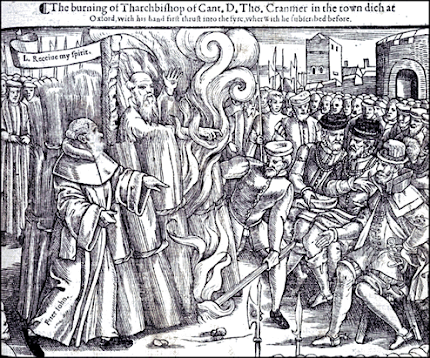
The burning of Tharchbishop of Cant. D. Tho. Cranmer in the town dich at Oxford, with his hand first thrust into the fyre, wherwith he subscribed before. [Click on the picture to see Cranmer's last words.]

Daily Bible Verse

Showing posts with label 1662 Book of Common Prayer. Show all posts

Friday, April 11, 2025

Collect from the 1662 Book of Common Prayer


The following collect is from the 1662 Book of Common Prayer and the second Sunday in advent.  Although this is not the proper time of the year for the collect, it is one of my favorites.  


Blessed Lord, who caused all holy Scriptures to be written for our learning: Grant us so to hear them, read, mark, learn, and inwardly digest them, that we may embrace and ever hold fast the blessed hope of everlasting life, which you have given us in our Savior Jesus Christ; who lives and reigns with you and the Holy Spirit, one God, for ever and ever. Amen.


Saturday, March 01, 2014

Sanctification: A Lifelong Process

These preachers often talk quite a lot about the Holy Spirit; but they deny to the Spirit the power to give a man eternal life. By eternal I mean eternal; not a life that ends in the near future. Thus they do not have assurance; nor do they preach the Gospel, for the Gospel promises at least the possibility of assurance. It promises, not the mere possibility of eternal life; it promises eternal life.   Dr. Gordon H. Clark


CHAPTER XIII—Of Sanctification
1.  They, who are once effectually called, and regenerated, having a new heart, and a new spirit created in them, are further sanctified, really and personally, through the virtue of Christ’s death and resurrection, (1 Cor. 6:11, Acts 20:32, Phil. 3:10, Rom. 6:5–6) by His Word and Spirit dwelling in them, (John 17:17, Eph. 5:26, 2 Thess. 2:13) the dominion of the whole body of sin is destroyed, (Rom. 6:6,14) and the several lusts thereof are more and more weakened and mortified; (Gal. 5:24, Rom. 8:13) and they more and more quickened and strengthened in all saving graces, (Col. 1:11, Eph. 3:16–19) to the practice of true holiness, without which no man shall see the Lord. (2 Cor. 7:1, Heb. 12:14)


The Westminster Confession of Faith (Oak Harbor, WA: Logos Research Systems, Inc., 1996).

There seems to be some confusion on the part of certain Baptistic "Calvinists" online.  Several of them are advocating the view that sanctification is not a process and that there needs to be no significant change of habit or lifestyle for a person to have a valid profession of faith.   They are advocating what can be identified as the "once saved always saved" view of salvation rather than the more reformed view of sanctification as it is outlined in the Westminster Confessional Standards and other reformed confessional statements, including the Anglican Formularies (Thirty-nine Articles of Religion, 1662 Book of Common, and the Ordinal).   (See:  Westminster Confession of Faith, and the Three Forms of Unity).

This is not the Reformed view, however.  While it is true that justification is by faith alone, it is not true that salvation is by faith alone.  My views on this have been significantly modified because of my reading of Dr. Gordon H. Clark's works recently.  Dr. Clark upheld the Westminster Confession of Faith as the most complete and thorough definition of Christianity.  Further, Dr. Clark did not believe that Christianity is a "religion."  Basically, salvation includes the entire ordo salutis.  Therefore, salvation is not by faith alone.  Salvation would also include repentance and sanctification.  Justification is the bedrock upon which the other temporal out-workings of God's eternal decrees are based. 

Those who take the time to study the Westminster Standards and read all the Scripture proof texts will benefit greatly in their Christian walk.  Salvation is not something to be taken for granted.  Even our perseverance is a struggle, according to Dr. Clark.  However, the Christian need not worry that God will not preserve him or her in their Christian faith and walk:
This is an assurance that many popular evangelists do not have themselves and cannot promise to their hearers. Yes, they insist on assurance, but it is not the assurance that the Bible teaches. These evangelists, the ones I have in mind, are Arminians. They do not believe in the perseverance of the saints, or, as they call it, eternal security. They claim to be very sure that they are saved now; but they are not sure that they will be saved tomorrow or next week. If they die tonight, they will be in Heaven immediately. But if they should live a while longer, they might fall into sin, fall from grace, and then they would be eternally lost. But they are very sure just now. Their mentality is hard to understand. How can anyone be very happy if he thinks he has an eternal life that is so little eternal that it might end next week? How can such a person look to the future with equanimity and confidence if he is so unsure of Heaven? Such an evangelist might as well be a Romanist. They talk about being born again, about regeneration; but the kind of regeneration they preach is something that a man must experience as many times as he falls from grace. To be really saved, i.e., to get to Heaven, one must be born again over and over again. Their hope therefore is one that can easily disappoint. These preachers often talk quite a lot about the Holy Spirit; but they deny to the Spirit the power to give a man eternal life. By eternal I mean eternal; not a life that ends in the near future. Thus they do not have assurance; nor do they preach the Gospel, for the Gospel promises at least the possibility of assurance. It promises, not the mere possibility of eternal life; it promises eternal life.

Gordon H. Clark (2013-03-04T05:00:00+00:00). What Is The Christian Life? (Kindle Locations 3353-3364). The Trinity Foundation. Kindle Edition.

The short answer is that assurance of salvation proceeds from obedience that is founded upon the promises of God in Scripture, including justification by faith alone.  And you will notice that Dr. Gordon H. Clark indirectly implies that Arminians do not preach the Gospel.  Would that more Reformed ministers and scholars would say these things more straightforwardly.

Sanctification is not the basis for saving faith.  But is a necessary result of regeneration.  Those who have no change of habits cannot have assurance of salvation (Hebrews 12:14).  On the other hand, those who endeavor to walk by faith and to obey the information revealed in God's written Word can be most certain that God will never let them fall away.

Question 69

What is the communion in grace which the members of the invisible church have with Christ?

The communion in grace which the members of the invisible church have with Christ, is their partaking of the virtue of his mediation, in their justification, (Rom. 8:30) adoption, (Eph. 1:5) sanctification, and whatever else, in this life, manifests their union with him. (1 Cor. 1:30)

Question 77

Wherein do justification and sanctification differ?

Although sanctification be inseparably joined with justification, (1 Cor. 6:11, 1 Cor. 1:30) yet they differ, in that God in justification imputeth the righteousness of Christ; (Rom. 4:6 ,8) in sanctification of his Spirit infuseth grace, and enableth to the exercise thereof; (Ezek. 36:27) in the former, sin is pardoned; (Rom. 3:24–25) in the other, it is subdued: (Rom. 6:6,14) the one doth equally free all believers from the revenging wrath of God, and that perfectly in this life, that they never fall into condemnation (Rom. 8:33–34) the other is neither equal in all, (1 John 2:12–14, Heb. 5:12–14) nor in this life perfect in any, (1 John 1:8,10) but growing up to perfection. (2 Cor. 7:1, Phil. 3:12–14)


The Westminster Larger Catechism: With Scripture Proofs. (Oak Harbor, WA: Logos Research Systems, Inc., 1996).


Tuesday, August 06, 2013

Last Sunday's Sermon at Christ Church, Longwood, Florida


Last Sunday's sermon at Christ Church, Longwood, Florida was certainly a turnabout.  The visiting “priest” was the Rev. J. H. Booker, Jr.  Unfortunately, his answer to the previous rector’s emphasis on the moral law of God was to preach an antinomian sermon on Christian liberty.  Unfortunately, the definition given by Booker for Christian liberty was that the moral law is legalism and that there is no “list” of right and wrong in the Bible.  This was simply amazing, especially since one of the texts read in the service was from Colossians 3:1-11.  


I took it that the minister meant that the ten commandments or the Decalogue no longer applies today.  Of course, the Thirty-nine Articles of religion stringently disagrees with that assessment, as does the 1662 Book of Common Prayer.  Article 7 of the 39 Articles of Religion plainly says that Christian men and women are still obligated to obey the moral law:


THE Old Testament is not contrary to the New; for both in the Old and New Testament everlasting life is offered to mankind by Christ, who is the only Mediator between God and man, being both God and man. Wherefore there are not to be heard which feign that the old fathers did look only for transitory promises. Although the law given from God by Moses, as touching ceremonies and rites, do not bind Christian men, nor the civil precepts thereof ought of necessity to be received in any commonwealth; yet, notwithstanding, no Christian man whatsoever is free from the obedience of the commandments which are called moral.


The 1662 Book of Common Prayer includes the  reading of the Decalogue in every communion service or the Lord’s Supper:  

Then shall the Priest, turning to the people, rehearse distinctly all the TEN COMMANDMENTS; and the people still kneeling shall, after every Commandment, ask God mercy for their transgression thereof for the time past, and grace to keep the same for the time to come, as followeth.
Minister.
GOD spake these words, and said; I am the Lord thy God: Thou shalt have none other gods but me.
    People. Lord, have mercy upon us, and incline our hearts to keep this law.
    Minister. Thou shalt not make to thyself any graven image, nor the likeness of any thing that is in heaven above, or in the earth beneath, or in the water under the earth. Thou shalt not bow down to them, nor worship them: for I the Lord thy God am a jealous God, and visit the sins of the fathers upon the children unto the third and fourth generation of them that hate me, and shew mercy unto thousands in them that love me, and keep my commandments.
    People. Lord, have mercy upon us, and incline our hearts to keep this law.
    Minister. Thou shalt not take the Name of the Lord thy God in vain: for the Lord will not hold him guiltless, that taketh his Name in vain.
    People. Lord, have mercy upon us, and incline our hearts to keep this law.
    Minister. Remember that thou keep holy the Sabbath-day. Six days shalt thou labour, and do all that thou hast to do; but the seventh day is the Sabbath of the Lord thy God. In it thou shalt do no manner of work, thou, and thy son, and thy daughter, thy man-servant, and thy maid-servant, thy cattle, and the stranger that is within thy gates. For in six days the Lord made heaven and earth, the sea, and ail that in them is, and rested the seventh day: wherefore the Lord blessed the seventh day, and hallowed it.
    People. Lord, have mercy upon us, and incline our hearts to keep this law.
    Minister. Honour thy father and thy mother; that thy days may be long in the land which the Lord thy God giveth thee.
    People. Lord, have mercy upon us, and incline our hearts to keep this law.
    Minister. Thou shalt do no murder.
    People. Lord, have mercy upon us, and incline our hearts to keep this law.
    Minister. Thou shalt not commit adultery.
    People. Lord, have mercy upon us, and incline our hearts to keep this law.
    Minister. Thou shalt not steal.
    People. Lord, have mercy upon us, and incline our hearts to keep this law.
    Minister. Thou shalt not bear false witness against thy neighbour.
    People. Lord, have mercy upon us, and incline our hearts to keep this law.
    Minister. Thou shalt not covet thy neighbour's house, thou shalt not covet thy neighbour's wife, nor his servant, nor his maid, nor his ox, nor his ass, nor any thing that is his.
    People. Lord, have mercy upon us, and write all these thy laws in our hearts, we beseech thee.  (Exodus 20:1-17).


Even worse, the minster in question did not seem to know the law and gospel distinction that is at the heart of the Protestant Reformation, which distinction was affirmed by both Lutherans and Calvinists alike.  He instead asserted that Christian liberty is completely divorced from the law.  He openly stated that following the clearly stated moral laws revealed in Scripture is “easier” than having to figure out complex ethical situations on a case by case basis.  In other words, any idea of revealed moral law in the inspired and infallible Scriptures is to be rejected.  Can you say "relativism"?


Furthermore, the minister said that the reason for the prohibition on adultery in the Old Testament was because women were viewed as property.  This is nothing more than a liberal redefinition of adultery so as to permit extramarital sexual encounters in the name of “Christian liberty.”  The primary reason for the prohibition of adultery, according to Jesus, was that it violated the purpose of God in creation:


The Pharisees also came to Him, testing Him, and saying to Him, "Is it lawful for a man to divorce his wife for just any reason?" 4 And He answered and said to them, "Have you not read that He who made them at the beginning`made them male and female,' 5 "and said,`For this reason a man shall leave his father and mother and be joined to his wife, and the two shall become one flesh '? 6 "So then, they are no longer two but one flesh. Therefore what God has joined together, let not man separate." 7 They said to Him, "Why then did Moses command to give a certificate of divorce, and to put her away?" 8 He said to them, "Moses, because of the hardness of your hearts, permitted you to divorce your wives, but from the beginning it was not so. 9 "And I say to you, whoever divorces his wife, except for sexual immorality, and marries another, commits adultery; and whoever marries her who is divorced commits adultery." 10 His disciples said to Him, "If such is the case of the man with his wife, it is better not to marry." (Matthew 19:3-10 NKJ)


Mark 10:11-12 shows clearly that if a woman leaves her husband and marries another, an indication that women in the time of Jesus had the right to divorce, then she likewise commits adultery.  The reason for this is that women are not property.  In fact, in the creation Adam and Eve were equal.  God’s purpose in the creation was for one man and one woman to be wed in holy matrimony for life.  Any sex outside of marriage is fornication and adultery.  Amazingly, this liberal minister, Mr. Booker, also redefined fornication from Colossians 3:5 where the Greek word is porneia.  Booker said that this term is restricted to temple prostitution among the Greeks and Romans.  He also conceded that temple prostitution in the Old Testament could be in mind as well.  Unfortunately, anyone who can read Strong’s Exhaustive Concordance can see that fornication is an umbrella term that refers not only to pagan prostitution, idolatry, etc., but the term refers to all illicit sexual activity outside of holy matrimony.  That would include incest (1 Corinthians 5:1), bestiality, premarital sex, et. al.  Therefore, it does not follow that Moses had a different understanding of adultery from what we have today.  Marital unfaithfulness is not being true to the marital covenant or to God’s moral law for marriage revealed in creation.  Fornication, likewise, is any illicit sexual behavior outside of God’s purpose in creation.  (Genesis 2:20-25).


The argument I had in the fellowship hall after the service was over was revealing.  The minister made it clear that “he” thought gay marriage was wrong.  “He” has problems with it.  But he never once said that Scripture forbids it or that God forbids it.  In other words, it’s all relative.  He also said that certain fishermen in a certain part of the world where he had lived “tried out” their  future wives to see if they could bear children before they committed to marriage.  In other words, Mr. Booker approves of sex before marriage.  I thought he most likely approves of sex between homosexuals provided they are not allowed to marry.  He was a devious one and as slippery as an eel to say the least.  In his sermon he never once mentioned the moral law of God or the pedagogical use of God’s law.  He basically said the Decalogue is irrelevant and it is up to you to decide what is best for you.  His definition of Christian “liberty” is therefore lawlessness and antinomianism.  


My problem with my Evangelical friend, David Knox, who lost his job because of the liberals in the congregation, is that he rejects the Westminster Confession of Faith and the Westminster Standards as a whole because of his Armyraldianism.  For him, nailing down biblical propositions into systematic statements or creeds is to impose things that he thinks ought to be left to Christian “liberty” as well.  This is also an indicator for neo-orthodoxy, although I am not sure if he knows that is what he is espousing:

Barth asserts that the concepts of theology cannot be systematically connected, a systematic conspectus is an impossibility, and the name of Jesus Christ as used by Paul does not represent a unified thought.  Barth's point is not merely that the Bible is inconsistent.  He indeed holds that it is; he accepts only its main teaching and rejects the doctrine of infallible inspiration.  But here he is talking about theology, his own theology; and  it is his own theology that he now says is illogical, unsystematic, and self-contradictory.  The wording just quoted does not so much refer to the Biblical writers themselves as it refers to what the theologian can do with them.  Not only Paul lacks a unified thought when he uses the name Jesus Christ; this is true of Barth also.  In the name Jesus Christ "Cross and Resurrection are one, but not," Barth significantly adds, "--either for Paul, or for his first readers, or for us either--in what is stated in explanation over and above this name."  In these words, "for his first readers, or for us either," Barth denies that theology can be systematic, logical, and consistent. 

Gordon H. Clark, Karl Barth's Theological Method, 1963, 2nd Edition, (Unicoi: Trinity Foundation, 1997), pp. 63-64.

David, to his credit, does uphold the law of God as the standard for Christian living.  Unfortunately, although he does believe in justification by faith alone, he often blurred the law and gospel distinction.  My other beef with him is that he thinks “conservative” and “orthodox” Anglo-Catholics, namely those who uphold traditional views of Christian morality, are “Christians.”  I would vehemently disagree for the simple reason that Anglo-Catholics are, for all practical purposes, Roman Catholics.  The Anglo-Catholic position allows for faith plus obedience as the means of justification, which is to confuse justification by faith alone as a legal declaration with the imperfect sanctification that is our progressive process in holiness from the time of regeneration to the hour of our death.  Sanctification without justification can only merit hell for so-called Christians.  The only basis for saving faith is our justification based solely on the active and passive obedience of Christ.  He kept all the law of God perfectly for elect believers by keeping God’s moral law perfectly for them vicariously by His active obedience.  He paid the eternal penalty for the sins of His elect by dying on the cross to bear the wrath of God against them in their place as well.


Due to time constraints I am not providing all the proof texts for this.  But needless to say when law becomes the gospel—even in regards to my Evangelical friend—what happens is people feel beaten up with no relief.  A truly reformed sermon includes both law and gospel.  The gospel is what God promises to do for us because we are helpless to do those things for ourselves!  The law can only reveal us to be lowly sinners who deserve God’s eternal wrath and punishment.  (Romans 3:20; 3:20-23; 7:7).  Of course, even a liberal would not accept the three uses of God’s moral law, namely the 1) pedagogical use, 2) the civil use, and 3) the Christian duty to live by faith according to God’s moral precepts.  The pedagogical use shows us that law keeping or obedience is never enough to save us or merit salvation.  That’s why salvation must be founded on justification by faith alone.  Without justification by faith alone there is no foundation for sanctification or salvation whatsoever.  The just shall live by faith, not by the deeds of the law.  (Romans 1:16-17).  We are free from the law in that sense, that is as a means of earning or meriting or living up to an impossible standard.  But we are not free from the law as if we have a license to sin!  That is called antinomianism.  (1 John 3:4-9; Romans 6:1-2).


Mr. Booker is a false teacher who redefines biblical terms to justify his relativism and lawlessness.  (Acts 20:27-31; Jude 1:3-5).  He would approve of fornication and adultery by redefining the terms so that what the terms meant in biblical times is not applicable to the Christian today.  So long as no one is hurt it is ok to engage in gay sex, premarital sex, and even extramarital affairs!  The opposite error of my Evangelical friend is to confuse law with gospel such that the gospel is simply the law rehearsed.  It reminds me of Ronald and Nancy Reagan’s anti-drug abuse campaign:  “Just say no!”  If sinners are not slaves to sin, that would make perfect sense.  But Pelagianism has never worked.  The only sinless man who ever kept God’s law from birth to the grave without ever breaking it once was our Lord Jesus Christ.  (1 Peter 2:22-25).  Christ did not come to give the elect a license to sin all they want.  He came to set His elect people free from their slavery to sin.  (John 8:32-36).  Augustine, the bishop of Hippo in the fourth century, caused a huge controversy when he prayed, “Lord, command what you will, and grant us the grace to do what you command.”  I am paraphrasing a bit.  But the point is Pelagius—like the Arminians, semi-pelagians, papists, and liberals of today—got upset because he thought it would be unfair of God to command something men and women are unable to do:  obey.  What Pelagius forgot was that when Adam fell from grace and rebelled against God He brought a curse on all mankind.  That curse includes both the guilt of Adam’s original sin imputed to them and the traducian view that sin is passed on from one generation to the next by natural generation.  That is, sin is inborn.  (Psalm 51:4-5; Psalm 58:3; Ephesians 4:18).  God does not answer to man but man must answer to God, and, as the late Dr. Gordon  H. Clark said, nothing God does is wrong.  That would include when God strikes men with hardness of heart and reprobation (Romans 1:24; Romans 9:11-13; 1 Thessalonians 2:11-12).


My Evangelical friend, David Knox, on the other hand, needs to learn systematic theology and the law/gospel distinction.  Anyone who thinks Rome or Tractarianism offers any hope whatsoever to the reprobate has been deceived by the enemy.  One reason I keep upholding the 39 Articles of Religion and the 1662 Book of Common Prayer is that the Anglican Formularies do teach these essential doctrines.  For example, Article 7 clearly upholds the law/gospel distinction without advocating antinomianism:

Article VII

Of the Old Testament

The Old Testament is not contrary to the New; for both in the Old and New Testament everlasting life is offered to mankind by Christ, who is the only Mediator between God and man, being both God and man. Wherefore they are not to be heard which feign that the old fathers did look only for transitory promises. Although the law given from God by Moses, as touching ceremonies and rites, do not bind Christian men, nor the civil precepts thereof ought of necessity to be received in any commonwealth; yet, notwithstanding, no Christian man whatsoever is free from the obedience of the commandments which are called moral.

The prayer of humble access and other portions of the Lord’s Supper advocate that God does not “weigh” our “merits” but instead pardons “our offenses.”  “We are not worthy so much as to gather up the crumbs under thy table.”  (Matthew 15:27; Mark 7:28; Luke 16:20-22).  These portions of the service clearly indicate that Archbishop Thomas Cranmer wanted to teach the doctrine of justification by faith alone through the liturgy.  But he likewise rejected antinomianism since he also included exhortations to live by faith and obedience:

Then shall the Priest say to them that come to receive the holy Communion, 

YE that do truly and earnestly repent you of your sins, and are in love and charity with your neighbours, and intend to lead a new life, following the commandments of God, and walking from henceforth in his holy ways; Draw near with faith, and take this holy Sacrament to your comfort; and make your humble confession to Almighty God, meekly kneeling upon your knees.  (The Lord’s Supper).

I can only pray for the remnant of naïve believers left at Christ Church Longwood.  May God grant them the discernment to see the lies of the enemy. May God preserve their souls and cause them to persevere to the end.

Amen.

Charlie


Tuesday, June 04, 2013

Question 17: Short Catechism for Young Churchmen: What are good works?


Q. (17) What are good works?

A. "Good works are the fruits of faith, and follow after justification. They spring out necessarily of a true and lively faith, so that by them a lively (i.e. living) faith may be as evidently known as a tree discerned by its fruit."-(Art. XII; Phil. 1:11; John 15:4, 5; Gal. 5:6.)


Sunday, May 26, 2013

Trinity Sunday: The Athanasian Creed


At Morning Prayer.


Upon these Feasts; Christmas Day, the Epiphany, Saint Matthias, Easter Day, Ascension Day, Whitsunday, Saint John Baptist, Saint James, Saint Bartholomew, Saint Matthew, Saint Simon and Saint Jude, Saint Andrew, and upon Trinity Sunday, shall be sung or said at Morning Prayer, instead of the Apostles' Creed, this Confession of our Christian Faith, commonly called the Creed of Athanasius, by the Minister and people standing.
Quicunque vult.
WHOSOEVER will be saved : before all things it is necessary that he hold the Catholick Faith.
   Which Faith except every one do keep whole and undefiled : without doubt he shall perish everlastingly.
   And the Catholick Faith is this: That we worship one God in Trinity, and Trinity in Unity;
   Neither confounding the Persons : nor dividing the Substance.
   For there is one Person of the Father, another of the Son : and another of the Holy Ghost.
   But the Godhead of the Father, of the Son, and of the Holy Ghost, is all one : the Glory equal, the Majesty co-eternal.
   Such as the Father is, such is the Son : and such is the Holy Ghost.
   The Father uncreate, the Son uncreate : and the Holy Ghost uncreate.
   The Father incomprehensible, the Son incomprehensible : and the Holy Ghost incomprehensible.
   The Father eternal, the Son eternal : and the Holy Ghost eternal.
   And yet they are not three eternals : but one eternal.
   As also there are not three incomprehensibles, nor three uncreated : but one uncreated, and one incomprehensible.
   So likewise the Father is Almighty, the Son Almighty : and the Holy Ghost Almighty.
   And yet they are not three Almighties : but one Almighty.
   So the Father is God, the Son is God : and the Holy Ghost is God.
   And yet they are not three Gods : but one God.
   So likewise the Father is Lord, the Son Lord : and the Holy Ghost Lord.
   And yet not three Lords : but one Lord.
   For like as we are compelled by the Christian verity to acknowledge every Person by himself to be both God and Lord;
   So are we forbidden by the Catholick Religion : to say, There be three Gods, or three Lords.
   The Father is made of none : neither created, nor begotten.
   The Son is of the Father alone : not made, nor created, but begotten.
   The Holy Ghost is of the Father and of the Son : neither made, nor created, nor begotten, but proceeding.
   So there is one Father, not three Fathers; one Son, not three Sons : one Holy Ghost, not three Holy Ghosts.
   And in this Trinity none is afore, or after other : none is greater, or less than another;
   But the whole three Persons are co-eternal together : and co-equal.
   So that in all things, as is aforesaid : the Unity in Trinity and the Trinity in Unity is to be worshipped.
   He therefore that will be saved : must think thus of the Trinity.
   Furthermore, it is necessary to everlasting salvation : that he also believe rightly the Incarnation of our Lord Jesus Christ.
   For the right Faith is, that we believe and confess : that our Lord Jesus Christ, the Son of God, is God and Man;
   God, of the substance of the Father, begotten before the worlds : and Man of the substance of his Mother, born in the world;
   Perfect God and perfect Man : of a reasonable soul and human flesh subsisting.
   Equal to the Father, as touching his Godhead : and inferior to the Father, as touching his manhood;
   Who, although he be God and Man : yet he is not two, but one Christ;
   One, not by conversion of the Godhead into flesh : but by taking of the Manhood into God;
   One altogether; not by confusion of Substance : but by unity of Person.
   For as the reasonable soul and flesh is one man : so God and Man is one Christ;
   Who suffered for our salvation : descended into hell, rose again the third day from the dead.
   He ascended into heaven, he sitteth at the right hand of the Father, God Almighty : from whence he will come to judge the quick and the dead.
   At whose coming all men will rise again with their bodies : and shall give account for their own works.
   And they that have done good shall go into life everlasting : and they that have done evil into everlasting fire.
   This is the Catholick Faith : which except a man believe faithfully, he cannot be saved.

   Glory be to the Father, and to the Son, and to the Holy Ghost;  As it was in the beginning, is now and ever shall be, world without end.  Amen.

Monday, September 24, 2012

The World's Ruined: Reformed Liturgical Confession and Absolution


Jack Miller, over at The World's Ruined blog has posted some excellent observations on the use of public and general confessions of sin and the Gospel absolution.  I found this comment in particular to be to the point:

As you'll see below, the power of forgiveness was anchored in the Gospel and not the minister.  One of the striking things in the following examples is that the minister offers absolution not to just anyone sitting in the pew, but only to those who repent and believe in the gospel.  Absolution is not merely a word proclaimed by the minister.  Rather, it is a sure and certain pardon offered and proclaimed by the minister to all who repent and believe in Christ Jesus for the forgiveness of their sins.  By the hearing of the Good News offered in Christ Jesus via the words of God's ordained minister of the gospel, the faith of the sinner/saint is engaged.  And it is through faith in Christ that forgiveness and mercy are received by the grace of God.

Click here to read the rest of Jack's post:  The World's Ruined: Reformed Liturgical Confession and Absolution

Friday, September 21, 2012

Today's Collect: St. Matthew the Apostle and Martyr


Today's collect is for St. Matthew the Apostle and Martyr.  If you know how to read the Morning and Evening Prayer service I do encourage you to do so.  Just follow the links for the Scripture lessons/readings.  If you follow this reading plan you will not only read through the Psalms several times during the year but you will cover the entire Old Testament and the New Testament.  Also, you will read the written prayers which are all drawn from the Scriptures.  I would say that 98% of what is in the 1662 Book of Common Prayer is Scripture.


Saint Matthew the Apostle.
 
The Collect.
 
O ALMIGHTY God, who by thy blessed Son didst call Matthew from the receipt of custom to be an Apostle and Evangelist; Grant us grace to forsake all covetous desires, and inordinate love of riches, and to follow the same thy Son Jesus Christ, who liveth and reigneth with thee and the Holy Ghost, one God, world without end. Amen.


1662 Book of Common Prayer: Daily Prayer:  Morning Prayer:  St. Matthew the Apostle and Martyr

Thursday, August 23, 2012

Morning Prayer: 1662 Book of Common Prayer

I will be posting the Morning and Evening Prayer services on my other blog, 1662 Book of Common Prayer: Daily Prayer.  Today's Morning Prayer service with the lessons and today's collect is posted at August 23rd.

I am doing this because all the links at Linda Howell's 1662 Book of Common Prayer site do not work for the daily Scripture lessons.  Also, I found that Miss Howell did not use the 1662 Lectionary for the lessons but instead used the 1871 Lectionary.  The 1662 Lectionary is more complete and includes longer readings for those who wish to read systematically through the Bible while praying daily through the Bible verses in the prayer book and the collects.  

Liturgy is important and so is a systematic reading through the Bible since as we pray so are we.  There is something to be said for learning the catechisms, Bible verses, and daily prayers by heart.  Saying the catholic or universal creeds helps us to understand what the church has always taught--even before the Papists hijacked the Bible and the traditions of the church after the 4th century.  This culminated in the Great Schism of the 11th century and the Protestant Reformation in the 16th century.  The genius of Archbishop Thomas Cranmer was in teaching the doctrines of grace, the Scriptures, and the doctrine of justification by faith alone in the liturgy of the 1552 Book of Common Prayer.  His legacy in the 42 Articles of Religion and the 1552 BCP is largely preserved in the Anglican Formularies: The 1662 Book of Common Prayer, the 39 Articles of Religion, and the Homilies. (Cf.  Ashley Null:  Liturgy as Catechesis).

Thursday, May 17, 2012

Ascension Day Collect and Lessons

The Collect

GRANT, we beseech thee, Almighty God, that like as we do believe thy only-begotten Son our Lord Jesus Christ to have ascended into the heavens; so we may also in heart and mind thither ascend, and with him continually dwell, who liveth and reigneth with thee and the Holy Ghost, one God, world without end. Amen.

1 The former account I made, O Theophilus, of all that Jesus began both to do and teach, 2 until the day in which He was taken up, after He through the Holy Spirit had given commandments to the apostles whom He had chosen, 3 to whom He also presented Himself alive after His suffering by many infallible proofs, being seen by them during forty days and speaking of the things pertaining to the kingdom of God. 4 And being assembled together with them, He commanded them not to depart from Jerusalem, but to wait for the Promise of the Father, "which," He said, "you have heard from Me; 5 "for John truly baptized with water, but you shall be baptized with the Holy Spirit not many days from now." 6 Therefore, when they had come together, they asked Him, saying, "Lord, will You at this time restore the kingdom to Israel?" 7 And He said to them, "It is not for you to know times or seasons which the Father has put in His own authority. 8 "But you shall receive power when the Holy Spirit has come upon you; and you shall be witnesses to Me in Jerusalem, and in all Judea and Samaria, and to the end of the earth." 9 Now when He had spoken these things, while they watched, He was taken up, and a cloud received Him out of their sight. 10 And while they looked steadfastly toward heaven as He went up, behold, two men stood by them in white apparel, 11 who also said, "Men of Galilee, why do you stand gazing up into heaven? This same Jesus, who was taken up from you into heaven, will so come in like manner as you saw Him go into heaven." (Acts 1:1-11 NKJ)

14 Later He appeared to the eleven as they sat at the table; and He rebuked their unbelief and hardness of heart, because they did not believe those who had seen Him after He had risen. 15 And He said to them, "Go into all the world and preach the gospel to every creature. 16 "He who believes and is baptized will be saved; but he who does not believe will be condemned. 17 "And these signs will follow those who believe: In My name they will cast out demons; they will speak with new tongues; 18 "they will take up serpents; and if they drink anything deadly, it will by no means hurt them; they will lay hands on the sick, and they will recover." 19 So then, after the Lord had spoken to them, He was received up into heaven, and sat down at the right hand of God. 20 And they went out and preached everywhere, the Lord working with them and confirming the word through the accompanying signs. Amen. (Mark 16:14-20 NKJ)

Collects, Epistles, and Gospels -- Easter season.

Wednesday, April 25, 2012

Saint Mark's Day Collect and Lessons


Saint Mark's Day.

The Collect.
O ALMIGHTY God, who hast instructed thy holy Church with the heavenly doctrine of thy Evangelist Saint Mark; Give us grace, that, being not like children carried away with every blast of vain doctrine, we may be established in the truth of thy holy Gospel; through Jesus Christ our Lord. Amen.

7 But to each one of us grace was given according to the measure of Christ’s gift. 8 Therefore He says:


“When He ascended on high,

He led captivity captive,


And gave gifts to men.”
[a]

9 (Now this, “He ascended”—what does it mean but that He also first[b] descended into the lower parts of the earth? 10 He who descended is also the One who ascended far above all the heavens, that He might fill all things.)

11 And He Himself gave some to be apostles, some prophets, some evangelists, and some pastors and teachers, 12 for the equipping of the saints for the work of ministry, for the edifying of the body of Christ, 13 till we all come to the unity of the faith and of the knowledge of the Son of God, to a perfect man, to the measure of the stature of the fullness of Christ; 14 that we should no longer be children, tossed to and fro and carried about with every wind of doctrine, by the trickery of men, in the cunning craftiness of deceitful plotting, 15 but, speaking the truth in love, may grow up in all things into Him who is the head—Christ— 16 from whom the whole body, joined and knit together by what every joint supplies, according to the effective working by which every part does its share, causes growth of the body for the edifying of itself in love.  (Ephesians 4:7-16).


“I am the true vine, and My Father is the vinedresser. 2 Every branch in Me that does not bear fruit He takes away;[a] and every branch that bears fruit He prunes, that it may bear more fruit. 3 You are already clean because of the word which I have spoken to you. 4 Abide in Me, and I in you. As the branch cannot bear fruit of itself, unless it abides in the vine, neither can you, unless you abide in Me.

5 “I am the vine, you are the branches. He who abides in Me, and I in him, bears much fruit; for without Me you can do nothing. 6 If anyone does not abide in Me, he is cast out as a branch and is withered; and they gather them and throw them into the fire, and they are burned. 7 If you abide in Me, and My words abide in you, you will[b] ask what you desire, and it shall be done for you. 8 By this My Father is glorified, that you bear much fruit; so you will be My disciples.

9 “As the Father loved Me, I also have loved you; abide in My love. 10 If you keep My commandments, you will abide in My love, just as I have kept My Father’s commandments and abide in His love.
11 “These things I have spoken to you, that My joy may remain in you, and that your joy may be full.  (John 15:1-11)

Monday, February 13, 2012

The Doctrines of Grace in the 1662 Book of Common Prayer

The collect for the second Sunday before Lent should be noted carefully.  (See Wikipedia:  Collect).  The emphasis is not on what we do but on God's mercy.  The Lordship salvation crowd, like the Arminians, love to focus on what we do and on our good works rather than on Christ and what He did for us on the cross.  The collect says:

O LORD God, who seest that we put not our trust in any thing that we do; Mercifully grant that by thy power we may be defended against all adversity; through Jesus Christ our Lord. Amen.

Most people literally cannot appreciate anything that is absolutely free.  The principle applies to giving children a gift rather than having them earn the money to buy what they want.  For example, if a parent buys a new car for a teenage son, he will not take as much care of the car than if the son had worked a part time job to pay for the car himself.  Most people cannot understand that a free gift is not necessarily "cheap grace".  It may have cost the parent a significant amount of money to purchase the new car for the son.  The same principle applies to the sacrifice of Jesus Christ on the cross for the sins of all the elect in the whole world and since the foundation of the world to the end of the world.  He shed His precious blood to redeem the elect from all their sins of the past, the present and the future.  (1 Peter 1:18, 19, 20; Ephesians 1:3-11).  Therefore, the idea that salvation is a free gift apart from our obedience, merits, good works, or progression in sanctification or consecration to God is not cheap grace.  It cost our Savior everything.  (Galatians 6:14, 15, 16).

Unfortunately the idea that we must earn our own way is wrongly applied to salvation by most religions of the world.  (Romans 4:4).  Even in Christianity this idea has crept in.  The semi-pelagianism of Rome, Eastern Orthodoxy, and of the Arminians says that man must "do" his part and then God does His part in man's salvation.  Unfortunately this is impossible for two reasons:  1)  The debt we all owe God on an individual basis is greater than we could ever repay. (Matthew 18:23-27). 2)  All mankind is fallen in Adam and is totally unable do anything whatsoever to obey God or please God.  (Romans 5:12-14; Romans 3:10-20, 23; Romans 8:8).  The Gospel, however, naturally follows from the moral law of God.  The moral law is impossible for sinners to fulfill.  Why?  God requires absolute obedience from cradle to grave.  (Matthew 5:17-21; Romans 10:1-5;   The only man who was sinless is Jesus Christ. (Hebrews 4:15). The 39 Articles of Religion reflect this biblical teaching in Article XV:

CHRIST in the truth of our nature was made like unto us in all things, sin only except, from which He was clearly void, both in His flesh and in His spirit. He came to be the lamb without spot, Who by sacrifice of Himself once made, should take away the sins of the world: and sin, as S. John saith, was not in Him. But all we the rest, although baptized and born again in Christ, yet offend in many things: and if we say we have no sin, we deceive ourselves, and the truth is not in us.  (Hebrews 2:14, 17;Hebrews 4:15; 1 Peter 2:22; 1 Peter 1:19; Hebrews 7:27; Hebrews 9:12, 26; John 1:29; 1 John 3:5; James 3:2; 1 John 1:8).


It is easy to see the hand of Archbishop Thomas Cranmer in this collect and in the 39 Articles of Religion, which Archbishop Matthew Parker edited from 42 Articles penned by Cranmer .  Cranmer sought to teach the doctrines of grace and justification by faith alone through the liturgy of the English church.  He reformed the Roman Catholic liturgy and made it completely Protestant.  Even more radically, the Bible and the English liturgy were now available in English translation.  In the fifteenth century the official language of the English government was French and Latin and the language of the English church was Latin.

The idea that there is a via media between Rome and the English Reformation is simply a propaganda device used by Anglo-Catholics and Tractarians to lead Protestants back to Rome.  The King James Bible in conjunction with the 1662 Book of Common Prayer and its earlier editions, beginning with the 1549 Book of Common Prayer, the least reformed edition, revolutionized English society in that it now made religion available to all the people from the plow boy to the king.  With the advent of a new respectability for the English language, the translation of the Bible into the vernacular, and the liturgy being both in English and revised in accordance with the English Bible there was a widespread literacy in both reading and religion.  With a new emphasis on a proper reading of the church fathers in line with the apostolic teaching of the New Testament the English reformers sought to correct centuries of superstition and man-made traditions that were not supported by the Bible.

The teaching of the collect from Sexagesima is a reflection of the teaching from Titus 3:5:

But when the kindness and the love of God our Savior toward man appeared, 5 not by works of righteousness which we have done, but according to His mercy He saved us, through the washing of regeneration and renewing of the Holy Spirit, 6 whom He poured out on us abundantly through Jesus Christ our Savior, 7 that having been justified by His grace we should become heirs according to the hope of eternal life. (Titus 3:4-7 NKJ)


The other doctrine taught in this collect is that God is sovereign over every adversity we face in life.  This doctrine is as hard to accept as the doctrine of grace alone as the basis for our salvation.  The pride of men will not allow them to acknowledge that even their very life depends on God allowing them to live.  (Acts 17:28; Genesis 2:7; Job 12:10).  God controls all the adversities we face in life.  (Isaiah 45:7; Amos 3:6; Lamentations 3:38).  In fact, why would we pray if God cannot actually control nature and adversity in our lives?  (Philippians 4:6, 7).  Furthermore, why pray for the conversion of the lost if God cannot actually soften hardened hearts or open the eyes of rebellious sinners in bondage to sin?  (Romans 9:15, 16; Acts 16:14; Daniel 4:34; Ephesians 1:18).

Although it is hard to accept, God is sovereign in the salvation of His elect and in the damnation of the lost.  Romans 9:18, 19, 20, 21).  He will have mercy on whom He will have mercy.  The pelagian tendency to human self-righteousness (Romans 10:1, 2, 3) is inherent in the human nature.  But we must face the fact that God brought us into the world and He will take us out of it at His own good pleasure and in His time.  (Psalm 115:3; Hebrews 9:27; Ecclesiastes 3:1, 11; 1 Timothy 6:7).

May the peace of God be yours,

Charlie  (Romans 5:1, 2)


(See also:  The Story of the Book of Common Prayer and Celebrating 350 Years of the Book of Common Prayer.  Even the idea that we should read and mark our Bibles was advised by the Book of Common Prayer:  Second Sunday in Advent).

Sunday, February 05, 2012

Is Anglo-Catholicism a Via Media? Charles Pettit McIlvaine

Rev. Charles Pettit McIlvaine, Born Again Episcopalian.
[The following quote is from Oxford Divinity Compared with that of the Romish and Anglican Churches, with a Special View to the Illustration of the Doctrine of Justification by Faith, by Charles Pettit McIlvaine.  Click here to see the Google book:  Oxford Divinity Compared.]

"If any  man thirst let him come unto me and drink;" a mode of preaching Christ, that shall ever delight to proclaim to all people a full, perfect and ready salvation to the vilest sinner, whenever, in sickness or health, he turns unto God, truly repenting and believing in Jesus--a salvation which justifies perfectly, and immediately, on the act of a living faith, and which sanctifies perfectly, but progressively, as the necessary fruit of the same faith; a salvation so perfect and free, that, in the words of Hooker, "although in ourselves, we be altogether sinful and unrighteous, yet even that man that is impious in himself, full of iniquity, full of sin, him being found in Christ, through faith, and having his sins remitted through repentance, him God beholdeth with a gracious eye, putteth away his sin by not imputing it, taketh quite away the punishment due thereto by pardoning it, and accepteth him in Jesus Christ, as pefectly righteous as if he had fulfilled all that is commanded him in the Law."  --Charles Pettit McIlvaine.


Chapter II

STATEMENTS PREPARATORY TO THE RIGHT ESTIMATION OF THE OXFORD DOCTRINE OF JUSTIFICATION

Professions of Oxford Divines concerning the conformity of their doctrine with that of the Church of England--Their account of Ultra-Protestantism--Their identity of their system with that of Alexander Knox--The condemnation of the latter, as Romish and dangerous, by certain eminent divines, of diverse schools in the Church of England, before its development, at Oxford, had excited special interest.

Before proceeding any further, it is proper to state that the Divinity which we propose to examine, is loudly proclaimed by its advocates to be the middle path, the Via Media, of the Church of England, "distinct from the by-ways of Ultra-Protestantism on the one side, and neither verging towards, nor losing itself in, Romanism on the other."(1)  The formularies of the Church of England, and the writings of her standard Divines are often and confidently appealed to as exhibiting the precise doctrines of the system.  Now it is the simple question how far these pretensions are true, which we propose to institute.  But in order to estimate this Via Media aright, the first thing is to get a view of the opposing sides between which it proposes to pass.  Of the one side, viz. of Romanism, we are to speak particularly hereafter.  Of the other, ULTRA-PROTESTANTISM, a something which occurs with singular frequency in the works of these writers, what shall we say?  What is Ultra-Protestantism?  We have seen no definition.  But according to the use of Dr. Pusey, and others, the name seems to be applied to whatever is in religion, or relating to it, negatively, or positively, for, or against, only excepting Romanism or Oxfordism; embracing of cause and effect, doctrine and inference; from the case of those clergy of the Church of England, who are, "in the main, orthodox and sound, in spite of the natural tendency of their principles," through Lutheranism and Calvinism, and every grade of unromish dissent and heterodoxy, down to what is considered the result of the common tendency, an entire Rationalism, and Socinianism, ut nec pes, nec caput uni reddatur formae.  One would suppose that a coast so undefined would afford but little guidance in keeping the middle way, except when as mariners, under fear of hidden shoals and currents, on an unseen shore, keep as far away as possible.

Some specimens will help us judge how far the Via Media is really a middle way.

Dr. Pusey describes "a large portion" of the clergy of the Church of England as holding "Justification is not a gift of God through His sacraments, but the result of a certain frame of mind, of a going forth of themselves and resting themselves upon their Saviour; that this is the act whereby they think themselves to have been justified; and so as another would revert to his "baptism and engraffing into Christ, and thus his being in Christ, so do they this act whereby they were justified."  "They sever Justification from Baptism, and make it consist in the act of reliance upon the merits of Christ only; sin, according to them, is forgiven, at once, upon each renewal of this act: and in this they virtually substitute this act for Baptism; a man has no more to do with his past sins than he has with those remitted by baptism;" according to them "when men have been been once brought, in repentance to renounce their sins, and seek reconciliation through the free mercy of Christ--then their sins are done away, they are covered, they can appear no more; the handwriting is blotted out." This "apprehension of Christ's merits is to them a full remission of sins, completely effacing them."  "To revert to past sins is to doubt of Christ's mercy; to bear a painful recollection of it is to be under the bondage of the law; to seek to efface it by repentance is weakness of faith; to do acts of mercy or self-denial, or self-abasement, or to fast with reference to it, is to interfere with 'the freeness and the fulness of the Gospel:'  to insist upon them 'is place repentance in the stead of Christ.'" (2)

It is impossible not to see in this strange caricature, which really applies, in all respects, to no class of the clergy of England, that "the large portion" intended is that which is best known in this country by such names as Robinson, Scott, Venn, the two Milners, Simeon; of whose mode of exhibiting the way of salvation, the writings of such living divines as the present Bishop Wilson, of Calcutta, the two Bishops Sumner, the one of Winchester, the other of Chester, the Rev. G. S. Faber, &c. are fair examples.  True indeed the views of this most honourable and useful body of the English Clergy are very singularly overdrawn; one can hardly recognize them under the strained and warped features for which they are made to be accountable; but without doubt, the Ultra-Protestantism referred to in the above extracts, is intended to be understood as being displayed in the general mode which appears in that class of English divines, of representing "the nature and essence of the medicine whereby Christ cureth our disease, the manner of applying it, and the number and the power of the means."


Of such views, does Dr. Pusey write as follows:  "This abuse of the doctrine of justification by faith sears men's consciences now, as much as the indulgences of the Romish system did before.  It used to be said that 'the Romish was an easy religion to die in,' but even the Romish, in its corruptions, scarely offered terms so easy, at all events made not a boast of the easiness of its terms."  Then follows an evident preference of the Romish system, on the ground that if only "the stale dregs of the system of the ancient Church," it has the dregs--"something of the bitterness of the ancient medicine;" it still teaches men "to make sacrifices for the good of their souls; to accuse and condemn themselves, that so they might find mercy" through Christ--to be "punished in this world, that their souls might be saved in the Day of the Lord."  We are given distinctly to understand that "a large portion" of the English Clergy, is worse than even these stale dregs of the medicine of the ancient Church; because it stifles continually the strong emotions of terror and amazement which God has wrought upon the soul, and by an artificial wrought-up peace, checks the deep and searching agony, whereby God, as in a furnace, purifies the whole man, by the spirit of judgment and the Spirit of burning."  It is "a spurious system, misapplying the promises of the Gospel, usurping the privileges of baptism which it has not to confer, giving peace which it has not to bestow, and going counter to the whole tenor of Scripture, that every man shall be judged according to his works." (3)

The same singularly extravagant and most painful strain of condemnation is found everywhere in Mr. Newman's Lectures on Justification.  The following is a specimen.  He calls the righteousness of Christ imputed to us for Justification as held by the "large portion" of the English Clergy, above referred to, "an unreal righteousness and a real corruption," "bringing us in bondage to shadows"--"another gospel."  "Away then (he says) with this modern, this private, this arbitrary system, which promises liberty conspires against it; which abolishes sacraments; to introduce dead ordinances; and for the real participation of Christ, and justification through His Spirit, would at the very marriage  feast, feed us on shells and husks, who hunger and thirst after righteousness."(4)

It is not the purpose here to say a word, in argument, concerning all these wonderful and melancholy of morbid mind and spiritual discernment.  Whoever has paid any serious attention to the writings of the Clergy, thus professedly displayed, will need no help in estimating the justness of the condemnation.  But where there is no need of argument, there may be propriety in assertion; and sometimes there is a solemn duty in assertion, if only for the purpose of bearing our solemn testimony, whatever it may be worth, to some precious, but despised and reviled portion of the truth as it is in Jesus.  Such testimony, the present writer feels constrained to give, in this place,  after such an afflicting reprobation of what he most solemnly believes to be nothing else than "the glorious Gospel of the blessed God," our Saviour.  Denying entirely the justice of the draft of doctrine laid to the charge of the class of divines professedly described; but perceiving just enough of truth therein to mark distinctly who compose "the large portion" of Clergy whom our Oxford divines have thus represented as teaching for the way of salvation, "another gospel"--a spurious system--"an unreal righteousness and a real corruption,"--worse even than the system of indulgences in the Church of Rome; the author of these pages does earnestly hope that his name may be counted worthy to take part in their condemnation.  If the way here called another gospel, even that of Justification through the obedience and death of Christ, accounted unto us for righteousness, through the instrumental agency of a living faith, be not the only hope of the sinner, then he, for one, has no hope.  He has learned of no other "anchor of the soul sure and steadfast, which entereth to that within the veil."  He does hope that he may ever be identified with that divinity, that way of preaching Christ Jesus the Lord, which instead of a "reserve" in making known the precious doctrine of Atonement, instead of treating salvation by grace, through faith, as "a great secret," and keeping the secret out of the sight of the ungodly for fear of "an indelicate exposure of the sacred mystery," as these writers urge,(5) shall lift up the voice to the perishing and penitent, like the Master and Lord, when to the great multitudes, on the last day of the feast, He cried, "If any  man thirst let him come unto me and drink;" a mode of preaching Christ, that shall ever delight to proclaim to all people a full, perfect and ready salvation to the vilest sinner, whenever, in sickness or health, he turns unto God, truly repenting and believing in Jesus--a salvation which justifies perfectly, and immediately, on the act of a living faith, and which sanctifies perfectly, but progressively, as the necessary fruit of the same faith; a salvation so perfect and free, that, in the words of Hooker, "although in ourselves, we be altogether sinful and unrighteous, yet even that man that is impious in himself, full of iniquity, full of sin, him being found in Christ, through faith, and having his sins remitted through repentance, him God beholdeth with a gracious eye, putteth away his sin by not imputing it, taketh quite away the punishment due thereto by pardoning it, and accepteth him in Jesus Christ, as pefectly righteous as if he had fulfilled all that is commanded him in the Law.  Let it counted folly, or frenzy, or fury, whatsoever; it is our comfort and our wisdom." (6)  So testifies our admirable Hooker--most suredly an Ultra-Protestant, in the matter of Justification,  as branded, as others, with the hot denunication of these Oxford divines.

Click here to see Chapter II of Charles Pettit McIlvaine's book, Oxford Divinity Compared with that of the Romish and Anglican Churches....

[Addendum:  It would appear that the Lordship Salvation view as well as the view of the neo-legalists would be more in line with the Tractarians than with Canterbury or Geneva or Wittenberg on the issue of justification by faith alone.  The neo-legalists would appear to agree with the Tractarians that some sort of good works must be added to faith.  The Reformed view is that justifying faith is a living faith..   Charlie].


Footnotes:

1.  Pusey's Letter, page 14.
2.  Ibid., pp. 74, 8, 54, 5.
3.  Ibid., pp. 56-59.
4.  Lectures on Justification, p. 61.  Extremes meet.  Socinus calls the same doctrine, faeda, execranda, pernitiosa, detestanda.
5.  See No. 80, Tracts for the Times.
6.  Discourse of Justification, Paragraph 6.


--
Reasonable Christian Blog Glory be to the Father, and to the Son : and to the Holy Ghost; Answer. As it was in the beginning, is now, and ever shall be : world without end. Amen. 1662 Book of Common Prayer

Friday, May 21, 2010

R. Scott Clark:1662 Book of Common Prayer and the Black Rubric: Creature/Creator Distinction

The “Black Rubric” was so-called because it was set in black print in the 1661–1662 edition of the Book of Common Prayer. It was first inserted into the Second Edwardian Prayer Book in 1552. It was intended to explain that when communicants received the elements of holy communion they were not by the act of kneeling adoring the elements. This was a concern because it had been many years prior that, when communicants knelt to receive the supper it was reckoned to be the transubstantiated (essentially transformed from bread into the body and blood of Christ) and therefore the proper object of veneration.

For the complete article by R. Scott Clark click on Black Rubric.

Wednesday, May 19, 2010

Part One of the Catechism: 1662 Book of Common Prayer


A Catechism

That is to say, an Instruction to be Learned of Every Person, Before he be Brought to be Confirmed by the Bishop.


QUESTION. What is your Name?
    Answer. N. or M.
    Question. Who gave you this Name?
    Answer. My Godfathers and Godmothers in my Baptism; wherein I was made a member of Christ, the child of God, and an inheritor of the kingdom of heaven.
    Question. What did your Godfathers and Godmothers then for you?
    Answer. They did promise and vow three things in my name. First, that I should renounce the devil and all his works, the pomps and vanity of this wicked world, and all the sinful lusts of the flesh. Secondly, that I should believe all the Articles of the Christian Faith. And thirdly, that I should keep God's holy will and commandments, and walk in the same all the days of my life.
    Question. Dost thou not think that thou art bound to believe, and to do, as they have promised for thee?
    Answer. Yes verily: and by God's help so I will. And I heartily thank our heavenly Father, that he hath called me to this state of salvation, through Jesus Christ our Saviour. And I pray unto God to give me his grace, that I may continue in the same unto my life's end.


  Glory be to the Father, and to the Son : and to the Holy Ghost;
    Answer. As it was in the beginning, is now, and ever shall be : world without end. Amen.


Tuesday, May 18, 2010

Saturday, February 20, 2010

Quote of the Day: Archbishop Thomas Cranmer

The following quote is from the homilies established as standard sermons during the English Reformation.  The homily is called, A Short Declaration of the True, Lively and Christian Faith.

I will first post the original text which uses archaic spelling and then I will transliterate the archaic spelling into modern English spelling.  Once you get the hang of it the original is quite easy to read and understand.


First, the quote from the original:

Such is the true faith, that the Scripture doeth so much commend, the which when it seeth and considereth what GOD hath done for vs, is also mooued through continuall assistance of the Spirit of GOD, to serue and please him, to keepe his fauour, to feare his displeasure, to continue his obedient children, shewing thankefulnesse againe by obseruing or keeping his commandements, and that freely, for true loue chiefly, and not for dread of punishment, or loue of temporall reward, considering how cleerely, without deseruings wee haue receiued his mercy and pardon freely.

And now my transliteration into modern spelling:

Such is the true faith, that the Scripture doth so much commend, the which when it seeth and considereth what God hath done for us, is also moved through continual assistance of the Spirit of God, to serve and please him, to keep his favor, to fear his displeasure, to continue his obedient children, showing thankfulness again by observing or keeping his commandments, and that freely, for true love chiefly, and not for dread of punishment, or love of temporal reward, considering how clearly, without deservings we have received his mercy and pardon freely.

Archbishop Thomas Cranmer


  Glory be to the Father, and to the Son : and to the Holy Ghost;
    Answer. As it was in the beginning, is now, and ever shall be : world without end. Amen.


Sunday, January 24, 2010

Quote of the Day: Archbishop Henry Orombi (Uganda)

Consider, first, the centrality of the Word of God in faith and life. No honest reading of historic Anglican formularies and the English Reformers can deny the central place of Scripture in Anglicanism. Our worldwide communion is in danger today of confusing doctrine and discipline. The various disciplines of the autonomous provincial churches can be contextualized, but doctrine, based on Scripture, transcends all such cultural distinctions.

We would not be facing the crisis in the Anglican Communion if we had upheld the basic Reformation convictions about Holy Scripture: its primacy, clarity, sufficiency, and unity. Part of the genius of the Reformation was its insistence that the Word of God and the liturgy be in the language of the people—that the Bible could be read and understood by the simplest plowboy. The insistence from some Anglican circles (mostly in the Western world) on esoteric interpretations of Scripture borders on incipient Gnosticism that has no place in historic or global Anglicanism.

Saturday, December 05, 2009

Daily Morning Prayer in Modern English from the 1662 BCP and the ESV


[Please note: The following is my work. I have developed a literal following of the 1662 Book of Common Prayer for Morning Prayer with modern English. I have utilized Lynda M. Howell's 1662 BCP website for the general forms and the lectionary and replaced all Scripture with quotes from the English Standard Version. I have retained as much as possible the exact wording of the 1662 BCP but have converted the Elizabethan English into modern English by removing thees and thous and other such archaic forms. Words not listed as "archaic" in modern English dictionaries are retained.]


Morning Prayer for December 3, 2009


Using the 1662 Book of Common Prayer with modern English adaptations and the English Standard Version.


At the beginning of Morning Prayer the Minister shall read with a loud voice some one or more of these Sentences of the Scriptures that follow. And then he shall say that which is written after the said Sentences.


"Again, when a wicked person turns away from the wickedness he has committed and does what is just and right, he shall save his life." (Ezekiel 18:27, ESV)


"For I know my transgressions, and my sin is ever before me." (Psalm 51:3, ESV)


"Hide your face from my sins, and blot out all my iniquities." (Psalm 51:9, ESV)


"and rend your hearts and not your garments." Return to the Lord your God, for he is gracious and merciful, slow to anger, and abounding in steadfast love; and he relents over disaster." (Joel 2:13, ESV)


"To the Lord our God belong mercy and forgiveness, for we have rebelled against him and have not obeyed the voice of the Lord our God by walking in his laws, which he set before us by his servants the prophets." (Daniel 9:9-10, ESV)


"Correct me, O Lord, but in justice; not in your anger, lest you bring me to nothing." (Jeremiah 10:24, ESV)


"O Lord, rebuke me not in your anger, nor discipline me in your wrath." (Psalm 6:1, ESV)


"Repent, for the kingdom of heaven is at hand." (Matthew 3:2, ESV)


"I will arise and go to my father, and I will say to him, "Father, I have sinned against heaven and before you. I am no longer worthy to be called your son. Treat me as one of your hired servants." '" (Luke 15:18-19, ESV)


"Enter not into judgment with your servant, for no one living is righteous before you." (Psalm 143:2, ESV)


"If we say we have no sin, we deceive ourselves, and the truth is not in us. If we confess our sins, he is faithful and just to forgive us our sins and to cleanse us from all unrighteousness." (1 John 1:8-9, ESV)


DEARLY beloved brethren, the Scripture moves us, in sundry places, to acknowledge and confess our manifold sins and wickedness; and that we should not dissemble nor cloak them before the face of Almighty God our heavenly Father; but confess them with an humble, lowly, penitent, and obedient heart; to the end that we may obtain forgiveness of the same, by his infinite goodness and mercy. And although we ought, at all times, humbly to acknowledge our sins before God; yet ought we chiefly so to do, when we assemble and meet together to render thanks for the great benefits that we have received at his hands, to set forth his most worthy praise, to hear his most holy Word, and to ask those things which are requisite and necessary, as well for the body as the soul. Wherefore I pray and beseech you, as many as are here present, to accompany me with a pure heart, and humble voice, unto the throne of the heavenly grace, saying after me;


A general Confession to be said of the whole Congregation after the Minister, all kneeling.


ALMIGHTY and most merciful Father; We have erred, and strayed from your ways like lost sheep. We have followed too much the devices and desires of our own hearts. We have offended against your holy laws. We have left undone those things which we ought to have done; And we have done those things which we ought not to have done; And there is no health in us. But you, O Lord, have mercy upon us, miserable offenders. Spare them, O God, who confess their faults. Restore those who are penitent; According to your promises declared unto mankind in Christ Jesus our Lord. And grant, O most merciful Father, for his sake; That we may hereafter live a godly, righteous, and sober life, To the glory of your holy Name. Amen.

The Absolution, or Remission of sins, to be pronounced by the Priest alone, standing; the people still kneeling.


ALMIGHTY God, the Father of our Lord Jesus Christ, who desires not the death of a sinner, but rather that he may turn from his wickedness, and live; and has given power, and commandment, to his Ministers, to declare and pronounce to his people, being penitent, the Absolution and Remission of their sins : He pardons and absolves all those who truly repent, and unfeignedly believe his holy Gospel. Wherefore let us beseech him to grant us true repentance, and his Holy Spirit, that those things may please him, which we do at this present; and that the rest of our life hereafter may be pure, and holy; so that at the last we may come to his eternal joy; through Jesus Christ our Lord.


The people shall answer here, and at the end of all other prayers, Amen.

If no priest be present the person saying the service shall read the Collect for the Twenty-First Sunday after Trinity, that person and the people still kneeling.


The Twenty-first Sunday after Trinity.

The Collect.

GRANT, we beseech you, merciful Lord, to your faithful people pardon and peace, that they may be cleansed from all their sins, and serve you with a quiet mind; through Jesus Christ our Lord. Amen.


Then the Minister shall kneel, and say the Lord's Prayer with an audible voice; the people also kneeling, and repeating it with him, both here, and wherever else it is used in Divine Service.


OUR Father, which art in heaven, Hallowed be thy Name. Thy kingdom come. Thy will be done in earth, As it is in heaven. Give us this day our daily bread. And forgive us our trespasses, As we forgive them that trespass against us. And lead us not into temptation, But deliver us from evil. For thine is the kingdom, The power, and the glory, For ever and ever. Amen.


OUR Father in heaven, hallowed be your name. Your kingdom come, your will be done, on earth as it is in heaven. Give us this day our daily bread, and forgive us our debts, as we also have forgiven our debtors. And lead us not into temptation, but deliver us from evil. Amen. (Matthew 6:9-13, ESV)


Then likewise he shall say,

O Lord, open our lips.
Answer. And our mouth shall show forth your praise.
Priest. O God, make speed to save us.
Answer. O Lord, make haste to help us.

Here all standing up, the Priest shall say,


Glory be to the Father, and to the Son, and to the Holy Spirit;
Answer. As it was in the beginning, is now, and ever shall be, world without end. Amen.
Priest. Praise the Lord.
Answer. The Lord's Name be praised.


Then shall be said or sung this Psalm following; Except on Easter Day, upon which another Anthem is appointed; and on the nineteenth day of every month it is not to be read here, but in the ordinary course of the Psalms.

Venite, exultemus Domino.


Psalm 95 (ESV)


95 Oh come, let us sing to the Lord;

let us make a joyful noise to the rock of our salvation!

2 Let us come into his presence with thanksgiving;

let us make a joyful noise to him with songs of praise!

3 For the Lord is a great God,

and a great King above all gods.

4 In his hand are the depths of the earth;

the heights of the mountains are his also.

5 The sea is his, for he made it,

and his hands formed the dry land.

6 Oh come, let us worship and bow down;

let us kneel before the Lord, our Maker!

7 For he is our God,

and we are the people of his pasture,

and the sheep of his hand.

Today, if you hear his voice,

8 do not harden your hearts, as at Meribah,

as on the day at Massah in the wilderness,

9 when your fathers put me to the test

and put me to the proof, though they had seen my work.

10 For forty years I loathed that generation

and said, "They are a people who go astray in their heart,

and they have not known my ways."

11 Therefore I swore in my wrath,

"They shall not enter my rest."


Glory be to the Father, and to the Son : and to the Holy Spirit;


As it was in the beginning, is now, and ever shall be : world without end.
Amen.


Then shall follow the Psalms in order as they be appointed. And at the end of every Psalm throughout the year, and likewise at the end of Benedicite, Benedictus, Magnificat, and Nunc dimittis, shall be repeated,


Glory be to the Father, and to the Son : and to the Holy Spirit;

Answer. As it was in the beginning, is now, and ever shall be : world without end. Amen.


Then shall be read distinctly with an audible voice the First Lesson, taken out of the Old Testament, as is appointed in the Calendar, except there be proper Lessons assigned for that day : He that reads so standing and turning himself, as he may best be heard of all such as are present. And after that, shall be said or sung, in English, the Hymn called Te Deum Laudamus, daily throughout the Year.

Note, That before every Lesson the Minister shall say, Here begins such a Chapter, or Verse of such a Chapter, of such a Book : And after every Lesson, Here ends the First, or the Second Lesson.


Te Deum Laudamus.


WE praise you, O God : we acknowledge you to be the Lord.
All the earth worships you : the Father everlasting.
To you all Angels cry aloud : the Heavens, and all the Powers therein.
To you Cherubim and Seraphim : continually do cry,
Holy, Holy, Holy : Lord God of Hosts;
Heaven and earth are full of the Majesty : of your glory.
The glorious company of the Apostles : praise you.
The goodly fellowship of the Prophets : praise you.
The noble army of Martyrs : praise you.
The holy Church throughout all the world : acknowledges you;
The Father : of an infinite Majesty;
Your honorable, true : and only Son;
Also the Holy Spirit : the Comforter.
You are the King of Glory : O Christ.
You are the everlasting Son : of the Father.
When you took upon yourself to deliver man : you did not abhor the Virgin's womb.
When you had overcome the sharpness of death : you did open the Kingdom of Heaven to all believers.
You sit at the right hand of God : in the glory of the Father.
We believe that you shall come : to be our Judge.
We therefore pray that you help your servants : whom you have redeemed with your precious blood.
Make them to be numbered with your Saints : in glory everlasting.
O Lord, save your people : and bless your heritage.
Govern them : and lift them up forever.
Day by day : we magnify you;
And we worship your Name : ever world without end.
Vouchsafe, O Lord : to keep us this day without sin.
O Lord, have mercy upon us : have mercy upon us.
O Lord, let your mercy abide upon us : as our trust is in you.
O Lord, in you have I trusted : let me never be confounded.


Then shall be read in like manner the Second Lesson, taken out of the New Testament. And after that, the Hymn following; except when that shall happen to be read in the Chapter for the day, or for the Gospel on Saint John Baptist's Day.


Benedictus.


Luke 1:68


Luke 1:68-79 (ESV)

68 "Blessed be the Lord God of Israel,

for he has visited and redeemed his people

69 and has raised up a horn of salvation for us

in the house of his servant David,

70 as he spoke by the mouth of his holy prophets from of old,

71 that we should be saved from our enemies

and from the hand of all who hate us;

72 to show the mercy promised to our fathers

and to remember his holy covenant,

73 the oath that he swore to our father Abraham, to grant us

74 that we, being delivered from the hand of our enemies,

might serve him without fear,

75 in holiness and righteousness before him all our days.

76 And you, child, will be called the prophet of the Most High;

for you will go before the Lord to prepare his ways,

77 to give knowledge of salvation to his people

in the forgiveness of their sins,

78 because of the tender mercy of our God,

whereby the sunrise shall visit us from on high

79 to give light to those who sit in darkness and in the shadow of death,

to guide our feet into the way of peace."


Glory be to the Father, and to the Son : and to the Holy Spirit;
As it was in the beginning, is now, and ever shall be : world without end. Amen.


Then shall be sung or said the Apostle's Creed, by the Minister and the people standing : Except only such days as the Creed of Saint Athanasius is appointed to be read.


I BELIEVE in God the Father Almighty, Maker of heaven and earth :
And in Jesus Christ his only Son our Lord: Who was conceived by the Holy Spirit, Born of the Virgin Mary: Suffered under Pontius Pilate, Was crucified, dead, and buried: He descended into hell; The third day he rose again from the dead: He ascended into heaven, And sits on the right hand of God the Father Almighty: From there he shall come to judge the living and the dead.
I believe in the Holy Spirit: The holy catholic church; The Communion of Saints: The Forgiveness of sins: The Resurrection of the body, And the Life everlasting. Amen.


And after that these Prayers following, all devoutly kneeling: the Minister first pronouncing with a loud voice,

The Lord be with you.
Answer. And with your spirit.
Minister. Let us pray.
Lord, have mercy upon us.
Christ, have mercy upon us.
Lord, have mercy upon us.


Then the Minister, Clerks, and people shall say the Lord's Prayer with a loud voice.


OUR Father, which art in heaven, Hallowed be thy Name. Thy kingdom come. Thy will be done in earth, As it is in heaven. Give us this day our daily bread. And forgive us our trespasses, As we forgive them that trespass against us. And lead us not into temptation, But deliver us from evil. Amen.

OUR Father in heaven, hallowed be your name. Your kingdom come, your will be done, on earth as it is in heaven. Give us this day our daily bread, and forgive us our debts, as we also have forgiven our debtors. And lead us not into temptation, but deliver us from evil." Amen. (Matthew 6:9-13, ESV)


Then the Priest standing up shall say,

O Lord, show your mercy upon us.
Answer. And grant us your salvation.
Priest. O Lord, save us [the Queen].
Answer. And mercifully hear us when we call upon you.
Priest. Endue your Ministers with righteousness.
Answer. And make your chosen people joyful.
Priest. O Lord, save your people.
Answer. And bless your inheritance.
Priest. Give peace in our time, O Lord.
Answer. Because there is no one who fights for us, except you, O God.
Priest. O God, make clean our hearts within us.
Answer. And take not your Holy Spirit from us.

Then shall follow three Collects; the first of the day.


The first Collect of the Day.

The Twenty-fifth Sunday after Trinity.

STIR up, we beseech you, O Lord, the wills of your faithful people; that they, plenteously bringing forth the fruit of good works, may of you be plenteously rewarded; through Jesus Christ our Lord. Amen.


The second Collect, for Peace.


O GOD, who are the author of peace and lover of concord, in knowledge of whom stands our eternal life, whose service is perfect freedom; Defend us your humble servants in all assaults of our enemies; that we, surely trusting in your defence, may not fear the power of any adversaries, through the might of Jesus Christ our Lord. Amen.

The third Collect, for Grace.

O LORD, our heavenly Father, Almighty and everlasting God, who has safely brought us to the beginning of this day; Defend us in the same with your mighty power; and grant that this day we fall into no sin, neither run into any kind of danger; but that all our doings may be ordered by your governance, to do always what is righteous in your sight; through Jesus Christ our Lord. Amen.

In Choirs and Places where they sing here follows the Anthem.


Psalm 122 (ESV)

122 A Song of Ascents. Of David.

1 I was glad when they said to me,

"Let us go to the house of the Lord!"

2 Our feet have been standing

within your gates, O Jerusalem!

3 Jerusalem—built as a city

that is bound firmly together,

4 to which the tribes go up,

the tribes of the Lord,

as was decreed for Israel,

to give thanks to the name of the Lord.

5 There thrones for judgment were set,

the thrones of the house of David.

6 Pray for the peace of Jerusalem!

"May they be secure who love you!

7 Peace be within your walls

and security within your towers!"

8 For my brothers and companions' sake

I will say, "Peace be within you!"

9 For the sake of the house of the Lord our God,

I will seek your good.


Glory be to the Father, and to the Son : and to the Holy Spirit;

Answer: As it was in the beginning, is now, and ever shall be : world without end. Amen.


Then these five Prayers following are to be read here: Except when the Litany is read; and then only the two last are to be read, as they are there placed.


A Prayer for the President and Those in Authority.


O LORD, our heavenly Father, the high and mighty, King of kings, Lord of lords, the only Ruler of princes, who from your throne behold all the dwellers upon earth; Most heartily we beseech you with your favor to behold and bless your servant, President Barack Obama, and all others in authority; and so replenish [regenerate] them with the grace of your Holy Spirit, that they may always incline to your will, and walk in your way. Endue them plenteously with heavenly gifts; grant them in health and prosperity long to live; strengthen them that they may vanquish and overcome all their enemies; and finally, after this life, they may attain everlasting joy and felicity; through Jesus Christ our Lord. Amen.


A Prayer for the President's Family.


ALMIGHTY God, the fountain of all goodness, we humbly beseech you to bless the First Lady, Michelle Obama and all the President's family: Endue them with your Holy Spirit; enrich them with your heavenly grace; prosper them with all happiness; and bring them to your everlasting kingdom; through Jesus Christ our Lord. Amen.

A Prayer for the Clergy and People.


ALMIGHTY and everlasting God, who alone works great marvels; Send down upon our Bishops, and other Clergy, and all Congregations committed to their charge, the healthful Spirit of your grace; and that they may truly please you, pour upon them the continual dew of your blessing. Grant this, O Lord, for the honor of our only Advocate and Mediator, Jesus Christ. Amen.

A Prayer of St. Chrysostom.


ALMIGHTY God, who has given us grace at this time with one accord to make our common supplications unto you; and do promise, that when two or three are gathered together in your Name you will grant their requests; Fulfill now, O Lord, the desires and petitions of your servants, as may be most expedient for them; granting us in this world knowledge of your truth, and in the world to come life everlasting. Amen.

2 Corinthians 13:14 (ESV)

14 The grace of the Lord Jesus Christ and the love of God and the fellowship of the Holy Spirit be with you all. Amen.


Here ends the Order of Morning Prayer throughout the Year.


Support Reasonable Christian Ministries with your generous donation.