>

Martyred for the Gospel

Martyred for the Gospel
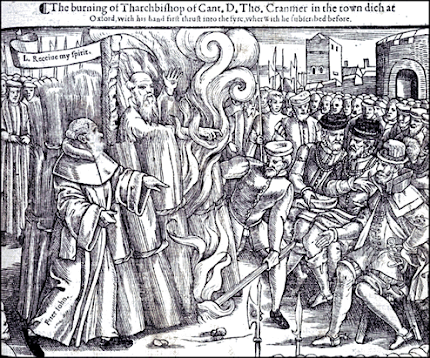
The burning of Tharchbishop of Cant. D. Tho. Cranmer in the town dich at Oxford, with his hand first thrust into the fyre, wherwith he subscribed before. [Click on the picture to see Cranmer's last words.]

Daily Bible Verse

Showing posts with label Thirty-nine Articles of Religion. Show all posts

Tuesday, April 01, 2025

Repost: The Consensus of Tigurinus

 [This post was originally posted in 2009.  I am reposting it here for information purposes.]

The following confession of faith is an agreement made by the churches of the Swiss Reformation in Zurich, representing the Zwinglians, and Geneva, representing the Calvinists. James I. Packer has said that Cranmer and the other English Reformers of this period were not unaware of this agreement and probably had it in mind when formulating their own theology of the sacrament. Packer says,

 
Dix in reply (Cranmer Dixit et non timuit: Church Quarterly Review, April 1948, pp. 145ff.; July 1948, pp. 44ff., and published separately) tried to drive a wedge between Cranmer and Bucer, arguing that Cranmer's view of the eucharistic reception of Christ was (a) in harmony with that of the contemporary Swiss school, people like Hooper and Bullinger, and (b) out of line with Bucer's. He was more convincing on (a) than on (b), though he was wrong to think that by proving (a) he confirmed his thesis that Cranmer was a Zwinglian: Swiss doctrine had advanced well beyond memorialism by the 1540's. (Dix never noticed the Consensus Tigurinus, let alone saw its significance.) After this, Dr. C.C. Richardson (Zwingli and Cranmer on the Eucharist: Cranmer Dixit et ContradicixitEvanston, 1949) maintained that it was nominalist philosophy which moved Cranmer and Zwingli to reject the real presence and corporal feeding on Christ, and Dr. Mascall would evidently like to agree (op. cit. pp. 117-21). But with Cranmer, at any rate, the motives prompting this rejection were not philosophical and rationalistic, but biblical and Christological: he was seeking to do justice to the view of the eucharist forced on him by the Bible and its patristic expositors, that it is a means whereby God makes present to our faith and savingly imparts to our souls (not a part of Christ, but) 'whole Christ', God, man, and Mediator, in all the power of His incarnation, passion, resurrection, and ascension; so that it is a means of grace in a far richer sense than expositors of the real presence ever suspected. (James I. Packer, "Cranmer in Some Recent Writing," The Work of Thomas Cranmer. Vol. 2. Ed. G.E. Duffield. (Berkshire: Sutton Courtney Press, 1964). Pp. xl-xli.


Clearly then, even the Anglo-Catholic theologian Dom Gregory Dix thought that Cranmer was a Zwinglian. Of course this means that Dix would never try to say that Cranmer taught or believed in real presence in the elements themselves. James I. Packer thought Dix was wrong but affirmed that Cranmer did not teach real presence and that Zwinglianism itself did not teach a bare memorial in the 1540's. The Consensus Tigurinus is proof enough that the distinctions between the Calvinist view, the Cranmerian view, and the Zwinglian view were not insurmountable and were in actuality closer than Anglo-Catholics are willing to admit.


The Consensus Tigurinus


John Calvin (1549) translated by Henry Beveridge

 
Mutual Consent in Regard to the Sacraments Between the Ministers of the Church of Zurich and John Calvin, Minister of the Church of Geneva. Now published by those who framed it.


Article 1. The Whole Spiritual Government of the Church Leads us to Christ.


Seeing that Christ is the end of the law, and the knowledge of him comprehends in itself the whole sum of the gospel, there is no doubt that the object of the whole spiritual government of the Church is to lead us to Christ, as it is by him alone we come to God, who is the final end of a happy life. Whosoever deviates from this in the slightest degree, can never speak duly or appositely of any ordinances of God.

Article 2. A True Knowledge of the Sacraments from the Knowledge of Christ.

As the sacraments are appendages of the gospel, he only can discourse aptly and usefully of their nature, virtue, office, and benefit, who begins with Christ: and that not by adverting cursorily to the name of Christ, but by truly holding for what end he was given us by the Father, and what blessings he has conferred upon us.

Article 3. Nature of the Knowledge of Christ.

We must hold therefore that Christ, being the eternal Son of God, and of the same essence and glory with the Father, assumed our flesh, to communicate to us by right of adoption that which he possessed by nature, namely, to make us sons of God. This is done when ingrafted by faith into the body of Christ, and that by the agency of the Holy Spirit we are first counted righteous by a free imputation of righteousness, and then regenerated to a new life: whereby being formed again in the image of our heavenly Father, we renounce the old man.

Article 4. Christ a Priest and King.

Thus Christ, in his human nature, is to be considered as our priest, who expiated our sins by the one sacrifice of his death, put away all our transgressions by his obedience, provided a perfect righteousness for us, and now intercedes for us, that we may have access to God. He is to be considered as a repairer, who, by the agency of his Spirit, reforms whatever is vicious in us, that we may cease to live to the world and the flesh, and God himself may live in us. He is to be considered as a king, who enriches us with all kinds of blessings, governs and defends us by his power, provides us with spiritual weapons, delivers us from all harm, and rules and guides us by the sceptre of his mouth. And he is to be so considered, that he may raise us to himself, the true God, and to the Father, until the fulfilment of what is finally to take place, viz., God be all in all.

Article 5. How Christ Communicates Himself to Us.

Moreover, that Christ may thus exhibit himself to us and produce these effects in us, he must be made one with us, and we must be ingrafted into his body. He does not infuse his life into us unless he is our head, and from him the whole body, fitly joined together through every joint of supply, according to his working, maketh increase of the body in the proportion of each member.

Article 6. Spiritual Communion. Institution of the Sacraments.

The spiritual communion which we have with the Son of God takes place when he, dwelling in us by his Spirit, makes all who believe capable of all the blessings which reside in him. In order to testify this, both the preaching of the gospel was appointed, and the use of the sacraments committed to us, namely, the sacraments of holy Baptism and the holy Supper.

Article 7. The Ends of the Sacraments

The ends of the sacraments are to be marks and badges of Christian profession and fellowship or fraternity, to be incitements to gratitude and exercises of faith and a godly life; in short, to be contracts binding us to this. But among other ends the principal one is, that God may, by means of them, testify, represent, and seal his grace to us. For although they signify nothing else than is announced to us by the Word itself, yet it is a great matter, first, that there is submitted to our eye a kind of living images which make a deeper impression on the senses, by bringing the object in a manner directly before them, while they bring the death of Christ and all his benefits to our remembrance, that faith may be the better exercised; and, secondly, that what the mouth of God had announced is, as it were, confirmed and ratified by seals.

Article 8. Gratitude.

Now, seeing that these things which the Lord has given as testimonies and seals of his grace are true, he undoubtedly truly performs inwardly by his Spirit that which the sacraments figure to our eyes and other senses; in other words, we obtain possession of Christ as the fountain of all blessings, both in order that we may be reconciled to God by means of his death, be renewed by his Spirit to holiness of life, in short, obtain righteousness and salvation; and also in order that we may give thanks for the blessings which were once exhibited on the cross, and which we daily receive by faith.

Article 9. The Signs and the Things Signified Not Disjoined but Distinct.

Wherefore, though we distinguish, as we ought, between the signs and the things signified, yet we do not disjoin the reality from the signs, but acknowledge that all who in faith embrace the promises there offered receive Christ spiritually, with his spiritual gifts, while those who had long been made partakers of Christ continue and renew that communion.

Article 10. The Promise Principally to Be Looked To in the Sacraments.

And it is proper to look not to the bare signs, but rather to the promise thereto annexed. As far, therefore, as our faith in the promise there offered prevails, so far will that virtue and efficacy of which we speak display itself. Thus the substance of water, bread, and wine, by no means offers Christ to us, nor makes us capable of his spiritual gifts. The promise rather is to be looked to, whose office it is to lead us to Christ by the direct way of faith, faith which makes us partakers of Christ.

Article 11. We Are Not to Stand Gazing on the Elements.

This refutes the error of those who stand gazing on the elements, and attach their confidence of salvation to them; seeing that the sacraments separated from Christ are but empty shows, and a voice is distinctly heard throughout proclaiming that we must adhere to none but Christ alone, and seek the gift of salvation from none but him.

Article 12. The Sacraments Effect Nothing by Themselves.

Besides, if any good is conferred upon us by the sacraments, it is not owing to any proper virtue in them, even though in this you should include the promise by which they are distinguished. For it is God alone who acts by his Spirit. When he uses the instrumentality of the sacraments, he neither infuses his own virtue into them nor derogates in any respect from the effectual working of his Spirit, but, in adaptation to our weakness, uses them as helps; in such manner, however, that the whole power of acting remains with him alone.

Article 13. God Uses the Instrument, but All the Virtue Is His.

Wherefore, as Paul reminds us, that neither he that planteth nor he that watereth is any thing, but God alone that giveth the increase; so also it is to be said of the sacraments that they are nothing, because they will profit nothing, unless God in all things make them effectual. They are indeed instruments by which God acts efficaciously when he pleases, yet so that the whole work of our salvation must be ascribed to him alone.

Article 14. The Whole Accomplished by Christ.

We conclude, then, that it is Christ alone who in truth baptizes inwardly, who in the Supper makes us partakers of himself, who, in short, fulfils what the sacraments figure, and uses their aid in such manner that the whole effect resides in his Spirit.

Article 15. How the Sacraments Confirm.

Thus the sacraments are sometimes called seals, and are said to nourish, confirm, and advance faith, and yet the Spirit alone is properly the seal, and also the beginner and finisher of faith. For all these attributes of the sacraments sink down to a lower place, so that not even the smallest portion of our salvation is transferred to creatures or elements.

Article 16. All Who Partake of the Sacraments Do Not Partake of the Reality.

Besides, we carefully teach that God does not exert his power indiscriminately in all who receive the sacraments, but only in the elect. For as he enlightens unto faith none but those whom he hath foreordained to life, so by the secret agency of his Spirit he makes the elect receive what the sacraments offer.

Article 17. The Sacraments Do Not Confer Grace.

By this doctrine is overthrown that fiction of the sophists which teaches that the sacraments confer grace on all who do not interpose the obstacle of mortal sin. For besides that in the sacraments nothing is received except by faith, we must also hold that the grace of God is by no means so annexed to them that whoso receives the sign also gains possession of the thing. For the signs are administered alike to reprobate and elect, but the reality reaches the latter only.

Article 18. The Gifts Offered to All, but Received by Believers Only.


It is true indeed that Christ with his gifts is offered to all in common, and that the unbelief of man not overthrowing the truth of God, the sacraments always retain their efficacy; but all are not capable of receiving Christ and his gifts. Wherefore nothing is changed on the part of God, but in regard to man each receives according to the measure of his faith.

Article 19. Believers Before, and Without the Use of the Sacraments, Communicate with Christ.

As the use of the sacraments will confer nothing more on unbelievers than if they had abstained from it, nay, is only destructive to them, so without their use believers receive the reality which is there figured. Thus the sins of Paul were washed away by baptism, though they had been previously washed away. So likewise baptism was the laver of regeneration to Cornelius, though he had already received the Holy Spirit. So in the Supper Christ communicates himself to us, though he had previously imparted himself, and perpetually remains in us. For seeing that each is enjoined to examine himself, it follows that faith is required of each before coming to the sacrament. Faith is not without Christ; but inasmuch as faith is confirmed and increased by the sacraments, the gifts of God are confirmed in us, and thus Christ in a manner grows in us and we in him.

Article 20. The Benefit Not Always Received in the Act of Communicating.

The advantage which we receive from the sacraments ought by no means to be restricted to the time at which they are administered to us, just as if the visible sign, at the moment when it is brought forward, brought the grace of God along with it. For those who were baptized when mere infants, God regenerates in childhood or adolescence, occasionally even in old age. Thus the utility of baptism is open to the whole period of life, because the promise contained in it is perpetually in force. And it may sometimes happen that the use of the holy Supper, which, from thoughtlessness or slowness of heart does little good at the time, afterward bears its fruit.

Article 21. No Local Presence Must Be Imagined.

We must guard particularly against the idea of any local presence. For while the signs are present in this world, are seen by the eyes and handled by the hands, Christ, regarded as man, must be sought nowhere else than in Heaven, and not otherwise than with the mind and eye of faith. Wherefore it is a perverse and impious superstition to inclose him under the elements of this world.

Article 22. Explanation of the Words "This Is My Body."

Those who insist that the formal words of the Supper, "This is my body; this is my blood," are to be taken in what they call the precisely literal sense, we repudiate as preposterous interpreters. For we hold it out of controversy that they are to be taken figuratively, the bread and wine receiving the name of that which they signify. Nor should it be thought a new or unwonted thing to transfer the name of things figured by metonymy [modern spelling: metonymy] to the sign, as similar modes of expression occur throughout the Scriptures, and we by so saying assert nothing but what is found in the most ancient and most approved writers of the Church.

Article 23. Of the Eating of the Body.

When it is said that Christ, by our eating of his flesh and drinking of his blood, which are here figured, feeds our souls through faith by the agency of the Holy Spirit, we are not to understand it as if any mingling or transfusion of substance took place, but that we draw life from the flesh once offered in sacrifice and the blood shed in expiation.

Article 24. Transubstantiation and Other Follies.

In this way are refuted not only the fiction of the Papists concerning transubstantiation, but all the gross figments and futile quibbles which either derogate from his celestial glory or are in some degree repugnant to the reality of his human nature. For we deem it no less absurd to place Christ under the bread or couple him with the bread, than to transubstantiate the bread into his body.

Article 25. The Body of Christ Locally in Heaven.

And that no ambiguity may remain when we say that Christ is to be sought in Heaven, the expression implies and is understood by us to intimate distance of place. For though philosophically speaking there is no place above the skies, yet as the body of Christ, bearing the nature and mode of a human body, is finite and is contained in Heaven as its place, it is necessarily as distant from us in point of space as Heaven is from Earth.

Article 26. Christ Not to Be Adored in the Bread.

If it is not lawful to affix Christ in our imagination to the bread and the wine, much less is it lawful to worship him in the bread. For although the bread is held forth to us as a symbol and pledge of the communion which we have with Christ, yet as it is a sign and not the thing itself, and has not the thing either included in it or fixed to it, those who turn their minds towards it, with the view of worshipping Christ, make an idol of it.

Addendum:  See also, Wikipedia, Consensus Tigurinus.  Note that the document was published in 1549, well within Archbishop Cranmer's time frame.  Cranmer would have been aware of it and Wikipedia says it was received well in England.


See also,  Phillip Schaff, History of the Christian Church, Volume VIII:  Modern Chrisitanity:  The Swiss Reformation, § 132. The Eucharistic Controversies. Calvin and Westphal. Christian Classics Ethereal Library.

This version of the Consensus of Tigurinus was originally posted at the Westminster Seminary, California website.  It is now posted at the Heidelblog:  Consensus of Tigurinus

Tuesday, August 06, 2013

Last Sunday's Sermon at Christ Church, Longwood, Florida


Last Sunday's sermon at Christ Church, Longwood, Florida was certainly a turnabout.  The visiting “priest” was the Rev. J. H. Booker, Jr.  Unfortunately, his answer to the previous rector’s emphasis on the moral law of God was to preach an antinomian sermon on Christian liberty.  Unfortunately, the definition given by Booker for Christian liberty was that the moral law is legalism and that there is no “list” of right and wrong in the Bible.  This was simply amazing, especially since one of the texts read in the service was from Colossians 3:1-11.  


I took it that the minister meant that the ten commandments or the Decalogue no longer applies today.  Of course, the Thirty-nine Articles of religion stringently disagrees with that assessment, as does the 1662 Book of Common Prayer.  Article 7 of the 39 Articles of Religion plainly says that Christian men and women are still obligated to obey the moral law:


THE Old Testament is not contrary to the New; for both in the Old and New Testament everlasting life is offered to mankind by Christ, who is the only Mediator between God and man, being both God and man. Wherefore there are not to be heard which feign that the old fathers did look only for transitory promises. Although the law given from God by Moses, as touching ceremonies and rites, do not bind Christian men, nor the civil precepts thereof ought of necessity to be received in any commonwealth; yet, notwithstanding, no Christian man whatsoever is free from the obedience of the commandments which are called moral.


The 1662 Book of Common Prayer includes the  reading of the Decalogue in every communion service or the Lord’s Supper:  

Then shall the Priest, turning to the people, rehearse distinctly all the TEN COMMANDMENTS; and the people still kneeling shall, after every Commandment, ask God mercy for their transgression thereof for the time past, and grace to keep the same for the time to come, as followeth.
Minister.
GOD spake these words, and said; I am the Lord thy God: Thou shalt have none other gods but me.
    People. Lord, have mercy upon us, and incline our hearts to keep this law.
    Minister. Thou shalt not make to thyself any graven image, nor the likeness of any thing that is in heaven above, or in the earth beneath, or in the water under the earth. Thou shalt not bow down to them, nor worship them: for I the Lord thy God am a jealous God, and visit the sins of the fathers upon the children unto the third and fourth generation of them that hate me, and shew mercy unto thousands in them that love me, and keep my commandments.
    People. Lord, have mercy upon us, and incline our hearts to keep this law.
    Minister. Thou shalt not take the Name of the Lord thy God in vain: for the Lord will not hold him guiltless, that taketh his Name in vain.
    People. Lord, have mercy upon us, and incline our hearts to keep this law.
    Minister. Remember that thou keep holy the Sabbath-day. Six days shalt thou labour, and do all that thou hast to do; but the seventh day is the Sabbath of the Lord thy God. In it thou shalt do no manner of work, thou, and thy son, and thy daughter, thy man-servant, and thy maid-servant, thy cattle, and the stranger that is within thy gates. For in six days the Lord made heaven and earth, the sea, and ail that in them is, and rested the seventh day: wherefore the Lord blessed the seventh day, and hallowed it.
    People. Lord, have mercy upon us, and incline our hearts to keep this law.
    Minister. Honour thy father and thy mother; that thy days may be long in the land which the Lord thy God giveth thee.
    People. Lord, have mercy upon us, and incline our hearts to keep this law.
    Minister. Thou shalt do no murder.
    People. Lord, have mercy upon us, and incline our hearts to keep this law.
    Minister. Thou shalt not commit adultery.
    People. Lord, have mercy upon us, and incline our hearts to keep this law.
    Minister. Thou shalt not steal.
    People. Lord, have mercy upon us, and incline our hearts to keep this law.
    Minister. Thou shalt not bear false witness against thy neighbour.
    People. Lord, have mercy upon us, and incline our hearts to keep this law.
    Minister. Thou shalt not covet thy neighbour's house, thou shalt not covet thy neighbour's wife, nor his servant, nor his maid, nor his ox, nor his ass, nor any thing that is his.
    People. Lord, have mercy upon us, and write all these thy laws in our hearts, we beseech thee.  (Exodus 20:1-17).


Even worse, the minster in question did not seem to know the law and gospel distinction that is at the heart of the Protestant Reformation, which distinction was affirmed by both Lutherans and Calvinists alike.  He instead asserted that Christian liberty is completely divorced from the law.  He openly stated that following the clearly stated moral laws revealed in Scripture is “easier” than having to figure out complex ethical situations on a case by case basis.  In other words, any idea of revealed moral law in the inspired and infallible Scriptures is to be rejected.  Can you say "relativism"?


Furthermore, the minister said that the reason for the prohibition on adultery in the Old Testament was because women were viewed as property.  This is nothing more than a liberal redefinition of adultery so as to permit extramarital sexual encounters in the name of “Christian liberty.”  The primary reason for the prohibition of adultery, according to Jesus, was that it violated the purpose of God in creation:


The Pharisees also came to Him, testing Him, and saying to Him, "Is it lawful for a man to divorce his wife for just any reason?" 4 And He answered and said to them, "Have you not read that He who made them at the beginning`made them male and female,' 5 "and said,`For this reason a man shall leave his father and mother and be joined to his wife, and the two shall become one flesh '? 6 "So then, they are no longer two but one flesh. Therefore what God has joined together, let not man separate." 7 They said to Him, "Why then did Moses command to give a certificate of divorce, and to put her away?" 8 He said to them, "Moses, because of the hardness of your hearts, permitted you to divorce your wives, but from the beginning it was not so. 9 "And I say to you, whoever divorces his wife, except for sexual immorality, and marries another, commits adultery; and whoever marries her who is divorced commits adultery." 10 His disciples said to Him, "If such is the case of the man with his wife, it is better not to marry." (Matthew 19:3-10 NKJ)


Mark 10:11-12 shows clearly that if a woman leaves her husband and marries another, an indication that women in the time of Jesus had the right to divorce, then she likewise commits adultery.  The reason for this is that women are not property.  In fact, in the creation Adam and Eve were equal.  God’s purpose in the creation was for one man and one woman to be wed in holy matrimony for life.  Any sex outside of marriage is fornication and adultery.  Amazingly, this liberal minister, Mr. Booker, also redefined fornication from Colossians 3:5 where the Greek word is porneia.  Booker said that this term is restricted to temple prostitution among the Greeks and Romans.  He also conceded that temple prostitution in the Old Testament could be in mind as well.  Unfortunately, anyone who can read Strong’s Exhaustive Concordance can see that fornication is an umbrella term that refers not only to pagan prostitution, idolatry, etc., but the term refers to all illicit sexual activity outside of holy matrimony.  That would include incest (1 Corinthians 5:1), bestiality, premarital sex, et. al.  Therefore, it does not follow that Moses had a different understanding of adultery from what we have today.  Marital unfaithfulness is not being true to the marital covenant or to God’s moral law for marriage revealed in creation.  Fornication, likewise, is any illicit sexual behavior outside of God’s purpose in creation.  (Genesis 2:20-25).


The argument I had in the fellowship hall after the service was over was revealing.  The minister made it clear that “he” thought gay marriage was wrong.  “He” has problems with it.  But he never once said that Scripture forbids it or that God forbids it.  In other words, it’s all relative.  He also said that certain fishermen in a certain part of the world where he had lived “tried out” their  future wives to see if they could bear children before they committed to marriage.  In other words, Mr. Booker approves of sex before marriage.  I thought he most likely approves of sex between homosexuals provided they are not allowed to marry.  He was a devious one and as slippery as an eel to say the least.  In his sermon he never once mentioned the moral law of God or the pedagogical use of God’s law.  He basically said the Decalogue is irrelevant and it is up to you to decide what is best for you.  His definition of Christian “liberty” is therefore lawlessness and antinomianism.  


My problem with my Evangelical friend, David Knox, who lost his job because of the liberals in the congregation, is that he rejects the Westminster Confession of Faith and the Westminster Standards as a whole because of his Armyraldianism.  For him, nailing down biblical propositions into systematic statements or creeds is to impose things that he thinks ought to be left to Christian “liberty” as well.  This is also an indicator for neo-orthodoxy, although I am not sure if he knows that is what he is espousing:

Barth asserts that the concepts of theology cannot be systematically connected, a systematic conspectus is an impossibility, and the name of Jesus Christ as used by Paul does not represent a unified thought.  Barth's point is not merely that the Bible is inconsistent.  He indeed holds that it is; he accepts only its main teaching and rejects the doctrine of infallible inspiration.  But here he is talking about theology, his own theology; and  it is his own theology that he now says is illogical, unsystematic, and self-contradictory.  The wording just quoted does not so much refer to the Biblical writers themselves as it refers to what the theologian can do with them.  Not only Paul lacks a unified thought when he uses the name Jesus Christ; this is true of Barth also.  In the name Jesus Christ "Cross and Resurrection are one, but not," Barth significantly adds, "--either for Paul, or for his first readers, or for us either--in what is stated in explanation over and above this name."  In these words, "for his first readers, or for us either," Barth denies that theology can be systematic, logical, and consistent. 

Gordon H. Clark, Karl Barth's Theological Method, 1963, 2nd Edition, (Unicoi: Trinity Foundation, 1997), pp. 63-64.

David, to his credit, does uphold the law of God as the standard for Christian living.  Unfortunately, although he does believe in justification by faith alone, he often blurred the law and gospel distinction.  My other beef with him is that he thinks “conservative” and “orthodox” Anglo-Catholics, namely those who uphold traditional views of Christian morality, are “Christians.”  I would vehemently disagree for the simple reason that Anglo-Catholics are, for all practical purposes, Roman Catholics.  The Anglo-Catholic position allows for faith plus obedience as the means of justification, which is to confuse justification by faith alone as a legal declaration with the imperfect sanctification that is our progressive process in holiness from the time of regeneration to the hour of our death.  Sanctification without justification can only merit hell for so-called Christians.  The only basis for saving faith is our justification based solely on the active and passive obedience of Christ.  He kept all the law of God perfectly for elect believers by keeping God’s moral law perfectly for them vicariously by His active obedience.  He paid the eternal penalty for the sins of His elect by dying on the cross to bear the wrath of God against them in their place as well.


Due to time constraints I am not providing all the proof texts for this.  But needless to say when law becomes the gospel—even in regards to my Evangelical friend—what happens is people feel beaten up with no relief.  A truly reformed sermon includes both law and gospel.  The gospel is what God promises to do for us because we are helpless to do those things for ourselves!  The law can only reveal us to be lowly sinners who deserve God’s eternal wrath and punishment.  (Romans 3:20; 3:20-23; 7:7).  Of course, even a liberal would not accept the three uses of God’s moral law, namely the 1) pedagogical use, 2) the civil use, and 3) the Christian duty to live by faith according to God’s moral precepts.  The pedagogical use shows us that law keeping or obedience is never enough to save us or merit salvation.  That’s why salvation must be founded on justification by faith alone.  Without justification by faith alone there is no foundation for sanctification or salvation whatsoever.  The just shall live by faith, not by the deeds of the law.  (Romans 1:16-17).  We are free from the law in that sense, that is as a means of earning or meriting or living up to an impossible standard.  But we are not free from the law as if we have a license to sin!  That is called antinomianism.  (1 John 3:4-9; Romans 6:1-2).


Mr. Booker is a false teacher who redefines biblical terms to justify his relativism and lawlessness.  (Acts 20:27-31; Jude 1:3-5).  He would approve of fornication and adultery by redefining the terms so that what the terms meant in biblical times is not applicable to the Christian today.  So long as no one is hurt it is ok to engage in gay sex, premarital sex, and even extramarital affairs!  The opposite error of my Evangelical friend is to confuse law with gospel such that the gospel is simply the law rehearsed.  It reminds me of Ronald and Nancy Reagan’s anti-drug abuse campaign:  “Just say no!”  If sinners are not slaves to sin, that would make perfect sense.  But Pelagianism has never worked.  The only sinless man who ever kept God’s law from birth to the grave without ever breaking it once was our Lord Jesus Christ.  (1 Peter 2:22-25).  Christ did not come to give the elect a license to sin all they want.  He came to set His elect people free from their slavery to sin.  (John 8:32-36).  Augustine, the bishop of Hippo in the fourth century, caused a huge controversy when he prayed, “Lord, command what you will, and grant us the grace to do what you command.”  I am paraphrasing a bit.  But the point is Pelagius—like the Arminians, semi-pelagians, papists, and liberals of today—got upset because he thought it would be unfair of God to command something men and women are unable to do:  obey.  What Pelagius forgot was that when Adam fell from grace and rebelled against God He brought a curse on all mankind.  That curse includes both the guilt of Adam’s original sin imputed to them and the traducian view that sin is passed on from one generation to the next by natural generation.  That is, sin is inborn.  (Psalm 51:4-5; Psalm 58:3; Ephesians 4:18).  God does not answer to man but man must answer to God, and, as the late Dr. Gordon  H. Clark said, nothing God does is wrong.  That would include when God strikes men with hardness of heart and reprobation (Romans 1:24; Romans 9:11-13; 1 Thessalonians 2:11-12).


My Evangelical friend, David Knox, on the other hand, needs to learn systematic theology and the law/gospel distinction.  Anyone who thinks Rome or Tractarianism offers any hope whatsoever to the reprobate has been deceived by the enemy.  One reason I keep upholding the 39 Articles of Religion and the 1662 Book of Common Prayer is that the Anglican Formularies do teach these essential doctrines.  For example, Article 7 clearly upholds the law/gospel distinction without advocating antinomianism:

Article VII

Of the Old Testament

The Old Testament is not contrary to the New; for both in the Old and New Testament everlasting life is offered to mankind by Christ, who is the only Mediator between God and man, being both God and man. Wherefore they are not to be heard which feign that the old fathers did look only for transitory promises. Although the law given from God by Moses, as touching ceremonies and rites, do not bind Christian men, nor the civil precepts thereof ought of necessity to be received in any commonwealth; yet, notwithstanding, no Christian man whatsoever is free from the obedience of the commandments which are called moral.

The prayer of humble access and other portions of the Lord’s Supper advocate that God does not “weigh” our “merits” but instead pardons “our offenses.”  “We are not worthy so much as to gather up the crumbs under thy table.”  (Matthew 15:27; Mark 7:28; Luke 16:20-22).  These portions of the service clearly indicate that Archbishop Thomas Cranmer wanted to teach the doctrine of justification by faith alone through the liturgy.  But he likewise rejected antinomianism since he also included exhortations to live by faith and obedience:

Then shall the Priest say to them that come to receive the holy Communion, 

YE that do truly and earnestly repent you of your sins, and are in love and charity with your neighbours, and intend to lead a new life, following the commandments of God, and walking from henceforth in his holy ways; Draw near with faith, and take this holy Sacrament to your comfort; and make your humble confession to Almighty God, meekly kneeling upon your knees.  (The Lord’s Supper).

I can only pray for the remnant of naïve believers left at Christ Church Longwood.  May God grant them the discernment to see the lies of the enemy. May God preserve their souls and cause them to persevere to the end.

Amen.

Charlie


Tuesday, June 04, 2013

Question 17: Short Catechism for Young Churchmen: What are good works?


Q. (17) What are good works?

A. "Good works are the fruits of faith, and follow after justification. They spring out necessarily of a true and lively faith, so that by them a lively (i.e. living) faith may be as evidently known as a tree discerned by its fruit."-(Art. XII; Phil. 1:11; John 15:4, 5; Gal. 5:6.)


Friday, April 19, 2013

Westminster Larger Catechism: Question 61

Question 61

Are all they saved who hear the gospel, and live in the church?

All that hear the gospel, and live in the visible church, are not saved; but they only who are true members of the church invisible. (John 12:38–40, Rom. 9:6, Matt. 22:14, Matt. 7:21, Rom. 11:7)


The Westminster Larger Catechism: With Scripture Proofs. (Oak Harbor, WA: Logos Research Systems, Inc., 1996).

For those Anglicans who would dispute this doctrine I am including a brief quote from the late Rev. Dr. D. Broughton Knox, former principal of Moore Theological College, Sydney, Australia, and George Whitefield College, South Africa.

The visible church is the congregation worshipping according to the Word of God, and there are as many visible churches as there are true congregations. The Articles do not speak specifically of the 'invisible Church' but have only passing references. It is a mistake to think that the Articles deny the concept of the invisible or mystical Church, or to misread Article 19 as though it began 'The Church of Christ is a visible congregation', as is frequently done.ii Nor is there any ground for the assertion of the Vicar of All Saints', Margaret Street, London, that 'The Church of Engand repudiates any notion of an invisible church.'iii The concept of the invisible Church was uniformly held by the Reformers and was affirmed as early as the Bishop's Book of 1537 and the Thirteen Articles of 1538. It would be very unlikely, and in fact is not the case, that the Thirty-Nine Articles repudiated the concept of the invisible or mystical Church of Christ, or fell into the mistake of which Hooker castigated when he wrote: 'For lack of diligent observing the difference between the church of God mystical and visible, the oversights are neither few nor light that have been committed'.iv
Article 19 is concerned with the church in its visible aspect -- the visible congregation. But the opening clause of Article 26 which also speaks of the 'visible Church' implies a contrast with the Church in its invisible aspect round the throne of God, where the evil is not mingled with the good. The word 'Church' appears to be used of the 'invisible' Church in Article 27, which states that 'they that receive Baptism rightly are grafted into the Church', the mystical body of Christ; for all without exception who outwardly receive baptism are admitted to the visible church. But right reception (Latin recte), that is with a believing heart, is the requisite for being engrafted into Christ and into the assembly gathered around Him in heaven.  [The Doctrine of the Church and Denominations, Chapter 9 of The Historic Basis of the Thirty-Nine Articles of Religion].

Thursday, April 18, 2013

Our Good Deeds Justify Us Not « The Reformed Reader


Antichrist turneth the roots of the tree upward.  He maketh the goodness of God the branches and our goodness the roots.  -- William Tyndale


Dr. Scott Clark over at the Heidelblog posted this link to the Reformed Reader.  I decided to post it since it clearly has a link to the Thirty-Nine Articles of Religion, Article XII:

“Our blind disputers will say, if our good deeds justify us not, if God look not on our good deeds neither regard them nor love us the better for them what need we to do good works?”
“I answer God looketh on our good deeds and loveth them, yet loveth us not for their sakes.  God loveth us first in Christ of his goodness and mercy, and poureth his Spirit into us, and giveth us power to do good deeds.  And because he loveth us, he loveth our good deeds: yea because he loveth us, he forgiveth us our evil deeds which we do of frailty and not of purpose or of the nonce.  Our good deeds do but testify only that we are justified and beloved.”
“For except we were beloved and had God’s Spirit we could neither do nor yet consent unto any good deed.  Antichrist turneth the roots of the tree upward.  He maketh the goodness of God the branches and our goodness the roots.  We must be first good after Antichrist’s doctrine, and move God and compel him to be good again for our goodness’ sake: so must God’s goodness spring out of our goodness.  Nay verily God’s goodness is the root of all goodness and our goodness, if we have any, springeth out of his goodness.”  William Tyndale, The Obedience of a Christian Man.

Article XII of the Thirty-Nine Articles says:  

XII. Of Good Works.
 
ALBEIT that good works, which are the fruits of faith and follow after justification, cannot put away our sins and endure the severity of God's judgement, yet are they pleasing and acceptable to God in Christ, and do spring out necessarily of a true and lively faith, insomuch that by them a lively faith may be as evidently known as a tree discerned by the fruit.
It seems likely to me that Tyndale's theology had some influence on the English Reformers, including Archbishop Thomas Cranmer, who composed the original Forty-Two Articles of Religion which were edited to Thirty-Nine Articles in 1571.

Click here to see the original post:  Our Good Deeds Justify Us Not « The Reformed Reader

See also:  William Tyndale.

Thursday, August 30, 2012

Dwight L. Moody: Sovereign Grace and the Thirty-nine Articles of Religion


[Note:  This article is a quote from Dwight L. Moody's book, Sovereign Grace.  Charlie].

That is stronger than I ever put it. These Articles say of works before justification that “they have the nature of sin.” I never called them sin! So you see this is not any new doctrine that we are preaching. When the church and the world wake up to the fact that works before salvation go for nought, then—and not till then, I believe—men will come flocking into the kingdom of God by hundreds. We work from the cross, not to it. WE work because we are saved, not in order to be saved. -- Dwight L. Moody

WHAT THE THIRTY-NINE ARTICLES SAY. 

I find some people have accused me of teaching heresy, because I say salvation is all of grace. I remember once, a clergyman said I was teaching false doctrine because I said salvation was all of grace. He said that works had as much to do with our salvation as grace. At that time I had never read the Thirty-Nine Articles; if I had I should have been ready to meet him. I got the Prayer Book, and looked through the Thirty-Nine Articles; and I found, to my amazement, that they put it a good deal stronger than I had done.

Let us hear what they say—

XI. Of the Justification of Man. We are accounted righteous before God, only for the merit of our Lord and Saviour Jesus Christ by Faith, and not for our own works or deservings: Wherefore, that we are justified by Faith only, is a most wholesome doctrine, and very full of comfort.”

XII. Of Good Works. Albeit that Good Works, which are the fruits of Faith, and follow after Justification, cannot put away our sins, and endure the severity of God’s judgment; yet are they pleasing and acceptable to God in Christ, and do spring out necessarily of a true and lively Faith; insomuch that by them a lively Faith may be as evidently known as a tree discerned by the fruit.”

XIII. Of Works Before Justification. Works done before the grace of Christ, and the inspiration of His Spirit, are not pleasant to God; forasmuch as they spring not of faith in Jesus Christ, neither do they make men meet to receive grace, or (as the school-authors say) deserve grace of congruity: yea rather, for that they are not done as God hath willed and commanded them to be done, we doubt not but they have the nature of sin.”


That is stronger than I ever put it. These Articles say of works before justification that “they have the nature of sin.” I never called them sin! So you see this is not any new doctrine that we are preaching. When the church and the world wake up to the fact that works before salvation go for nought, then—and not till then, I believe—men will come flocking into the kingdom of God by hundreds. We work from the cross, not to it. WE work because we are saved, not in order to be saved. We work from salvation, not up to it. Salvation is the gift of God.

You have heard the Prayer Book: now hear Paul; “Abraham believed God; and it was counted unto him for righteousness. Now to him that worketh is the reward not reckoned of grace, but of debt. But to him that worketh not, but believeth on Him that justifieth the ungodly, his faith is counted for righteousness.” Notice what the Apostle says: “To him that worketh not.” That is plain language, is it not? I may perhaps startle some of you by saying that many of you have been kept out of the kingdom of God by your good works. Nevertheless it is true. If you put works in the place of faith, they become a snare to you. It is “to him that worketh not, but believeth.”  [Romans 4:3-5 KJV]

I freely admit salvation is worth working for; it is worth a man’s going round the world on his hands and knees, climbing its mountains, crossing its valleys, swimming its rivers, going through all manner of hardship in order to attain it. But we do not get it in that way. Paul went through all the trials and hardships he had to endure, because by the grace of God resting on him he was enabled to do so.


Moody, Dwight Lyman (2011-03-24). Sovereign Grace Its Source, Its Nature and Its Effects (Kindle Locations 110-134). Kindle Edition.

Support Reasonable Christian Ministries with your generous donation.