>

Martyred for the Gospel

Martyred for the Gospel
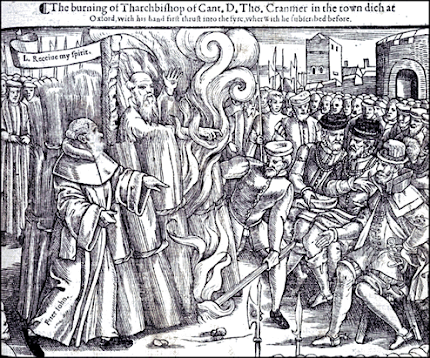
The burning of Tharchbishop of Cant. D. Tho. Cranmer in the town dich at Oxford, with his hand first thrust into the fyre, wherwith he subscribed before. [Click on the picture to see Cranmer's last words.]

Daily Bible Verse

Showing posts with label Cranmer's Theology of the Sacraments. Show all posts

Tuesday, April 01, 2025

Repost: The Consensus of Tigurinus

 [This post was originally posted in 2009.  I am reposting it here for information purposes.]

The following confession of faith is an agreement made by the churches of the Swiss Reformation in Zurich, representing the Zwinglians, and Geneva, representing the Calvinists. James I. Packer has said that Cranmer and the other English Reformers of this period were not unaware of this agreement and probably had it in mind when formulating their own theology of the sacrament. Packer says,

 
Dix in reply (Cranmer Dixit et non timuit: Church Quarterly Review, April 1948, pp. 145ff.; July 1948, pp. 44ff., and published separately) tried to drive a wedge between Cranmer and Bucer, arguing that Cranmer's view of the eucharistic reception of Christ was (a) in harmony with that of the contemporary Swiss school, people like Hooper and Bullinger, and (b) out of line with Bucer's. He was more convincing on (a) than on (b), though he was wrong to think that by proving (a) he confirmed his thesis that Cranmer was a Zwinglian: Swiss doctrine had advanced well beyond memorialism by the 1540's. (Dix never noticed the Consensus Tigurinus, let alone saw its significance.) After this, Dr. C.C. Richardson (Zwingli and Cranmer on the Eucharist: Cranmer Dixit et ContradicixitEvanston, 1949) maintained that it was nominalist philosophy which moved Cranmer and Zwingli to reject the real presence and corporal feeding on Christ, and Dr. Mascall would evidently like to agree (op. cit. pp. 117-21). But with Cranmer, at any rate, the motives prompting this rejection were not philosophical and rationalistic, but biblical and Christological: he was seeking to do justice to the view of the eucharist forced on him by the Bible and its patristic expositors, that it is a means whereby God makes present to our faith and savingly imparts to our souls (not a part of Christ, but) 'whole Christ', God, man, and Mediator, in all the power of His incarnation, passion, resurrection, and ascension; so that it is a means of grace in a far richer sense than expositors of the real presence ever suspected. (James I. Packer, "Cranmer in Some Recent Writing," The Work of Thomas Cranmer. Vol. 2. Ed. G.E. Duffield. (Berkshire: Sutton Courtney Press, 1964). Pp. xl-xli.


Clearly then, even the Anglo-Catholic theologian Dom Gregory Dix thought that Cranmer was a Zwinglian. Of course this means that Dix would never try to say that Cranmer taught or believed in real presence in the elements themselves. James I. Packer thought Dix was wrong but affirmed that Cranmer did not teach real presence and that Zwinglianism itself did not teach a bare memorial in the 1540's. The Consensus Tigurinus is proof enough that the distinctions between the Calvinist view, the Cranmerian view, and the Zwinglian view were not insurmountable and were in actuality closer than Anglo-Catholics are willing to admit.


The Consensus Tigurinus


John Calvin (1549) translated by Henry Beveridge

 
Mutual Consent in Regard to the Sacraments Between the Ministers of the Church of Zurich and John Calvin, Minister of the Church of Geneva. Now published by those who framed it.


Article 1. The Whole Spiritual Government of the Church Leads us to Christ.


Seeing that Christ is the end of the law, and the knowledge of him comprehends in itself the whole sum of the gospel, there is no doubt that the object of the whole spiritual government of the Church is to lead us to Christ, as it is by him alone we come to God, who is the final end of a happy life. Whosoever deviates from this in the slightest degree, can never speak duly or appositely of any ordinances of God.

Article 2. A True Knowledge of the Sacraments from the Knowledge of Christ.

As the sacraments are appendages of the gospel, he only can discourse aptly and usefully of their nature, virtue, office, and benefit, who begins with Christ: and that not by adverting cursorily to the name of Christ, but by truly holding for what end he was given us by the Father, and what blessings he has conferred upon us.

Article 3. Nature of the Knowledge of Christ.

We must hold therefore that Christ, being the eternal Son of God, and of the same essence and glory with the Father, assumed our flesh, to communicate to us by right of adoption that which he possessed by nature, namely, to make us sons of God. This is done when ingrafted by faith into the body of Christ, and that by the agency of the Holy Spirit we are first counted righteous by a free imputation of righteousness, and then regenerated to a new life: whereby being formed again in the image of our heavenly Father, we renounce the old man.

Article 4. Christ a Priest and King.

Thus Christ, in his human nature, is to be considered as our priest, who expiated our sins by the one sacrifice of his death, put away all our transgressions by his obedience, provided a perfect righteousness for us, and now intercedes for us, that we may have access to God. He is to be considered as a repairer, who, by the agency of his Spirit, reforms whatever is vicious in us, that we may cease to live to the world and the flesh, and God himself may live in us. He is to be considered as a king, who enriches us with all kinds of blessings, governs and defends us by his power, provides us with spiritual weapons, delivers us from all harm, and rules and guides us by the sceptre of his mouth. And he is to be so considered, that he may raise us to himself, the true God, and to the Father, until the fulfilment of what is finally to take place, viz., God be all in all.

Article 5. How Christ Communicates Himself to Us.

Moreover, that Christ may thus exhibit himself to us and produce these effects in us, he must be made one with us, and we must be ingrafted into his body. He does not infuse his life into us unless he is our head, and from him the whole body, fitly joined together through every joint of supply, according to his working, maketh increase of the body in the proportion of each member.

Article 6. Spiritual Communion. Institution of the Sacraments.

The spiritual communion which we have with the Son of God takes place when he, dwelling in us by his Spirit, makes all who believe capable of all the blessings which reside in him. In order to testify this, both the preaching of the gospel was appointed, and the use of the sacraments committed to us, namely, the sacraments of holy Baptism and the holy Supper.

Article 7. The Ends of the Sacraments

The ends of the sacraments are to be marks and badges of Christian profession and fellowship or fraternity, to be incitements to gratitude and exercises of faith and a godly life; in short, to be contracts binding us to this. But among other ends the principal one is, that God may, by means of them, testify, represent, and seal his grace to us. For although they signify nothing else than is announced to us by the Word itself, yet it is a great matter, first, that there is submitted to our eye a kind of living images which make a deeper impression on the senses, by bringing the object in a manner directly before them, while they bring the death of Christ and all his benefits to our remembrance, that faith may be the better exercised; and, secondly, that what the mouth of God had announced is, as it were, confirmed and ratified by seals.

Article 8. Gratitude.

Now, seeing that these things which the Lord has given as testimonies and seals of his grace are true, he undoubtedly truly performs inwardly by his Spirit that which the sacraments figure to our eyes and other senses; in other words, we obtain possession of Christ as the fountain of all blessings, both in order that we may be reconciled to God by means of his death, be renewed by his Spirit to holiness of life, in short, obtain righteousness and salvation; and also in order that we may give thanks for the blessings which were once exhibited on the cross, and which we daily receive by faith.

Article 9. The Signs and the Things Signified Not Disjoined but Distinct.

Wherefore, though we distinguish, as we ought, between the signs and the things signified, yet we do not disjoin the reality from the signs, but acknowledge that all who in faith embrace the promises there offered receive Christ spiritually, with his spiritual gifts, while those who had long been made partakers of Christ continue and renew that communion.

Article 10. The Promise Principally to Be Looked To in the Sacraments.

And it is proper to look not to the bare signs, but rather to the promise thereto annexed. As far, therefore, as our faith in the promise there offered prevails, so far will that virtue and efficacy of which we speak display itself. Thus the substance of water, bread, and wine, by no means offers Christ to us, nor makes us capable of his spiritual gifts. The promise rather is to be looked to, whose office it is to lead us to Christ by the direct way of faith, faith which makes us partakers of Christ.

Article 11. We Are Not to Stand Gazing on the Elements.

This refutes the error of those who stand gazing on the elements, and attach their confidence of salvation to them; seeing that the sacraments separated from Christ are but empty shows, and a voice is distinctly heard throughout proclaiming that we must adhere to none but Christ alone, and seek the gift of salvation from none but him.

Article 12. The Sacraments Effect Nothing by Themselves.

Besides, if any good is conferred upon us by the sacraments, it is not owing to any proper virtue in them, even though in this you should include the promise by which they are distinguished. For it is God alone who acts by his Spirit. When he uses the instrumentality of the sacraments, he neither infuses his own virtue into them nor derogates in any respect from the effectual working of his Spirit, but, in adaptation to our weakness, uses them as helps; in such manner, however, that the whole power of acting remains with him alone.

Article 13. God Uses the Instrument, but All the Virtue Is His.

Wherefore, as Paul reminds us, that neither he that planteth nor he that watereth is any thing, but God alone that giveth the increase; so also it is to be said of the sacraments that they are nothing, because they will profit nothing, unless God in all things make them effectual. They are indeed instruments by which God acts efficaciously when he pleases, yet so that the whole work of our salvation must be ascribed to him alone.

Article 14. The Whole Accomplished by Christ.

We conclude, then, that it is Christ alone who in truth baptizes inwardly, who in the Supper makes us partakers of himself, who, in short, fulfils what the sacraments figure, and uses their aid in such manner that the whole effect resides in his Spirit.

Article 15. How the Sacraments Confirm.

Thus the sacraments are sometimes called seals, and are said to nourish, confirm, and advance faith, and yet the Spirit alone is properly the seal, and also the beginner and finisher of faith. For all these attributes of the sacraments sink down to a lower place, so that not even the smallest portion of our salvation is transferred to creatures or elements.

Article 16. All Who Partake of the Sacraments Do Not Partake of the Reality.

Besides, we carefully teach that God does not exert his power indiscriminately in all who receive the sacraments, but only in the elect. For as he enlightens unto faith none but those whom he hath foreordained to life, so by the secret agency of his Spirit he makes the elect receive what the sacraments offer.

Article 17. The Sacraments Do Not Confer Grace.

By this doctrine is overthrown that fiction of the sophists which teaches that the sacraments confer grace on all who do not interpose the obstacle of mortal sin. For besides that in the sacraments nothing is received except by faith, we must also hold that the grace of God is by no means so annexed to them that whoso receives the sign also gains possession of the thing. For the signs are administered alike to reprobate and elect, but the reality reaches the latter only.

Article 18. The Gifts Offered to All, but Received by Believers Only.


It is true indeed that Christ with his gifts is offered to all in common, and that the unbelief of man not overthrowing the truth of God, the sacraments always retain their efficacy; but all are not capable of receiving Christ and his gifts. Wherefore nothing is changed on the part of God, but in regard to man each receives according to the measure of his faith.

Article 19. Believers Before, and Without the Use of the Sacraments, Communicate with Christ.

As the use of the sacraments will confer nothing more on unbelievers than if they had abstained from it, nay, is only destructive to them, so without their use believers receive the reality which is there figured. Thus the sins of Paul were washed away by baptism, though they had been previously washed away. So likewise baptism was the laver of regeneration to Cornelius, though he had already received the Holy Spirit. So in the Supper Christ communicates himself to us, though he had previously imparted himself, and perpetually remains in us. For seeing that each is enjoined to examine himself, it follows that faith is required of each before coming to the sacrament. Faith is not without Christ; but inasmuch as faith is confirmed and increased by the sacraments, the gifts of God are confirmed in us, and thus Christ in a manner grows in us and we in him.

Article 20. The Benefit Not Always Received in the Act of Communicating.

The advantage which we receive from the sacraments ought by no means to be restricted to the time at which they are administered to us, just as if the visible sign, at the moment when it is brought forward, brought the grace of God along with it. For those who were baptized when mere infants, God regenerates in childhood or adolescence, occasionally even in old age. Thus the utility of baptism is open to the whole period of life, because the promise contained in it is perpetually in force. And it may sometimes happen that the use of the holy Supper, which, from thoughtlessness or slowness of heart does little good at the time, afterward bears its fruit.

Article 21. No Local Presence Must Be Imagined.

We must guard particularly against the idea of any local presence. For while the signs are present in this world, are seen by the eyes and handled by the hands, Christ, regarded as man, must be sought nowhere else than in Heaven, and not otherwise than with the mind and eye of faith. Wherefore it is a perverse and impious superstition to inclose him under the elements of this world.

Article 22. Explanation of the Words "This Is My Body."

Those who insist that the formal words of the Supper, "This is my body; this is my blood," are to be taken in what they call the precisely literal sense, we repudiate as preposterous interpreters. For we hold it out of controversy that they are to be taken figuratively, the bread and wine receiving the name of that which they signify. Nor should it be thought a new or unwonted thing to transfer the name of things figured by metonymy [modern spelling: metonymy] to the sign, as similar modes of expression occur throughout the Scriptures, and we by so saying assert nothing but what is found in the most ancient and most approved writers of the Church.

Article 23. Of the Eating of the Body.

When it is said that Christ, by our eating of his flesh and drinking of his blood, which are here figured, feeds our souls through faith by the agency of the Holy Spirit, we are not to understand it as if any mingling or transfusion of substance took place, but that we draw life from the flesh once offered in sacrifice and the blood shed in expiation.

Article 24. Transubstantiation and Other Follies.

In this way are refuted not only the fiction of the Papists concerning transubstantiation, but all the gross figments and futile quibbles which either derogate from his celestial glory or are in some degree repugnant to the reality of his human nature. For we deem it no less absurd to place Christ under the bread or couple him with the bread, than to transubstantiate the bread into his body.

Article 25. The Body of Christ Locally in Heaven.

And that no ambiguity may remain when we say that Christ is to be sought in Heaven, the expression implies and is understood by us to intimate distance of place. For though philosophically speaking there is no place above the skies, yet as the body of Christ, bearing the nature and mode of a human body, is finite and is contained in Heaven as its place, it is necessarily as distant from us in point of space as Heaven is from Earth.

Article 26. Christ Not to Be Adored in the Bread.

If it is not lawful to affix Christ in our imagination to the bread and the wine, much less is it lawful to worship him in the bread. For although the bread is held forth to us as a symbol and pledge of the communion which we have with Christ, yet as it is a sign and not the thing itself, and has not the thing either included in it or fixed to it, those who turn their minds towards it, with the view of worshipping Christ, make an idol of it.

Addendum:  See also, Wikipedia, Consensus Tigurinus.  Note that the document was published in 1549, well within Archbishop Cranmer's time frame.  Cranmer would have been aware of it and Wikipedia says it was received well in England.


See also,  Phillip Schaff, History of the Christian Church, Volume VIII:  Modern Chrisitanity:  The Swiss Reformation, § 132. The Eucharistic Controversies. Calvin and Westphal. Christian Classics Ethereal Library.

This version of the Consensus of Tigurinus was originally posted at the Westminster Seminary, California website.  It is now posted at the Heidelblog:  Consensus of Tigurinus

Wednesday, February 29, 2012

The Real Presence: Church Association Tract 025


THE REAL PRESENCE


I. It is of the utmost importance that we rightly understand the meaning of the expression “the Real Presence;” as otherwise we may be contending against what is not maintained, or rejecting what ought to be embraced most firmly.

II. The Church of England nowhere uses the phrase, “The Real Presence” in reference to the Lord’s Supper. It was an expression equivalent in the minds of the Reformers to the Popish doctrine of Transubstantiation. Thus Cranmer speaks of “The Popish doctrine of Transubstantiation, of the real presence of CHRIST’s flesh and blood in the sacrament of the altar, as they call it.”

Still, a real presence of CHRIST not only may be, but must be maintained by every true Christian; a real presence, that is of “CHRIST and his Holy Spirit by their mighty and sanctifying power, virtue, and grace, not in or under the form of bread and wine, but in all them that worthily receive the same.” Nor is this real presence confined to the right use of the Lord’s Supper. It is also to be maintained in the right use of all the ordinances of CHRIST’S Church, and all the means of grace whether public or private.

III. The Ritualists, however, use the expression, if not exactly in the Popish sense as equivalent to transubstantiation yet to express substantially the same doctrine; and to deny this is a mere juggle of words without meaning. Their doctrine is this:

That by virtue of consecration the Body and Blood of our Saviour, CHRIST, are present really and truly, but spiritually and ineffably under the form of bread and wine.” “This presence is conferred by the word of CHRIST, as spoken by the priest, through the operation of the HOLY GHOST, irrespective of faith and of any personal qualification, either in the consecrator or receiver.” (Declaration of twenty-one priests : and Mackonochie’s pastoral.)

This language is plain. It matters not whether it be called transubstantiation or consubstantiation; superlocal or supralocal; ineffable, transcendental, mysterious or spiritual. The meaning is plain, viz., that the real Body and Blood of CHRIST are really and truly present on the table, under the form of bread and wine.

IV. It is not necessary at present to point out that if this be so, the Adoration of the Host, and the Sacrifice of the Mass are but legitimate consequences of the doctrine; but the object of this paper is to prove that the doctrine of the Real Presence, as thus defined, is contrary to the Church of England.

1. In the Prayer of Consecration, we ask GOD to grant that “we receiving these his creatures of bread and wine, according to our Saviour JESUS CHRIST’S holy institution, in remembrance of his death and passion, may be partakers of his most blessed body and blood.” [Nota bene: To see the Prayer of Consecration go to the Holy Communion service and scroll down to just below the Prayer of Humble Access. Charlie.]

This petition would be wholly needless if CHRIST were really present under the form of bread and wine; for in that case he that received the one must also receive the other. The petition therefore would be, not that we may be partakers, but that we may be worthy partakers.

Church Association Tract 025 Page 2 of 4

2. In the second post communion prayer, we thank GOD for that he does “vouchsafe to feed us, who have duly received these holy mysteries (i.e. sacred emblems) with the spiritual food of the most precious Body and Blood of our Saviour, CHRIST.

Here the reception of the Body and Blood is confined to those who “duly receive.” Not so, however, if the Real Presence be under the form of bread and wine, irrespective of any personal qualification on the part of the receiver.

3. In the declaration, at the end of the Communion Service, we are told that “no adoration ought to be done unto any Corporal Presence of CHRIST’S natural Flesh and Blood. For the natural Body and Blood of our Saviour, CHRIST, are in Heaven, and not here;” it being against the truth of CHRIST’S natural Body to be at one time in more places than one.

Note here—any Corporal Presence is denied by the Church. The word corporal means bodily, and can mean nothing else. So that the Church rejects any bodily presence of CHRIST: no matter what words are used to mystify plain people, such as supra-local, ineffable, and mysterious; to all such we reply, the Church rejects any bodily presence whatever.

The Ritualists try to evade the force of this by saying, that, whilst the natural Body of CHRIST is in heaven, the spiritual Body is on the table. What ridiculous absurdity, and heretical withal. Has CHRIST two bodies, a natural and a spiritual: one in heaven and the other on earth? It would be an insult to the understanding of a child to attempt to refute that, which carries its own refutation with it; just as much to assert that one and one make three.

4. In the Communion of the Sick we are told that “if the sick man do truly repent him of his sins, and steadfastly believe in the Blood of CHRIST shed for his redemption, he doth eat and drink the Body and Blood of Christ profitably to his soul’s health, although he do not receive the Sacrament with his mouth.

Here we have Real Presence in the soul of the penitent believer independent of the Sacrament altogether.

The Catechism teaches us “that the Body and Blood of CHRIST are verily and indeed taken and received by the faithful in the LORD’S Supper.” This limitation of the reception to the personal qualification of the receiver, the faithful, is fatal to the idea of a real presence independent of faith. The faithful, and the faithful only, i.e. those, who are indeed believers in CHRIST, find a real presence; a real presence of CHRIST within their hearts, not in the elements.

6. The 28th Article declares that “the Body of CHRIST is given, taken, and eaten in the Supper only after an heavenly and spiritual manner. And the mean whereby the Body of CHRIST is received and eaten in the Supper is Faith.”

This would not be true if the Body is eaten by the mouth; for this is not spiritual, but natural and carnal. Nor is it true, that the Mean—the one, only, mean of reception is Faith, if we receive it also in the hand. The doctrine of the 28th Article is therefore against the notion of the Ritualistic Real Presence, and agrees with the beautiful expression of Hooker, that “Faith is the only hand which putteth on Christ to justification, and Christ the only garment which being so put on covereth the shame of our defiled natures.”

7. The 29th Article is “of the wicked who eat not the Body of CHRIST in the Lord’s Supper.”

This one Article is conclusive, if even it stood alone; for it declares that “the wicked, and such as be void of a living faith, although they do carnally and visibly press with their teeth the Sacrament of

Church Association Tract 025 Page 3 of 4

the Body and Blood of CHRIST, yet in no wise are partakers of Christ; but rather to their condemnation, do eat and drink the sign or Sacrament of so great a thing.”

Note here—those, that are destitute of a living faith, are in no wise partakers of CHRIST, although they do eat and drink the outward sign or Sacrament. This would not be true if there were a Real Presence irrespective of faith; for then they would in some wise, even if to their condemnation, receive CHRIST. But now they “in no wise” receive the Body, but only the sign of the Body.

Observe, too, the contrast between the statements in the Catechism and in this place.

The faithful receive the Body and Blood of CHRIST verily and indeed in the Lord’s Supper; yea, whether they receive the Lord’s Supper or not. (Vide Communion of Sick.)

The faithless are in no wise partakers of CHRIST, whether they eat the Sacrament or no. (Art. xxix.)

It is evident, therefore, that the doctrine of the Church is in perfect accordance with that of Holy Scripture on this subject. CHRIST is the bread of life. He that cometh to me, saith the Saviour, shall hunger; he that believeth on me shall never thirst. Therefore, to come is to eat; to believe is to drink. Again: “he that believeth on me hath everlasting life; and whoso eateth my flesh and drinketh my blood hath everlasting life.” The same result—everlasting life—is connected with believing on CHRIST, or eating his flesh and drinking his blood. These expressions then are equivalent—mean the same spiritual action; unless indeed we maintain, that we can have eternal life by eating without believing, or by believing without eating.

V. The Ritualistic Real Presence is contrary to the views of the Reformers.

Cranmer says—

They say that CHRIST is corporally under or in the form of bread and wine, we say that CHRIST is not there, neither corporally nor spiritually; but in them that worthily eat and drink the bread and wine he is spiritually, and corporally in heaven. (P.S. p. 5.)

Hooker says—

The Real Presence of CHRIST’S most blessed Body and Blood is not therefore to be sought for in the Sacrament, but in the worthy receiver of the Sacrament.” (Vol. ii. p. 5.)

Jeremy Taylor—

CHRIST is present in the Sacrament to our spirits only, i.e. not present to any other sense but that of faith. CHRIST is present as the Spirit of GOD is present in the hearts of the faithful by blessing and grace.” (p. 522.)

Where, now, is the difference? Here by ‘spiritually,’ they mean present after the manner of a spirit; by ‘spiritually,’ we mean present to our spirits only; that is, so as Christ is not present to any other sense but that of faith, a spiritual susception.” (Real Presence, p. 15.)

Again—

But we by the real spiritual presence of Christ do understand Christ to be present, as the Spirit of God is present in the hearts of the faithful by blessing and grace.” (Ibid.)

Lastly—to quote the Judgment of the Privy Council in the Bennett case, delivered June 8th, 1872—we read,

Church Association Tract 025 Page 4 of 4

Any other presence than this—ANY PRESENCE WHICH IS NOT A PRESENCE TO THE SOUL OF THE FAITHFUL RECEIVER—the Church does not by her Articles and Formularies affirm, or require her ministers to accept. This cannot be stated too plainly.”

Protestant Churchmen, enough has now been written, not merely to assert, but to prove that the doctrine of the Real Presence as taught by the Ritualists of our day, is unscriptural, anti-Reformational, and expressly condemned by the formularies of the Church.

Wherever this doctrine is held, it is accompanied by the blasphemous Sacrifice of the Mass and the idolatrous worship of the Host. Already, this is the case in countless churches throughout the land. If the plague be not arrested and eliminated from the National Church, it must lose its hold on public opinion and fall. Let us make an effort to prevent such a catastrophe.

--  Glory be to the Father, and to the Son : and to the Holy Ghost; As it was in the beginning, is now, and ever shall be : world without end. Amen.

Sunday, November 01, 2009

The Father of the English Reformation: Archbishop Thomas Cranmer


Archbishop Thomas Cranmer: A Reformation Day Tribute

Introduction:

Probably one of the most controversial figures in the history of the Protestant Reformation is Archbishop Thomas Cranmer (2 July 1489 -- 21 March 1556). While the father of the Protestant Reformation is rightly Dr. Martin Luther (10 November 1483 – 18 February 1546), the English Reformation has its own father, Thomas Cranmer. Luther kicked off the Protestant Reformation on October 31, 1517 by nailing the 95 Theses to the Wittenberg castle door, criticizing the Roman Catholic practice of issuing indulgence. Luther claimed the practice was not only unbiblical but the motive for indulgences was fund raising and led to taking advantage of the poor.

Another Reformer, John Calvin (10 July 1509 – 27 May 1564) led the Geneva branch of the Protestant Reformation. This summer the churches who attribute their theology to Calvin celebrated the 500th anniversary of Calvin's birth.

Finally, the Swiss branch of the Reformation was headed by Ulrich Zwingli (1 January 1484 – 11 October 1531) in Zurich. It would be the followers of Zwingli who eventually persuaded Archbishop Thomas Cranmer that the sacraments were symbolic and were in fact visible signs of God's Word preached and were intended to nourish true faith in the heart of the believer. What makes Cranmer so important to the English Reformation is his contribution to the 39 Articles of Religion and the final version of the Prayer Book of 1662, which one Swiss Reformed scholar has called Cranmer's Immortal Bequest. (Samuel Leuenberger).

I. What caused Thomas Cranmer to reject the Roman Catholic tradition and strike out on a mission to reform the English church? The answer to this question is a complicated one and perhaps a biographical sketch of the Archbishop's life will help to put the gradual move of Cranmer from Catholic to Protestant into the proper context. In particular the Anglo-Catholic disdain for Cranmer has significantly skewed his legacy because of their biases against the Protestant Reformation and the theological principles which caused it in the first place. For this reason even today if one does a google search on the internet, one will find only the Wikipedia and the Encyclopedia Britannica websites, which never even mention Cranmer's final views on the sacraments or his greatest achievement, the 1552 Book of Common, which is the primary basis for the 1662 Book of Common Prayer. The 1662 Book of Common Prayer is still the official prayer book of the Church of England despite moves toward more Anglo-Catholic friendly services in The Alternative Service Book 1980.


Cranmer was born in meager circumstances in Aslockton, Nottinghamshire, England, July 2, 1489. When Cranmer's father, Thomas senior died, his mother, Anne Hatfield Cranmer, sent him off to Jesus College, Cambridge at age fourteen to be educated. Because of his academic abilities Thomas became a fellow at Jesus College in 1510 but he soon lost his fellowship because he fell in love with Joan Black, the daughter of the landlady of the Dolphin Inn where he was living. From this it is apparent that Cranmer did not intend to enter the ministry. Unfortunately, Joan died in childbirth during the first year of their marriage and since there was a grace period Cranmer was able to re-establish his fellowship at Jesus College. Because of his wife's death Cranmer was able to be ordained to the ministry in 1523.

II. There are many details which in the interest of brevity will be left out. However, by the providence of God Cranmer had become an Archdeacon under the reign of Henry the VIII. Henry, as most of you know, was in need of an heir and therefore sought a suitable wife for political purposes as was common in his day. When Henry's older brother Arthur died, Henry VII, Henry's father decided that he should marry his brother's widow, Catherine of Aragon, who was the daughter of the Spanish King Ferdinand II. The problem, however, was that Catherine had been previously married to Arthur, Henry VIII's older brother, which would have constituted incest since both Leviticus 18:16 and 20:21 said a man should not marry his brother's wife.

Well, the story gets more interesting. Henry VII obtained a papal dispensation from Rome for the marriage to go ahead. The dispensation was granted on the basis of Deuteronomy 25:5 which said:

Deuteronomy 25:5 (ESV)

5 "If brothers dwell together, and one of them dies and has no son, the wife of the dead man shall not be married outside the family to a stranger. Her husband's brother shall go in to her and take her as his wife and perform the duty of a husband's brother to her.1

The problem was that after Henry VIII ascended to the throne he was unable to produce a male heir. He and Catherine only produced one daughter, Mary Tudor I, who would in the end take the throne after Henry's death and usher in a Roman Catholic counter-reformation earning her the name, "Bloody Mary," because of all the Protestants she tortured and burned at the stake.

To make a long story short, Henry VIII wanted to divorce Catherine of Aragon because she was unable to give him a male heir. Henry began to see this as a curse because he did not believe he should have married Catherine in the first place but did so only on his father's insistence and because of the papal dispensation. Henry read Leviticus 20:21 and concluded that he was cursed because of his marriage to Catherine. The verse says:

Leviticus 20:21 (ESV)

21 If a man takes his brother's wife, it is impurity. He has uncovered his brother's nakedness; they shall be childless.

So Henry began looking for theologians to support him in his efforts to get a divorce from Catherine so he could marry Anne Boleyn, which the Pope refused to do under military pressure from Charles the V in the Holy Roman Empire. By God's providence Henry had chosen Archdeacon Thomas Cranmer to assist him in the theological task to accomplish a political end during 1527-1533. Cranmer sided with Henry on this issue because clearly the marriage was unbiblical. Interestingly, the Roman Catholic pope offered bigamy as a solution and would have given a papal dispensation for Henry to have two wives, the second being Ann Boleyn.

III. But we ask again, what caused Cranmer to change from the Roman Catholic side to the Protestant side? No one really knows for sure. However, as early as 1520, just 3 years after Luther nailed the 95 Theses on the Wittenberg Castle door, Cranmer was severely critical of Luther's doctrine of justification by faith alone. So what caused Cranmer to change his views in 1532? We think a woman is to blame. But before you get upset with me let me explain!

Cranmer had been appointed as an ambassador to the Holy Roman Empire (now modern Germany) in order to win over the support of Charles V, which never happened. But Cranmer hoped to win the theological support of the Lutherans for Henry's case for a divorce. That never happened either, which in the end is why Cranmer's attempt to unify the Lutheran Reformers with the English Reformation via the Wittenberg Articles (1538) failed. It is also ultimately why the English Church never embraced Lutheran views on the sacraments.

But here is the interesting part. During Cranmer's travels in the Holy Roman Empire he visited Nuremberg and observed all the freedoms the Lutheran reformation had brought to that city. In particular he noticed that the Lutheran clergy were all married. While trying to persuade the Lutherans Cranmer won over one supporter, Andreas Osiander, and became good friends with him. Somehow this friendship led to Cranmer's being introduced to Margarete, the niece of Osiander's wife, Katharina. Well, one thing led to another and the rest is history. Cranmer secretly got married to Margarete, thereby violating his vow of celibacy! Some say that this is an indication that Cranmer's views were already evangelical but I have to say that I believe it was a woman who was to blame! Obviously, Cranmer missed married life. In the end, Cranmer decided to follow the advice of the Lutherans to their clergy to break their vows to celibacy and "sin boldly". In other words, they were free to marry.

One could reasonably argue that even though privately Cranmer was moving more toward an evangelical theology prior to 1532, the catalyst was his visit to the Holy Roman Empire and his face to face discussions with both Lutheran and Zwinglian reformers. After this point and in tandem with his work to achieve a divorce for Henry VIII based on biblical grounds, Cranmer was fully committed to the Protestant Reformation in England, though he had to move slowly since Henry himself remained mostly Catholic in his theology but only broke from Rome over political expediency.

IV. The plot thickens at this point. While Cranmer is still in Nuremberg the Archbishop of Canterbury, William Warham, suddenly dies and Henry decides to appoint Archdeacon Cranmer as the new Archbishop and called for Cranmer to return to England. Some reports say that Cranmer delayed returning to England by as much as six months. Since even Henry would not have approved of his marriage Cranmer was reluctant to return and had to keep his marriage secret.

As early as 1536 Cranmer rejected the Catholic doctrine of confession in the presence of a priest and his views had changed from transubstantiation to the Lutheran view and finally to the Zwinglian view well before Henry VIII's death in 1547. He did not wish to be burned at the stake even though he was essentially in favor with Henry. After Henry died, however, Cranmer finally came out in public with his doctrine of the sacraments as symbolic rather than any idea of transubstantiation or real presence. In fact, his view on the sacrament as Zwinglian cost him his life under Bloody Mary, who hated him for helping her father divorce her mother, Catherine of Aragon.

The high point of Cranmer's contribution to the English Reformation was the 42 Articles and the 1552 Book of Common Prayer, although Tractarians and Anglo-Catholics consider this the low point of the history of the Church of England. One modern Lutheran scholar, John Stephenson, ("Wittenberg and Canterbury," Concordia Theological Quarterly, vol. 48, no. 2 & 3, April-July, 1984, pp. 165-184) laments the fact that for over 300 years the English Church rejected real presence and instead adopted the Reformed view of the sacraments. This would include Richard Hooker, who is often misidentified by Anglo-Catholics and high churchmen as supporting the doctrine of real presence. One would find it odd for a Lutheran to be complaining about the Reformed nature of the English Church up until the 19th century if it were not in fact true.

V. The real cause of the Protestant Reformation was a move by theologians in the Roman Catholic Church from medieval scholasticism to a new Christian humanism. Cranmer was therefore predisposed to reform simply on the basis of his training as a humanist theologian rather than a scholastic. Humanists insisted on reading Scripture from the plain text and to reject the earlier use of allegorical or spiritualized interpretations of the text to justify human traditions which were not actually in the Bible itself. This emphasis by Cranmer led him to ultimately reject all but two of the seven sacraments of the Roman Catholic Church. He also rejected both the Roman Catholic view of transubstantiation in the Lord's Supper and the Lutheran view of real presence.

This is still a major reason by the Reformed churches and the Lutheran churches are not in union. Even though the Reformed and the Lutherans are in unity on the doctrine of justification by faith alone, the strong disagreement between Luther and the Calvinists and the Zwinglians on the Lord's Supper continues to this day. Against what Anglo-Catholic revisionists would say, the Church of England sided with Cranmer's view of the sacraments which was somewhat a mid-way view between Calvinist and Zwinglian. In other words, the true way we receive the body and blood of Christ is in the heart of the believer and by faith and not a real presence in the bread and wine.

The 1662 Book of Common Prayer says this when the elements are distributed to the people:

THE Body of our Lord Jesus Christ, which was given for thee, preserve thy body and soul unto everlasting life. Take and eat this in remembrance that Christ died for thee, and feed on him in thy heart by faith with thanksgiving.

THE Blood of our Lord Jesus Christ, which was shed for thee, preserve thy body and soul unto everlasting life. Drink this in remembrance that Christ's Blood was shed for thee, and be thankful.

The genius of Cranmer was his 42 Articles of Religion published under the reign of Edward VI, though they were eventually edited by Archbishop Matthew Parker to the current 39 Articles of Religion. Even more importantly Article 29 was reinstated in 1571 which strictly forbids the Lutheran view of real presence:

Article XXIX

Of the wicked which do not eat the body of Christ, in the use of the Lord's Supper

The wicked and such as be void of a lively faith, although they do carnally and visibly press with their teeth (as S. Augustine saith) the sacrament of the body and blood of Christ, yet in no wise are they partakers of Christ, but rather to their condemnation do eat and drink the sign or sacrament of so great a thing.

Even though Cranmer and the magisterial reformers like Luther still believed in appealing to the church fathers as a secondary authority, they rejected the Roman Catholic doctrine that apostolic succession gave the bishops of the church and church tradition equal authority with Holy Scripture and that the church had the sole right to interpret the Scriptures:

Article VI

Of the sufficiency of the Holy Scripture for Salvation

"Holy Scripture containeth all things necessary to salvation: so that whatsoever is not read therein, nor may be proved thereby, is not to be required of any man, that it should be believed as an article of the faith, or be thought requisite or necessary to salvation." 
But an even greater genius of Cranmer was his ability as an editor and a translator. He successfully translated much of the Roman liturgy from Latin into English and edited the materials to reflect what he believed the Scriptures taught and what the church fathers really said when interpreted in light of Scripture rather than Roman Catholic tradition. The 1552 Book of Common Prayer became the basis of the finally approved 1662 Book of Common Prayer during the rule of Charles II. Cranmer was burned at the stake in 1556 by Mary Tudor but his was a lasting legacy. One Anglo-Catholic expert in liturgy, Gregory Dix, has grudgingly admitted that Cranmer was the first Reformer to teach the doctrine of justification by faith alone in the format of a formal liturgy or order of service. Over and over again in the communion service we are told that it is not on the basis of our "merits" (in other words, our good works) that we are accepted but rather on the basis of the merits of Jesus Christ who lived a perfect life in our place. One example of this is the Prayer of Humble Access, which we read every communion service even in the 1979 Book of Revised Services. 
From the Prayer of Humble Access:
WE do not presume to come to this thy Table, O merciful Lord, trusting in our own righteousness, but in thy manifold and great mercies. We are not worthy so much as to gather up the crumbs under thy Table. But thou art the same Lord, whose property is always to have mercy: Grant us therefore, gracious Lord, so to eat the flesh of thy dear Son Jesus Christ, and to drink his blood, that our sinful bodies may be made clean by his body, and our souls washed through his most precious blood, and that we may evermore dwell in him, and he in us. Amen.

For Cranmer the repeating of the same liturgy every week is a way to teach the Evangelical and Protestant faith. The genius of Cranmer is that he transformed the Roman Catholic liturgy into a Protestant liturgy so people would begin to memorize Scripture quotes and a Reformed understanding of justification, salvation, and the sacraments. Unfortunately, with the 1979 Book of Common Prayer and the 1928 Book of Common Prayer before that, the Anglo-Catholic party has tried to corrupt the purity of Reformed worship by sneaking Roman Catholic doctrines back into the liturgy in underhanded ways. This is one reason why I prefer the 1662 Book of Common Prayer and use it for my morning and evening devotions. 

In closing, I would just like to read a few excerpts from the 1662 Book of Common Prayer as a tribute both to Cranmer and to the beauty of the language of the prayer book itself. Many of these are in use even today in traditional marriage ceremonies by other denominations. These are all either written by Cranmer or translated and edited by Cranmer from Latin into English:

Prior to receiving the communion Cranmer said these words:

YE that do truly and earnestly repent you of your sins, and are in love and charity with your neighbours, and intend to lead a new life, following the commandments of God, and walking from henceforth in his holy ways; Draw near with faith, and take this holy Sacrament to your comfort; and make your humble confession to Almighty God, meekly kneeling upon your knees.

The post communion prayer:

O LORD and heavenly Father, we thy humble servants entirely desire thy fatherly goodness mercifully to accept this our sacrifice of praise and thanksgiving; most humbly beseeching thee to grant, that by the merits and death of thy Son Jesus Christ, and through faith in his blood, we and all thy whole Church may obtain remission of our sins, and all other benefits of his passion. And here we offer and present unto thee, O Lord, ourselves, our souls and bodies, to be a reasonable, holy, and lively sacrifice unto thee; humbly beseeching thee, that all we, who are partakers of this holy Communion, may be fulfilled with thy grace and heavenly benediction. And although we be unworthy, through our manifold sins, to offer unto thee any sacrifice, yet we beseech thee to accept this our bounden duty and service; not weighing our merits, but pardoning our offences, through Jesus Christ our Lord; by whom, and with whom, in the unity of the Holy Ghost, all honour and glory be unto thee, O Father Almighty, world without end. Amen.

From the marriage service:
Thirdly, It was ordained for the mutual society, help, and comfort, that the one ought to have of the other, both in prosperity and adversity. Into which holy estate these two persons present come now to be joined. Therefore if any man can shew any just cause, why they may not lawfully be joined together, let him now speak, or else hereafter forever hold his peace.
And finally, a couple of quotes to show Cranmer's view of the Lord's Supper was indeed symbolic. The first quote comes from the 1551 introduction to his treatise on the Lord's Supper and the other two are from the treatise itself:

Likewise in plain speech it is not true, that we eat Christ's body, and drink his blood. For eating and drinking, in their proper and usual signification, is with the tongue, teeth, and lips to swallow, divide, and chaw in pieces: which thing to do to the flesh and blood of Christ, is horrible to be heard of any Christian. . . p. 128.

And:

Wherefore to all them that by any reasonable means will be satisfied, these things before rehearsed are sufficient to prove, that the eating of Christ's flesh and drinking of his blood, is not to be understand simply and plainly, as the words do properly signify, that we do eat and drink him with our mouths; but it is a figurative speech spiritually to be understand, that we must deeply print and fruitfully believe in our hearts, that his flesh was crucified and his blood shed, for our redemption. And this our belief in him, is to eat his flesh and drink his blood, although they be not present here with us, but be ascended into heaven. As our forefathers, before Christ's time, did likewise eat his flesh and drink his blood which was so far from them, that he was not yet born.


And finally, Cranmer's view of justification by faith alone is expressed in his comment that justification is a necessary doctrine of a true church:


Now they that think they may come to justification by performance of the law, by their own deeds and merits, or by any other mean than is above rehearsed, they go from Christ, they renounce his grace: Evacuati estis a Christo, saith St. Paul, Gal. v., quicunque, in lege, judificamini, a gratia excidistis. They be not partakers of the justice, that he hath procured, or the merciful benefits that be given by him. For St. Paul saith a general rule for all them that will seek such by-paths to obtain justification; those, saith he, which will not knowledge the justness or righteousness which cometh by God, but go about to advance their own righteousness, shall never come to that righteousness which we have by God (Rom. 10:1-4); which is the righteousness of Christ: by whom only all the saints in heaven, and all other that have been saved, have been reputed righteous, and justified. So that to Christ our only Saviour and Redeemer, on whose righteousness both their and our justification doth depend, is to be transcribed all the glory thereof.


Archbishop Thomas Cranmer gave his life in the flames for these doctrines. Although an old man, he was tortured into submitting to Rome. But at the hour of his death he renounced his forced recantation with these words:

I have sinned, in that I signed with my hand what I did not believe in my heart.  When the flames are lit, this hand shall be the first to burn.

An eyewitness recounted what happened next:


And when the fire was lit around his feet, he leaned forward and held his right hand in the fire until it was charred to a stump. Aside from this, he did not speak or move, except that once he raised his left hand to wipe the sweat from his forehead.


1 The Holy Bible : English standard version. 2001. Wheaton: Standard Bible Society.

Support Reasonable Christian Ministries with your generous donation.