>

Martyred for the Gospel

Martyred for the Gospel
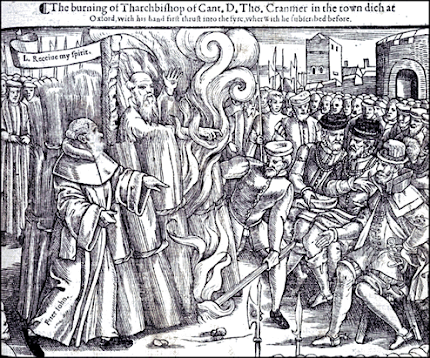
The burning of Tharchbishop of Cant. D. Tho. Cranmer in the town dich at Oxford, with his hand first thrust into the fyre, wherwith he subscribed before. [Click on the picture to see Cranmer's last words.]

Daily Bible Verse

Showing posts with label Thirty-Nine Articles: The Historic Basis of the Anglican Faith. Show all posts

Tuesday, June 04, 2013

Question 17: Short Catechism for Young Churchmen: What are good works?


Q. (17) What are good works?

A. "Good works are the fruits of faith, and follow after justification. They spring out necessarily of a true and lively faith, so that by them a lively (i.e. living) faith may be as evidently known as a tree discerned by its fruit."-(Art. XII; Phil. 1:11; John 15:4, 5; Gal. 5:6.)


Friday, April 19, 2013

Westminster Larger Catechism: Question 61

Question 61

Are all they saved who hear the gospel, and live in the church?

All that hear the gospel, and live in the visible church, are not saved; but they only who are true members of the church invisible. (John 12:38–40, Rom. 9:6, Matt. 22:14, Matt. 7:21, Rom. 11:7)


The Westminster Larger Catechism: With Scripture Proofs. (Oak Harbor, WA: Logos Research Systems, Inc., 1996).

For those Anglicans who would dispute this doctrine I am including a brief quote from the late Rev. Dr. D. Broughton Knox, former principal of Moore Theological College, Sydney, Australia, and George Whitefield College, South Africa.

The visible church is the congregation worshipping according to the Word of God, and there are as many visible churches as there are true congregations. The Articles do not speak specifically of the 'invisible Church' but have only passing references. It is a mistake to think that the Articles deny the concept of the invisible or mystical Church, or to misread Article 19 as though it began 'The Church of Christ is a visible congregation', as is frequently done.ii Nor is there any ground for the assertion of the Vicar of All Saints', Margaret Street, London, that 'The Church of Engand repudiates any notion of an invisible church.'iii The concept of the invisible Church was uniformly held by the Reformers and was affirmed as early as the Bishop's Book of 1537 and the Thirteen Articles of 1538. It would be very unlikely, and in fact is not the case, that the Thirty-Nine Articles repudiated the concept of the invisible or mystical Church of Christ, or fell into the mistake of which Hooker castigated when he wrote: 'For lack of diligent observing the difference between the church of God mystical and visible, the oversights are neither few nor light that have been committed'.iv
Article 19 is concerned with the church in its visible aspect -- the visible congregation. But the opening clause of Article 26 which also speaks of the 'visible Church' implies a contrast with the Church in its invisible aspect round the throne of God, where the evil is not mingled with the good. The word 'Church' appears to be used of the 'invisible' Church in Article 27, which states that 'they that receive Baptism rightly are grafted into the Church', the mystical body of Christ; for all without exception who outwardly receive baptism are admitted to the visible church. But right reception (Latin recte), that is with a believing heart, is the requisite for being engrafted into Christ and into the assembly gathered around Him in heaven.  [The Doctrine of the Church and Denominations, Chapter 9 of The Historic Basis of the Thirty-Nine Articles of Religion].

Thursday, August 30, 2012

Dwight L. Moody: Sovereign Grace and the Thirty-nine Articles of Religion


[Note:  This article is a quote from Dwight L. Moody's book, Sovereign Grace.  Charlie].

That is stronger than I ever put it. These Articles say of works before justification that “they have the nature of sin.” I never called them sin! So you see this is not any new doctrine that we are preaching. When the church and the world wake up to the fact that works before salvation go for nought, then—and not till then, I believe—men will come flocking into the kingdom of God by hundreds. We work from the cross, not to it. WE work because we are saved, not in order to be saved. -- Dwight L. Moody

WHAT THE THIRTY-NINE ARTICLES SAY. 

I find some people have accused me of teaching heresy, because I say salvation is all of grace. I remember once, a clergyman said I was teaching false doctrine because I said salvation was all of grace. He said that works had as much to do with our salvation as grace. At that time I had never read the Thirty-Nine Articles; if I had I should have been ready to meet him. I got the Prayer Book, and looked through the Thirty-Nine Articles; and I found, to my amazement, that they put it a good deal stronger than I had done.

Let us hear what they say—

XI. Of the Justification of Man. We are accounted righteous before God, only for the merit of our Lord and Saviour Jesus Christ by Faith, and not for our own works or deservings: Wherefore, that we are justified by Faith only, is a most wholesome doctrine, and very full of comfort.”

XII. Of Good Works. Albeit that Good Works, which are the fruits of Faith, and follow after Justification, cannot put away our sins, and endure the severity of God’s judgment; yet are they pleasing and acceptable to God in Christ, and do spring out necessarily of a true and lively Faith; insomuch that by them a lively Faith may be as evidently known as a tree discerned by the fruit.”

XIII. Of Works Before Justification. Works done before the grace of Christ, and the inspiration of His Spirit, are not pleasant to God; forasmuch as they spring not of faith in Jesus Christ, neither do they make men meet to receive grace, or (as the school-authors say) deserve grace of congruity: yea rather, for that they are not done as God hath willed and commanded them to be done, we doubt not but they have the nature of sin.”


That is stronger than I ever put it. These Articles say of works before justification that “they have the nature of sin.” I never called them sin! So you see this is not any new doctrine that we are preaching. When the church and the world wake up to the fact that works before salvation go for nought, then—and not till then, I believe—men will come flocking into the kingdom of God by hundreds. We work from the cross, not to it. WE work because we are saved, not in order to be saved. We work from salvation, not up to it. Salvation is the gift of God.

You have heard the Prayer Book: now hear Paul; “Abraham believed God; and it was counted unto him for righteousness. Now to him that worketh is the reward not reckoned of grace, but of debt. But to him that worketh not, but believeth on Him that justifieth the ungodly, his faith is counted for righteousness.” Notice what the Apostle says: “To him that worketh not.” That is plain language, is it not? I may perhaps startle some of you by saying that many of you have been kept out of the kingdom of God by your good works. Nevertheless it is true. If you put works in the place of faith, they become a snare to you. It is “to him that worketh not, but believeth.”  [Romans 4:3-5 KJV]

I freely admit salvation is worth working for; it is worth a man’s going round the world on his hands and knees, climbing its mountains, crossing its valleys, swimming its rivers, going through all manner of hardship in order to attain it. But we do not get it in that way. Paul went through all the trials and hardships he had to endure, because by the grace of God resting on him he was enabled to do so.


Moody, Dwight Lyman (2011-03-24). Sovereign Grace Its Source, Its Nature and Its Effects (Kindle Locations 110-134). Kindle Edition.

Sunday, February 19, 2012

David Broughton Knox Upholds Scripture as Propositional Truth


"In the last resort, the concept that God's revelation is in deeds can only be maintained by a forgetfulness that God is all-sovereign over the world. The fact is that there is no event which God controls more than another and, therefore, every event is equally revelational of some aspect of his character. Yet to say this is to say that no event is revelational in itself. For example, God controlled the migrations of the Syrians from Kir and the Philistines from Caphtor as completely as He brought up the Israelites out of Egypt (Amos 9:7). What is it then that makes the tribal migrations of the Israelites pregnant with revelation throughout the Old and New Testaments, while those of their related tribe, the Syrians, reveal only the one fact of God's general providence to which Amos alludes? Similarly, why are the invasions of neighbouring countries by the Assyrians, and the fate that overtook the Assyrians, revelational of God's character (see Isaiah 10), while the inter-tribal warfare of, say, the Maoris is not? It is not as though God's sovereign control is exercised any the more over the one, or any the less over the other, of these different events, but simply that to the one have been added interpretative propositions and statements, but not to the other. It is the proposition which is the revelation, giving meaning to the event. Through the proposition we know of God. The event, by itself, reveals nothing."

From:  The Nature of Revelation

Saturday, February 18, 2012

A Critical Review of The Christian Faith: A Systematic Theology for Pilgrims On the Way, Part One


Part One:  A Critical Review of The Christian Faith: A Systematic Theology for Pilgrims On the Way


Michael Horton. The Christian Faith: A Systematic Theology for Pilgrims On the Way. (Grand Rapids: Zondervan, 2011). 1,051 pages.

[See Part Two].

I have decided to do my review of Mike Horton's book in a series of articles. The reason for this is that I have fresh ideas about what I am reading as I read through the book from beginning to end. My first comments will deal with the introduction, The Dogma Is the Drama: A Theology for Pilgrims on the Way. Afterwards, I want to speak to several issues that Horton raises in Part 1: Knowing God: The Presuppositions of Theology. Section 1, Dissonant Dramas: Paradigms for Knowing God and the World.


The first thing the reader will note is that, unlike most systematic theologies written from a Reformed perspective, Horton does not begin with Scripture or the doctrine of Scripture as the primary means of God's special revelation to man. I am not sure what his reasoning for this approach might have been, so I will not speculate.


In his introduction, Horton defends the study of God as theology and doctrine or teaching. On the positive side, Horton emphasizes the need for a systematic exposition of Scripture and for dogma:


For many Christians, words such as doctrine and theology—and especially systematic theology—conjure up images of intellectual pride, divisiveness, and the presumption that we can put God in a box, neatly explained by our categories and formulations. Of course, we are nearly infinitely resourceful in using good things with corrupt motives and for less than noble ends. We can exhibit spiritual pride also in our experience or morality. However, it is the goal of good theology to humble us before the triune God of majesty and grace. (p. 13).


Admirably, Horton goes on to emphasize that knowing God in a personal relationship is informed by doctrine and theology. He wants us to understand that living the Christian life and “knowing doctrine” are not diametrically opposed but complementary sides of the same coin. (Pp. 13-14).


Beginning with page 14, however, I had a few alarm bells go off because Horton starts to discuss the Bible as if all that matters is the “drama” or the “story” told there. For Horton, it seems that the very words of God in verbal plenary inspiration are an afterthought to the big picture. Unfortunately, Horton's Van Tilian biases seem to have predisposed him to thinking that revelation takes place solely in history and not in the propositional truths revealed through Holy Scripture, the inspired Word of God. Although Horton wants to refute the liberal theologians and their appeal to Scripture as myth, he himself winds up trying to have it both ways:


Modern secularists often imagine that their most deeply held beliefs are not really beliefs at all, but more like a simple acknowledgment of facts. They suppose that they are not personally involved, and certainly they have no sense of these “facts” being interpreted through a wider set of assumptions (i. e., narrative). In fact, “telling a story” is often classified with myths and fairy tales. Although the cure can be worse than the disease if taken in excessive doses, postmodern criticism of the “myth of neutrality” or “the view from nowhere” offers a powerful antidote to the hubris of modern reason. (P. 14).


This will become a continual problem with reading Horton's book. In too many places he agrees with either postmodernist theories of truth or with neo-orthodox theories of revelation. For example, he ends up agreeing with C. S. Lewis, the infamous Anglo-Catholic, when Lewis claims that myth and fact are not necessarily opposed to one another:


We do not have to say that Christianity is a metanarrative to affirm that it is true. C. S. Lewis pointed out that Christianity is the true myth—the myth that actually became fact. “It happens—at a particular date, in a particular place, followed by definable historical consequences. We pass from a Balder or an Osiris dying nobody knows when or where, to a historical Person crucified (it is all in order) under Pontius Pilate. By becoming fact it does not cease to be myth.” In other words, it is still a story, even though it is true. Not even the resurrection is a metanarrative; its meaning cannot just be read off of the surface of historical events but is defined by its intratextual context as part of an unfolding plot. (P. 18).


The implications of these sorts of ideas are devastating to conservative Christianity and confessional orthodoxy. For Horton it seems that myth and revelation are one and the same thing, although he cautiously admits that the myth is based on facts. For Horton history is revelational and Scripture as the basis for that historical revelation seems to be an afterthought, not the main focus or main thrust of his thesis. How Horton's view differs in any practical way from neo-orthodoxy I can only speculate upon. For neo-orthodoxy historical revelation is indeed impossible but Barth's theology of Geschichte or inspired history outside of time is not a far step away from Horton's view that “Christianity is the true myth—the myth that actually became fact." (Ibid.). Horton further cites Geerhardus Vos in support of his emphasis on story rather than verbal plenary revelation in the inspired Bible:


The Christian faith is, first and foremost, an unfolding drama. Geerhardus Vos observed, “The Bible is not a dogmatic handbook but a historical book of dramatic interest.” The story that runs from Genesis to Revelation, centering on Christ, not only richly informs the mind; it captivates the heart and the imagination, animating and motivating our action in the world. (P. 19).


While it is true that Scripture is not always speaking in terms of dogmatic doctrine, it is a stretch to appeal only to the historical narratives as if that is the only genre included in the canon of Scripture. The Bible obviously does include extended dogmatic teaching, particularly in the pauline epistles and in the four accounts of the Gospel. The Bible is not simply historical events recorded in the interest of an inspiring and dramatic “story”. Nor is the Bible meant only to stir us emotionally, although it can and does do this at times. The Bible is not simply a written version of a Hollywood movie on the exodus from Egypt. The Bible contains extended teaching in both the Old Testament and in the New Testament. In fact, the word “Torah” means “teaching”. The “teaching” of Moses is a crucial part of the Old Testament. Although I understand that Horton is trying to make his systematic theology new and refreshing to a new, postmodern generation, it seems to me that he ends up conceding too much to neo-orthodoxy and postmodernism. He even speaks in glowing admiration of Karl Barth—as if Barth were a true teacher of the Gospel rather than a heretic who denied the authority of Scripture, revelation in the very words of Scripture or any idea of objective historical events recorded therein:


Although he often stood in a critical relation to Reformed orthodoxy, Karl Barth expressed his debt to these theologians for introducing him to the richness and depth of the church's dogmatic reflection—in sharp contrast with Friedrich Schleiermacher and liberal theology. As Barth began to prepare his Gottingen lectures, he expressed wonder at how his training could have skipped over the rich heritage of Protestant orthodoxy. (P. 31).


One has to wonder how Barth was a positive voice for orthodoxy when both Cornelius Van Til and Gordon H. Clark sharply criticized Barth's existential theology. Although Van Til's critique is at best weak, even Van Til strongly objected to Barth's attack on Reformed orthodoxy:


Only if we start with Luther and Calvin and their idea of God’s speaking directly in Christ and Scripture, do we have a Christ who chooses us before we choose him. (Van Til, C. (1962). Christianity and Barthianism. The Presbyterian and Reformed Publishing Company: Philadelphia.)


Unfortunately, Horton capitulates more to postmodernist ideas and neo-orthodoxy than Van Til himself did. But part of Horton's problem is that he rejects the Bible as propositional truth. He out and out attacks Carl F. H. Henry's view of Scripture as the verbally inspired Word of God in the form of logical and propositional truth claims. And even worse, Horton says that Gordon H. Clark's view of Scripture as the univocal Word of God is rationalist and confuses Scripture with God's being, something that Gordon H. Clark would have strongly disputed. These sorts of straw man misrepresentations of the Scripturalist position as a confusion of God's being with His revelation is not only wrong, it is for all practical purposes dishonest:


Like Scotus, however, many modern theologians (both conservative and liberal) have regarded the doctrine of analogy as a halfway house on the way to skeptical equivocity. If we cannot be sure that our predictions correspond exactly to the inner being of God, then how can we claim true knowledge? This charge has been leveled in recent decades, for example, by writers as diverse as liberal theologians Langdon Gilkey and conservative evangelical Carl F. H. Henry. According to Gordon Clark (Henry's mentor), truth is only given in the form of propositional statements and if our knowledge is only analogical of God's, we have no foundation for certainty. (P. 56).


Unfortunately, Horton does not seem to be aware of Clark's actual position or Carl F. H. Henry's true position since neither of these men would dare to say that we can know God's being univocally. God's being, according to both Clark and Henry, is incomprehensible. There is no dispute whatsoever here. In fact, Gordon H. Clark's defenders and he wrote a response to the false accusations of rationalism on the part of Cornelius Van Til and his supporters when Clark was charged formally with rationalism and other departures from the Westminster Confession during the Clark/Van Til controversy in 1944. At that time Clark was a professor at Westminster Theological Seminary, Philadelphia. (To read the charges click here: The Text of a Complaint. To read Clark's response click here: The Answer). What was at issue in the dispute between Van Til and Clark was the nature of God's special revelation in Holy Scripture. Is Scripture univocally the very words of God, the inspired and plenary verbal Word of God? Or is Scripture only an analogy of God's Word? Clark's critique of Van Til's position was so devastating that the Philadelphia Presbytery of the Orthodox Presbyterian Church overwhelmingly confirmed Clark's ordination and dismissed all charges. Not only was Clark's position not rationalist but Clark's view also did not violate the Creator/creature distinction as Van Til and his followers had falsely charged. Anyone willing to read Clark's response in the section, On Incomprehensibility, can see that Clark is not saying that we can know God's being in any way whatsoever. What Clark does says is that we can know what God has revealed in Scripture on that one single point of convergence. Unfortunately, the false accusations of Van Til have been perpetuated down to the present day and Horton's straw man caricature of Carl Henry's position and Gordon Clark's position is inexcusable, frankly. Clark goes to great lengths to show that Van Til's accusations were wrong. For example, The Answer says:


The view of the Complaint is that “God because of his very nature must remain incomprehensible to man” (P. 2, 3: O. 8); it is “not the doctrine that God can be known only if he makes himself known and in so far as he makes himself known” (ibid.). Moreover all knowledge which man can attain differs from the knowledge of God “in a qualitative sense and not merely in degree” (P. 4, 2; O. 15). Thus God's knowledge and man's knowledge do not “coincide at any single point” (P. 5, 3; O. 21). A proposition does not “have the same meaning for man as for God” (P. 5, 2; O. 20). Man's knowledge is “analogical to the knowledge God possesses, but it can never be identified with the knowledge” which God “possesses of the same proposition” (P. 5, 3; O. 21). “The divine knowledge as divine transcends human knowledge as human, even when that human knowledge is a knowledge communicated by God” (P. 3, 1; O. 9). “Because of his very nature as infinite and absolute the knowledge which God posseses of himself and of all things must remain a mystery which the finite mind of man cannot penetrate” (ibid.). This latter statement does not mean merely that man cannot penetrate this mystery unaided by revelation; it means that even revelation by God could not make man understand the mystery, for the preceding sentences assert that it is the nature of God that renders him incomprehensible, not the lack of a revelation about it. As the analysis proceeds, these quotations with the argument from which they are taken will be seen to imply two chief points. First, there is some truth that God cannot put into propositional form; this portion of truth cannot be expressed conceptually. Second, the portion of truth that God can express in propositional form never has the same meaning for man as it has for God. Every proposition that man knows has a qualitatively different meaning for God. Man can grasp only an analogy of the truth, which, because it is an analogy, is not the truth itself.

On the other hand Dr. Clark contends that the doctrine of the incomprehensibilty of God as set forth in Scripture and in the Confession of Faith includes the following points: 1. The essence of God's being is incomprehensible to man except as God reveals truths concerning his own nature; 2. The manner of God's knowing an eternal intuition, is impossible for man; 3. Man can never know exhaustively and completely God's knowledge of any truth in all its relationships and implications; because every truth has an infinite number of relationships and implications and since each of these implications in turn has other infinite implications, these must ever, even in heaven, remain inexhaustible for man; 4. But, Dr. Clark maintains, the doctrine of the incomprehensibility of God does not mean that a proposition, e. g., two times two are four, has one meaning for man and a qualitatively different meaning for God, or that some truth is conceptual and other truth is non-conceptual in nature.

Here is the crux of the issue. By insisting that God's knowledge is qualitatively different from that of man and that “his knowledge and our knowledge” do not “coincide at any single point,” the Complaint is advancing a theory of a two-fold truth; while Dr. Clark holds that the nature of truth is one, that if man knows any item of truth, both God and man know that same identical item, and that on this item God's knowledge and man's knowledge coincide. According to the Complaint man can never know even one item of truth God knows; man can know only an “analogical” truth, and this analogical truth is not the same truth that God knows, for the truth that God knows is “qualitatively” different, and God cannot reveal it to man because man is a creature. To repeat: the truth that God knows and the truth that man knows are never the same truth, for they do not “coincide at any single point.” God's knowledge therefore would be incomprehensible to man for the specific reason that God could not reveal any particular fact about it without destroying the “Creator-creature relationship.” Dr. Clark holds that God can reveal any item of knowledge in propositional form without destroying the Creator-creature relationship, and that such a revealed proposition has the same meaning for God and for man when, as is sometimes the case, man understands it. (From: On Incomprehensibility).

Horton wishes to disguise his departure from traditional and orthodox confessional Reformed theology by placing his attack on the univocal nature of God's special revelation in Holy Scripture in a section on the philosophical worldview of Christianity, along with his Van Tilian presuppositions--which presuppositions are not straightforwardly admitted but instead are only obliquely referenced. (Pp. 56-57). As you can see from the above quote, Clark's position is not that we can know everything about God but that we can know what God reveals in the plenary verbal form of written Scriptures. The axiom that Clark developed is that the Bible is the Word of God, without equivocation. Horton, like most neo-Van Tilians, wishes to equivocate and vacillate back and forth between lip service to inerrancy and verbal inspiration and his essentially new version of neo-orthodoxy that emphasizes the “story” of Scripture and that Scripture is basically historical events that are inspired myths, though he concedes these “myths” are factual. (P. 18). For Horton, it is not the words of Scripture that are determinative of doctrine but the big story and the historical events:

The great doctrines of the Christian faith arise out of this dramatic plot. “And the Word became flesh and dwelt among us, and we have seen his glory, glory as of the only Son from the Father, full of grace and truth.” (John 1:14). Where the world's religions focus on timelessly eternal truths, the most important teaching of Christianity concern historical events. There was once a time when the Son was not incarnate and had not yet won our redemption at Golgotha. Yet we live on this side of that divine achievement. (P. 20).

Horton's disdain with the idea that doctrine can be logical and propositional seethes from almost every page of the introduction and the section on knowing God:

Separated from its dramatic narrative, doctrine becomes abstract, like mathematical axioms. However, if we focus on the Christian story (the tendency of some narrative theologies), we miss the crucial implications of that plot and the inner connections between its various sequences. (P. 21).

In short, the “grammar” of Christianity for Horton is not propositional truth and understanding doctrine logically and rationally. For Horton doctrine is about events, stories, inspired and factual myths, and analogical truths that may or may not be what God knows and reveals at all. This sounds more like neo-orthodoxy than confessional Reformed theology.

Unfortunately, the Westminster Confession refutes Horton's postmodernist point of view:

6. The whole counsel of God, concerning all things necessary for His own glory, man's salvation, faith and life, is either expressly set down in Scripture, or by good and necessary consequence may be deduced from Scripture: unto which nothing at any time is to be added, whether by new revelations of the Spirit, or traditions of men. Nevertheless, we acknowledge the inward illumination of the Spirit of God to be necessary for the saving understanding of such things as are revealed in the word; and that there are some circumstances concerning the worship of God, and government of the Church, common to human actions and societies, which are to be ordered by the light of nature, and Christian prudence, according to the general rules of the word, which are always to be observed. (Westminster Confession of Faith, Chapter 1.6).


More critical examination of Horton's systematic theology will follow soon. Stay tuned.


Peace,


Charlie

Addendum:  One has to wonder why Horton winds up sounding more like an agnostic at some points instead of a conservative theologian?  If our knowledge of what God communicates does not coincide at any single point, then how do we know that the cross satisfies for all the sins of the elect?  Maybe there's something God knows that we do not know when God communicates that doctrine to us in the inspired and written Scriptures? 

Also, if according to Horton, all of Scripture is like the metaphors he mentions, then what Horton is really saying is that Scripture is indeed just a huge metaphor.  This is particularly true when Horton attacks the doctrine of Scripture as propositional truth:

. . . For a certain proposition to be true, according to this perspective, it must mean exactly the same thing for God as it does for us.  
Especially as refined by Protestant scholasticism, however, the doctrine of analogy affirms that finite and creaturely knowledge is nevertheless true knowledge because it has its ultimate source in God even though it is not identical with God's knowledge.  (P. 57).
Like other Van Tilians, Horton confuses the doctrine of incomprehensibility, which no Clarkian denies, with the doctrine of special revelation.  For example, when we say that Jesus died on the cross, that truth is precisely the same truth both for us and for God.  Of course, God knows more than we do about His covenant of redemption and His eternal decrees.  But on that one point of doctrine--which by the way is not a myth but an historical fact recorded in the infallible and inerrant and inspired Word of God--what we know and what God knows does coincide exactly.  2 + 2 = 4 for both God and for us, although God's knowledge of mathematics surely exceeds ours.  If there is no single point of convergence between our knowledge and God's knowledge even in special revelation, then for all practical purposes your theology of analogy is to make Scripture merely a metaphor for truth, not doctrinal truth itself.

For Horton, it is impossible for us to know absolute truth in any respect whatsoever.  Only God knows absolute truth:
Creatures can obtain finite knowledge (dependent truth) because God possesses infinite knowledge (absolute Truth).  Therefore, against certain forms of postmodern theory, Christian theology affirms that there is a God's-eye perspective from which genuine truth can be communicated, but, against the tendency of modern thought, it denies that anyone but God occupies this privileged perch.  We must be satisfied with God's Word and leave God's sovereign knowledge to himself.  (P. 57).
Horton is not being honest here.  His view of Scripture is that it is not the very words of God but merely an analogy of God's words.  What is worse, Horton's appeal to the Reformers as supporting his view is simply untrue.  Although the Reformers did affirm the doctrine of the incomprehensibility of God and the Creator/creature distinction, they did not say that Scripture is not propositional truth or absolute truth nor did they say that Scripture does not converge with God's knowledge at any one single point of reference.  That is Horton reading his Van Tilian presuppositions into the Reformers and into Scripture itself.

Perhaps Horton is unaware of the implications of his position.  But nevertheless endorsing Van Til's theory of analogy and reading postmodernist views into 16th and 17th century Reformed scholasticism and their understanding of the archetypal/ectypal distinction is disingenuous.  For Horton Scripture and truth must in the end be merely relative.  Unknowingly, Horton winds up agreeing with Immanuel Kant that revelation is impossible because God is absolute and we are finite.  All that matters is theology from below.  Special revelation is finite and therefore cannot univocally be propositional truth or absolute truth, even in any single point of convergence.  Maybe Jesus did not really die only for the elect?  Maybe that truth is optional?  Maybe that is why Horton can fellowship with semi-pelagian Arminians without batting an eye?

Addendum Two:

David Broughton Knox:


Denial of 'propositional revelation' makes Christian faith logically impossible in its fullest and deepest expression of trust, for it is impossible to trust absolutely unless we have a sure Word of God. Such denial restricts Christianity to a religion of works, that is, to following Jesus Christ as best we can. Moreover, denial of propositional revelation makes the lordship of Christ impossible of actual realization, for it is only by the sceptre of His Word that he can exercise that absolute lordship over men's consciences and wills which is His by right. For it is wrong to give absolute obedience to an uncertain command or to place absolute trust on an uncertain promise. Indeed, obedience to God as an element in the Christian life implies a command from God to obey. If there is no such revealed command (which is apprehended as a proposition) obedience gives place to prudence, that is, to the doing of what seems right in one's own eyes.  From:  The Nature of Revelation


-->

Saturday, January 21, 2012

Conspiracy of the Anonymous « God's Hammer

It looks like a cover-up is underway in the Presbyterian Church in America. Now it seems that bloggers reporting on heresy trials and such is more problematic than the actual heresies that are arising within the PCA. Sean Gerety reports on this on the God's Hammer blog article, Conspiracy of the Anonymous:

Now, the focus of the meeting, at least according to byFaith, was to “ease denominational tension” that has been caused, not by false teaching and the false gospel that continues to spread like cancer virtually unabated throughout the PCA, but by bloggers and a narrow minded faction within presbyteries (read TRs) who are evidently too concerned with orthodoxy when examining candidates seeking ordination in the PCA. According to one nameless attendee; “At the presbytery level, pockets of the PCA have become overly concerned with measuring orthodoxy.” Oh, my. We can’t have that. Of course, this raises the question what else should those at the presbytery level be concerned with when examining candidates for ministry besides measuring a candidate’s level of orthodoxy? Admittedly, there are other variables that need to be taken under consideration when someone is seeking ordination like can he teach or does he become tongue-tied or break into a sweat when speaking before a room full of people. Beyond that his personal character, maturity in the faith, along with his ability to manage his family are all areas to be examined. However, I would have thought that measuring the orthodoxy of prospective pastors would be the primary concern of those at the presbytery level. In fact, PCA BCO 21 requires a “careful examination” (would that be same as a precise examination) of a candidate’s “knowledge of the Greek and Hebrew languages, Bible content, theology, the Sacraments, Church history, the history of the Presbyterian Church in America, and the principles and rules of the government and discipline of the church.”


To read the rest of Sean's comments click here: Conspiracy of the Anonymous « God's Hammer


As an aside, I always point out that The Trinity Foundation and the God's Hammer blog have apparently endorsed the Nestorian views of Gordon H. Clark's final book, The Incarnation.  Although I generally support the work of The Trinity Foundation, I believe that Nestorianism is as serious a departure from confessional Reformed teaching as the Federal Vision or the New Perspectives on Paul. This is true because there is only one mediator between God and man. He must be both divine and human to fully execute the penal substitutionary atonement in the place of the elect persons chosen by God before the foundation of the world.

See:

Thirty-nine Articles of Religion: Article II

Of the Word, or Son of God, which was made very man

The Son, which is the Word of the Father, begotten from everlasting of the Father, the very and eternal God, and of one substance with the Father, took man's nature in the womb of the blessed Virgin, of her substance: so that two whole and perfect natures, that is to say, the Godhead and manhood, were joined together in one person, never to be divided, whereof is one Christ, very God and very man, who truly suffered, was crucified, dead, and buried, to reconcile His Father to us, and to be a sacrifice, not only for original guilt, but also for all actual sins of men.


Wednesday, August 19, 2009

Part XX: Thirty-Nine Articles: The Historic Basis of the Anglican Faith: The Articles Incomplete


". . . A modern confession must strive to express what the Scriptures have to say to the world of today."


Thirty-Nine Articles: The Historic Basis of the Anglican Faith

A book by David Broughton Knox (Sydney: Anglican Church League, 1967).

The author: Canon David Broughton Knox, B.A., A. L. C. D., B.D., M.Th., D. Phil. (Oxford), was Principal of Moore Theological College, Sydney, Australia. Ordained in 1941 he served in an English parish and as a chaplain in the Royal Navy before becoming a tutor at Moore College 1947-53. On leave in England he was tutor and lecturer in New Testament at Wycliffe Hall, Oxford 1951-53 and Assistant Curate in the parish of St. Aldale's, Oxford. He became Vice Principal of Moore College in 1954 and Principal in 1959. He was elected Canon of St. Andrew's Cathedral in 1960. His other books include "The Doctrine of Faith in the Reign of Henry VIII" (London: James Clarke, 1961).

David Broughton Knox also founded George Whitefield College in South Africa in 1989.


Chapter Nine

The Articles Incomplete

In conclusion it may be said that there is room for a verbal revision of the Articles to remove some of the obscurities of the language in order to make clear their original meaning. But this sort of merely verbal revision of the Articles would absorb a lot of time and talent which is not worth spending for the small gain in clarity here and there. It is better to allow them to stand as they are, in their Elizabethan English.

Because the Articles were written four hundred years ago it is natural that there are some matters touched on which are less important in our current situation than they were in the sixteenth century. This is no reason for dropping these statements, since they are in themselves correct. Similarly, there are matters which have come to the fore during the last four hundred years and which seem important to the modern Church, but which the Articles omit to treat. In this sense the Articles are incomplete, and there may well be room for a supplementary confession. Both Dean Matthews and Professor Lampe stress the point that the Articles do not deal with some topics of current importance. This in itself is no argument for dropping the Articles, but it does suggest that it might be advisable for the modern Church to put out a supplementary confession which incorporates the Articles, in the same way as the Articles have incorporated the earlier Creeds, but which goes on speak on topics on which the Articles are silent. But it is a matter of fundamental importance that any such statement by the modern Church should follow the same principles of construction as the Creeds and the Articles themselves. That is to say, a modern confession must strive to express what the Scriptures have to say to the world of today.

The historical position of the Church of England is that the Scriptures are sufficient, and that the principles they enunciate are adequate for all human situations. It may be that we need to incorporate those principles in further Articles or other form of confession which speaks to our modern situation. In this way the Church of England would become once more a confessing Church, confessing the faith in the presence of today's form of unbelief and misbelief. But if our denomination were to decide to supplement in this way the Creeds and Articles already agreed upon, it is essential that it should proceed by the method of basing such a confession quite firmly on the historical Christian doctrine revealed in Holy Scripture, so as to ensure that the declaration prefixed to the Articles might continue to be 'that the Articles of the Church of England . . . do contain the true Doctrine of the Church of England agreeable to God's Word'.

[This completes the book.]
The Tenth Sunday after Trinity.
The Collect.
LET thy merciful ears, O Lord, be open to the prayers of thy humble servants; and that they may obtain their petitions make them to ask such things as shall please thee; through Jesus Christ our Lord. Amen.

Part XIX: Thirty-Nine Articles: The Historic Basis of Anglican Faith: Denominational Association

"Thus, on doubtful or less important doctrines the Articles are rightly silent. But ambiguity which aims at the same liberty which silence provides is a false and unworthy method for association, and there is no evidence that the Articles proceed by such a method."

"Members of a Christian association which has a doctrinal basis, as has the Church of England, should be expected to hold that basis themselves, especially if they receive remuneration from their membership."

Thirty-Nine Articles: The Historic Basis of the Anglican Faith

A book by David Broughton Knox (Sydney: Anglican Church League, 1967).

The author: Canon David Broughton Knox, B.A., A. L. C. D., B.D., M.Th., D. Phil. (Oxford), was Principal of Moore Theological College, Sydney, Australia. Ordained in 1941 he served in an English parish and as a chaplain in the Royal Navy before becoming a tutor at Moore College 1947-53. On leave in England he was tutor and lecturer in New Testament at Wycliffe Hall, Oxford 1951-53 and Assistant Curate in the parish of St. Aldale's, Oxford. He became Vice Principal of Moore College in 1954 and Principal in 1959. He was elected Canon of St. Andrew's Cathedral in 1960. His other books include "The Doctrine of Faith in the Reign of Henry VIII" (London: James Clarke, 1961).

David Broughton Knox also founded George Whitefield College in South Africa in 1989.


Chapter Nine

Denominational Association

In such a visible church, where there is believing fellowship in prayer and God's Word, and where as a consequence the Holy Spirit is present according to Christ's promise, there is plainly less need of a binding doctrinal statement as a basis of association. God's Word mutually ministered and accepted is sufficient. But in the course of centuries churches have become linked in exclusive groupings, as, for example, as has been mentioned, the Novation, Catholic and Donatist churches in the ancient world, and in our own time the various Catholic and Protestant denominations. These groups are usually called Churches, though in fact they have no biblical prototypes. They differ from churches in that they never assemble, nor form a congregation in which the pure Word of God can be preached so as to do its work of informing and correcting the mind and the conscience. Now if such an association in groups is to be helpful to the churches concerned, it is necessary that there should be a clear doctrinal basis for the association, and this is especially needed when, as in most denominational groups, the central organization of the denomination has taken over some of the duties of the congregation, in particular the duty of ensuring that the pure Word of God is preached within it, by the selecting and disciplining of the ministers. More frequently than not, the denomination has a large say in the appointment of the minister of the church, and in the discipline of church members, including the minister. The denomination also very often regulates the worship of the church. In this way the denomination has taken over the duty of ensuring that the pure Word of God is preached and the sacraments duly administered in the way that Christ ordained, on which, according to Article 19, the very existence of the visible church depends. It is therefore a matter of absolute necessity that the denominational association should have a doctrinal basis.

The need for a clear and full doctrinal basis for denominational association is enhanced by the financial sanctions which the denomination comes to possess over the church or the congregation. The denomination attracts to itself gifts and legacies in trust, which its central organization and office-bearers administer. Grants in aid of ministers' salaries or superannuation, or the awarding of theological bursaries, are examples. Moreover, in some denominations the property which the Church finds convenient to use, such as the church building where it meets, or the house for its minister, is owned or controlled by the denomination. This arrangement is often convenient and helpful, but it puts the possibility of powerful financial sanctions into the hands of those in charge of the central organization. It is a 'this-worldly' type of sanction and has nothing at all in common with the spiritual sanctions or discipline which alone should be exercised in the congregation, namely, the Word of God. for God's Word has the power when it is faithfully ministered to convict a regenerate conscience, and to move the will of the child of God (II Corinthians 7:8-11).

To minimize the possibility of the central organization tyrannizing over ministers of the Gospel in the church, it is not only necessary to have carefully articulated church law (i.e., denominational rules) which preserve the exercise of spiritual principles to the minister and the congregation, and to keep these rules; it is also necessary to have a carefully articulated theological statement which controls all the lawmaking of the denomination's legislative body, and to which assent is required from the ministers which the denomination sends to the churches.

If the denominational association is to be stable, and to serve the purposes for which it was brought into being, it is essential to have a doctrinal basis for the association. Though this theological statement should at every point be based on Scripture, Scripture itself was not written as a document for a basis of association of churches and it is not suitable for this purpose. Yet a doctrinal basis of association is necessary especially when the association takes a form in which the churches hand over to the central organization of the association so many vital matters which concern their own continuance as truly Christian churches. In these circumstances it goes without saying that any assent given to a doctrinal basis of association must be given ex animo,1 and that any required statement of belief that the basis is agreeable to the Word of God must be meant unequivocally. On the other hand, proper liberty for Christian thought should be preserved within the terms of association. Thus, on doubtful or less important doctrines the Articles are rightly silent. But ambiguity which aims at the same liberty which silence provides is a false and unworthy method for association, and there is no evidence that the Articles proceed by such a method.

Members of a Christian association which has a doctrinal basis, as has the Church of England, should be expected to hold that basis themselves, especially if they receive remuneration from their membership. Occasionally clergy leave the Church of England for doctrinal reasons and this is straightforward action. According to the rules of the association mutually agreed upon (e.g., Canon 5 of 1604), roundly to denounce the doctrinal basis as full of erroneous doctrines (as some modern churchmen have done) is automatically to exclude oneself from membership of the association (and so disqualify oneself for holding preferment within it). This also is straightforward and honest. In negotiations for denominational amalgamation the Articles can play a useful part. A question that should asked and answered early in the negotiations is how the negotiating churches stand with regard to the Articles. Not all the Articles are of equal importance for a basis of association. This has been recognized from the beginning. For example, the Act of 1571 which required the clergy to assent to the Articles restricted the requirement to those Articles 'which only concern the true Christian faith and the doctrine of the sacraments'iv; and by the Act of Toleration of 1689 dissenting ministers were required to subscribe only the doctrinal Articles and not those which treated of church polity, namely Articles 34, 35, 36 and the opening clause of Article 20.v But some of the Articles are crucial for any denominational association, and it would be a more straightforward and satisfactory method for the negotiating parties to state how they stood with regard to these than to draw up a new doctrinal statement.


1From the heart: sincerely.
ivHardwick: A History of the Articles of Religion (1851), pp. 217f.
vGee and Hardy: Documents Illustrative of English Church, p. 638.
The Tenth Sunday after Trinity.
The Collect.
LET thy merciful ears, O Lord, be open to the prayers of thy humble servants; and that they may obtain their petitions make them to ask such things as shall please thee; through Jesus Christ our Lord. Amen.

Part XVIII: Thirty-Nine Articles: The Historic Basis of Anglican Faith: Are the Articles Necessary?


"A religion of revelation which is given in the events and words of history must be dogmatic in character. But doctrine that is founded on nothing but enthusiasm, that is to say, on current opinions whether of the individual or of a group, or on opinions sufficiently long held to be called tradition, is unstable and gives promise of no permanence in the future."


Thirty-Nine Articles: The Historic Basis of the Anglican Faith

A book by David Broughton Knox (Sydney: Anglican Church League, 1967).

The author: Canon David Broughton Knox, B.A., A. L. C. D., B.D., M.Th., D. Phil. (Oxford), was Principal of Moore Theological College, Sydney, Australia. Ordained in 1941 he served in an English parish and as a chaplain in the Royal Navy before becoming a tutor at Moore College 1947-53. On leave in England he was tutor and lecturer in New Testament at Wycliffe Hall, Oxford 1951-53 and Assistant Curate in the parish of St. Aldale's, Oxford. He became Vice Principal of Moore College in 1954 and Principal in 1959. He was elected Canon of St. Andrew's Cathedral in 1960. His other books include "The Doctrine of Faith in the Reign of Henry VIII" (London: James Clarke, 1961).

David Broughton Knox also founded George Whitefield College in South Africa in 1989.


Chapter Nine

Are the Articles Necessary?

But Professor Lampe has raised another question which is prior to the question of revision, or even of the maintenance of the status quo, and that is whether the Church of England needs Articles at all. Are they really necessary? Should they be dropped as a doctrinal statement and the Church remain content merely with the Creeds? This is what Professor Lampe advocates. He believes that the Articles should be retained as an important historical document of the Church of England, witnessing to its beliefs at the time that it separated itself from the Church of Rome in the sixteenth century, but that the Church should now proceed without requiring any assent either to them or to any other Articles which might take their place. He writes: "Our best course would be to dispense with Articles, retaining the thirty-nine but explicitly recognizing them to be an important document of our church which no longer serves its original function and to which no form of subscription should now be required."iii

The cancelling of the requirements for assent to the dogmatic statements of the Articles would be in keeping with the present temper of protestantism which since the rise of pietism (as exampled by the Quakers) has seen the progressive eroding of the importance of dogma in Christianity. Luther saw the danger when he wrote in the Smalcald Articles (III:8): "Enthusiasm" (that is, piety that does not stick to the Word of God) "clings to Adam and his descendants, and it is the strength, source and power of all heresies including those of the papacy and of Mohommet." Undogmatic Christianity has very largely replaced the Christian faith of the Reformation amongst Protestants. This attitude can give no value to the requirement of assent to dogmatic statements, but sees this only as a burden, so that even if the assent is still given in accordance with inherited requirements, it is not treated with seriousness. There is, however, no future for undogmatic Christianity -- that is, for a Christianity that follows wherever the thoughts of its current theological leaders may lead -- because Christianity is essentially, and always has been historically, a dogmatic religion. When Jesus asked his disciples, "Whom say ye that I am?"and asked His adversaries, "What think ye of Christ, whose son is he?" He incorporated dogma as integral part of the Christian faith. A religion of revelation which is given in the events and words of history must be dogmatic in character. But doctrine that is founded on nothing but enthusiasm, that is to say, on current opinions whether of the individual or of a group, or on opinions sufficiently long held to be called tradition, is unstable and gives promise of no permanence in the future. Historical Christianity is thoroughly dogmatic, and has an unchanging basis for its doctrines -- the inspired teaching of the Scriptures -- though it is always open to an improved understanding of what this unchanging basis teaches.

The Christian faith must always adhere closely to the Word of God, which means that it will be characterized by dogma. But this does not in itself answer the question whether the Church needs Articles apart from the Word of God in Holy Scripture to incorporate that dogma. At first sight it might seem that it does not. If the visible church is defined as "a congregation of faithful men, in the which the pure Word of God is preached, and the Sacraments be duly administered", what more is needed than this word of God preached within the context of the faithful congregation? The answer is that nothing more is needed; but this does not mean that the Church of England can do without Articles or the requirement of assent to them from its office bearers. The solution to the paradox is the distinction between the church and the denomination which also goes by the name of church, and unless this distinction is clearly kept much confusion in many areas of theology and ecumenical endeavor results. The visible church is rightly defined by the nineteenth Article as "a congregation of faithful men, in the which the pure Word of God is preached, and the Sacraments be duly administered according to Christ's ordinance". Such a visible church does not necessarily need Articles, nor assent to Articles, in order to preserve the true Christian faith within its fellowship, so long as the congregation retains and exercises its authority and duties as a congregation. The Christian congregation's duty is to exhort one another as to the mind and will of God, and to admonish one another whenever any deviation from the revealed mind of God shows itself.

This exhortation and admonition by members of the congregation one of another includes, of course, exhortation and admonition of those ministers whom the Spirit of God has placed in the congregation. Only those who worship together and know one another in daily life, can truly exercise pastoral care over one another. By mutual exhortation and "submitting yourselves to one another in the fear of God" (Ephesians 5:21) the preaching of the Word of God is kept within the doctrines of the Word of God. For by exhortation and admonition from the hearer the preacher prompted by his Spirit-led mind and conscience responds to the exhortation and so keeps within the revealed Word of God, just as the preacher, by the exercise of his gift, maintains and builds up the spiritual understanding and Christian character of the congregation. Thus the pastor of the pastors is the congregation itself. Moreover, if any member of the congregation (whether pastor or not) is not subject to admonition based on the Word of God (for only 'godly admonition' binds the Christian's conscience) then the New Testament makes clear that it is every Christian's duty to withdraw his fellowship from such a brother who walks disorderly.

Next Section

iii The Articles of the Church of England, p. 111.

The Tenth Sunday after Trinity.
The Collect.
LET thy merciful ears, O Lord, be open to the prayers of thy humble servants; and that they may obtain their petitions make them to ask such things as shall please thee; through Jesus Christ our Lord. Amen.

Support Reasonable Christian Ministries with your generous donation.