>

Martyred for the Gospel

Martyred for the Gospel
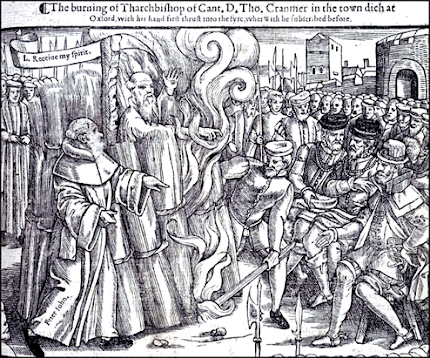
The burning of Tharchbishop of Cant. D. Tho. Cranmer in the town dich at Oxford, with his hand first thrust into the fyre, wherwith he subscribed before. [Click on the picture to see Cranmer's last words.]

Daily Bible Verse

Showing posts with label Nestorianism. Show all posts

Friday, May 05, 2017

Book Review: The Presbyterian Philosopher


Book Review: The Presbyterian Philosopher: The Authorized Biography of Dr. Gordon H. Clark

By Charlie J. Ray, M. Div.

Douglas Douma. The Presbyterian Philosopher: The Authorized Biography of Gordon H. Clark. (Eugene: Wipf and Stock, 2017). Ebook edition.

Douglas Douma has done us all a great service with the research and effort he has put into writing this biography of the late Dr. Gordon Haddon Clark, a controversial figure by all accounts. The reason for the controversy, however, is not what you might think. In fact, the reason Clark was a controversial figure is that he was unafraid to challenge bad theology and bad doctrine. Dr. Clark was one of the most ardent defenders of the doctrine of Sola Scriptura in the 20th century. He not only upheld the doctrine of the plenary verbal inspiration of the Holy Scriptures, following the old line Princeton theologians, but he also faithfully defended the doctrine of the infallibility and inerrancy of Scripture. Dr. Clark held that Scripture alone is the word of God and that because God is Logic (John 1:1) the Scriptures themselves are logical and propositional revelation from God and therefore perspicuous and plain precisely because God himself is intellectual, intelligible, and rational in his tri-personal being. If the Scriptures can mean anything, according to Dr. Clark, they mean nothing at all. That is, the Scriptures must have a definite meaning and exegesis. The Scriptures are not open to any and every exegetical interpretation.

We live in troubled times. Evangelicals have sold their Evangelical and Protestant birthright to mainline Protestant liberalism and neo-orthodoxy without even realizing what they have done. Although Dr. Clark would not like this illustration, he could be called the Mr. Spock of Presbyterianism. That's because Clark held that the Bible is not a book of psychological experiences, ecstatic experiences or emotionalism. According to Clark, replacing doctrine with psychological categories of thought undermines the dogmatic emphases of the Scriptures and leads ultimately to skepticism, liberalism, and even atheism. Even his friend and mentor, Dr. J. Gresham Machen, who was forced out of Princeton Seminary and the Presbyterian Church of the United States, said that liberal Christianity and classical Protestant Christianity are two different religions. For Dr. Clark the Bible is a rational revelation from God that can be understood logically and propositionally. Further, Clark held that propositions can be systematized; because logical propositions are all interrelated other propositions can be deduced from certain other propositions.

While Douglas Douma's book purports to be an authorized biography of the late Dr. Gordon H. Clark, it is much more than that. In fact, the book's first three chapters provide much biographical information. The heritage of Dr. Clark seems to have been a great influence on his theological formation prior to his going off to study philosophy at the University of Pennsylvania, an Ivy League school. Clark's grandfather and father were both Presbyterian ministers and Clark had numerous conversations on these matters with both men, not to mention that the young Gordon H. Clark had access to read many classical theological works written by the Puritans and the 19th century Calvinist theologians because of his father's extensive theological library. It should also be pointed out that Clark was an only child and had plenty of intellectual stimulation from both his parents.

The next few chapters deal with the ordination controversy and the theological issues behind the controversy. And several other chapters deal with Clark's views on empiricism and other issues. Unfortunately it is difficult to cover eighty years of Gordon Haddon Clark's life and fully deal with all of his philosophical views and theological views in such a brief book. Douma does an admirable job of doing this but I think he was too easy on the Van Tilians and probably had some influence from John Frame and Kenneth Talbot to soften the edge a bit. This is particularly true of Douma's assertion that the authors of the Complaint revised their view to say that there was some element of coincidence between the Bible and what God knows. But in the appendix of the book, Dr. Gordon H. Clark says the opposite is true. The retraction paper did not in any serious way deal with Dr. Clark's objections to Cornelius Van Til's doctrine of the incomprehensibility of God. In the body of the book, Douma says that the complainants retracted their attack on Dr. Clark's view that the Bible is univocally the very words of God. According to an email conversation I had with Douglas on this issue he said that the timeline was wrong and that Clark's paper presented in the appendix was written prior to the retraction written by the complainants. This does appear to be the case but there was an earlier retraction on mimeographed paper and it is to this earlier retraction that Clark responds in his paper. Since the supporters of Van Til continue to this day to mispresent Clark's views, I would contend that Clark's assessment of the earlier retraction most likely still applies to the later retraction. That's because Clark never again mentions any changes in Van Til's views. In his paper Clark says:

It is true that at one point the papers [sic] seems to withdraw from the position of the Complaint. On page 3 it says, "Truth is one. And man may and does know the same truth that is in the divine mind . . . " This statement is entirely acceptable because it flatly contradicts the Complaint. And if the paper as a whole consistently maintained this view, it too would be acceptable. But it is soon seen that this, which seems to be a retraction is but a temporary and superficial lapse from their fixed doctrines. The very same paragraph continues to say that man "cannot possibly have in mind a conception to eternity that is identical or that coincides with God's own thought of his eternity." This is nothing else than the doctrine of the Complaint over again. In the first lines of the paragraph they say that man can have the same truth that is in the divine mind, and immediately below they say that man cannot have the concept of eternity. The conception of eternity that the complainants have—not God's conception of eternity—is the conception of endless years. If this is not God's conception of eternity, it must follow that the complainants have the wrong conception of eternity. Man, according to them, cannot know that God is eternal; he can only know that God has endless duration. Endless duration is an analogy of eternity. God has the truth; man has only an analogy of the truth, and he can be quite sure that he does not have the truth itself.

Dr. Gordon H. Clark. "Appendix C. Studies of the Doctrine of the Complaint". Douglas Douma. The Presbyterian Philosopher: The Authorized Biography of Gordon H. Clark. (Eugene: Wipf and Stock, 2017). Ebook edition.

Nota Bene: I am unable to give an accurate page number due to the epub reader I am using.

Interestingly the proponents of Dr. Cornelius Van Til's theology continue to charge Clark with rationalism. Of course Dr. Clark was not a rationalist because he started with the axiom of Scripture, not with reason or rationalist arguments for God's existence.

Furthermore, Van Til claimed to reject both rationalism and irrationalism but in fact embraced both as his starting points. First, Van Til was an irrationalist because he said that man's logic does not apply to God because there is no point of coincidence or univocal knowledge between God and His creatures. Interestingly enough, by Van Til's own theology this would not be possible to know because that would be prying into the incomprehensibility of God as Van Til defines incomprehensibility as unintelligibility and unknowability. How does Van Til know that God has feelings and emotions or that God has no logical coincidence with "mere human logic"? And why do I say that Van Til was a rationalist? I say that because consistent with Van Til's Thomist views he tried to prove God exists by way of the transcendental argument for God's existence. Basically this is just another version of the ontological argument. Because we can conceive of no higher being than God then God must exist, otherwise we could not conceive of such a being with so many perfections.

The TAG is a transcendental argument that attempts to prove that God is the precondition for logic, reason, or morality. The argument proceeds as follows:

God (most often God is defined as the supreme entity found in Christianity), is a necessary precondition for logic and morality.

People know things (have logical, and moral intuitions).

Therefore, God exists.

Cornelius Van Til likewise wrote:

"We must point out ... that univocal reasoning itself leads to self-contradiction, not only from a theistic point of view, but from a non-theistic point of view as well... It is this that we ought to mean when we say that we reason from the impossibility of the contrary. The contrary is impossible only if it is self-contradictory when operating on the basis of its own assumptions."

— (A Survey of Christian Epistemology [Philadelphia: Presbyterian and Reformed, 1969], p. 204).

From: Wikipedia: "Transcendental Argument for the Existence of God".


It is not clear to me why Van Til thought that univocal revelation in the Bible is a self-contradiction. Did Van Til really believe the Bible is special revelation from God? And exactly what was Van Til arguing? That it is impossible for God to not exist? The "impossibility of the contrary" seems to mean that the assertion that God does not exist is an impossibility to the contrary. But why Van Til thought this was true still is not clear.

On the other hand, Dr. Clark thought that Van Til was advocating a version of the cosmological argument or the argument that God is the first cause of all things:

Some more quotes. "With regard to the existence of God and the truth of Christian theism, there is absolutely certain proof. There is a cogent theistic proof." Now, Frame's statement there is quite true, Van Til has said this over and over again. He doesn't accept Thomas' proof or any other proof. But he insists that there is an absolutely certain proof. A cogent theistic proof. And he indicates he means the cosmological proof not the ontological proof. And for some forty years now I've been bugging him to show me the proof, so I can see whether it is valid or not. He hasn't accommodated me as yet.

From the transcript of Clark's lecture, "John Frame and Cornelius Van Til".

The Gordon H. Clark Foundation.


Douma does not deal with these two issues in the book but I think the key to understanding the continuing controversy on the incomprehensibility of God is that Van Til, according to Dr. Gordon H. Clark, inadvertently stumbled into neo-orthodoxy without realizing it:

Student asks question at around 17:49 in the lecture: Um, how does Van Til . . . (garbled)?

Clark: "I hope to talk about Van Til before the class . . .before the semester is over but let me say this. My impression is--I could mention some differences between the two—but my impression is that in spite of the fact Van Til denies he is a neo-orthodox apologete, I think he has been very deeply influenced by neo-orthodoxy and unwittingly supports their position. But let that do for the present and I'll try to explain it further when we get to uh ….(garbled)."

From Clark's lecture, "Irrationalism". Posted at the Trinity Foundation: http://www.trinitylectures.org/MP3/Irrationalism.mp3

As Douma's book correctly points out, Clark held that incomprehensibility as it was defined by the classical Calvinist theologians like Hodge and the earlier Puritans was that God's knowledge is immeasurable, not that God was totally unintelligible. Van Til did a great disservice to the conservative Presbyterian cause by opening the door to irrationalism and neo-orthodox theology within the Evangelical Presbyterian churches and seminaries.

The strength of Douma's book is that he provides a detailed timeline for the ordination controversy and the participants involved on both sides. He also refutes the typical view that Clark left the Orthodox Presbyterian Church in a heated emotional outburst. Nothing could be further from the truth. As Douma points out, Clark only left because his supporters were attacked and forced out leaving him to defend himself alone. What other choice did he have other than leaving? Douma's account of the situation gives an insight into the man that I have not seen before and for this Douma is to be greatly commended.

Another strength of the book is that Douma accurately describes and explains in detail Clark's rejection of empiricism and logical positivism. Related to this is the issue of how sensations could produce impressions or perceptions. Clark emphatically rejected the view that sensations could produce sensory images that led to perceptions which in turn produced knowledge. My only question is how Clark understood the role of sensations since in the question and answer session at the end of his lecture on A Contemporary Defense of the Bible he stated that sensations could stimulate recollection by the mind.

Questioner: Dr. Clark let me ask a question to try to clarify this a bit. In your philosophy what exactly is the role of empiricism and sensory data?

There is role of empiricism in my philosophy. I am utterly anti-­empiricist. I've been trying to get that point across. And I give you the challenge again, show me how you get perception out of sensation.

Questioner: Well, I think that's not really what we're trying to get to.

Well, that's what I'm trying to get to.

Questioner: I understand. For example, a man, a scientist in a laboratory, he gathers data.

No he doesn't gather data. There are no such things as data in the science of physics.

Questioner: That's what they call it.

Some scientists don't know much science.

Questioner: Well, what would you consider they are gathering? What are they collecting in the laboratory? When they do run experiments.

They are not collecting. They are formulating a construction. They never discover anything. And every law of physics is false.

Questioner: What is the role, for example, when you read a book, you're using your eyes to read the book.

You don't even know you have a book in your hand.

Questioner: You assume you have a book.

Is that your assumption?

Questioner: Well, I wouldn't, yes sir that'd be my assumption.

Well then you deduce a lot of theorems from the assumption, "I have a book in my hand." Can you construct a philosophy on the assumption "I have a book in my hand?" Of course you can't appeal to sensation, because you're starting with a proposition "I have a book in my hand."

Questioner: Right, ok, when you read. What role does reading have in your philosophy?

Well I answered that a moment ago, but see you were offering an alternate point of view. You wish to base a philosophy on the proposition "I have a book in my hand."

Questioner: No, no. Taking your presupposition "the Bible is the word of God" that is your fundamental principle. In your philosophy, when you read, what role does reading have? When you see what role does seeing have?

A stimulus to recollection if you wish.

From: Transcript of "A Contemporary Defense of the Bible: Question and Answer Session".


The weakness of Douma's book, I think is that he downplays the continuing controversy between the Clarkian camp and the Van Tilian camp. While this could make the book more broadly appealing to a wider audience, I do not think it serves either party well. The book is endorsed by John Frame but as the lecture on John Frame and Cornelius Van Til shows, Clark was no fan of Frame or Van Til. In fact, the paper in Appendix C straightforwardly says that Van Til's view is not Reformed and that it is a departure from classical Reformed theology. Also, the anecdotal accounts of four meetings between Clark and Van Til later in life hardly means the two men reconciled. To the contrary, it seems to me that the rift between the two men was never reconciled and the audio evidence on Van Til's side of the issue confirms my view. Van Til on several occasions accused Clark of neo-orthodoxy, which is laughable at best. In another audio I heard, Van Til said that Clark was responsible for the neo-evangelical liberalism at Fuller Seminary and that Clark's apologetics amounted to positing "theories." Van Til apparently did not know the difference between a logical theorem deduced from an axiom and a conditional theory to be tested by empirical science. Obviously Clark completely rejected empiricism so it would be impossible for him to base his apologetics on empirical theories. For Clark all induction is false. I apologize for not providing quotes and time stamps to Van Til's remarks but one of the lectures was on The New Evangelicalism posted at Sermon Audio.


There is also a chapter on the issue of Clark's view of the Incarnation. Douma does an adequate job of explaining that controversy as well, though I think Clark's reasons for rejecting the one Person view of the Incarnation are more complicated than some interpreters of his work have indicated. Clark was not a Nestorian but his major concern was to reject the kenosis view of the incarnation and he contended that taking an Apollinarian view where an impersonal human nature receives the Logos as a replacement for the human soul of Christ implies the liberal doctrine of kenosis and in fact denies that Christ was both fully human and fully God.

I am greatly appreciative for all the information Douglas Douma has provided in regards to Clark's childhood, education, and marriage. He has truly brought to life a controversial figure. I highly recommend this book to both the supporters and opponents of Dr. Gordon H. Clark's apologetics, philosophy and theology.

For an excerpt of the book:


To purchase the book:


Tuesday, January 03, 2017

Incarnation


-->
A Theological and Scripturalist Defense of Gordon H. Clark's Two Person View of the Incarnation
Part 1
By Charlie J. Ray, M. Div.
This blog article will be the first in a series of posts in which I will investigate the doctrine of the Incarnation of Jesus Christ in the view of the ecumenical creeds, the Reformed Confessions, the Holy Scriptures, and Dr. Gordon H. Clark's harmonization of the apparent paradox involved in defining the two natures of Jesus Christ and whether or not the two natures are personal or impersonal.  In beginning to do so, I would like to quote from an audio lecture given by Dr. R. C. Sproul where Dr. Sproul is teaching on the doctrine of biblical inerrancy.  In that lecture it inevitably came up that Jesus himself viewed the Old Testament as divinely inspired and as the infallible and inerrant word of God.  According to Jesus, the Scripture cannot be broken.  (John 10:35).  But this brings up the doctrine of the Incarnation of Jesus as well as the doctrine of God.  If Jesus is a real human being, how can he also be God?  Dr. Sproul's lecture deals with just one aspect of this question but he is dealing with it in relation to the issue of omniscience. 
According to Dr. Sproul, liberal scholars such as C. H. Dodd acknowledged that Jesus had a high view of Scripture but that Jesus erred in his assertions about Scripture because he was not omniscient in his human nature.  The title of the lecture is "Infallibility and Inerrancy" and the audio lecture is posted at Sermon Audio at Infallibility and Inerrancy.  Beginning at the 14:13 minute mark and ending at the 17:26 minute mark Dr. Sproul says:
. . . So what I am saying is there are few, very few, if any scholars who would challenge the view that Jesus of Nazareth taught what the church for 2,000 years has been teaching but at the same time these scholars who make that admission turn around and say that Jesus was wrong in his view of Scripture.  Now when you hear that at first blush you wonder about the arrogance of such statements from a Christian theologian.  To say, "Well, I have a view of Scripture which is a correct one and I am going to have to correct Jesus in his teaching to the church about the nature of Scripture."  But they hasten to add that not only was Jesus wrong about his view of Scripture but it is OK that he was wrong because he was influenced by the prevailing view of the primitive, pre-scientific Jewish community of his age and in his human nature he had no possible way of knowing that the current view of Scripture that was popular in his day was erroneous.  And they are also quick to point out that if you argue that Jesus was omniscient in his human nature and that he knew everything that that would be a Christological heresy because the Christology of the church historically teaches that omniscience belongs to the divine nature and not to the human nature; and touching his human nature there were things manifestly that Jesus did not know.  When pressed about the day and the hour of his return, for example, he says to his disciples that this day has not been revealed, that the angels don't know it and even the Son does not know it but only the Father knows it.  [Matthew 24:36].  So Jesus himself gave a limit to his own knowledge and so that he gave us a false view of Scripture is excusable.
In response to that, orthodox scholars say, "Wait a minute.  It's not necessary for Jesus to be omniscient to be our redeemer.  And we grant that touching his human nature that he did not have the attribute of omniscience."  Obviously, the divine nature did.  But the human nature didn't.  But the broader issue, the deeper issue here is the sinlessness of Christ--because if Christ committed one sin he would be disqualified as our Savior.  He couldn't make an atonement for his own sin let alone for ours.  And so then the question becomes would it be sinful for a teacher, who claims to teach nothing except that which he has received from God, to teach an error?
Dr. R. C. Sproul.  "Infallibility and Inerrancy".   Sermon Audio.
I am quoting Dr. Sproul for the simple reason that I am often accused of being unorthodox for simply stating that Jesus as a genuine human being was not omniscient, omnipresent, or omnipotent.  The doctrine of the incarnation of Christ can be extremely technical and detailed.  Moreover, even conservative theologians are often at odds as to how to properly exegete the Scriptural passages that teach us who Jesus Christ is and what attributes he possessed as both man and as God incarnate.  The Christological heresy of which Dr. Sproul is speaking is called the monophysite heresy.  That heresy teaches that in the incarnation the two natures of Christ are so intertwined as to be mixed together to form a new nature that is neither completely human nor completely divine.  In fact, that is one of the disputes between the Lutherans and the Calvinists in regards to the Lord's Supper.  Lutherans contend that after the resurrection the body and blood of Jesus Christ are ubiquitous or omnipresent and are thus present in, with and under the visible appearance of the communion elements of bread and wine.  The Calvinist view, however, is that the communion elements remain bread and wine but are only called by the names of what they represent.  To say that the body and blood of Christ is omnipresent is to attribute divinity to material objects; and worse, it confuses the human nature of Christ with his divine nature.  The traditional doctrine of the church is that the two natures of Christ are hypostatically united but not mixed together or confused.  This view is deduced from Scripture and is expounded in the Definition of Chalcedon, 451 A.D.
The Definition of the Council of Chalcedon (451 A.D)
Therefore, following the holy fathers, we all with one accord teach men to acknowledge one and the same Son, our Lord Jesus Christ, at once complete in Godhead and complete in manhood, truly God and truly man, consisting also of a reasonable soul and body; of one substance with the Father as regards his Godhead, and at the same time of one substance with us as regards his manhood; like us in all respects, apart from sin; as regards his Godhead, begotten of the Father before the ages, but yet as regards his manhood begotten, for us men and for our salvation, of Mary the Virgin, the God-bearer; one and the same Christ, Son, Lord, Only-begotten, recognized in two natures, without confusion, without change, without division, without separation; the distinction of natures being in no way annulled by the union, but rather the characteristics of each nature being preserved and coming together to form one person and subsistence, not as parted or separated into two persons, but one and the same Son and Only-begotten God the Word, Lord Jesus Christ; even as the prophets from earliest times spoke of him, and our Lord Jesus Christ himself taught us, and the creed of the fathers has handed down to us.
One question I would ask my readers to consider and to reflect upon is the question of how Jesus Christ could be both ignorant of the future and totally omniscient in regards to knowing the future?  If Jesus is not omniscient in his human nature but he is omniscient in his divine nature, how could he be one person?  Would that not be to confuse the two natures of Christ if we say that he is one person but is both ignorant and omniscient?  Or maybe Jesus was schizophrenic and had a lot of confusion in his mind as one person?
Considering these apparent contradictions, therefore, the purpose of this series of blog posts will be to defend Dr. Gordon H. Clark's view of the incarnation and his view that Jesus was two persons and not one person.  This seems to be a controversial issue because opponents of Dr. Clark's view have accused him of Nestorianism, a Christological error that says that Jesus Christ was two "separate" persons.  Since that is not Dr. Clark's view, I contend that Dr. Clark has not committed the Nestorian heresy and that his view, properly understood, is simply a more refined view of who Jesus was as a genuine human being who was also God incarnate.  It is very clear to anyone who has read the most of Dr. Clark's works that he had a very high view of Scripture, the Westminster Standards, and the orthodox view of the Trinity and of the Incarnation of Jesus Christ.  In particular, how Dr. Clark defines knowledge and how he defines what a person is has a substantial impact on the conclusions to be drawn later in this study.  For Dr. Clark, all knowledge is propositional and propositions must be organized into a logical system that stands in harmony with all the parts.  Knowledge, according to Dr. Clark, cannot be a series of isolated aggregates or nuggets that have no relation to the other parts.  Also, for Dr. Clark the law of contradiction is basic to how man thinks.  Since the Bible teaches that man is God's image, Dr. Clark concludes that God is not irrational or illogical.  In fact, Jesus Christ, as the incarnate second person of the Godhead, is the rational and intelligent mind of God or the Logos.  According to Dr. Clark, the Word means God is Logic.  That is what the Greek word means in John 1:1.
I will continue this discussion tomorrow with part two.  Tomorrow I want to discuss the doctrine of the Trinity and how that relates to the Incarnation.  Also, Dr. Clark's view of a person as the propositions that he thinks plays a critical part in understanding both the Trinity and the Incarnation.  I should also note here that my views have changed.  As most people initially are caught off guard by the proposition that Jesus is two persons, I too did not accept this at first.  But after reading Dr. Clark carefully over the past several years and after listening to his lectures over and over for several years now I have changed my opinion and it is my studied opinion that most of those who accuse Dr. Clark of the Christological heresy of Nestorianism have not understood Clark nor have they understood the original heresy correctly.
Also, I should note that the Westminster Confession of Faith follows the Definition of Chalcedon 451 A.D.
2.      The Son of God, the second person in the Trinity, being very and eternal God, of one substance and equal with the Father, did, when the fulness of time was come, take upon Him man's nature, (John 1:1, 14, 1 John 5:20, Phil. 2:6, Gal. 4:4) with all the essential properties, and common infirmities thereof, yet without sin; (Heb. 2:14, 16–17, Heb. 4:15) being conceived by the power of the Holy Ghost, in the womb of the virgin Mary, of her substance. (Luke 1:27, 31, 35, Gal. 4:4) So that two whole, perfect, and distinct natures, the Godhead and the manhood, were inseparably joined together in one person, without conversion, composition, or confusion. (Luke 1:35, Col. 2:9, Rom. 9:5, 1 Pet. 3:18, 1 Tim. 3:16) Which person is very God, and very man, yet one Christ, the only Mediator between God and man. (Rom. 1:3–4, 1 Tim. 2:5).


Index to posts on the Incarnation: Incarnation Part 1 Incarnation Part 2 Incarnation Part 3 Incarnation Part 4 Incarnation Part 5 Incarnation Part 6

Sunday, September 13, 2015

Did Jesus Have Two Minds?

"In the case of God Incarnate, we must recognize something like two distinct ranges of consciousness. … The divine mind of God the Son contained, but was not contained by, his earthly mind, or range of consciousness. That is to say, there was what can be called an asymmetric accessing relation between the two minds." (pp. 102-3)  Thomas Morris

I have not read Thomas Morris' book, The Logic of God Incarnate.  However, I have read Dr. Gordon H. Clark's book, The Incarnation.  Morris' book makes Dr. Clark's book much more understandable.  Dr. Clark died before finishing his last book, The Incarnation.  I wonder if he would have agreed with Thomas Morris?  I am almost certain that he would.  However, the following blog article criticizes Morris and accuses him of Nestorianism, the same thing Dr. Clark is falsely accused of:


In my analysis what Morris has suggested is a noetic version of the classical doctrine of the extra Calvinisticum. In this way the fathers, and later the Reformed tradition, argued that the divine Word of God is both fully present within the life of the human Jesus and also outside that flesh (etiam extra carnem).  Jesus is fully the Word of God made flesh — but the Word is not so restricted in His infinite existence that He sets aside divine attributes (as in kenoticism) or temporarily vacates the throne of heaven, from which He rules and continually sustains the universe (cf. Col. 1:17; Heb. 1:3).  In the same way, on Morris’ view, the divine mind is personally united with the human mind but not contained by it.


Darren Summer:  Does Jesus Have Two Minds?  Thomas Morris On the Incarnation.

I highly recommend that the critics read Dr. Clark's book, The Trinity, and his book, The Incarnation.  I will be purchasing and reading Morris' book soon.  Darren Summer commits the error of monophysitism at the end of his article because he says that Jesus is theandric.  That would not be accurate.

Wednesday, April 30, 2014

Was Gordon H. Clark a Nestorian? by Dr. Gary Crampton and Dr. Kenneth Talbot


My thinking on Dr. Gordon H. Clark's final book has changed.  At first I thought he was guilty of Nestorianism.  Since reading more of Dr. Clark's works and carefully reading Clark's books, The Atonement, The Trinity, and The Incarnation, I have decided that I judged Clark too hastily. 

There are many critics in the Van Tilian camp who continue to falsely charge Dr. Clark with the heresy known as Nestorianism.  However, what Clark sought to do was to carefully examine and define the doctrine of the incarnation in light of Scripture.  The following article by Dr. Gary Crampton and Dr. Kenneth Talbot, although not perfect, gives a good summary of Dr. Clark's argument.  I did find at least one glaring error, though:
Hodge first tells us that Nestorius was not a Nestorian, and then secondly he points out that Mary only gives birth to the human nature, body and soul, and the Second Person of the Godhead is placed in that womb.  [Was Gordon Clark a Nestorian?, Crampton, Talbot, p. 6.]
God cannot be contained in a human womb.  So it would appear that Hodge contradicts himself at this point.

This is an excellent review of Dr. Clark's book, although it is certainly not perfect.  I question whether or not Dr. Kenneth Talbot is consistently a Scripturalist since it would appear that he also claims to be a theonomist and was at one time a hyper-preterist.  [See:  The Kenneth Talbot Story: Cycle of Control].  Talbot is the head of tiny online seminary called Whitefield Theological Seminary.  Dr. Crampton is supposed to be a professor at the seminary and  was also awarded a doctorate from the seminary.  Matthew McMahon, owner of A Puritan's Mind website, is an ordained minister with Talbot's denomination, Reformed Presbyterian Church General Assembly.  One has to wonder how an otherwise solidly Scripturalist writer and speaker like Dr. Gary Crampton could have associated himself with the likes of Dr. Kenneth Talbot?

Aside from the above mentioned problems with the The Gordon H. Clark Foundation website, the article itself seems to be well written and a fairly accurate assessement of Clark's book.  Unfortunately, since the deaths of both Dr. Clark and Dr. John Robbins, no Reformed scholar has been able to provide the leadership necessary to start a Presbyterian or Anglican Reformed denomination dedicated to a purely Scripturalist theology.  As Dr. Clark said, Scripture alone is the axiom of Christianity.  (2 Timothy 3:15-17; 2 Peter 1:19-21; Isaiah 8:20).

I previously errored in my posts on the blog.  However, rather than hiding my errors, I have chosen to let the posts stand so that people can see the evolution of my thought on the issue.

Charlie

Friday, March 15, 2013

Gordon H. Clark: Quote of the Day: The Incarnation

"Therefore, since God is Truth, we shall define person, not as a composite of sensory impressions, as Hume did, but, rejecting with him the meaningless term substance, we shall define person as a composite of truths.  A bit more exactly, since all men make mistakes and believe some falsehoods, the definition must be a composite of propositions.  As a man thinketh in his (figurative) heart, so is he.  A man is what he thinks."  Gordon H. Clark, The Incarnation, (Jefferson:  Trinity Foundation, 1988), p. 54.

The verse Clark is quoting is from Proverbs:

For as he thinks in his heart, so is he. "Eat and drink!" he says to you, But his heart is not with you. (Proverbs 23:7 NKJ)
Of course, God thinks nothing that could be false since God is the source of all truth, being truth himself.  Each person of the trinity thinks the divine propositions of deity in common with the others since all three persons are fully God and share the same divine nature.  That nature is not a substance but is rather God himself as he is defined by the attributes or propositions of deity.  According to Clark, the distinction between the three persons has to do with the propositions each thinks.  The Father does not think he is the Son nor the Spirit.  Here Clark is following both Scripture and the Athanasian Creed.  God is one in one sense and three in another, although finding definable terms is difficult.  In his book on the trinity Clark acknowledges this difficulty and asserts that what is most important is that we recognize that God is one in one sense and three in another, namely one God who is also three persons.

Carried over to the incarnation this means that the man Jesus Christ is two persons based on the 681 creed that Jesus had two wills or centers of consciousness.  Jesus was both a human person and the divine Logos, the second person of the Godhead, united in one man.  (Cf. 1 Timothy 3:16; Colossians 1:19; Colossians 2:9; John 1:1-3; John 1:18; Philippians 2:5-11).

Clark rightly pointed out that the Definition of Chalcedon vacillated between Nestorianism and Apollinarianism.  Most modern Evangelicals hold to a form of Apollinarianism where the human "nature" of Christ is said to be impersonal.  Unfortunately, the Definition of Chalcedon contradicts that view when it says that Jesus had a "reasonable human soul".  The question raised by Clark is how could an impersonal human nature have a soul?  How can an impersonal human nature be a person while at the same time having an "impersonal" human nature?  

Also, Clark rightly asked how the second person of the trinity could change in the incarnation without also affecting the trinity?  If the Logos suffers, so would the triune God, which implies the ancient heresy of patripassionism, contra Jurgen Moltmann and J. Ligon Duncan III.

I will be writing more about these issues in coming posts.  But let me ask you when you last heard a sermon on the trinity or the incarnation?  Evangelicals are woefully ignorant of what can only be called essential doctrines of the Christian faith.  I should state here also that I no longer believe that Gordon H. Clark was guilty of Nestorianism.  His view falls more into the category of the dyothelite view of Christ having two wills, which logically implies that Jesus had two minds or centers of consciousness.  We as men think propositions that sometimes are false.  Jesus never erred in any proposition, being preserved from the noetic effects of sin even in his human person. 


Wednesday, February 22, 2012

Was Gordon H. Clark a Nestorian Heretic? The Incarnation

On the left is the orthodox teaching and on the right is the Nestorian heresy.  Mary is called the "God bearer" because the son she gave birth to is fully God.  The Nestorian error calls Mary the Christ bearer because there is no complete union of the two natures in Jesus Christ.  The two natures are loosely associated in a "relationship".
"Clark is here proving that not only empirical science is subject to correction but so is theological and philosophical science apparently."  --Charlie J. Ray

[11/18/2013.  Addendum: I no longer believe that Clark was guilty of Nestorianism.  I am letting this article stand as written to show the process of my thinking.  Basically, Clark defines the "person" as the propositions he thinks.  Thus, the divine Person of the Logos thinks what only God can think and what only the second Person of the Godhead thinks.  This is also what distinguishes the three Persons of the Trinity.  Clark's thought evolved over the years as well.  Anyone reading his books can see that he earlier on did not challenge the traditional view that Christ is one Person with two natures.  But the philosophical and logical mind of Clark could not be content with apparent contradictions.  So Clark tackled the apparent paradox of the incarnation.  He has been falsely accused of rationalism because of this.  But would that not also make the theologians who formulated the Definition of Chalcedon guilty of "rationalism"?  Also, it should be noted that Dr. Clark distinguished between common, every day language and technical definitions.  He rejected the idea of "religion" because the word is undefined.  But he acknowledged that the word is useful in everyday language.  The same can be said of the traditional language that Jesus is one Person in two natures.  Technically, if He had two wills, divine and human, he must have had two minds and two persons united in one incarnate Jesus Christ.  Charlie]


Similarly Titus 2:13.  The King James version has it:  "the great God and our Savior Jesus Christ."  This allows the objector to separate the great God from our Lord Jesus Christ.  But the sense, even in the King James version, and even more so by the usual rules of Greek grammar, does not permit this separation, for the subject matter is the glorious return of our Lord.  One person returns:  not the Father, but the Son.  Hence the great God and Jesus is the same person. --Gordon H. Clark, The Trinity.


Due to recent ad hominem attacks in a Facebook forum I am compelled to post a brief statement in response to a debate that occurred at the God's Hammer blog a year or so ago.  You can read a few of the posts that I did at my blog during that period here:  The Incarnation Debate.  This response is not a formal paper but an ad hoc response due to the controversy being rehashed in a Facebook forum.

Unfortunately, the followers of Clark are not as well trained in logic as Clark himself was.   That being the case, along with the noetic effects of sin, human beings often make mistakes in reasoning from the logical propositions recorded in Scripture.  The logic of Scripture is not the problem but our ability to reason properly remains.  That being the case the debate over just how Jesus Christ could be both God and man in one person is an ongoing debate. 

Gordon H. Clark died prematurely and was unable to finish his last book, The Incarnation, (Jefferson:  Trinity Foundation, 1988).  In that book, Clark argued that the term "nature" does not adequately deal with the issue of what constitutes a human being as a "person" with a human and physical body.  Clark defines person as the propositions that he thinks.  So Clark concludes that since it is impossible for a finite mind to be omniscient it is therefore impossible for Christ to be both God and man in the same "person".  Clark then utilizes his distinction of persons for his theology of the trinity in solving the problem for the incarnation.  The persons of the trinity are distinguished from each other by the propositions they think.  In the same way the divine person of the Logos is distinguished from the human person of Jesus Christ by the propositions that each thinks.  So there are two persons in Jesus Christ, said Dr. Clark.  One is left to infer that the body is a shell inhabited by two persons.  That conclusion does indeed imply the Nestorian heresy since there is no true hypostatic union of the two "natures" in the one person of Christ.  Whether or not Dr. Clark is actually guilty of that error is a matter of debate.  The traditional formulation of the doctrine of the incarnation is irrational, according to Dr. Clark.  Therefore there must be a reformulation of the doctrine. 

Earlier in Dr. Clark's career he advocated the Chalcedonian theology of the Incarnation without qualification.  (See Definition of Chalcedon 451). That can be seen easily by reading his commentary on Colossians and other sources.  Additionally, it should be noted that the Westminster Confession and Standards, the Anglican Formularies, and the Three Forms of Unity all uphold the theology of Chalcedon:


2. The Son of God, the second person in the Trinity, being very and eternal God, of one substance and equal with the Father, did, when the fulness of time was come, take upon Him man's nature,1 with all the essential properties and common infirmities thereof, yet without sin;2 being conceived by the power of the Holy Ghost, in the womb of the Virgin Mary, of her substance.3 So that two whole, perfect, and distinct natures, the Godhead and the manhood, were inseparably joined together in one person, without conversion, composition, or confusion.4 Which person is very God, and very man, yet one Christ, the only Mediator between God and man.5

See also: WLC 36-37 | WSC 21-22
--------------------------------------------------------------------------------
1 John 1:1,14; 1 John 5:20; Phil. 2:6; Gal. 4:4.
2 Heb. 2:14,16,17; Heb. 4:15.
3 Luke 1:27,31,35; Gal. 4:4.
4 Luke 1:35; Col. 2:9; Rom. 9:5; 1 Pet. 3:18; 1 Tim. 3:16.
5 Rom. 1:3,4; 1 Tim. 2:5.

The Westminster Larger Catechism says:


<big>Westminster Larger Catechism</big> 36. Who is the Mediator of the covenant of grace?

Answer: The only Mediator of the covenant of grace is the Lord Jesus Christ,1 who, being the eternal Son of God, of one substance and equal with the Father,2 in the fulness of time became man,3 and so was and continues to be God and man, in two entire distinct natures, and one person, for ever.4

See also: WCF 8.2 | WSC 21-22
--------------------------------------------------------------------------------

1 1 Tim. 2:5.
2 John 1:1,14; John 10:30; Phil. 2:6
3 Gal. 4:4
4 Luke 1:35; Rom. 9:5; Col. 2:9; Heb. 7:24,25.

37. How did Christ, being the Son of God, become man?

Answer: Christ the Son of God became man, by taking to himself a true body, and a reasonable soul,1 being conceived by the power of the Holy Ghost in the womb of the Virgin Mary, of her substance, and born of her,2 yet without sin.3

See also: WCF 8.2 | WSC 21-22
--------------------------------------------------------------------------------
1 John 1:14; Matt. 26:38.
2 Luke 1:27,31,35,42; Gal. 4:4.
3 Heb. 4:15; Heb. 7:26.

38. Why was it requisite that the Mediator should be God?

Answer: It was requisite that the Mediator should be God, that he might sustain and keep the human nature from sinking under the infinite wrath of God, and the power of death;1 give worth and efficacy to his sufferings, obedience, and intercession,2 and to satisfy God's justice,3 procure his favour,4 purchase a peculiar people,5 give his Spirit to them,6 conquer all their enemies,7 and bring them to everlasting salvation.8
--------------------------------------------------------------------------------
1 Acts 2:24;,25; Rom. 1:4; Rom. 4:25; Heb. 9:14.
2 Acts 20:28; Heb. 9:14; Heb. 7:25-28.
3 Rom. 3:24,25,26.
4 Eph. 1:6; Matt. 3:17.
5 Tit. 2:13,14.
6 Gal. 4:6.
7 Luke 1:68,69,71,74.
8 Heb. 5:8,9; Heb. 9:11-15.

39. Why was it requisite that the Mediator should be man?

Answer: It was requisite that the Mediator should be man, that he might advance our nature,1 perform obedience to the law,2 suffer and make intercession for us in our nature,3 have a fellow-feeling of our infirmities;4 that we might receive the adoption of sons,5 and have comfort and access with boldness unto the throne of grace.6
--------------------------------------------------------------------------------
1 Heb. 2:16.
2 Gal. 4:4
3 Heb. 2:14; Heb. 7:24,25
4 Heb. 4:15
5 Gal. 4:5
6 Heb. 4:16

40. Why was it requisite that the Mediator should be God and man in one person?

Answer: It was requisite that the Mediator, who was to reconcile God and man, should himself be both God and man, and this in one person, that the proper works of each nature might be accepted of God for us,1 and relied on by us, as the works of the whole person.2
--------------------------------------------------------------------------------
1 Matt. 1:21,23; Matt. 3:17; Heb. 9:14.
2 1 Pet. 2:6

41. Why was our Mediator called Jesus?

Answer: Our Mediator was called Jesus, because he saveth his people from their sins.1
--------------------------------------------------------------------------------
1 Matt. 1:21

42. Why was our Mediator called Christ?

Answer: Our Mediator was called Christ, because he was annointed with the Holy Ghost above measure;1 and so set apart, and fully furnished with all authority and ability,2 to execute the offices of prophet,3 priest,4 and king of his Church,5 in the estate both of his humiliation and exaltation.

See also: WCF 8.3 | WSC 23
--------------------------------------------------------------------------------
1 John 3:34; Ps. 45:7.
2 John 6:27; Matt. 28:18,19,20.
3 Acts 3:21,22; Luke 4:18,21.
4 Heb. 5:5,6,7; Heb. 4:14,15.
5 Ps. 2:6; Matt. 21:5; Isa. 9:6,7; Phil. 2:8-11.
The Heidelberg Catechism makes it even more clear that unless the Mediator is fully divine the full price of redemption cannot be met:

Heidelburg Catechism
Question 17. Why must he in one person be also very God?

Answer: That he might, by the power of his Godhead sustain in his human nature, the burden of God's wrath; and might obtain for, and restore to us, righteousness and life.  (See: Lord's Day 6).


I can post similar doctrinal propositions from the Three Forms of Unity and from the Anglican Formularies.  It should suffice that Dr. Clark chose to go against traditional Reformed theology here.  His view, although not technically identical with the Nestorian error does reject the Westminster Confession, which is supposed to be Dr. Clark's theological standard.  It is therefore not unreasonable to say that at this point Dr. Clark became unconfessional. 

Dr. Clark's conclusion is that the hypostatic union is impossible:


The usual theological treatment  of the problem is so self-contradictory that nearly any escape looks promising.  After stating that Jesus was a man, a "true" man, the theologians continue by arguing that he was not a man at all--he was only a "nature".  For them the boy in the temple and the assistant carpenter in Nazareth was some set of qualities attaching to the Second Person.  But this is impossible for two reasons.  First, it attaches contradictory characteristics to a single Person.  He is both omnipotent and frail; he is both omnipresent and localized; he is omniscient, but he is ignorant of some things.  In the second place, closely related to the first, the characteristics of an ordinary man cannot possibly attach to Deity.  The Logos never gets tired or thirsty; the Logos never increases in either stature or wisdom.  The Logos is eternal and immutable.  How then can these human characteristics possibly be characteristics of God?  But by irresponsibly assigning such qualities to God, the theologians contradict their other statement that Jesus was truly man.  Even the  word true betrays the weakness of their position.  Let your yea be yea and your nay be nay. The Scripture simply and plainly says, "The Man Christ Jesus."  (The Incarnation, pp. 76-77).

Three years earlier Clark espoused a completely different view of the incarnation in his book, The Trinity,  reprint 1990, (Jefferson:  Trinity Foundation, 1985).  He seems to uphold the full deity of Christ in pages 12-17 and even cites Matthew 11:27; John 1:1; Acts 20:28; Romans 9:5; Philippians 2:6; Colossians 2:9; Titus 2:13 to prove that Jesus Christ is indeed fully God.  On page 17, however, we begin see a bit of doubt:


Similarly Titus 2:13.  The King James version has it:  "the great God and our Savior Jesus Christ."  This allows the objector to separate the great God from our Lord Jesus Christ.  But the sense, even in the King James version, and even more so by the usual rules of Greek grammar, does not permit this separation, for the subject matter is the glorious return of our Lord.  One person returns:  not the Father, but the Son.  Hence the great God and Jesus is the same person.  In the list of  verses above, the New American Standard translation was used.  [See:  Titus 2:13 NASB].  This is a better translation of this verse, for it is difficult in Greek to separate "of us" (our) from "the great God."

Now, these are by no means the only verses that assert the Deity of Christ.  There are many others.  Nevertheless, no matter how clear these verses are by themselves, they raise tremendous problems when taken with the remainder of the Scriptures.  The first has already been mentioned:  How can there be two or three Gods?  What is the relation of the second to the first?  The early Church faced a second problem also.  The New Testament describes Jesus, not merely as God, but also as a man.  He had a body, he ate, he walked, he got tired, he wept, and he died.  How then can he be God?  A man cannot be God, can he?  Not only did the early Church have difficulty in thinking so; but Kierkegaard assures us that it is absolutely impossible.  To say that God is eternal and that he became incarnate is to contradict oneself.  (The Trinity, pp. 16-17).

On page 59 Clark out and out rejects the two person view as heresy:


But the orthodox doctrine allows the three persons of the Trinity to have one will only, while surprisingly the incarnate Jesus has two wills, one divine, one human; and yet even with a human will, and "reasonable soul," he is not a human person.  Nestorianism, with its assertion that Christ was two persons, though plausible on the ground of this psychology, is nonetheless, on the ground of the mediatorial atonement, a heresy.  (The Trinity, page 59).

Clark likes to proceed through several long and complicated arguments before we arrive at his conclusions.  This is particularly true of  his last book, The Incarnation.  As you can see, however, in three short years Clark went from advocating the view espoused in the Athanasian Creed, the Definition of Chalcedon, and the Westminster Standards to the opposite view, namely that Jesus is two persons and not one person with the attributes of both the divine being and the human being united hypostatically.  In his book on the trinity, Clark has no problem uniting three persons in one being.  That would mean that the trinity has a non-personal being that unites the three persons who are defined by the "propositions" that they think.  Yet, in his book on the incarnation Clark reverses himself and says that a "nature" is meaningless without the definition of "person" as a set of propositions that the person "thinks".   So not only does Clark's final book reverse his view of the incarnation as Christ being a unity of a reasonable soul of a human with the divine Logos in one Person, but Clark seems to undermine the genus of unity of the three persons of the Godhead.  In short, his final book on the incarnation would imply that the trinity is really tritheism since the divine nature is not a meaningful term in Clark's opinion.  Of course, Scripture says that there is a divine nature:


θείας κοινωνοὶ φύσεως (2Pe 1:4 NA27)  and θειότης (Rom 1:20 NA27)  [Theias koinonoi phuseos 2 Peter 1:4 NASB and theiotes Romans 1:20].

If we follow the axiom that Scripture is the univocal Word of God as Clark and his supporters postulated in The Answer, then it would seem that Clark's objection to the creeds and the Westminster Standards are based on his exaltation of human intellect above Scripture.  If God is not contradictory in Himself, then the inerrant Scriptures are not contradictory either.  If Scripture portrays Jesus as both human and as God then we must find another way of solving the apparent contradiction than denying what the Scriptures plainly teach, as Clark himself earlier acknowledged in The Trinity.

Although some will disagree, it would seem simply from this brief examination that Clark has been unduly influenced by Kierkegaard's opinion when he said:


A man cannot be God, can he?  Not only did the early Church have difficulty in thinking so; but Kierkegaard assures us that it is absolutely impossible.  To say that God is eternal and that he became incarnate is to contradict oneself.  (The Trinity, p. 17).

Clark is here proving that not only empirical science is subject to correction but so is theological and philosophical science apparently.  Judging simply on this and what the original language texts have to say Clark's solution to the dilemma introduces more problems than it solves.  I will not go so far as to call his view Nestorianism since he never fully explains how his two person view is compatible with the biblical doctrine that Jesus is one person, which Clark himself admitted in his book on the trinity.  There has to be a unity of the divine person/nature and the human person/reasonable soul without dividing, confusing, mixing or conflating them.  The idea that Christ is a man and not divine could also be open to the charge of kenosis, that the Logos emptied Himself of Deity to become man.  Clark would never agree to that since the trinity would then be reduced to two persons and that God could "change".   As you can see Clark's solution opens up other questions and does not actually improve on the confessional statements in Westminster or in the Athanasian Creed or the Definition of Chalcedon.


John Robbins does not clarify much in the conclusion to The Incarnation when he says:


The relationship that obtains between the Logos, the Second Person of the Trinity, and Jesus is unique, unlike that between the Logos and every other man who comes into the world (see John 1:9).  The Logos did not merely light the mind of Christ;  the Logos is fully in Christ.  Christ could therefore say, "I am the Way, the Truth, and the Life."  No mere prophet could make such an astounding claim.  Prophets, inspired by God, possess some of the divine propositions.  Christ, however, possesses them all, as the author of Hebrews argues in his first chapter.  (The Incarnation, p. 77).

One has to ask if the other prophets possess some portion of the divine nature?  Scripture says that Jesus was unique not because of having more propositions than other men but because he was full of deity and he possessed the divine nature as noted above.  But Scripture never once says that the prophets possess some of the "propositions" inherent in the "divine nature".  This also raises the question about the premise of The Trinity Foundation that even a plow boy can read the Bible and understand theology.  If Scripture is sufficient and is non-contradictory, why are we obligated to answer Kierkegaard's objection on the basis of reason?  Should not the fact that revelation is the very Word of God be sufficient?  If so, then despite our inability to solve the apparent contradiction at this time, we ought to believe God's Word first.  That would include the confession of the catholic and Reformed churches which draw the warrant for that confession from Scripture as the final authority, not the opinions of individual men like Clark and Robbins.  (See:  Article VIII, Thirty-nine Articles of Religion).

Although I generally do endorse the Scripturalism of Gordon H. Clark, where Clark departs from the clear teaching of Scripture and the confessions that draw their warrant from Scripture I am not obliged to follow.  Sola Scriptura!  That being said, I admire and endorse the work of The Trinity Foundation in its battle against theonomy/reconstruction, the Federal Vision/Auburn Avenue/New Perspectives on Paul and other heresies confronting the Reformed churches today.

Unfortunately, some who frequent ad hoc discussion forums cannot differentiate between a rational and prepared paper or article discussing issues biblically and logically and emotivist and ad hominem fallacies that frequently occur in such forums.  I am as guilty as anyone else of allowing my temper to get the best of me when irrational and unbiblical positions are presented as if they were the only possible interpretation of the texts in Scripture.  Even the supporters of Dr. Clark, The Philadelphia Presbytery of the Orthodox Church,  acknowledged that everyone makes mistakes in exegesis:  

Since everyone makes mistakes in exegesis, it is beside the point whether Dr. Clark is right or wrong on this point. All that should be of concern to Presbytery is whether Dr. Clark asserts both sovereignty and responsibility.  (p. 31, of The Answer).

In conclusion, I wish to apologize for any overly polemical statements I made during the debate with Sean Gerety at God's Hammer.   However, I stand by my view that Dr. Clark and Dr. Robbins were unconfessional and possibly in error in their statements made in The Incarnation.  That does not negate the whole body of work of both men as I agree with them more often than not.  However, as a guard against error we as Reformed Christians are obligated to the perspicuity of Scripture first and foremost.  Our commitment to confessional statements does acknowledge that confessional statements and creeds are subject to be corrected by Scripture should they be proved wrong.  Unless and until a better solution to the problem presented by the incarntion of Jesus Christ is developed it is my opinion that Reformed believers should side with the creeds and confessions as they draw their most certain warrant from Holy Scripture.

Sincerely in Christ,

Charlie J. Ray


Addendum:  Since Clark like everyone else was fallible, it is strange to find so many of his followers unwilling to question Clark or even to defend his views in rational form.  When "discussion" of The Incarnation comes up they resort to appealing to Clark as if what he wrote in his last book were an infallible papal bull.  As I pointed out above, Clark completely threw out everything he had written on the subject of the incarnation in his previous body of work.  Ironically, Clark, who prided himself on the law of contradiction, contradicts his life's work in the last book and even crosses the line into an unconfessional view.  As one who is unafraid of controversy, I am willing to fight for the truth.   When the Scriptures say something unequivocally--as even Clark admits that Scripture called Jesus "our great God and Savior"--then we are obligated to believe the Scriptures no matter who contradicts them.  When Van Til contradicts Scripture we must disagree with Van Til.  When Clark disagrees with Scripture then we must disagree with Clark as well.  As you can see here I've been more generous than David Engelsma, who unapologetically says that Clark's view is the Nestorian view.


Addendum:  Nestorius himself did not actually endorse the two person view.  His view was that Christ was one prosopon or person uniting two distinct natures.  Nestorius called Mary the "Christ bearer" or "Christotokos" because for Nestorius the two "natures" could not be completely united because that would imply the monophysite view.  Some of Nestorius' followers took the implications of this further than Nestorius did and advocated the two person view, hence the heresy is called "Nestorianism" even though Nestorius himself did not officially advocate the two person view.  His view was that there was no hypostatic union since this implied a blending of the divine nature with the human nature.  See Nestorius' Understanding of the Person of Christ
  and Nestorius' Orthodox Position


--

Reasonable Christian Blog Glory be to the Father, and to the Son : and to the Holy Ghost; Answer. As it was in the beginning, is now, and ever shall be : world without end. Amen. 1662 Book of Common Prayer

Support Reasonable Christian Ministries with your generous donation.