>

Martyred for the Gospel

Martyred for the Gospel
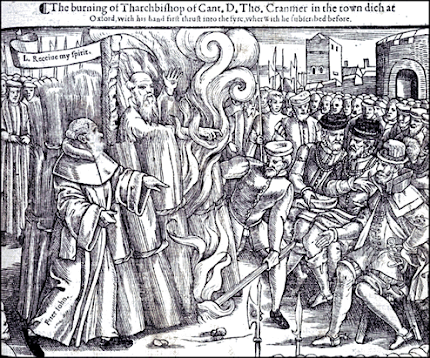
The burning of Tharchbishop of Cant. D. Tho. Cranmer in the town dich at Oxford, with his hand first thrust into the fyre, wherwith he subscribed before. [Click on the picture to see Cranmer's last words.]

Daily Bible Verse

Showing posts with label Federal Vision. Show all posts

Sunday, June 23, 2024

What Is Final Salvation?


Perhaps a point of general agreement from which we may start is the Biblical teaching that Christ saves us not only from the penalty of sin, but from sin itself. “He died that we might be forgiven; he died to make us good.” Or, in Scriptural language, “Shall we continue in sin that grace may abound?” “Let not sin therefore reign in your mortal bodies.” “For we are his workmanship, created in Christ Jesus for good works.” 

If this be agreed upon, if we all admit that we must no longer be the servants of sin but must present our members as instruments of righteousness unto God, the next questions logically are: What is sin, What are good works, What is righteousness? We want to do good works, we want to avoid evil works; but how can we distinguish between them? 

There need be no vague guessing as to the answer to these questions. The Scripture speaks very definitely. The Scripture says precisely what sin is. “Sin is the transgression of the law” (1 John 3:4). “Where no law is, there is no transgression” (Romans 4:15). “Through the law cometh the knowledge of sin” (Romans 3:20). It should be clear then that sin is always defined by the law. Unless one knows the law of God, he cannot know what is wrong, evil, or sinful.


Gordon H. Clark. What Is the Christian Life? (Kindle Locations 1882-1893). Kindle Edition.   See also:  "The Christian and the Law"Trinity Review.  March 1979.

Generally speaking, the late Dr. Gordon H. Clark did not address the Federal Vision heresy because it was not yet a major issue.  However, I want to take issue with a few of the responses to the FV that I think go too far in the other direction by way of equivocation.  While it is true that at the final judgment that the elect will finally be justified by the active and passive obedience of Christ through the instrumental application of right belief, it does not follow that everyone who professes Christ is actually an elect believer.  The Federal Vision teaches that at the final judgment the believer's good works somehow contribute to the justification of the believer.  This is not true and would undermine the doctrine of justification by faith alone.

However, the problem is that some have gone so far in their repudiation of the objective covenant teaching of the FV and the FV doctrine of final justification that they have for all practical purposes gone over to the once saved, always saved view of the Baptists.  There is a difference between the Reformed doctrine of the perseverance of the saints and the doctrine of once saved, always saved.  The Reformed doctrine of the perseverance of the saints is that God before creation not only unconditionally elects those who will be saved, but God also predetermines that the elect will persevere in faith.  That is, God keeps them saved, and He does so monergistically.  The human volition or will does not cooperate in either regeneration or in perseverance.  Both regeneration and perseverance are works of God's mercy and grace.

The point here being that the true believer will demonstrate a changed or transformed life, however imperfect that might be.  The justified believer cannot contribute to his or her own justification.  But a person who has no concern for evidencing their Christian faith cannot legitimately profess belief in Christ.  Furthermore, at the final judgment that person might discover that he or she was never saved or justified whatsoever.  (1 John 2:19; Matthew 7:13-23).  


Friday, September 15, 2023

Is Assurance of Salvation a "Second Blessing"? A Short Response to R. Scott Clark


"Before regeneration a sinful human being does not think this way. He believes that God is too good to condemn anybody, and, besides, he himself is quite respectable. But the gift of faith changes his ideas. Jesus, whom he previously admitted to be an admirable ethical teacher, he now believes to be the Lord of Glory. The sins he has loved, he now hates, or at least begins to hate, for regeneration is not instantaneous perfection."  Dr. Gordon H. Clark


A. W. Pink quoted Walter Marshall, a British non-conformist in 1692:

We are to look upon holiness as a very necessary part of that salvation that is received by faith in Christ. Some are so drenched in a covenant of works that they accuse us of making good works needless to salvation, if we will not acknowledge them to be necessary, either as conditions to procure an interest in Christ, or as preparatives to fit us for receiving Him by faith. And others, when they are taught by the Scriptures that we are saved by faith, even by faith without works, do begin to disregard all obedience to the Law as not at all necessary to salvation, and do account themselves obliged to it only in point of gratitude—if it be wholly neglected, they doubt not but free grace will save them nevertheless. Yea, some are given up to such strong Antinomian[67] delusions, that they account it a part of the liberty from bondage of the Law purchased by the blood of Christ, to make no conscience of breaking the Law in their conduct.


Arthur W. Pink. The Doctrine of Sanctification (Kindle Locations 340-347). Chapel Library. Kindle Edition. 


I understand that R. Scott Clark is opposed to the Federal Vision error.  But the problem I have is that Scott Clark does not differentiate between misrepresentations of the Westminster Confession of Faith and the actual teaching of the Westminster Confession as it is deduced from the Scriptures.  Even worse, R. Scott Clark, who claims to be recovering the Reformed confessions, openly rejects the Westminster Confession on the issue of assurance of salvation.  Or maybe RSC made a typological error?  At any rate, he misquotes the WCF when he says:

Indeed, the divines insisted that believers do finally gain assurance “extraordinary revelation” through “the right use of ordinary means” (i.e., the preaching of the gospel, the use of the sacraments, and prayer). Contra Rome, this doctrine of assurance does not lead believers to lead immoral lives but to lead godly lives. The divines were concerned that people should not think that because they doubt and struggle that they are not or no longer believers. Rather, they were trying to encourage not discourage people.  R. Scott Clark, Heidelblog, "Does The Westminster Confession Contradict Calvin On Assurance And Faith?", October 20, 2016.

Unfortunately, the confession says just the opposite of what I have placed in italics in the quote.  The confession says, 

III. This infallible assurance doth not so belong to the essence of faith, but that a true believer may wait long, and conflict with many difficulties, before he be partaker of it:k yet, being enabled by the Spirit to know the things which are freely given him of God, he may, without extraordinary revelation, in the right use of ordinary means, attain there unto.l   WCF 18:3.

Westminster Assembly. The Westminster Confession of Faith: Edinburgh Edition. Philadelphia: William S. Young, 1851. Print.

It is often difficult to understand exactly what RSC is talking about.  Apparently, the Calvin versus the Calvinists school believed that assurance of salvation depended on an initial justification and a subsequent second blessing. Furthermore, I take it that the Calvin versus Calvinism school has something to do with the Federal Vision heresy where the FV proponents wish to make the Westminster Confessional Standards agree with their conflation of the visible church with the invisible church;  their conflation of the visible signs and seals of covenant with the invisible graces is one source of the problem.  Additionally, they misunderstand unconditional election, which God only grants to the elect. The adherents of the Federal Vision contend that election and regeneration are conveyed through baptism into membership in the visible church.  They also say that election and regeneration can be lost if the person commits apostasy or falls into grievous sins.  But this is not the position of the Bible or the Reformed confessions.


Oddly enough, RSC is making a similar error by misquoting both John Calvin and the Westminster divines out of context.  I say that because Calvin and the later Westminster divines were indeed dealing with their settings in life or cultural situations.  R. Scott Clark wants to conflate the cultural problems of the 16th and 17th centuries with the 20th and 21st centuries.  Calvin was dealing with the Roman Catholic undermining of the assurance of salvation.  The Westminster divines were dealing with both hypocrisy and the undermining of the assurance of salvation.

There is a dual problem today as well.  But the duality is that almost no one today actually fears God anymore.  So the problem is not so much the lack of assurance of salvation, but rather a lack of concern for their obedience.  Even the Romanists do not fear God anymore.  As Dr. Gordon H. Clark once remarked in relation to the doctrine of repentance, liberals think that God must be too good to damn anyone to hell:

The religious world of the present century has witnessed a tidal wave of anti-intellectualism. Inundated by the outright irrationalism of the Neo-orthodox and the existentialists, popular religion holds every intellectual decision – the acceptance of an intellectual doctrine – to be either insincere or trivial, and that only emotion is genuine and “authentic.” With the prevalence of such views, a further repetition of the Catechism seems called for. Repentance includes an “apprehension of the mercy of God in Christ.” Before regeneration a sinful human being does not think this way. He believes that God is too good to condemn anybody, and, besides, he himself is quite respectable. But the gift of faith changes his ideas. Jesus, whom he previously admitted to be an admirable ethical teacher, he now believes to be the Lord of Glory. The sins he has loved, he now hates, or at least begins to hate, for regeneration is not instantaneous perfection. By this change of mind he turns from sin to God; or, more accurately, this change of mind is his turning to God. Nor can this turning or conversion occur without a full purpose and endeavor to obey God’s law. There is nothing insincere in this. To use John Calvin’s remark, it is the pious assent of the mind.

Gordon H. Clark. What Is the Christian Life?  1990.  1992.  Third edition. (Unicoi:  Trinity Foundation, 2012).   Kindle Locations 270-279. Kindle Edition. 

I did my time in Bible college and seminary; but when I read the Heidelblog it is as if I am reading a foreign language.  I have read the classical systematic theologies.  I have read Charles Hodge, Louis Berkhof, Stephen Charnock, Lorraine Boettner, Gordon H. Clark, and even Van Til.  But when I listen to the podcasts from both the Westminster Seminary, Philadelphia, Pennsylvania and Westminster Seminary,  Escondido, California or read their posted literature, it is as if I am reading a foreign language.  Most of it has very little to do with the actual Scriptures or the Reformed confessions themselves.  One doctrine that you will never hear any of them mention, or at least only in brief, is the doctrine of predestination.  Almost everything these schools have to say is colored by their rose-colored glasses of common grace and their focus on christology and covenant theology as the alleged center of their system of analogical theology.

The main  problem I have with the Escondido school is the constant barrage of justification by faith alone as if that doctrine is all there is in the Reformed confessions.  The other problem is the constant appeal to modern and postmodern theologians as if their spin on church history is the interpretative grid which must be imposed on both the Scriptures and the Reformed confessions themselves.  These writers, including R. Scott Clark, wish to emphasize the total transcendence of God above all else so that the Scriptures become merely an ectypal condescension to the human level, not the very words of God univocally.  Of course, we are not omniscient and cannot see the total picture or think with super-intelligence as God does.  He knows everything intuitively and directly, while our knowledge as creatures is discursive and revealed to us through the innate image of God, natural revelation and special revelation; but that is another essay for another day.

The issue here is that R. Scott Clark overreacts to the Federal Vision error to the point that he has tendencies to misrepresent the actual warning passages in Scripture and how the Westminster Confession and the Canons of Dort address those issues.  The fact of the matter is that assurance of salvation does not always accompany conversion to Christ.  That's because many persons come from bad backgrounds, being former criminals.  Others come from a Romanist background and have no assurance.  But the vast majority of new converts--who may or may not be regenerate--have an attitude of easy believism.  That's because of the church growth movement and the influence it has on the denominations.  

Although the Escondido school pretends to reject the pragmatism of the church growth movement, they actually practice the same pragmatism.  Without new churches, new members and new ministers, seminaries tend to become irrelevant and die out.  So that means that there can be no real education in what Scripture actually says on the issues or even what the Reformed confessions say.  Instead the other graces of repentance, sanctification, and assurance must be either reinterpreted or downplayed.  John MacArthur, one of R. Scott Clark's most hated targets, at least emphasizes sanctification.  So RSC attacks pastors he does not like.  He continually attacks MacArthur as a legalist but most of the attacks are in fact straw man fallacies.  RSC also totally despises the late Dr. Gordon H. Clark on many levels.  GHC is a "hyper-Calvinist", a rejecter of the free offer and common grace.  He's one of those despised fundamentalists, according to RSC.

John MacArthur even preaches the doctrine of total depravity, which he calls the most hated doctrine in the world.  Although I somewhat agree, I think the most hated doctrine is the doctrine of predestination.  We are told to never talk about that one:  

There is also the case of the Bible professor in a so-called Christian college, who told me, "Even if you believe in predestination, don't let anyone know you do."  He constantly told his students never to study the subject nor mention it in their preaching.  One student who held his professor in high respect was shocked to find that the Bulgarian laborers with whom he worked in Chicago were extremely interested in the forbidden subject.  But if predestination is not to be mentioned, God must have made an embarrassing blunder in revealing it to us.  

Gordon H. Clark.  What Do Presbyterians Believe?  The Westminster Confession Yesterday and Today.  1965  Second edition.  (Unicoi:  Trinity Foundation, 2001).  P. 43. 

To get to my main point of this article, however, it seems to me that RSC and many other so-called Reformed theologians are hypocritical on so many levels that it would take a book length response to analyze them all.  RSC says that assurance cannot be lost but only diminished.  But the WCF says that assurance can be diminished and shaken to the point that it is almost completely lost.  (WCF 18:4).  Not only that, the Westminster divines were not as much concerned with assurance as with hypocrisy.  (WCF 18:1).  In fact, it is possible to have saving faith without having assurance of salvation at all.  (WCF 18:3, quoted above).  The doctrines of grace should not encourage looseness in morality but a growth in the grace and knowledge of our Lord and Savior, Jesus Christ.  (2 Peter 3:18).  

...And therefore it is the duty of every one to give all diligence to make his calling and election sure; that thereby his heart may be enlarged in peace and joy in the Holy Ghost, in love and thankfulness to God, and in strength and cheerfulness in the duties of obedience, the proper fruits of this assurance: so far is it from inclining men to looseness.  (WCF 18:3; 2 Peter 1:10)

Westminster Assembly. The Westminster Confession of Faith: Edinburgh Edition. Philadelphia: William S. Young, 1851. Print. .

R. Scott Clark and others focus on theology from below instead of the doctrines of sovereign grace taught in the Bible and summarized by the Westminster Standards.  I pray that God will grant them repentance.  The system of propositional truth deduced from the Bible and summarized by the Westminster Standards is what we are obligated to believe.   

I highly recommend this online edition of the Westminster Confession of Faith and the Larger and Shorter Catechisms:  The Westminster Standards.


Wednesday, March 30, 2016

Mercersburg and the Federal Vision

Phillip Schaff had similar ideas, though his concerns were more in the direction of church history.  He took a Hegelian view of history, with progress being chief, and newer and better truth continually being discovered through the synthesis of thesis and antithesis.


This article by Matt Powell gives an excellent explanation of why the Federal Vision is wrong and why it really is nothing new.  The article appears on Powell's blog and was posted in the Aquila Report.

Phillip Schaff had similar ideas, though his concerns were more in the direction of church history.  He took a Hegelian view of history, with progress being chief, and newer and better truth continually being discovered through the synthesis of thesis and antithesis.  He gave the tradition of the church a much higher role than most Protestants were comfortable with (a discussion which probably needs a whole separate post).  He was less concerned with the complete revelation of absolute truth in the Scriptures and more interested in the development of interpretation of that truth through the traditions of the church.  Matt Powell.
Mercersburg and the Federal Vision

The real danger of Hegelian philosophy from a Clarkian Scripturalist perspective is its rejection of the law of contradiction.  How can one synthesize two contradictions into one new proposition?  The new proposition would itself be a contradiction since A and non-A cannot be synthesized.  Since the Bible is a logical and propositional revelation the Hegelian view of progress is anti-biblical and leads to irrationalism and skepticism.

Monday, March 16, 2015

Richard Gaffin, Jr.: Promoter of Faith Plus Works


For anyone willing to investigate, you can listen to Dr. Richard Gaffin, Jr.'s lectures on union with Christ for free at Monergism.com. Dr. Gaffin is a proponent of the Federal Vision within the Orthodox Presbyterian Church and openly denies that sanctification is the logical result of justification. Instead, Dr. Gaffin says that justification and sanctification are united together through the doctrine of union with Christ and that no one will be saved apart from both faith and good works.  Gaffin also openly states that salvation is corporate and that no one can be saved apart from church membership. You can hear him state his heretical views clearly at the end of lecture 1 here at the Monergism.com website:

The Mystery of Union with Christ

You can read articles about Gaffin's conflation of justification with sanctification at the Trinity Foundation site here:

Richard Gaffin's New Perspective on Paul

See also:  The Gaffin Question

Friday, February 13, 2015

Why the Presbyterian Church in America Is No Longer Confessional

"The Federal Vision and the PCA’s response to it looms large in Phelps’ conclusion that the denomination as a whole has departed from the Reformed Faith."

The Reformed Free Publishing website has posted an article explaining why the Presbyterian Church in America is no longer Reformed or committed to its confessional documents.  Click here to read the article:  The PCA Has Failed to be Meaningfully Confessional.


Wednesday, August 13, 2014

What's Wrong with the Federal Vision?


The following is an excerpt from an excellent Reformed critique of the Federal Vision error.  There are numerous websites out there that claims that the Federal Vision is difficult to understand.  They muddy the waters by saying not all the FV proponents teach the same things and that it is not the same thing as the New Perspective on Paul, etc.  But none of that is true.  Although there are divergences and varieties of the FV, they are all in disagreement with the Reformed view as taught by the Scriptures and the Reformed confessional standards.   --  Charlie

First, the clear emphasis of the Federal Vision is on covenant—not on Christ. The Federal Vision teaches that we are saved by the covenant, whereas the Reformed faith (in line with the Bible) teaches that we are saved by Christ. The Federal Vision teaches that the covenant itself conveys a relationship of peace and favour with God; the Reformed faith (again, in line with the Bible) teaches that Christ is the only Mediator, the only Redeemer of God’s elect, and that the covenant offers salvation only by faith in Him. Richard D. Phillips observes,

“The most stunning feature of the Federal Vision writings is the way Jesus Christ, in His person and work, recedes into the background. I am astonished that in the great mass of Federal Vision material dealing with God’s covenant and salvation, our Savior is almost completely ignored” (The Auburn Avenue Theology, Pros and Cons: Debating the Federal Vision, p. 84).
From:  
The Federal Vision
A New Perspective—an Old Heresy
By Rev. T. Aicken

Tuesday, May 27, 2014

Monday, November 25, 2013

The Federal Vision Heresy: Analyzing the Federal Vision


In 2007 Guy Prentiss Waters and several other Presbyterian ministers and scholars gathered together to discuss and analyze the problems with the Federal Vision error in the Presbyterian Church in America.  After that conference the PCA did a study where they found that the Federal Vision to be a violation of their doctrinal standards as outlined in the Westminster Confession of Faith and the Larger and Shorter Catechism. 

Unfortunately, the PCA has completely reversed itself and at the last General Assembly gave full endorsement to the Federal Vision heresy and the teaching of Peter Leithart and several other ministers who make no attempt to hide their adherence to the Federal Vision and the Auburn Avenue theology.

I am posting a link to a series of messages hosted by Guy Prentiss called Analyzing the Federal Vision.

Thursday, October 25, 2012

R. Scott Clark: Baptism and the Benefits of Christ (CPJ 2) | The Confessional Presbyterian

In this article in The Confesssional Presbyterian Journal, R. Scott Clark lays out clearly what is wrong with the Auburn Avenue/Federal vision view of conditional election.  The confessional Reformed view, according to Clark, is that we by charity consider all members of the visible church to be elect, although not all of them may in fact be elect.  The Federal Vision error states dogmatically that all members of the visible church are elect and that apostasy from election is a real possibility.  Although the traditional Reformed view is that members of the visible church can and do commit apostasy, only the elect have true and living faith and participate in the benefits of Christ by faith.  Only the elect are members of the invisible church.  The error of the Federal Visionists is therefore to reject the distinction between the communion of saints on earth and the invisible communion of saints in the invisible church.   The invisible church is composed only of those who have been unconditionally elected by God from before the foundation of the earth.  Election, according to the Reformed confessions, is always unconditional and does not depend on foreseen works whether they be good or evil.

Dr. Clark clearly lays out Calvin's theology of the sacrament of baptism here:

Calvin taught throughout his ministry that the sacraments are signs and seals which the Spirit uses to confer comfort and assurance, not election, union with Christ, or regeneration. He defined baptism this way:
Baptism is the sign of the initiation by which we are received into the society of the church, in order that, engrafted in Christ , we may be reckoned among God’s children. (29).  (Page 8).

Click here to read R. S. Clark's article in PDF format:  R. Scott Clark: Baptism and the Benefits of Christ (CPJ 2) | The Confessional Presbyterian

Addendum:  There is a typographical error on page 12 in the article.  Clark quotes from the New Testament Greek of Colossians 2:8.  He mistakenly cites the word "deceit" or "deception" as  "agapes" [ἀγάπη, -ης, ἡ] rather than "apates".  [ἀπάτη, -ης ἡ] Cf.   Βλέπετε μή τις ὑμᾶς ἔσται ὁ συλαγωγῶν διὰ τῆς φιλοσοφίας καὶ κενῆς ἀπάτης, κατὰ τὴν παράδοσιν τῶν ἀνθρώπων, κατὰ τὰ στοιχεῖα τοῦ κόσμου, καὶ οὐ κατὰ χριστόν· (Colossians 2:8 BYZ)

"Agapes" is the gentive singular declension of the Greek noun "agape".  

Friday, January 27, 2012

Fwd: New Book by Dr. John Frame "A Reformed Response to Escondido Theology"


Jesus answered, "My kingdom is not of this world. If My kingdom were of this world, My servants would fight, so that I should not be delivered to the Jews; but now My kingdom is not from here." (John 18:36 NKJ)

(See the ad from TheNiceneCouncil.Com which inspired this article here:  The Escondido Theology, by John Frame.  Charlie).


It looks like the neo-legalist Van Tilians and theonomists are up to more contumelious attacks against the doctrines of grace and the Gospel promises.  Legalists, being obsessed with their own ability to transform themselves and society, seem to think that only their efforts and thoughts and logic can possibly be correct.  I got a huge chuckle out of the following ad I received by e-mail from The NiceneCouncil.Com site concerning the new book by the multiperspectivalist "Reformed" writer, John Frame, The Escondido Theology We are told in the ad that, "Dr. Frame's insight and analysis clearly represents the Reformed Christian World and Life View because it is historically rooted in Calvinistic theology."

What is amusing about this bare assertion is that it makes a fallacious argument.  Simply asserting the conclusion that Frame's view "represents the Reformed Christian World . . . View" does not make it so.  If the premise is wrong then the conclusion is wrong as well.  First of all, the premise is that Frame's view "is historically rooted in Calvinistic theology."  But what does this mean?  Even the imminent church historian Carl Trueman of Westminster Theological Seminary, Philadelphia has acknowledged that there is no reified "Reformed tradition".  So how can Frame represent the entire Reformed Christian worldview if there is no such thing?  The fact is the Reformed tradition has from the beginning had competing factions and taken as a whole the movement is diverse and often at odds, including the divisions between modernists and traditionalists, between theonomists and two kingdoms theology, between confessional Reformed theology and the Federal Visionist/Auburn Avenue theology, between the advocates of neo-Kuyperian common grace and those who uphold classical Calvinist theology, and between the followers of Cornelius Van Til and the followers of Gordon H. Clark's Scripturalist presuppositional apologetics.

My advice to my readers is the same advice I received in college and seminary.  Do not trust secondary sources in forming your opinions about any position.  In other words, if you want to understand the two kingdoms theology then read the primary sources like Meredith Kline, Michael Horton, or R. Scott Clark.  Only after reading the primary sources can you then critically read the secondary source criticisms of the two kingdoms view.  I would say the same about Frame.  If you want to critique Frame, read Frame's works first and then read the criticisms made of Frame's work.  Unfortunately, John Frame's triperspectivalism or multiperspectivalism opens the door to subjectivism and relativism, which implies that Frame's views are less than biblically based propositional truth claims.  Although Frame places Scripture as the first premise of triperspectivalism, that is Scripture is the normative basis for the other two premises, the problem is that for Frame Scripture is not the final word on any matter at all. Obviously interpreting the Bible through the lens of triperspectivalist presuppositions like situational ethics and semi neo-orthodox existentialism as the the other two points of his theory makes Frame's presuppositional approach relativist and not Scripturalist. 

Gordon H. Clark's apologetics method is far superior since for Clark the logical propositions in Scripture are univocally God's thoughts on all matters of faith and practice.  Frame's approach, however, is inherently liberal since in the final analysis Frame makes the three branches of triperspectivalism equal in authority.  That is, for Frame Scripture is not the final authority but is simply one of three equals:  1) Scripture as the normative perspective, 2) Situational ethics as the situational perspective, and 3) Existential experience as the existential perspective.  It is this sort of thinking that has changed the focus of popular Reformed theology from the hereafter and transcendent theology to the here and now, this world, and transforming society.  Sound familiar? 


Yes, the social gospel, although on the left, had a similar emphasis on transforming society to make it more fair and equitable to the poor.  In doing so the doctrines of grace relating to the hereafter and where the soul would spend eternity were left by the wayside and a socialist, materialistic mentality took over to the point that Christianity for all practical purposes became simply an agnostic, atheist political organization rather than a metaphysical religion.

Although theonomists, reconstructionists, neo-legalists, and neo-Kuyperian Calvinists consider themselves as transforming society and fighting liberalism, they are in fact a right wing theocratic version of liberalism.  Ironically, the emphasis on the here and now, theology from below, and transforming society rather than preaching the Gospel and where the individual soul will spend eternity winds up leading in two undesirable directions.  On the one hand such thinking leads back to Rome and the papist mentality of ruling the world as vicars of Christ on earth.  On the other hand, theonomy, reconstruction, and neo-legalism leads to the very liberalism that theonomists "think" they are fighting against since ecumenicalism and co-belligerency in the political realm trumps the doctrines of grace (Galatians 1:6-9) and the promises of God (2 Corinthians 1:20).  These unforeseen consequences are indeed ironic. 

I would contend that transforming society has never been the focus of classical Reformed theology.  Jonathan Edwards' classic sermon, "Sinners in the Hands of an Angry God," is evidence enough of that.  The real question is, "Where will you spend eternity?"  (Matthew 16:15, 16).  The attempt to marginalize classical Calvinists and the biblical focus on the promises of God and eternity is a telling indictment against theonomy/reconstruction and its theological offshoot, the Federal Vision/Auburn Avenue heresy.

Saturday, January 21, 2012

Conspiracy of the Anonymous « God's Hammer

It looks like a cover-up is underway in the Presbyterian Church in America. Now it seems that bloggers reporting on heresy trials and such is more problematic than the actual heresies that are arising within the PCA. Sean Gerety reports on this on the God's Hammer blog article, Conspiracy of the Anonymous:

Now, the focus of the meeting, at least according to byFaith, was to “ease denominational tension” that has been caused, not by false teaching and the false gospel that continues to spread like cancer virtually unabated throughout the PCA, but by bloggers and a narrow minded faction within presbyteries (read TRs) who are evidently too concerned with orthodoxy when examining candidates seeking ordination in the PCA. According to one nameless attendee; “At the presbytery level, pockets of the PCA have become overly concerned with measuring orthodoxy.” Oh, my. We can’t have that. Of course, this raises the question what else should those at the presbytery level be concerned with when examining candidates for ministry besides measuring a candidate’s level of orthodoxy? Admittedly, there are other variables that need to be taken under consideration when someone is seeking ordination like can he teach or does he become tongue-tied or break into a sweat when speaking before a room full of people. Beyond that his personal character, maturity in the faith, along with his ability to manage his family are all areas to be examined. However, I would have thought that measuring the orthodoxy of prospective pastors would be the primary concern of those at the presbytery level. In fact, PCA BCO 21 requires a “careful examination” (would that be same as a precise examination) of a candidate’s “knowledge of the Greek and Hebrew languages, Bible content, theology, the Sacraments, Church history, the history of the Presbyterian Church in America, and the principles and rules of the government and discipline of the church.”


To read the rest of Sean's comments click here: Conspiracy of the Anonymous « God's Hammer


As an aside, I always point out that The Trinity Foundation and the God's Hammer blog have apparently endorsed the Nestorian views of Gordon H. Clark's final book, The Incarnation.  Although I generally support the work of The Trinity Foundation, I believe that Nestorianism is as serious a departure from confessional Reformed teaching as the Federal Vision or the New Perspectives on Paul. This is true because there is only one mediator between God and man. He must be both divine and human to fully execute the penal substitutionary atonement in the place of the elect persons chosen by God before the foundation of the world.

See:

Thirty-nine Articles of Religion: Article II

Of the Word, or Son of God, which was made very man

The Son, which is the Word of the Father, begotten from everlasting of the Father, the very and eternal God, and of one substance with the Father, took man's nature in the womb of the blessed Virgin, of her substance: so that two whole and perfect natures, that is to say, the Godhead and manhood, were joined together in one person, never to be divided, whereof is one Christ, very God and very man, who truly suffered, was crucified, dead, and buried, to reconcile His Father to us, and to be a sacrifice, not only for original guilt, but also for all actual sins of men.


Sunday, January 30, 2011

Ties to the Federal Vision: Open Letter to Michael Horton Pyromaniacs

Someone over at the Puritan Board pointed me to this comment by R. Scott Clark:

MacArthur's view, as articulated in the Lordship Controversy and reflected in The Gospel According to Jesus and the like isn't much different from Norman Shepherd's. This is the problem with the whole controversy. Confessional Reformed people should say: a pox on both your houses. The Zane Hodges ("easy believism"; walk the aisle, pray the prayer, ex opere operato view) is antinomian because it denies the moral necessity of the third use of the law, the moral necessity of fruit as evidence, the moral necessity of sanctity in the justified. MacArthur, however, because he isn't a confessional Protestant (and he will tell you so) but a biblicist, didn't have the categories by which evaluate the Zane Hodges view properly. He reacted by doing as many have been wont to do, by trying to make sanctity essential to justification. Since that time, I'm told, he has said more orthodox things but he has never, to my knowledge substantially revised what he published in the Gospel According to Jesus.

The confessional Reformed view, taught in the Three Forms and in the Westminster Standards is that justification is by trusting in the finished work of Christ alone AND that those who believe and are united by the Spirit to Christ, will produce fruit as evidence of their justification. Those who are united to Christ must seek to conform their lives to the moral law of God, not as a condition of acceptance with God but as a consequence of having been freely accepted by God for Christ's sake.

Everyone should read the two essays by Paul Schaefer in Christ the Lord. They are the single best treatments of the controversy.

Tragically, there has been something of a confluence between the Shepherdites (justification through faithfulness) and MacArthurites, such as Frank Turk, via Doug Wilson. The latter is quite the Wilsonite and I've heard more than a few Shepherdites pledge allegiance to MacArthur, as if we had a side in the Lordship Controversy.


R. Scott Clark is a professor of historical theology at Westminster Theological Seminary, California. I happen to agree with his assessment and am actually shocked to see that Dr. Clark has publicly stated his opinion on this. Good for him! You'll have to click on this link and then scroll down to see Dr. Clark's remarks: Open Letter to Michael Horton Pyromaniacs

Sincerely in Christ,

Charlie


Friday, January 28, 2011

Frank Turk Supports Doug Wilson: Father Hunger

If you will click on the link and then look at the comments section you'll see Frank Turk supports Doug Wilson as far back as 2006. I'm not sure how far that support goes but this is at least some indication. Just for the record, Doug Wilson started out as a theonomist and then went into the Federal Vision error. I hope everyone can see why I blame theonomy for many of the defections to Federal Vision and Auburn Avenue in Presbyterian and Reformed circles and why the Reformed Episcopal Church has gone in the Tractarian/Anglo-Catholic direction. Where there is smoke there is fire. Click on this link, Father Hunger, to see Doug Wilson's blog and the comment made by Frank Turk. You can also see Doug Wilson singing praises to Frank Turk here: Frank the Baptist Nails It.


Tuesday, April 20, 2010

Wes White Exposes the Link Between Federal Visionism and Anglo-Catholicism

You will be amused at how certain "presbyterians" in the Presbyterian Church in American look, act and walk like ducks... I mean Anglo-Catholics. Take a look at the pictures on Wes White's blog, Johannes Weslianus. The presbytery in question is the New York Metro Presbytery of the PCA. Please note that any posts I made from Tim Keller do not endorse Keller's other writings or his association with Federal Visionists and Tractarians in presbyterian churches.

Support Reasonable Christian Ministries with your generous donation.