>

Martyred for the Gospel

Martyred for the Gospel
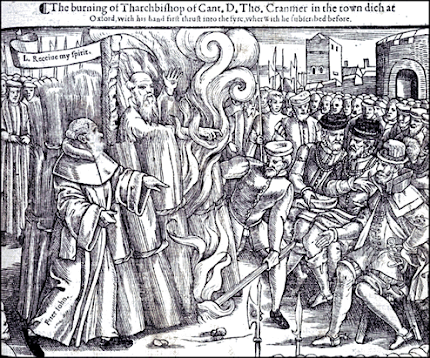
The burning of Tharchbishop of Cant. D. Tho. Cranmer in the town dich at Oxford, with his hand first thrust into the fyre, wherwith he subscribed before. [Click on the picture to see Cranmer's last words.]

Daily Bible Verse

Showing posts with label Church growth. Show all posts

Tuesday, April 01, 2025

Open Letter to Pastor Jeff Tell: Lexington ARPC Church Plant


I have been retired since October of last year.  Since my job required lots of travel, I was not a member of any local church in my area, namely Lexington, South Carolina.  In fact, the only church that was traditional and even remotedly resembled a truly Reformed Presbyterian church is First Presbyterian Church in Columbia.  The problem there is that the church is very large, and the other problem is that the ARPC allows for the ordination of women to the office of deacon.  FPC, being an Associate Reformed Presbyterian session or church, allows for the ordination of women, also.  That is the reason that I did not become a member there, despite the fact that the preaching generally sound and Reformed.  The current pastor is Dr. Neil Stewart.

The ARPC has a church planting program and a new church is being planted in Lexington and the pastor chosen to do the work is Jeff Tell.  Unfortunately, the church plant is being conducted along the lines of the pragmatic church growth movement, following the example of the Presbyterian Church in America or PCA.  The PCA is at best a mix of truly reformed churches and churches formed under the church growth model, which focuses on dumbing down doctrinal distinctives.  One of the largest PCA churches in my area is Lexington Presbyterian Church, which supported the Revoice heresy of accepting "celibate" homosexuals as members and as teaching elders.

There have been warning signs at the new ARPC church plant in Lexington.  I sent a couple of emails to the pastor to register my complaints.  He did answer me once or twice.  After that it became silence.  So my only option now is to publicly address the complaints.  I cannot and do not support any church that openly discourages new members from agreeing with the doctrinal standards, namely the Westminster Confession of Faith and the Larger and Shorter Catehisms.

I wrote the following letter to Pastor Jeff Tell by way of email:

Dear Jeff,

I am not sure that I know exactly what to say about this church plant.  So, I will just give my opinion so far.

First, I was troubled by your suggestion that new members need not concern themselves with what the ministers are required to subscribe to in regards to the doctrinal standards of the denomination.  I think you said that they could just flip through the Westminster Standards.  The other red flag is that this edition has no biblical proof texts given to support the doctrinal positions.


The first chapter of the Westminster Confession of Faith makes it clear that the most important doctrine of any presbyterian church is the doctrine of Sola Scriptura.  So your remark that the new members need not concern themselves with points iii through vii was disturbing.

The point that most bothers me is point vii.  I cannot and never will promise to obey any church or church official who contradicts what the Bible plainly and univocally says.  I say this because the ARPC has officially allowed local sessions to ordain women to the male only office of deacon as prescribed by 1 Timothy 3:12.  In fact, as I studied the history of the decision of the general synod of 1969, it came to my attention that the moderator of the 2005 synod was Rev. William B. Evans, a supporter of the doctrine of the ordination of women.  Evans recently retired from Erskine College and transferred his ordination to the liberal mainline denomination, the Presbyterian Church USA.


I have been following the denominational issues of several Presbyterian denominations for many years by reading the Aquila Report online.  So, I am well aware of the "moderates" and liberals within the ARPC.  One of Evans' complaints was the influence of Ligonier and Reformed Theological Seminary, Charlotte, NC, according to his blog:  A Change in Ecclesiastical Affiliation.

The other deal breaker for me is that the church pamphlet keeps putting quotes from Tim Keller, a self-avowed promoter of the woke view of social justice, also known as social Marxism.  Keller is passed on, but his views on the doctrinal standards were liberal to say the least.  He promoted a version of the Revoice homosexual celibacy view in the Presbyterian Church in America.  He also promoted the theistic evolution view of Biologos.

In this week's pamphlet, the quote from Keller was completely wrong.  First, off, the covenant of grace began with the protoevangelium in Genesis 3:16.  [The correct citation is Genesis 3:15, not 3:16.  Sorry for the error.]  Later God expanded on this covenant of grace with the covenant of Abram in Genesis 15.  So, when Keller makes the generalization that "ancient covenants were marked  by an oath-sign in which the curse of disobeying the covenant was made clear . . .," the statement is clearly casuistry and equivocation meant to mislead novices.  The covenant of works was initiated in the garden of Eden and is still in effect until the consummation, except for those who are unconditionally elected in eternity, effectually called by monergistic regeneration, and given the gift of saving faith.


[The following was not included in the letter to Pastor Tell.  It is the quote from Tim Keller in the church pamphlet  that I found to be misleading:

"The Lord's Supper was a covenant-making ceremony, in which Jesus created a new people and entered into covenant with them as their Lord.  Ancient covenants were marked by an oath-sign in which the curse of disobeying the covenant was made clear, but Jesus shows us that this time, he takes on the curse for breaking the covenant himself.  He will take the cup of God's wrath so we can have the cup of fellowship and blessing."]

In fact, the doctrinal standards specifically state that even the elect are not under the law as covenant of works.  However, the moral law does tell them how they are to live as Christians:

WCF 19.6  Although true believers be not under the law as a covenant of works, to be thereby justified or condemned; yet is it of great use to them, as well as to others; in that, as a rule of life, informing them of the will of God and their duty, it directs and binds them to walk accordingly; discovering also the sinful pollutions of their nature, hearts, and lives; so as, examining themselves thereby, they may come to further conviction of, humiliation for, and hatred against sin; together with a clearer sight of the need they have of Christ, and the perfection of His obedience. It is likewise of use to the regenerate, to restrain their corruptions, in that it forbids sin; and the threatenings of it serve to show what even their sins deserve, and what afflictions in this life they may expect for them, although freed from the curse thereof threatened in the law. The promises of it, in like manner, show them God's approbation of obedience, and what blessings they may expect upon the performance thereof, although not as due to them by the law as a covenant of works: so as a man's doing good, and refraining from evil because the law encourageth to the one, and deterreth from the other, is no evidence of his being under the law, and not under grace. (WCF 19:6 WCS)


As you can see, the Confession actually says that believers are still under the moral law as a rule for living out the Christian life.  Unregenerate persons are still under the moral law as a covenant of works:


WCF 19.5  The moral law doth for ever bind all, as well justified persons as others, to the obedience thereof; and that, not only in regard of the matter contained in it, but also in respect of the authority of God, the Creator, who gave it. Neither doth Christ, in the Gospel, any way dissolve, but much strengthen this obligation. (WCF 19:5 WCS)  See also: 19:1-2.


Finally, as far back as 1995 when I graduated from Asbury Seminary with the M. Div. I took a church growth class with George Hunter, III.  I am well aware of the church growth pragmatism approach to church planting.   In those days, I was still a classical Pentecostal.  I was appalled at the dumbing down of Wesleyan theological distinctives recommended by Hunter.  The end result of refusing to preach theological distinctives and the whole counsel of God in the inerrant, infallible, and God-breathed Scriptures is a church full of novices at best, and unconverted persons who have no understanding of the Bible whatsoever.


I became a Calvinist in 1992 or so precisely because of the Pentecostal emphasis on spiritual experiences and personal piety over against any intellectual understanding of the Bible or the Christian faith.  Donald McGavran's denomination has one creed:  No creed but the Bible.  The early Pentecostals after the 1906 Azusa Street Revival had no doctrinal confessions of faith until the Oneness Pentecostal controversy around 1914.


Moreover, over the past 6 or 7 years that I have resided in Lexington, SC, I have visited just about every church that has claimed to be "Reformed".  Most of them were either PCA or ARP, except for Saxe Gotha.  Lexington Presbyterian Church, last I visited there, was pushing the Revoice controversy.  The other PCA churches, though smaller, were also following the pragmatic church growth pattern that decidedly dumbed down doctrine.

It came down to attending First Presbyterian Church, Columbia because that church at least has traditional worship with conservative preaching and the right administration of the sacraments.  However, I could not in good conscience join FPC because the session ordains women to the church office of deacon.  Your church plant, otoh, does not follow the regulative principle of worship and instead replicates the charismatic and emotive style of worship meant to de-emphasize the Bible as the final authority.

Your church plant gave a glimmer of hope that there would be solid preaching by expository sermons, along with solid opportunities for Christian education by way of Sunday school classes with competent instructors.  I realize that it takes time to develop these programs.  However, it is not looking good.  

The other problem, as I see it, is that your new members class does not emphasize the doctrinal standards whatsoever.  Instead, you're following Tim Keller's re-interpretation of the doctrinal standards, the Navigators, etc.  The Navigators were Arminian in orientation as I recall.   In more conservative sessions of various Presbyterian denominations, children who were baptized as infants are required to go through the Shorter Catechism class prior to becoming communicant members who partake of the Lord's table.  There should be some basic understanding of the doctrinal standards required to join a local session, including the Larger Catechism.  Glossing over the catechism is not healthy, imo.


While fellowship is important, I do not think that church picnics and church fellowship is what makes for a healthy church.  Community and family can be found anywhere, including the local bar or another religion.  As you said in the sermon from the previous week, the temptation for church planters is to take shortcuts.  Well, the church growth movement itself is just a huge shortcut.  Healthy churches are based on solid biblical preaching, doctrinal preaching, and the right administration of the sacraments.  Without the preaching of the word the sacraments are meaningless.  

In short, anyone can nominally claim to be reformed or that their church is reformed.  However, the term reformed needs to have a definition.  Reformed In Name Only or RINO does not meet that requirement.

As it stands now, I will not be joining the church as a member.


For I have not shunned to declare unto you all the counsel of God. (Acts 20:27 KJV)

And that from a child thou hast known the holy scriptures, which are able to make thee wise unto salvation through faith which is in Christ Jesus. 16 All scripture is given by inspiration of God, and is profitable for doctrine, for reproof, for correction, for instruction in righteousness: 17 That the man of God may be perfect, throughly furnished unto all good works. (2 Tim. 3:15-17 KJV)


Sincerely yours in Christ,


Charlie J. Ray, M. Div.

P.S.  I do a blog at www.reasonablechristian.blogspot.com.  


Addendum:  I was unaware that Jesus created a new people when He established the sacrament of the Lord's supper.  1 Corinthians 11:23-32.  The new church is also administering the Lord's supper weekly and in at least one church pamphlet referred to is as a "eucharist."  The term eucharist is code for real presence, consubstantiation, and transubstantiation.  The Calvinist and Zwinglian view reached a consensus rejecting the eucharistic view of the sacrament.  The Consensus of Tigurinus was written by John Calvin himself.


There are 7 vows that a person must make in order to become a member of the new Lexington Associate Presbyterian Church according to the handouts given in the new member class:


i.  Do you profess that you are a sinner in the sight of God; that you deserve His punishment; that you are unable to save yourself; and that you are without hope of salvation except for God's love and mercy?

ii. Do you believe in the Lord Jesus Christ as the Son of God and the Savior of sinners; and do you receive and trust in Him alone for your salvation?


iii. Do you accept the Bible, comprised of the Old and New Testaments, as the written Word of God; and that it is the only perfect rule of faith and how to live?


iv.  Do you promise to trust in the guidance and strength of the Holy Spirit so that you can live all of life as a Christian, following the example set by Jesus Christ?


v.  Do you promise to exercise faithful stewardship of God's resources entrusted to you for the furtherance of God's Kingdom and purposes?


vi.  Do you accept that the doctrines and principles of the Standards of the Associate Reformed Presbyterian Church are founded upon the Scriptures?


vii.  In loving obedience, do you submit yourself to the government and discipline of this church, promising to seek the peace, purity, and prosperity of this congregation as long as you are a member of it? 


The doctrines of the Westminster Confession of Faith are not "founded upon the Scriptures.  The doctrines of Bible are summarized by the Westminster Confession of Faith, and the Westminster Confession of Faith is "deduced" from the Bible "by good and necessary consequence" or inference.  See WCF 1:6.


Tuesday, January 14, 2025

The Free Offer of the Gospel, Common Grace, and Pragmatic Church Growth: Part 2


“. . . By 1936 the signers of the Auburn Affirmation showed that they had captured the church by reorganizing Princeton Seminary and placing one of the signers on its governing board, by electing one of their number Moderator of the General Assembly [of the United Presbyterian Church in the United States of America], and, what was decisive, by excommunicating those ministers who had insisted on maintaining the Westminster standards in practice.  Thus, ministers who rejected the Scripture and all it contains were given authority, while men who believed the Bible and all it contains were rejected as disturbers of the peace.  Since that day the Westminster Confession has been a dead letter in that denomination, and now the process to drop it officially has begun.” 

Dr. Gordon H. Clark.  What Do Presbyterians Believe?  The Westminster Confession Yesterday and Today.  1st Ed.  1965.  (Unicoi:  Trinity Foundation, 2001).  P. viii.


The Free Offer of the Gospel, Common Grace, and Pragmatic Church Growth:  Part 2


I will now discuss the free offer of the Gospel or FOG.  This is closely related to another doctrine proposed by those who wish to water down the Bible and the best summary of the Bible ever produced, namely the Westminster Confession of Faith.  The other doctrine is called the well-meant offer of the Gospel.  The doctrine of the free offer of the Gospel presupposes that the reprobate wicked can be persuaded to believe the Gospel and thus moved from the category of reprobation to the category of unconditional election.  The justification for this is that we here on earth do not know what God’s eternal decree has foreordained to happen.  Since we have no knowledge of God’s hidden or secret decree, it is therefore justified to completely ignore the doctrines of predestination, special providence, regeneration/effectual calling and to preach the Gospel as any Arminian would preach it.  (Deuteronomy 29:29).

Those who promote the doctrines of the free offer of the gospel, common grace, and pragmatism in evangelism and mission will tell us that we should never mention predestination or special providence when preaching because those are doctrines that immediately irritate unbelievers and stand as roadblocks to our evangelistic mission.  Unfortunately, the downgrade begins with ignoring certain parts of Scripture and focusing on more favorable portions of Scripture instead.  These semi-Calvinists want to focus on the common ground that Calvinists and Arminians have instead of the differences and the distinctions.

In my Pentecostal days, it was often claimed that Pentecostals alone preached the full Gospel message.  Of course, what they meant by this was the supernatural gifts of the Holy Spirit, which they claim is normative for all times and places up until the parousia or the return of Christ.  The proposition comes from Acts 20:27  KJV.  “For I have not shunned to declare to you the whole counsel of God.” (Acts 20:27 NKJ)  Presupposing Pentecostal experiential theology, I suppose that could be one way to interpret that verse.  But Presbyterians focus on propositional revelation in the Scriptures, not experiential hermeneutics.  The Bible contains numerous propositions from which other propositions can be deduced.  These logical propositions can then be arranged into a system of propositional truths which is deduced from Scripture by good and necessary consequence:

WCF 1.6 The whole counsel of God, concerning all things necessary for His own glory, man's salvation, faith and life, is either expressly set down in Scripture, or by good and necessary consequence may be deduced from Scripture:  . . .  (Westminster Confession of Faith.  Of the Holy Scripture.)

The Presbyterian who truly believes that all Scripture is God-breathed, including ministers and the laity, has an obligation to believe all of the Scriptures.  As the late Dr. Gordon H. Clark once said, all Scripture is profitable for doctrine.  2 Timothy 3:16. This means that not only are the evangelistic verses appropriate for doctrinal teaching, but also the less significant portions of Scriptures like the genealogies and how many pots and pans were in the temple that Solomon built.  Since the Westminster Confession is arranged in a descending order of theological importance, the most important doctrine of Scripture is the doctrine of Sola Scriptura in chapter one.  Scripture alone is the written Word of God.  (2 Timothy 3:16; 2 Peter 1:19-21; John 10:35; Isaiah 8:20; Matthew 5:17-19).  The second most important doctrine of the Bible, according to the Westminster divines, is the doctrine of God as Triune.  The most important attributes of deity are dealt with in chapter 2, Of God, and the Holy Trinity.  However, the third most important doctrine of the Westminster Confession of Faith is the most controversial one, yet the most avoided doctrine.  It is the doctrine of predestination:  chapter 3, Of God’s Eternal Decree.

Dr. Gordon H. Clark lays out the issue that is most disturbing to unbelievers and Arminians:

The Protestant Reformation, the greatest religious awakening since the days of the Apostles, was characterized by a zeal to understand God’s Word.  Not only were its obvious teachings emphasized, e.g., the sufficiency of Christ’s work for our salvation and the uselessness of purgatory and penance, but also its deeper doctrines, e.g., predestination, were carefully examined.

However, two or three centuries later, after the love many had waxed cold, and when unbelief came in like a flood, the discouraged and fragmented faithful became Fundamentalists and were content to defend a few vital doctrines.  Sometimes they even said that Christians ought not to go too deeply into the Scriptures.  It is presumptuous, useless, and worst of all, divisive.

Such an attitude is not commended in the Scriptures themselves, nor was it the practice of the Reformers and the Westminster divines.  The Bible says that all Scripture is profitable for doctrine, not just some.  And the Reformers did not draw back from the difficult passages on predestination, foreordination, and God’s eternal decrees.  [Emphasis is mine.]  Really, these passages are not difficult to understand, though many people find them difficult to believe.  But if they are God’s words, then we should study, believe, and preach them.

The Westminster Confession, summarizing the Bible, asserts in Chapter III that God from all eternity did ordain whatsoever comes to pass.  Obviously, if God is omnipotent, if nothing can thwart his will, and if he decided to make a world, then all his creatures and all their actions must be according to his plan.

This is easy to understand; but many people find it difficult to believe that God planned to have sin in the world.  Does Chapter III of the Confession mean that God commits sin?  And even in the case of a man’s doing something good, does it mean that God makes the man do the good act while the man willed to do something evil?  These questions have perplexed many minds, but the first question is, What does the Bible say?  If the Bible talks about foreordination, we have no right to avoid it and keep silent.   [Emphasis is mine.]

Dr. Gordon H. Clark.  What Do Presbyterians Believe?, pp. 36-37.

On one side of the issue are those who oppose the doctrine of the free offer.  The objection is that it is impossible to persuade a person who has been unconditionally reprobated prior to the creation of the world by God’s eternal decree.  The opponents of FOG do not object to the promiscuous preaching of the Gospel everywhere on earth to all who will hear the message.  That is often a false misrepresentation used to label opponents as “hyper-Calvinists” who do not believe in evangelism or foreign missions. 

On the other hand, the proponents of the FOG will then argue two things.  First, they argue that we cannot know God’s secret will in His archetypal mind.  We can only have an analogical and ectypal knowledge of God’s will revealed in Holy Scripture.  From this they further infer that it would be confusing to the congregation to speak the truth emphatically that no one can come to Christ without first being born again.  This would upset those in the congregation who are not fully on board with what the Bible says about unconditional election and reprobation.  This objection is a telling indictment on those who refuse to teach all that the Bible says.

One proponent of the doctrine of the free offer is Dr. R. Scott Clark of Westminster Theological Seminary, Escondido, California.  He objects to David Engelsma’s contention that the Latin word for offer, namely offero, means only to present or exhibit:

Both Klaas Schilder (1890-1952) and Herman Hoeksema and more recently David Engelsma and Randy Blacketer have argued that when Dort and our theologians said, “offero” they only meant, “to present” or “to demand.” There is weighty evidence to the contrary however. For example, Caspar Olevianus (1536–87) used this term and its cognates frequently to mean “to offer with intention that the offer should be fulfilled if the recipients meet the condition of trust in Christ.” In his massive 1579 commentary on Romans and in his final commentary on the Apostles’ Creed, De substantia foederis gratuiti inter Deum et electos (1585) he used it frequently this way (e.g. “oblatum beneficium”) just as Dort later used it.


When our theologians wished to say “present” or “exhibit” or “demand” they had other verbs (e.g. “exhibeo” or “mando”) with which to do it. They did not need “offero” to perform the same function. Rather, when our theologians spoke of the “evangellium oblatum,” i.e., “gospel offered” in preaching, they believed that it entailed a well and sincerely meant revealed divine intention that whoever believes should be saved. As we shall see below, the semantic range of “offero,” as it was used by the orthodox is closer to “invitation,” than “demand.”

R. Scott Clark.  The Heidelblog, “The Reformed Tradition On The Free Or Well-Meant Offer Of The Gospel,” December 29, 2013.

Scott Clark then proceeds to argue in an equivocal manner that Christ is offered on the cross for the sins of the whole world.  I say that he is arguing equivocally because here he substitutes the Latin term oblatae or oblation for the word offero.  Any Calvinist worth his salt will instantly recognize that nowhere does Scott Clark even mention the fact that Christ died on the cross as a propitiation for the sins of all the elect in all times and places from the beginning of the world to the end of the world.  So, the offer of the Gospel is not effectual to all who hear it, as even Scott Clark must acknowledge.  Yet, the oblation that Christ was offered on the cross for the all the sins of those who are unconditionally elect is an effectual oblation or sacrifice which propitiates God’s wrath against the elect, who by original sin and total depravity are sinners.  Only the elect are provided for efficaciously by the cross of Jesus Christ.  This makes me wonder why Clark even brings it up?  Does Scott Clark think that there is a possibility that the person who is eternally decreed to reprobation can be persuaded?  In other words, Clark is deliberately conflating the atonement with the general call of the Gospel.  One is effectual and efficacious and the other is not.

Apparently, Scott Clark is offended that the general call of the Gospel is a command to repent and to believe the Gospel.  It is the Arminians who spend the most of their time trying to convince reprobate persons that the Gospel is true.  But this is because Arminians do not believe in total depravity or total inability.  Instead, Arminians believe that common grace makes depravity less than total.  Common grace, according to the Arminians lessens the effects of original sin so that libertarian free will is restored such that even the worst sinner has enough liberty to choose between two equal choices:  salvation and damnation.  But is that what the Bible says?  The so-called “reformed” doctrine of common grace is meant to be a compromise between the Westminster Confession of Faith and the doctrines of the Remonstrance.  The “reformed” insist that there are two kinds of grace:  1.  Special or efficacious grace, and, 2. Common grace that is not salvific.  So why does Scott Clark pivot to an Arminian presentation of the Gospel instead of preaching the biblical view of election, regeneration, and effectual call?  Is for pragmatic purposes?

John Wesley referred to the Arminian view of common grace as “prevenient grace.”  However, even here Wesley is misusing the term prevenient in a way that is opposed to the way the term in used in the Thirty-nine Articles of Religion in the 1662 Book of Common Prayer, which he as an Anglican clergyman would be obligated to believe.  But that is information to be discussed more fully in the next article.

The major problem with R. Scott Clark is that his view is to downplay the clear biblical doctrines of predestination, special providence, effectual calling, total depravity and to find a middle ground between free will and predestinaion:

In this regard, the approach of the Synod of Dort is in contrast to that of both the Remonstrants and the modern critics of the well meant-offer. Rather than making deductions from the revealed fact of God’s sovereign eternal decree, the Synod was committed to learning and obeying God’s revealed will, even if it seems paradoxical to us.  [Emphasis is mine.]

R. Scott Clark, Ibid.

In other words, R. Scott Clark rejects propositional revelation and instead proposes that we accept all Scripture as paradoxical--even when Scripture is crystal clear that God alone decides who will be saved and who will be lost.  For Scott Clark, the preaching of the general call of the Gospel must conform to the Arminian presentation of persuasion, begging the sinner to repent, and an outward appeal to libertarian free will.  Of course, Scott Clark denied all that by citing The Canons of Dort, Rejection of Errors 2:6.  But this debate has nothing to do with merits or congruent grace.  The problem is that Scott Clark talks out of both sides of his mouth.  Is election unconditional or is it conditioned on faith? 

That one is called by the preaching of the Gospel does not make one elect, because this call is common to elect and reprobates, on the condition of faith (sub conditione fidei).  R. Scott Clark.  Ibid.

Just above, Clark contradicts himself:

Having ordained the means of grace, God is free is to confer faith or not through the external Gospel call. [Emphasis is mine.]  The moral culpability for unbelief lies in those who “carelessly do not receive the Word of life” (verbum vitae non admittunt securi). “Therefore,” Dort says, justifying faith is the “Dei donum,” not because “it is offered by God to man’s free will,” (a Deo hominis arbitrio offeratur) but because faith is “conferred,” (conferatur), “inspired,” (inspiretur) and “infused,” (infundatur).  R. Scott Clark.  Ibid.

As you can clearly see, Scott Clark knows that his view is apparently contradictory or "paradoxical."  That's why he has to reject WCF 1:6 and propositional revelation in favor of a theology of paradox.  The Bible is not analogical revelation.  It is a logical and propositional revelation from God because God is Logic.  John 1:1. Man is responsible to obey God and the Gospel precisely because the moral law is written in man's heart in creation and because as God's image man is a rational creature.  (John 1:9; Genesis 1:27; Romans 2:14-15).  Mankind alone is created with rationality and holiness.  Animals, not being in God's image, cannot sin.

What is the apparent contradiction?  The apparent contradiction or paradox that Scott Clark favors is the idea that God "sincerely" desires or wills the salvation of the reprobate by giving them a well-meant offer of salvation.  But how could God both desire and will the salvation of those He has decreed to reprobation while withholding the grace of regeneration which He alone can bestow or confer?  We agree that God is the primary cause of their reprobation, and that the sinner is the secondary cause of his or her own unbelief, and, therefore, morally culpable for their own damnation.  The problem is that Scott Clark does not wish to acknowledge that sin is ultimately caused by God, and, by logical inference, so is the sin of unbelief.  We call that reprobation.  Scott Clark calls it paradox. 

Here ends Part 2 of my blog series on efficaciously the free offer, common grace, and pragmatic church growth.  I will post Part 3 in the near future.

You can read the previous post here:  Part 1.  You can read the next post here:  Part 3.


Monday, January 13, 2025

The Free Offer of the Gospel, Common Grace, and Pragmatic Church Growth: Part 1


“The question very really concerns the attitude of God with respect to the reprobate. We may limit the controversy to this question: what must the preacher of the gospel say of God’s intention with respect to the reprobate? And these, too, may be called by different names, such as: the impenitent, the wicked, the unbelievers, etc., etc.” 


“The answer to this question defines the difference between Dr. Clark and the complainants sharply and precisely.” 


“The complainants answer: the preacher must say that God sincerely seeks the salvation of the reprobate through the preaching of the gospel.” 


“Dr. Clark answers: that is not true, the preacher may never say that in the name of God.”


“And, in the light of Scripture, he should say: God seeks His own glory and justification in preparing the reprobate for their just damnation even through the preaching of the gospel.’”


“It is plain from the above description that the views of the complainants prevailed in the booklet, ‘The Free Offer of the Gospel,’ and in the Orthodox Presbyterian Church.”  Herman Hoeksema.


Home / Archive / Volume 49 /1973 / Vol 49 Issue 13.  Standard Bearer.  “The OPC and the ‘Free Offer.’”


The Free Offer of the Gospel, Common Grace, and Pragmatic Church Growth

Part 1


What do these three things have in common?  Having studied the issue of the so-called “reformed” doctrine of common grace as it is explained by the Three Points of Common Grace of 1924, I would say that there is a nexus between these three topics.  All three of these doctrinal issues tend to undermine biblical and dogmatic theology as it is deduced from Scripture and summarized in the extended creed of the Westminster Confession of Faith and the Larger and Shorter Catechism.

I recently retired from over the road truck driving.  So, being at home on a more consistent basis, I have been looking to join a local church which consistently teaches and preaches the doctrines of sovereign grace.  What I have found instead are many churches that claim to be reformed but are instead what I would describe as RINO reformed churches.  That is, these churches put on a show of being reformed; instead they are Reformed in Name Only or RINO reformed churches.  One of the chief architects of this approach to church growth is the late Tim Keller. 

I write this blog post out of my sincere concern for the deception that is being propagated as “conservative” and “reformed” Christianity in my local area.  Having been involved in the Pentecostal/Charismatic movement for the first ten years of my recovery from backsliding, I was excited to start attending a church that consistently taught Calvinism.  After my divorce in 1999, I moved to the Orlando, Florida area.  I now live in Columbia, South Carolina.  What I found in both locations is that none of the churches that I visited were actually Calvinist or Reformed.  The vast majority of these churches were either focused on the pragmatic church growth model, or they were so much into the well meant offer of the Gospel, the free offer of the Gospel, or the “reformed” doctrine of common grace that for all practical purposes their preaching sounded more like Arminianism than Calvinism.

The most traditional Presbyterian church in my area is First Presbyterian Church of Columbia, South Carolina.  The two previous pastors there were associated with Ligonier Ministries:  Sinclaire Ferguson and Derek Thomas.  The current pastor is Neil Stewart.  The church has a livestream channel on YouTube where you can watch the weekly services:  First Presbyterian Church live.  What I like about the services is that the singing is from the hymnbook and there is a huge pipe organ.  There is actually sacred music there with the emphasis somewhat on the regulative principle of worship, although there is no singing from the Psalter for the most part.  The Associate Reformed Presbyterian churches were originally focused only on singing from the Psalter with no hymnbook; but that changed over time.  In fact, I think I read somewhere that First Presbyterian Church used to be part of the United Presbyterian Church in the United States.  The church left and became part of the ARP after the PCUSA voted to ordain women as teaching elders in the 1970s.  Ironically, the ARP does not ordain women as teaching elders; but, they do ordain women to the male only office of the deacon.  The biblical standard for becoming a deacon is to be the husband of one wife; no woman could possibly meet that standard.  (1 Timothy 3:10-12).  Biblical patriarchy is anathema in modern times, apparently.

I could tolerate the deviations to a degree, so I was thinking about joining First Presbyterian Church.  However, it came to my attention that FPC was sponsoring a church plant in Lexington, SC, where I currently reside.  I began to investigate this from a distance, curious as to whether or not this church plant would actually be a presbyterian church? 

Before I go into that, let me mention that there is a fairly large Presbyterian Church in America or PCA, near me.  It is called Lexington Presbyterian Church, which is just off Barr Road in Lexington.  There is a mix of conservative and traditional worship with a few of the contemporary worship songs mixed in.  I have tried to distance myself from compromises with culture, especially anything that smacks of the charismatic experientialism of the Pentecostal/Charismatic movement;  that is because I do not like being emotionally manipulated by music with lyrics that sound more like pablum than solid biblical sacred music and hymnody.  The recently departed pastor at Lexington Presbyterian Church, Chuck Parker, soon revealed to the congregation that he teaches from the Tim Keller model of church growth.  The church building and the congregation is fairly large.  But what tipped me off to something problematic was that Parker was open to the Revoice heresy.  What is that?  Revoice is the compromise with secular ideology that human beings are born with an immutable sexual orientation but that homosexuals are welcome to join the church so long as their behavior is celibate.  This is unbiblical on so many points that I will not go into all of it at this point.  I will only say that the cause of homosexuality is original sin, not an inborn sexual orientation.  Furthermore, the apostle Paul clearly said that Christians are no longer homosexuals.  (1 Corinthians 6:9-11).  As far as I can tell, the PCA has not authoritatively rejected this heresy.  At one point, the PCA even allowed a “celibate” homosexual male to be ordained as a teaching elder in a PCA church in Missouri.  That pastor has since resigned, and his church voted to leave the denomination.  At the time, I wrote an open letter to Pastor Chuck Parker, a letter which I mailed to him at his church and which I posted online at my blog:  An Open Letter to  Pastor Chuck Parker Concerning Homosexual Ministers.

In my next post, I will further particularize and expand on the three points above, beginning with the problems I have with the free offer of the Gospel as it is defined by the semi-Calvinist churches.

You can read the next posts here:  Part 2Part 3.

[See my remarks about a sermon preached by Dr. Neil Stewart at FPC in November of last year:  A Brief Response to Last Sunday's Election Sermon.]

Friday, September 15, 2023

Is Assurance of Salvation a "Second Blessing"? A Short Response to R. Scott Clark


"Before regeneration a sinful human being does not think this way. He believes that God is too good to condemn anybody, and, besides, he himself is quite respectable. But the gift of faith changes his ideas. Jesus, whom he previously admitted to be an admirable ethical teacher, he now believes to be the Lord of Glory. The sins he has loved, he now hates, or at least begins to hate, for regeneration is not instantaneous perfection."  Dr. Gordon H. Clark


A. W. Pink quoted Walter Marshall, a British non-conformist in 1692:

We are to look upon holiness as a very necessary part of that salvation that is received by faith in Christ. Some are so drenched in a covenant of works that they accuse us of making good works needless to salvation, if we will not acknowledge them to be necessary, either as conditions to procure an interest in Christ, or as preparatives to fit us for receiving Him by faith. And others, when they are taught by the Scriptures that we are saved by faith, even by faith without works, do begin to disregard all obedience to the Law as not at all necessary to salvation, and do account themselves obliged to it only in point of gratitude—if it be wholly neglected, they doubt not but free grace will save them nevertheless. Yea, some are given up to such strong Antinomian[67] delusions, that they account it a part of the liberty from bondage of the Law purchased by the blood of Christ, to make no conscience of breaking the Law in their conduct.


Arthur W. Pink. The Doctrine of Sanctification (Kindle Locations 340-347). Chapel Library. Kindle Edition. 


I understand that R. Scott Clark is opposed to the Federal Vision error.  But the problem I have is that Scott Clark does not differentiate between misrepresentations of the Westminster Confession of Faith and the actual teaching of the Westminster Confession as it is deduced from the Scriptures.  Even worse, R. Scott Clark, who claims to be recovering the Reformed confessions, openly rejects the Westminster Confession on the issue of assurance of salvation.  Or maybe RSC made a typological error?  At any rate, he misquotes the WCF when he says:

Indeed, the divines insisted that believers do finally gain assurance “extraordinary revelation” through “the right use of ordinary means” (i.e., the preaching of the gospel, the use of the sacraments, and prayer). Contra Rome, this doctrine of assurance does not lead believers to lead immoral lives but to lead godly lives. The divines were concerned that people should not think that because they doubt and struggle that they are not or no longer believers. Rather, they were trying to encourage not discourage people.  R. Scott Clark, Heidelblog, "Does The Westminster Confession Contradict Calvin On Assurance And Faith?", October 20, 2016.

Unfortunately, the confession says just the opposite of what I have placed in italics in the quote.  The confession says, 

III. This infallible assurance doth not so belong to the essence of faith, but that a true believer may wait long, and conflict with many difficulties, before he be partaker of it:k yet, being enabled by the Spirit to know the things which are freely given him of God, he may, without extraordinary revelation, in the right use of ordinary means, attain there unto.l   WCF 18:3.

Westminster Assembly. The Westminster Confession of Faith: Edinburgh Edition. Philadelphia: William S. Young, 1851. Print.

It is often difficult to understand exactly what RSC is talking about.  Apparently, the Calvin versus the Calvinists school believed that assurance of salvation depended on an initial justification and a subsequent second blessing. Furthermore, I take it that the Calvin versus Calvinism school has something to do with the Federal Vision heresy where the FV proponents wish to make the Westminster Confessional Standards agree with their conflation of the visible church with the invisible church;  their conflation of the visible signs and seals of covenant with the invisible graces is one source of the problem.  Additionally, they misunderstand unconditional election, which God only grants to the elect. The adherents of the Federal Vision contend that election and regeneration are conveyed through baptism into membership in the visible church.  They also say that election and regeneration can be lost if the person commits apostasy or falls into grievous sins.  But this is not the position of the Bible or the Reformed confessions.


Oddly enough, RSC is making a similar error by misquoting both John Calvin and the Westminster divines out of context.  I say that because Calvin and the later Westminster divines were indeed dealing with their settings in life or cultural situations.  R. Scott Clark wants to conflate the cultural problems of the 16th and 17th centuries with the 20th and 21st centuries.  Calvin was dealing with the Roman Catholic undermining of the assurance of salvation.  The Westminster divines were dealing with both hypocrisy and the undermining of the assurance of salvation.

There is a dual problem today as well.  But the duality is that almost no one today actually fears God anymore.  So the problem is not so much the lack of assurance of salvation, but rather a lack of concern for their obedience.  Even the Romanists do not fear God anymore.  As Dr. Gordon H. Clark once remarked in relation to the doctrine of repentance, liberals think that God must be too good to damn anyone to hell:

The religious world of the present century has witnessed a tidal wave of anti-intellectualism. Inundated by the outright irrationalism of the Neo-orthodox and the existentialists, popular religion holds every intellectual decision – the acceptance of an intellectual doctrine – to be either insincere or trivial, and that only emotion is genuine and “authentic.” With the prevalence of such views, a further repetition of the Catechism seems called for. Repentance includes an “apprehension of the mercy of God in Christ.” Before regeneration a sinful human being does not think this way. He believes that God is too good to condemn anybody, and, besides, he himself is quite respectable. But the gift of faith changes his ideas. Jesus, whom he previously admitted to be an admirable ethical teacher, he now believes to be the Lord of Glory. The sins he has loved, he now hates, or at least begins to hate, for regeneration is not instantaneous perfection. By this change of mind he turns from sin to God; or, more accurately, this change of mind is his turning to God. Nor can this turning or conversion occur without a full purpose and endeavor to obey God’s law. There is nothing insincere in this. To use John Calvin’s remark, it is the pious assent of the mind.

Gordon H. Clark. What Is the Christian Life?  1990.  1992.  Third edition. (Unicoi:  Trinity Foundation, 2012).   Kindle Locations 270-279. Kindle Edition. 

I did my time in Bible college and seminary; but when I read the Heidelblog it is as if I am reading a foreign language.  I have read the classical systematic theologies.  I have read Charles Hodge, Louis Berkhof, Stephen Charnock, Lorraine Boettner, Gordon H. Clark, and even Van Til.  But when I listen to the podcasts from both the Westminster Seminary, Philadelphia, Pennsylvania and Westminster Seminary,  Escondido, California or read their posted literature, it is as if I am reading a foreign language.  Most of it has very little to do with the actual Scriptures or the Reformed confessions themselves.  One doctrine that you will never hear any of them mention, or at least only in brief, is the doctrine of predestination.  Almost everything these schools have to say is colored by their rose-colored glasses of common grace and their focus on christology and covenant theology as the alleged center of their system of analogical theology.

The main  problem I have with the Escondido school is the constant barrage of justification by faith alone as if that doctrine is all there is in the Reformed confessions.  The other problem is the constant appeal to modern and postmodern theologians as if their spin on church history is the interpretative grid which must be imposed on both the Scriptures and the Reformed confessions themselves.  These writers, including R. Scott Clark, wish to emphasize the total transcendence of God above all else so that the Scriptures become merely an ectypal condescension to the human level, not the very words of God univocally.  Of course, we are not omniscient and cannot see the total picture or think with super-intelligence as God does.  He knows everything intuitively and directly, while our knowledge as creatures is discursive and revealed to us through the innate image of God, natural revelation and special revelation; but that is another essay for another day.

The issue here is that R. Scott Clark overreacts to the Federal Vision error to the point that he has tendencies to misrepresent the actual warning passages in Scripture and how the Westminster Confession and the Canons of Dort address those issues.  The fact of the matter is that assurance of salvation does not always accompany conversion to Christ.  That's because many persons come from bad backgrounds, being former criminals.  Others come from a Romanist background and have no assurance.  But the vast majority of new converts--who may or may not be regenerate--have an attitude of easy believism.  That's because of the church growth movement and the influence it has on the denominations.  

Although the Escondido school pretends to reject the pragmatism of the church growth movement, they actually practice the same pragmatism.  Without new churches, new members and new ministers, seminaries tend to become irrelevant and die out.  So that means that there can be no real education in what Scripture actually says on the issues or even what the Reformed confessions say.  Instead the other graces of repentance, sanctification, and assurance must be either reinterpreted or downplayed.  John MacArthur, one of R. Scott Clark's most hated targets, at least emphasizes sanctification.  So RSC attacks pastors he does not like.  He continually attacks MacArthur as a legalist but most of the attacks are in fact straw man fallacies.  RSC also totally despises the late Dr. Gordon H. Clark on many levels.  GHC is a "hyper-Calvinist", a rejecter of the free offer and common grace.  He's one of those despised fundamentalists, according to RSC.

John MacArthur even preaches the doctrine of total depravity, which he calls the most hated doctrine in the world.  Although I somewhat agree, I think the most hated doctrine is the doctrine of predestination.  We are told to never talk about that one:  

There is also the case of the Bible professor in a so-called Christian college, who told me, "Even if you believe in predestination, don't let anyone know you do."  He constantly told his students never to study the subject nor mention it in their preaching.  One student who held his professor in high respect was shocked to find that the Bulgarian laborers with whom he worked in Chicago were extremely interested in the forbidden subject.  But if predestination is not to be mentioned, God must have made an embarrassing blunder in revealing it to us.  

Gordon H. Clark.  What Do Presbyterians Believe?  The Westminster Confession Yesterday and Today.  1965  Second edition.  (Unicoi:  Trinity Foundation, 2001).  P. 43. 

To get to my main point of this article, however, it seems to me that RSC and many other so-called Reformed theologians are hypocritical on so many levels that it would take a book length response to analyze them all.  RSC says that assurance cannot be lost but only diminished.  But the WCF says that assurance can be diminished and shaken to the point that it is almost completely lost.  (WCF 18:4).  Not only that, the Westminster divines were not as much concerned with assurance as with hypocrisy.  (WCF 18:1).  In fact, it is possible to have saving faith without having assurance of salvation at all.  (WCF 18:3, quoted above).  The doctrines of grace should not encourage looseness in morality but a growth in the grace and knowledge of our Lord and Savior, Jesus Christ.  (2 Peter 3:18).  

...And therefore it is the duty of every one to give all diligence to make his calling and election sure; that thereby his heart may be enlarged in peace and joy in the Holy Ghost, in love and thankfulness to God, and in strength and cheerfulness in the duties of obedience, the proper fruits of this assurance: so far is it from inclining men to looseness.  (WCF 18:3; 2 Peter 1:10)

Westminster Assembly. The Westminster Confession of Faith: Edinburgh Edition. Philadelphia: William S. Young, 1851. Print. .

R. Scott Clark and others focus on theology from below instead of the doctrines of sovereign grace taught in the Bible and summarized by the Westminster Standards.  I pray that God will grant them repentance.  The system of propositional truth deduced from the Bible and summarized by the Westminster Standards is what we are obligated to believe.   

I highly recommend this online edition of the Westminster Confession of Faith and the Larger and Shorter Catechisms:  The Westminster Standards.


Wednesday, June 18, 2014

Who Says Liberal Churches Are Dying Out? Liberal Methodist Booked for Six Months

The common myth is that "conservative" Christianity is prevailing, prospering and growing both numerically and spiritually.  Unfortunately the propaganda does not seem to agree.  Some reports indicate that conservative denominations are losing active members as well.  And from the number of active supporters of social action/social gospel denominations--even if they are losing members--it would appear that liberal denominations are alive and well.  The Presbyterian Church USA, for example, has more active members than either the Presbyterian Church in America or the Orthdox Presbyterian Church, both conservative theologically.

Recently Frank Schaefer, a United Methodist pastor, was defrocked for refusing to agree not to perform any further gay marriages.  He refused.   Now he has been booked solidly for six months to speak at liberal congregations and gay events.  It would seem that he gained at least a temporary income base as a reward for his rebellion against the discipline of his denomination.  (See:  Frank Schaefer Headlines DC Gay Pride Event.)

While the visible church is supposed to be prophetic challenge to the world, it seems that the conservative churches are increasingly thinking that if the enemy cannot be beaten, why not join them?  After all, the cost of disagreeing with the propaganda of the secular humanists and socialists in popular media is that your denomination will be considered "fundamentalist" or "hyper-Calvinist" and no one will want to come to join your local congregations.  Since when did numbers or financial income determine the truth of the Scriptures?

Charlie

Sunday, April 03, 2011

Evangelical Christianity: Selling the Gospel for Personal Profit


Evangelical Christianity: Selling the Gospel for Personal Profit

In the 16th century the Protestant Reformation was sparked by the controversial issue of the selling of indulgences by the Roman Catholic Church. The fund raising tactic was designed for the purpose of underwriting the cost of building Saint Peter's Basilica, which by today's monetary values would be a multimillion dollar project. Additionally, pilgrimages to Jerusalem, relics of the saints and the cross, were sources of income for the Roman Catholic Church and for Saxon princes who owned such relics. Most of the relics were of course spurious but that did not deter the big business aspect of the selling of such relics for a sizable profit. The Shroud of Turin is most likely another of these pricey spurious relics meant to generate monetary income for its owner, the Roman Catholic Church.

During the 1980's when the American economy boomed the Evangelical churches in general benefited from the generosity of a prospering laity and a growth in new membership. In particular the Pentecostal/Charismatic churches were beneficiaries of this economic boom and time of prosperity. The church growth movement was born out of the application of Charles Finney's pelagian theology of psychological manipulation and pragmatics above the Reformation principle of doctrinal purity and faithfulness to Scripture. In fact, the church growth movement was initiated by Pentecostal/Charismatic leaders Donald McGraven and Peter Wagoner. Rick Warren, a Southern Baptist pastor, applied these same techniques to become wealthy and personally prosperous. His book, The Purpose Driven Life, is simply a sociological reapplication of Finney's theology of pragmatism and the church growth theology of McGraven and Wagoner. (See Purpose Driven Church).

Basically, Evangelical Christianity, including the majority of “reformed” churches, has become less concerned with catechesis, confessions of faith, or Scriptural teaching. The new emphasis is on pragmatic results and gaining new members so that the church--especially the pastors on staff--can prosper. In short, bigger churches means bigger salaries for church staff and greater personal wealth for the pastors of those churches. The same can be said for para church organizations such as The White Horse Inn. The irony here is that The White Horse Inn began as a prophetic critique of the church growth movement and the wider Evangelical emphasis on pragmatism and a practical pelagianism. Now even Mike Horton and The White Horse Inn is marketing the message of Modern Reformation with e-mail and advertising. I was especially shocked to see that Horton will be sponsoring a Modern Reformation Cruise where participants will come up with their own 95 new theses for a modern reformation. It seems that the critics have become what they have criticized. The temptation for personal profit is too much for even Mike Horton.

Equally disappointing is the mass marketing of Christian education at Christian colleges and seminaries. Christian institutions have taken advantage of government subsidized student loans so that these colleges and seminaries could increase enrollment and thereby profit the staff and teaching professors of those institutions with extravagant salaries on par with those of the pastors and staff of mega churches. In fact, the banks and Sallie Mae have no fear of losing their loans since the federal government guarantees the loans. But these so-called helps to the poor to better themselves through higher education are actually taking advantage of the poor. Those who are unable to find good jobs after they receive their degrees are unable to file bankruptcy in order to clear the unpayable debt. In the end Christian institutions, the banks, and the Federal government all participate together in a huge loan sharking scheme which benefits few of the recipients of student loans with better employment and opportunity.

Higher education is now big business. Marketing information is bought and sold through websites which claim to offer jobs and employment but whose real purpose is to recruit students for state and independent universities and colleges. Why? Because the staff and professors of these institutions have federally guaranteed student loans as a solid foundation for their extravagant salaries. Ironically, Evangelical colleges and seminaries have sold out to monetary gain at the expense of their students. There is little concern for the fact that Evangelical colleges and seminaries produce a huge oversupply of trained pastors for a relatively small opportunity base for employment in local churches. The trend toward mega churches and a de-emphasis on a multiplicity of smaller mid-sized congregations with highly trained clergy is in effect leaving many graduates disillusioned with Evangelical Christianity.

Many of these highly educated Evangelicals have been forced back into blue collar jobs which actually pay more. Most are unable to find even bi-vocational positions at smaller churches due to this same over supply of educated clergy. In Pentecostal/Charismatic churches this is even more problematic since most of the more successful mega church pastors have little to no theological education, a fact that perpetuates the dumbing down of the theology of Scripture and the Gospel.

The fact is most Evangelical churches have little to no concern for outreach to the lower classes and instead follow the church growth paradigm of reaching out to the “target audience”. Ironically, this “target audience” is almost always a more affluent middle to upper middle class, which of course produces more financial income for the church and for missions and outreach. Unfortunately, mission and outreach almost always means more middle class congregations which in turn produce more income for the pastors and staff so they can live a middle class or upper middle class lifestyle and pay off their own educational loans.

The system is inherently built on covetousness and greed. The epistle of James is a scathing critique of modern Evangelicalism. However, you will not see even many Reformed pastors properly exegete James 2 on this issue. Usually the emphasis is sidelined into the faith and works controversy of the Protestant Reformation while ignoring the plain meaning of the text which is clearly the issue of favoring the rich over the poor and taking advantage of the poor for personal profit:

My brothers, show no partiality as you hold the faith in our Lord Jesus Christ, the Lord of glory. 2 For if a man wearing a gold ring and fine clothing comes into your assembly, and a poor man in shabby clothing also comes in, 3 and if you pay attention to the one who wears the fine clothing and say, "You sit here in a good place," while you say to the poor man, "You stand over there," or, "Sit down at my feet," 4 have you not then made distinctions among yourselves and become judges with evil thoughts? 5 Listen, my beloved brothers, has not God chosen those who are poor in the world to be rich in faith and heirs of the kingdom, which he has promised to those who love him? 6 But you have dishonored the poor man. Are not the rich the ones who oppress you, and the ones who drag you into court? 7 Are they not the ones who blaspheme the honorable name by which you were called? 8 If you really fulfill the royal law according to the Scripture, "You shall love your neighbor as yourself," you are doing well. 9 But if you show partiality, you are committing sin and are convicted by the law as transgressors. 10 For whoever keeps the whole law but fails in one point has become accountable for all of it. (James 2:1-10 ESV)

Unfortunately it does not appear that the new Calvinists are any different from Evangelicalism at large. Covetousness and greed seem to have prevailed over the emphasis on preaching the Gospel to all without showing favoritism. I was recently excommunicated from a local Presbyterian Church in America for daring to criticize the pastor's “Evangelical” ecumenicalism, which was in effect simply a form of theological liberalism embracing Roman Catholicism and any other generic Christian church which adhered to the three ecumenical creeds. The reason for this ecumenicalism is obviously to appeal to a wider audience in hopes of making the church grow numerically. Ironically, this emphasis reduces the appeal of the church since it makes it simply another broad evangelical church rather than a uniquely Reformed church which is faithful to Scripture, the Protestant Reformation, and the Reformed Standards.

Evangelical and Reformed churches these days are more concerned for the personal profit of their leaders than for a genuine preaching of the Gospel promiscuously to every social class, gender, culture, nation and tribe. The mission field is wide open here in the United States. We have more Mexican and Hispanic immigrants than ever before but few Evangelical churches are reaching out to these lower class immigrants yet these same churches raise significant funds to send a handful of missionaries to third world countries.

Moreover, most Evangelical churches are more concerned with tithing than with doctrinal purity or the Gospel of free grace. This emphasis on meritorious rewards for faithfulness and good works is in effect a new pelagianism. Unfortunately it appears that even Mike Horton and The White Horse Inn has been seduced by the opportunity for personal profit. Even Reformed seminaries are more concerned for raising their enrollments than with doctrinal purity or real mission outreach to all people without favoritism.

May the peace of God be with you,

Charlie
--
Reasonable Christian Blog Glory be to the Father, and to the Son : and to the Holy Ghost; Answer. As it was in the beginning, is now, and ever shall be : world without end. Amen. 1662 Book of Common Prayer

Saturday, October 24, 2009

Tim Keller and Triperspectivalism

Tim Keller's Review of Willow Creek: What About Gospel Clarity? by Rick Phillips at Reformation21.

Am I the only one who thinks people like John Frame and Tim Keller are undermining the Gospel? Maybe not!

Support Reasonable Christian Ministries with your generous donation.