>

Martyred for the Gospel

Martyred for the Gospel
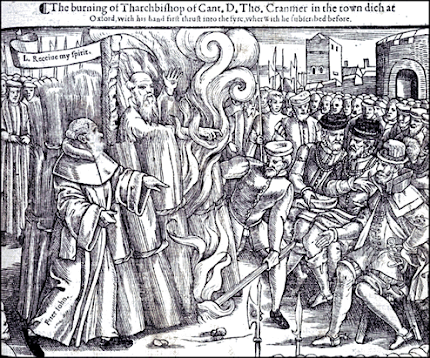
The burning of Tharchbishop of Cant. D. Tho. Cranmer in the town dich at Oxford, with his hand first thrust into the fyre, wherwith he subscribed before. [Click on the picture to see Cranmer's last words.]

Daily Bible Verse

Showing posts with label R. Scott Clark. Show all posts

Friday, November 10, 2023

A Brief Response to Scott Clark on Predestination and the Well Meant Offer


Indeed, in the next few lines Calvin says much the same thing: “It is unreasonable that man should scrutinize with impunity those things that the Lord has determined to be hidden in himself.… The secret of his will which he determined to reveal to us, he discovers [discloses] in his Word.”2 It is not only unreasonable to scrutinize the hidden will of God, as Calvin says; it is impossible. Knowledge of predestination is to be sought in God’s revealed will, in the Word, and in the Word alone. Let us not pry elsewhere with that curiosity that Calvin condemns, but let us not neglect to study carefully what God reveals to us and intends that we should study.


Gordon H. Clark. Predestination (Kindle Locations 97-102). The Trinity Foundation. Kindle Edition.


"But I do want to make it clear that while I am no universalist, my own inclination is to emphasize the "wideness in God's mercy" rather than the "small number of the elect" motif that has often dominated the Calvinist outlook."  Richard Mouw.


Further, if God’s will can only be spoken of in one sense, then we would become universalists! Nevertheless, we must deal honestly with God’s Word and recognize that, given the hiddenness of the divine decree, there is a genuine and true sense in which God must be said to will the salvation of all.   R. Scott Clark


A Brief Response to the Theologian of Paradox and Contradiction:  Is Denying Common Grace, the Free Offer and the Well Meant Offer Hyper-Calvinism?


I generally do not waste much time refuting an old strawman fallacy leveled at the apologetics of the late Dr. Gordon H. Clark, the Protestant Reformed Church in America, Dr. David Engelsma, and others who reject the liberal progressives in the mainstream Evangelical and Reformed movement.  Sadly, the most conservative Calvinists and Evangelicals are constantly vilified with abusive ad hominem fallacies, gaslighting, and unjustified polemics by the so-called “tolerant” and confessional Reformed academics.  I speak specifically of Dr. R. Scott Clark, a professor of theological history at Westminster Theological Seminary in Escondido, California.  R. S. Clark recently rehashed a litany of false accusations against those who refuse to accept the theology of paradox which is advocated by the students of the late Dr. Cornelius Van Til and which was advocated by Van Til himself.  You can read his article here:  Hyper-Calvinism, Rationalism, and Anti-Predestinarians.

Scott Clark is the perfect example of what happens when an earlier departure from the biblical and confessional Reformed theology begins to diverge into even greater departures from the system of propositional truth revealed in the Bible.  Dr. Gordon H. Clark traced this theology all the way back to the Romanist theologian, Thomas Aquinas, who proposed a two-fold view of truth, one for God and another humanity.  While it is true that there are differences between how an eternally omniscient, omnipotent, omnipresent, and immutable God knows everything intuitively, and how humans only know discursively and in time, it does not follow that truth changes from the Creator to the creature.  If so, then humans cannot know anything God knows.  But as Dr. Gordon H. Clark once said, does God know that 2 + 2 = 4?  Of course He does know this.  There must be a univocal connection between what God has revealed and what we know of that revelation.  This twofold view of truth, which is being advocated by the students of Cornelius Van Til, actually began with Abraham Kuyper and his influence on the Old Princeton Seminary in New Jersey and on Calvin Seminary in Grand Rapids, Michigan.  Along with that came the new liberalism of neo-orthodoxy and existentialism, which was promoted by Karl Barth, Gerhard Von Rad, Emil Brunner, and others.  These theologians wanted to curb logic and rationality because they did not believe that supernatural revelation could withstand the scrutiny of internal consistency.  Ironically, R. Scott Clark and most of the semi-Calvinists today agree more with the higher and lower liberal critics and the neo-orthodox theologians than with the twentieth century Fundamentalists and Evangelicals of Old Princeton.

Somehow, R. S. Clark believes that we must curb rationality because rationality questions supernatural revelation and attacks the Bible and the Christian worldview.  While it is certainly true that reason divorced from faith and supernaturalism results in natural religion and liberalism, it does not logically follow that philosophy cannot be subservient to Scripture.  Even Richard Muller argues for this magisterial and ministerial use of philosophy in his first volume on the what he calls Reformed dogmatics. 

(See:  Muller, Richard A. Post-Reformation Reformed Dogmatics: The Rise and Development of Reformed Orthodoxy;  Volume 1: Prolegomena to Theology. 2nd ed. Grand Rapids, MI: Baker Academic, 2003. Print.)

R. S. Clark wants to argue that he is not a rationalist because he affirms the theology of paradox as his default go to when confronted with apparent contradictions.  Instead of using the logical propositions in the Bible to solve the apparent antinomies and dilemmas, RSC wants to excuse his inability to reconcile the biblical texts to his cultural concerns and pastoral concerns as they relate to evangelism and pastoral care in the local congregation.  But this is not the approach taken by Jesus and the apostles.  Instead, they faced their opponents head on with Scripture.  However, RSC does not like Sola Scriptura that much either, and anyone who opposes his theology or exegesis of the biblical texts is gaslighted with abusive ad hominem attacks like hyper-Calvinist, biblicist, and rationalist.

Astonishingly, R. S. Clark says that the hyper-Calvinsts have more in common with universalists, presumably Arminian universalism, than with Calvinism:

Ironically, the “evangelical” universalists and the hyper-Calvinists (we should speak of “hyper-predestinarians”) deserve each other. The universalists cannot see how it is that God can freely and genuinely offer the gospel to all unless it is the case that Christ actually died for everyone who ever lived and unless it is that Christ’s death has made it possible for all to be saved if they will only do their part. Methodologically, in both cases, what their nets cannot catch are not butterflies. The limits of their intellect are the limits of what God can or cannot do.

Orthodox, confessional Calvinism does not limit God by the limits of our comprehension. We understand that God transcends our ability to comprehend Him. We may be wrong, but we really do believe that we are following God’s Word when we confess both that God has known his elect from all eternity, and that he reprobates some by passing them by, and that Christ died for those whom the Father gave to him from all eternity (pactum salutis), and that God has ordained that the gospel of free salvation through faith alone (sola fide), by grace alone (sola gratia), in Christ alone (solo Christo) should be preached and offered freely to all as a well-meant offer of the gospel.

But this is his position, not ours.  In fact, Clark openly admits that he cut his teeth in the Universalist and Unitarian church of his upbringing.  He cannot seem to divorce himself from his past and falsely projects his own universalist tendencies upon traditional and classical Calvinists who insist on a strict reading of the Reformed confessions and Calvin himself.  Common grace, which R. S. Clark promotes, is a universalist doctrine which comes amazingly close to the Arminian doctrine of common grace, with the exception that RSC admits that there are two kinds of grace; one kind of grace is special and particular to the elect and the other kind of grace is general and common to both the elect and the reprobate.   But what kind of grace is it that does not save anyone?  It’s not even the Arminian common grace because at least the Arminian common grace makes salvation a contingency.  Semi-Calvinist common grace says that God loves the reprobate, knowing that He will not save them.

Furthermore, Scott Clark conveniently fails to mention that the well meant offer means that God actually desires to save everyone while not decreeing to save everyone.  In the first case, the well meant offer is simply preaching a contingency to humans and telling them that God really does want to save everyone without exception--which is essentially lying to them, because the Bible clearly says that God will not save everyone.  If God is omnipotent, omniscient, and omnipresent, then God should be able to save everyone without exception, which is a universalism that goes well beyond what the Arminians argue for, namely libertarian free will and contingency.  If God is able to save everyone but does not do so, then it cannot be that God both desires or wills to save everyone and yet does not decree or will to save everyone.  And this is precisely the contradiction that RSC does not wish to discuss here.  Instead, he attacks his theological and apologetical opponents with polemics based on his self acknowledged ignorance of what God knows in His archetypal knowledge.

While Clark denies that he is a universalist, other promoters of the well meant offer, the free offer and common grace, such as Richard Mouw, have openly said that they hold out hope that everyone would be saved in the last day.  If this is not univeralism, I do not know what else to call it:

Throughout this discussion I have been rather free in employing the well-worn Calvinist categories of "elect" and "non-elect" or "reprobate." I make no apologies for doing so. The categories are biblical ones. Nevertheless, I do not mean to mean [sic] to imply that I actually have clear notions about how to divide the human race up into these classifications. Here too - even especially here, I am convinced - we mortals stand before a great mystery. But I do want to make it clear that while I am no universalist, my own inclination is to emphasize the "wideness in God's mercy" rather than the "small number of the elect" motif that has often dominated the Calvinist outlook. I take seriously the Bible's vision of the final gathering-in of the elect, of that "great multitude that no one could count, from every nation, from all tribes and peoples and languages," who shout the victory cry, "Salvation belongs to our God who is seated on the throne, and to the Lamb" (Revelation 7:9-10). For all I know - and for all any of us can know - much of what we now think of as common grace may in the end time be revealed to be saving grace.  . . .

Richard J. Mouw. He Shines in All That's Fair: Culture and Common Grace (Kindle Locations 1020-1027). Kindle Edition.

As we can see from the comments of Richard Mouw, the semi-Calvinists affirm Calvinism and then openly deny Calvinism because their theology requires that everything is a mystery and an apparent contradiction or paradox.  How this is different from neo-orthodoxy they are unwilling to explain, because that too would constitute “rationalism”.  Richard Mouw claims that he is not a univeralist, yet if common grace applies to the whole human race from the beginning to the end, then

much of what we now think of as common grace may in the end time be revealed to be saving grace.

Richard J. Mouw. He Shines in All That's Fair: Culture and Common Grace (Kindle Locations 1026-1027). Kindle Edition.

What Mouw is saying is based on a postmillennialist view of eschatology.  However, implicit in his remarks is that the wide road will lead to salvation and the narrow road to damnation, precisely the opposite of what Jesus said (Matthew 7:14).  It is my contention that this is deliberate on their part and a way of hiding what their true beliefs are.  Liberals do not wish to openly admit what they believe privately--much like progressives in the political sphere--so that by the time the churches realize what has happened, it is too late to turn back.  The frog in the kettle analogy comes to mind here.

If God says that not everyone will be saved and that some will go to hell by His predetermined foreknowledge and predestination, does that mean that God somehow wills to save those whom He has not decreed to election, regeneration and ultimate salvation?  Of course not.  But this is where the theology of paradox comes in to rescue the semi-Calvinists from their Arminian accusers.  The semi-Calvinists will agree with the Arminians and the universalists that both are true at the same time and in the same way.  God both desires to save the reprobates who were decreed to reprobation prior to the creation of the world, and God does not will to save them at the same time and in the same way.  This is an outright contradiction, not merely an apparent contradiction or paradox.  Any Arminian can understand that this is a contradiction. 

The Arminian solution to the problem is to make God unable to save and to make salvation merely a possibility left up to partially depraved sinners, who have had libertarian free will restored sufficiently so that the sinner can have enough common grace to make a genuine choice between salvation and damnation.  Of course, this is exactly the same view held by the semi-Calvinists, though they wish to deny it by appealing to a legitimate desire on God’s part to save those who frustrate His desire, even foreknowing that they will not accept the “free” offer.

The problem here is that God’s foreknowledge is perfect, otherwise God would not be omniscient, knowing the exact future as it will inevitably occur in historical time.  The Arminian says that God makes His election decisions based on peering into the future to learn how history will unfold once God set the creation in motion.  This smacks openly of deism whereby God creates and then has no providential control over nature, humanity, or anything else.  As the old saying goes, “Stuff happens.”  But the Arminian view entails that God must be ignorant of the future and therefore He must learn new information in order to decide who to save.  This also leads to the heresy of Open Theism.  Even Arminians once identified Open Theism as a heresy but now it has become popularized by the chief heresiarch of Arminianism, Roger Olson:

Open theism is, in my opinion, although mistaken, closer to the true heart of Arminianism than is Molinism (insofar as it uses middle knowledge to reconcile divine determinism with free will). It ought to be considered a variety of Arminianism just as, say, supralapsarianism is considered a legitimate variety of Calvinism. Calvinism is a diverse tradition.  (Is Open Theism a Type of Arminianism?).

These kinds of heresies and deviations are not just resident with the Arminians.  They exist with the post Reformation dogmatics of the semi-Calvinists as well.  In fact, there is much infighting amongst the followers of Van Til.  John Frame, for example, holds to two different existences of God to try to bridge the gap between God’s transcendence as the Creator and God’s immanence with His creation and His creatures.  Scott Oliphant has proposed using an anology of the incarnation and applying that to the Creator so that He now has this third category of covenantal properties or attributes, which allow for Him to interact with His creation.  And Richard Muller has suggested that the ectypal revelations of God in the form of the written Scriptures are actually derived from the archetypal knowledge of God, which is known only to Himself.  But if what Muller, Oliphant, and Frame says is true, it is yet another mystery or outright contradiction.  I say that because you cannot derive ectypal knowledge from an unknown archetypal knowledge which is accessible only to God Himself.  Even more telling, Muller himself acknowledges that he disagrees with Francis Turretin’s view of the ectypal and archetypal knowledge of God.  For Turretin, the distinction is not an outright contradiction or a paradox, much to the chagrin of the Van Tilians.  Turretin’s view, in fact, seems much more in tune with the late Dr. Gordon H. Clark’s view of univocity between God’s knowledge and man’s knowledge at certain points of convergence. For the irrationalists, as GHC pointed out, there is no contact between two parallel lines and therefore, creatures can know nothing whatsoever that God knows.  Muller, at least, acknowledges that ectypal knowledge is derived from God’s archetypal knowledge, implying that there are points of contact between God’s knowledge and our knowledge, not irrational parallel lines.  I am sure that Muller and the Van Tilians will disagree with my analysis but the implications are there for all to see if you read volume one of his Post-Reformation Dogmatics.

R. Scott Clark cannot understand the apparent contradiction between predestination and the general call of the Gospel, so his response is to contend for an actual contradiction which he calls a paradox.  First of all, a paradox is not an actual contradiction.  Paradoxes have logical solutions; actual contradictions have no solution.  So if God foreknows who will be saved, it is not a contradiction to say that God has never intended to save those whom He has decreed to reprobation prior to creation.  Whether the theologian opts for supralapsarianism or infralapsarianism, the decree is an eternal and timeless decree, not subject to what happens in time.  Therefore, an eternal God could not have an emotional desire to do what He has not predetermined in eternity.  God has no emotions or passions, precisely because God has no body or bodily sensations.  It is inescapable for Scott Clark that predestination ultimately determines who is saved and who is not saved, whether he likes it or not.  Predestination is a central doctrine to the doctrine of God and the trinity.  If God is sovereign, then predestination is an essential attribute of God’s eternal will, His eternal omniscience, and His eternal omnipresence.  

Dr. Gordon H. Clark solved the problem of predestination versus the general call of the Gospel.  However, he is not the first to do so.  There were many of the primary reformers who also solved this problem.  John Calvin’s distinction between remote and proximate causation is just one example.  Scott Clark claims to believe in predestination; but then he sweeps predestination under the rug because he does not want to actually discuss the doctrine or any solutions to the paradox.  This is why Dr. Gordon H. Clark referred to these men as semi-Calvinists.  

R. Scott Clark openly admits that he is neo-orthodox and universalist, in the Arminian sense at least, by his remarks at the end of his article.  He says that there is no point of contact between the written word of God and RS Clark's view of the well meant offer, which is always in the mysteries of God's hidden and archetypal knowledge:

To my hyper-Calvinist friends and correspondents, I was reminded by a post on Reformation Theology by John Samson, of this verse: “Who desires all people to be saved and to come to the knowledge of the truth” (1 Tim 2:4). The English verb “to desire” translates the Greek verb which is usually translated “to will” (θελειν). Against the free or well-meant offer, it has been argued that we cannot speak of God’s will in two aspects or in two ways, that we must speak univocally. Univocity, however, assumes an intersection between the divine and human intellect, and that is, of course, a form of rationalism. It is not Reformed theology, which is premised on the Creator-creature distinction.

Further, if God’s will can only be spoken of in one sense, then we would become universalists! Nevertheless, we must deal honestly with God’s Word and recognize that, given the hiddenness of the divine decree, there is a genuine and true sense in which God must be said to will the salvation of all. It is in light of this sort of biblical language that the Reformed faith has historically taught the substance of what has come to be called the “free” or “well-meant” offer of the gospel.

Ibid., R. Scott Clark. 

There is a reason that R. Scott Clark does not like the doctrine of predestination.  It is because he knows that the well meant offer and the free offer of the Gospel, as defined by RSC and other semi-Calvinists, directly contradicts what the Bible plainly says about predestination.  If God foreknows that particular individuals will not receive regeneration and believe, then obviously election cannot be conditional as the free offer of the Gospel entails.  Election is particular and foreknowledge of who is elect and reprobate is an immutable decree of God (Romans 9:11-13).  Simply because we do not know who is elect or reprobate does not entail that God both decrees particular individuals to election and reprobation, and that God does not decree particular individuals to election and reprobation.  Scott Clark wants there to be contingencies and possibilities in God's immutable mind so that he can preach an Arminian gospel of possibility.  Even the late R. C. Sproul recognized that he could not tell an unbelieving person that Jesus died for their sins.  There is no way to know that unless you're preaching contingencies.  Ironically and paradoxically, it is Scott Clark who is the universalist, and he openly admits that his view is not founded on the Scriptures but in his theology of paradox!

I will be making more remarks on the topic of predestination in the next series of posts.  I am currently reading Richard Muller’s first volume of Post-Reformation Dogmatics.  He apparently thinks that later departures from the earlier positions taken by the initial Protestant Reformers trumps what the first generation Reformers said.  Muller also tries to read his own views into the post-Reformation theologians rather than letting them speak in their own terms.  I have many examples of this, and there is more to follow.

[Postscript:  1 Timothy 2:4 means that God wants to save His elect from every class of mankind, high and low.  It does not literally mean universal salvation for all of mankind as the Arminians, the Unitarian Universalists, and the common grace Semi-Calvinists contend.  The general call of the Gospel does not prove that God literally desires to save everyone head for head, as the purveyors of paradox contend.  Rather, the general call of the Gospel is preached to all indiscriminately because we do not know whom God has individually elected.  He wants us to preach to all so that the elect may be gathered from all nations and classes of men.  The common grace people take this is as a contradiction with no solution.  See Calvin's Commentaries: 

4. Who wishes that all men may be saved. Here follows a confirmation of the second argument; and what is more reasonable than that all our prayers should be in conformity with this decree of God?

And may come to the acknowledgment of the truth. Lastly, he demonstrates that God has at heart the salvation of all, because he invites all to the acknowledgment of his truth. This belongs to that kind of argument in which the cause is proved from the effect; for, if “the gospel is the power of God for salvation to every one that believeth,” (Rom. 1:16,) it is certain that all those to whom the gospel is addressed are invited to the hope of eternal life. In short, as the calling is a proof of the secret election, so they whom God makes partakers of his gospel are admitted by him to possess salvation; because the gospel reveals to us the righteousness of God, which is a sure entrance into life.

Hence we see the childish folly of those who represent this passage to be opposed to predestination. “If God,” say they, “wishes all men indiscriminately to be saved, it is false that some are predestinated by his eternal purpose to salvation, and others to perdition.” They might have had some ground for saying this, if Paul were speaking here about individual men; although even then we should not have wanted the means of replying to their argument; for, although the will of God ought not to be judged from his secret decrees, when he reveals them to us by outward signs, yet it does not therefore follow that he has not determined with himself what he intends to do as to every individual man.

But I say nothing on that subject, because it has nothing to do with this passage; for the Apostle simply means, that there is no people and no rank in the world that is excluded from salvation; because God wishes that the gospel should be proclaimed to all without exception. Now the preaching of the gospel gives life; and hence he justly concludes that God invites all equally to partake salvation. But the present discourse relates to classes of men, and not to individual persons; for his sole object is, to include in this number princes and foreign nations. That God wishes the doctrine of salvation to be enjoyed by them as well as others, is evident from the passages already quoted, and from other passages of a similar nature. Not without good reason was it said, “Now, kings, understand,” and again, in the same Psalm, “I will give thee the Gentiles for an inheritance, and the ends of the earth for a possession.” (Ps. 2:8, 10.)

In a word, Paul intended to shew that it is our duty to consider, not what kind of persons the princes at that time were, but what God wished them to be. Now the duty arising out of that love which we owe to our neighbour is, to be solicitous and to do our endeavour for the salvation of all whom God includes in his calling, and to testify this by godly prayers.

Calvin's commentary on 1 Timothy 2:4.

Calvin, John, and William Pringle. Commentaries on the Epistles to Timothy, Titus, and Philemon. Bellingham, WA: Logos Bible Software, 2010. Print.]


Friday, September 15, 2023

Is Assurance of Salvation a "Second Blessing"? A Short Response to R. Scott Clark


"Before regeneration a sinful human being does not think this way. He believes that God is too good to condemn anybody, and, besides, he himself is quite respectable. But the gift of faith changes his ideas. Jesus, whom he previously admitted to be an admirable ethical teacher, he now believes to be the Lord of Glory. The sins he has loved, he now hates, or at least begins to hate, for regeneration is not instantaneous perfection."  Dr. Gordon H. Clark


A. W. Pink quoted Walter Marshall, a British non-conformist in 1692:

We are to look upon holiness as a very necessary part of that salvation that is received by faith in Christ. Some are so drenched in a covenant of works that they accuse us of making good works needless to salvation, if we will not acknowledge them to be necessary, either as conditions to procure an interest in Christ, or as preparatives to fit us for receiving Him by faith. And others, when they are taught by the Scriptures that we are saved by faith, even by faith without works, do begin to disregard all obedience to the Law as not at all necessary to salvation, and do account themselves obliged to it only in point of gratitude—if it be wholly neglected, they doubt not but free grace will save them nevertheless. Yea, some are given up to such strong Antinomian[67] delusions, that they account it a part of the liberty from bondage of the Law purchased by the blood of Christ, to make no conscience of breaking the Law in their conduct.


Arthur W. Pink. The Doctrine of Sanctification (Kindle Locations 340-347). Chapel Library. Kindle Edition. 


I understand that R. Scott Clark is opposed to the Federal Vision error.  But the problem I have is that Scott Clark does not differentiate between misrepresentations of the Westminster Confession of Faith and the actual teaching of the Westminster Confession as it is deduced from the Scriptures.  Even worse, R. Scott Clark, who claims to be recovering the Reformed confessions, openly rejects the Westminster Confession on the issue of assurance of salvation.  Or maybe RSC made a typological error?  At any rate, he misquotes the WCF when he says:

Indeed, the divines insisted that believers do finally gain assurance “extraordinary revelation” through “the right use of ordinary means” (i.e., the preaching of the gospel, the use of the sacraments, and prayer). Contra Rome, this doctrine of assurance does not lead believers to lead immoral lives but to lead godly lives. The divines were concerned that people should not think that because they doubt and struggle that they are not or no longer believers. Rather, they were trying to encourage not discourage people.  R. Scott Clark, Heidelblog, "Does The Westminster Confession Contradict Calvin On Assurance And Faith?", October 20, 2016.

Unfortunately, the confession says just the opposite of what I have placed in italics in the quote.  The confession says, 

III. This infallible assurance doth not so belong to the essence of faith, but that a true believer may wait long, and conflict with many difficulties, before he be partaker of it:k yet, being enabled by the Spirit to know the things which are freely given him of God, he may, without extraordinary revelation, in the right use of ordinary means, attain there unto.l   WCF 18:3.

Westminster Assembly. The Westminster Confession of Faith: Edinburgh Edition. Philadelphia: William S. Young, 1851. Print.

It is often difficult to understand exactly what RSC is talking about.  Apparently, the Calvin versus the Calvinists school believed that assurance of salvation depended on an initial justification and a subsequent second blessing. Furthermore, I take it that the Calvin versus Calvinism school has something to do with the Federal Vision heresy where the FV proponents wish to make the Westminster Confessional Standards agree with their conflation of the visible church with the invisible church;  their conflation of the visible signs and seals of covenant with the invisible graces is one source of the problem.  Additionally, they misunderstand unconditional election, which God only grants to the elect. The adherents of the Federal Vision contend that election and regeneration are conveyed through baptism into membership in the visible church.  They also say that election and regeneration can be lost if the person commits apostasy or falls into grievous sins.  But this is not the position of the Bible or the Reformed confessions.


Oddly enough, RSC is making a similar error by misquoting both John Calvin and the Westminster divines out of context.  I say that because Calvin and the later Westminster divines were indeed dealing with their settings in life or cultural situations.  R. Scott Clark wants to conflate the cultural problems of the 16th and 17th centuries with the 20th and 21st centuries.  Calvin was dealing with the Roman Catholic undermining of the assurance of salvation.  The Westminster divines were dealing with both hypocrisy and the undermining of the assurance of salvation.

There is a dual problem today as well.  But the duality is that almost no one today actually fears God anymore.  So the problem is not so much the lack of assurance of salvation, but rather a lack of concern for their obedience.  Even the Romanists do not fear God anymore.  As Dr. Gordon H. Clark once remarked in relation to the doctrine of repentance, liberals think that God must be too good to damn anyone to hell:

The religious world of the present century has witnessed a tidal wave of anti-intellectualism. Inundated by the outright irrationalism of the Neo-orthodox and the existentialists, popular religion holds every intellectual decision – the acceptance of an intellectual doctrine – to be either insincere or trivial, and that only emotion is genuine and “authentic.” With the prevalence of such views, a further repetition of the Catechism seems called for. Repentance includes an “apprehension of the mercy of God in Christ.” Before regeneration a sinful human being does not think this way. He believes that God is too good to condemn anybody, and, besides, he himself is quite respectable. But the gift of faith changes his ideas. Jesus, whom he previously admitted to be an admirable ethical teacher, he now believes to be the Lord of Glory. The sins he has loved, he now hates, or at least begins to hate, for regeneration is not instantaneous perfection. By this change of mind he turns from sin to God; or, more accurately, this change of mind is his turning to God. Nor can this turning or conversion occur without a full purpose and endeavor to obey God’s law. There is nothing insincere in this. To use John Calvin’s remark, it is the pious assent of the mind.

Gordon H. Clark. What Is the Christian Life?  1990.  1992.  Third edition. (Unicoi:  Trinity Foundation, 2012).   Kindle Locations 270-279. Kindle Edition. 

I did my time in Bible college and seminary; but when I read the Heidelblog it is as if I am reading a foreign language.  I have read the classical systematic theologies.  I have read Charles Hodge, Louis Berkhof, Stephen Charnock, Lorraine Boettner, Gordon H. Clark, and even Van Til.  But when I listen to the podcasts from both the Westminster Seminary, Philadelphia, Pennsylvania and Westminster Seminary,  Escondido, California or read their posted literature, it is as if I am reading a foreign language.  Most of it has very little to do with the actual Scriptures or the Reformed confessions themselves.  One doctrine that you will never hear any of them mention, or at least only in brief, is the doctrine of predestination.  Almost everything these schools have to say is colored by their rose-colored glasses of common grace and their focus on christology and covenant theology as the alleged center of their system of analogical theology.

The main  problem I have with the Escondido school is the constant barrage of justification by faith alone as if that doctrine is all there is in the Reformed confessions.  The other problem is the constant appeal to modern and postmodern theologians as if their spin on church history is the interpretative grid which must be imposed on both the Scriptures and the Reformed confessions themselves.  These writers, including R. Scott Clark, wish to emphasize the total transcendence of God above all else so that the Scriptures become merely an ectypal condescension to the human level, not the very words of God univocally.  Of course, we are not omniscient and cannot see the total picture or think with super-intelligence as God does.  He knows everything intuitively and directly, while our knowledge as creatures is discursive and revealed to us through the innate image of God, natural revelation and special revelation; but that is another essay for another day.

The issue here is that R. Scott Clark overreacts to the Federal Vision error to the point that he has tendencies to misrepresent the actual warning passages in Scripture and how the Westminster Confession and the Canons of Dort address those issues.  The fact of the matter is that assurance of salvation does not always accompany conversion to Christ.  That's because many persons come from bad backgrounds, being former criminals.  Others come from a Romanist background and have no assurance.  But the vast majority of new converts--who may or may not be regenerate--have an attitude of easy believism.  That's because of the church growth movement and the influence it has on the denominations.  

Although the Escondido school pretends to reject the pragmatism of the church growth movement, they actually practice the same pragmatism.  Without new churches, new members and new ministers, seminaries tend to become irrelevant and die out.  So that means that there can be no real education in what Scripture actually says on the issues or even what the Reformed confessions say.  Instead the other graces of repentance, sanctification, and assurance must be either reinterpreted or downplayed.  John MacArthur, one of R. Scott Clark's most hated targets, at least emphasizes sanctification.  So RSC attacks pastors he does not like.  He continually attacks MacArthur as a legalist but most of the attacks are in fact straw man fallacies.  RSC also totally despises the late Dr. Gordon H. Clark on many levels.  GHC is a "hyper-Calvinist", a rejecter of the free offer and common grace.  He's one of those despised fundamentalists, according to RSC.

John MacArthur even preaches the doctrine of total depravity, which he calls the most hated doctrine in the world.  Although I somewhat agree, I think the most hated doctrine is the doctrine of predestination.  We are told to never talk about that one:  

There is also the case of the Bible professor in a so-called Christian college, who told me, "Even if you believe in predestination, don't let anyone know you do."  He constantly told his students never to study the subject nor mention it in their preaching.  One student who held his professor in high respect was shocked to find that the Bulgarian laborers with whom he worked in Chicago were extremely interested in the forbidden subject.  But if predestination is not to be mentioned, God must have made an embarrassing blunder in revealing it to us.  

Gordon H. Clark.  What Do Presbyterians Believe?  The Westminster Confession Yesterday and Today.  1965  Second edition.  (Unicoi:  Trinity Foundation, 2001).  P. 43. 

To get to my main point of this article, however, it seems to me that RSC and many other so-called Reformed theologians are hypocritical on so many levels that it would take a book length response to analyze them all.  RSC says that assurance cannot be lost but only diminished.  But the WCF says that assurance can be diminished and shaken to the point that it is almost completely lost.  (WCF 18:4).  Not only that, the Westminster divines were not as much concerned with assurance as with hypocrisy.  (WCF 18:1).  In fact, it is possible to have saving faith without having assurance of salvation at all.  (WCF 18:3, quoted above).  The doctrines of grace should not encourage looseness in morality but a growth in the grace and knowledge of our Lord and Savior, Jesus Christ.  (2 Peter 3:18).  

...And therefore it is the duty of every one to give all diligence to make his calling and election sure; that thereby his heart may be enlarged in peace and joy in the Holy Ghost, in love and thankfulness to God, and in strength and cheerfulness in the duties of obedience, the proper fruits of this assurance: so far is it from inclining men to looseness.  (WCF 18:3; 2 Peter 1:10)

Westminster Assembly. The Westminster Confession of Faith: Edinburgh Edition. Philadelphia: William S. Young, 1851. Print. .

R. Scott Clark and others focus on theology from below instead of the doctrines of sovereign grace taught in the Bible and summarized by the Westminster Standards.  I pray that God will grant them repentance.  The system of propositional truth deduced from the Bible and summarized by the Westminster Standards is what we are obligated to believe.   

I highly recommend this online edition of the Westminster Confession of Faith and the Larger and Shorter Catechisms:  The Westminster Standards.


Saturday, September 27, 2014

Further Evidence of Relativism in Dr. R. Scott Clark's Theology

A second aspect of the QIRC is the desire to be “right.” This is to be distinguished from the desire to “get it right.” The latter knows that he may be wrong, that being wrong isn’t a theory, it’s a reality. The question isn’t whether he is wrong but rather where he is wrong and how frequently. The fellow who knows he is right knows that because he must be right. He cannot be right. You’ve had discussions and arguments with such folks. If you say the sky is blue they will tell you that it isn’t really. Even when they’re demonstrably wrong, they will doggedly insist that they are right even if they cannot demonstrate quite how they are right.  

Dr. R. Scott Clark, The QIRC-er Must Be Right

I wonder if Van Tilians ever claim to be right?  Oh, wait.  Dr. R. Scott Clark is not claiming to know what is right.  He is just trying to get it right and he does not really know whether he is right or wrong.  He is just progressing as he goes along.   This reminds me of a verse in the Bible:

 
always learning and never able to come to the knowledge of the truth. Now as Jannes and Jambres resisted Moses, so do these also resist the truth: men of corrupt minds, disapproved concerning the faith;” (2 Timothy 3:7–8, NKJV)

I guess for Dr. R. Scott Clark he cannot know if the trinity is right or not?  Maybe the Bible could be wrong?

Really, these strawman arguments against dogmatic presuppositionalism or Scripturalism are just repetitious fallacies.  Repeating  a fallacious argument over and over again does not and cannot make it so.

And Scott Clark knows that Scripture is an analogy and it must be so.  After all, if it is not so then the Van Tilians would have to admit they are wrong, would they not?  As the redneck plow boy once said, "Say it ain't so!"  Would Scott Clark entertain the thought that he might be wrong about Dr. Gordon H. Clark's fundamentalism and Scripturalism?  No, he would not.  So it would appear that the theology of paradox and contradiction extends even to the Van Til/Clark controversy.  The difference is not that Van Tilians are just trying to get it right while the Clarkians know they are right.  The difference is not even that Dr. Gordon H. Clark claimed to be infallible, unerring, or always right.  He upheld the doctrine of total depravity, including the noetic effects of sin.  Gordon H. Clark said many times that people can err by misunderstanding God's Word.  In fact, the Bible says that individuals can and do twist the Scriptures to their own destruction:


and consider that the longsuffering of our Lord is salvation—as also our beloved brother Paul, according to the wisdom given to him, has written to you, as also in all his epistles, speaking in them of these things, in which are some things hard to understand, which untaught and unstable people twist to their own destruction, as they do also the rest of the Scriptures.” (2 Peter 3:15–16, NKJV)


Really, what R. Scott Clark is doing is deflecting any criticism of his own views.  It is similar to the arguments used by Pentecostals and Charismatics that misuse the Scriptures to stop critical examination of the flaws in their experiential and subjective theology.


 Saying, "Do not touch My anointed ones, And do My prophets no harm." (1 Chronicles 16:22; Psalm 105:15 NKJV)


The Van Tilian has more in common with the Anabaptists in this regard since their theology is based on existentialist paradoxes, inspired myths, and relativistic theology that changes with multi-perspectivalist logic.  Of course, Scott Clark disagrees with John Frame's triperspectivalism.  But a relativist disagreeing with another relativist is like saying, "I'm trying harder to get it right than you are!"

The only argument Scott Clark can mount against Scripturalism and Dogmaticism is to use the abusive ad hominem fallacy:  "You're a rationalist.  You're a gnostic."  Of course, the Scripturalist view is not that we have secret knowledge.  Rather, the Scripturalist view is that we are God's image and the mind and the intellect is not evil.  In fact, Scott Clark is the gnostic because he thinks he has a secret insight that Clarkians do not have.  The Clarkian view is that even a plow boy can read and understand the plain and perspicuous teachings of the Scriptures.  Even a child can read and understand the Bible (2 Timothy 3:15).  Why?  Because even a child thinks logically and all language is formulated in terms of logic.  A cat by definition is not a dog.  Good by definition is not evil.  I ask Scott Clark, "Is it prying into God's secret decrees and secret knowledge to know the Scriptures are God's literal, logical, univocal revelation?"  I think not.  (John 1:1; John 1:9).  Of course, I do not claim to absolutely know anything.  That would require omniscience, which I do not possess and never will possess.  However, I do know that Scripture claims to be God's infallible, inerrant, and fully inspired Word (2 Timothy 3:16-16; 2 Peter 1:19-21; Isaiah 8:20).  Furthermore, what God sends his Word to do, God accomplishes (Isaiah 55:11).

Scott Clark should come out of his ivory tower and stop hiding behind his curtain like the wizard of Oz.  A real Reformed scholar is not afraid to answer his opponents' attacks publicly.  Dodging the issues and pretending to be right is what Scott Clark is doing and it is the very thing he supposedly abhors.  He is claiming to be right without even debating his opponents on the issues at hand.


Another example of Scott's irrationalism is when he claims to be a presuppositionalist but affirms empiricism as the basis for knowledge:

In such a deconstructed world, in reaction to the prevailing Gnosticism (“the world doesn’t work the way your senses tell you it does.  (Ibid.)

Since when do the senses think?  Animals have senses that are even more accurate many times than the human senses.  Eagles have keener eyesight and dogs can smell much better.  But can eagles or dogs think or do calculus?  Can eagles do geometry or design a building?  How is it gnosticism to insist on a particular epistemological worldview, namely that all knowledge begins with Scripture as the beginning axiom?  

The senses are never wrong, right, Scott?  Of course, magicians prove this not to be true all the time.  After all, the whole point of magic tricks is to mislead the senses.  But logic can figure out the trick where the senses never could.

What it really boils down to is that Scott Clark accepts the world's rationalism because he openly endorses the epistemology of the empiricists.  Of course, this collapses into skepticism.  It does so by allowing science to have equal authority or a higher authority than Scripture.  When this happens you get departures from the Reformed view into theistic evolution and outright neo-orthodoxy.  This is obvious enough from the recent scandals where both Tim Keller and Bruce Waltke have openly endorsed theistic evolution.  (See:  Bruce Waltke:  Another Theistic Evolutionist Comes Out of the Closet).

Of course, this is a direct  result of rejecting Scripture as the final authority.  But the major reason that Van Tilians can do this is because they accept the three points of common grace endorsed by the Christian Reformed Church in 1924 during the modernist controversy.  In fact, many of the Christian Reformed ministers were kicked out of that denomination because the leaders of the CRC decided that they knew they were right and the Protestant Reformed ministers were wrong.

Worse, because Scott Clark cannot decide what is true or not true, he cannot bring himself to call the Federal Visionists "heretics."  Like the Presbyterian Church in America, he has decided that heretics are really just confused "friends."  As the old saying goes, "Liberals of a feather flock together."

I do not know I am right.  I believe it.  And I believe it because I know what the Bible says.  Of course, according to Scott Clark, we cannot really believe the Bible is God's Word.  If we did that would be trying to be omniscient or something.  Really?

Now the serpent was more cunning than any beast of the field which the LORD God had made. And he said to the woman, "Has God indeed said,`You shall not eat of every tree of the garden'?" (Genesis 3:1 NKJV)
Well, according to Scott Clark, we cannot claim to be right if we say that God really said anything at all in the Bible.  We are just hoping beyond hope we can get it right.  Will we ever get there?  Is it really a sin to practice sexual immorality or homosexuality, Scott?  Do you know the Bible is right?  Or maybe that is open to interpretation, too?  So much for paradox.  What's wrong today may be right tomorrow--including homosexual marriage (Leviticus 18:22; Romans 1:24-28).


To the law and to the testimony! If they do not speak according to this word, it is because there is no light in them.” (Isaiah 8:20, NKJV)

Sunday, September 14, 2014

One Point: Van Tilian Political Correctness, Logic, and the Priesthood of Believers

Now the serpent was more cunning than any beast of the field which the LORD God had made. And he said to the woman, "Has God indeed said,`You shall not eat of every tree of the garden'?" (Genesis 3:1 NKJ)"The bottom line here is that the Van Tilians are the ones who agree with Satan.  They ask the same question that the serpent asked in the garden:  "Hath God really said?"--  Charlie J. Ray


For a heads up, I want to let my readers know that this article will be an editorial opinion and not necessarily exegetical or systematic theology.  That being said from the get go, I want to issue a complaint against the ivory towers of Van Tilianism, neo-legalism, and various other miscreant theological aberrations within the general umbrella of what is generally known as Calvinism.  

First of all, I want to admit up front that I am not omniscient nor have I ever claimed to be omniscient.  I operate within my own limitations as an individual person who thinks propositionally.  In fact, my thinking is often subject to mistakes and logical errors.  I have never been trained formally in logic or philosophy other than a few classes in college and seminary; so I do make mistakes.  I am often forgetful and lose a train of thought.

But since all men are subject to these noetic effects of sin, even theologians whose professional occupation is teaching and writing theology and biblical exegesis are in the same situation.  This is why I wonder why people like R. Scott Clark and Mike Horton think that their opinion trumps the priesthood of believers.  The last I checked the Protestant Reformation does not teach the Anabaptist principle of subjective leadings to an ever changing truth.  The Reformers also did not teach lone ranger views of the priesthood of believers.  They outright rejected solipsism or any view of the liberty of conscience that made the individual the center of authority in matters of biblical interpretation.  Solo scriptura is therefore out. 

But where does that leave us?  Sola scriptura rejects the church as an infallible magisterium or interpreter of Scripture; thus the papist view that the pope and the church have an equal authority with Scripture is out.  Moreover, the Protestant Reformers certainly believed in scholarship.  The Reformation did not begin as a grass roots movement.  It began with humanist scholars who began to read the biblical texts for themselves.  Using logic and consistently critical methods they saw that Rome's views on doctrinal issue were not biblical but had been derived instead from human traditions.  Furthermore, the Latin Vulgate was shown to be an unreliable translation from the original Greek and Hebrew majority texts available to the Reformers.

The Reformers were out to educate the public.  The first thing they did was to translate the Bible into the vernacular languages of the people.  That's because the Reformers believed that even a common man, a plow boy could read the Bible for himself and see that Rome's traditions were wrong.  That's because the Bible is a logical revelation and logical propositions can be logically arranged to fit into a logical system that fits together into a whole system of theology (John 10:35).  The Scriptures cannot be broken.  Out of that grew the conviction that the system of theology in the Bible should be summarized into an extended creedal statement.  The Westminster divines were so committed to this principle that Scripture is perspicuous, plain, and logical that a culmination of that effort was the Westminster Assembly and the the documents we know as the Westminster Standards (Confession of Faith, Larger and Shorter Catechism).  But notice carefully that the Westminster Assembly of 1647 did not reject the priesthood of believers.  Their goal was to put the Bible in the hands of the common man.  The Bible alone is the Word of God in their view.  (2 Timothy 3:16).  Even a child or a redneck plowboy can understand the plain and perspicuous Scriptures and be saved (2 Timothy 3:15).  That is because Scripture is logical and the God who inspired Scripture is Logic (John 1:1).  Man is the image of God (John 1:9; Genesis 1:26-27).

What is amazing to me today, however, is that modern Reformed scholars in the Van Tilian camp are now directly challenging the doctrine of the perspicuity of Scripture, that Scripture is so plain that even a child can read and understand the essential and plain passages of the text and be saved (2 Timothy 3:15; 2 Peter 1:19-21).  Instead, the Van Tilians claim that all Scripture is apparently contradictory.  This is nothing more than neo-orthodoxy, of course.  The Bible is not really the word of God because at no single point does the Christian know anything that God knows.  This, of course, begs the question:  why would God reveal anything at all if it is impossible to know anything God knows?  The Van Tilian out for this question is analogical knowledge.  We don't know anything God knows except analogically.  So God didn't really reveal logical and propositional truth.  He only revealed glimmerings of irrational truths that don't make sense in the human mind.  To try to understand God's Word is really just a form of Arminian rationalism, according to the Van Tilians.  So why have seminaries or train men to think if it is all just rationalism to try to understand God's Word logically?  Without logic there can be no communication whatsoever.  That's because the law of contradiction is absolutely necessary for communication and understanding.   Van Tilians know this because they are always contradicting the views of the late Dr. Gordon H. Clark.  However, an analogy is not a logical proposition.  Dr. Clark rightly pointed out that unless an analogy or metaphor has a logical proposition behind it, then it is conveys nothing meaningful or understandable.

Van Til's views are therefore a direct repudiation of the inerrancy, infallibility, perspicuity, and reliability of Scripture.  In its place, Van Til places the authority of church synods that have a higher authority than Scripture.  After all, without the minister the lay man cannot read and understand the Bible.  For Van Til and his followers the priesthood of believers is subject to Van Til's final authority.  In short, disagree with the papal authority of Van Til and you are politically incorrect and black listed.  The name of Gordon H. Clark is anathema in the Reformed world today.  Dare to disagree with R. Scott Clark and you will be permanently banned from commenting on his blog or elsewhere. Dare to disagree with Westminster Seminary East or West or any other Reformed seminary promoting Van Tilian paradox and you are immediately unemployable as a minister in any of those churches.  In fact, I wonder why any orthodox Reformed minister would want to be ordained in a denomination where the theology of irrationalism prevails?

I am not rejecting confessional theology.  Obviously, Dr. Clark did not do that either.  He held that the Westminster Confession of Faith is the best summary of the propositional revelation in the bible that has ever been produced.  But I am saying that even a lowly lay person can study and read the Bible and use the Westminster Standards as a guide to understanding the system of theology that has been expositionally and exegetically drawn from the clear warrant of the Holy Scriptures.

In short, the Van Tilians have no authority over classical Calvinists.  The Bible is the final authority, not R. Scott Clark or Mike Horton.  They will ridicule and use the abusive ad hominem fallacy, of course.   They falsely accused Dr. Clark of hyper-Calvinism, rationalism and other things.  The bottom line, however, is that Scripture alone is the Word of God.  When a theological tradition bases its theology on an axiom other than Scripture, namely the Van Tilian axiom that "all Scripture is apparently paradoxical," the end result is skepticism, neo-orthodoxy, theonomy, the Federal Vision, the Auburn Avenue error, etc.  Most of this originated with Abraham Kuyper, Herman Bavinck, Gerhardus Vos, and other Reformed theologians whose theology logically culminated in the Auburn Affirmation, which ironically led to the formation of Westminster Seminary in Philadelphia and the Orthodox Presbyterian Church in the first place.

Sean Gerety asked a question his book, Can the Presbyterian Church in America Be Saved?  He pointed out the conflict between logical contradictions and the Van Tilian view that all Scripture is apparently contradictory.  This leaves the Van Tilians free to read the equivocations of the Federal Visionists with charity.  Lane Keister of the Green Baggins blog could not bring himself to say that Doug Wilson is an enemy of the Gospel.  The same thing is true of R. Scott Clark and Mike Horton.  Their commitment to irrationalism is so great that even though they disagree with the neo-legalism of Richard Gaffin, Jr. and the Federal Visionists, their commitment to a false charity given to false teachers is greater than their commitment to the Bible.  Furthermore, since neither Horton nor R. S. Clark actually believes the Bible is unequivocally and univocally the very words of God, they leave themselves open to skepticism.   To Horton the Bible is an inspired myth that is factual and R. S. Clark says that to say Scripture is the very words of God and univocally God's logical and propositional revelation is to promote a quest for an illegitimate intellectual certainty (QIRI).  (See:  Religious Uncertainty: Recovering the Reformed Confession and A Critical Review of Pilgrims on the Way).  In short, truth is subsumed under the rubric of loyalty to a seminary or a denomination rather than loyalty to the system of theology revealed in Holy Scripture and summarized by the Westminster Standards. 

According to R. Scott Clark, the temptation of Adam and Eve was not about believing God's logical command not to eat of the tree of the knowledge of the knowledge of good and evil.  It was about a quest to know things just as God knows them:

QIRC is an acronym: Quest for Illegitimate Religious Certainty. It has at least two aspects. The first is the ancient, sinful desire to know what God knows, the way he knows it. That is what the Evil One offered to us in the garden (Gen 3). He suggested to us that our kind, holy, and righteous Creator God was was afraid of us, that, if we would only trust him, the devil, we could know what God knows the way he knows it. As you may know, that sale went horribly wrong because it was horribly wrong from the beginning. It was a lie and when we signed that contract with our own blood.   (From: The QIRC-er Must Be Right, by R. Scott Clark.

The problem with R.S. Clark's premise is that it is flat wrong.  The problem is not a quest for illegitimate knowledge.  Did Adam know God's command to not eat of the tree of the knowledge of good and evil?  Or was the command somehow apparently contradictory?   Did God issue a command in the form of logic that would require the law of contradiction to be properly understood?  And did Adam know God's words just as God understood these words?

Now the serpent was more cunning than any beast of the field which the LORD God had made. And he said to the woman, "Has God indeed said,`You shall not eat of every tree of the garden'?" (Genesis 3:1 NKJ)

The problem is not that the serpent was tempting Eve with knowledge.  He tempted her to reject the plain teaching of God's Word.  The Word was not yet written but it was nevertheless the very words of God told her by Adam.  And it is even likely that God Himself instructed Eve since both Adam and Eve walked with God in the garden of Eden (Genesis 3:8).  Of course, the promise that you can be like God is a continuing problem in the cults.  But that is certainly not what the Westminster Confession teaches, contra R. Scott Clark.  (See:  Westminster Confession of Faith 1.6).

Furthermore, is it an illegitimate quest for knowledge to believe that the Bible is univocally the same words God knows?  Of course, we only know what is revealed (Deuteronomy 29:29; Romans 16:25-26).  But is it illegitimate to know God's special revelation in Scripture?  According to R. Scott Clark, it is illegitimate to know anything God knows, therefore ruling out special revelation.  We can only analogically guess what God knows--even when God reveals His thoughts in the Bible.  By Van Tilian reasoning it is illegitimate to question anyone's interpretation of the text because to inquire into the meaning of the text is to seek to know what God knows just as God knows it.  So Scott Clark is the one agreeing with the devil, not the Scripturalist.  The Scripturalist agrees with the commands of God because those commands are univocally the same commands in the mind of God and in the mind of the man who hears or reads God's revelation in spoken words:

Chapter I


Of the Holy Scripture

I. Although the light of nature, and the works of creation and providence do so far manifest the goodness, wisdom, and power of God, as to leave men unexcusable;[1] yet are they not sufficient to give that knowledge of God, and of His will, which is necessary unto salvation.[2] Therefore it pleased the Lord, at sundry times, and in divers manners, to reveal Himself, and to declare that His will unto His Church;[3] and afterwards for the better preserving and propagating of the truth, and for the more sure establishment and comfort of the Church against the corruption of the flesh, and the malice of Satan and of the world, to commit the same wholly unto writing;[4] which makes the Holy Scripture to be most necessary;[5] those former ways of God's revealing His will unto His people being now ceased.[6]

Westminster Confession of Faith, 1.1.


In light of these compromises regarding the authority, inspiration and authority of Scripture, I would like to ask Dr. R. Scott Clark how he can with a straight face oppose the Federal Vision if it is not a logical contradiction to the system of theology logically and univocally revealed in Scripture and summarized on a warrant from Scripture in the Reformed confessions we know as the Westminster Standards, the Three Forms of Unity, and the Anglican Formularies?  After all, Scripture is inherently and apparently paradoxical, according to R.S. Clark.  These apparent contradictions are only resolved in God's mind and it is a violation of the creature/Creator distinction to say that Doug Wilson is a false teacher or that Richard Gaffin, Jr. or Norman Shepherd have contradicted the Gospel in any way whatsoever, right?

The bottom line here is that the Van Tilians are the ones who agree with Satan.  They ask the same question that the serpent asked in the garden:  "Hath God really said?"

Just asking.


Charlie

Sunday, February 16, 2014

Van Til's Modalistic View of the Godhead

"You openly declare that the immutable will of God is to be known, but you forbid the knowledge of His immutable prescience. Do you believe that He foreknows against His will, or that He wills in ignorance? If then, He foreknows, willing, His will is eternal and immovable, because His nature is so: and, if He wills, foreknowing, His knowledge is eternal and immovable, because His nature is so."  --Martin Luther's logical response to Erasmus' semi-pelagianism.


Almost everything Scott Clark writes is in adherence to the now dead pope of Van Tilian "Reformed" theology:


As Remonstrant theology developed, however, its basic nature became clearer and that basic nature was rationalism. Arminius was a rationalist in at least one sense of the word inasmuch as he denied the fundamental Reformed distinction between the intellect of the Creator and the intellect of the creature. For Arminius (as for some rebellious and rationalist Reformed theologians in the 20th century) if we could not know what God knows, the way he knows it, we cannot ultimately know anything.
Why Did Arminianism Win?

Of course, Arminian theology is irrational, just like Van Til. After all, who needs to reconcile God's foreknowledge with God's absolute sovereignty, omnipotence, and omnipresence? How is it that God can be immutable in His Tri-personal nature and yet there could be an irrational ignorance of what He has decreed to come to pass in the future? The Van Tilian mantra is that everyone who disagrees with them is a "rationalist," be it the Arminians or classical Calvinists.  Of course, R. Scott Clark cannot decide if Calvinists are rationalists or hyper-Calvinists.  Anyone who disagrees with the Westminster Seminary California faculty just has to be either a rationalist or a hyper-Calvinist or both.  Even Martin Luther was a "rationalist" by Scott Clark's standards. That's because Luther solved the problem of God's immutability, sovereignty, and foreknowledge:


THIS, therefore, is also essentially necessary and wholesome for Christians to know: That God foreknows nothing by contingency, but that He foresees, purposes, and does all things according to His immutable, eternal, and infallible will. By this thunderbolt, "Free-will" is thrown prostrate, and utterly dashed to pieces. Those, therefore, who would assert "Free-will," must either deny this thunderbolt, or pretend not to see it, or push it from them. But, however, before I establish this point by any arguments of my own, and by the authority of Scripture, I will first set it forth in your words.

Are you not then the person, friend Erasmus, who just now asserted, that God is by nature just, and by nature most merciful? If this be true, does it not follow that He is immutably just and merciful? That, as His nature is not changed to all eternity, so neither His justice nor His mercy? And what is said concerning His justice and His mercy, must be said also concerning His knowledge, His wisdom, His goodness, His will, and His other Attributes. If therefore these things are asserted religiously, piously, and wholesomely concerning God, as you say yourself, what has come to you, that, contrary to your own self, you now assert, that it is irreligious, curious, and vain, to say, that God foreknows of necessity? You openly declare that the immutable will of God is to be known, but you forbid the knowledge of His immutable prescience. Do you believe that He foreknows against His will, or that He wills in ignorance? If then, He foreknows, willing, His will is eternal and immovable, because His nature is so: and, if He wills, foreknowing, His knowledge is eternal and immovable, because His nature is so.

The Sovereignty of God: The Bondage of the Will

I guess Luther was prying into the secret mind of God by using logic to deduce from the Scriptures that free will does not exist?  The fact of the matter is that Scott Clark's irrationalism has more in common with Arminianism and modern Lutheranism than with the classical Reformed view or with the logic employed by Luther. Without logic and the law of contradiction every epistemology ultimately leads to skepticism. R. Scott Clark's irrationalism is a tacit approval of Arminian irrationalism.   Moreover, Martin Luther's denunciation of semi-pelagianism by his use of the law of contradiction and logic is a prime example of why R. Scott Clark is an irrationalist.  Anyone who can logically refute Van Til's multiple contradictions and antinomies just has to be a "rationalist."  


A prime example of Van Til's irrationalism is when he confuses common language references to God by the singular pronoun "He" with the credal formulations based in Scripture that God is actually a tri-personal being who exists in one nature.  One Van Tilian accuses the traditional doctrine of the Trinity of making God's nature "impersonal."  Please note the comment made by Camden Bucey at the Reformed Forum:
Camden Bucey says:

Charlie, let me reiterate that within the Trinity are distinctions without separation. The Father, Son, and Spirit each indwell the Godhead (and hence eachother) fully. They share one divine essence – or nature as you prefer.
The language of “contain” has spatial connotations, and therefore I think the biblical language of “indwelling” is more appropriate. If you don’t find that helpful, another way to phrase the perichoretic relation is to say that there are full and exhaustive yet distinct manners of subsistence. Yet this indwelling, though exhaustive, does not obliterate the personal distinctions. The Father is unbegotten, the Son begotten, and the Spirit proceeds. These are real distinctions that belong to the persons.

I am not confusing the persons and the nature as you claim. Furthermore, this perichoretic formulation avoids the twin heresies of Sabellianism (modalism) and tritheism, which have also been thrown out there.

Let me ask you a question. Are you comfortable with positing an impersonal essence within the Godhead? 

As you can see, Bucey perpetuates the error of Van Til by asserting that the three persons of the one divine nature/ being of God interpenetrate each other.  Nothing could be further from the truth since the three persons of the Godhead are absolutely distinct from the other two persons at each and every point.  That is what the Scriptures teach and it is what the Athanasian Creed teaches as well.  Each of the three persons are fully God/Divine and therefore share that same essence.  God is one is one sense (being) and three in another (persons).  The personal subsistences do not interprenetrate each other, yet all three are united as One in one divine nature.  God is not impersonal since God is tri-personal.  God is not separated into three gods, nor is God one Person and three Persons.  That would be tri-theism in the first instance and modalism in the second instance.  It is true that in common language we often refer to God as "He."  However, in general we are referring to God the Father in that instance.   (2 Corinthians 13:14).

Furthermore, Van Til's insistence that "all Scripture is apparently paradoxical" is a tacit admission that Van Til thinks that Scripture does not adhere to logic or the law of contradiction.  If God does not reveal Scripture through logic, then Scripture itself is illogical and irrational by the standards of Van Til's theology.  Who could say that good is evil and evil is good except by the law of contradiction?  (Isaiah 5:20).  For Van Tilians, anyone who disagrees with them on the basis of logic is a "rationalist."  Thus, they have openly rejected the very foundation of the confessional Reformed theology:

The whole counsel of God, concerning all things necessary for His own glory, man's salvation, faith and life, is either expressly set down in Scripture, or by good and necessary consequence may be deduced from Scripture: unto which nothing at any time is to be added, whether by new revelations of the Spirit, or traditions of men.    WCF 1:6
Westminster Confession of Faith:  Chapter 1, Of the Holy Scriptures, Section 6.

Postscript:  I forgot to mention that Dr. Gordon H. Clark's definition of a person is the propositions that he thinks.  (Proverbs 23:7).  So if God is three persons, then it follows that each person of the Godhead thinks certain propositions in common with the other two persons since all three are fully divine and have all the attributes of deity.  But, as the Athanasian Creed points out, the three persons of the Godhead likewise think propositions unique to each person.  The Father cannot think that He is the Son or the Spirit, etc.

Monday, December 30, 2013

Sean Gerety's Open Letter to R. Scott Clark: Man Up and Defend Your Views Exegetically

Sean Gerety has made a legitimate point against the semi-Arminian, R. Scott Clark.  Clark resorts to the abusive ad hominem fallacy to defend the "well meant offer," which is a direct contradiction of the decretive will of God and the doctrine of double predestination.  The problem is that Van Til's theology of paradox and contradiction makes it possible for neo-Calvinists today to deny the direct teaching of Luther, Calvin, Gill, Turretin, and other classical Calvinist scholars who denied the well meant offer.  Scripture nowhere says that God contradicts Himself by offering to the reprobates what He has not decreed.  As Sean Gerety points out, the moral law commands an imperative which the reprobate is unable to obey.  In short, the error of the advocates of paradox is that they confuse the imperatives with the indicatives in Scripture.  Simply because God commands all men to repent does not mean that this is God's desire.  God does whatever He pleases.  (Psalm 115:3; Daniel 4:35).

Click here to read the Open Letter to R. Scott Clark.

Tuesday, May 14, 2013

Scotty Becomes a Vulcan: Logic Requires that We Recognize the Humanity of the Unborn


Over at the Heidelblog Mr. Scott has come to his logical senses, if only briefly.  It looks like the woman's right to choose is not a paradox after all.  In fact, killing an unborn "fetus" is a matter of deontological and apodeictic moral law.  Without logical propositions there is no possibility for knowledge in general, and there is no possibility for morality in general or in particular.  R. Scott Clark nails down the logical reasons that we ought to reject the infanticide we call abortion.  Of course, religious, political and philosophical liberals are not bound by the laws of logic or by the moral law of God as it is revealed in Holy Scripture.  (Exodus 20:1-17; Romans 3:20; 7:7).  Van Tilians love to exploit the idea that logic is a creation of God rather than the very architecture of the ontological being of God.  John 1:1 makes the logical propositional truth claim that "God is Logic."  If only R. Scott Clark were consistently logical!  His comments below are apropriate:

What of those humans who are killed, in utero, before viability? I’ve had this discussion with some ardent pro-abortion types in recent months. They seek to deny that humanity is inherent to pre-natal humans and they seek to make the humanity of the pre-natal infant contingent upon the will of the mother. This is the Nietzschean “will to power.” As a matter of fact and logic, humans conceive, gestate, and give birth to humans. We don’t magically become human at 23 or 24 weeks of gestation. We were human before viability and we are human afterward. Remember that viability is a shifting standard that depends on technological developments. So, logically, viability is an arbitrary standard. Human life develops organically.  (See:  Heidelblog:  Killing Infants Is A Crime).

If there are two or more kinds of logic, then logic would itself be contradictory.  The problem with R. Scott Clark and other Van Tilians is that they contend that logic means something different for God and for men.  That is, truth and logic are two-fold.  Nothing we know as creatures is the same thing God knows.  But here Van Tilians beg the question.  As Arthur Holmes once said, "All truth is God's truth."  So if we as creatures know anything that is true, it logically follows that God as an omniscient and personal Being knows that same truth as we know it.  Of course, God knows much more than we know as creatures.  But if we know anything at all that is true, then on that single proposition God knows that same truth.  My point being that if we know that killing unborn human babies is murder, God knows that exact same logical proposition and thus God and man know the exact same proposition univocally.  (Exodus 20:13 KJV).  Truth is not up for negotiation via the doctrine of theological or moral paradox.  That view is the view of neo-orthodoxy and liberalism, not biblical Christianity.  Scott Clark ought to come clean and admit that Van Til's theology is ambiguous and contradictory.


The real question here is whether or not humans are merely "carbon units" and fetuses while in the womb or are they human beings who are created in the image and likeness of God?  Since God is sovereign and gives life at His sovereign will, it logically follows that humans should not usurp the place of God by claiming to have the power of life and death over the most vulnerable human beings of all:  unborn infants.  (Exodus 20:3 KJV; Psalm 82:6-8 KJV).

Support Reasonable Christian Ministries with your generous donation.