

The following story confirms my other post below: Anglicans Ablaze: Southern Baptist Pastor Comes Out in Favor of Homosexual Rebellion.
Martyred for the Gospel
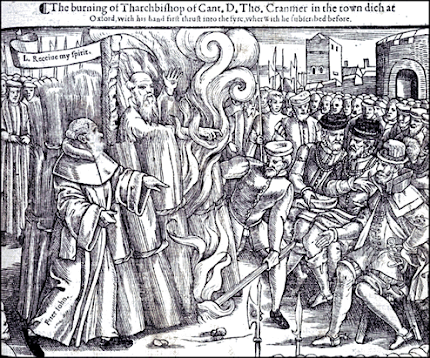
The burning of Tharchbishop of Cant. D. Tho. Cranmer in the town dich at Oxford, with his hand first thrust into the fyre, wherwith he subscribed before. [Click on the picture to see Cranmer's last words.]
Showing posts with label Anglo-Reformed. Show all posts
Showing posts with label Anglo-Reformed. Show all posts
Wednesday, June 18, 2014


Wednesday, September 04, 2013
The Ridley Institute: An Introduction to Reformation Anglicanism
Hat tip to Bishop Josep Miguel Rossello for pointing me to the link to St. Andrews, in Mt. Pleasant, South Carolina. A series of lectures will be presented there beginning on September 17th, 2013, and the topic of that lecture series is Reformation Anglicanism. Speakers will include Ashley Null, Gerald Bray, Peter Jensen, and other well known Evangelical and Calvinist Anglicans. I highly recommend this conference to anyone who is interested in Reformation Anglican theology.
Click here: An Introduction to Reformation Anglicanism
Charlie
Tuesday, October 02, 2012
Cradle or Creedal?: Week of June 10 - YouTube
What's wrong with this presentation by Canon Phil Ashley of the American Anglican Council? The clue here is that Ashley says that "the creeds are the basis for the Thirty-nine Articles." This is misleading since the Thirty-nine Articles of Religion is itself a "creed". The Thirty-nine Articles flesh out the soteriological issues of the English Reformation and the doctrines of the sacraments and the congregation as an assembly of faithful men where the sacraments are rightly and duly administered and the Gospel is rightly preached. (Article 19). Unfortunately, the American Anglican Council and the Anglican Church in North America are predominately Anglo-Catholic and do not accept the five solas of the Protestant Reformation, nor do they abide by the plain meaning of the Thirty-nine Articles of Religion. In fact, they follow the revisionist view of the Articles as they were reinterpreted by the Tractarians. Such a reading of the Articles is a dissimulation of their true meaning and their true intent since they were not intended as a via media between the Papists and the Puritans.
Rather, the Anglican Formularies (Thirty-nine Articles of Religion, 1662 Book of Common Prayer, the First and Second Book of Homilies, and the Ordinal) were intended to uphold the English understanding of the Protestant Reformation. The Articles serve to interpret the 1662 BCP and not the other way around. Also, there are elements of Lutheranism in regards to the doctrine of justification by faith alone and the law/gospel distinction. Yet there are strong indicators of Cranmer's affection for Reformed theology in his more Zwinglian teaching on the sacraments and his Calvinist understanding of soteriology in Articles 9-18.
In short, the "good" canon above is an angel of light who is out to lead people astray. (2 Corinthians 11:14-15). While all churches have creeds--including Baptists--it does not follow that only the ecumenical creeds are "fundamental" to saving faith. No, I would argue that the five solas of the Reformation are likewise essential doctrine. The Thirty-nine Articles have Scripture as their basis and not the ecumenical creeds. Scripture alone is the final authority in all matters of faith and practice.
Cradle or Creedal?: Week of June 10 - YouTube
Tuesday, May 29, 2012
Anglicans Ablaze: Pat Robertson Says The Episcopal Church Is Becoming 'Apostate'
Anglicans Ablaze reports that Pat Robertson thinks the Anglican Communion will declare The Episcopal Church to be apostate:
The Global South, including the Sydney Anglicans, is also under assault by those promoting the immorality of the gay/lesbian/transgender agenda. In Africa most of the provinces are morally conservative but unfortunately Evangelicalism and Reformed theology is no longer dominate but in fact Anglo-Catholic theology has taken the upper hand even in the Global South. Sydney is probably the only province that still stands against the theology of glory and the semi-papist theology of the Tractarian movement. Even in Sydney Evangelicals are too liberal because they insist that Anglo-Catholics are not lost but are simply separated brethren.
If Roman Catholicism is a false religion, it logically follows that Anglo-Catholicism is a false religion and that those who are caught up in those false gospels need conversion to the true Gospel of sovereign grace through our Lord and Savior Jesus Christ. Of course, most Evangelicals are Arminians and are lost themselves--which explains why the Evangelicals and Catholics Together movement is alive and well. Even Albert Mohler is no longer consistent on this point, even participating in a conservative Anglo-Catholic conference (see Mere Anglicanism) in South Carolina a couple of years ago and signing the Manhattan Declaration! (See also: AlbertMohler.com: When the Lights Go Out: The Death of a Denomination).
Pat Robertson is an Arminian and a Charismatic. He thinks conservative Anglo-Catholics and Roman Catholics are saved and on their way to heaven. In short, Pat Robertson is as lost as any "apostate" Episcopalian and so is the pope.
There is only one Gospel and those who preach another gospel are leading people astray. (Galatians 1:6-9; Acts 4:10, 12; John 14:6; Romans 3:23-25; Jude 1:3). Where in the following video by Archbishop Rowan Williams do you hear any appeal to the final authority of Scripture or the 39 Articles of Religion?
To see the original article at Anglicans Ablaze click here:
Anglicans Ablaze: Pat Robertson Says The Episcopal Church Is Becoming 'Apostate'
In remarks made on the 700 Club on Wednesday, Robertson stated that "the whole Episcopal Church in America has left its roots" and that it being declared apostate "is on the way."
Robert H. Lundy, communications officer for the American Anglican Council, a conservative movement hoping to return The Episcopal Church to "an apostolic faith," told The Christian Post that he agreed with Robertson's assessment.Although I agree that The Episcopal Church is apostate, the Anglican Communion will not declare TEC to be apostate. Why not? Well, the Anglican Communion itself is apostate and theologically liberal, particularly in England where the Archbishop of Canterbury heads up the council of bishops. In the UK there is a strong push for the acceptance of openly homosexual ministers and bishops as well as the ordination of women. None of this has been accepted as of yet but it is merely a matter of time before that happens in the United Kingdom.
The Global South, including the Sydney Anglicans, is also under assault by those promoting the immorality of the gay/lesbian/transgender agenda. In Africa most of the provinces are morally conservative but unfortunately Evangelicalism and Reformed theology is no longer dominate but in fact Anglo-Catholic theology has taken the upper hand even in the Global South. Sydney is probably the only province that still stands against the theology of glory and the semi-papist theology of the Tractarian movement. Even in Sydney Evangelicals are too liberal because they insist that Anglo-Catholics are not lost but are simply separated brethren.
If Roman Catholicism is a false religion, it logically follows that Anglo-Catholicism is a false religion and that those who are caught up in those false gospels need conversion to the true Gospel of sovereign grace through our Lord and Savior Jesus Christ. Of course, most Evangelicals are Arminians and are lost themselves--which explains why the Evangelicals and Catholics Together movement is alive and well. Even Albert Mohler is no longer consistent on this point, even participating in a conservative Anglo-Catholic conference (see Mere Anglicanism) in South Carolina a couple of years ago and signing the Manhattan Declaration! (See also: AlbertMohler.com: When the Lights Go Out: The Death of a Denomination).
Pat Robertson is an Arminian and a Charismatic. He thinks conservative Anglo-Catholics and Roman Catholics are saved and on their way to heaven. In short, Pat Robertson is as lost as any "apostate" Episcopalian and so is the pope.
There is only one Gospel and those who preach another gospel are leading people astray. (Galatians 1:6-9; Acts 4:10, 12; John 14:6; Romans 3:23-25; Jude 1:3). Where in the following video by Archbishop Rowan Williams do you hear any appeal to the final authority of Scripture or the 39 Articles of Religion?
To see the original article at Anglicans Ablaze click here:
Anglicans Ablaze: Pat Robertson Says The Episcopal Church Is Becoming 'Apostate'
Saturday, March 10, 2012
Thursday, February 09, 2012
Anglicans Ablaze: The Anglican Church in North America: An Alternative Episcopal Church
This is the latest article by Robin Jordan over at Anglicans Ablaze:
Click here to read the rest of the article: Anglicans Ablaze: The Anglican Church in North America: An Alternative Episcopal Church
The fundamental declarations of the Anglican Church in North America, the doctrinal provisions of its canons, its Ordinal, and the two reports of its Prayerbook and Common Liturgy Taskforce clearly show that the Anglican Church in North America is following in the footsteps of the Episcopal Church. As I noted in my last article in the series on the ACNA theological lens and the guiding principles behind its proposed Prayer Book, the Anglican Church in North America may be described as an alternative Episcopal Church in which two groups are putting their ideas of ecclesiastical governance, church order, worship, and the like into practice.
These two groups represent two movements that influenced Episcopalianism in the twentieth century. The first movement is the Anglo-Catholic movement. Its origin may be traced to the Tractarian and Ritualist movements of the nineteenth century. The second movement is the Ancient-Future, or Convergence, movement. . . .
Click here to read the rest of the article: Anglicans Ablaze: The Anglican Church in North America: An Alternative Episcopal Church
George Conger Raises David Virtue's Dander
I do not generally read VirtueOnline because of its blatantly Anglo-Catholic bias. However, I was amused by this piece that David Virtue posted attacking George Conger's articles on the current situation with the Anglican Mission in America and the Rwandan house of bishops. Ironically, George Conger is an "orthodox" and "conservative" Anglo-Catholic who chose to remain within The Episcopal Church and work for reform. As most readers of my blog know, I do not consider Anglo-Catholics to be truly converted to the Christian faith. That would include "orthodox" Anglo-Catholics. I was banned from posting comments at VirtueOnline for stating my position in a polemical manner. Polemics seems to be the only way that these papist ecumenicalists get the message. (Jude 1:3-4)
Robin Jordan of the Anglicans Ablaze blog attended, Moving Forward Together, the recent meeting between the Rwanda bishops, conservative AMiA congregational leaders, and the archbishop of the Anglican Church in North America, Robert Duncan, who is also an avowed Anglo-Catholic. Robin hoped to persuade the more Evangelical and Reformed members of the AMiA to consider joining together in a new Reformed and Evangelical association of Anglicans. Whether or not that happens is unclear, although Robin said that the Reformed leaning Anglicans he spoke with at the conference were not convinced that there is no place for them in the Anglican Church in North America. The naivete of Evangelicals is truly astounding. They do not seem to realize that the borg mentality of Anglo-Papists is that they are welcome so long as they keep the Gospel under wraps and go along with the false gospel of the Anglo-Papists. That is assuming, of course, that these Evangelical Anglicans actually do understand the Gospel. The irony here is that Duncan was there to persuade the AMiA to go with the ACNA, while Archbishop Rwaje of the Anglican Church in Rwanda was there to try to bring about reconciliation between the AMiA and the Rwandan house of bishops.
I am unsure of exactly how Reformed and Evangelical the Rwanda Anglicans are. However, it would appear that they are not nearly as high church as the ACNA. Robin Jordan has been blogging for some time now about how Anglo-Catholic the doctrine and canons of the ACNA are. Most recently his critique of the new prayer book to be produced by the ACNA has been most insightful: ACNA: Theological Guiding Lens
David Virtue seems to think that Chuck Murphy and John Rodgers of the AMiA will be able work out a deal where the AMiA can join with the ACNA by this June. The more the merrier I suppose.
Robin Jordan of the Anglicans Ablaze blog attended, Moving Forward Together, the recent meeting between the Rwanda bishops, conservative AMiA congregational leaders, and the archbishop of the Anglican Church in North America, Robert Duncan, who is also an avowed Anglo-Catholic. Robin hoped to persuade the more Evangelical and Reformed members of the AMiA to consider joining together in a new Reformed and Evangelical association of Anglicans. Whether or not that happens is unclear, although Robin said that the Reformed leaning Anglicans he spoke with at the conference were not convinced that there is no place for them in the Anglican Church in North America. The naivete of Evangelicals is truly astounding. They do not seem to realize that the borg mentality of Anglo-Papists is that they are welcome so long as they keep the Gospel under wraps and go along with the false gospel of the Anglo-Papists. That is assuming, of course, that these Evangelical Anglicans actually do understand the Gospel. The irony here is that Duncan was there to persuade the AMiA to go with the ACNA, while Archbishop Rwaje of the Anglican Church in Rwanda was there to try to bring about reconciliation between the AMiA and the Rwandan house of bishops.
I am unsure of exactly how Reformed and Evangelical the Rwanda Anglicans are. However, it would appear that they are not nearly as high church as the ACNA. Robin Jordan has been blogging for some time now about how Anglo-Catholic the doctrine and canons of the ACNA are. Most recently his critique of the new prayer book to be produced by the ACNA has been most insightful: ACNA: Theological Guiding Lens
David Virtue seems to think that Chuck Murphy and John Rodgers of the AMiA will be able work out a deal where the AMiA can join with the ACNA by this June. The more the merrier I suppose.
Click here to see the original article at VirtueOnline: George Conger Raises David Virtue's Dander
Addendum: Robin Jordan corrected my comment above. He said that it was never his intention to proselytize anyone but rather was there to report on the situation and see what kinds of responses he would get from the more Evangelical side of the aisle.
--
Reasonable Christian Blog Glory be to the Father, and to the Son : and to the Holy Ghost; Answer. As it was in the beginning, is now, and ever shall be : world without end. Amen. 1662 Book of Common Prayer
Saturday, February 04, 2012
Propositional Revelation, the Only Revelation – D.B. Knox : Anglican Church League, Sydney, Australia
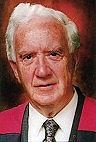 |
| Dr. David Broughton Knox |
THE BIBLICAL VIEW OF REVELATION
The denial of “propositional revelation” is the denial that God reveals Himself to men through the medium of words, that is to say, through meaningful statements and concepts expressed in words; for such is the only sense that can be given to the word “propositional” in this phrase. The denial that revelation is propositional in form, though widespread and repeated nowadays from writer to writer, runs counter to the biblical view of revelation.
The view of the Bible is that revelation is essentially propositional. This may be established in two ways. First, by considering how the Bible describes revelation, and secondly, by examining biblical revelation to see what in fact its nature is.
Click here to read the full article: Propositional Revelation, the Only Revelation – D.B. Knox : Anglican Church League, Sydney, Australia
Saturday, February 19, 2011
Book Review: The True Profession of the Gospel: Augustus Toplady and Reclaiming Our Reformed Foundations
“At every Coronation for over three hundred years, British Monarchs have promised to maintain, 'the true profession of the gospel . . . the Protestant Reformed religion.' At a time when many Evangelicals and Anglicans are questioning their theology and re-thinking their identity, it is more important than ever for us to remember this gospel of sovereign grace.” --Lee Gatiss--
A Critical Review of THE TRUE PROFESSION OF THE GOSPEL: AUGUSTUS TOPLADY AND RECLAIMING OUR REFORMED FOUNDATIONS, by Lee Gatiss
Lee Gatiss. The True Profession of the Gospel: Augustus Toplady and Reclaiming Our Reformed Foundations. (London: Latimer Trust, 2010). 131 pages.
Anglo-Reformed Evangelicals will appreciate the work of Lee Gatiss in this concise survey of the Reformed theological tradition in the Church of England from the time of the English Reformation up to the eighteenth century Arminian and Calvinist controversies between John Wesley and George Whitefield and between Wesley and Augustus Toplady. The material comes from Gatiss' studies for a series of lectures given for the Fellowship of Word and Spirit conference in 2009. The lectures then inspired Gatiss toward this focus in his thesis for a master of theology at Westminster Theological Seminary in Philadelphia. He did his undergraduate work in the United Kingdom at New College, Oxford and Oak Hill College, London. [I mistakenly called New College an evangelical college earlier. I believe Oak Hill College is evangelical.]
What I particularly like about this book is Reverend Gatiss' irenic tone while at the same time making pointedly critical observations about the state of the Anglican church primarily in the United Kingdom; his observations apply with equal ultimacy to the Anglican Communion around the world. He begins with an assessment of the modern situation in the Evangelical and Anglican movement and how it relates to the more latitudinarian and liberal parties as well as the Anglo-Catholic and Tractarian parties within Anglicanism. In particular, the controversies over the biblical, moral and ethical stances taken by the Global South against theological relativism and omnisexuality or pansexuality in the more “civilized” provinces in the U.K., U.S.A. and Canada has heated things up considerably. Gatiss describes this conflict as a midlife crisis:
No-one can deny that paroxysms of doubt and division, fuelled by lust (for illicit sex or simply money and power), have wracked both constituencies on a global scale. The result is a confusion about the character of Evangelicalism and the identity of Anglicanism—who is 'in,' who is 'out,' what is authentic and what an intrusive novelty? This should be unsurprising given the levels of theological experimentation and cultural accommodation that have been tried. (P. 3).
The real point or thesis of the book is the discussion of what true Anglicanism is or at least should be given its historical roots in the English Reformation and even before the Reformation. For Lee Gatiss what constitutes “true” Anglicanism is the oath taken by the monarch at Coronation services in the Church of England. Yes, that still implies a divine connection between rulers and their accountability to God. The oath taken by Queen Elizabeth II was “to the utmost of her power” to uphold “the true profession of the gospel . . . the Protestant Reformed religion” (p. 5). Unfortunately, revisionists will always seek a way to spin or revise that concept to justify their departure from it. This also raises the question of the reification of the term “Reformed” as Carl Trueman discusses historical fallacies in his new book, Histories and Fallacies: Problems Faced in the Writing of History, (Wheaton: Crossway, 2010).
Given the brevity of this book, Gatiss expertly summarizes the modern situation, the history of the unique English expression of the Reformed theology which was taking place throughout the world during the English Reformation, and the subsequent Evangelical revivals in the eighteenth century. Moreover, the latter part of the book gives an overview of Augustus Toplady's life and his contribution to the apologetic for the Anglo-Reformed tradition in the Church of England. I found the discussion of the polemical rhetoric between John Wesley and Augustus Toplady particularly stimulating since I did my seminary training at Asbury Theological Seminary, Wilmore, Kentucky. [Asbury is part of the Wesleyan holiness tradition and was started in reaction to the modernist controversies of the 1920s.]
Gatiss' supervisor for his Th. M. was none other than Carl Trueman, professor of historical theology at Westminster Seminary, Philadelphia. His other supervisor for his dissertation was Dr. Garry Williams of the John Owen Centre in London. As I noted in an earlier post, Trueman has a high view of English common sense philosophy and empirical philosophy in the telling of history. Undoubtedly, however, depending on who is doing the telling, there are presupposed assumptions so that there is no such thing as a reified “objectivity” in doing historiography. This is no less true of Gatiss in his telling of the Anglican Reformed history and the remarkable influence of Augustus Toplady during his short life (November 4, 1740 – August 11, 1778). In this case, those who lean toward Evangelicalism and a broader tradition of Reformed theology in the Church of England and Anglicanism at large will find the book uplifting and validating. Gatiss convincingly argues that the Anglo-Reformed movement is the real position of the Church of England and it is upon this bedrock that the Anglican Communion thrived during the seventeenth and eighteenth centuries.
On the other hand, liberalism, according to Gatiss, is an insidious and parasitic disease that “will ultimately suck the life out of any ecclesiastical witness to Christian truth so that it becomes little more than a pious spiritualised veneer for worldliness and moralism” (p. 4). He rightly points out that “inclusivism” and “pluriformity” are no marks of the “genius of Anglicanism” but instead are the Achilles heel which cripples any attempt to bring the church back to its Reformed roots. Even more pointedly he observes that those in power are often the modernists and revisionists and their telling of the history amounts to what I myself can only call propaganda designed to marginalize Evangelicals and the ministers who preach sovereign grace.
History is so often written by the victors as a way of manipulating their defeated opponents into accepting a new self-identity as the weak and deservedly marginalised losers. This is what coaxes many Evangelicals to leave behind the simple faith of their youth . . . Once they have gained entry into the 'inner circle,' too often they willingly connive at the marginalisation of those with whom they were formerly associated.
This is the familiar story of those who sell out the Gospel in order to attain worldly success as “company men” faithful to the more “tolerant” and “moderate” religion of the elite liberals. I can testify to this personally since I was at one time ordained as a deacon with the Reformed Episcopal Church and was eventually forced out by an Anglo-Catholic minister who was at one time a minister with the Orthodox Presbyterian Church. The REC has in recent years gone completely over to the Tractarians and the Anglo-Catholics, a development which Allen C. Guelzo documented in his book, For the Union of Evangelical Christendom: The Irony of the Reformed Episcopalians, (University Park: Pennsylvania State University, 1994). Guelzo's book predicted the apostasy of the REC into Tractarianism and that prognostication has come to full and complete fruition. The irony, of course, is that the raison d'être of the REC in 1873 when it seceded from the Protestant Episcopal Church was that Evangelicals and their theology were not tolerated by the high church Anglo-Catholics. The issue causing the final split was that the Evangelicals were having open communion and open pulpits with Presbyterians, something the Tractarian bishops of nineteenth century America could not and would not tolerate.
But Gatiss argues that genuine Anglicanism was always Reformed and the revisionists simply have an agenda to dissimulate. His book focuses on Augustus Toplady's defense of the Reformed tradition in the face of the Arminian attacks leveled against it by John Wesley and his followers. Moreover, Wesley's vitriolic rhetoric was over the top, often provoking a similar response from Toplady, although the author admits that Toplady should have handled himself better in his response.
The book argues that prior to the eighteenth century Calvinist/Arminian controversy the overt connection between Arminianism and the movement back toward a more Roman Catholic position is exemplified in Archbishop Laud. This is perhaps why modern “orthodox” high churchmen and Anglo-Catholics reverence Laud above measure and denigrate the magisterial English Reformers as “Puritans”. Gatiss seems to agree that the English Reformers were indeed Puritans. However, I would want to make a distinction between the more extreme Puritans who rejected all vestments including the cassock and surplice, which the author does mention in his discussion of the normative principle of worship in contrast to the regulative principle of worship. (Pp. 15-16). Cranmer's genius was in not advocating the rejection of the prayer book altogether but in teaching the law and gospel and the doctrines of grace in a completely reformed liturgy. This has been argued convincingly in Samuel Leuenberger's article at the Churchman, Archbishop Cranmer's Immortal Bequest and in his book, Archbishop Cranmer's Immortal Bequest: The Book of Common Prayer of the Church of England : An Evangelistic Liturgy, (Wipf & Stock, 2004). I would have liked to have seen more discussion of Toplady's understanding of the use of the 1662 Prayer Book and how it in fact teaches the Reformed and Evangelical faith as Cranmer understood it. To be fair, the author does say that Toplady utilized the Thirty-nine Articles to defend the Reformed character of the English church.
However, it should be pointed out that how we worship and pray teaches theology, “lex orandi, lex credendi.” If Reformed Anglicans are serious about the Protestant and Reformed religion then they ought to be serious about teaching the laity the Reformed faith via the Scriptures and the Anglican Formularies, which would include re-emphasizing the use of the 1662 Book of Common Prayer in the liturgy and re-emphasizing catechesis, as James I. Packer has argued in his “last crusade”. Moreover, Toplady's gifts as a writer of poetry and hymns shows his concern to teach theology through worship.
However, it should be pointed out that how we worship and pray teaches theology, “lex orandi, lex credendi.” If Reformed Anglicans are serious about the Protestant and Reformed religion then they ought to be serious about teaching the laity the Reformed faith via the Scriptures and the Anglican Formularies, which would include re-emphasizing the use of the 1662 Book of Common Prayer in the liturgy and re-emphasizing catechesis, as James I. Packer has argued in his “last crusade”. Moreover, Toplady's gifts as a writer of poetry and hymns shows his concern to teach theology through worship.
The discussion of the Thirteen Articles and the Henrician connection to the “Philipist” Lutherans is excellent. Gatiss effectively rebuts the contention by modern high churchmen that the English Reformation was primarily in agreement with the Melanchthonian Lutherans on predestination, the sacraments, and the so-called “adiaphora” of statues and icons. Furthermore, in the section where Toplady defends the Reformed view Gatiss shows convincingly the weaknesses of Nowell's and Heylyn's Arminian perspective. Advocates of the more semi-pelagian side of the Lutheran tradition in Philip Melanchthon tend to read that into the English Reformation in an attempt to undercut the clearly Calvinistic center of English theology. Some in that school of thought find Arminianism everywhere including the sermons of Latimer and Ridley and in the Homily on “declining from God.” While it is true that Latimer was somewhat ambiguous and tended toward what could be called a “pre-Arminian” view, to then extend that to the rest of what was going on in England at the time of the Reformation is overreaching. The Arminians' abrupt dismissal of what could only be called a strong pre-Reformed theological tradition and presence in the English church and the nation at large even prior to the actual Reformation is soundly refuted by Toplady and his legacy continues today.
Gatiss' rebuttal of the Laudian revisionists is stinging:
Yet the Laudian agenda was more positively presented by its most prominent propagandist Peter Heylyn as the rediscovery of the original foundations of the Reformation. Over time Heylyn developed patterns of defence for the new theology and ecclesiastical style which would be used well into the future. One popular Arminian ploy (borrowed from Romanist polemics) was to intimate that Reformed theology was an insidiously 'foreign' influence, emanating particularly from Switzerland but also from the foreign wives of men like Cranmer, Hooper, and Coverdale. Yet in an attempt to distance the Church of England from Calvinism, Heylyn enthusiastically linked Laudianism to Melanchthhonian Lutheranism.
Heylyn made this link for several reasons. First, the Lutherans had retained images in churches as well as 'Popish' apparel which was popular with the Laudians, while remaining firmly Protestant. Second, post-Luther Lutheranism owed more to Luther's successor, Philip Melanchthon, on the topics of free will and predestination than to Luther's own 'Calvinism avant la lettre' as will be seen in his great exchange with Erasmus in The Bondage of the Will. Melanchthon's early work, the Loci Communes (1521), shows certain affinities at points with the common Protestant thrust of the Thirty-nine Articles, but later in his career Melancthon changed his mind . . . Third, there was polemical distance between the German Lutherans and the Reformed due particularly to their inability to agree on the Lord's Supper . . .
For these reasons, a link between later Lutheranism and Arminianism was often embraced by polemicists such as Heylyn. (Pp. 21-22).
The connection between the high church Arminians and popish tendencies is one that should not be overlooked. Gatiss 'work is particularly helpful here in flushing out the deceptions of high churchmen who are working against Evangelicals and the Anglo-Reformed movement and who are in collusion with the Tractarians. Co-belligerence with conservative Anglo-Catholics and high church Arminians against theological liberalism, according to Gatiss, must not be mistaken for agreement on soteriological issues:
Alliances for limited co-belligerence are one thing: expressions of full communion and fellowship with those who deny the basic tenets of Reformed (and therefore truly Anglican and Evangelical) theology, however, would give away something extraordinarily precious. That could be a step in the direction of the doctrinally latitudinarian (or as it is called today, 'generously orthodox') stance of Gilbert Burnet and John Wesley . . . History demonstrates that a liberalising tide is not easily turned back. (P. 125).
While I found the telling of the historical theological perspective and the historiography of Toplady compelling and convincing, I must admit that Gatiss is preaching to the choir here. The Anglo-Catholics and high church Arminians will be unconvinced. But it is useful that Gatiss defends Toplady's thesis that Arminianism is inherently opposed to the doctrines of grace and the sovereignty of God and therefore is an overt move back toward Roman Catholicism. The connection to the conspiracy theory of Jesuit encouragement of the Remonstrants and of their working through the high church Laudians under Charles I cannot be dismissed out of hand.
Additionally, Gatiss' rebuttal of the Anglo-Catholic hijacking of Richard Hooker for their cause is also commendable:
Richard Hooker (1554-1600) is often seen as the theologian of the via media (between Geneva and Rome) thanks in part to the revisionist efforts of the Oxford Movement in the nineteenth century. Yet properly set in his own context, Hooker can also be seen as standing within this mainstream of sixteenth century Reformed orthodoxy. . . . “Hooker, and the Church of England, embraced the Reformation and in fact willingly adopted a Reformed position in all cardinal tenets.” (See p. 17).
I first noticed this when reading through a publication of one of Hooker's writings at the 1928 Prayer Book Society and compared their edition with a classical edition in Google books which proved that the edition used by PBS was indeed an expurgated, censored copy removing any references to anything that would contradict the revisionist reading of Hooker.
Although The True Profession of the Gospel is only 131 pages it is chock full of historical facts and events. What is especially enjoyable is Gatiss' discussion of other contemporary events going on at the same time Toplady was engaged in the Calvinist/Arminian debates. This tends to bring the whole contemporary era to life and it made an indelible impression in my mind as to what was actually happening and why. This is the greatest strength of the book in my opinion. Gatiss is able to tell the story in its historical setting in such a convincing way that it becomes obvious that the “true profession of the gospel” is indeed “the Protestant and Reformed religion.”
The greatest weakness of the book, however, is that the Reformed center is never clearly identified. What I did like was that Toplady clearly showed that the English Reformed tradition was not simply an import from Geneva or Zurich. Rather, the English Reformed tradition was home grown. Put that in your pipe and smoke it! What Gatiss says he has tried to argue is that
Toplady defended the idea that Anglicanism and Evangelicalism were Reformed. Indeed, how they could trace their roots back many centuries to anti-Pelagianism within the mainstream church and not just to the traditional radical succession of Wycliffe, the Lollard, and Hus. This descriptive task is undertaken in imitation of Toplady's own conviction that what once was Anglican and Evangelical now ought to be considered authentically so again. To be Reformed in either movement is not to be a gate crasher but to assert a rightful claim to the doctrinal heritage. This claim needs pressing more firmly, more often. (P. 122).
My only complaint is that sometimes too broad a view of what is “Reformed” Anglicanism can give too much leeway to the moderate Calvinist view or Amyraldianism. The trouble with Amyraldianism is that for all practical purposes—where the rubber meets the road—it leads back in the Arminian direction and not in the more Reformed direction. Gatiss realizes this and argues strongly for double predestination and particular atonement while advocating unity with the moderates. He also argues strongly that the British delegation to the Synod of Dort (1611-1618) shows the English Church had a vested interest in Reformed theology and represented a tradition committed to both double predestination and particular atonement, although Gatiss does concede that some of the delegates were likely moderates on those issues. (Pp. 18-20).
Finally, his perception on the situation with the New Perspectives on Paul are hinted at toward the end of the book. I particularly liked his observation on the compromise of any idea of a “future justification”:
To those who speak of a second justification by works at the last day, Toplady says (while expounding Latimer's writings) that “works . . . will not be the ground even of that public and declarative justification, which will be predicated of the elect at that awful season.” . . . and digresses a little . . . to establish that “If righteousness, either justification itself, or any part of the righteousness which justifies, come by the law, accrue, though ever so remotely, to any sinner, by or through his own conformity to the moral law; then it would follow that Christ is dead in vain.” (Page 111).
However, Gatiss seems to be unaware that John Piper holds a version of justification as a future “vindication” which is not that far removed from the same view espoused by N. T. Wright:
Piper: Present justification is based on the substitutionary work of Christ alone, enjoyed in union with him through faith alone. Future justification is the open confirmation and declaration that in Christ Jesus we are perfectly blameless before God. This final judgment accords with our works. That is, the fruit of the Holy Spirit in our lives will be brought forward as the evidence and confirmation of true faith and union with Christ. Without that validating transformation, there will be no future salvation. (See: Piper on Future Justification and Christianity Today: The Justification Debate).
Unfortunately, in Gatiss' list of international “Reformed” stars or “charismatic” leaders he has chosen men who have in one way or another compromised conservative adherence to Reformed teaching, including John Piper (future vindication) and Tim Keller (triperspectivalism). (p. 123). He also too lightly overlooks the inherent problems the “Reformed” Baptists have when they accept an Anabaptist view of the sacraments and credo-baptism, both of which have more in common with Arminianism than with a strictly Reformed understanding of election (infant baptism) and the magisterial Reformers' emphasis on a “right” preaching of the Law and Gospel and “duly” administering the two sacraments. Gatiss sees this in the Arminian doctrine of universal atonement but fails to see the same problem with the hyper-pietism of some branches of Puritanism and the Reformed Baptists. Moreover, rejecting the sacraments of baptism and the Lord's Supper and assuming they are mere memorials leads to this kind of depersonalized emphasis:
The idea of Christ's personal atonement for 'me' in Galatians 2:20 becomes entirely impersonal if universalised, and the cross is thus evacuated of any special importance in assuring the believer, who may turn elsewhere for assurance instead (such as to their works or experience) rather than to the particular love of God to his people as demonstrated at the cross. (P. 85).
Of course, this is not to say that Cranmer's view is real presence but only that Cranmer's view would have been in complete accord with Calvin's carefully worked out Consensus of Tigerinus.
It seems to me that Gatiss has been overly influenced by what I would call “Evangelical” ecumenicalism, although he does not go as far as a Mark Noll. It is true that we should not be overly narrow in our fellowship. At the same time we ought to judge our fellowship case by case. As the old saying goes, “The devil is in the details.”
I was pleased to note that Gatiss did see that GAFCON's foundational documents conveniently left out the word “alone” in the doctrine of justification by faith. (P. 5, footnote 6.). His strong allusion that perhaps the Sydney Anglicans were too quick to enter full fellowship and communion with the largely Anglo-Catholic GAFCON and Anglican Church in North America is a warning we all need to hear:
A global attempt to make the Anglican Communion merely Christian again (without distinctively Evangelical and Reformed emphases such as justification by faith alone) is seen by many as a spiritual advance . . .
In historical perspective this reveals just how much ground has been lost. Co-belligerence in the face of aggressive liberal intolerance is not necessarily a bad thing, though it has its dangers if not kept in proper perspective. . . . Alliances easily forged in time of need can become insidiously corrupting. (P. 5).
While some of the discussion about the dispute between Whitefield and Wesley is well known, the way Gatiss tells the story is fresh and invigorating. His portrayal of Wesley's use of atheistic arguments against the sovereignty of God are priceless. I completely agreed with his assessment of Wesley as a Pelagian, a title Wesley seemed to wear proudly. (P. 77). It seems to me that the general view that Arminianism and Anglo-Catholicism are at heart Pelagianism revived is an accurate one. It could be that the natural born Pelagianism of most people makes Wesley more successful than Whitefield in preserving the results of revival rather than Wesley's alleged organizational skills. Human pride can be deceiving. But that should be no surprise to those who understand the biblical doctrine of total inability.
I highly recommend this book and this review barely scratches the surface of the material covered, including an enlightening discussion of Whitefield's view of the covenant of redemption or pactum salutis. (Pp. 45-47). Although there is no extensive bibliography, the material has thorough footnotes to sources. The possibilities for further studies supporting the thesis that the Anglican Communion is most Anglican when it is faithful to its Reformed roots in the indigenous English church are endless. More studies in the direction Gatiss has presented are crucial to promoting an Anglo-Reformed perspective and bringing this perspective home to local congregations. I would hope that this book will be read far and wide by those who wish to bring vitality and truth back to the Anglican Communion. Ecclesia semper reformanda est!
--
Reasonable Christian Blog Glory be to the Father, and to the Son : and to the Holy Ghost; Answer. As it was in the beginning, is now, and ever shall be : world without end. Amen. 1662 Book of Common Prayer
Saturday, December 04, 2010
The Anglican Reformed Tradition
The Anglican Reformed Tradition
The Theologian: The Internet Journal for Integrated Theology has an interesting series of audio messages by Lee Gatiss on The Reformed tradition in the Church of England. There are at least three ministers from the 18th century that I can think of right away: John Newton, Augustus Toplady, and George Whitefield. You could mention Archbishop Ussher as well (17th century). You might want to listen to these three lectures on church history by Lee Gatiss.
Sunday, October 17, 2010
Welcome! - The Anglo-Reformed Movement
Welcome! - The Anglo-Reformed Movement
Charlie
It looks like the Reformation movement among Anglo-Reformed believers is gaining momentum. Hudson Barton has created a website for those interested in becoming part of this ministry for those who are more concerned with preserving the Gospel in the Anglican Communion. Click on the title above to check it out.
Charlie
Wednesday, February 10, 2010
Episcopalian, Anglican, and Evangelical: What Do These Terms Mean?
Episcopalian, Anglican and Evangelical: What Do These Three Terms Mean?
By Charlie J. Ray
The Ritualists represent themselves as Catholics, and say they are eager to revive the traditions and worship of the Primitive Church. This representation is contrary to the fact. The Church of England took that course at her Reformation; all that was pure, primitive, and Catholic, both in worship, faith, and order, she retained. She cast off only the fictions, idolatry, and error by which Roman Priest--craft and Italian ambition had disfigured the Apostolic faith. But the Reformation and the works of our Reformed Church is denounced by Ritualists as mutilated, Anti-christian, and a pestilent heresy, while, in fact, the Ritualists are merely reintroducing the ceremonies and dogmas which our fathers cast off as idolatrous and superstitious. When therefore they call themselves Catholics, they mean Romanists. – Bishop J. C. Ryle
Recently the Central Florida Diocese of the Episcopal Church had its forty-first annual convention at the Lakeland Center in Lakeland, Florida. I attended that event as a lay delegate representative for my local church or congregation, which is Christ Church, Longwood, Florida. The following Sunday our congregation had its own annual business meeting, which is the usual practice. During that meeting several members of the congregation were visibly upset because of a minor change made on the new church sign purchased by the vestry. The problem with the sign, according to the dissidents, is that it removed the word "Episcopal" from the sign.
As a way of explaining myself to both the members of our congregation and to those who read my blog, I want to tell the story of the evangelical side of the Anglican Communion world-wide and particularly of the evangelical side here in the United States. Unfortunately, the story is a long and complicated one. However, I will try to be as brief as possible in giving a historical and theological background for the issues at hand.
First of all, many Episcopalians are woefully uninformed about the polity of their own denomination. The Anglican Communion is a loosely organized association of local congregations around the world. The geographical area where that particular group of congregations reside is called a "province." So with that understanding we can see that The Episcopal Church is the title given to the province of the Anglican Communion here in the United States. So in general terms all who reside here in the United States and are part of the province called The Episcopal Church are called "Episcopalian" due to their membership in this province.
To make matters even more complicated there is now a new province here in the United States called the Anglican Church in North America. This new province, depending on who you ask, is officially Anglican and on an equal status with The Episcopal Church. In other words, there are two Anglican provinces here in the United States sharing the same geographical location. The complication, however, is that the Anglican Church in North America has not yet received full approval from the Anglican Consultative Council nor from Lambeth, the seat of the council of primates or leading bishops from the provinces of the Anglican Communion around the world. But since the Archbishop of Canterbury has no real political or ecclesiastical authority to force any of the consecrated primates or archbishops to follow his instructions, they are free to ordain and consecrate ministers around the world as they see fit.
To further complicate matters, the provinces of the Anglican Church of Canada, The Episcopal Church, and the Church of England in the United Kingdom have all gone in a theologically liberal direction. This is to say that the three provinces are either openly or secretly pushing progressivism. In other words, they wish to change the Anglican Communion and the secular and political governments of the entire world to reflect their ideas of social justice. To them the center of authority is not the Bible but human reason in the here and now. Eternal and transcendent revelation into the human realm via the Holy Scriptures and the divine man, Jesus Christ, is impossible in their view and therefore the Bible is merely a human book and is merely culturally relevant to its own place in history and time. To progressives and liberals, Jesus is merely a good teacher but not actually divine. He was sincere in claiming to be God but sincerely misled. Therefore, in their view the Bible contains things which are misogynist (against women), homophobic (against those born with a homosexual orientation), and judgmental (against those who practice progressive sexual ethics of any sort). So the progressives or liberals are willing to dissimulate and work secretly to undermine Scriptural authority. They wish to bring in openly homosexual ministers, bishops and deacons and they wish to push for homosexual rights in the church and in the secular realm, including making homosexual marriage not only legal world-wide in secular governments but also in the Anglican Communion. Furthermore, their agenda is to coerce all citizens of all countries globally to move toward their views of "tolerance", which is code for progressivism. In short, theological liberalism adopts a this-worldly socialism and tries to coerce all others to accept their views at any cost. It is a highly militant movement that has more in common with paganism than with biblical Christianity. Unfortunately, the Archbishop of Canterbury, Rowan Williams, is in my estimation either openly or at least secretly part of the progressive party. The evidence for this is there for anyone willing to look at his track record.
It is difficult to summarize briefly the various aspects of complicated state of affairs in the Anglican Communion and in the province of the United States. Things have moved so rapidly that the Lambeth Conference at Canterbury has been unable to keep up with the pace. The new Anglican Church in North America is legitimately Anglican as far as polity goes and has even been endorsed and received into full communion by the Sydney Diocese of the Anglican Church of Australia. Notice that I used two separate links. The Sydney Anglicans website is distinct from the website of the national provincial church, which is the Anglican Church of Australia. (See the Anglican Church League. The Sydney Anglican Diocese drew up this resolution accepting their full communion with the Anglican Church in North America: Resolution).
Traditionally, the Anglican Communion at large is supposed to be a mix of three main streams or traditions; the three traditions are the Anglo-Catholic tradition, the Evangelical tradition, and the Charismatic tradition. However, since the advent of Tractarianism in the 19th century, the Anglo-Catholic tradition has patronized the other two traditions and even dominated them by force and coercion. Charismatics in particular have roots in common with the Evangelical tradition but because their emphasis is on the subjective and ecstatic experiences of individuals they have no problem embracing Anglo-Catholicism. Anglo-Catholicism itself is divided into two major branches, the one being theologically and morally conservative and the other being theologically, sociologically progressive and liberal. (See Anglo-Catholic Social Theology).
The battle for the heart of Anglicanism is not a new one. From the time of the English Reformation and the break of Church of England from the dominance of the Roman Catholic Church there have been various parties within the Anglican Communion. Some have tried to push the idea that the Anglican Communion is a via media between Rome and Geneva, that is between the Roman Catholic Church and the Protestant Reformation as it is expressed in the Reformed or Calvinist side of the Protestant Reformation. While this is somewhat of an oversimplification and raises issues of its own, for the sake of brevity I will not go into all the details. However, the very heart of the English Reformation was something of a combination of Calvinism, Zwinglianism, and Lutheran theology, despite some remaining Roman Catholic conservatives who tried to keep the English Reformation within a Roman Catholic paradigm. Even after the original English Reformers were burned at the stake under the reign of Mary Tudor, there remained a strong Evangelical and Protestant party in the Church of England. When Elizabeth I came to the throne the English Reformation once again moved forward.
In particular the formularies of the Church of England became the doctrinal standards for the Anglican provinces world-wide, established under the colonization policies of England. The 1662 Book of Common Prayer, the Thirty-nine Articles, and the Ordinal were the official doctrine and practice of Anglicans everywhere. However, this all changed when the Tractarian movement started in England under the leadership of John Henry Neuman, John Keble, Edward Pusey, Isaac Williams and others. While the Church of England and the Anglican Communion did have some high church and Arminian elements prior to the Tractarians, none of them were openly papist or Roman Catholic. Neuman's Tracts for the Times were an attempt to re-interpret the obviously Protestant and Reformed nature of the Thirty-nine Articles and the 1662 Book of Common Prayer to make them more favorable to a Roman Catholic view. Neuman was dishonest in doing this and in fact capitalized on the emphasis on doctrinal minimalism as opposed to the more Puritan emphasis on spelling out detailed confessional and theological statements of faith and catechisms. Those who emphasize minimalism are unwittingly playing into the hands of 19th century Anglo-Catholicism and their Lambeth Quadrilateral, which calls for a doctrinal commitment to an emphasis on: 1. Holy Scripture (no mention of Scripture as the final authority in doctrinal matters). 2. The Creeds. 3. The Sacraments of Baptism and Holy Communion. 4. The historic episcopate locally adapted. While all this on the surface looks good, the Anglo-Catholics intended to downplay Scripture and exalt the church above it and the emphasis on the two sacraments was really a way to bring people to accept the other five "sacraments" that are really not sacraments. Also, point four shows that tradition is the guiding factor since the "historic" episcopacy does not and never did exist. Episcopacy is merely a preference that the Church of England and the Anglican communion prefers but apostolic succession and any historical proof of a continuous line of bishops all the way back to Peter is questionable.
Evangelicals rallied against Tractarianism in the 19th century. Leaders like the English bishop, J. C. Ryle and the American bishop, George David Cummins, who founded the Reformed Episcopal Church, said that Tractarianism was not biblical and was in fact divisive. For example, regarding the Tractarian movement, Ryle said:
The Ritualists represent themselves as Catholics, and say they are eager to revive the traditions and worship of the Primitive Church. This representation is contrary to the fact. The Church of England took that course at her Reformation; all that was pure, primitive, and Catholic, both in worship, faith, and order, she retained. She cast off only the fictions, idolatry, and error by which Roman Priest--craft and Italian ambition had disfigured the Apostolic faith. But the Reformation and the works of our Reformed Church is denounced by Ritualists as mutilated, Antichristian, and a pestilent heresy, while, in fact, the Ritualists are merely reintroducing the ceremonies and dogmas which our fathers cast off as idolatrous and superstitious. When therefore they call themselves Catholics, they mean Romanists. (Bishop J. C. Ryle).
Apparently, the reason for the separation of Evangelicals from the Protestant Episcopal Church in 1873 was not that they were merely forced out by heavy handed Anglo-Catholics, though that was certainly in the mix. The real issue is that the American Evangelicals rejected Anglo-Catholicism as ritualistic and idolatrous. The Tractarian high churchmen in return disciplined any Evangelical for sharing pulpits with other Evangelical denominations and sharing communion with other Evangelical denominations. This was due to the Anglo-Catholic emphasis on the historic episcopate rather than on biblical and apostolic doctrine. The reasons given for Bishop Cummins' separation from the Protestant Episcopal Church are given in his letter to the Anglo-Catholic bishop of the diocese of Kentucky, Benjamin Bosworth Smith:
NEW YORK, November 10, 1873.
TO THE RIGHT REVEREND BENJAMIN BOSWORTH SMITH, D.D., BISHOP OF THE PROTESTANT EPISCOPAL CHURCH IN THE DIOCESE OF KENTUCKY.
Rt. Rev. and Dear Bishop:--Under a solemn sense of duty, and in the fear of God, I have to tell you that I am about to retire from the work in which I have been engaged for the last seven years in the Diocese of Kentucky, and thus to sever the relations which have existed so happily and harmoniously between us during that time.
It is due to you, and to my many dear friends in the Diocese of Kentucky and elsewhere, that I should state clearly the causes which have led me to this determination.
I. First, then, you well know how heavy has been the trial of having to exercise my office in certain Churches in the Diocese of Kentucky where the services are conducted so as to symbolize and to teach the people doctrines, subversive of the "truth as it is in Jesus," and as it was maintained and defended by the Reformers of the Sixteenth Century.
On each occasion that I have been called upon to officiate in those Churches, I have been most painfully impressed by the conviction that I was sanctioning and endorsing, by my presence and official acts, the dangerous errors symbolized by the services customary in Ritualistic Churches.
I can no longer, by my participation in such services, be "a partaker of other men's sins," and must clear my own soul of all complicity in such errors.
2. I have lost all hope that this system of error now prevailing so extensively in the Church of England, and in the Protestant Episcopal Church in this country, can be or will be eradicated by any action of the authorities of the Church, legislative or executive. The only true remedy, in my judgment, is the judicious, yet thorough Revision of the Prayer Book, eliminating from it all that gives countenance, directly or indirectly, to the whole system of Sacerdotalism and Ritualism: a Revision after the model of that recommended by the Commission appointed in England under Royal Authority, in 1689, and whose work was endorsed by the great names of Burnet, Patrick, Tillotson, and Stillingfleet, and others, of the Church of England--a blessed work, which failed, alas! to receive the approval of Convocation, but was taken up afterwards by the Fathers of the Protestant Episcopal Church in the United States, and embodied in the Prayer Book of 1785, which they set forth and recommended for use in this country.
I propose to return to that Prayer Book, sanctioned by William White, and to tread in the steps of that saintly man, as he acted from 1785 to 1789.
3. One other reason for my present action remains to be given. On the last day of the late conference of the Evangelical Alliance, I participated in the celebration of the Lord's Supper, by invitation, in the Rev. Dr. John Hall's Church, in the City of New York, and united with Dr. Hall, Dr. William Arnot, of Edinburgh, and Prof. Dorner, of Berlin, in that precious Feast. It was a practical manifestation of the real unity of "the blessed company of all faithful people" whom God "hath knit together in one communion and fellowship, in the mystical body of His Son Jesus Christ."
The results of that participation have been such as to prove to my mind, that such a step cannot be taken by one occupying the position I now hold, without sadly disturbing the peace and harmony of "this Church," [i.e. the Protestant Episcopal Church] and without impairing my influence for good over a large portion of the same Church, very many of whom are within our own Diocese.
As I cannot surrender the right and privilege thus to meet my fellow-Christians of other Churches around the tables of our dear Lord, I must take my place where I can do so without alienating those of my own household of faith.
I, therefore, leave the communion in which I have labored in the sacred ministry for over twenty-eight years, and transfer my work and office to another sphere of labor. I have an earnest hope and confidence that a basis for the union of all Evangelical Christendom can be found in a communion which shall retain or restore a Primitive Episcopacy and a pure Scriptural Liturgy, with a fidelity to the doctrine of Justification by Faith only, Articulus stantis vel cadentis Ecclesiae, a position towards which the Old Catholics in Europe are rapidly tending, and which has already taken a definite form in "The Church of Jesus," in Mexico.
To this blessed work I devote the remaining years of life, content if I can only see the dawn of that blessed day of the Lord.
I am, dear Bishop, faithfully yours in Christ,
GEORGE DAVID CUMMINS.
My address for the present will be No. 2 Bible House, New York.
Amazing that the bishops in today's Reformed Episcopal Church have in fact become Anglo-Catholics or at least Anglo-Catholic sympathizers and participate in the very rituals that Cummins, Rev. Charles Cheney and other Reformed Episcopalians could not tolerate. The Evangelicals were not only forced to participate in high church sacerdotalism when in attendance at other churches in their diocese but they were forbidden by their Anglo-Catholic bishops to share the pulpit and communion with other Evangelicals in other denominational churches. The sort of situation exists today. Any Evangelical who dares to say that historic apostolic succession is unbiblical or merely a traditional preference which has no real authority is shunned and often attacked by the Anglo-Catholic hierarchy and powers that be. Sadly, this is true of the Reformed Episcopal Church today. Where once the REC stood hand in hand with Evangelicals the REC now defrocks Evangelical deacons and presbyters who uphold Scriptural authority as the only final and binding authority. Any Evangelical who dares to say that Anglo-Catholicism is sacerdotal idolatry is accused of being associated with Harold Camping, who says people should withdraw from organized denominations altogether. Camping's view is not the Reformed position since the Reformed Confessions uphold the organized church as a secondary authority which is to be submitted to Holy Scripture as the measure of necessary doctrine.
The problem as I see it is that when there is a combination of a high church ecclesiology and theology with a socialistic liberal theology what you wind up with is not only sacerdotalism but a sanctified sacerdotalism which sees homosexuality not as sinful but sees homosexuals as an oppressed minority and blessed of God rather than under God's just judgment and wrath. (See Romans 1:18ff; Leviticus 18:22; 20:13; 1 Corinthians 6:9-11). In other words, instead of the church submitting to Scripture we have the Scriptures submitted to the church. What happens when the church decides what Scripture really says, as opposed to the plain meaning of the text itself, is that if and when the church goes off into an accommodation to culture mode then the culture decides what is right and wrong rather than the culture being prophetically called to repentance in accordance with God's word. Instead of condemning sinful behavior as sinful the church now calls evil good and good evil. (See Isaiah 5:20-21). Rather we should be looking to Scripture to guide individual Christians and congregations as the final authority in all matters of doctrine and behavior. (Isaiah 8:20).
If the recent forty-first convention of the Central Florida Diocese of the Episcopal Church proves anything at all, it is that loyalty to denominations and the "historic episcopate" rather than loyalty and allegiance to Holy Scripture leads to the embracing of open immorality. Bishop John Howe has proved that he is more concerned with being loyal to an apostate denomination rather being faithful to God and to the Gospel. This is what we can expect when the emphasis is on apostolic succession, external communion and fellowship rather than emphasizing a true and lively faith and being truly born again as a true child of God. This can only happen if the Gospel of justification by faith alone is the center of our preaching and teaching. This can only happen if the cross of Jesus Christ is the center of our theology rather than ecclesiastical concerns and an idolatrous centering on human authority on earth rather than submitting to our Father who is in heaven.
The peace of God be with you!
Charlie
Glory be to the Father, and to the Son : and to the Holy Ghost;
Answer. As it was in the beginning, is now, and ever shall be : world without end. Amen.
http://www.eskimo.com/~lhowell/bcp1662/
http://www.reasonablechristian.blogspot.com/
Sunday, November 22, 2009
The Charade Continues
The Anglican Church in North America is papist to its core and outright denies the five solas of the Protestant and English Reformation. Yet equivocators like David Virtue would have us believe that he agrees with the statement made by the Church Society that
A proper rejection of theological liberalism should therefore not be accompanied by a turning to the Church of Rome and its unbiblical teachings and practices. Rather, both theological liberalism and the unscriptural teachings and practices of the Church of Rome are contrary to the Bible and to the historic doctrines of the Church of England as a Protestant, Reformed, Evangelical and catholic church.
We grieve that the Church of England, along with our nation, has fallen so low in its spiritual and moral condition. We pray that God would pour out His Spirit on both church and nation, leaders concluded. [From: Church Society Response to Rome].
The truth of the matter is that the Anglican Church in North America is dominated by Tractarians and Anglo-Catholics who have no interest in the ultimate authority of Holy Scripture as the final and only rule of faith in matters of doctrine and morality. It is a fact that when reason trumps Scripture as the final revelation and this is then combined with the idea that bishops and the church are equal in authority to Scripture what happens is not only revisionism of doctrine but of morality. Liberal Anglo-Catholicism is simply the end of the slippery slope. So-called "orthodox" Anglo-Catholicism is merely the precursor to liberalism since the hermeneutics of Tractarianism is in essence revisionist and post modern. In other words, the views of the presiding bishops become the doctrine of the church rather than Scripture being the final authority.
One should not overlook the fact that many of the ministers in the Anglican Church in North America retain a form of theological liberalism which is every bit as liberal as that of The Episcopal Church except they reject homosexual behavior. However, many of them still recommend the ordination of women which erodes the biblical standards and the order of creation, which in turn leads to the idea that homosexuality is normal rather than a perversion of nature and creation. It is simply a matter of time before the ACNA returns like a dog to its own vomit. (Proverbs 26:11; 2 Peter 2:22).
The fact that David Virtue himself endorses transexuals as long as they are celibate is just an open admission that Virtue does not understand biblical authority or God's purposes in creation. (See David Virtue Goes Transexual). God creates men and women as they are and any idea that the mind does not match the body is simply a perversion of God's creation and a rebellion against the divine image and likeness. (Genesis 1:26-27; 3:7, 22-23).
It is popular to distinguish between fundamentalism and evangelicalism. I would not consider myself either since the ultra fundamentalists are essentially pelagian and arminian. Fundamentalists tend to ignore higher theological education and to be anti-intellectual. On the other hand, evangelicalism is a meaningless term these days since everybody and their brother claims to be one--including Anglo-Catholics, left wing "neo-" evangelicals, and even Roman Catholics. I would prefer to identify myself as a conservative neo-fundamentalist Protestant who happens to be Reformed and Calvinist by God's set plan and foreknowledge.
Evangelicalism these days is increasingly influenced by the ecumenical movement and many so-called "evangelicals" are willing to sacrifice doctrinal truth and propositional truth for the sake of the amalgamation of denominations. This is nothing new since the Roman Catholic Church invented the idea of the use of secular force and military means to convert entire populations to the Roman Catholic faith. The term "christendom" or the "church militant" is a reference to this idea that entire nations and populations should be coerced into an external conformance to secular powers wielded at the hands of the church. The idea that the pope is the vicar of Christ on earth developed into the thesis that God operates through earthly rulers to further the kingdom of God on earth.
It is this same sort of thinking which predominates in the theology of theonomy and reconstruction within evangelical circles and it is also why you see reconstructionists who are willing to compromise the principles of the English and Protestant Reformations in order to bring about a moral change in society at large. Rather than focusing on the true conversion of individuals to a personal faith in Jesus Christ and on the propositional truths revealed in Holy Scripture, the focus becomes an emphasis on creating a universal or catholic organization with minimalist doctrinal requirements. (John 14:36). Unfortunately, this downplaying of doctrine in documents like the Lambeth Quadrilateral has the effect of creating a relativistic and liberalistic religion with little similitude to true Christianity as it is revealed in Holy Scripture.
Our concern ought not to be the creation of denominations or even of one denomination but rather on being faithful to what the Bible as a whole teaches. Even suggestions along the lines of Dr. Michael Horton's many rooms is inherently relativistic since in the main room he only advocates inerrancy of Scripture and the doctrine of the trinity. Unfortunately, Horton has unwittingly endorsed C.S. Lewis' theory of relativism where all the side rooms are equally valid, which they are not. Some of the side rooms are teaching false doctrine.
Horton's protest against doctrinal minimalism is solved by appealing to doctrinal minimalism again! (See the Village Green). Some evangelicals, James I. Packer, have tried to solve the problem by distinguishing between secondary and tertiary levels of doctrinal importance. But Packer only makes matters worse since he seems to think the Protestant Reformation is over and even goes so far as to sign the Evangelicals and Catholics Together document. In one recent lecture series he suggested that the "Anglican quadrilateral" is a good thing. By this he seems to be referring to the Lambeth Quadrilateral. Packer's solution is no solution either since he implies that the 39 Articles can be legitimately interpreted in two contradictory ways which are diametrically opposed to one another. The Packer of earlier years would not have endorsed such relativism but the Packer of today is more interested in ecumenical amalgamation than in the propositional truths of Holy Scripture and the Gospel.
There is indeed a tension between separation and unity. (Matthew 10:34-39; Luke 12:51-53, 14:25-33). The tensions between fundamentalism and the broad tent of evangelicalism are not solved by appealing to C.S. Lewis' Anglo-Catholic theology of relativism as Dr. Michael Horton has done. Nor is it solved by appealing to the Anglo-Catholic theology of the Lambeth Quadrilateral as Packer has done. Rather, it seems to me, that the way forward is an uncompromising return to the neo-fundamentalism of J. Gresham Machen and any cooperation or fellowship we have must be on the basis of detailed doctrinal discussions and not on theological minimalism.
Such minimalism leads inevitably back to theological liberalism and relativism which true Christians should rightly eschew. True Christianity is focused on the right preaching of the Gospel and Holy Scripture as a whole, not on minimalist ideas of cooperation and amalgamation. Reminds me of a cartoon where the issue of homosexuality caused a church to focus on the one and only verse they could legitimately still endorse in the Scriptures: "Jesus wept." (John 11:35).
Reformed Anglicans need not cooperate with Anglo-Catholics or even other Evangelicals in any formal organizational way. Instead the total focus of reforming Anglicanism must be upon the right preaching of the Gospel and the right administration of the word and sacraments. The focus of Scripture is upon the conversion of lost sinners to understand the Bible and come to a right relationship with Jesus Christ and God the Father through the power of the Holy Spirit. It is increasingly obvious that ecumenicalism is an anti-Christian movement meant to undermine our commitment to the truth. (Matthew 7:13) Rather than caring who our friends in the world are we ought to be more concerned with what God thinks and what God says in total in the Holy Scriptures. (Matthew 4:4).
Article XIX
Of the Church
The visible Church of Christ is a congregation of faithful men, in the which the pure word of God is preached and the sacraments be duly ministered according to Christ's ordinance in all those things that of necessity are requisite to the same. As the Church of Jerusalem, Alexandria, and Antioch have erred: so also the Church of Rome hath erred, not only in their living and manner of ceremonies, but also in matters of faith.
1662 Book of Common Prayer
The Collect.
O LORD, we beseech thee, absolve thy people from their offences; that through thy bountiful goodness we may all be delivered from the bands of those sins, which by our frailty we have committed: Grant this, O heavenly Father, for Jesus Christ's sake, our blessed Lord and Saviour. Amen.
Subscribe to:
Posts (Atom)

 Posts
Posts


