>

Martyred for the Gospel

Martyred for the Gospel
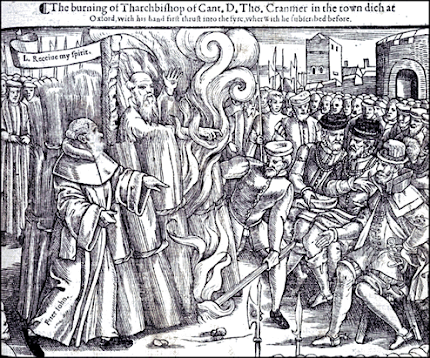
The burning of Tharchbishop of Cant. D. Tho. Cranmer in the town dich at Oxford, with his hand first thrust into the fyre, wherwith he subscribed before. [Click on the picture to see Cranmer's last words.]

Daily Bible Verse

Showing posts with label Reformation Anglicanism. Show all posts

Monday, November 03, 2014

The Anglican Church in North America Discriminates Against Reformed Ministers and Congregations


"How the mighty have fallen, And the weapons of war perished!" (2 Samuel 1:27 NKJV)

Robin Jordan on the Anglican Church in North America:


A careful examination of the Anglican Church in North America’s formularies—its constitution, canons, rites and services, and catechism—reveals the systematic exclusion of the Anglican Reformed beliefs and liturgical practices from these formularies.
The Anglican Church in North America in its formularies does not extend to the Anglican Reformed clergy and congregations the freedom to practice and propagate their faith that it extends to Anglo-Catholic and philo-Orthodox clergy and congregations.
The constitution and canons of the Anglican Church in North America do not offer Anglican Reformed clergy, ordination candidates, dioceses, networks, and congregations any protection from theological discrimination.

Why North America Needs a Second Alternative Anglican Province


I agree somewhat with what Robin Jordan is saying.  But what he does not get is that no Reformation Anglican or Reformed/Calvinist minister or congregation would dare to join an apostate denomination or "communion."  James I. Packer and other compromisers are basically in fellowship with heresiarchs who lead their congregations and the communion as a whole to hell.  It was never a possibility that oil and water would mix.  Truth and deception are as incompatible as good and evil.

Woe to those who call evil good, and good evil; Who put darkness for light, and light for darkness; Who put bitter for sweet, and sweet for bitter! 21 Woe to those who are wise in their own eyes, And prudent in their own sight! (Isaiah 5:20-21 NKJV)

One of the founding Bishops of the Reformed Episcopal Church, Charles Cheney, delivered a sermon which logically pointed out the incompatibility of Anglo-Catholicism with Biblical Christianity and Reformation Anglicanism:


It is sometimes urged that the Church of Christ existed before the Gospels, and that therefore the traditions of the Church are to be accepted as authoritative interpreters of the New Testament. So did the tradition to which St. John refers at the close of his Gospel, that Christ had declared that the beloved "disciple should not die," exist before the Gospel which corrected it. But for that very reason was that part of St. John's Evangel written, that it might contradict, upon the authority of inspiration, the errors of ecclesiastical tradition, and brand the previous belief of the Church as a lie that no Christian was to accept.

The Evangelical Ideal of the Visible Church, by Bishop Charles Cheney.

Ironically, the Reformed Episcopal Church is now a full-blown Anglo-Catholic denomination that discriminates against Calvinists and Reformed Anglicans and Evangelical Protestants in general.  That is why the REC is now a full member of the Anglican Church in North America.

How the mighty have fallen.  The Reformed Episcopal Church was founded on the principles of the Anglican and Protestant Reformation.  Its founders are probably rolling over in their graves.

 "The beauty of Israel is slain on your high places! How the mighty have fallen! 20 Tell it not in Gath, Proclaim it not in the streets of Ashkelon-- Lest the daughters of the Philistines rejoice, Lest the daughters of the uncircumcised triumph. (2 Samuel 1:19-20 NKJV)
 "How the mighty have fallen in the midst of the battle! Jonathan was slain in your high places. (2 Samuel 1:25 NKJV)
 "How the mighty have fallen, And the weapons of war perished!" (2 Samuel 1:27 NKJV)

See also:   Bishop Leonard Richs Presides

Thursday, September 05, 2013

Gordon H. Clark: Free Will Rejected by the Reformation


Thirty-four persons were persecuted and expelled from the towns of Winston and Mendelsham, because “they denied man’s free will and held that the Pope’s church did err.” If more evidence is desired for the Calvinism of the Reformation, there is an abundance of it in the history books and in the original writings of these faithful men.  -- Dr. Gordon H. Clark


The struggles of these loyal exponents of the Gospel of free grace culminated in the Protestant Reformation. At the Council of Trent, the Roman Church officially repudiated the doctrines that put salvation into the hands of God only. Rome chose free will and human merit. Luther and Calvin continued the apostolic teaching. In our present century of ignorance, one must insist that Luther as well as Calvin rejected the Pelagian-Romish-Arminian view of man. It was Erasmus, the man who drew back from the Reformation and made his peace with Rome, who defended free will. The book that Luther wrote in reply to him is titled The Bondage of the Will. In its Conclusion there is this sentence: “For if we believe it to be true that God foreknows and foreordains all things, that he can neither be deceived nor hindered in his prescience and predestination, and that nothing can take place but according to his will…then there can be no free will in man, in angel, or in any creature.” 

While the later Lutherans – under Phillip Melanchthon’s compromising spirit, which went so far as to seek reunion with Rome – abandoned many of Luther’s doctrines, it must be remembered that these matters were not in dispute among Luther, Zwingli, and Calvin, nor among Ridley, Cranmer, Latimer, Bucer, Zanchius, and Knox. The same is true of the victims of Bloody Mary. Richard Woodman, who was burned at the stake with nine other martyrs at Lewes in Sussex, answered his examiners: “If we have free will, then our salvation cometh of ourselves: which is a great blasphemy against God and his Word.” Richard Gibson, examined by the Bishop of London, was called upon to profess that “a man hath by God’s grace a free choice and will in his doing.” Gibson denied the proposition and was burned to death with two others in Smithfield. Thirty-four persons were persecuted and expelled from the towns of Winston and Mendelsham, because “they denied man’s free will and held that the Pope’s church did err.” If more evidence is desired for the Calvinism of the Reformation, there is an abundance of it in the history books and in the original writings of these faithful men.

Gordon H. Clark. Religion, Reason and Revelation (Kindle Locations 4752-4771). The Trinity Foundation.

Wednesday, September 04, 2013

The Ridley Institute: An Introduction to Reformation Anglicanism


Hat tip to Bishop Josep Miguel Rossello for pointing me to the link to St. Andrews, in Mt. Pleasant, South Carolina.  A series of lectures will be presented there beginning on September 17th, 2013, and the topic of that lecture series is Reformation Anglicanism.  Speakers will include Ashley Null, Gerald Bray, Peter Jensen, and other well known Evangelical and Calvinist Anglicans.  I highly recommend this conference to anyone who is interested in Reformation Anglican theology.


Charlie

Sunday, April 21, 2013

Peter Toon: Anglo-Catholic Dissimulator: Part 2

In addition to Peter Toon's dissimulation on the doctrine of justification by faith "alone" which I noted in  Part 1 below, Toon was also a member of the Prayerbook Society, USA.  Unfortunately, the prayerbook that the PBS USA promotes is none other than the 1928 Book of Common Prayer, which contains prayers for the dead, prayers of oblation prior to the consecration of the elements and other departures from the Reformation theology of the 1552 and 1662 books of common prayer.  

Moreover, the Anglo-Catholics in the US, as Toon openly admitted in The Churchman article on justification, completely revise the meaning of the Thirty-Nine Articles of Religion, which misreading is not in agreement with the plain meaning of the text or in agreement with the original historical background of the Articles.  The Anglo-Catholics completely violate the Black Rubric by lifting up and adoring the bread and wine as if they were the body of Christ.  Such adoration of mere creatures or created things is idolatry plain and simple.

My confidence in Church Society and its new president, Lee Gatiss, is therefore greatly lessened.  Reformed and Evangelical Anglicans should speak up and challenge Mr. Gatiss on this dissimulation on the part of his leadership and on the part of Church Society in the past and the present.


Reasonable Christian: Peter Toon: Anglo-Catholic Dissimulator Part 1

Support Reasonable Christian Ministries with your generous donation.