>

Martyred for the Gospel

Martyred for the Gospel
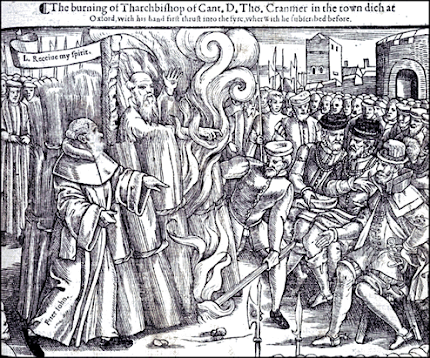
The burning of Tharchbishop of Cant. D. Tho. Cranmer in the town dich at Oxford, with his hand first thrust into the fyre, wherwith he subscribed before. [Click on the picture to see Cranmer's last words.]

Daily Bible Verse

Showing posts with label Civil Law. Show all posts

Monday, September 25, 2023

What Does the Bible Say About the Civil Magistrate?


". . . My thesis is that secularism necessarily implies dictatorship and totalitarian rule.  . . . The result is state control of religion and of all human good, nothing excepted.  . . . "


“The Confession in section i states that it is God who has ordained civil magistrates.  Their authority comes from him;  therefore, they cannot rightfully act as dictators; their just powers are only those which God has assigned them.”  Dr. Gordon H. Clark


What Is Christian Nationalism?  What  Does the Bible Say About the Civil Magistrate?


Once again I must answer the objections of the libertarians and the radical two kingdoms proponents.  Their contention is that the secular governments must be obeyed no matter what, based on what the apostle Paul says in Romans 13:1-10.  But is this what the Bible really says? 

I am not sure what the term Christian nationalism means, since the definition varies depending on whom you ask.  R. Scott Clark of the Heidelblog defines the term this way:

The West is declining rapidly and in response some American Christians have begun arguing for a return to theocracy and even for a theocratic Caesar figure to replace the secular republican form of government established in the Constitution.  (From: Heidelblog: Resources on Christian Nationalism).

The first assumption which R. S. Clark makes is that “some American Christians are arguing for a return to theocracy.”  Unfortunately, Clark does not define the term theocracy as it is applied in modern times.  The term, as I have always understood it, refers to the biblical theocracy which occurred during the time of the judges and the theocracy under the leadership of Moses, Aaron, and later, Joshua.  But, if this is the biblical definition of theocracy, then I am not aware of any Evangelical Christians of any kind today who advocate for that sort of theocracy or any theocracy whatsoever; that would include the theonomists and the reconstructionists. 

I suppose that might imply the issue of civil religion such as what happened when Billy Sunday was an evangelist in the early part of the twentieth century.  Billy Sunday was a supporter of the war effort during WWI and raised money to support that effort.  As a result of Sunday’s support of the temperance movement and the war effort, it became popular among “fundamentalist” churches to display both the American flag and the Christian flag inside the church.  However, whenever I see someone accused of being a fundamentalist during the first half of the twentieth century, I usually see that as Evangelical.  The fundamentalists of yesterday are the Evangelicals of today.  Unfortunately, the neo-Evangelicals have hijacked the term when in fact they disagree with both the oldline fundamentalists and the conservative Evangelicals of today.

The radical two kingdoms point of view is that churches and pastors should never comment on political issues, while they themselves openly comment on political issues every single time they complain about Christian nationalists.  This sort of double standard is par for the course for Democrats.  Therefore, it makes me suspicious that most of these radical two kingdoms theologians and church historians are actually progressive Democrats in their political views.  The time for pretending that churches and pastors have no solid political commitments is over.  That’s because our democratic republic is quickly devolving into political chaos and open anarchy.

There was a time when the Christian worldview was predominate over the leftist and Marxist worldview in the United States and European countries.  Even the Roman Catholic nations were at one time more politically and morally conservative.  However, now even the Roman Catholic nations are becoming more secular and atheistic in their political orientations.  Even worse, the pope and the Roman Catholic Church is now openly promoting the ideology of the LGBTQIA+ agenda by saying that homosexuality and perversion should not be illegal.  Protestants and Evangelicals who are “woke” are promoting the same sort of nonsense.  First of all, there is nothing immoral about outlawing what God’s moral law outlaws.  To make the point even clearer, the pope and a majority of the Catholic bishops in America and Europe claim to be against abortion and the pro-choice ideology but do not wish to make abortion illegal in their nations.  Neo-Evangelicals are in complete agreement with this approach and so are the radical two kingdoms theologians and churches.

The question therefore is who decides what is right and wrong in the political realm?  The radical two kingdoms people have ceded the argument to the secular humanists, who they say get to determine moral laws in the political realm, while the church should stay in the closet and say nothing when genocide and perversion predominates the larger society and culture.  The trouble with that approach is eventually Christianity itself is made illegal.  An example of that is the current issue of sex change operations performed on minors at almost any age.  The public schools are openly propagandizing and proselytizing young people for the so-called transgender movement and homosexuality.  Some conservative political pundits refer to this as grooming children for future members of the LGBTQIA+ movement.  This is because the Marxist left and the progressives have turned the tables on Evangelicals and conservative Christians.  The Christian church has always catechized the youthful members of the congregation, knowing that the younger a person reads, studies and believes the Bible, the more likely that child is to persevere in the Christian faith.  (Proverbs 22:6).

Some who profess to follow the apologetics of the late Dr. Gordon H. Clark affirm a form of political libertarianism which, for all practical purposes, agrees with the apparent moral relativism of the radical two kingdoms proponents.  However, Jesus said that there can be no neutrality in matters of morality.  I take that to mean more than just personal piety but also in ecclesiastical politics and the civil government.  In fact, Jesus was arrested and crucified by both the religious and political authorities of his day.  But Jesus did not say do not get involved.  What He said was:

“And he said to them all, If any man will come after me, let him deny himself, and take up his cross daily, and follow me. For whosoever will save his life shall lose it: but whosoever will lose his life for my sake, the same shall save it. For what is a man advantaged, if he gain the whole world, and lose himself, or be cast away? For whosoever shall be ashamed of me and of my words, of him shall the Son of man be ashamed, when he shall come in his own glory, and in his Father’s, and of the holy angels.” (Luke 9:23–26, KJV)

Does this sound like Jesus wanted Christians to hide from the world and say nothing about morality, the moral law or the Gospel?  I think not.  Of course, we as Christians must show prudence in dealing with employers and employees with whom we work in the secular realm.  But does it mean that Christian churches should take no political positions on moral and ethical issues, that Christian churches should not encourage their members to support political movements which stand for the Bill of Rights and other Constitutionally guaranteed freedoms?  Again, I think they should be involved.  After all, the liberal and progressive churches have no such qualms.  Their moral relativism has become the law of the land.  Evangelical Christians and churches have been attributed with false guilt.  They are called homophobic deplorables, transphobic, white nationalists, white supremacists, racists, and a host of other abusive ad hominems in the name of silencing theological, moral, and political dissent from a biblical perspective and the Christian worldview perspective.

The late Dr. Gordon H. Clark would not have agreed with the political moral relativism of the libertarian variety.  Libertarians have only one moral law:  Do no harm to others.  But this is a vague and vacuous imperative since the proposition does not even appeal to a universal moral standard.  Instead it appeals to an unbiblical standard:

“And the children of Israel departed thence at that time, every man to his tribe and to his family, and they went out from thence every man to his inheritance. In those days there was no king in Israel: every man did that which was right in his own eyes.” (Judges 21:24–25, KJV)

When there is no moral leadership from Evangelical churches in their local cities, counties, and the state or commonwealth in which they reside, there is an aggressive attack on Christianity at large nationally and locally.  Evangelicals need to organize at every level, including nationally.  Otherwise, the United States of America is on the same trajectory as Canada and Europe.  An increasingly tyrannical totalitarianism will continue to push against Christianity until they control even the local churches.  If the fake pandemic is any indication, the progressives have the power to shut down religious freedoms and Evangelicals just go along with it like sheep to the slaughter.  Christian ministers in Canada can be arrested for daring to say that homosexuality is a perversion of the natural order or a sinful rebellion against God. 

I am not advocating the confusion of the law and gospel, nor am I advocating for any so-called Christian nationalism.  What I am advocating for is that Christian churches and pastors stop ignoring their moral duty to stand against immorality, crime and the loss of religious liberties in our nation and our local states and cities.  When Jesus commanded us to evangelize the nations, He was not just advocating the evangelizing of individuals but the evangelizing of entire nations and regions.  The Apostle Paul took this seriously and made at least three missionary journeys.  Was Paul colonizing for the white race?  I do not think so.  Christianity is for all nations, tribes, and peoples.  Every kind and class of human beings is called in the general call of the gospel; rich, poor, kings and paupers and every gender and race are all to be evangelized without compromising the moral law or the gospel whatsoever--that would include evangelizing atheists and homosexuals and transgendered homosexuals.  But Christians should not be duped into buying into the lie that the homosexuals and transgenders are not morally responsible because they are born with a sexual orientation that is essentially biologically and genetically predetermined.  There is no biblical support for imposing a materialistic or behavoristic excuse for immorality upon the Christian churches or Christian individuals.

Dr. Clark repudiated the idea that humans are biological machines, a theory developed by Thomas Hobbes; he also rejected naturalism, behaviorism, and secularism.  The following comment on the Westminster Confession’s chapter on free will is exemplary:

What then does the Confession mean by the natural liberty of the will?  The remainder of the section quoted answers this question as well as two lines can.  Man’s will “is neither forced nor by any absolute necessity of nature determined.”  These words were written to repudiate those philosophies which explain human conduct in terms of physico-chemical law.  Although the Westminster divines did not know twentieth century behaviorism, nor even Spinoza, they very probably knew Thomas Hobbes, and they certainly knew earlier materialistic theories.  That man’s conduct is determined by inanimate forces is what the Confession denies.  Man is not a machine;  his motions cannot be described by mathematical equations as can the motions of the planets.  His hopes, plans, and activities are not controlled by physical conditions.  He is not determined by any absolute necessity of nature.

Dr. Gordon H. Clark.  What Do Presbyterians Believe?  The Westminster Confession Yesterday and Today.  1965.  Second Edition.  (Unicoi:  Trinity Foundation, 2001).  P. 106.

The secularists contend that there are human rights which are independent of any divine moral law or divine imperative.  Instead, they propose a materialistic and a humanistic approach which is supposed to reduce human suffering to the lowest common denominator.  Of course, to accomplish their goals they take a utilitarian approach to attaining their political and moral superiority.  The end justifies the means according to them; and they openly state this when they comment on abortion, euthanasia, homosexuality, sex change mandates, and their contention that they will not allow President Trump to be re-elected—even if the majority of the states’ populations votes for him.  They openly admit that they will use pandemics, their relativizing of the rule of law, and whatever other means, including disinformation and propaganda, to keep our democratic republic from electing a popular president.  According to the secular humanists, evil is merely an existential experience of human suffering, not a violation of divine moral law.  This is why they appeal to climate change, pandemics, lockdowns, open borders, and sexual deviancy to justify their totalitarian tactics.  They also use racial divisions and male and female issues to gain power.

But once again, Dr. Gordon H. Clark’s comments are amazingly applicable even in our contemporary political and moral situation.  Although his remarks are directed particularly at the issue of plenary verbal inspiration and the inerrancy of the Bible, his comments also apply to the political realm:

A second objection to verbal and plenary inspiration can be reproduced by repeating a verse previously quoted. The verse was, “The Scripture which the Holy Ghost by the mouth of David spake.” And the rejection is the great outcry against the theory of mechanical dictation. The liberals regularly accuse orthodox Christians to reducing the prophets to the status of typewriters, or at most, stenographers. This makes them machines and violates their personality. Since it is unthinkable that God would violate anyone’s personality, the doctrine of verbal inspiration must be rejected no matter what the Bible says.

In answer to this objection, I would like to make a minor point and a major point. Actually, it is hard to tell which of these points is major and which is minor. But one is more remote and fundamental, the other is immediate and direct. The more remote and fundamental reply is the denial of the liberal concept of God on which their concept is based. For the liberal, man has certain rights that God cannot violate. Man is in some way independent of God and God is in some way subject to rules of justice that he did not set up. The Bible however presents a sovereign God who out of the same lump of clay create [sic] one man to honor and another to dishonor. No man has the right to complain to God and ask, “why has thou made me thus?”

Obviously, God has created rocks and trees, birds and elephants. And no bird has the right to complain that it is not an elephant. Similarly, God is sovereign in creating men. And if he has created some men to be used as typewriters at times, no one has a right to complain. Hence the first reply to the liberals is to reject their notion of the relation between God and man. God is not man’s valet nor even his cosmic pal and co­pilot. God is the sovereign creator against whom no one has any claim whatever.

Dr. Gordon H. Clark.  “The Inerrancy of the Bible.”  The Gordon H. Clark Foundation.  P. 6.

Whether the libertarians or the radical two kingdoms proponents wish to acknowledge it or not, nations and even the entire global human race, both individually and corporately, are morally accountable to God.  It follows, therefore, that churches and pastors and denominations are morally accountable to God for what they think, say, and do, and for what they omit to do in regards to the moral law.  This is a non-negotiable demand of the moral law, and not even Christians under the covenant of grace are exempt from keeping the moral law, albeit not as a covenant of works.  (See: Westminster Confession of Faith, Chapter 19:5-7).  “V. The moral law doth forever bind all, as well justified persons as others, to the obedience thereof; and that not only in regard of the matter contained in it, but also in respect of the authority of God the Creator who gave it.”  (Ibid.).  The Bible clearly says that we must obey God rather men.  (Acts 5:29).  This means that when secular governments become tyrannical and threaten Christians and Christian pastors with jail time or loss of their employment for exercising their God given right to the freedom of religion, freedom of assembly, and the freedom of speech, they should instead obey what God plainly says the Holy Scriptures.  Jesus did not merely suggest such opposition but in fact commands it.  (John 15:18-25).

Gordon Clark succinctly opposes both libertarian relativism and secular humanism in these remarks:

. . . My thesis is that secularism necessarily implies dictatorship and totalitarian rule.  . . . The result is state control of religion and of all human good, nothing excepted.  . . . 

The Confession in section i states that it is God who has ordained civil magistrates.  Their authority comes from him; therefore, they cannot rightfully act as dictators; their just powers are only those which God has assigned to them.  What those powers are and what they are not is indicated here and there throughout the Bible; . . .

Clark, What Do Presbyterians Believe?, pp. 207-208.


Monday, June 26, 2023

Gordon H. Clark: Civil Law


"But people who say that you cannot legislate morality and people who say they  don’t want Christian morality imposed on them, don’t seem to object to laws against theft.  Particularly if they’re the victims. And the law against theft of course comes from the ten  commandments. So those who make these objections are inconsistent. They don’t follow the  logic of their principles. I don’t see how they could sustain any laws."  Dr. Gordon H. Clark 


“Let every soul be subject to the governing authorities. For there is no authority except from God, and the authorities that exist are appointed by God. Therefore whoever resists the authority resists the ordinance of God, and those who resist will bring judgment on themselves. For rulers are not a terror to good works, but to evil. Do you want to be unafraid of the authority? Do what is good, and you will have praise from the same. For he is God’s minister to you for good. But if you do evil, be afraid; for he does not bear the sword in vain; for he is God’s minister, an avenger to execute wrath on him who practices evil.” (Romans 13:1–4, NKJV)


Gordon H. Clark’s Comments on the Civil Magistrate:  A Quick Look


The current attack on the conservative views of Christians who live in middle America is nothing new.  These same sorts of attacks by the political left and the Marxists was prevalent in the early to middle twentieth century as well.  The late Dr. Gordon H. Clark wrote a brief commentary on the Westminster Confession of Faith, originally published in 1965.  His remarks are extraordinarily similar to observations being made today by religious and political pundits.  What is missing is Clark’s contention that secularism or secular humanism almost always leads to totalitarianism:


In another volume I have analyzed several of the secular theories of the state and have attempted to make clear that the social contract theory, either in Rousseau’s form or in Locke’s form, and all other secular theories as well, are in the final analysis simply assertions of brute force.  My thesis is that secularism necessarily implies dictatorship and totalitarian rule.  For example, Aristotle pointedly objects to Plato’s communism; but his own theory defines the state as the partnership or “community” which includes all partnerships, and the good of the state as the good which includes all goods.  The result is state control of religion and of all human good. 

Dr. Gordon H. Clark.   What Do Presbyterians Believe?  The Westminster Confession Yesterday and Today.  First Edition, 1965.  (Trinity Foundation:  Unicoi, 2001).  P. 207.


In a question and answer session following his lecture on Predestination in the Old Testament, Clark said that he favored basing the civil laws of the United States of America on the Decalogue or Ten Commandments.  I cannot find the transcript for that discussion at the moment, but suffice it to say that Clark remarked that the civil law makes stealing and perjury crimes.  Murder is also a crime.  In fact, stealing is against the 8th commandment; perjury violates the 9th commandment.  Murder violates the 6th commandment.  Further remarks in Clark’s commentary on chapter 19 of the Westminster Confession of Faith state that the Supreme Court has violated the law of God.  It seems clear, therefore, that Clark advocated the general equity view of the moral law of God:


The moral law also provides principles for the conduct of our civil affairs.  It does not spell out the details, but it sets limits and furnishes norms.  (Ibid., p. 185).


And in the last two paragraphs of the same chapter, Clark says:


This is the corruption that permeates our national life.  From the office of the President on down there are scandals, murder, syndicates, riots and destruction of property, not to mention the much-advertised [sic] sexual decay among fraternities and sororities as they gather for their wild festivities.

Evil education has been warping American youth for years.  There is no easy way to reverse the trend.  Atheism and immorality are entrenched.  One thing that is needed is powerful preaching of the law of God.  Right is right because God commands it.  Wrong is what God forbids.  There is no other basis for moral distinctions.  If, however, the world will not hear the preaching of righteousness, if it loves its sins as the people of Sodom did, then at least we can examine our own lives and see if there is any wicked way in us.  The law of God is a lamp on our pathway and a light to our feet.  By taking heed thereto a young man, and an older man too, may correct his ways.  (Ibid., p. 187).


A few years ago, I got into an email debate with Sean Gerety, who writes an allegedly Clarkian Scripturalist blog called God’s Hammer.   To be fair, Gerety has not done much blogging recently.  I first encountered the writings of Gordon H. Clark after reading Gerety’s blog and investigating the Trinity Foundation website, which is the only place to purchase Clark’s books.  Clark’s books are now out of print elsewhere.   I later learned that Gerety’s political views are out of agreement with Clark’s views, which I would generally identify as the general equity view, though not necessarily theonomic.  The Trinity Foundation is out of agreement with the Westminster Confession of Faith, in my opinion, on the issue of the perseverance of the saints.  Instead, I would argue that the Trinity Foundation, hosted by Tom Juoditis, promotes something closer to the once saved always saved view, which is ultimately antinomian.  Gerety seems to hold to this view as well since he argued in private email messages that gambling, prostitution, and drug abuse do not need to be against the civil law since every region of America can decide for itself what laws should exist.  Gerety also disagreed with blue laws which closed businesses on Sunday to allow for sabbath observance by Christians who attend church on Sunday.  These laws also allowed for other religious adherents to attend the church or synagogue of their own preference.  When I was growing up my parents did not attend church, so we usually had family time together.

Something is lost when the morality of the Bible is no longer the guiding principle for our nation.  The current decadence of America in regards to the grooming of children in the public schools for the homosexual and transgender movement, including and up to giving kindergartners sex change operations, is unconscionable.  The use of brute force by the Democrat Party to overturn the Christian worldview in America seems to be working, as even the fake conservative megachurches have jumped on the social justice bandwagon.  Tim Keller is probably roasting in hell because he promoted homosexuality as just another minor sin.  Homosexuals pretend to be celibate in those churches until social norms can be uprooted and replaced by accommodation to the political left. 

Unless and until Evangelical Christians and their church leaders repent and politically oppose the apostasy of America, the situation will only grow worse.  In 1965 the situation was not yet as dire as it is today.  But if Canada and Europe is any indication, the United States of America is on the verge of making Christianity a state sponsored religion of the left and any political or theological dissidence will be severely punished.  The freedom of religion and the freedom of speech is under attack like never before.  The libertarians are only naively helping the Marxist and atheist takeover of America.  Although I do not think former President Donald Trump is a Christian or a moral person, he at least understands that the freedoms of the American people are being eroded by the left.  I for one wholehearted support his re-election in 2024.


[Addendum:  I found the exact quote from the Questions and Answers audio transcript.  I believe this Q&A comes from the lecture on Puritan Ethics in America.

Moderator: Dr. Clark, should the federal and state governments of the U.S. include the ten  commandments in their basic body of ordinances?


Moderator: This is in line with your Puritan ethics, I suppose.


Dr. Clark: If you make the franchise dependent on church membership, it results in great  hypocrisy in the church. And it has proved deleterious in the case of the Puritans. Now, what  was further in that question?


Moderator: Should we, should the federal and state governments of the U.S. include the ten  commandments in their basic body of ordinances?


Dr. Clark: Well, yes I rather suppose so. And in fact it has been done done perhaps not  completely. But people who say that you cannot legislate morality and people who say they  don’t want Christian morality imposed on them, don’t seem to object to laws against theft.  Particularly if they’re the victims. And the law against theft of course comes from the ten  commandments. So those who make these objections are inconsistent. They don’t follow the  logic of their principles. I don’t see how they could sustain any laws. 


The Gordon H. Clark Foundation:  Questions and Answers.]


CHAPTER XXIII. Of the Civil Magistrate


GOD, the supreme Lord and King of all the world, hath ordained civil magistrates to be under him, over the people, for his own glory, and the public good; and, to this end, hath armed them with the power of the sword, for the defence and encouragement of them that are good, and for the punishment of evil-doers.a

II. It is lawful for Christians to accept and execute the office of a magistrate, when called thereunto:b in the managing whereof, as they ought especially to maintain piety, justice, and peace, according to the wholesome laws of each commonwealth;c so, for that end, they may lawfully, now under the New Testament, wage war upon just and necessary occasions.d


a Rom. 13:1. Let every soul be subject unto the higher powers. For there is no power but of God: the powers that be are ordained of God. Ver. 2. Whosoever therefore resisteth the power, resisteth the ordinance of God: and they that resist shall receive to themselves damnation. Ver. 3. For rulers are not a terror to good works, but to the evil. Wilt thou then not be afraid of the power? do that which is good, and thou shalt have praise of the same: Ver. 4. For he is the minister of God to thee for good. But if thou do that which is evil, be afraid: for he beareth not the sword in vain; for he is the minister of God, a revenger to execute wrath upon him that doeth evil. 1 Pet. 2:13. Submit yourselves to every ordinance of man for the Lord’s sake: whether it be to the king, as supreme; Ver. 14. Or unto governors, as unto them that are sent by him for the punishment of evil-loers, and for the praise of them that do well.


b Prov. 8:15. By me kings reign, and princes decree justice. Ver. 16. By me princes rule, and nobles, even all the judges of the earth. Rom. 13:1, 2, 4. [See in letter a.]


c Psal. 2:10. Be wise now therefore, O ye kings: be instructed, ye judges of the earth.—Ver. 11. Serve the Lord with fear, and rejoice with trembling. Ver. 12. Kiss the Son, lest he be angry, and ye perish from the way, when his wrath is kindled but a little: blessed are all they that put their trust in him. 1 Tim. 2:2. For kings, and for all that are in authority; that we may lead a quiet and peaceable life in all godliness and honesty. Psal. 82:3. Defend the poor and fatherless: do justice to the afflicted and needy. Ver. 4. Deliver the poor and needy; rid them out of the hand of the wicked. 2 Sam. 23:3.—The God of Israel said, The Rock of Israel spake to me, He that ruleth over men must be just, ruling in the fear of God. 1 Pet. 2:13. [See in letter a.]


d Luke 3:14. And the soldiers likewise demanded of him, saying, And what shall we do? And he said unto them, Do violence to no man, neither accuse any falsely, and be content with your wages. Rom. 13:4. [See letter a.] Mat. 8:9. For I am a man under authority, having soldiers under me: and I say to this man. Go, and he goeth: and to another, Come, and he cometh: and to my servant, Do this, and he doeth it. Ver. 10. When Jesus heard it, he marvelled, and said to them that followed, Verily I say unto you, I have not found so great faith, no, not in Israel. Acts 10:1. There was a certain man in Cesarea called Cornelius, a centurion of the band called the Italian Band, Ver. 2. A devout man, and one that feared God with all his house, which gave much alms to the people, and prayed to God alway. Rev. 17:14. These shall make war with the Lamb, and the Lamb shall overcome them: for he is Lord of lords, and King of kings: and they that are with him are called, and chosen, and faithful. Ver. 16. And the ten horns which thou sawest upon the beast, these shall hate the whore, and shall make her desolate and naked, and shall eat her flesh, and burn her with fire.


Westminster Assembly. The Westminster Confession of Faith: Edinburgh Edition. Philadelphia: William S. Young, 1851. Print.


Sunday, April 08, 2018

A Scripturalist Critique of Libertarianism


WCF 23.3  The civil magistrate may not assume to himself the administration of the Word and sacraments, or the power of the keys of the kingdom of heaven:1 yet he hath authority, and it is his duty, to take order, that unity and peace be preserved in the church, that the truth of God be kept pure and entire, that all blasphemes and heresies be suppressed, all corruptions and abuses in worship and discipline prevented or reformed, and all the ordinances of God duly settled, administered, and observed.2 For the better effecting whereof, he hath power to call synods, to be present at them, and to provide that whatsoever is transacted in them be according to the mind of God.3  (WCF 23:3 WCS)  [Westminster  Confession of Faith.]

“The sovereignty of God is the key to the basic problem of ethics. Why is anything good, right, or obligatory? Neither utilitarianism, nor pragmatism, nor emotionalism can give a rational answer. Calvin has given the answer in very precise language: ‘the will of God is the highest rule of justice; so that what he wills must be considered just, for this very reason, because he wills it.’ God establishes moral norms by sovereign decree.”  Dr. Gordon H. Clark.  “Ethics”.  The Gordon H. Clark Foundation.

“….And as for the “inviolability of personality,” man has no “rights” that are inviolable by God. God is the creator; man is a creature. “Who are you that replies against God?” Just return to chapter one on creation. Omnipotence settles the argument. ….”  Predestination.  Dr. Gordon H. Clark

“Thus the first understanding and use of the Law is to restrain the wicked. For the devil reigns in the whole world and drives men to all sorts of shameful deeds. This is why God has ordained magistrates, parents, teachers, laws, shackles, and all civic ordinances, so that, if they cannot do any more, they will at least bind the hands of the devil and keep him from raging at will.”  Martin Luther

A Scripturalist Critique of Political Libertarianism

In an email exchange with another blogger who self identifies as a Clarkian Scripturalist I was informed that libertarianism in his opinion is the best system of political philosophy in regards to government.  Moreover, the American system of government is subject to a right or proper interpretation of the founding documents, including the Declaration of Independence and the United States Constitution and Bill of Rights.  Liberals and progressives interpret the Constitution and the Bill of Rights as changing with time and open to new interpretations and applications in regards to changes in culture and the United States’s changing values and mores.  In addition conservative pundits interpret the Constitution and the Bill of Rights as a matter of immutable principles that anchor the government to certain and absolute values which cannot change with time, culture or revisionary historical interpretations.  What ultimately matters is what was intended by the founding fathers who wrote and signed the Constitution and the Bill of Rights.  But in regards to Clarkian Scripturalism the founding document for any political system or philosophy must be Scripture.  According to the late Dr. Gordon H. Clark, the basis for all knowledge is the beginning axiom of Holy Scripture.  Knowledge does not begin with human reason, empiricism, or solipsistic opinions of individual persons but with the truth of God as He has logically revealed Himself and His preceptive will in the propositional revelation of Holy Scripture.  (2 Timothy 3:16; John 10:35; Isaiah 8:20; Matthew 4:4; Romans 13:1-5).

In this paper I intend to examine the beginning axiom of the secular philosophy of libertarianism as that has been adopted and revised by Reformed or Calvinistic libertarians and compare and contrast that dogmatic political philosophy with the Calvinism which is deduced from Scripture and  which is summarized by the system of theology in the Westminster Confession of Faith.  Before I do that, however, I want to discuss Gordon H. Clark’s theology and philosophy of knowledge. 

I.                 Scripturalism and Epistemological Systems of Thought.

According to Dr. Clark, all knowledge must be propositional.  This sounds puzzling to those who are unfamiliar with Dr. Clark’s writings.  However, John 1:1 tells us that in the beginning the second Person of the Godhead, the Word, was with God and the Word was God. Most readers of the Scriptures understand that this is the Pre-incarnate Christ.  The Koine Greek word used for the Word in the text is Logos.  This word can also be translated as rationality, intellectual thought, reason, or logic.  From this verse Dr. Clark deduced the proposition that God is Logic.  In other words, logic is how God thinks.  It should be noted clearly there that logic is not subject to temporality or the passing of one thought to the next in God’s eternally immutable mind because God knows all the propositions that can possibly be known and He knows them all at once.  Furthermore, since propositions can be arranged in systematic form, God knows every possible proposition in every possible combination as these can be arranged into an immeasurable system of knowledge.  God is absolutely omniscient.  The human creature, on the other hand, can only think discursively and sequentially in time.  That is, man thinks one thought after another while God thinks the whole system as one comprehensive whole.  From the human perspective this is immeasurable and incomprehensible but not absolutely beyond understanding since man can know certain propositions God knows at single points of coincidence if not exhaustively and comprehensively.  Only God is absolutely omniscient and never learns anything new.  He knows the end from the beginning in every single detail.  (Isaiah 46:9-11; Ephesians 1:11). 

Furthermore, since man is created in God’s image and the image of God is spiritual (John 4:24), it follows that the image of God is rationality and the ability to think intelligibly.  (John 1:9).  Even the unbelieving reprobate person has the ability to think despite the noetic effects of total depravity.  The fall of Adam means that mankind thinks irrational and sinful thoughts instead of thinking pure and holy and logical thoughts.  (Philippians 4:8-9; 2 Corinthians 10:5).  In fact, it is the inborn depravity of the soul inherited by natural generation that predetermines fallen mankind to a sinful corruption and disposition from birth.  (Romans 1:18-32; 3:10-23; Psalm 51:5; Psalm 58:3; Psalm 11:5).

Moreover, mankind in general is held accountable both as individual men and as collective groups of men in regards to nations and other organizations.  In other words, the propositional system of epistemological foundations applies everywhere as a total worldview rather than simply making mankind only isolated individuals held accountable as individuals.  The idea that Adam acted solely for himself is called the heresy of Pelagianism.  The Bible does not teach that everyone is a sinner because of their own decisions to sin whereby they become sinners by following Adam’s bad example.  Rather the Bible teaches that Adam is our federal representative in regards to original sin being imputed to all of Adam’s progeny.  Scripture teaches that a real corruption of the human soul is spiritually inherited by natural general from Adam and passed on to each successive generation.  (Psalm 51:5; 58:5).  In the same way, sin affects not only individuals who are held accountable to God but nations and churches are also held accountable for their collective sins as a corporate group.  (Westminster Larger Catechism 35, 53; Judges 11:27; Ezekiel 11:8-13).  God judges nations and the Bible overwhelmingly upholds this in both the Old and New Testaments.  (Psalm 67:4; Psalm 82:8; Isaiah 2:4; Micah 4:3).  In other words, God controls not just individuals but entire nations through His providential governance of all things.  (Westminster Confession of Faith, chapter 5).

II.               Definition of Libertarianism.

There are likely to be different particular definitions of Libertarianism.  However, for the purposes of this paper I will focus on the definition given by Christians who support the political philosophy of libertarianism.  I will also speculate on their motivations for taking this position and whether or not their reasons accomplish the goals they think Christian libertarianism will accomplish in regards to peace among competing worldviews in the political and civil realm.


In regards to the economic issues, capitalism, free enterprise, and private ownership of property I fully agree with the biblical implications of limited government and the United States Constitution and Bill of Rights.  It should be noted that much of the founding documents were deduced from the Bible and its influence through the Magna Carta and, in the United States, the Westminster Standards.  The real issue for me here is the alleged “rights” of the wicked to live as they please under the auspices of a secular humanist philosophy of morality and values.  I will further elaborate on this in later sections of this paper.  (See:  “Humanism and Its Aspirations: Humanist Manifesto III, a Successor to the Humanist Manifesto of 1933”.)

For now, I will try to give an accurate explanation of the Christian libertarian philosophy of political science as that is espoused by certain Christians who profess to follow the Scripturalism of the late Dr. Gordon H. Clark.  One of the founders of this point of view was the late Dr. John W. Robbins, who was at one time a theonomist himself but later adopted the political libertarianism of Ron Paul.  Robbins also served as one of Ron Paul’s advisors during Paul’s presidential campaign.  Other advocates of this point of view are C. Jay Engel, Doug Douma, and Sean Gerety.  


What is the most basic axiom of Christian libertarianism?  This is difficult to ascertain but I will attempt to pull together a few stated propositions from the Reformed Libertarian website.  However, it should be noted the site does not follow the logical implications of the law of contradiction since it seems to continually use fallacious arguments that contradict both the Bible and the Westminster Confession of Faith.  It should be noted that Dr. Gordon H. Clark was a strict subscriptionist to the WCF and that nowhere does the Bible or the WCF advocate moral libertarianism as it is defined by libertines and antinomians.   The problem is that most often these Christian libertarians conflate the issues of economic liberty, personal property, and free enterprise with the issue of moral anarchy as if the two are two equally ultimate implications of a generic “liberty”.  But is it so?


If the so-called Reformed libertarian view was restricted to the economic and capitalist point of view that private property and free enterprise are the foundations of free society I would have no objections.  But the problem is that the Reformed libertarian view is not biblical and it is therefore not Reformed either.  In short, the point of libertarianism in general is not political freedom but moral license and the libertine position of antinomianism and moral relativism.  To each of these points of view and propositions anyone even remotely familiar with Dr. Gordon H. Clark’s writings should know that equivocation and dissimulation is being used to justify a point of view that Clark himself would have strongly opposed.  Appealing to Clark as an authority for an antinomian point of view is also a logical fallacy called appealing to authority.  Unfortunately, Clark would have opposed moral anarchy as advocated by all forms of libertarianism.


But to show that my accusation against Reformed libertarianism is accurate I will quote from a primer on Reformed libertarianism.  I do not know who wrote the piece since the author is not named on the page.  But the article flatly states that the government should not enforce any moral point of view whatsoever:

Thus, there is a hard and fast rubric for determining where the libertarian thinker will stand on a variety of so-called “policy issues.”  If a given action in society is not a violation of the above principle, then no aggressive force is required to address it.  The “aggressive force” that addresses crimes in society can also be referred to with the phrase “The Sword.”  Those who legitimately “wield The Sword” must do so justly, that is, in response to an actual crime or in self-defense.  The sword-bearer has been referred to in history as a “magistrate” or “government,” and we think it is monumentally helpful to make a distinction between the just sword-wielder and sword-wielder that thrives in corruption and criminality.  We have explained the logic of this distinction here and here (in which we cite Augustine).

The purpose of “civil law” (as opposed to moral law —which details what is required of man to be right with God) is to make men right with each other by seeking the avoidance of actual conflict in society, given our world of scarce resources and mutually exclusive wants.  We agree with J. Gresham Machen when he wrote:

There are vast departments of life with which they [civil laws] should have nothing whatever to do.  They are exceeding their God-given function when they seek to enforce inward purity or purity of the individual life, since theirs is the business only of enforcing –and that in necessarily imperfect fashion — that part of righteousness which concerns the relations between man and man.

In all this, we understand precisely what is meant when society advocates for something to be “illegal.”  And thus we also know what it means when we say something should be “legal.”  All we are referring to, once we honestly consider the situation, is that “illegal” means that the use of aggression is justified against a given activity and “legal” means that the use of aggression is not justified to prevent it.  As we have stated before in a review of an essay,

Baptist Isaac Backus who, opposing the  “interrelation of church and state” of a certain paedobaptist, stated: “Therefore the dignity of [Christ’s] government is maintained not by carnal but by spiritual weapons….

The rubric by which we determine the legitimacy of punishment against the criminal is the criminal’s transgression against the person and property of another individual.  Beyond that, in our estimation, the Christian ought to use all sorts of “spiritual weaponry;” that is, we must use persuasion and instruction to speak truth into the life of those around us, especially those in sin.  To use Backus’ vocabulary, “The question between us is not whether it be the duty” to act ethically and obey God’s commands, but rather, the question is “whether that duty ought to be enforced by the sword.”

This serves to address the concern that, in allowing a variety of immoral deeds to go unpunished, we are in effect refusing to make it plain that these deeds are wrong. But in the same sense that most would agree that lying is both immoral yet should not be illegal, so there are many things which require “spiritual weaponry” and not the sword of the state. God will have his own vengeance in due time.


The basic error of this position is that the government is said not to enforce moral values whatsoever and everyone is free to make their own moral decisions without any interference from the government.  But this implies moral relativism at best.  How can the government not enforce values of any kind whatsoever?  One only needs to see the enforcement of the LGBTQ agenda on the nation as a whole to see that there is no such thing as moral neutrality.  Is abortion a non-issue for Christians since Christians are only morally accountable for their own individual actions?  Does the Christian have a moral obligation to resist the government enforced immorality of laws that encourage and promote licentiousness and immorality?  (Acts 5:29).  According to the premise of the above post, Christians should only be concerned with their own personal morality and leave society to its own amoral, moral or immoral values.  But if the basic principle of libertarianism is do no one no harm, is it harmful to allow a society to self-destruct by defying God’s moral law and using widespread propaganda to undermine traditional Christian family values in order to seduce your children and family members into immorality and licentiousness?  Should government run education be teaching communism, socialism, homosexuality, sexual promiscuity, and moral relativism at tax payers’ expense?  And further, does propagating gambling and other moral vices undermine the moral fabric of a safe community?   The basic error of libertarianism is its hostility to the Christian worldview.  It is my contention therefore that libertarians are not advocating freedom of conscience but another form of totalitarianism that basically accepts the propaganda of the left that homosexual marriage should be the moral norm of a “free” society.  The subtilty of this deception makes it sound convincing on a superficial examination but the implications of endorsing a society that endorses moral relativism is that it enforces an immoral system of values on the Christian and attempts to undermine the very liberty of conscience that Reformed Libertarians claim to support.

Futhermore, what is the motivation for libertarianism?  Reformed Libertarians seem to think that the secular humanist manifesto is more authoritative than the moral law of God and that following secularist axioms which place the rights of individuals above God’s moral law is the way to achieve peace in society.  But it is my contention that both the Bible and the Reformed Confessions deny this.  Even worse, the idea that government can be neutral seems to imply the common grace position, not the confessional teaching that all mankind is totally depraved and fallen in Adam.  There is no one who does good, not even one.  (Romans 1:18-21; Romans 3:10-12).  The thoughts of the wicked are continually wicked all the time.  (Genesis 6:5).

To make things even worse, some of those who claim to be confessionally Reformed openly advocate New Covenant Theology, not the confessional and covenantal theology of the Westminster Standards.  One Baptist who advocates for the NCT is Brandon Adams who mistakenly says that the Old Covenant is abolished:

2) The civil penalties that were given to Israel were given as part of the Old Covenant, specifically as covenant curses (Deut 27:26; 21:22-23). Its purpose was to create a holy, earthly kingdom as a type of the holy, heavenly kingdom of Christ. Israelites were given explicit authority to execute God's judgment upon sin with the iron sword in order to purge the physical holy land where God physically dwelt, of evil. They were thus not violating the moral law when they executed adulterers because God is free to judge as He pleases. However, the Old Covenant has been abolished. No one is under it today.   [Stated in the comments under the article, “What Is Reformed Libertarianism?”]

The WCF in contradistinction from Brandon Adams’s view says that there is one covenant of grace that is revealed under various and sundry dispensations of the one covenant of grace:

WCF 7.6  Under the gospel, when Christ the substance1 was exhibited, the ordinances in which this covenant is dispensed are the preaching of the Word, and the administration of the sacraments of Baptism and the Lord's Supper,2 which, though fewer in number, and administered with more simplicity and less outward glory, yet in them it is held forth in more fulness, evidence, and spiritual efficacy,3 to all nations, both Jews and Gentiles;4 and is called the New Testament.5 There are not therefore two covenants of grace differing in substance, but one and the same under various dispensations.6 (WCF 7:6 WCS)
……6.   Gal. 3:14,16; Acts 15:11; Rom. 3:21,22,23,30; Ps. 32:1; Rom. 4:3,6,16,17,23,24; Heb. 13:8.

[Addendum:  The covenant of works is also binding since the time that the moral law was given to Adam in the garden of Eden.  The moral law is forever binding on all, although believers are not under the moral law as a means of justification before God or as a covenant of works.  See:  WCF 7:2; 19:1, 6; WLC 30; WLC 97.]

To avoid becoming too distracted with other details I will now move on to the next section of this paper and compare and contrast the biblical and confessional view of political philosophy with the secular view that the Reformed libertarians are endorsing.  Although I consider the term Reformed libertarian an oxymoron and an outright contradiction of the Reformed and confessional view of the civil magistrate, I will retain this term for the sake of an easier identification of what I am refuting.

III.              Comparison and Contrast.

How does libertarianism compare to Reformed theology and how do the two differ in regards to a political philosophy of government?  It should first be noted that that the Westminster Confession of Faith was written during a time when there was no secularist attack against the free exercise of religious freedom and no attempt to relegate Christianity to the closet or private practice.  The WCF upholds the civil magistrate as a legitimately appointed authority to prosecute heresies as defined by Scripture and the church:

WCF 23.3  The civil magistrate may not assume to himself the administration of the Word and sacraments, or the power of the keys of the kingdom of heaven:1 yet he hath authority, and it is his duty, to take order, that unity and peace be preserved in the church, that the truth of God be kept pure and entire, that all blasphemes and heresies be suppressed, all corruptions and abuses in worship and discipline prevented or reformed, and all the ordinances of God duly settled, administered, and observed.2 For the better effecting whereof, he hath power to call synods, to be present at them, and to provide that whatsoever is transacted in them be according to the mind of God.3 (WCF 23:3 WCS)
WCS Notes (WCF 23:3)

Notes: 
1 2 Chron. 26:18
2 Matt. 16:19; 1 Cor. 4:1,2
3 John 18:36; Mal. 2:7; Acts 5:29
4 Isa. 49:23
5 Ps. 105:15; Acts 18:14-16
6 2 Sam. 23:3; 1 Tim. 2:1; Rom. 13:4

It logically follows therefore that the Westminster divines were opposed to libertarianism as defined by the so-called Reformed libertarians above.  Even if we concede that the American version of the WCF amended and revised this section, the American version does not advocate an absolute separation of church and state in regards to morality and religious freedom.  In fact, the religious freedom advocated by the American revision only advocates the freedom of Christian churches to differ with one another within the framework of a Protestant and Christian denominationalism within the broader Evangelicalism of Protestant denonominations.  This would exclude churches like the Roman Catholic Church and the Eastern Orthodox Church which advocate that there is only one true church or communion of faith.  Even the Eastern Orthodox Church rejects papal supremacy, the main issue underlying the Great Schism of the 11th century.

The American revision of chapter 23 reads:

Civil magistrates may not assume to themselves the administration of the Word and Sacraments;1 or the power of the keys of the kingdom of heaven;2 or, in the least, interfere in matters of faith.3 Yet as nursing fathers, it is the duty of civil magistrates to protect the Church of our common Lord, without giving the preference to any denomination of Christians above the rest, in such a manner that all ecclesiastical persons whatever shall enjoy the full, free, and unquestioned liberty of discharging every part of their sacred functions, without violence or danger.4 And, as Jesus Christ hath appointed a regular government and discipline in his Church, no law of any commonwealth should interfere with, let, or hinder, the due exercise thereof, among the voluntary members of any denomination of Christians, according to their own profession and belief.5 It is the duty of civil magistrates to protect the person and good name of all their people, in such an effectual manner as that no person be suffered, either upon pretense of religion or infidelity, to offer any indignity, violence, abuse, or injury to any other person whatsoever; and to take order, that all religious and ecclesiastical assemblies be held without molestation or disturbance.6 (WCF 23:3 WCS)

Notice that the American version does not endorse libertarianism but rather an interdenominational tolerance between Evangelical and Protestant churches.  Nowhere does this revision advocate atheism, secular humanism, or religious pluralism among world religions such as Islam, Buddhism, Taoism, Roman Catholicism, Judaism, or various other religious sects such as Mormonism.  In fact, it is the duty of the civil magistrate to protect the church from society and from the government which would make totalitarian laws that interfere with or suppress the public expression of religious beliefs.
Secular humanism, secular libertarianism and Reformed libertarianism are all agreed that in the public realm the church should not advocate Christian morality or values and that atheist and secular government should be the norm instead.  Reformed libertarians are in full agreement that God should be divorced from a secular government and that only concern is pragmatic peace between all parties on an amoral and values neutral playing field.

The axiom of secularism is do no harm to others.  The problem with this is who decides what is harmful to others and who enforces these moral norms?  Also, since Scripturalism advocates the view that epistemological knowledge begins with Scripture, why are so-called Scripturalists advocating a form of liberty deduced from a secular philosophy of political science rather than from the Bible or from a propositional system of knowledge deduced from the Bible and the propositional revelation in Scripture?

Conclusion.

Much more could be said.  However, in regards to the libertarian view that man has certain rights independent of God it should be pointed out that even Thomas Jefferson rejected this view when he said that men are endowed with certain unalienable rights from their Creator.  The moral law of God is innate in man such that man is without excuse even when he denies God and God’s morality.  (Romans 1:18-21; Romans 2:1-16; Romans 3:4-8).  Although it is impossible in such a short paper to give quotes and references to everything Clark said in rejection of licentiousness and libertine philosophy the fact is Clark absolutely rejected libertarianism.  According to Clark, before God man has no rights that he can demand of his Creator:


Jeremiah 32:17 reads, “Ah, Lord God,…there is nothing too hard for you.” Ten verses later the text uses a rhetorical question, “Behold, I am the Lord,… Is there anything too hard for me?” Come to think of it, this sentiment is a familiar one, not original with Jeremiah, for Genesis 18:14 reads, “Is anything too hard for the Lord?” Now, what does “anything” include? Of course it includes Sarah’s bearing a son at an old age. It also includes the capture of Jerusalem by the Chaldeans; for these two events are those specified in the contexts. But the principle itself is far wider. When God wanted to convince Abraham and Sarah that they would have a son, he did not say, “I can give you a son”; he said, “I can do anything.” Therefore, the general principle applies to anything and everything. It follows, therefore, that God can control the will of man. And as for the “inviolability of personality,” man has no “rights” that are inviolable by God. God is the creator; man is a creature. “Who are you that replies against God?” Just return to chapter one on creation. Omnipotence settles the argument. Therefore, God can control man’s will, and the examples show that he does.

Gordon H. Clark. Predestination (Kindle Locations 1803-1811). The Trinity Foundation. Kindle Edition.

It logically follows that if God cannot do anything that violates man’s “rights” as a creature then surely God would not violate man’s rights by causing a nation to advocate a system of government that upholds the general principles of Christianity in regards to morality and ethical values.  The idea that the wicked are morally neutral has more in common with atheism or the Arminian doctrine of common grace than with the biblical doctrine of God’s sovereignty over the nations.  Even Martin Luther, the father of the Protestant Reformation and the advocate of justification by faith alone, did not reject the authority of the civil magistrate to enforce the morality of the Decalogue:

Here one must know that there is a double use of the Law. One is the civic use. God has ordained civic laws, indeed all laws, to restrain transgressions. Therefore every law was given to hinder sins. Does this mean that when the Law restrains sins, it justifies? Not at all. When I refrain from killing or from committing adultery or from stealing, or when I abstain from other sins, I do not do this voluntarily or from the love of virtue but because I am afraid of the sword and of the executioner. This prevents me, as the ropes or the chains prevent a lion or a bear from ravaging something that comes along. Therefore restraint from sins is not righteousness but rather an indication of unrighteousness. Therefore just as a rope holds a furious and untamed beast and keeps it from attacking whatever it meets, so the Law constrains an insane and furious man lest he commit further sins. This restraint makes it abundantly clear that those who have need of it—as does everyone who is outside Christ—are not righteous but unrighteous and insane, whom it is necessary to tame with the rope and with prison to keep them from sinning. Therefore the Law does not justify.

"Thus the first understanding and use of the Law is to restrain the wicked. For the devil reigns in the whole world and drives men to all sorts of shameful deeds. This is why God has ordained magistrates, parents, teachers, laws, shackles, and all civic ordinances, so that, if they cannot do any more, they will at least bind the hands of the devil and keep him from raging at will. Therefore just as ropes and chains are bound upon men who are possessed and in whom the devil is ruling powerfully, to keep them from harming someone, so the whole world, which is possessed by the devil and is being led headlong into every crime, has the magistrate with his ropes and chains, that is, his laws, restraining its hands and feet lest it rush headlong into all sorts of evil. If it does not permit itself to be restrained this way, it will pay with the price of its head.

This civic restraint is extremely necessary and was instituted by God, both for the sake of public peace and for the sake of preserving everything, but especially to prevent the course of the Gospel from being hindered by the tumults and seditions of wild people. Paul is not discussing that civic use here (Galatians 3.19); it is indeed very necessary, but it does not justify. For as a possessed person is not free and mentally balanced just because his hands and feet are bound, so when the world is most restrained from external acts of disgrace by the Law, it is not righteous on that account but remains unrighteous. In fact, this very restraint indicates that the world is wicked and insane and that it is driven by its prince, the devil; otherwise there would be no need for it to be kept from sinning by laws.

#MartinLuther LW26:308-309


It is my contention therefore that it is not wrong for the civil government to restrain all kinds of evil, including the moral evils of pornography, gambling, homosexuality, incest, pedophilia, and various other vices which violate the moral law of God.

Let every soul be subject unto the higher powers. For there is no power but of God: the powers that be are ordained of God. 2 Whosoever therefore resisteth the power, resisteth the ordinance of God: and they that resist shall receive to themselves damnation. 3 For rulers are not a terror to good works, but to the evil. Wilt thou then not be afraid of the power? do that which is good, and thou shalt have praise of the same: 4 For he is the minister of God to thee for good. But if thou do that which is evil, be afraid; for he beareth not the sword in vain: for he is the minister of God, a revenger to execute wrath upon him that doeth evil. 5 Wherefore ye must needs be subject, not only for wrath, but also for conscience sake. (Rom. 13:1-5 KJV)

Support Reasonable Christian Ministries with your generous donation.