


Theological Theology: An apology to all readers of this blog
Martyred for the Gospel
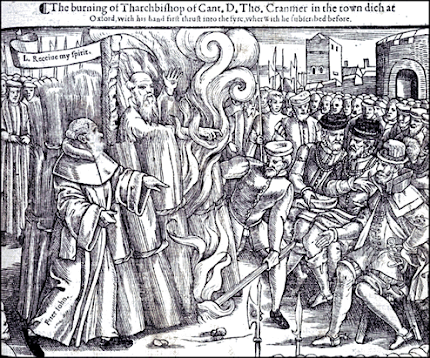
The burning of Tharchbishop of Cant. D. Tho. Cranmer in the town dich at Oxford, with his hand first thrust into the fyre, wherwith he subscribed before. [Click on the picture to see Cranmer's last words.]
Tuesday, May 31, 2011


Sunday, May 29, 2011
Saturday, May 28, 2011
Friday, May 27, 2011
Thursday, May 26, 2011
Parents keep child's gender secret - Parentcentral.ca
When political correctness (read propaganda) reaches epic proportions even social liberal ask questions. Click here to read the story: Parents keep child's gender secret - Parentcentral.ca
"Common Grace Considered": Common Grace: the "Restraint of Sin in all Men" (26)
Professor Herman Hanko's blog, Common Grace Considered made these observations:
You can read the rest of the article here:
"Common Grace Considered": Common Grace: the "Restraint of Sin in all Men" (26)
Kuyper’s view had a broader purpose than a coalition with the Roman Catholics in order to capture the reins of government. The fact was that although the Reformed Church was a national church, and although technically all the citizens of the Netherlands were members of the church and were required to be baptized, married and buried by the church, not by any means all within the church were true believers. Yet these unbelieving members had to become a part of the enterprise to bring the Reformed faith to all parts of the world. On what doctrinal basis could that be done? Kuyper found the answer in his theory of general grace. Sin was restrained in all men by this general grace, with the result that all men were capable of doing good. Thus all, believers and unbelievers alike, could labor together for this common cause of bringing the Reformed faith to all parts of the world.
The second remark that needs making is this: the restraint of sin resulted, according to Kuyper, in the ability of the unregenerate to do good works, which could be used in the service of the cause of the establishment of the kingdom of Christ here in the world.
While, therefore, these two ideas of a general restraint of sin and the resulting ability of the unregenerate to do good works belong together, we are going to treat them separately.
You can read the rest of the article here:
"Common Grace Considered": Common Grace: the "Restraint of Sin in all Men" (26)
Wednesday, May 25, 2011
Re: Anglican revival? What will it take? Part 2
Jacob,
Frankly, your views have more in common with theological pluralism than with the magisterial Protestant Reformation.
I never said Reformed Baptists were liberals. I said they are not Reformed.
Also, I believe the theonomic/reconstructionist movement IS liberal as Mohler's confusion of moralism and political activism with the Gospel proves. No Reformed man worth his salt would compromise with Tractarians and idolaters who worship the bread and wine or pray to the saints.
While there is no perfect Reformed church, unreforming churches are not true churches whatsoever. If you join with a synagogue of satan hoping to reform it the opposite will happen. You will find yourself as an apostate idolater in agreement with "orthodox" idolaters. Simply because a Roman Catholic is morally and theologically conservative does not remove the fact that theologically conservative idolaters are still heretics who deny justification by faith alone.
The ACNA is a heterodox hodge podge of semi-pelagians, Arminians, charismaniacs and outright Anglo-Papists.
True believers are less concerned with belonging to the right social club or "company" and more concerned with the true Gospel and the propositional truths of Scripture. There are many hirelings out there. Don't become just another one.
Sincerely yours,
Charlie
On 5/25/2011 10:21 AM, Jacob Todd wrote:
-- Frankly, your views have more in common with theological pluralism than with the magisterial Protestant Reformation.
I never said Reformed Baptists were liberals. I said they are not Reformed.
Also, I believe the theonomic/reconstructionist movement IS liberal as Mohler's confusion of moralism and political activism with the Gospel proves. No Reformed man worth his salt would compromise with Tractarians and idolaters who worship the bread and wine or pray to the saints.
While there is no perfect Reformed church, unreforming churches are not true churches whatsoever. If you join with a synagogue of satan hoping to reform it the opposite will happen. You will find yourself as an apostate idolater in agreement with "orthodox" idolaters. Simply because a Roman Catholic is morally and theologically conservative does not remove the fact that theologically conservative idolaters are still heretics who deny justification by faith alone.
The ACNA is a heterodox hodge podge of semi-pelagians, Arminians, charismaniacs and outright Anglo-Papists.
True believers are less concerned with belonging to the right social club or "company" and more concerned with the true Gospel and the propositional truths of Scripture. There are many hirelings out there. Don't become just another one.
Sincerely yours,
Charlie
On 5/25/2011 10:21 AM, Jacob Todd wrote:
Charlie,
Thanks for the response and I do not mind at all you posting it. I was surprised as to your feelings on the ACNA. I would disagree for I do believe they uphold the authority of Scripture. Having said that there are several points I would also disagree with them on, such as female pastors. They may well have Anglo-Catholic tendencies, however, there is no perfect denomination out there. In one way or another every denomination is always in need of reform. Even if someone planted a truly reformed Anglican church, they would still not be perfect, would still error at times, for we are constantly in need of repentance. I do not believe there exist a perfect Church and all I can do is fight for orthodoxy where God has placed me, be it a dead southern baptist church or an anglo-catholic, works based, church.
I am aware of Stott, Packer, and Bray, but most people are not. Most people are aware of the Driscolls and Pipers. My problem is that they are old and of another generation. I see the need for the younger generations to rise to the call of godly leadership, staunchly fighting for biblical truth. Someone must take the torch from them.
As far as Baptist are concerned, I will never allow the issue of Baptism to get in the way of advancing the Good News of Christ Jesus. Neither do they, as most work with paedo-baptist and vice-versa. The staunch refusal to work with conservatives who hold to a different view of baptism is dying out. Nobody lets that get in the way in the younger generations. We respect others who can show in the Bible their beliefs and few would argue that different views of Baptism make someone a liberal. I don't think anybody would argue that Al Mohler or Charles Spurgeon are/were liberals.
I know there are good Anglicans/Episcopalians who adamantly hold to Justification by faith alone. If they do exist within an apostate denomination, that does not make them apostates themselves. I personally look at that situation and see an opportunity. An opportunity to enter the fray, put forth my leadership, and reform from within and give the godly, Bible believing Anglicans hope in a leader who is willing to stand up for truth. To give them a parish that will stand up for Christ Jesus and justification by faith, etc. I see the Anglicans in the US as sheep without a shepherd. Someone must step up.
I would not refuse to say Anglo-Catholics are orthodox (at least not some). I attended Catholic schools my whole life and know of some wonderful people who love Christ and Scripture with a passion. They are following their leaders. It comes to LEADERSHIP.
You are not raining on my parade, I just view the situation differently. I see a field wide open and worth fighting for. I see wounded, miserable, and lonely Anglicans/Episcopalians who are desperate for Christ. I see poor leaders with awful doctrine and no guts unwilling to stand up for biblical authority because they are ensnared in tradition. I see sheep crying out for shepherds who are willing to fight for them. I see a church in need of reform, people in need of leaders, and the Bible in need of defending. I want people to find healing at the Cross of Christ, not squibbling (I'm not addressing this at you...I see this at my school constantly) over sprinkling or immersion. I want Christ Jesus to conquer sin in people's lives so those people can turn around and let the world know of the indescribable glories of the Messiah, dwelling within our hearts.
So you haven't rained on my parade at all. I greatly appreciate your brutal honesty and I still think you have a wonderful blog and I think you are doing a great thing. Keep up the good work!
Respectfully,
Jake (feel free to post)
On Tue, May 24, 2011 at 7:26 PM, Charlie J. Ray <cranmer1959@hotmail.com> wrote:
Jake,
You've said a mouthful here and I don't know where to begin. I hope you will forgive me for posting this to the blog. However, I believe this needs to be said to the blogosphere at large.--
First of all, I consider the Anglican Church in North America to be as apostate or worse than The Episcopal Church. The reason being that it is an Anglo-Catholic/Tractarian denomination and fully opposes the five solas of the Protestant Reformation and despises true Calvinism.
Also, you should be aware that John Stott, James I. Packer, and Gerald Bray are all Anglican scholars. Stott, unfortunately, does not believe in eternal punishment but endorses the annihilation of the soul. I could also mention Ashely Null.
As for the so-called "reformed" scholars you mention, I would regard Tim Keller as a theological liberal pretending to be reformed and evangelical. His theology of "triperspectivalism" does not even begin with Scripture.
I would also question whether or not "reformed" Baptists are really "Reformed". The Protestant Reformation was magisterial, not Anabaptist. Reformed Baptists are Calvinistic but not truly Reformed since they reject the sacraments and infant baptism.
I would not recommend the ACNA to anyone since I regard Roman Catholics, the Eastern Orthodox, and Anglo-Catholics as heretics who preach "another gospel" (Galatians 1:6-9) and another Jesus (2 Corinthians 11:3-4). I have noted that Albert Mohler has spoken at an Anglo-Catholic event in South Carolina, which makes me wonder if he has ties to the Reconstructionist/Theonomy movement. That theology leads to ecumenicalism and to a form of liberalism that sacrifices Reformed and Protestant theology and the Gospel to their goals for social and political change.
I also reject Cornelius Van Til and accept the views of Gordon H. Clark and his student, Carl F. H. Henry on the issue of propositional truth. Van Til's theology has produced theonomy, reconstruction, triperspectivalism, and the idea that Scripture is merely an "analogy" of God's Word and not God's Word in and of itself. How this differs from neo-orthodoxy no one has been able to tell me.
I would further reject neo-Calvinist doctrines like common grace and the free offer. Classical Calvinism does not teach those views, which are products of Abraham Kuyper and his student, Herman Bavinck.
The short of it is that in my opinion there are no Reformed Anglicans today. They are an extinct breed. Even Packer and Bray are willing to say that Anglo-Catholics are "orthodox". That is something I absolutely refuse to do. In fact, as much as I like the writing of both men, I must say that the both of them are jellyfish with no spines. Anglo-Catholics are lost and in need of conversion to the true Gospel. There is only ONE Gospel and the Roman Catholics, Eastern Orthdox, Anglo-Catholics, theological liberals, and theonomists do not have it.
If you want to plant a Reformed Anglican church, that would be about the only way to go. The idea that doctrine should be minimalized for unity of differing beliefs is just bunk. The 39 Articles of Religion were never meant to endorse Anglo-Catholicism, Amyraldianism, Arminianism or any other semi-pelagian or idolatrous system of theology.
If I've rained on your parade, please forgive me. However, I believe the truth should be laid on the table openly. What will it take for an Anglican renewal? It will take a sovereign decree of God, which has not happened yet. Anglicanism is apostate. That would include the Anglican Mission in America and even the Sydney Anglicans, who are by and large Amyraldians with a few exceptions. The Archbishop in the Sydney Diocese, Peter Jensen, is a five point Calvinist. His brother, Philip Jensen, unfortunately, is an Amyraldian or one point Arminian. I regard both Amyraldianism and Arminianism as heresies to be seriously challenged and confronted and not something to be tolerated.
Sincerely yours in Christ,
Charlie
On 5/24/2011 9:12 AM, Jacob Todd wrote:Charlie,
Thanks for the great blog! I think its probably the best Anglican blog around. I am a student at Southern Seminary in Louisville with strong Anglican leanings and I have some questions and observations for you (I am asking you because I believe you hold to the correct Anglican theology...truly reformed and undeniably Anglican.).
What is it going to take for the ACNA to rally together and become a unified body fighting for orthodoxy in America? I see the credo-baptist world really doing this, along with greats like Sproul and Keller. There seems to be this unity among conservative, reformed Christians in America but from my vantage point, the Anglicans seem not to be a part of this alliance? At least publicly. It seems that the group I mentioned above has figure heads that the Church can rally behind. Driscoll, Piper, Keller, Sproul, MacArthur, Stanley, Mohler. Have the Anglicans nobody to put forth? Nobody to team up with the Mohlers and Driscolls of the age to represent the Anglicans in North America? Am I wrong in my assessment or am I missing something?
What power there would be in seeing an Anglican pastor writing books with Driscoll and speaking with Mahaney!
I am leaning on the fence of the ACNA, that is, in ordination. A part of me wants to enter the fray and join hands with the guys I mentioned above. Anyway...just some thoughts that I was curious as to your opinions.
Respectfully,
Jake Todd
Reasonable Christian Blog Glory be to the Father, and to the Son : and to the Holy Ghost; Answer. As it was in the beginning, is now, and ever shall be : world without end. Amen. 1662 Book of Common Prayer
Reasonable Christian Blog Glory be to the Father, and to the Son : and to the Holy Ghost; Answer. As it was in the beginning, is now, and ever shall be : world without end. Amen. 1662 Book of Common Prayer
Tuesday, May 24, 2011
Fwd: Re: Anglican revival? What will it take?
You've said a mouthful here and I don't know where to begin. I hope you will forgive me for posting this to the blog. However, I believe this needs to be said to the blogosphere at large.
First of all, I consider the Anglican Church in North America to be as apostate or worse than The Episcopal Church. The reason being that it is an Anglo-Catholic/Tractarian denomination and fully opposes the five solas of the Protestant Reformation and despises true Calvinism.
Also, you should be aware that John Stott, James I. Packer, and Gerald Bray are all Anglican scholars. Stott, unfortunately, does not believe in eternal punishment but endorses the annihilation of the soul. I could also mention Ashely Null.
As for the so-called "reformed" scholars you mention, I would regard Tim Keller as a theological liberal pretending to be reformed and evangelical. His theology of "triperspectivalism" does not even begin with Scripture.
I would also question whether or not "reformed" Baptists are really "Reformed". The Protestant Reformation was magisterial, not Anabaptist. Reformed Baptists are Calvinistic but not truly Reformed since they reject the sacraments and infant baptism.
I would not recommend the ACNA to anyone since I regard Roman Catholics, the Eastern Orthodox, and Anglo-Catholics as heretics who preach "another gospel" (Galatians 1:6-9) and another Jesus (2 Corinthians 11:3-4). I have noted that Albert Mohler has spoken at an Anglo-Catholic event in South Carolina, which makes me wonder if he has ties to the Reconstructionist/Theonomy movement. That theology leads to ecumenicalism and to a form of liberalism that sacrifices Reformed and Protestant theology and the Gospel to their goals for social and political change.
I also reject Cornelius Van Til and accept the views of Gordon H. Clark and his student, Carl F. H. Henry on the issue of propositional truth. Van Til's theology has produced theonomy, reconstruction, triperspectivalism, and the idea that Scripture is merely an "analogy" of God's Word and not God's Word in and of itself. How this differs from neo-orthodoxy no one has been able to tell me.
I would further reject neo-Calvinist doctrines like common grace and the free offer. Classical Calvinism does not teach those views, which are products of Abraham Kuyper and his student, Herman Bavinck.
The short of it is that in my opinion there are no Reformed Anglicans today. They are an extinct breed. Even Packer and Bray are willing to say that Anglo-Catholics are "orthodox". That is something I absolutely refuse to do. In fact, as much as I like the writing of both men, I must say that the both of them are jellyfish with no spines. Anglo-Catholics are lost and in need of conversion to the true Gospel. There is only ONE Gospel and the Roman Catholics, Eastern Orthdox, Anglo-Catholics, theological liberals, and theonomists do not have it.
If you want to plant a Reformed Anglican church, that would be about the only way to go. The idea that doctrine should be minimalized for unity of differing beliefs is just bunk. The 39 Articles of Religion were never meant to endorse Anglo-Catholicism, Amyraldianism, Arminianism or any other semi-pelagian or idolatrous system of theology.
If I've rained on your parade, please forgive me. However, I believe the truth should be laid on the table openly. What will it take for an Anglican renewal? It will take a sovereign decree of God, which has not happened yet. Anglicanism is apostate. That would include the Anglican Mission in America and even the Sydney Anglicans, who are by and large Amyraldians with a few exceptions. The Archbishop in the Sydney Diocese, Peter Jensen, is a five point Calvinist. His brother, Philip Jensen, unfortunately, is an Amyraldian or one point Arminian. I regard both Amyraldianism and Arminianism as heresies to be seriously challenged and confronted and not something to be tolerated.
Sincerely yours in Christ,
Charlie
On 5/24/2011 9:12 AM, Jacob Todd wrote:
-- First of all, I consider the Anglican Church in North America to be as apostate or worse than The Episcopal Church. The reason being that it is an Anglo-Catholic/Tractarian denomination and fully opposes the five solas of the Protestant Reformation and despises true Calvinism.
Also, you should be aware that John Stott, James I. Packer, and Gerald Bray are all Anglican scholars. Stott, unfortunately, does not believe in eternal punishment but endorses the annihilation of the soul. I could also mention Ashely Null.
As for the so-called "reformed" scholars you mention, I would regard Tim Keller as a theological liberal pretending to be reformed and evangelical. His theology of "triperspectivalism" does not even begin with Scripture.
I would also question whether or not "reformed" Baptists are really "Reformed". The Protestant Reformation was magisterial, not Anabaptist. Reformed Baptists are Calvinistic but not truly Reformed since they reject the sacraments and infant baptism.
I would not recommend the ACNA to anyone since I regard Roman Catholics, the Eastern Orthodox, and Anglo-Catholics as heretics who preach "another gospel" (Galatians 1:6-9) and another Jesus (2 Corinthians 11:3-4). I have noted that Albert Mohler has spoken at an Anglo-Catholic event in South Carolina, which makes me wonder if he has ties to the Reconstructionist/Theonomy movement. That theology leads to ecumenicalism and to a form of liberalism that sacrifices Reformed and Protestant theology and the Gospel to their goals for social and political change.
I also reject Cornelius Van Til and accept the views of Gordon H. Clark and his student, Carl F. H. Henry on the issue of propositional truth. Van Til's theology has produced theonomy, reconstruction, triperspectivalism, and the idea that Scripture is merely an "analogy" of God's Word and not God's Word in and of itself. How this differs from neo-orthodoxy no one has been able to tell me.
I would further reject neo-Calvinist doctrines like common grace and the free offer. Classical Calvinism does not teach those views, which are products of Abraham Kuyper and his student, Herman Bavinck.
The short of it is that in my opinion there are no Reformed Anglicans today. They are an extinct breed. Even Packer and Bray are willing to say that Anglo-Catholics are "orthodox". That is something I absolutely refuse to do. In fact, as much as I like the writing of both men, I must say that the both of them are jellyfish with no spines. Anglo-Catholics are lost and in need of conversion to the true Gospel. There is only ONE Gospel and the Roman Catholics, Eastern Orthdox, Anglo-Catholics, theological liberals, and theonomists do not have it.
If you want to plant a Reformed Anglican church, that would be about the only way to go. The idea that doctrine should be minimalized for unity of differing beliefs is just bunk. The 39 Articles of Religion were never meant to endorse Anglo-Catholicism, Amyraldianism, Arminianism or any other semi-pelagian or idolatrous system of theology.
If I've rained on your parade, please forgive me. However, I believe the truth should be laid on the table openly. What will it take for an Anglican renewal? It will take a sovereign decree of God, which has not happened yet. Anglicanism is apostate. That would include the Anglican Mission in America and even the Sydney Anglicans, who are by and large Amyraldians with a few exceptions. The Archbishop in the Sydney Diocese, Peter Jensen, is a five point Calvinist. His brother, Philip Jensen, unfortunately, is an Amyraldian or one point Arminian. I regard both Amyraldianism and Arminianism as heresies to be seriously challenged and confronted and not something to be tolerated.
Sincerely yours in Christ,
Charlie
On 5/24/2011 9:12 AM, Jacob Todd wrote:
Charlie,
Thanks for the great blog! I think its probably the best Anglican blog around. I am a student at Southern Seminary in Louisville with strong Anglican leanings and I have some questions and observations for you (I am asking you because I believe you hold to the correct Anglican theology...truly reformed and undeniably Anglican.).
What is it going to take for the ACNA to rally together and become a unified body fighting for orthodoxy in America? I see the credo-baptist world really doing this, along with greats like Sproul and Keller. There seems to be this unity among conservative, reformed Christians in America but from my vantage point, the Anglicans seem not to be a part of this alliance? At least publicly. It seems that the group I mentioned above has figure heads that the Church can rally behind. Driscoll, Piper, Keller, Sproul, MacArthur, Stanley, Mohler. Have the Anglicans nobody to put forth? Nobody to team up with the Mohlers and Driscolls of the age to represent the Anglicans in North America? Am I wrong in my assessment or am I missing something?
What power there would be in seeing an Anglican pastor writing books with Driscoll and speaking with Mahaney!
I am leaning on the fence of the ACNA, that is, in ordination. A part of me wants to enter the fray and join hands with the guys I mentioned above. Anyway...just some thoughts that I was curious as to your opinions.
Respectfully,
Jake Todd
Reasonable Christian Blog Glory be to the Father, and to the Son : and to the Holy Ghost; Answer. As it was in the beginning, is now, and ever shall be : world without end. Amen. 1662 Book of Common Prayer
--
Reasonable Christian Blog Glory be to the Father, and to the Son : and to the Holy Ghost; Answer. As it was in the beginning, is now, and ever shall be : world without end. Amen. 1662 Book of Common Prayer
Monday, May 23, 2011
Does God Speak Today Apart from the Bible? by R. Fowler White
Grudem’s position can be summarized this way: In the New Testament gift of prophecy (and its correlates — visions, dreams, auditions, words of knowledge, and wisdom) the church should find a source of practical, though fallible, guidance. To adequately consider this proposition, we must notice that Grudem says very plainly that God now speaks as He has never previously spoken. Though the means through which God speaks are purportedly the same, the words He speaks are different from everything He has said before — to the Old Testament saints, to Jesus, to the apostles. In short, the words God speaks have been redefined, for they are no longer His very words, inerrant and authoritative.
If the Bible actually says that this is the case, then so be it. But we need to consider Grudem’s evidence from the Bible. Aside from his treatment of Agabus the prophet, Grudem’s chief support for prophecy as a source of fallible practical guidance comes from two texts: 1 Corinthians 14:29 and I Thessalonians 5:20-22.
To read the entire article click here: Does God Speak Today Apart from the Bible? by R. Fowler White
Saturday, May 21, 2011
Anger After Controversial Anti-Gay Pastor Recites Prayer at Minnesota State House - FoxNews.com
Remember when it was controversial to be pro-gay? Now it's controversial to say that homosexuality is a sin? You know God's judgment could fall any day against the pagan United States.
Anger After Controversial Anti-Gay Pastor Recites Prayer at Minnesota State House - FoxNews.com
Wednesday, May 18, 2011
"Common Grace Considered: What is the Preaching of the Gospel?"
The following is an excerpt from Professor Herman Hanko's blog, Common Grace Considered, on the issue of common grace and the free offer of the Gospel. His insights are worthy of your consideration:
Today, preachers who want to be popular and attract large crowds, are afraid or embarrassed by the gospel as Paul preached it. They are concerned about making the gospel more palatable, more attractive, more appealing to men. So it is with the gracious offer of the gospel. It holds to the fact that God has an attitude of favor to all men, that it is Biblical to teach that God loves all men and that Christ died for all men. They claim that if a preacher keeps talking about sin all the time and condemning sin, then people will turn away from him. People have to be told that they have some remarkably good qualities about them and that sin is not always so bad as it is said to be: surely man is not totally depraved. And so God loves them all, makes salvation available to them all, and desires their salvation. All that remains is for man to accept the loving overtures of the gospel and all is well.
Paul will have none of that. The gospel is God’s power to save. God himself saves through the gospel and God saves whom he wills to save. He accomplishes salvation in the atoning suffering and death of his own Son. The gospel is the proclamation of that truth. And through it God does what he has eternally determined to do, that is, save his people.
Paul puts it clearly in 1 Corinthians 1. He says that the gospel may very well be a stumbling block to the Jews and foolishness to the Greeks, but it is nonetheless “unto them which are called, both Jews and Greeks, Christ the power of God and the wisdom of God” (1 Cor. 1:24).
Because the power of the gospel does not lie in human ability or skill, in the persuasiveness of the preacher, in his charisma, where does the power of the gospel lie? The answer is, in the work of the Holy Spirit.
To read the rest of the article click here: "Common Grace Considered: What is the Preaching of the Gospel?"
Monday, May 16, 2011
Sunday, May 15, 2011
EV News :: Plans announced for GAFCON 2 and London and Africa offices
“We continue to be troubled by the promotion of a shadow gospel that appears to replace a traditional reading of Holy Scriptures and a robust theology of the church with an uncertain faith and a never ending listening process. This faith masquerades as a religion of tolerance and generosity and yet it is decidedly intolerant to those who hold to the “faith once and for all delivered to the saints”.
Odd but I get the same sort of feeling from GAFCON itself. GAFCON, like the Anglican Church in North America, is composed primarily of Anglo-Catholics and/or high church Arminians, neither of which can truly be called "Evangelical" or "Reformed". True Anglicanism which is faithful to the English Reformation and the magisterial Reformation is not and never will be "Anglo-Catholic" or Roman Catholic-lite. Instead the final authority is Holy Scripture, not the traditions of men.
You leave the commandment of God and hold to the tradition of men." 9 And he said to them, "You have a fine way of rejecting the commandment of God in order to establish your tradition! (Mark 7:8-9 ESV)
I do not nullify the grace of God, for if righteousness were through the law, then Christ died for no purpose. (Galatians 2:21 ESV)
EV News :: Plans announced for GAFCON 2 and London and Africa offices
Saturday, May 14, 2011
Anglicans Ablaze: Is That So?
Robin Jordan has posted an excellent critique of a brochure published by the Anglican Church in North America. Robin has pinpointed several blatant errors and misleading statements in the pamphlet which every concerned Evangelical and Reformed believer ought to be aware of.
To read the rest of the article click here: Anglicans Ablaze: Is That So?
The first statement is, “Anglican Christians are evangelical Christians.” Authentic historic Anglicanism is evangelical. The problem is the accompanying explanation of what it means to be evangelical. Being evangelical involves more than believing that “the Bible is the Word of God and has a unique authority in our lives.” The Tractarians also believed that the Bible was God’s Word and had a unique authority in the life of a Christian. But they were not evangelicals. Believing that the Bible has a unique authority in a Christian’s life is not the same as believing that it is the supreme and final authority in all matters of faith and practice. The word “evangelical” is derived from the Greek word, “evangelion,” or glad tidings—a reference to the Gospel of Grace. A true evangelical believes that the essence of Gospel teaching is salvation by grace by faith alone in Jesus Christ alone, as opposed to sacraments and good works. The English Reformers called themselves “gospel men,” which is another way of saying “evangelicals.” The English Reformation was sparked by their rediscovery of the Gospel of Grace in the New Testament. “God’s love for the world expressed in Jesus,” which the accompanying explanation describes as “Good News that we are all called to share with everyone” is a watered-down version of the Gospel. It makes no mention of the Cross. The explanation of what being evangelical means is inaccurate and adequate. It represents a redefinition of the term “evangelical” that permits its application to people who are not evangelical in the classical Anglican sense.
To read the rest of the article click here: Anglicans Ablaze: Is That So?
Tuesday, May 10, 2011
WordPress.com
Looks like R. Scott Clark has finally wimped out on us. It was refreshing to see a seminary professor defend his ideas on the internet. Looks like job security and book sales were more important than truth. Why am I not surprised?
The real truth is theologically trained laypersons who blog have no fears of losing their jobs. So truth can be openly debated, discussed, and fought over in the blogosphere. If you really want to learn... don't go to seminary. Read widely in the classical reformed theological works. Study Greek and Hebrew on your own. You're sure to get as much education or more than you will at the increasingly liberal "evangelical" seminaries and colleges out there.
The real truth is theologically trained laypersons who blog have no fears of losing their jobs. So truth can be openly debated, discussed, and fought over in the blogosphere. If you really want to learn... don't go to seminary. Read widely in the classical reformed theological works. Study Greek and Hebrew on your own. You're sure to get as much education or more than you will at the increasingly liberal "evangelical" seminaries and colleges out there.
WordPress.com
Monday, May 09, 2011
Navy Chaplains to Officiate Gay Marriages - FoxNews.com
This politically correct move to marginalize traditional marriage, heterosexuality, and true Christianity is getting out of hand.
Navy Chaplains to Officiate Gay Marriages - FoxNews.com
Navy Chaplains to Officiate Gay Marriages - FoxNews.com
Sunday, May 08, 2011
Why Evangelicalism Has Lost Touch with Its Roots in the Protestant Reformation
But I am afraid that as the serpent deceived Eve by his cunning, your thoughts will be led astray from a sincere and pure devotion to Christ. 4 For if someone comes and proclaims another Jesus than the one we proclaimed, or if you receive a different spirit from the one you received, or if you accept a different gospel from the one you accepted, you put up with it readily enough. (2 Corinthians 11:3-4 ESV)
And no wonder, for even Satan disguises himself as an angel of light. 15 So it is no surprise if his servants, also, disguise themselves as servants of righteousness. Their end will correspond to their deeds. (2 Corinthians 11:14-15 ESV)
Why Evangelicalism Has Lost Touch with Its Roots in the Protestant Reformation
Recently I was excommunicated at a local Presbyterian church which is affiliated with the Presbyterian Church in America, namely Faith Presbyterian Church of Wauchula, Florida. The reason I was excommunicated was that I had dared to question the pastor's openly ecumenical liberalism in the Sunday school class. When he contended that Roman Catholics are “saved” because “they believe in Jesus” I had to wonder what would cause an allegedly “reformed” pastor to say such a stupid thing? As if doctrine does not matter and all that matters is that we all believe in a Jesus who has no firm doctrinal convictions and a Jesus who is defined ambiguously according to the subjective interpretations of each single individual?
I began to think about where this equivocation and lack of theological clarity comes from. There are many sources within Evangelicalism, including the infamous Charles Colson who pretends to be reformed while in fact upholding what can only be called an Arminian theology. Colson apparently has no problem with Roman Catholicism either since his Prison Fellowship ministry is necessarily ecumenical in outlook, although superficially it “claims” to be Evangelical. But such definitions of Evangelicalism are so broad that they include a church that has officially condemned Evangelicalism and the Protestant Reformation since the 16th century. Those anathemas are officially recorded in the canons of the Council of Trent.
The canons of Trent say things that officially condemn the statements of faith of most Evangelical churches as heresy. Yet we see these same Evangelical churches openly embracing Roman Catholicism as just another Christian denomination, something which is obviously is not. What anathemas am I referring to? Take these examples for your consideration:
Canon 14.
If anyone says that man is absolved from his sins and justified because he firmly believes that he is absolved and justified, or that no one is truly justified except him who believes himself justified, and that by this faith alone absolution and justification are effected, let him be anathema.
Canon 15.
If anyone says that a man who is born again and justified is bound ex fide to believe that he is certainly in the number of the predestined, let him be anathema. [From: Trent: Let Me Be Anathema.]
The fact is the majority of the anathemas condemn Protestants as heretics worthy of damnation. How folks like Charles Colson and other mainline “Evangelical” leaders can openly endorse a false church and its members as “Christians” is beyond me.
Glory be to the Father, and to the Son : and to the Holy Ghost; Answer. As it was in the beginning, is now, and ever shall be : world without end. Amen.
King James Bible turns 400 | Christian News on Christian Today
King James Bible turns 400
The King James Version of the Bible officially turns 400 years old oday after months of celebration worldwide leading up to the day.
by Jennifer Riley, Christian PostPosted: Monday, May 2, 2011, 18:17 (BST)

- AP
- In this Tuesday, April 19, 2011 picture, a copy of the King James bible is displayed at the London Library in central London.
- Full Size [+]
The King James Version was commissioned by King James I during a time of unrest and division in England. He brought together Anglican leaders and Puritans – who had disdain for one another – at Hampton Court in January 1604 for a conference that would lead to a new translation.
At the time, the Puritans were calling for a new translation that would bring reform within the Church of England. Earlier versions, such as the Bishop’s Bible and the Geneva Bible, caused dissension between Christian factions.
On July 22, 1604, King James announced that a new translation would be produced by a committee of scholars and theologians made up of both Anglicans and Puritans. He hoped the partnership between the two rival groups would help heal England’s religious division.
Seven years later, the King James Version was completed with the help of 47 scholars and theologians.
To read the entire article click here: King James Bible turns 400 | Christian News on Christian Today
Saturday, May 07, 2011
Friday, May 06, 2011
Archbishop of Canterbury appoints flying bishops | World news | The Guardian
I don't know which is worse... liberal Anglo-Catholics or conservative Anglo-Catholics. Both are equally heretical.
Archbishop of Canterbury appoints flying bishops | World news | The Guardian
Wednesday, May 04, 2011
Tuesday, May 03, 2011
Monday, May 02, 2011
Sunday, May 01, 2011
Founders Ministries Blog: Olsen, Piper, tragedy and theodicy
Roger Olsen's god is not the God revealed in Holy Scripture. Olson's god is a god who dances to Olson's commands and wishes, apparently. Open theism is simply a Christian version of atheism, in my opinion.
To read a critique of Olson click on the following link: Founders Ministries Blog: Olsen, Piper, tragedy and theodicy
Subscribe to:
Posts (Atom)

 Posts
Posts


