>

Martyred for the Gospel

Martyred for the Gospel
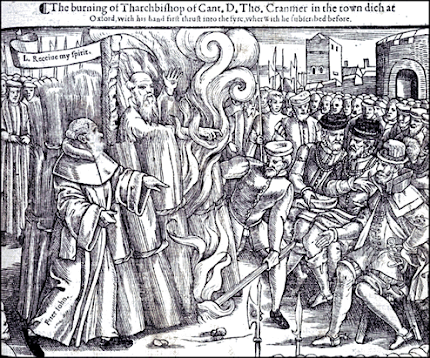
The burning of Tharchbishop of Cant. D. Tho. Cranmer in the town dich at Oxford, with his hand first thrust into the fyre, wherwith he subscribed before. [Click on the picture to see Cranmer's last words.]

Daily Bible Verse

Showing posts with label Anglo-Catholicism. Show all posts

Monday, November 03, 2014

The Anglican Church in North America Discriminates Against Reformed Ministers and Congregations


"How the mighty have fallen, And the weapons of war perished!" (2 Samuel 1:27 NKJV)

Robin Jordan on the Anglican Church in North America:


A careful examination of the Anglican Church in North America’s formularies—its constitution, canons, rites and services, and catechism—reveals the systematic exclusion of the Anglican Reformed beliefs and liturgical practices from these formularies.
The Anglican Church in North America in its formularies does not extend to the Anglican Reformed clergy and congregations the freedom to practice and propagate their faith that it extends to Anglo-Catholic and philo-Orthodox clergy and congregations.
The constitution and canons of the Anglican Church in North America do not offer Anglican Reformed clergy, ordination candidates, dioceses, networks, and congregations any protection from theological discrimination.

Why North America Needs a Second Alternative Anglican Province


I agree somewhat with what Robin Jordan is saying.  But what he does not get is that no Reformation Anglican or Reformed/Calvinist minister or congregation would dare to join an apostate denomination or "communion."  James I. Packer and other compromisers are basically in fellowship with heresiarchs who lead their congregations and the communion as a whole to hell.  It was never a possibility that oil and water would mix.  Truth and deception are as incompatible as good and evil.

Woe to those who call evil good, and good evil; Who put darkness for light, and light for darkness; Who put bitter for sweet, and sweet for bitter! 21 Woe to those who are wise in their own eyes, And prudent in their own sight! (Isaiah 5:20-21 NKJV)

One of the founding Bishops of the Reformed Episcopal Church, Charles Cheney, delivered a sermon which logically pointed out the incompatibility of Anglo-Catholicism with Biblical Christianity and Reformation Anglicanism:


It is sometimes urged that the Church of Christ existed before the Gospels, and that therefore the traditions of the Church are to be accepted as authoritative interpreters of the New Testament. So did the tradition to which St. John refers at the close of his Gospel, that Christ had declared that the beloved "disciple should not die," exist before the Gospel which corrected it. But for that very reason was that part of St. John's Evangel written, that it might contradict, upon the authority of inspiration, the errors of ecclesiastical tradition, and brand the previous belief of the Church as a lie that no Christian was to accept.

The Evangelical Ideal of the Visible Church, by Bishop Charles Cheney.

Ironically, the Reformed Episcopal Church is now a full-blown Anglo-Catholic denomination that discriminates against Calvinists and Reformed Anglicans and Evangelical Protestants in general.  That is why the REC is now a full member of the Anglican Church in North America.

How the mighty have fallen.  The Reformed Episcopal Church was founded on the principles of the Anglican and Protestant Reformation.  Its founders are probably rolling over in their graves.

 "The beauty of Israel is slain on your high places! How the mighty have fallen! 20 Tell it not in Gath, Proclaim it not in the streets of Ashkelon-- Lest the daughters of the Philistines rejoice, Lest the daughters of the uncircumcised triumph. (2 Samuel 1:19-20 NKJV)
 "How the mighty have fallen in the midst of the battle! Jonathan was slain in your high places. (2 Samuel 1:25 NKJV)
 "How the mighty have fallen, And the weapons of war perished!" (2 Samuel 1:27 NKJV)

See also:   Bishop Leonard Richs Presides

Thursday, May 08, 2014

An Open Letter to David Virtue, Virtue Online

I sent the following open letter to Mr. David Virtue, owner of the Virtue Online news service.  Mr. Virtue "claims" to be an Evangelical but he is in open fellowship with Anglo-Catholics and high church Arminians both of which openly and publicly deny the doctrines of sovereign grace and the final authority of Holy Scripture.  To be sure the Anglo-Catholics and Tractarians openly deny all five of the solas of the Protestant Reformation.
 
Charlie


Virtue Online


Dear Mr. Virtue:
 
I will never support your ministry since I believe that so-called "orthodox" Anglo-Catholicism is a heresy of the same order or worse than the Federal Vision.  The English Reformers would never have practiced sacerdotalism nor would they have compromised on the doctrine of justification by faith ALONE.  Sola fide!  Scripture alone is the final authority.  J.I. Packer, as solid as his Calvinism is, is not Reformed.  I say that for the simple reason that he thinks heretics don't need to teach the Reformed doctrines or believe the Gospel.  Rome officially condemned the Gospel at the Council of Trent and the Anglo-Catholics are in full agreement with Rome and the Tractarian heresy of the 19th century.

As far as I'm concerned, you might as well either go liberal or join up with Rome.  You are certainly not a Protestant nor are you an Evangelical, at least not as those terms are defined during the Protestant Reformation.

Forgive the pun but "virtue" will only earn you a deeper place in hell.  (Romans 6:23).  The only virtue that has earned the salvation of the elect is the virtue of Christ.  Calvinism IS the Gospel.

Sincerely yours,

Charlie J. Ray

Thursday, August 22, 2013

Alister McGrath: Anglo-Catholicism Is an Aberration


A Facebook friend, Joao Luis Canha, shared this link in our Reformed Anglicans for Scripturalism group:  Alister McGrath on Anglo-Catholicism.  It is my view that the Anglo-Catholic movement was nothing more than a not so subtle attempt to reverse the English Reformation and take the Engish church back in a Rome-ward direction.  It is a false religion for the same reasons that Eastern Orthodoxy and Roman Catholicism are false religions.  Any church that makes tradition an equal revelation to that which is preserved in the plenary-verbally inspired Scriptures is prone to deny key biblical doctrines like justification by faith alone.  And that is precisely why these three "traditions" flatly deny all five of the solas of the Protestant Reformation in general:  Sola Scriptura, Sola Gratia, Sola Fide, Solus Christus, and Soli Gloria Deo.


Saturday, April 20, 2013

Peter Toon: Anglo-Catholic Dissimulator

Church Society - Issues - Doctrine - Heads of Theology - Salvation - Peter Toon Lecture 2013

I have to wonder why Church Society thinks Peter Toon, who converted to Anglo-Catholic views while in the US, is such a paragon of Evangelical and Reformed Anglicanism?   Furthermore, the title of the lecture by Bishop Michael Nazir-Ali on the topic of "justification by faith" is conveniently missing a key qualifier.  "Alone."  Is justification by faith "alone" or is justification by faith plus works? 
Click here to see the story: 

Church Society - Issues - Doctrine - Heads of Theology - Salvation - Peter Toon Lecture 2013

See also Peter Toon's denial of justification by faith alone in this article at The Churchman:  A Critical Review of John Henry Newman's Doctrine of Justification, 094/4, 1980.

Monday, October 29, 2012

Declining to Answer a Few Basic Questions

Bishop Ian Anderson in response to my e-mail inquiry refused to say which prayer book his denomination uses and whether or not his denomination approves of high church Arminianism.  As you can guess this usually indicates a high church view on such matters.  (See:  Ian Anderson's blog.  No, he's not the British rocker from the band Jethro Tull).

The theology of glory seems to have infected the entire Anglican tradition for some reason.  It does not need to be this way but apparently the influence of the Arminians and the Anglo-Catholics is too much for them?

Jerry Ogles and Charles Morley have apparently joined up in their promotion of the high church theology of glory and their infatuation with the 1928 Book of Common Prayer, along with its prayers for the dead and prayers of oblation.

Charlie

Addendum:  Be careful not to make any dogmatic doctrine clear on your blog when advocating a "new" denomination.  After all, doctrine divides and we wouldn't want that, now would we?  See:  Who Are We?


The former Traditional Protestant Episcopal Church, headed by Bishop Charles Morley, joined up with the Anglican Orthodox Church, headed by Jerry Ogles, after Delbert Murray, Ian Anderson and several other pastors pulled out of Morley's group and started The Protestant Episcopal Church USA.  While Morley called himself "Reformed" his true views are closer to high church Arminianism.  I've discovered that high church Arminians like to wrongly call themselves "Reformed" in attempt to dissmulate their true views.  The 1928 BCP is inherently Anglo-Catholic and remains the standard prayer book for continuing Anglo-Catholic and high church Arminian denominations.  I have to wonder why these splinter groups do not simply join up with the Anglican Church in North America since they all seem to follow high church theology anyway?

Tuesday, October 02, 2012

Cradle or Creedal?: Week of June 10 - YouTube


What's wrong with this presentation by Canon Phil Ashley of the American Anglican Council?  The clue here is that Ashley says that "the creeds are the basis for the Thirty-nine Articles."  This is misleading since the Thirty-nine Articles of Religion is itself a "creed".  The Thirty-nine Articles flesh out the soteriological issues of the English Reformation and the doctrines of the sacraments and the congregation as an assembly of faithful men where the sacraments are rightly and duly administered and the Gospel is rightly preached.  (Article 19).  Unfortunately, the American Anglican Council and the Anglican Church in North America are predominately Anglo-Catholic and do not accept the five solas of the Protestant Reformation, nor do they abide by the plain meaning of the Thirty-nine Articles of Religion.  In fact, they follow the revisionist view of the Articles as they were reinterpreted by the Tractarians.  Such a reading of the Articles is a dissimulation of their true meaning and their true intent since they were not intended as a via media between the Papists and the Puritans.  

Rather, the Anglican Formularies (Thirty-nine Articles of Religion, 1662 Book of Common Prayer, the First and Second Book of Homilies, and the Ordinal) were intended to uphold the English understanding of the Protestant Reformation.  The Articles serve to interpret the 1662 BCP and not the other way around.  Also, there are elements of Lutheranism in regards to the doctrine of justification by faith alone and the law/gospel distinction.  Yet there are strong indicators of Cranmer's affection for Reformed theology in his more Zwinglian teaching on the sacraments and his Calvinist understanding of soteriology in Articles 9-18.  

In short, the "good" canon above is an angel of light who is out to lead people astray.  (2 Corinthians 11:14-15).  While all churches have creeds--including Baptists--it does not follow that only the ecumenical creeds are "fundamental" to saving faith.  No, I would argue that the five solas of the Reformation are likewise essential doctrine.  The Thirty-nine Articles have Scripture as their basis and not the ecumenical creeds.  Scripture alone is the final authority in all matters of faith and practice.

Cradle or Creedal?: Week of June 10 - YouTube

Sunday, August 26, 2012

Reasonable Christian: An Open Letter to Bishop Royal Grote

Bishop Royal "Roy" Grote on the left.

This is a letter I wrote to one of the bishops in the Reformed Episcopal Church over the intended merger with the Anglican Province of America.  That merger never happened since the opportunity to merge with the Anglican Church in North America presented itself.  The point of the letter stands, however, since the ACNA is as Anglo-Papist as the APA is.  What is particularly disturbing about all this is that even Evangelical Anglicans refuse to call the Tractarians on their heresies.  Bishop J.C. Ryle would be rolling over in his grave.  Even the Sydney Anglicans and the Anglican Church League think the Gospel and justification by faith ALONE is somehow a matter of adiaphora since the Tractarians and Anglo-Catholics openly deny sola fide, sola gratia and the final authority of Scripture or sola Scriptura.  I have been challenging Dr. Mark Thompson and my former pastor, David Knox on these issues for some time.

I guess they don't get it that I'm quite willing to speak out publicly on these issues and raise a ruckus.  I've been called one who sows discord among the brethren by at least one Presbyterian.   But it would require that the discord is among brethren.  Anglo-Catholics and Arminians are not "brethren".  They are heretics who preach another gospel.

Click here to read the original letter: Reasonable Christian: An Open Letter to Bishop Royal Grote

Sunday, August 12, 2012

C.S. Lewis: An Anglo-Catholic Latitudinarian and a Bridge to Rome

"The result is a generic Christianity that suits anyone anywhere who can in any way relate to God. Lewis bent over backwards trying to find common ground with all denominations, omitting any doctrine that may be deemed offensive."  -- J. Saunders


The Berean Beacon has once again made a solid argument against the popular view that C. S. Lewis was somehow an Evangelical.  The truth is Lewis was an advocate of a broad latitudinarianism and Anglo-Catholic theology.  J. Saunders wrote the following article about Lewis.  Here is a brief excerpt:

In 1952, C.S. Lewis published his theological work Mere Christianity, which originally began in 1942 as a three-part BBC radio broadcast. As the title suggests, Lewis focused on the mere or common ground he felt existed in Christianity and tried to restate a theology without controversy. The result is a generic Christianity that suits anyone anywhere who can in any way relate to God. Lewis bent over backwards trying to find common ground with all denominations, omitting any doctrine that may be deemed offensive. For this reason, Tolkien disparagingly labelled his friend “Everyman’s Theologian.” Even Mormons find his writings inoffensive.

“He [Lewis] is widely quoted from tried-and-true defenders of Mormon orthodoxy. It just shows the extraordinary acceptability and the usefulness of C.S. Lewis because, of course, most of what he says is perfectly acceptable to Mormons.” 6
Mere Christianity has long been regarded a classic exposition of the Christian faith, yet oddly enough, not one Bible verse is quoted in the first half of the book and only three partial verses in the latter half with no Bible references in the entire book. How can we present Christianity without its foundation – the Word of God?
To read the entire article click here:  C. S. Lewis: A Bridge to Rome

See also:  The Ruling Elder:  Was C. S. Lewis an Anglo-Catholic?

Tuesday, May 29, 2012

Anglicans Ablaze: Pat Robertson Says The Episcopal Church Is Becoming 'Apostate'

Anglicans Ablaze reports that Pat Robertson thinks the Anglican Communion will declare The Episcopal Church to be apostate:
In remarks made on the 700 Club on Wednesday, Robertson stated that "the whole Episcopal Church in America has left its roots" and that it being declared apostate "is on the way."

Robert H. Lundy, communications officer for the American Anglican Council, a conservative movement hoping to return The Episcopal Church to "an apostolic faith," told The Christian Post that he agreed with Robertson's assessment.
Although I agree that The Episcopal Church is apostate, the Anglican Communion will not declare TEC to be apostate.  Why not?  Well, the Anglican Communion itself is apostate and theologically liberal, particularly in England where the Archbishop of Canterbury heads up the council of bishops.  In the UK there is a strong push for the acceptance of openly homosexual ministers and bishops as well as the ordination of women.  None of this has been accepted as of yet but it is merely a matter of time before that happens in the United Kingdom.

The Global South, including the Sydney Anglicans, is also under assault by those promoting the immorality of the gay/lesbian/transgender agenda.  In Africa most of the provinces are morally conservative but unfortunately Evangelicalism and Reformed theology is no longer dominate but in fact Anglo-Catholic theology has taken the upper hand even in the Global South.  Sydney is probably the only province that still stands against the theology of glory and the semi-papist theology of the Tractarian movement.  Even in Sydney Evangelicals are too liberal because they insist that Anglo-Catholics are not lost but are simply separated brethren.

If Roman Catholicism is a false religion, it logically follows that Anglo-Catholicism is a false religion and that those who are caught up in those false gospels need conversion to the true Gospel of sovereign grace through our Lord and Savior Jesus Christ.  Of course, most Evangelicals are Arminians and are lost themselves--which explains why the Evangelicals and Catholics Together movement is alive and well.  Even Albert Mohler is no longer consistent on this point, even participating in a conservative Anglo-Catholic conference (see Mere Anglicanism) in South Carolina a couple of years ago and signing the Manhattan Declaration!  (See also:  AlbertMohler.com:  When the Lights Go Out:  The Death of a Denomination).

Pat Robertson is an Arminian and a Charismatic.  He thinks conservative Anglo-Catholics and Roman Catholics are saved and on their way to heaven.  In short, Pat Robertson is as lost as any "apostate" Episcopalian and so is the pope.

There is only one Gospel and those who preach another gospel are leading people astray.  (Galatians 1:6-9; Acts 4:10, 12; John 14:6; Romans 3:23-25; Jude 1:3).  Where in the following video by Archbishop Rowan Williams do you hear any appeal to the final authority of Scripture or the 39 Articles of Religion?


To see the original article at Anglicans Ablaze click here:

 Anglicans Ablaze: Pat Robertson Says The Episcopal Church Is Becoming 'Apostate'

Monday, May 14, 2012

The Anglican Debacle: Roots and Patterns : Anglican Church League, Sydney, Australia

Dr. Mark Thompson,Moore Theological College
Although this article is fairly accurate, one has to wonder why Dr. Thompson thinks that the Arminian, John Wesley, was somehow a friend of Evangelical and Reformed Anglicanism? The Arminians were always on the side of Archbishop Laud and the closet papists. That would include the Second Awakening Evangelicals of the 18th century who were Arminians. Make no mistake about it but the Arminians are no more a friend of the Gospel of grace than the Anglo-Catholics or the liberals.  Billy Graham, for example, in his twilight years "mellowed out".  That means that Graham no longer knows what he believes or why.  He basically adopted a liberal view that Roman Catholics and those who have never heard the Gospel are saved by works or "by the light they have."  That's way different from saying that the elect are saved by faith alone, by grace alone, and through the means of Gospel preaching alone.  (Acts 4:10, 12; Ephesians 2:8, 9; Titus 3:5-7; John 14:6; Romans 4:3).

The most perspicacious insight expressed by Dr. Thompson is when he rightly points out the deception of Anglo-Catholics when they try to re-interpret the 39 Articles of Religion to fit their semi-papist theology:

However, the real seeds of the problem we now face lie in the nineteenth century. John Henry Newman’s infamous Tract 90, published in 1841, encouraged Anglicans to read the Thirty-nine Articles as a Catholic document.2 In this way he opened the door to the possibility that you might publicly assent to the Articles while reinterpreting them to say what you wanted them to say. What he did in the interests of a more Catholic version of Anglicanism others would do in the interests of a more liberal version before very long. As one scholar put it, ‘whether he intended to or not, he taught us to lie’.


 Click here to read Dr. Thompson's article:  The Anglican Debacle: Roots and Patterns : Anglican Church League, Sydney, Australia

Thursday, March 29, 2012

Anglo-Papist Orthodoxy? AlbertMohler.com – ‘Mere Anglicanism’ and the Essence of Biblical Christianity

This audio is from 2009 and the Mere Anglicanism conference in Charleston, SC. Oddly enough, Mohler admires Rick Warren's support of Proposition 8 in California but not one word about Warren's ecumenicalism or his Arminianism. Also, Mohler is blatantly participating in an Episcopal conference predominated by "orthodox" Anglo-Papists. How can someone who claims to be a Calvinist endorse a soteriology that is papist???!


As the Episcopalian Church in the United States of America (ECUSA) has moved further into theological liberalism and away from biblical fidelity, many evangelical American Anglicans have ventured out in search of faithful church structures. In a special broadcast from the Mere Anglicanism Conference in Charleston (SC), Dr. Mohler welcomes Rev. Dr. William Dickson–rector of St. Andrews Episcopal Church in Forth Worth, TX–to the program to discuss the significance of these developments not only for Anglicans, but for evangelicals at large.

AlbertMohler.com – ‘Mere Anglicanism’ and the Essence of Biblical Christianity


Addendum:  Ironically, Mohler himself promotes morally conservative "civil religion":


Why I Signed the Manhattan Declaration


Further condemning evidence for compromise, Mohler thinks the Anglo-Papists are "Evangelical."  And in the discussion Mohler is duped into advocating the 1549 Book of Common Prayer as the ideal for Anglicanism.  What Mohler does not know is that though the 1549 BCP was edited by Cranmer it is NOT the most reformed prayer book.  Rather the 1552 BCP is the reformed standard that influenced the 1662 Book of Common Prayer, which is part of the Anglican Formularies.  The fact is that the 1549 BCP is upheld by the Anglo-Papists because they do not want to accept the 1552 reforms and the official 1662 Book of Common Prayer, nor do they accept the literal interpretation of the 39 Articles of Religion, which are Protestant.  I cannot believe that Mohler is so ignorant of the history of the English Reformation and the Tractarian controversy.

Thursday, March 15, 2012

The Gippsland Crisis | Theological Theology

Dr. Mark Thompson, Moore Theological College
Dr. Mark Thompson of Moore Theological College in Sydney posted the article, The Gippsland Crisis on his blog. While Dr. Thompson clearly has the moral issues right he also seems to be attacking the symptoms of the disease rather than the disease itself. That is, Thompson and the Anglican Church League and the Sydney Diocese of the Anglican Church of Australia have endorsed the Anglican Church in North America as an "orthodox" Anglican province of the Anglican Communion. Unfortunately, this enodorse completely ignores the fact that the Anglican Church in North America is predominately an Anglo-Catholic or Tractarian denomination or province and therefore is not "orthodoox" nor is it truly Christian.  The Protestant Reformation was a return to the catholic or universal doctrines of the first century church.  It is in fact the Roman Catholics, Anglo-Catholics, Eastern Orthodox, Arminians and Pentecostals who have corrupted the plain teaching of the Scriptures, the only infallible record of apostolic doctrine and God's special revelation.

Moreover, the ACNA is an apostate denomination because it denies the soteriology of the Bible--justification by faith alone--and makes tradition an equal revelation with Scripture.  Confessional Anglicanism has its doctrinal standards laid out clearly in a literal reading of the Anglican Formularies, namely the Thirty-nine Aricles of Religion, the 1662 Book of Common Prayer, and the second Book of the Homilies.  I concede that the Ordinal is included as well, although apostolic succession does not follow from an episcopal form of church polity.  (See Declaration of Principles).

What Dr. Thompson does not seem to get is that once the door is open to making the church an authority over Scripture then the door is also open to revisionism once a church goes off in a modernist or postmodernist direction. When theology is done from below rather than accepting the final authority of God's written Word in Holy Scripture then it is only a matter of time before evil takes over. Not only this but to deny justification by faith alone and to make good works and morality a basis for saving faith is to deny the very Gospel itself. That means that even conservative Anglo-Catholics, Roman Catholics, and the Eastern Orthodox are lost because of their semi-pelagianism and their confusing of law with gospel, merits with grace, and sanctification with justification. Moreover, once the liberals infiltrate a church--even Protestant churches--it is a short time before the dissimulation and relativism produces a propaganda approach like this one:


This is the context in which the actions of the Bishop of Gippsland, John McIntyre, have taken place. Last December the diocesan newspaper in Gippsland announced the appointment of an openly homosexual man as priest in charge of one of the parishes of the diocese. Since then, voices of protest have been raised and the bishop has attempted to take refuge behind the strict wording of only one part of the Lambeth resolution, the refusal to accept the ordination of people involved in homosexual behaviour. He, very clearly, did not ordain this person, he simply appointed him, in full knowledge of his situation (after all, a picture of the man and his partner was included in the diocesan newspaper) to be the senior minister in a local Christian congregation.  (Mark Thompson).


Click here to read the full article:  The Gippsland Crisis | Theological Theology

Saturday, March 10, 2012

VirtueOnline - News - Exclusives - The Future of Anglicanism - Michael Horton interviews David Virtue

The future of Anglicanism appears to be bleak judging by this interview with David Virtue. Virtue sings the praises of Anglo-Catholicism and the Anglican Church in North America and Mike Horton never once asks the question that Virtue is practically begging to be asked, "Is Anglo-Catholicism a true religion?" My answer, of course, is a solid no. Roman Catholic-lite is still a religion of salvation by works. Only when Horton interviews Bishop C. FitzSimmons Allison (retired Bishop of South Carolina) do we hear anything at all about justification by faith alone as a forensic declaration. Tractarians deny the doctrine of forensic justification as a "legal fiction".

Click here to hear the interview:  VirtueOnline - News - Exclusives - The Future of Anglicanism - Michael Horton interviews David Virtue

Sunday, February 26, 2012

Distinctive Vestments, by J. C. Ryle


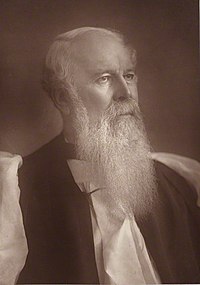
Bishop J. C. Ryle


DISTINCTIVE VESTMENTS


BY REV. CANON J. C. RYLE

VICAR OF STRADBROKE

WHAT is the meaning of the expression which heads this paper? What are these “distinctive vestments,” about which there is so much controversy among Churchmen? Are they of any real importance? Ought they to be formally sanctioned or not? To these questions it is proposed in this paper to supply an answer. “Distinctive Vestments,” then, are certain articles of ministerial dress, which some clergymen wish to be allowed to wear in the celebration of the Lord’s Supper, and declare they cannot be satisfiedunless they are allowed. It is asserted that these vestments are specially and peculiarly connectedwith the office which the clergyman performs in that sacrament, and that he ought to be allowed to wear them in that part of his ministrations, if in no other.

Now, what are these famous “Vestments” to which such importance is attached? It may be useful to have our minds clearly informed about this. A surplice, a hood, and a scarf, most people understand. But what are these “distinctive vestments?” They are described in the Directorium Anglicanum, and in Dr. Blakeney’s admirable work on the Prayer Book, a book which every faithful Churchman ought to read in the present day. The three principal vestments are these:

1. The alb: a linen garment, fitting close to the body, reaching to the feet, and bound with a girdle.

2. The chasuble: a silken robe, worn over the alb, richly embroidered, and open in front.

3. The cope: a garment of a circular form, something like a poncho, with an opening for the head, cut out at the sides for the arms, leaving a straight pendent piece behind and before.


Such are the articles of dress which are disturbing the Church of England at the present time. Such is the apparel which many tell us is almost essential for the right celebration of the Lord’s Supper. Such are the “distinctive vestments,” which, it is commonly reported, many members of Convocation are actually prepared to advise Parliament to sanction! Now the grave question which I want all faithful Churchmen in this day to consider is this:—Is there any real objection to these articles of dress being worn by those clergymen who like them, in celebrating the Lord’s Supper? Is there any good and solid reason why clergymen; who, beside a surplice, a hood, and a scarf, wish to wear an alb, a chasuble, and a cope, should not be allowed to wear them? Let us see. The first idea of many innocent and simple-minded Churchmen is to let every clergyman do as he likes, and to allow the widest liberty and toleration.—“Where is the use,” they say, “of making such a stir about a mere question of outward apparel? Why not let people alone, if they are earnest and hard-working clergymen? Why not allow them to indulge their taste? What can it really signify in the end? How can a few chasubles, and copes, and albs do any harm to the Church of England?”—To all who talk and think in this way I venture to offer a few plain facts about these “vestments,” which cannot be disputed, and I invite them to consider them well. Most of them are historical facts, which any intelligent reader can verify for himself. I challenge all who are disposed to make light of the “vestment” question, to look these facts fairly in the face.

Church Association Tract 033 Page 2 of 4

1. It is a fact that there is not the slightest proof in Scripture, that any “distinctive vestments” were worn, or considered necessary for the due celebration of the Lord’s Supper, in the days of the Apostles. These “vestments” are purely and entirely an invention of a later age and of uninspired men. The gorgeous dress of the high-priest in the Mosaic dispensation was never meant to be a pattern to the Christian Church. It was part of a typical system, which was ordained for a special purpose, and was intended to pass away.

2. It is a fact that the use of these “distinctive vestments” is one of the many distinctive marks of the Church of Rome. That unhappy Church connects them closely with that crowning error and blasphemous delusion in her theological system—the sacrifice of the Mass!

3. It is a fact that in the beginning of the English Reformation, when our Reformers were only half enlightened, the use of these distinctive vestments was expressly ordered. The first Prayer Book of Edward the VIth, put forth in 1549, contains the following words in the rubric before the Communion Service:—“The priest shall put upon him the vestment appointed for the ministration of the Holy Communion, that is to say, a white alb plain, with a vestment or cope.”

4. It is a fact that, as soon as our Reformers saw Scriptural truth fully and clearly, they expressly forbade the clergy to use these “distinctive vestments.” The second Prayer Book of Edward the VIth, put forth in 1552, contains the following words at the beginning of the morning service, “The priest shall wear neither alb, vestment, nor cope,—but he shall have and wear a surplice only.”

5. It is a fact that when the English Reformation was begun over again in the difficult days of Elizabeth, after Bloody Mary’s destructive reign, the only rubric put forth about the ministers’ dress, expressly omits to mention the “distinctive vestments,” and only directs, in vague and general language, “such ornaments to be used as were in use in the second year of Edward VI.”—But that these “ornaments” did not mean the famous Popish “vestments,” as some assert now-a-days, is made as nearly certain as possible by two historical facts. One is, that in the first year of her reign, Elizabeth issued “injunctions” ordering ministers to “wear such seemly habits as were most commonly received in the LATTER DAYS of King Edward VI.”—The other is, that in 1564, the Queen issued “advertisements,” in which it is ordered that “every minister saying prayers or administering sacraments shall wear a comely surplice.” Neither in the injunctions or advertisements are the alb, the cope, or the chasuble mentioned.—Cardwell’s Documentary Annals, vol. i. p. 193, 292.

6. It is a fact that in 1569, Archbishop Parker, the first primate under Elizabeth, issued “Articles of inquiry” for the whole province of Canterbury, containing the following question:—“Whether your priests, curates, or ministers do use in the times of the celebration of divine service to wear a surplice, as prescribed by the Queen’s injunctions and the book of Common Prayer.”—CardweIl’s Documentary Annals, vol. i. 321.

7. It is a fact that in 1576 Archbishop Grindal, the second primate under Elizabeth, issued “articles of inquiry” for the whole province of Canterbury, in which he expressly asks “whether all vestments, albs, tunicles, &c., and such other relics and monuments of superstition and idolatry, be utterly defaced, broken and destroyed.”—Parker Society, Grindal’s Remains, p. 159. The same inquiry was made by Aylmer, Bishop of London in 1577, and by Sandys, Archbishop of York in 1578. Whether it is in the least likely that such an imperious Sovereign as Queen Elizabeth would have allowed such inquiries to be made, if the “ornaments rubric” legalized the vestments, is a question I leave to any one of common sense to answer!

8. It is a fact that the Canons of 1604 say nothing about “distinctive vestments,” as essential to the due celebration of the Lord’s Supper. The 58th canon simply orders that “Every minister saying the public prayers, or ministering the sacraments, or other rites of the Church, shall wear a decent and comely surplice.” This canon is the more remarkable, because the 24th canon orders the cope to

Church Association Tract 033 Page 3 of 4

be worn “in cathedrals” by those who administer the communion. However much we may regret that the “cope” is sanctioned in cathedrals, it must be remembered that the chasuble and not the cope, is peculiarly the sacrificial garment. The use of the chasuble is not ordered.

9. It is a fact that at the last revision of our Prayer Book, in the year 1662, nothing whatever was done to restore the “distinctive vestments,” and not a word was added to our rubrics that could justify the use of them.

10. It is a fact that for nearly three hundred years these “distinctive vestments” have never been used in the parish churches of the Church of England. Whatever some men may please to say, in the present day, about the lawfulness of alb, chasuble or cope, there is no getting over the fact that all custom is dead against them, and that from the first days of Queen Elizabeth they have been disused and laid aside.

11. It is a fact that the attempt to revive the use of “distinctive vestments,” in the celebration of the Lord’s Supper, is a thing of entirely modern date. It began with a party in the Church, which boldly avows its desire to unprotestantize the Church of England. It is pressed forward and supported almost entirely by those churchmen who, both in doctrine and practice, are making unmistakeable approaches toward the Church of Rome, and regard the Lord’s Supper as a sacrifice.

12. Last, but not least, it is a fact that the principal advocates of the Ritualistic movement in the Church of England, distinctly and expressly avow that the “distinctive vestments” in the Lord’s Supper are not taken up and pressed upon us as a mere matter of taste, but as sacrificial garments and the outward expression of an inward doctrine. That doctrine is nothing less than the Romish doctrine of a real corporal presence, a real sacrifice, a really sacrificing priest, and a real altar in the sacrament of the Lord’s Supper. That this is the fact any one may satisfy himself by reading the evidence of Mr. Bennett, the Vicar of Frome, given before the Royal Commissioners in 1867, (First report, p. 72.) Mr. Bennett, in reply to a question, distinctly told the Commissioners that “the use of the chasuble involved the doctrine of sacrifice,” and that “he considered he offered a propitiatory sacrifice in the Lord’s Supper.”

I lay these twelve facts before my readers, and commend them to their serious attention. I entreat them, mark, learn, and inwardly digest them. I unhesitatingly assert, in the face of these facts, that it is impossible to defend the use of the “distinctive vestment’s” in the celebration of the Lord’s Supper, either by Scripture, the Prayer Book, the law of the land, or custom. Reason and common sense alike, condemn them. I assert furthermore that it is no trifling matter to allow any clergyman to use these vestments, that the allowance will be the concession of a great principle, and that any effort that may be made, either in Convocation or Parliament, to obtain sanction for them, ought to be firmly resisted by every faithful Churchman.

I now call on every one who really loves the Church of England to use every effort to prevent “distinctive vestments” being sanctioned by the law of the land. If any doubting, hesitating, peace loving Churchman asks me why, I offer him the following reasons:

(a.) Because the “distinctive vestments” are utterly without warrant of Scripture, are not in the slightest degree essential to the due celebration of the Lord’s Supper, and are not of the slightest use to the souls of Christian worshippers.

(b.) Because the “distinctive vestments” were deliberately rejected and expressly forbidden by the English Reformers at the brightest period of the Reformation, and to sanction the use of them again would be an insult to the memory of the very men who were martyred at Oxford and Smithfield.

Church Association Tract 033 Page 4 of 4

(c.) Because the Church of England has done well enough without the “distinctive vestments” for three hundred years, and at the present time does not need more “ornaments,” but more preaching the Gospel and more holy living among its ministers.

(d.) Because the immense majority of the laity do not want the “distinctive vestments” to be worn by the clergy, and are quite satisfied with the customary surplice and hood. They wish for no innovation in the dress of ministers, and are likely to regard the sanction of them with annoyance and disgust. In short, the “vestments” may bring on secession, disruption and disestablishment.

(e.) Because the “distinctive vestments” are avowedly connected with one of the worst and most dangerous doctrines of the Church of Rome—viz., the sacrifice of the mass; and the sanction of them would therefore be displeasing to God, because highly dishonouring to the priestly office and finished work of our Lord Jesus Christ.

(f.) Because the adoption of the “distinctive vestments” is justly calculated to give great offence to the whole body of English nonconformists, and is likely to alienate them more and more from the Established Church, and to render reunion and comprehension impossible.

(g.) Because the sanction of the “distinctive vestments” would be a public declaration to the whole world, that the clergy of the Church of England wish to go back from the pure and Scriptural principles of Protestantism, on which the Church was first established, and to make a nearer approach to the Church of Rome, from which their forefathers seceded. In short, the “vestments” are a direct retrograde step towards Popery.

(h.) Because the sanction of “distinctive vestments” will more than ever separate the clergy of the Church of England into two opposing parties—those who wear sacrificial garments at the Lord’s table, and those who do not wear them. So far from the liberty to wear them promoting peace, it will only increase and multiply our “unhappy divisions.”

(i.) Because the sanction of “distinctive vestments” will only please a small minority of restless Churchmen, who have long avowed their dislike to Protestantism, while it will seriously offend that large mass of English people who are deeply attached to the principles of the Reformation. For these reasons I now call on all Churchmen who love the old Church of England, on all English Christians who love Christ, on all who dislike priestcraft or sacerdotalism, to unite as one man inresisting the efforts now being made to obtain a legal sanction for the use of “distinctive vestments” in the Established Church, at the Lord’s Supper. For peace sake let us be ready to concede much.

On indifferent matters let us allow the utmost liberty to men’s consciences. But we must never give up Christ’s truth,—If any persons want to have the sacrament of the Lord’s Supper formally declared to be a sacrifice, or want a sacrificial dress to be formally legalised at the Communion table of the Church of England, let us resolve firmly, that we will never, never, never consent.—Let our common watchword throughout England and Wales be this,—a Protestant Established Church, or else no Established Church at all! No compromise with Popery, whatever be the consequence! No peace with Rome! Those that want “the mass” ought to go outside the Church of England.

See also:  Church Association Tracts

Monday, February 20, 2012

Was C.S. Lewis an Anglo-Catholic? « Johannes Weslianus

As a reminder I'm reposting this article from Wes White's blog. The only point where I would disagree is in the comments section below the article where Brian Carpenter assumes out of hand that there are no Reformed Anglicans around these days. Church Society, the Anglican Church League, the Sydney Anglicans and other expressions of the Evangelical and Reformed side of Anglicanism do exist today to counter the Arminian/Anglo-Catholic and broad church side of Anglicanism.

Was C.S. Lewis an Evangelical? Obviously not. To read the article at Wes White's blog click here: Was C.S. Lewis an Anglo-Catholic? « Johannes Weslianus


Thursday, February 09, 2012

Anglicans Ablaze: The Anglican Church in North America: An Alternative Episcopal Church

This is the latest article by Robin Jordan over at Anglicans Ablaze:


The fundamental declarations of the Anglican Church in North America, the doctrinal provisions of its canons, its Ordinal, and the two reports of its Prayerbook and Common Liturgy Taskforce clearly show that the Anglican Church in North America is following in the footsteps of the Episcopal Church. As I noted in my last article in the series on the ACNA theological lens and the guiding principles behind its proposed Prayer Book, the Anglican Church in North America may be described as an alternative Episcopal Church in which two groups are putting their ideas of ecclesiastical governance, church order, worship, and the like into practice.

These two groups represent two movements that influenced Episcopalianism in the twentieth century. The first movement is the Anglo-Catholic movement. Its origin may be traced to the Tractarian and Ritualist movements of the nineteenth century. The second movement is the Ancient-Future, or Convergence, movement. . . .


Click here to read the rest of the article: Anglicans Ablaze: The Anglican Church in North America: An Alternative Episcopal Church


George Conger Raises David Virtue's Dander

I do not generally read VirtueOnline because of its blatantly Anglo-Catholic bias.  However, I was amused by this piece that David Virtue posted attacking George Conger's articles on the current situation with the Anglican Mission in America and the Rwandan house of bishops.  Ironically, George Conger is an "orthodox" and "conservative" Anglo-Catholic who chose to remain within The Episcopal Church and work for reform.  As most readers of my blog know, I do not consider Anglo-Catholics to be truly converted to the Christian faith.  That would include "orthodox" Anglo-Catholics.  I was banned from posting comments at VirtueOnline for stating my position in a polemical manner.  Polemics seems to be the only way that these papist ecumenicalists get the message.  (Jude 1:3-4)

Robin Jordan of the Anglicans Ablaze blog attended, Moving Forward Together, the recent meeting between the Rwanda bishops, conservative AMiA congregational leaders, and the archbishop of the Anglican Church in North America, Robert Duncan, who is also an avowed Anglo-Catholic.  Robin hoped to persuade the more Evangelical and Reformed members of the AMiA to consider joining together in a new Reformed and Evangelical association of Anglicans.  Whether or not that happens is unclear, although Robin said that the Reformed leaning Anglicans he spoke with at the conference were not convinced that there is no place for them in the Anglican Church in North America.  The naivete of Evangelicals is truly astounding.  They do not seem to realize that the borg mentality of Anglo-Papists is that they are welcome so long as they keep the Gospel under wraps and go along with the false gospel of the Anglo-Papists.  That is assuming, of course, that these Evangelical Anglicans actually do understand the Gospel.  The irony here is that Duncan was there to persuade the AMiA to go with the ACNA, while Archbishop Rwaje of the Anglican Church in Rwanda was there to try to bring about reconciliation between the AMiA and the Rwandan house of bishops.

I am unsure of exactly how Reformed and Evangelical the Rwanda Anglicans are.  However, it would appear that they are not nearly as high church as the ACNA.  Robin Jordan has been blogging for some time now about how Anglo-Catholic the doctrine and canons of the ACNA are.  Most recently his critique of the new prayer book to be produced by the ACNA has been most insightful:  ACNA:  Theological Guiding Lens

David Virtue seems to think that Chuck Murphy and John Rodgers of the AMiA will be able work out a deal where the AMiA can join with the ACNA by this June.  The more the merrier I suppose.

Click here to see the original article at VirtueOnline:  George Conger Raises David Virtue's Dander

Addendum:  Robin Jordan corrected my comment above.  He said that it was never his intention to proselytize anyone but rather was there to report on the situation and see what kinds of responses he would get from the more Evangelical side of the aisle.
--
Reasonable Christian Blog Glory be to the Father, and to the Son : and to the Holy Ghost; Answer. As it was in the beginning, is now, and ever shall be : world without end. Amen. 1662 Book of Common Prayer

Tuesday, February 07, 2012

Anglicans Ablaze: The ACNA Theological Lens: The Guiding Principles Behind the Proposed ACNA Prayer Book—Part 7

Robin Jordan has done an excellent job of revealing the modern Tractarian biases of the Anglican Church in North America's new prayer book revision committee. Unfortunately, the direction of the ACNA continues to flow against the English Reformation and Biblical Christianity. The misuse of the Anglican Formularies to justify the false religion of Anglo-Catholicism continues to prevail in the ACNA from all appearances. Anglo-Catholicism, like Rome, teaches that tradition is equal to the revelation is Scripture and includes faith plus works for justification and all the idolatries of the Roman Catholics and the Papists. Click here to read Robin Jordan's complete article: Anglicans Ablaze: The ACNA Theological Lens: The Guiding Principles Behind the Proposed ACNA Prayer Book—Part 7


Sunday, February 05, 2012

Is Anglo-Catholicism a Via Media? Charles Pettit McIlvaine

Rev. Charles Pettit McIlvaine, Born Again Episcopalian.
[The following quote is from Oxford Divinity Compared with that of the Romish and Anglican Churches, with a Special View to the Illustration of the Doctrine of Justification by Faith, by Charles Pettit McIlvaine.  Click here to see the Google book:  Oxford Divinity Compared.]

"If any  man thirst let him come unto me and drink;" a mode of preaching Christ, that shall ever delight to proclaim to all people a full, perfect and ready salvation to the vilest sinner, whenever, in sickness or health, he turns unto God, truly repenting and believing in Jesus--a salvation which justifies perfectly, and immediately, on the act of a living faith, and which sanctifies perfectly, but progressively, as the necessary fruit of the same faith; a salvation so perfect and free, that, in the words of Hooker, "although in ourselves, we be altogether sinful and unrighteous, yet even that man that is impious in himself, full of iniquity, full of sin, him being found in Christ, through faith, and having his sins remitted through repentance, him God beholdeth with a gracious eye, putteth away his sin by not imputing it, taketh quite away the punishment due thereto by pardoning it, and accepteth him in Jesus Christ, as pefectly righteous as if he had fulfilled all that is commanded him in the Law."  --Charles Pettit McIlvaine.


Chapter II

STATEMENTS PREPARATORY TO THE RIGHT ESTIMATION OF THE OXFORD DOCTRINE OF JUSTIFICATION

Professions of Oxford Divines concerning the conformity of their doctrine with that of the Church of England--Their account of Ultra-Protestantism--Their identity of their system with that of Alexander Knox--The condemnation of the latter, as Romish and dangerous, by certain eminent divines, of diverse schools in the Church of England, before its development, at Oxford, had excited special interest.

Before proceeding any further, it is proper to state that the Divinity which we propose to examine, is loudly proclaimed by its advocates to be the middle path, the Via Media, of the Church of England, "distinct from the by-ways of Ultra-Protestantism on the one side, and neither verging towards, nor losing itself in, Romanism on the other."(1)  The formularies of the Church of England, and the writings of her standard Divines are often and confidently appealed to as exhibiting the precise doctrines of the system.  Now it is the simple question how far these pretensions are true, which we propose to institute.  But in order to estimate this Via Media aright, the first thing is to get a view of the opposing sides between which it proposes to pass.  Of the one side, viz. of Romanism, we are to speak particularly hereafter.  Of the other, ULTRA-PROTESTANTISM, a something which occurs with singular frequency in the works of these writers, what shall we say?  What is Ultra-Protestantism?  We have seen no definition.  But according to the use of Dr. Pusey, and others, the name seems to be applied to whatever is in religion, or relating to it, negatively, or positively, for, or against, only excepting Romanism or Oxfordism; embracing of cause and effect, doctrine and inference; from the case of those clergy of the Church of England, who are, "in the main, orthodox and sound, in spite of the natural tendency of their principles," through Lutheranism and Calvinism, and every grade of unromish dissent and heterodoxy, down to what is considered the result of the common tendency, an entire Rationalism, and Socinianism, ut nec pes, nec caput uni reddatur formae.  One would suppose that a coast so undefined would afford but little guidance in keeping the middle way, except when as mariners, under fear of hidden shoals and currents, on an unseen shore, keep as far away as possible.

Some specimens will help us judge how far the Via Media is really a middle way.

Dr. Pusey describes "a large portion" of the clergy of the Church of England as holding "Justification is not a gift of God through His sacraments, but the result of a certain frame of mind, of a going forth of themselves and resting themselves upon their Saviour; that this is the act whereby they think themselves to have been justified; and so as another would revert to his "baptism and engraffing into Christ, and thus his being in Christ, so do they this act whereby they were justified."  "They sever Justification from Baptism, and make it consist in the act of reliance upon the merits of Christ only; sin, according to them, is forgiven, at once, upon each renewal of this act: and in this they virtually substitute this act for Baptism; a man has no more to do with his past sins than he has with those remitted by baptism;" according to them "when men have been been once brought, in repentance to renounce their sins, and seek reconciliation through the free mercy of Christ--then their sins are done away, they are covered, they can appear no more; the handwriting is blotted out." This "apprehension of Christ's merits is to them a full remission of sins, completely effacing them."  "To revert to past sins is to doubt of Christ's mercy; to bear a painful recollection of it is to be under the bondage of the law; to seek to efface it by repentance is weakness of faith; to do acts of mercy or self-denial, or self-abasement, or to fast with reference to it, is to interfere with 'the freeness and the fulness of the Gospel:'  to insist upon them 'is place repentance in the stead of Christ.'" (2)

It is impossible not to see in this strange caricature, which really applies, in all respects, to no class of the clergy of England, that "the large portion" intended is that which is best known in this country by such names as Robinson, Scott, Venn, the two Milners, Simeon; of whose mode of exhibiting the way of salvation, the writings of such living divines as the present Bishop Wilson, of Calcutta, the two Bishops Sumner, the one of Winchester, the other of Chester, the Rev. G. S. Faber, &c. are fair examples.  True indeed the views of this most honourable and useful body of the English Clergy are very singularly overdrawn; one can hardly recognize them under the strained and warped features for which they are made to be accountable; but without doubt, the Ultra-Protestantism referred to in the above extracts, is intended to be understood as being displayed in the general mode which appears in that class of English divines, of representing "the nature and essence of the medicine whereby Christ cureth our disease, the manner of applying it, and the number and the power of the means."


Of such views, does Dr. Pusey write as follows:  "This abuse of the doctrine of justification by faith sears men's consciences now, as much as the indulgences of the Romish system did before.  It used to be said that 'the Romish was an easy religion to die in,' but even the Romish, in its corruptions, scarely offered terms so easy, at all events made not a boast of the easiness of its terms."  Then follows an evident preference of the Romish system, on the ground that if only "the stale dregs of the system of the ancient Church," it has the dregs--"something of the bitterness of the ancient medicine;" it still teaches men "to make sacrifices for the good of their souls; to accuse and condemn themselves, that so they might find mercy" through Christ--to be "punished in this world, that their souls might be saved in the Day of the Lord."  We are given distinctly to understand that "a large portion" of the English Clergy, is worse than even these stale dregs of the medicine of the ancient Church; because it stifles continually the strong emotions of terror and amazement which God has wrought upon the soul, and by an artificial wrought-up peace, checks the deep and searching agony, whereby God, as in a furnace, purifies the whole man, by the spirit of judgment and the Spirit of burning."  It is "a spurious system, misapplying the promises of the Gospel, usurping the privileges of baptism which it has not to confer, giving peace which it has not to bestow, and going counter to the whole tenor of Scripture, that every man shall be judged according to his works." (3)

The same singularly extravagant and most painful strain of condemnation is found everywhere in Mr. Newman's Lectures on Justification.  The following is a specimen.  He calls the righteousness of Christ imputed to us for Justification as held by the "large portion" of the English Clergy, above referred to, "an unreal righteousness and a real corruption," "bringing us in bondage to shadows"--"another gospel."  "Away then (he says) with this modern, this private, this arbitrary system, which promises liberty conspires against it; which abolishes sacraments; to introduce dead ordinances; and for the real participation of Christ, and justification through His Spirit, would at the very marriage  feast, feed us on shells and husks, who hunger and thirst after righteousness."(4)

It is not the purpose here to say a word, in argument, concerning all these wonderful and melancholy of morbid mind and spiritual discernment.  Whoever has paid any serious attention to the writings of the Clergy, thus professedly displayed, will need no help in estimating the justness of the condemnation.  But where there is no need of argument, there may be propriety in assertion; and sometimes there is a solemn duty in assertion, if only for the purpose of bearing our solemn testimony, whatever it may be worth, to some precious, but despised and reviled portion of the truth as it is in Jesus.  Such testimony, the present writer feels constrained to give, in this place,  after such an afflicting reprobation of what he most solemnly believes to be nothing else than "the glorious Gospel of the blessed God," our Saviour.  Denying entirely the justice of the draft of doctrine laid to the charge of the class of divines professedly described; but perceiving just enough of truth therein to mark distinctly who compose "the large portion" of Clergy whom our Oxford divines have thus represented as teaching for the way of salvation, "another gospel"--a spurious system--"an unreal righteousness and a real corruption,"--worse even than the system of indulgences in the Church of Rome; the author of these pages does earnestly hope that his name may be counted worthy to take part in their condemnation.  If the way here called another gospel, even that of Justification through the obedience and death of Christ, accounted unto us for righteousness, through the instrumental agency of a living faith, be not the only hope of the sinner, then he, for one, has no hope.  He has learned of no other "anchor of the soul sure and steadfast, which entereth to that within the veil."  He does hope that he may ever be identified with that divinity, that way of preaching Christ Jesus the Lord, which instead of a "reserve" in making known the precious doctrine of Atonement, instead of treating salvation by grace, through faith, as "a great secret," and keeping the secret out of the sight of the ungodly for fear of "an indelicate exposure of the sacred mystery," as these writers urge,(5) shall lift up the voice to the perishing and penitent, like the Master and Lord, when to the great multitudes, on the last day of the feast, He cried, "If any  man thirst let him come unto me and drink;" a mode of preaching Christ, that shall ever delight to proclaim to all people a full, perfect and ready salvation to the vilest sinner, whenever, in sickness or health, he turns unto God, truly repenting and believing in Jesus--a salvation which justifies perfectly, and immediately, on the act of a living faith, and which sanctifies perfectly, but progressively, as the necessary fruit of the same faith; a salvation so perfect and free, that, in the words of Hooker, "although in ourselves, we be altogether sinful and unrighteous, yet even that man that is impious in himself, full of iniquity, full of sin, him being found in Christ, through faith, and having his sins remitted through repentance, him God beholdeth with a gracious eye, putteth away his sin by not imputing it, taketh quite away the punishment due thereto by pardoning it, and accepteth him in Jesus Christ, as pefectly righteous as if he had fulfilled all that is commanded him in the Law.  Let it counted folly, or frenzy, or fury, whatsoever; it is our comfort and our wisdom." (6)  So testifies our admirable Hooker--most suredly an Ultra-Protestant, in the matter of Justification,  as branded, as others, with the hot denunication of these Oxford divines.

Click here to see Chapter II of Charles Pettit McIlvaine's book, Oxford Divinity Compared with that of the Romish and Anglican Churches....

[Addendum:  It would appear that the Lordship Salvation view as well as the view of the neo-legalists would be more in line with the Tractarians than with Canterbury or Geneva or Wittenberg on the issue of justification by faith alone.  The neo-legalists would appear to agree with the Tractarians that some sort of good works must be added to faith.  The Reformed view is that justifying faith is a living faith..   Charlie].


Footnotes:

1.  Pusey's Letter, page 14.
2.  Ibid., pp. 74, 8, 54, 5.
3.  Ibid., pp. 56-59.
4.  Lectures on Justification, p. 61.  Extremes meet.  Socinus calls the same doctrine, faeda, execranda, pernitiosa, detestanda.
5.  See No. 80, Tracts for the Times.
6.  Discourse of Justification, Paragraph 6.


--
Reasonable Christian Blog Glory be to the Father, and to the Son : and to the Holy Ghost; Answer. As it was in the beginning, is now, and ever shall be : world without end. Amen. 1662 Book of Common Prayer

Last temptation of Castro: Get Religion, February 4, 2012 « Conger

It looks like Fidel Castro was never singled out for excommunication from the Roman Catholic Church. There was a general excommunication of atheistic communists pronounced in 1962 by Pope John XXIII. Fidel renounced his faith and so excommunicated himself. It seems that Fidel in his old age wants to return to the religion taught to him by the Jesuits who raised him. He even attended mass in 1998 when Pope John Paul II visited Cuba but did not receive the eucharist.

George Conger thinks this is a remarkable story because Fidel will be received back into communion. Presumably this means that Fidel Castro will take the eucharist when Pope Benedict XVI visits Cuba in March. Although the law of God is written in all men's hearts and they feel the guilt of breaking that law, only the Lord Jesus Christ Himself could pay the penalty for even one sin. How confessing sins to a priest, who is a false mediator, and taking an idolatrous communion that worships the communion elements as the literal body and blood of Christ can exonerate a terrible sinner is beyond me. The Bible says that there is only one mediator between God and men, Jesus Christ (1 Timothy 2:5).

The problem today is that due to the influence of Anglo-Catholicism, neo-orthodoxy, and theological liberalism the ecumenical movement has corrupted the Gospel in Evangelical circles. Even Billy Graham, the Baptist evangelist, compromised the Gospel by accepting Roman Catholics and the Eastern Orthodox Church representatives as genuinely converted Christians. Graham invited representatives of those churches to his crusades so that new converts could be directed to Roman Catholic parishes or Eastern Orthodox parishes.  (See:  Are Billy and Franklin Graham Leading Souls to Heaven or Hell?).

If semi-pelagianism and salvation by merits or works is a false religion--and it is--then Fidel's return to the Catholic Church is not a good thing. It is merely returning from atheism to a false religion. There is only one Gospel and that Gospel was officially condemned by the Roman Catholic Church in the canons of the Council of Trent.

To read the rest of the story at George Conger's blog, click here: Last temptation of Castro: Get Religion, February 4, 2012 « Conger


Support Reasonable Christian Ministries with your generous donation.