>

Martyred for the Gospel

Martyred for the Gospel
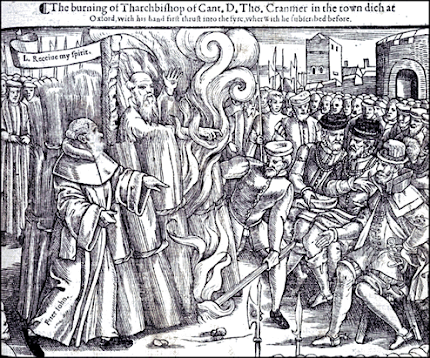
The burning of Tharchbishop of Cant. D. Tho. Cranmer in the town dich at Oxford, with his hand first thrust into the fyre, wherwith he subscribed before. [Click on the picture to see Cranmer's last words.]

Daily Bible Verse

Showing posts with label ecumenicalism. Show all posts

Wednesday, February 05, 2025

Should Women Be Ordained to Ministry? Part 1


“The Protestant Reformation, for all its opposition to Romanism, never questioned the practice of ordaining men only.  Now, if this practice has continued from the time of Abraham down to 1960 or thereabouts, those who are innovators surely must bear the burden of proof.  The Westminster Confession indeed says, ‘All Synods . . may err, and many have erred.’  Therefore, it is theoretically possible that the Reformed Presbyterian Church is in error.  But when the agreement is worldwide over 4,000 years, it is, I repeat, extremely improbable.” 

Dr. Gordon H. Clark, “The Ordination of Women.”  PCA History.org.


Should Women Be Ordained to Ministry?  Deacons or Otherwise?  Part 1


The infallible and inerrant Word of God should be the basis for dogmatic doctrine and for the praxis or practice of the visible churches.  Although there is wiggle room for the form of church polity to be adopted by different denominations, is the same true in regards to the ordination of women?  What was God’s original plan in creation?  What do we observe in the Old Testament?  And how is that played out in the New Testament.  These questions are related not only to covenant theology, but also to the doctrine of the federal headship of Adam and the federal headship of our Lord and Savior, Jesus Christ.

This series of blog posts will examine the controversy and address the issue from a biblical and confession stand point.  The doctrine of Sola Scriptura, being the primary and first doctrine of the Westminster Confession of Faith, will be the guiding principle throughout.

The old debate between complementarian views and egalitarian views of women in the church and in the nuclear family rages on.  However, the Bible should be the guiding authority on all matters of faith and practice.  Either the Bible is the written and God-breathed word of God or it is just a book of advice or inspired stories.  The Christian worldview is that the Holy Scriptures are special revelation directly from God in written form.  Although it has a host of human writers or authors, every single word written in the Bible is the same word that God breathed out.  In short, God is the ultimate Author of the Bible.  (2 Timothy 3:16; 1 Peter 1:19-21; John 10:35; Isaiah 8:20; Proverbs 30:5 Psalm 12:6).

I left the Pentecostal/Charismatic movement around 1995 or 1996 because of the outright heresies which are rampant in the movement.  Even the more conservative Pentecostals have heterodox doctrines.  Moreover, the classical Pentecostal movement has been overshadowed and taken over by the third and fourth wave Charismatic movement because the measure of success of a movement is how fast the church grows.  Unfortunately, part of every Pentecostal/Charismatic doctrinal emphasis has been the ordination of women to the offices of pastor/teacher, evangelist and even apostle.  The five-fold ministry, according to Pentecostals is apostles, prophets, evangelists, pastors, and  teachers: 

And he gave some, apostles; and some, prophets; and some, evangelists; and some, pastors and teachers; (Eph. 4:11 KJV)

This is really not much different from Anabaptist emphasis on ongoing spiritual revelations to individuals.  I am now a cessationist.  However, during my time at Southeastern College of the Assemblies of God, Lakeland, Florida, (name changed to Southeastern University), I had a class in American history.  The professor at that time was David Alexander.  During one of his lectures, Alexander suggested that Pentecostalism had more in common with the Anabaptist movement than with the Wesleyan holiness movement.  This was an eye-opener for me because I was familiar with the special leadings of Anabaptists, especially Anne Hutchinson of colonial times.  Hutchinson claimed to have direct revelations from God.  Her downfall was trying to exercise authority over men in the church, and when she was called before a council at the Massachusetts Bay Colony she was condemned and exiled in 1637.  The council was led by governor John Winthrop and Rev. Cotton Mather, both Puritans.  In 1643, after homesteading at what is now New York City, Anne Hutchinson along with fifteen others was murdered by warriors of the Siwanoy tribe of Native Americans.

The other reason that Pentecostals tended to ordain women was the fact that John Wesley’s influence in the American colonies led to the ordination of women early on in the Methodist Episcopal Church and the later 19th century Wesleyan holiness movement.  Wesley himself licensed or authorized several women ministers in the 17th century, including Sarah Crosby.  (See:  Ordination of Women in Methodism).  Of course, this carried over into the Pentecostal movement of the 19th century.

Unfortunately, this is now carrying over into the Presbyterian denominations which claim to be conservative and Evangelical.  I am not surprised that liberal mainline or nominal Presbyterian denominations have crossed over into the ordination of women.  The Presbyterian Church USA left behind their doctrinal commitments long ago, and the Westminster Standards are just a distant memory for them.  However, it is surprising that what begins as a minor compromise often leads to a downgrade that leads to other compromises.  The initial compromise is most often the ordination of deaconesses to a non-official position rather than to an official church office.  The Reformed Episcopal Church did this some years ago, although it is not actually a Calvinist denomination or presbyterian in polity. 

The Associate Reformed Presbyterian Church officially ordains women as deacons on equal par with male deacons who are ordained as deacons according to the prescription of qualifications in 1 Timothy 3:8-13.  Verse 12 clearly says that the deacon is to be the husband of one wife, the same qualification given for the office of a teaching elder.  (1 Timothy 3:12; 1 Timothy 3:2).  There is a convoluted argument from obscure passages of Scripture used by moderates and liberals in the ARPC to justify this blatant disregard of at least two references upholding male leadership in church offices.

In my next post I will examine a few passages of the Old Testament to show how God viewed the roles of males and females in the family and the congregation of Israel, although this can be complicated.  There are influences from the Ancient Near Eastern semitic cultures of that time period as well as what happens under the Mosaic covenant. 

You can read part 2 of this series here:  Part 2Part 3.


Friday, February 23, 2018

A Scripturalist Critique of Billy Graham’s Theological Ecumenicalism


“However, it is to be feared that not all Presbyterians are both intelligent and honest. There are those who regard the Westminster Confession as a meaningless form to which lip service is paid at ordination. In the Presbyterian Church in the U. S. A. on several occasions candidates for the ministry, when examined by Presbytery, have doubted or denied the Virgin Birth, the Resurrection, the existence of Satan and hell—not to mention effectual calling and the perseverance of the saints—and yet the Presbytery voted to ordain them, and they professed in words their adherence to the Confession they had just contradicted.”  -- Dr. Gordon H. Clark.


Enter ye in at the strait gate: for wide is the gate, and broad is the way, that leadeth to destruction, and many there be which go in thereat: (Matt. 7:13 KJV)


A Scripturalist Critique of Billy Graham’s Theological Ecumenicalism

With the recent passing of evangelist Billy Graham, November 7, 1918 – February 21, 2018, it is appropriate to reflect on his impact and legacy in the United States and around the world.  Although Graham is credited with bringing prestige to Evangelicalism after the modernist controversy of the early 1920s and 1930s, his theological legacy is a mixed one when examined critically and from a Protestant perspective.


There are those who are better gifted at writing historiographical and biographical reconstructions of the past than I.  Doug Douma has written an excellent account of the life of the late Calvinist and Presbyterian apologist and theologian, Dr. Gordon H. Clark.  His book is called, The Presbyterian Philosopher: The Authorized Biography of Gordon H. Clark . Wipf & Stock, an Imprint of Wipf and Stock Publishers. Kindle Edition.  Although this blog post is about Billy Graham’s life and legacy, my own commitment to systematic theology and the presuppositional apologetics of Dr. Gordon H. Clark mandates that I tie Dr. Clark’s thinking on evangelism to his personal connection to Billy Graham.  Billy Graham, often called by the title of Dr. Billy Graham, never earned an academic doctoral degree in theology but apparently was awarded an honorary doctorate by Bellmont Abbey College in 1967.  It is ironic that Graham received his honorary doctorate in theology from a Roman Catholic college.  (See:  Wikipedia:  Awards and Honors).


Ironically, Billy Graham was born to Scottish Presbyterian parents but became a Southern Baptist minister and a traveling evangelist.  After doing one semester at Bob Jones University, Graham transferred to Florida Bible Institute in central Florida and graduated in 1940.  (See:  Theopedia:  Billy Graham).  In 1940 Graham enrolled in Wheaton College and signed up for a philosophy class with Dr. Gordon H. Clark who taught apologetics at Wheaton beginning in 1937.  One contemporary student along with Billy Graham remembers an encounter between Clark and Graham when Clark was teaching a medieval philosophy class and the topic was the philosophy of Augustine of Hippo:


Believing that formal logic was essential for understanding Christian faith, Clark spent much time teaching the subject. Yet some of his students saw his emphasis on logic to be detrimental to their desired “warm” evangelism. In other words, many students were looking for an emotional, not an intellectual, appeal to faith. Samuel D. Faircloth witnessed this struggle between Clark and his students firsthand. Faircloth was a student in Clark’s Medieval Philosophy class alongside a young Billy Graham. According to Faircloth, Graham objected to Clark’s strictly logical and rational approach to Christianity. In an interview in 2010, Faircloth recalled, 


I was trying to catch up historically and every other way with the prof. He knew what he was talking about. He was a top-drawer teacher. Billy (Graham) was back in the background. He stood up one day and he looked Clark right in the eye. I’ll never forget this because I thought he had a lot of nerve. He stood up and pointed his finger at Clark, “Doc, you’re cold.” And Clark looked right back, “I prefer to remain cold.” Clark was a good philosophy professor and Graham was not operating on that level. He was operating on a warm evangelistic level and Clark was talking about Augustine’s City of God.169 


In short, Clark was not Billy Graham, an evangelist of broad popular appeal.170 While students like Graham may have objected to this approach, Clark’s “cold” logic was a corollary principle of his main axiom or first principle: the truth of the Bible. As Clark was fond of pointing out, if one is to think or speak at all, he must abide by the laws of logic.


Douma, Doug J. The Presbyterian Philosopher: The Authorized Biography of Gordon H. Clark.  (p. 44). Wipf & Stock, an Imprint of Wipf and Stock Publishers. Kindle Edition.


Ironically, Graham’s future wife, Ruth Bell Graham, was also raised as a Presbyterian and her parents were Presbyterian missionaries.  One has to wonder why his Calvinist upbringing did not take for Graham.  Needless to say, popular evangelists usually preach simple messages and unfortunately appeal more to emotions and persuasive arguments rather than appealing directly to an expository sermon developed from the Scriptures.  Billy Graham was no exception to this approach.  Many who laud his ministry point out that Graham was in the right place at the right time and was able to exploit the new media of radio and television to promote his evangelistic ministry.  But the first break in his national popularity was when a newspaper mogul, William Randolf Hearst, decided to promote one of Graham’s revivals in a major newspaper he owned:


Evangelist Billy Graham recalls in his new book the pivotal point in his young ministry when, during a 1949 Los Angeles crusade, a two-word directive from publisher William Randolph Hearst to "puff Graham" made him an instant celebrity nationwide.


The sudden front-page coverage showered on Graham by Hearst newspapers in mid-October (after three weeks of little notice) was quickly matched by other newspapers and newsmagazines--literally a media circus descending on his rallies under a big tent.
The elder statesman of evangelical Christianity contends in "Just as I Am" (HarperCollins), however, that he never learned why Hearst took an interest in him. "Hearst and I did not meet, talk by phone, or correspond as long as he lived," Graham wrote.


Graham's autobiography makes no reference to a theory by William Martin in his acclaimed 1991 Graham biography, "A Prophet With Honor," (William Morrow) that noted that all Hearst papers had boosted the nationwide Youth for Christ organization to which Graham belonged. Martin said Hearst also sent a "puff YFC" telegram in 1946. The Hearst-owned Los Angeles Examiner gave Youth for Christ leader Roy McKeown a weekly column to report on the group's activities.


John Dart.  Los Angeles Times.  June 07, 1997.


Over the years Graham has made many controversial statements during his crusades.  Liberals like to point out that Graham once made an anti-Semitic remark when he was in the oval office visiting privately with President Richard Nixon.  But for Calvinist Evangelicals who are faithful to Scripture and the principles of the Protestant Reformation Graham’s more controversial statements are in regards to his rejection of confessional Protestant theology in favor of a broad ecumenicalism that embraced not only Evangelical denominations but also liberal parachurch organizations like the World Council of Churches.  Graham also accepted pre-Reformation communions like the Eastern Orthodox churches and the Roman Catholic Church, both of which reject the doctrine of sola Scriptura and accept church tradition as equal special revelation alongside the Scriptures.  


Also controversial was Graham’s blatant semi-pelagianism.  In his book on predestination Gordon H. Clark names Billy Graham and remarks that the evangelist conducting a crusade with thousands in attendance said that God could not help those who were gathered at the altar:


What troubles certain Christians is the idea that God causes evil events. Some Christians even want to withdraw some good events from God’s power. When Dr. Billy Graham preached in Indianapolis, I went to hear him. Toward the end of the service he asked people to come forward and a crowd came. With them before him evangelist Graham addressed the large audience still in their seats and delivered a five or ten-minute diatribe against Presbyterianism. Don’t pray for these people who have come forward, he said. You may have prayed for them before, and that is good. You can pray for them later on, and that will be good too. But right now prayer is useless, for not even God can help them. They must accept Christ of their own free will, all by themselves, and God has no power over the will of man. Of course, this is full-fledged Arminianism. But most Christians are more perturbed about God’s causing evil events.


Gordon H. Clark. Predestination (Kindle Locations 792-798). The Trinity Foundation. Kindle Edition.


Popular Evangelicalism today is basically anti-intellectual.  Billy Graham did the Gospel no good when he decided to downplay doctrinal truth and replace it with a generic ecumenicalism.  In a Hungarian introduction to J. Gresham Machen’s book, Christianity and Liberalism, Rev. Imre Szoke quotes Dr. Clark:


Let us now examine two factors which promote the spread of liberalism:


We would name as the first factor, indifference towards systematic theology (dogmatics). The Presbyterian theologian, Gordon H. Clark, writes concerning this phenomenon as follows: “Theology, once acclaimed ‘the Queen of the Sciences,’ today hardly rises to the rank of a scullery maid; it is often held in contempt, regarded with suspicion, or just ignored.”14 Earnest Christians are saying: “No one is interested in doctrine. Doctrines only divide, there is no need for confessions, only Christ.” Of course, for us there is mystery surrounding the question of who this Christ is, what he is like and what he teaches. Unfortunately, there are those who would like to separate the person of Christ from his teachings. Christianity without doctrine, however, is not Christianity at all. Perhaps today’s Christians are marked most of all by spiritual infancy and lack of knowledge. That is why it is easy to mislead them, and so frequently they fall into the trap of following persuasive leaders. It is also because of this that they are not fit for the task of filtering out false teaching, or recognizing gradual theological diversion and liberalism. Ultimately, this is why they are incapable of bringing about reformation. They simply do not see the significance of these things.


Secondly, the passive attitude and wait-and-see policy of small evangelical groups within the liberal churches almost promotes the progress of liberalism. This is also betrayed by the inactivity of a quiet pietism and subjective Christianity. Thus liberalism is permitted to spread practically unchallenged in any way. This phenomenon, as we shall see, was most conspicuous in the case of American Presbyterianism.


Rev. Szoke’s critique of modern Evangelicalism is on the mark and most Evangelicals today do not know what they believe or why they believe it.  Additionally, biblical illiteracy among professing Christians is at an appallingly all time high.  Some Evangelicals today are calling President Donald J. Trump a born again Christian but the man has almost no knowledge of the Scriptures and says that his pastor growing up was Norman Vincent Peale, a liberal Presbyterian from the PCUSA who advocated positive thinking and founded the Guideposts magazine.  Billy Graham also repudiated doctrinal confessions of faith and instead affirmed a broad ecumenicalism that downplayed denominational commitments and biblical exposition.  Although Graham apparently disagreed with gay marriage and other blatantly anti-biblical teachings, he unwittingly invited liberal churches to his meetings and these same liberal churches were promoting the “social justice” issue of homosexuality.


As Graham's prestige and influence grew, particularly among "mainline" (non-evangelical) Christians, he drew criticism from fundamentalists who felt his cooperation with churches affiliated with the National and World Council of Churches signaled a compromise with the corrupting forces of modernism. Bob Jones accused him of peddling a "discount type of religion" and "sacrificing the cause of evangelism on the altar of temporary convenience." The enduring break with hard-line fundamentalism came in 1957, when, after accepting an invitation from the Protestant Council of New York to hold a crusade in Madison Square Garden, Graham announced, "I intend to go anywhere, sponsored by anybody, to preach the gospel of Christ, if there are no strings attached to my message. ... The one badge of Christian discipleship is not orthodoxy but love. Christians are not limited to any church. The only question is: are you committed to Christ?"


The problem with Billy’s remarks here is that he seems to be naïve about what these liberal mainline churches were preaching from their pulpits.  Perhaps Graham thought he could single handedly turn the liberal churches back to Christ as he is defined by Scripture.  But even in the remarks above Graham never mentioned the Scriptures as the final authority.  A liberal mainline church could say they believed in Jesus Christ and had a relationship with him due to their existential neo-orthodoxy made popular in America by the Niebhur brothers, Richard and Reinhard, and Karl Barth and Emil Brunner.  Is Christianity really about a “personal relationship” with Jesus Christ?  Or is it more than that?  No Protestant would deny that Christians need to pray to God, repent of their sins, and love God and their neighbor as they love themselves.  But how do we know what to believe and why?  The answer is the Bible.  Without the Bible there is no Christianity at all.  That’s because everything we know about God comes from the Holy Scriptures.  The Scriptures are a propositional revelation from God in logical and grammatical form.  Since all knowledge is propositional in nature, God has revealed himself to us in plain written language so that we can know what we must believe to be saved and how we are to live by faith after we are converted.  There are certain doctrines that are necessary to believe in order to be saved, which even Billy Graham must have known or else he would not ask for conversion.  Yet Graham’s message is devoid of any call to believe the Bible’s plain language.  Instead he asked for people to believe in Jesus Christ.  The problem should be obvious.  Do you believe in a Jesus Christ of your own imagination or do you believe in the Jesus Christ who is defined by the Holy Scriptures?   (See: 2 Corinthians 11:3-4).  Which Gospel are Christians to believe?  (See:  Galatians 1:6-9).


Graham also rejected creeds and confessions of faith, probably due to his Southern Baptist commitments.  But ironically the Southern Baptist Convention was once a Calvinist denomination as indicated by the history of the denomination promoted by the Founders.org website.  However, since Scripture is fully inspired by God in every jot and tittle, every word, and every propositional sentence, it logically follows that the Bible can be systematically organized into extended creeds and confessions in written form which summarize for us what the Bible teaches through the scope of the whole book.  Gordon H. Clark’s opening essay in his book, What Do Presbyterians Believe? is a devastating critique of creedless and confessionless Christianity:


Today many church leaders consider creeds as obstacles to ecumenical union. It would please such men to hand over the discussions of creedal differences to those impractical fuddy-duddies, the theologians, while they themselves made the important organizational arrangements by which the right people would get the prominent positions. 


Besides these ecumaniacs there are other more humble people who sincerely believe that the adoption of a creed is an act of ecclesiastical presumption. Therefore several denominations have no creed. Then there are others who regard creeds, not as necessarily presumptuous, but as unnecessary. This would be the attitude of those who, though their zeal is unquestioned, find creeds intellectually heavy. 


An evangelist I heard a year ago seems to be an instance of both these latter types. In his appeal to the unsaved he said that first they must repent, then they must have faith in Christ, and finally they must be born again. Since his denomination has no creed, no rule of his church forbids him to preach in this way. But had he been a Presbyterian, he would have been sailing under false colors, for I take it that no intelligent and honest Presbyterian would preach that faith and repentance precede regeneration. 


However, it is to be feared that not all Presbyterians are both intelligent and honest. There are those who regard the Westminster Confession as a meaningless form to which lip service is paid at ordination. In the Presbyterian Church in the U. S. A. on several occasions candidates for the ministry, when examined by Presbytery, have doubted or denied the Virgin Birth, the Resurrection, the existence of Satan and hell—not to mention effectual calling and the perseverance of the saints—and yet the Presbytery voted to ordain them, and they professed in words their adherence to the Confession they had just contradicted.[1]


Clark, Gordon H. Articles on the Westminster Confession of Faith (Kindle Locations 111-127). Kindle Edition.  [Note:  This is an abbreviated essay in the Kindle Edition.  For the extended essay consult What Do Presbyterians Believe? pp. 1-8.]


Clark further points out that the purpose of creeds and confessions of faith in written form is for church unity, not divisions.  The way we know the difference between a Mormon, a Jehovah’s Witness, Seventh Day Adventist and biblical Christianity is doctrine.  Without biblical exegesis and a systematic understanding of what the Scriptures teach there is no Christianity.  Biblical inerrancy and plenary verbal inspiration are non-negotiable as well.  And as Clark pointed out during the Auburn Affirmation controversy of the Presbyterian Church USA, the fundamentals of the faith are non-negotiable doctrines of Christianity as well.  


Unfortunately Billy Graham’s anti-intellectualism made him open to being deceived by liberal theology and even was persuaded by Robert Schuller to accept the wideness in God’s mercy doctrine that said that unevangelized people in other religions around the world could have an implicit faith in Christ.  I think this also ties into the Vatican II theology that though the Roman Catholic Church views itself as the only true church on earth there can be other ways to God besides just the Roman Catholic Church, including Judaism, Islam, Buddhism, and other non-Christian religions.  The most controversial statements Graham made on public television were made on a broadcast of Schuller’s Hour of Power:


Schuller:               Tell me, what do you think is the future of Christianity?


Graham:              Well, Christianity and being a true believer--you know, I think there's the Body of Christ. This comes from all the Christian groups around the world, outside the Christian groups. I think everybody that loves Christ, or knows Christ, whether they're conscious of it or not, they're members of the Body of Christ. And I don't think that we're going to see a great sweeping revival, that will turn the whole world to Christ at any time. I think James answered that, the Apostle James in the first council in Jerusalem, when he said that God's purpose for this age is to call out a people for His name. And that's what God is doing today, He's calling people out of the world for His name, whether they come from the Muslim world, or the Buddhist world, or the Christian world or the non-believing world, they are members of the Body of Christ because they've been called by God. They may not even know the name of Jesus but they know in their hearts that they need something that they don't have, and they turn to the only light that they have, and I think that they are saved, and that they're going to be with us in heaven.


Schuller:               What, what I hear you saying that it's possible for Jesus Christ to come into human hearts and soul and life, even if they've been born in darkness and have never had exposure to the Bible. Is that a correct interpretation of what you're saying?


Graham:              Yes, it is, because I believe that. I've met people in various parts of the world in tribal situations, that they have never seen a Bible or heard about a Bible, and never heard of Jesus, but they've believed in their hearts that there was a God, and they've tried to live a life that was quite apart from the surrounding community in which they lived.


Schuller:               [R. S. trips over his tongue for a moment, his face beaming, then says] I'm so thrilled to hear you say this. There's a wideness in God's mercy.


Graham:              There is. There definitely is.


You can read the full transcript of the conversation here:  Wideness in God’s Mercy.  The video is posted on YouTube here:  Wideness.  Perhaps Graham is playing the politician and giving an equivocal answer to avoid answering the question directly.  Giving Graham the benefit of the doubt, the official doctrinal statement of the Billy Graham Evangelist Association contradicts what Graham apparently said on the Hour of Power program.  (See:  Can All Religions Lead Us To God?)  But none of this refutes what Graham has openly said in regards to his affirmation of the salvation of Roman Catholics and of members of other false churches.  He was on good terms with Bishop Fulton Sheen, a bishop in the Roman Catholic Church as well.  I leave it up to the reader to draw his own conclusions from the evidence.


Wednesday, August 22, 2012

Mark Thompson Declares War: Avoiding evangelical civil war | Theological Theology


By Charlie J. Ray, M. Div.

I am constantly amazed by the inroads that Van Tilian paradox and irrationalism has made into Evangelical scholarship and seminaries.  This is particularly disturbing when those scholars and institutions make the claim to be Reformed in some way as well.  Although I have to admire the Evangelical commitments of the Sydney Diocese of the Anglican Church in Australia, I also note that Sydney is inconsistently committed to biblical theology and confessional Anglican and Reformed theology.  (Cf. Sydney Embraces Anglo-Catholicism).

In the linked article, Dr. Thompson makes it some sort of obligation that Calvinists and Anglicans accept his dogmatic statement that Christ died for all men in general (Point 2), which is nothing more than the first step in the direction of Arminianism via Amyraldianism:

Recognise that those who disagree with you on this particular theological point are people for whom Christ died. They are inestimably precious in his sight. They must not be regarded or treated as mere theological canon fodder. Even when you are convinced they are seriously in error they must be treated with respect and gentleness. The goal must be to persuade them of the truth not annihilate them as a warning to others.


Can mere persuasion change the heart or mind of the determined unbeliever or heretic?  I think not.  Thompson's own declaration of war against the Calvinist doctrines of particular election and particular atonement demonstrates that well enough.  (John 10:11, 15; Matthew 1:21; Exodus 12:23, 27; Revelation 5:9).

For all practical purposes Amyraldianism acts more like Arminianism than Calvinism since it advocates the view that the reprobate are somehow made "savable" because of a general atonement for those already in hell and for those who will in the future go to hell.  Such a view of the atonement as merely demonstrating God's love rather than being an actual penal/substitutionary atonement for the elect and the elect alone is extremely problematic if we believe in the inerrancy of Scripture.  The very principle of the inerrancy of Scripture means that logically speaking God cannot contradict Himself.  Does God really intend to save those for whom He has already decreed reprobation from all eternity before creation?  I think not!  (Isaiah 14:24; Isaiah 46:9-10; Ephesians 1:4-5, 11; 1 Peter 2:8; Romans 9:11-13, 17, 22).  Does the Bible anywhere say that Christ died to redeem every single individual without exception or perhaps the term "world" is in relation to the elect who are dispersed among every nation, tribe, people, social class, age of development, and gender?  (Revelation 5:9; Mark 13:27).

The problem with Thompson is that he rejects logic as the basis for understanding the Bible:

Recognise from the outset that there is no necessary correlation between the truth taught in Scripture and your own explanation of the truth taught in Scripture. This recognition stems from an acknowledgement of both our own human limitations (we are all historically, culturally and socially located and this shapes how we see things more than we realise) and our own stubborn sinfulness (pride, self-promotion or self-protection, party-spirit and envy are all evils which continue to plague us in various degrees and distort our vision as well).  (See Point 1).

The key word here is "necessary".  Of course no one would assert that there is always necessarily a correlation between the truth taught in Scripture" and our own "explanation of the truth taught in Scripture."  But here is the problem.  Thompson ignores the fact that Reformed churches do not advocate the principle of "solo" Scriptura.  The doctrine of "sola Scriptura" does not reject the secondary authority of creeds or confessions of faith which draw their warrant from Scripture.  (Cf. Article VIII).  Although creeds, confessions, and church councils and synods can and do err, it does not follow that the Reformed confessions and the Anglican Formularies are not the basis for Christian communion and fellowship.  (Cf. Article XX and Article XXI).  Thompson's view is essentially the Anabaptist view that individuals decide individually what Scripture says rather than having a consensus of the systematic and logical teaching of Scripture laid out in systematic form in confessional statements.  The doctrine of the priesthood of believers as prophets, priests, and kings does include the right of private interpretation but only in the context of being convinced of the truth of the Scriptures within a confessional context. (Cf. 2 Timothy 2:15; 1 Peter 2:9; 2 Peter 1:20; 2 Peter 3:15-16; Revelation 5:10).  If not then we have a problem having any sort of communion or fellowship on the basis of dogmatic or systematic theology.

Furthermore, I find it disturbing that Thompson thinks that Scripture is not an objective revelation in the verbal plenary view where the very words and propositions of Scripture encapsulate what God thinks.  If a person cannot read and understand what God says in the Scriptures and find truth there, then there is no revelation from God and no knowledge of God.  In fairness to Thompson he does concede that we ought to interpret Scripture with Scripture:

Our own teaching needs to be subjected to rigorous evaluation on the basis of a natural reading of the biblical text and proper inferences drawn from Scripture.

I am being generous here since biblical theology is often critical of systematic theology when in fact both go hand in hand.  Luther does not concede that he "might be wrong" at the Diet of Worms.  Rather his stance was, "Prove me wrong by the Scriptures!"  Since Scripture is the final authority and not Luther himself, Luther focuses on the text, not popular opinion or any concern about ecumenical fellowship.  If we take Thompson's view Luther was simply a rabble rouser who refused to admit he could be wrong.  Oddly enough, Thompson's point 2 advocating universal atonement is a similar statement that Thompson refuses to admit could be wrong.

Perhaps Thompson thinks that the reprobate and unconverted person is not really under God's wrath?  He says:

They are inestimably precious in his sight. They must not be regarded or treated as mere theological canon fodder. Even when you are convinced they are seriously in error they must be treated with respect and gentleness. (Point 2).

Judging from points 1 and 2 above then we must say that Thompson believes that he might be wrong on the issue of homosexuality. (Cf. John 3:36; Leviticus 18:22; Leviticus 20:13; Revelation 1:27).  It just might be that liberals are right and the Scriptures are wrong or that Scripture is somehow paradoxical or irrational to the point that we cannot really know what God thinks about homosexuality.  Although Thompson himself does not at this point believe he is wrong, his focus on theological relativism and irrationalism is disturbing.  It opens to the door to the possibility that the Sydney Diocese and Moore Theological College could at some point in the future change its mind on the issue of homosexual ministers and bishops.  Say it is not so!  Are there any absolute truths recorded in the Holy Scriptures by Thompson's view?  Or is this just one huge paradox?  It truly is amazing how neo-orthodoxy and irrationalism has infiltrated Evangelicalism.

In point three Thompson seems to be making a legitimate point that we should properly understand the other person's true position.  But his statement is so ambiguous as to make me wonder what he means.  Does understanding the other person's point of view involve empathy and an emotional connection with that person's point of view?  Or is Thompson's point that we should understand rationally and logically the doctrinal and dogmatic position with which we disagree?  If emotions are the basis for understanding with the mind another person's position then we have another concession to irrationalism and relativism.  After all, I can certainly empathize with a trans-sexual or homosexual who has convinced himself or herself of the truth of their rationalizations for their decisions.  But what is the biblical and apodeictic law of God in such matters?  (See Leviticus 18:22; Romans 1:18-32; 1 Corinthians 6:9-11).

Does Thompson regard the Scriptures as an objective revelation from God in the form of a written document the words of which are both fully inspired by God and given in the form of grammatical and propositional truth statements?  (Cf. John 10:35). Or does Thompson view the Scriptures as irrational paradox and subject to human subjectivism?  If the latter, then I can only say that Thompson's view is simply an Evangelical form of neo-orthodoxy along the lines of the followers of Cornelius Van Til and the theology of paradox and analogy.  One has to ask by what criterion Thompson decides what Scripture objectively says?

Even more troubling than the above is Thompson's contention that the doctrine of biblical infallibility and inerrancy is open for discussion with liberals:

Beware the 'h' word. One of my favourite memories of the late Professor Colin Gunton was hearing him under interrogation at a conference in King's College London. The questioner clearly thought the good professor had moved so seriously from Christian orthodoxy that he was now espousing heresy. He replied, 'I might not be a heretic, you know. I might just be wrong!' We can all make mistakes and a willingness to acknowledge that in ourselves and in others can take some of the sting out of a theological confrontation. The problem becomes much more serious when we persist in our mistake in spite of the evidence against it. Nevertheless, we should do all we can to avoid labels and precipitate judgements. For example, too often I have heard all who hold to biblical inerrancy dismissed as rationalists by those who should know better or those who have trouble making sense of inerrancy as Bible-denying liberals. Less labelling and more listening would instantly make our theological discussions more profitable and more godly.  (Point 7).

The implied meaning of point 7 is that we ought not to question those who question inerrancy.  But loosening the lines of orthodoxy helps no one.  Truth will ultimately divide and to try to reconcile truth with error only opens the door to more error until we reach a point where the communion itself is apostate.  Also, I would like to ask along with the late Gordon H. Clark by what criterion Thompson decides where Scripture has erred and where people have erred?

If in the face of this objection such theologians still maintain that many or even a few Scriptural doctrines can be retained out of an erroneous Bible, we have, at least, the right to know how they decide which doctrines they need. We press them for their method of retaining some while rejecting others. Just recently one liberal writer referred contemptuously to this challenge. He said the conservatives win a cheap victory by asking the liberals to state their non-Biblical criterion of acceptance and rejection. Why this challenge is cheap, I do not know. Why it is not a victory, he did not say. If a theologian accepts a doctrine simply because the Bible teaches it, he accepts Biblical infallibility; but if he rejects Biblical infallibility, he cannot accept the doctrine simply because the Bible teaches it. Therefore he must use some other criterion. I do not see anything cheap in asking what this criterion is. In fact, the ideals of scholarship are abandoned – and the ground of faith is disguised – unless this criterion is plainly stated. The Neo-orthodox, however, seem very reluctant to answer the question. They hide their criterion under a bushel. But it is “intellectually impossible” to get along without any replacement at all for the criterion of Scripture. In theology, as in automotive engineering, if you take out the spark plugs, you will have to use some substitute or the car won’t go. 

Gordon H. Clark (2011-07-02T18:48:21+00:00). God's Hammer: The Bible and Its Critics (Gordon H. Clark) (Kindle Locations 1164-1175). The Trinity Foundation. Kindle Edition.

Let it be duly noted that Thompson recognizes that those who adhere to biblical inerrancy and infallibility have been accused of rationalism. (See point 7).  I am reminded here of the charges made in 1940 by Cornelius Van Til and his followers against Dr. Clark's view that Scripture is the very words of God and thoughts of God in written form and not simply an analogy of revelation.  (Cf. The Complaint and The Answer).  The Bible IS God's Word.  Ironically, D. Broughton Knox, the former principal of Moore Theological College, held to the view that the Bible is propositional in character.  (See:  Broughton Knox, The Nature of Revelation).  Of course the late Dr. Broughton Knox was an Amyraldian himself but at least he acknowledged the propositional nature of Scripture as revelation from God.


I cannot help but find it humorous that Dr. Thompson's apparent criterion for truth is not Scripture but ecumenical concerns since he apparently thinks Scripture is ambigious rather than plain and straightforwardly propositional in nature.  (2 Timothy 3:15-17; 2 Peter 1:19-21; 2 Timothy 2:15; John 10:35).  Dr. Thompson in his arrogance thinks that his list of criteria trumps confessional theology and the doctrine of sola Scriptura.  He further denigrates anyone who would dare challenge his views in the blogosphere:

In the end, be more concerned about the glory and honour of God than about your own popularity or reputation. The desire to be liked or respected can lead in both directions. Some have adopted a posture of generosity and inclusion as a way of being accepted by as many people as possible. Others have engaged in a series of theological witch-hunts, gaining a reputation for sniffing out heresy no matter where it is hidden. In both directions the pursuit of reputation or popularity can lead to theological distortion and more importantly displacing God and his saving work in Christ from the centre of the entire enterprise. The extremes of unprincipled generosity and unrelenting precision can both be unhelpful and ungodly. But worst of all is a preoccupation with positioning myself in the academy or the popular Christian imagination (or even just the Christian blogosphere!).   Point 8.

The term "unrelenting" is simply a propaganda device rather than a rational criticism of the views of those who insist on Scripture alone as the final arbitration in any doctrinal dispute.  Either Scripture is the final authority or it is not.  Dr. Thompson seems to think that his criteria trumps that of Scripture.  In essence Dr. Thompson has declared war on the Reformed and Calvinist faith and that declaration should not go unnoticed on the "blogosphere".  I guess that Dr. Thompson's position as professor and an ordained minister allows him to condemn those who have been driven out of the church over doctrinal issues like the five solas, biblical inerrancy, propositional truth, and particular atonement.  And all the while he enjoys his reputation and popularity among the other compromisers of biblical truth and propositional revelation.  So be it!


The peace of God be with those who stand on Scripture alone!

Charlie J. Ray, M. Div.


Click here to read Dr. Thompson's blog entry:   Avoiding evangelical civil war | Theological Theology
To see Dr. Thompson's rejoinder you can either look at the comments below or click here:  Dr. Thompson's Rejoinder.

Wednesday, May 30, 2012

aztexan: Christianity: The Intelligible Axiom

Contrary to the unity commended by Scripture, the World Council, the National Council of Churches, and the Blake-Pike proposals envisage denominational mergers without any significant doctrinal agreement. This is consistent with their anti-intellectualism which leaves them no Gospel.  --Gordon H. Clark


The following excerpt from Gordon H. Clark's Christian Philosophy was posted on AZTexan's blog. I hope he will forgive me for borrowing this without asking. But Evangelical ecumenicalism is as bad as any of the liberal ecumenical movements. In other words, the National Association of Evangelicals has led to all sorts of theological errors.  The National Association of Evangelicals is as full of errors as any "liberal" ecumenical organization.

 Here is the quote from Dr. Clark:

 ... The whole attempt to disparage knowledge and logic, whether the attempt be that of the contemporary liberals or that of the anti-intellectual pietists, is clearly contradictory to Scripture.

The Scripture places a noticeable emphasis on knowledge. In Ephesians 1:17-18 the Apostle prays that "God may give you the spirit of wisdom and revelation in divine knowledge, the eyes of your understanding being enlightened." 1 John 5:20 says, "We know that the Son of God is come and has given us an understanding, that we may know him that is true." The same apostle records the words of our Lord, "This is life eternal, that they might know you, the only true God and Jesus Christ, whom you have sent." 1 Corinthians 15:34 gives a warning against ignorance: "Awake to righteousness and sin not, for some have no knowledge of God."

The Old Testament too commends knowledge. The stated purpose of the Proverbs of Solomon was to give subtlety to the simple and knowledge to young men. The fear of the Lord is the beginning or chief part of knowledge, but fools despise wisdom and instruction. And there are many other exhortations to knowledge.

To refer to a matter of contemporary interest and to illustrate how intellectualism or a respect for knowledge entails practical conclusions that contrast sharply with other types of religion, we may note that the ecumenical unity approved by the New Testament is unity of doctrine and knowledge. There is no great command to establish organizational unions, but we read with some frequence, "I beseech you that you all speak the same thing, and that there be no divisions among you, but that you be perfectly joined together in the same mind and in the same judgment" (1 Corinthians 1:10). Or, again, "Fulfill my joy, that you be likeminded, having the same love, being of one accord, of one mind" (Phillipians 2:2). Contrary to the unity commended by Scripture, the World Council, the National Council of Churches, and the Blake-Pike proposals envisage denominational mergers without any significant doctrinal agreement. This is consistent with their anti-intellectualism which leaves them no Gospel.

In addition to these Neo-orthodox groups, the pietists with their claims to individual guidance and additional revelations, and the saccharine devotional writers who malign dead orthodoxy and cold intellectualism, also exhibit a fundamental misunderstanding of Christianity when they draw their sharp distinction between the head and the heart. The head, for them, represents knowledge and dry theology; the heart is all the exciting emotionalism of hillbilly evangelism. But in Scripture there is no contrast whatever between head and heart. The view is a strictly modern innovation that conflicts with Biblical psychology and reflects a wrong notion of true religion. Depreciation of understanding, knowledge, reason, and logic not only stimulates an evil ecumenism but also leads to serious errors in theology, errors concerning human nature, sin, and therefore errors concerning the way of salvation.

Religion, or to speak clearly, the Christian religion is not an affair of the emotions, at least no more so than politics and economics are, but fundamentally an acceptance of an intelligible message.

The acceptance of this message is offered as a first principle, an axiom or postulate on which a superstructure of knowledge can be erected.... -

Gordon H. Clark From the lecture entitled "The Axiom of Revelation" Christian Philosophy (Works vol. 4). 318f.

Click here to see the original post:  aztexan: Christianity: The Intelligible Axiom

Tuesday, May 29, 2012

Tuininga’s Kingdoms and the Reformed Tradition | The Calvinist International

Brad Littlejohn critiques the two kingdoms theology of Westminster West and East here. Littlejohn is a "Reformed" Anglican who is studying for his Ph.D.

On further examination, however, it would appear that Littlejohn is a closet Federal Visionist and pushes for a Reformed "catholicity".  He also pushes for a "mystical presence" in the Lord's supper, code for Tractarianism.  I wonder how "reformed" his theology really is? 

Click here to read his article: Tuininga’s Kingdoms and the Reformed Tradition | The Calvinist International

Thursday, February 09, 2012

The Two Kingdoms Theology and Ecumenical Contradictions


Jesus answered, "My kingdom is not of this world. If My kingdom were of this world, My servants would fight, so that I should not be delivered to the Jews; but now My kingdom is not from here." (John 18:36 NKJV)


The Two Kingdoms Theology and Ecumenical Contradictions

At the risk of being considered an isolationist, a fundamentalist, and a divisionist I have decided to write this article to discuss what I consider to be self-contradictory in regards to the two kingdoms theology of Michael Horton and others. While these theologians make strong statements about the separation of church and state and the two kingdoms, namely the kingdom of God and the kingdom of the world, these same men continually make ambiguous statements about what the kingdom of God actually is and who belongs to that kingdom.

The real issue comes down to this: who is in and who is out? Mike Horton did an entire campaign a couple of years ago about Christless Christianity and said that much of Evangelicalism is essentially pelagian due to the influence of Charles Finney. I applauded his efforts. But when Horton came under fire for his views by the wider Evangelical community he backed off that statement and said that Arminians are not really semi-pelagians or pelagian. In fact, Horton has had William Willimon, an Arminian, on the White Horse Inn and he has had David Virtue of VirtueOnline on the program as well. Virtue is an open advocate for Anglo-Catholicism, though he pretends to be an “Evangelical”. If Evangelicalism includes Anglo-Papists, the Eastern Orthodox, and Roman Catholics in addition to the semi-pelagian Arminians, then for all practical purposes the term “Evangelical” is meaningless. The great Anglican Reformed minister, Augustus Toplady called Arminianism, The Road to Rome. If the syncretism of the Pentecostal/Charismatic movement with Christian Science, the prosperity gospel, Word of Faith movement, oneness Pentecostalism, and charismatic Roman Catholicism is part of Evangelicalism, then we are in a world of trouble (2 Corinthians 4:4). Some theologians in the Reformed tradition claim to be non-cessationists. Unfortunately most of them compromise with the errors mentioned above in some way or another. (See Mike Horton: Reformed and Charismatic?).

In light of what I just pointed out above, I am wondering how Horton could appeal to a village green or a big tent if he really believes in the two kingdoms theology? Who actually belongs to the kingdom of God? According to Horton to belong to the village green or the big tent all you need to believe is that the Bible is inspired of God and that it is inerrant and that God is three persons in one divine nature, the statement of faith of the Evangelical Theological Society. (See Doctrinal Basis). Is Horton equating Evangelicalism, the village green, and the big tent with “the kingdom of God”? If so, what is his justification for universalizing what should be particularized by a systematic confessional theology based on a wholistic biblical theology? If all “Evangelical” religion leads to God and Evangelicalism is so heterodox as a whole, then how can it be anything other than a secularizing movement in the church, as Edmund P. Clowney put it in his article, The Politics of the Kingdom?

But this sort of reductionism on the part of Horton and other advocates of the 2k view is troubling. If he thinks that there are two kingdoms, would not the kingdom of God be defined by a systematic confession of what Scripture teaches as a whole? Horton's view of the village green reminds me of the Lambeth Quadrilateral of 1888. That statement was drafted by the Anglo-Catholics and reduced essential doctrine to four main points:

1. The Holy Scriptures, as containing all things necessary to salvation;
2. The Creeds (specifically, the Apostles' and Nicene Creeds), as the sufficient statement of Christian faith;
4. The historic episcopate, locally adapted.


Obviously the Protestant Reformers, being committed to the Scriptures as the final authority in all matters of faith and practice, would not have reduced the principle for fellowship and communion to the two utilized by Horton and the Evangelical Theological Society. Most Evangelicals reject apostolic succession and any sacerdotal interpretation of the two Gospel sacraments. The Tractarians, however, accept all seven of the papist sacraments whole hog. Evangelical and Reformed Anglicans totally reject the Anglo-Catholic interpretation of the 39 Articles of Religion, the sacraments or any other Papist spin put on the English Reformation.

Even the National Association of Evangelicals has for all practical purposes become just another liberal ecumenical organization and is dominated by Pentecostals and Charismatics. Practically all the Reformed churches immediately after the separation from Rome formulated detailed confessions of faith, not short, pithy reductions to minimalist requirements. If the Scriptures contain everything a Christian is required to believe, then obviously reducing it all down to “Jesus wept” is unconscionable. (John 11:35).

Some Evangelicals and some Reformed pastors and teachers say that the basis for fellowship should be the ecumenical creeds. But this is simply a reduction of the Lambeth Quadrilateral into a more tolerable form. Although the ecumenical or catholic creeds are essential to saving faith, they are not the only essentials for saving faith. Additionally, a proper understanding of the five solas of the Reformation and the Law/Gospel distinction are absolutely necessary to a proper understanding of soteriology. Calvinism and Arminianism are mutually exclusive of one another and cannot be teaching the same Gospel message since for Arminians man saves himself ultimately by his own efforts to cooperate with God.

It seems to me that the only true basis for fellowship is to adhere to one of the Reformed standards consistently and along with that to affirm the catholic creeds. Everything else leads to either liberalism or to Rome or worse. (Anglican Formularies; Three Forms of Unity; Westminster Standards).


--
Reasonable Christian Blog Glory be to the Father, and to the Son : and to the Holy Ghost; Answer. As it was in the beginning, is now, and ever shall be : world without end. Amen. 1662 Book of Common Prayer

Support Reasonable Christian Ministries with your generous donation.