>

Martyred for the Gospel

Martyred for the Gospel
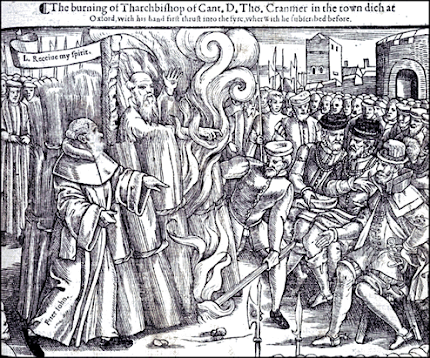
The burning of Tharchbishop of Cant. D. Tho. Cranmer in the town dich at Oxford, with his hand first thrust into the fyre, wherwith he subscribed before. [Click on the picture to see Cranmer's last words.]

Daily Bible Verse

Showing posts with label Two Kingdoms. Show all posts

Wednesday, January 15, 2025

The Free Offer of the Gospel, Common Grace, and Pragmatic Church Growth: Part 3


2. And not for ours only. He added this for the sake of amplifying, in order that the faithful might be assured that the expiation made by Christ, extends to all who by faith embrace the gospel.

Here a question may be raised, how have the sins of the whole world been expiated? I pass by the dotages of the fanatics, who under this pretence extend salvation to all the reprobate, and therefore to Satan himself. Such a monstrous thing deserves no refutation.  John Calvin’s commentary on 1 John 2:2.


The Free Offer of the Gospel, Common Grace, and Pragmatic Church Growth:  Part 3


In this blog post I will now consider how the free offer of the Gospel and the 19th and 20th century doctrine of common grace is related.  In future posts I will then show how the free offer or well meant offer of the Gospel and common grace have influenced the pragmatic approach to church growth and evangelism.

The most controversial downgrade of Calvinistic Reformed theology since the Protestant Reformation happened in 1924 when the Christian Reformed Church decided that God loves the reprobate, that the reprobate can do civic good, and that there is some hope that those who appear to be reprobate can be persuaded to accept the effectual call of the Gospel.  Of course, modern day semi-Calvinists will tell you that this is only an apparent contradiction or paradox.  The controversy at Kalamazoo, Michigan began when certain moderate theologians in the Christian Reformed Church passed the Three Points of Common Grace at the 1924 General Synod and later excommunicated the conservative Dutch Reformed pastors and theologians who dissented from the compromising document.  The deposed ministers then formed the Protestant Reformed Churches in America.  (See:  The Three Points of Common Grace).

Early on in my theological education I learned that accommodation to the surrounding culture leads to compromise, to theological liberalism and even universalism.  Even the classical Pentecostals at the Assemblies of God Bible college where I did my undergraduate studies warned students about the dangers of theological liberalism.  However, today, semi-Calvinist reformed denominations or churches are telling its laity that there is nothing to see here and that they are actually Evangelicals and conservatives.  Just recently, Dr. Neil Stewart, the senior pastor of First Presbyterian Church, which is part of the Associate Reformed Presbyterian denomination, asserted that this is one of the most conservative denominations in America.  Either Dr. Stewart is ignorant of the controversies going on behind the scenes at the presbytery level and at the denominational seminary and college, i.e. Erskine Theological Seminary, and Erskine College, or Dr. Stewart is deliberately misleading the congregants.  (See:  Dissolution of the Catawba Presbytery;  see also, William B. Evans:  A Change in Ecclesial Affiliation).

If the doctrine of common grace is true, why is it that society is waxing worse and worse and not better and better?  The basic premise of the doctrine of common grace is that God loves the entire human race but has a special love for the elect.  Unfortunately, this leaves the semi-Calvinists open to the charge of elitism.  Calvinists are special, do you not know?  The Bible, on the other hand, says that the entire human race is fallen in Adam and under the wrath of God.  (Romans 1:18-21; Romans 5:12-14).  Such love!  The apparent contradiction or paradox here is that God supposedly loves and desires the salvation of the reprobate; but the reprobate have decided to damn themselves and frustrate God’s desire to save them.  Of course, this would imply that God only reprobates them because He foresaw that they would harden their hearts and refuse to be saved.  But is this not Arminianism?  Does God need to look into the future to learn what will happen in order to make His eternal and timeless decree?

Not only is the culture and society at large getting worse, but it seems to me that Evangelical churches, colleges, and seminaries are on a downward spiral as well.  Church splits and new seminaries and colleges are formed as liberalism arises; Yet, in time these same organizations and denominations tend to drift into liberalism themselves.  Even the terms Evangelical and reformed have been redefined in ways that are foreign to their original meaning.  Even Roman Catholics today claim to be “Evangelical” if they happen to trend toward a more conservative interpretation of Romanism. 

If common grace means that the reprobate can do civil and civic good, why is woke ideology, LGBTQIA+, secular humanism, social justice, and Marxism turning the national morality on its head?  What was once generally considered evil is not called good.  (Isaiah 5:20).  Children from kindergarten age are being nurtured by irrational parents and public school teachers into the ideology of transgenderism and homosexuality.  Criminals are now the victims of society rather than lawbreakers who victimize other citizens.  The progressive left is turning homelessness and crime into virtues of victimhood rather than an undermining of the virtues of individual responsibility and hard work.

Modernism was a dismal failure as a means of ushering in the utopian of a brave new world.  World War I put an end to that fantasy.  We live in a fallen world where moral evil causes crime, wars, and totalitarian regimes.  Yet, the so-called progressive “conservatives” who promote the theology of apparent contradiction tell us that common grace means that the world is getting better.  Some of them are postmillennalists and others are amillennialists.  The amillennialists tend toward a radical separation between the kingdom of God ruled in the ecclesiastical realm and the kingdom of secularism ruled by the civil government.  The postmillennialists tend toward a theonomic view where the civil realm is made better and better through the agency of natural law and the moral law of God.  Both views compromise with the culture in order to achieve the goals of their respective theological agendas.

The problem is that there is no common ground between the Christian worldview and the worldview of secularism and secular humanism.  The world views abortion, homosexuality, and surgical trans-sexuality as morally good.  The world views criminals as victims who have no responsibility for their crimes because of systemic racism, systemic homophobia/transphobia, etc., et. al.  However, the Bible condemns all of these things as violations of God’s moral law.  Natural law is supposed to be deduced from the cultures around the world.  But if this so, why so many different views of what is right and wrong in various nations and societies around the world.  C. S. Lewis used the existence of relativistic moralism as an argument for the existence of a moral God.  However, this, too, seems to be a dismal failure.  Why?  The human mind is corrupted by the noetic effects of sin and idolatry seems to replace the biblical God at every turn.

It would seem ironic, then, that the optimism of Kuyperian common grace would so soon replace modernism just after the first world war.  Common grace, like modernism, has failed miserably at making the world a better place to live for the reprobate and for elect and believing Christians alike. 

The pragmatic church growth is the attempt to use Pelagian and Arminian ways of preaching the Gospel in an attempt to persuade the reprobate which, biblically speaking, cannot be persuaded.  Using the corporate business model of selling the unchurched a felt need, these progressive Evangelicals pretend to preserve their conservative theology while in fact selling out to the culture of woke-ism, behaviorism, and Marxism.  They claim that after these persons are persuaded into joining their churches, that the new members will be transformed by the teaching of the church.  By this means, the progressives hope to reform and transform the culture at large.  The problem is that the teaching remains obscure, equivocal, and ambiguous by hiding behind the theology of paradox.  It fails to transform individuals or society.

Here ends this blog post.  I will explain the historical roots of the church growth movement, Tim Keller’s compromise of the Reformed theology, and how this is producing psychological conversions instead of actual conversions to Calvinist and reformed Christianity in my next post.

You can read my previous posts here:  Part 1, Part 2.

The next post is Part 4.

Monday, September 25, 2023

What Does the Bible Say About the Civil Magistrate?


". . . My thesis is that secularism necessarily implies dictatorship and totalitarian rule.  . . . The result is state control of religion and of all human good, nothing excepted.  . . . "


“The Confession in section i states that it is God who has ordained civil magistrates.  Their authority comes from him;  therefore, they cannot rightfully act as dictators; their just powers are only those which God has assigned them.”  Dr. Gordon H. Clark


What Is Christian Nationalism?  What  Does the Bible Say About the Civil Magistrate?


Once again I must answer the objections of the libertarians and the radical two kingdoms proponents.  Their contention is that the secular governments must be obeyed no matter what, based on what the apostle Paul says in Romans 13:1-10.  But is this what the Bible really says? 

I am not sure what the term Christian nationalism means, since the definition varies depending on whom you ask.  R. Scott Clark of the Heidelblog defines the term this way:

The West is declining rapidly and in response some American Christians have begun arguing for a return to theocracy and even for a theocratic Caesar figure to replace the secular republican form of government established in the Constitution.  (From: Heidelblog: Resources on Christian Nationalism).

The first assumption which R. S. Clark makes is that “some American Christians are arguing for a return to theocracy.”  Unfortunately, Clark does not define the term theocracy as it is applied in modern times.  The term, as I have always understood it, refers to the biblical theocracy which occurred during the time of the judges and the theocracy under the leadership of Moses, Aaron, and later, Joshua.  But, if this is the biblical definition of theocracy, then I am not aware of any Evangelical Christians of any kind today who advocate for that sort of theocracy or any theocracy whatsoever; that would include the theonomists and the reconstructionists. 

I suppose that might imply the issue of civil religion such as what happened when Billy Sunday was an evangelist in the early part of the twentieth century.  Billy Sunday was a supporter of the war effort during WWI and raised money to support that effort.  As a result of Sunday’s support of the temperance movement and the war effort, it became popular among “fundamentalist” churches to display both the American flag and the Christian flag inside the church.  However, whenever I see someone accused of being a fundamentalist during the first half of the twentieth century, I usually see that as Evangelical.  The fundamentalists of yesterday are the Evangelicals of today.  Unfortunately, the neo-Evangelicals have hijacked the term when in fact they disagree with both the oldline fundamentalists and the conservative Evangelicals of today.

The radical two kingdoms point of view is that churches and pastors should never comment on political issues, while they themselves openly comment on political issues every single time they complain about Christian nationalists.  This sort of double standard is par for the course for Democrats.  Therefore, it makes me suspicious that most of these radical two kingdoms theologians and church historians are actually progressive Democrats in their political views.  The time for pretending that churches and pastors have no solid political commitments is over.  That’s because our democratic republic is quickly devolving into political chaos and open anarchy.

There was a time when the Christian worldview was predominate over the leftist and Marxist worldview in the United States and European countries.  Even the Roman Catholic nations were at one time more politically and morally conservative.  However, now even the Roman Catholic nations are becoming more secular and atheistic in their political orientations.  Even worse, the pope and the Roman Catholic Church is now openly promoting the ideology of the LGBTQIA+ agenda by saying that homosexuality and perversion should not be illegal.  Protestants and Evangelicals who are “woke” are promoting the same sort of nonsense.  First of all, there is nothing immoral about outlawing what God’s moral law outlaws.  To make the point even clearer, the pope and a majority of the Catholic bishops in America and Europe claim to be against abortion and the pro-choice ideology but do not wish to make abortion illegal in their nations.  Neo-Evangelicals are in complete agreement with this approach and so are the radical two kingdoms theologians and churches.

The question therefore is who decides what is right and wrong in the political realm?  The radical two kingdoms people have ceded the argument to the secular humanists, who they say get to determine moral laws in the political realm, while the church should stay in the closet and say nothing when genocide and perversion predominates the larger society and culture.  The trouble with that approach is eventually Christianity itself is made illegal.  An example of that is the current issue of sex change operations performed on minors at almost any age.  The public schools are openly propagandizing and proselytizing young people for the so-called transgender movement and homosexuality.  Some conservative political pundits refer to this as grooming children for future members of the LGBTQIA+ movement.  This is because the Marxist left and the progressives have turned the tables on Evangelicals and conservative Christians.  The Christian church has always catechized the youthful members of the congregation, knowing that the younger a person reads, studies and believes the Bible, the more likely that child is to persevere in the Christian faith.  (Proverbs 22:6).

Some who profess to follow the apologetics of the late Dr. Gordon H. Clark affirm a form of political libertarianism which, for all practical purposes, agrees with the apparent moral relativism of the radical two kingdoms proponents.  However, Jesus said that there can be no neutrality in matters of morality.  I take that to mean more than just personal piety but also in ecclesiastical politics and the civil government.  In fact, Jesus was arrested and crucified by both the religious and political authorities of his day.  But Jesus did not say do not get involved.  What He said was:

“And he said to them all, If any man will come after me, let him deny himself, and take up his cross daily, and follow me. For whosoever will save his life shall lose it: but whosoever will lose his life for my sake, the same shall save it. For what is a man advantaged, if he gain the whole world, and lose himself, or be cast away? For whosoever shall be ashamed of me and of my words, of him shall the Son of man be ashamed, when he shall come in his own glory, and in his Father’s, and of the holy angels.” (Luke 9:23–26, KJV)

Does this sound like Jesus wanted Christians to hide from the world and say nothing about morality, the moral law or the Gospel?  I think not.  Of course, we as Christians must show prudence in dealing with employers and employees with whom we work in the secular realm.  But does it mean that Christian churches should take no political positions on moral and ethical issues, that Christian churches should not encourage their members to support political movements which stand for the Bill of Rights and other Constitutionally guaranteed freedoms?  Again, I think they should be involved.  After all, the liberal and progressive churches have no such qualms.  Their moral relativism has become the law of the land.  Evangelical Christians and churches have been attributed with false guilt.  They are called homophobic deplorables, transphobic, white nationalists, white supremacists, racists, and a host of other abusive ad hominems in the name of silencing theological, moral, and political dissent from a biblical perspective and the Christian worldview perspective.

The late Dr. Gordon H. Clark would not have agreed with the political moral relativism of the libertarian variety.  Libertarians have only one moral law:  Do no harm to others.  But this is a vague and vacuous imperative since the proposition does not even appeal to a universal moral standard.  Instead it appeals to an unbiblical standard:

“And the children of Israel departed thence at that time, every man to his tribe and to his family, and they went out from thence every man to his inheritance. In those days there was no king in Israel: every man did that which was right in his own eyes.” (Judges 21:24–25, KJV)

When there is no moral leadership from Evangelical churches in their local cities, counties, and the state or commonwealth in which they reside, there is an aggressive attack on Christianity at large nationally and locally.  Evangelicals need to organize at every level, including nationally.  Otherwise, the United States of America is on the same trajectory as Canada and Europe.  An increasingly tyrannical totalitarianism will continue to push against Christianity until they control even the local churches.  If the fake pandemic is any indication, the progressives have the power to shut down religious freedoms and Evangelicals just go along with it like sheep to the slaughter.  Christian ministers in Canada can be arrested for daring to say that homosexuality is a perversion of the natural order or a sinful rebellion against God. 

I am not advocating the confusion of the law and gospel, nor am I advocating for any so-called Christian nationalism.  What I am advocating for is that Christian churches and pastors stop ignoring their moral duty to stand against immorality, crime and the loss of religious liberties in our nation and our local states and cities.  When Jesus commanded us to evangelize the nations, He was not just advocating the evangelizing of individuals but the evangelizing of entire nations and regions.  The Apostle Paul took this seriously and made at least three missionary journeys.  Was Paul colonizing for the white race?  I do not think so.  Christianity is for all nations, tribes, and peoples.  Every kind and class of human beings is called in the general call of the gospel; rich, poor, kings and paupers and every gender and race are all to be evangelized without compromising the moral law or the gospel whatsoever--that would include evangelizing atheists and homosexuals and transgendered homosexuals.  But Christians should not be duped into buying into the lie that the homosexuals and transgenders are not morally responsible because they are born with a sexual orientation that is essentially biologically and genetically predetermined.  There is no biblical support for imposing a materialistic or behavoristic excuse for immorality upon the Christian churches or Christian individuals.

Dr. Clark repudiated the idea that humans are biological machines, a theory developed by Thomas Hobbes; he also rejected naturalism, behaviorism, and secularism.  The following comment on the Westminster Confession’s chapter on free will is exemplary:

What then does the Confession mean by the natural liberty of the will?  The remainder of the section quoted answers this question as well as two lines can.  Man’s will “is neither forced nor by any absolute necessity of nature determined.”  These words were written to repudiate those philosophies which explain human conduct in terms of physico-chemical law.  Although the Westminster divines did not know twentieth century behaviorism, nor even Spinoza, they very probably knew Thomas Hobbes, and they certainly knew earlier materialistic theories.  That man’s conduct is determined by inanimate forces is what the Confession denies.  Man is not a machine;  his motions cannot be described by mathematical equations as can the motions of the planets.  His hopes, plans, and activities are not controlled by physical conditions.  He is not determined by any absolute necessity of nature.

Dr. Gordon H. Clark.  What Do Presbyterians Believe?  The Westminster Confession Yesterday and Today.  1965.  Second Edition.  (Unicoi:  Trinity Foundation, 2001).  P. 106.

The secularists contend that there are human rights which are independent of any divine moral law or divine imperative.  Instead, they propose a materialistic and a humanistic approach which is supposed to reduce human suffering to the lowest common denominator.  Of course, to accomplish their goals they take a utilitarian approach to attaining their political and moral superiority.  The end justifies the means according to them; and they openly state this when they comment on abortion, euthanasia, homosexuality, sex change mandates, and their contention that they will not allow President Trump to be re-elected—even if the majority of the states’ populations votes for him.  They openly admit that they will use pandemics, their relativizing of the rule of law, and whatever other means, including disinformation and propaganda, to keep our democratic republic from electing a popular president.  According to the secular humanists, evil is merely an existential experience of human suffering, not a violation of divine moral law.  This is why they appeal to climate change, pandemics, lockdowns, open borders, and sexual deviancy to justify their totalitarian tactics.  They also use racial divisions and male and female issues to gain power.

But once again, Dr. Gordon H. Clark’s comments are amazingly applicable even in our contemporary political and moral situation.  Although his remarks are directed particularly at the issue of plenary verbal inspiration and the inerrancy of the Bible, his comments also apply to the political realm:

A second objection to verbal and plenary inspiration can be reproduced by repeating a verse previously quoted. The verse was, “The Scripture which the Holy Ghost by the mouth of David spake.” And the rejection is the great outcry against the theory of mechanical dictation. The liberals regularly accuse orthodox Christians to reducing the prophets to the status of typewriters, or at most, stenographers. This makes them machines and violates their personality. Since it is unthinkable that God would violate anyone’s personality, the doctrine of verbal inspiration must be rejected no matter what the Bible says.

In answer to this objection, I would like to make a minor point and a major point. Actually, it is hard to tell which of these points is major and which is minor. But one is more remote and fundamental, the other is immediate and direct. The more remote and fundamental reply is the denial of the liberal concept of God on which their concept is based. For the liberal, man has certain rights that God cannot violate. Man is in some way independent of God and God is in some way subject to rules of justice that he did not set up. The Bible however presents a sovereign God who out of the same lump of clay create [sic] one man to honor and another to dishonor. No man has the right to complain to God and ask, “why has thou made me thus?”

Obviously, God has created rocks and trees, birds and elephants. And no bird has the right to complain that it is not an elephant. Similarly, God is sovereign in creating men. And if he has created some men to be used as typewriters at times, no one has a right to complain. Hence the first reply to the liberals is to reject their notion of the relation between God and man. God is not man’s valet nor even his cosmic pal and co­pilot. God is the sovereign creator against whom no one has any claim whatever.

Dr. Gordon H. Clark.  “The Inerrancy of the Bible.”  The Gordon H. Clark Foundation.  P. 6.

Whether the libertarians or the radical two kingdoms proponents wish to acknowledge it or not, nations and even the entire global human race, both individually and corporately, are morally accountable to God.  It follows, therefore, that churches and pastors and denominations are morally accountable to God for what they think, say, and do, and for what they omit to do in regards to the moral law.  This is a non-negotiable demand of the moral law, and not even Christians under the covenant of grace are exempt from keeping the moral law, albeit not as a covenant of works.  (See: Westminster Confession of Faith, Chapter 19:5-7).  “V. The moral law doth forever bind all, as well justified persons as others, to the obedience thereof; and that not only in regard of the matter contained in it, but also in respect of the authority of God the Creator who gave it.”  (Ibid.).  The Bible clearly says that we must obey God rather men.  (Acts 5:29).  This means that when secular governments become tyrannical and threaten Christians and Christian pastors with jail time or loss of their employment for exercising their God given right to the freedom of religion, freedom of assembly, and the freedom of speech, they should instead obey what God plainly says the Holy Scriptures.  Jesus did not merely suggest such opposition but in fact commands it.  (John 15:18-25).

Gordon Clark succinctly opposes both libertarian relativism and secular humanism in these remarks:

. . . My thesis is that secularism necessarily implies dictatorship and totalitarian rule.  . . . The result is state control of religion and of all human good, nothing excepted.  . . . 

The Confession in section i states that it is God who has ordained civil magistrates.  Their authority comes from him; therefore, they cannot rightfully act as dictators; their just powers are only those which God has assigned to them.  What those powers are and what they are not is indicated here and there throughout the Bible; . . .

Clark, What Do Presbyterians Believe?, pp. 207-208.


Saturday, December 07, 2013

What's Wrong With the Two Kingdoms Theology?


I have been reading as many of Dr. Gordon H. Clark's books as I could in the last year or two.  The more I read the more I come to the conclusion that the dialectical theology of the late Dr. Cornelius Van Til has become an excuse for promoting contradiction between natural law and God's moral law.  The truth is nations will be judged by God's moral law, and it is the duty of the church to preach not only to the congregation but to the nation and the world at large.  There is no contradiction between natural law and moral law.  The idea that we are to hide in the closet as the church is just unbiblical.  I post the following critique of the Two Kingdoms theology for your consideration:

What Is the "Two Kingdoms Theology" and Does It Matter?


Wednesday, February 06, 2013

Law/Gospel and the Two Kingdoms: Paganism, Democracy, and the Separation of Church and State

By Charlie J. Ray, M. Div.

The independence of the church from state interference was the intended meaning of the principle of separation of church and state in the Bill of Rights and the First Amendment.  But those are political issues which are not clearly outlined in Scripture.  I have to wonder if the two kingdoms theology is not reading modern political views into Scripture which may or may not be scriptural?  This is not to say that I am giving any sort of endorsement to the theology of the theonomists and reconstructionists.  It is only to point out that if theonomists are reading an alien paradigm into Scripture, then so might the two kingdoms view be doing the same thing.  I am certain that Luther would be appalled to learn that his theology of the two kingdoms was being used to endorse homosexuality in the civic realm.

What I am suggesting is that the church is called to preach the moral law--even when that moral law is diametrically opposed to the civil and criminal laws of a pagan nation, even though that nation generally calls itself a "democracy."  Pure capitalism and lassez faire economics can be as atheistic and materialistic as the Hegelian dialectic philosophy which Marx borrowed to support his socialistic and communistic political philosophy.  After all, it is pragmatically feasible for the state to endorse the porn industry since it is a multi-million dollar industry.  It is also economically and politically rewarding to endorse homosexuality, gay marriage and transgenderism--especially since that is quickly becoming the status quo as a result of the relentless propaganda released through the popular media.  The medium is the massage and the message.  The mindless masses do not wish to think more than superficially; so if David Letterman or President Obama says it is God's gift to be be gay, then of course it must be so.

The error of the theonomists and the reconstructionists is rooted in a confusion of civil law with the moral law.  In addition, theonomic theology for all practical purposes confuses justification with obedience.  These issues are problematic for the church.  The mission of the church is not cultural transformation via common grace as Kuyper and Bavinck and the Van Tilians insist.  In fact, common grace is nothing more than an adaptation of an Arminian and semi-pelagian doctrine into the Reformed faith under the dissimulation that this is really nothing more than general providence.  But in fact it is much more than that.  The doctrine of common grace claims to oppose the idea that this "grace" is saving grace in any way, yet the doctrine has been used to justify post-millennial ambitions for ushering in the return of Christ and a future utopia on earth.

Other problems with endorsing common grace as "Reformed" is that this doctrine in essence exalts general revelation to a status of equality with special revelation.  Even worse, common grace eventually gains a status of superiority to special revelation in Holy Scripture.  When this happens the doctrine of theistic evolution ensues.  From that point the mythological character of Genesis 1-11 becomes the established view, which really is nothing more than neo-orthodoxy posing as Reformed theology.  If Genesis 1-11 is "inspired myth" or "story," then what prevents the adoption of the same view of the whole of Scripture?  The creation account need not be a literal creation since God "could" have created the earth and man over long periods of time or ages, lending credibility to modern science as a source for philosophical and religious truth.  Unfortunately, once that door is opened religion, philosophy, theology, and metaphysics disappear into the vague morass of Kantian irrationalism.  Dr. Bruce Waltke might still believe in the historical reality of Adam and Eve as speculative first humans and primogenitors who evolved from apes, but eventually even that myth will be rejected in favor of "scientific" materialism.

The slippery slope continues to the homosexuality issue.  If Scripture is wrong about creation and evolution, then surely it could be wrong when the moral law of God condemns homosexuality, adultery and fornication?  Those are really just outdated moral codes of a pre-modern, theocratic nation, aren't they?  (Leviticus 18:22-29).

I totally agree with the two kingdoms view in that we must never confuse law and gospel.  Further, we must never confuse the gospel with cultural transformation or some post-millennial utopia to be ushered in by man's efforts to transform nations and cultures via common grace.  First of all, the Reformed doctrine is called "general providence" and under the Reformed doctrine there is not necessarily any transformation of any nation or culture.  In fact, in God's sovereign judgment individuals and nations can be hardened as punishment or simply just out of God's mere justice on the basis of the imputed guilt of Adam's original sin (Job 21:30; Proverbs 16:4; Romans 3:23; 5:12-21; 9:11-13, 20-23).  It is clear that in the Old Testament God did indeed judge entire nations (Psalm 110:5-6; Isaiah 45:7; Daniel 4:34-35; Amos 3:6).  God is not just some loving grandfather in heaven.  He is more than the ultimate being of benevolence (John 3:16; 1 John 4:7-8).  God is also holy and will execute His justice on earth and in the final judgment (Isaiah 6:1-5; Zechariah 7:9-14).

If the two kingdoms theology approves of the state's endorsement of evil in the form of abortion rights and gay/transgender rights as basic "human rights", then it has gone beyond the special revelation of the moral law in Scripture and has instead endorsed natural law, which is really nothing more than the self-evident axiom that man invents his own laws by natural reason rather than by special revelation from God as based on the principle of general equity.  Given that relativistic bent to natural law what is illegal in the "democratic" nation today may be the status quo of tomorrow, including homosexuality, pedophilia, and even euthanasia as a means of controlling poverty and human suffering.

In short, the two kingdoms view is correct inasmuch as it states that the role of the church is not political or social transformation of nations and the culture at large.  On the other hand, parachurch organizations are not churches or denominations and technically speaking it is not wrong for Reformed and Evangelical Christians to support political lobbies that speak out prophetically against the moral evils and vices that are currently being endorsed by the pagan state. 

Furthermore, when President Barack Obama had the audacity to say that God "created all men equal" and tied that phrase to the homosexual marriage issue, he was in effect saying that gay marriage is good and is blessed by God.  This is evident by the fact that immediately after he made that statement in his inauguration speech Kelly Clarkson sang, "My Country 'Tis of Thee."  The land of the pilgrims is now in favor of gay marriage?  Ironically, it could be that God did "create" homosexuals but not the way that Obama has envisioned or implied.  It might be that they were created as "vessels of wrath prepared for destruction" (Romans 1:18-32; 9:22).

In a recent Sunday school class at Covenant Presbyterian Church, Lakeland, Florida, one of the Florida Supreme Court justices taught.  Justice Charles T. Canady was appointed by Governor Jeb Bush.  He is politically conservative.  What troubled me, however, was that the oath he swore "before God" when taking office was that he would uphold the law.  He was upset, he said, because someone thought he said he swore to uphold the "Lord."  Of course, he was correct.  The separation of church and state means that the state cannot endorse religion at all.  But why swear on the Bible before God to uphold laws that may be constitutionally acceptable but morally reprehensible by the standards of God's moral law as it is revealed in Holy Scripture?  Can there be an absolute separation between church and state?  Or does such a view eventually lead to a secular state that is essentially nothing more than a materialistic capitalism which is quickly becoming a materialistic and atheistic socialism?  I guess religion is merely the opiate of the people after all?

Mike Horton is completely right in his critique of the pelagianism infesting Evangelicalism at large.  Unfortunately, this pelagianism is quickly infesting the more Evangelical Reformed denominations.  When the Reformed faith becomes secondary to being part of the broad Evangelical movement, then the stage is set for a descent into an anthropocentric deism rather than the emphasis on God's absolute sovereignty over all things.  Even Horton has hinted that he thinks it ought to be the law of the land that gays have the right to marry.  After all, it's none of the church's business what laws the state passes.  Unfortunately, when the nation goes into worse evil and paganism the church accommodates to the culture more, even in Reformed churches.  Rather than risking the "fundamentalist" label, Horton would rather be seen as the tolerant Evangelical Presbyterian who is great friends with heretics like Roger Olson, the Open Theist and hyper-classical-Arminian.

Horton's cohort, R. Scott Clark seems to reject gay marriage in the church in his comments in the article posted as, "Steve Chalke Comes Out For Homosexual Marriage."  To use an old Pentecostal cliche, "Thank-you, Jesus!"  Clark is against gay marriage in the church.  But he conveniently refuses to say that he is against gay marriage as a matter of the law of the land.  The two issues are linked, as anyone can see.  The implications of the nation going in the normalizing and normativizing of homosexuality as a "human right" carries implications for the church in that the state will now try to invade the religious arena and silence the prophetic voice of the preachers in their pulpits and the church as an organization.  Furthermore, Clark seems to have a deistic view of providence since he refuses to link natural disasters with God's judgment against original sin and actual sins:

We’ve also had discussions, however, about the problems associated with interpreting providence, first under the heading of knowing the will of God and also in response to the bridge collapse in the Twin Cities. As I pointed out in those places both as a matter of history and, more fundamentally, as a matter of biblical revelation, we are clearly taught not to try to interpret providence. It is a temptation that we must resist. When God has not revealed himself (either explicitly or by “good and necessary inference” from Scripture) we should be silent. The plain fact is that we don’t know why a tornado struck that steeple just at that moment. It is fascinating, and surely it is sobering, just as a cancer diagnosis is sobering. But think of the difficulties attached to interpreting providence.  (See:  Interpreting Providence).
The fact of the matter is that evil exists in the world because of God's judgment against all humanity on the basis of Adam's rebellion (Genesis 3:1-24; Romans 5:12-21; 8:20-22).  It is no secret that God judges through natural disasters, wars, and diseases (Deuteronomy 28; Isaiah 45:7; Amos 3:6; James 4:1-4).  Anyone reading the Bible from cover to cover can see that these general principles apply to nations, churches, and individuals today.  Although Clark is correct in saying that we cannot make particular assessments of specific disasters as God's judgment against particular sins, we can reasonably say that all natural disasters, calamities, diseases, famines, wars, crime, poverty, etc., et. al., both natural and moral evil, are the result of God's judgment.  To giggle at God's sovereignty over evil as Clark does is nothing short of blasphemous and implies a form of pragmatic deism.

My view in regards to the state's laws that violate the moral law is that these laws are fair game in the pulpit.  That is, if we can preach against the sins of individuals, then the pulpit must be used to condemn the sins of nations as well.  The Bible does indeed address individual sin.  But it also addresses corporate sin as the doctrine of the federal headship of Adam demonstrates well enough.  When a nation chooses to commit genocide, should not pastors condemn that sin as much as any other sin?  Suppose more pastors had condemned the genocide of the Jews as sinful?  Maybe more individual Christians and Christian parachurch organizations could have influenced the USA to intervene earlier?  If sin is both individual and corporate then it follows that the church has the responsibility to call for the repentance of both individuals and corporate bodies, including nations and churches.  Although we cannot convert entire nations, we can and should speak against all sin and call for individuals and nations to accept the gospel message (Matthew 28:19-21).

There is danger for the church in regards to getting involved in political issues, namely that the message becomes confused with social reform and the social gospel.  But there is equal danger in ignoring the responsibility of the church and all Christians to call sin what it is:  utterly sinful.  That applies to our beloved pagan democracy as well.  It ought to be remembered that the loyalty and citizenship of the believing Christian is in heaven, not in the United States of America (Philippians 3:20).  If more so-called "churches" were willing to become prophetic voices against the evil of atheistic state governments, there might be more conversions to Christ.  As long as the church cowers before the state and refuses to preach the truth of God's propositional revelation in Scripture in matters of both the moral law and the gospel of free grace, then pelagianism and atheism will continue to dominate the public sphere and the political realm.  

For the churches to hide behind tolerance and the two kingdoms theology, as a means of avoiding the duty to preach the moral law to everyone everywhere, is to violate God's moral law by omitting what God has commanded the church to do.  "Preach the Word!" (2 Timothy 4:2).  The Word of God includes both law and gospel, as even the proponents of the two kingdoms theology must admit.  Without law there is no conviction and no need for gospel (Romans 3:20; 7:7).

Why is it that the Christian and Reformed churches are no longer the moral conscience of the nation?  Could it be partly because the two kingdoms theology--as right as it is in general principle--has gone too far in the other direction?  Just asking.

Monday, February 13, 2012

Mike Horton: A Response to John Frame’s The Escondido Theology - White Horse Inn Blog

It would seem that Dr. Michael Horton has a similar response to Dr. John Frame that Dr. R. Scott Clark had a few years ago when he was still writing the Heidelblog. Although this sort of a polemical disagreement within the Reformed camp is regrettable, it is also absolutely necessary. John Frame is leading countless people in the Reformed tradition in the direction of Rome, heterodoxy and even outright heresy. Frame's defense of Joel Osteen is reprehensible. Although I disagree with Van Til's theology of Scripture as "analogy", I must say that otherwise I find Horton's no holds barred response refreshing. It's about time someone stood up for the Law/Gospel distinction. Dr. Horton's article appears on the White Horse Inn blog. Here is the lead in:

I’ve been reluctant to respond to Professor Frame’s The Escondido Theology, published recently by Whitefield Media. Since the book focuses its critique on Westminster Seminary California, where I teach, I’d encourage readers to visit the Seminary website for a brief response from our president, W. Robert Godfrey. It would be of no edifying value to anyone to go into the details of John Frame’s departure from WSC. Suffice it to say that there are two sides to every story and if you’ve read The Escondido Theology, you have only heard one side whose details many of us would dispute. None of this matters in any case for the general good of the church and the Great Commission, so I will not raise it here.

There are a lot of criticisms in the book directed at my writing, so I’ll say a brief word about it. Having read the book recently, my reluctance is due primarily to the fact that I don’t know quite where to begin and to respond point by point may not contribute much to the cause.

The bottom line for me is this. Whether intentionally misleading or merely sloppy, this book represents a new low in intra-Reformed polemics. I’m encouraged to hear that various Reformed companies declined to publish the book. It is so replete with caricatures, misrepresentations, and straw opponents that a healthy debate on important issues is aborted at the outset. If I held some of the views John attributes to me, I would be alarmed as well. Old grudges appear to cloud his judgment, even to the point of defending Joel Osteen, for example, against my critique (which, again, he caricatures). I hope readers of John’s book will also consult the books that he attacks rather than take his word for it that they say what he claims.


Click here to read the entire article: A Response to John Frame’s The Escondido Theology - White Horse Inn Blog

Click here to read my critical review of Mike Horton's systematic theology:  Pilgrims on the Way


Thursday, February 09, 2012

The Two Kingdoms Theology and Ecumenical Contradictions


Jesus answered, "My kingdom is not of this world. If My kingdom were of this world, My servants would fight, so that I should not be delivered to the Jews; but now My kingdom is not from here." (John 18:36 NKJV)


The Two Kingdoms Theology and Ecumenical Contradictions

At the risk of being considered an isolationist, a fundamentalist, and a divisionist I have decided to write this article to discuss what I consider to be self-contradictory in regards to the two kingdoms theology of Michael Horton and others. While these theologians make strong statements about the separation of church and state and the two kingdoms, namely the kingdom of God and the kingdom of the world, these same men continually make ambiguous statements about what the kingdom of God actually is and who belongs to that kingdom.

The real issue comes down to this: who is in and who is out? Mike Horton did an entire campaign a couple of years ago about Christless Christianity and said that much of Evangelicalism is essentially pelagian due to the influence of Charles Finney. I applauded his efforts. But when Horton came under fire for his views by the wider Evangelical community he backed off that statement and said that Arminians are not really semi-pelagians or pelagian. In fact, Horton has had William Willimon, an Arminian, on the White Horse Inn and he has had David Virtue of VirtueOnline on the program as well. Virtue is an open advocate for Anglo-Catholicism, though he pretends to be an “Evangelical”. If Evangelicalism includes Anglo-Papists, the Eastern Orthodox, and Roman Catholics in addition to the semi-pelagian Arminians, then for all practical purposes the term “Evangelical” is meaningless. The great Anglican Reformed minister, Augustus Toplady called Arminianism, The Road to Rome. If the syncretism of the Pentecostal/Charismatic movement with Christian Science, the prosperity gospel, Word of Faith movement, oneness Pentecostalism, and charismatic Roman Catholicism is part of Evangelicalism, then we are in a world of trouble (2 Corinthians 4:4). Some theologians in the Reformed tradition claim to be non-cessationists. Unfortunately most of them compromise with the errors mentioned above in some way or another. (See Mike Horton: Reformed and Charismatic?).

In light of what I just pointed out above, I am wondering how Horton could appeal to a village green or a big tent if he really believes in the two kingdoms theology? Who actually belongs to the kingdom of God? According to Horton to belong to the village green or the big tent all you need to believe is that the Bible is inspired of God and that it is inerrant and that God is three persons in one divine nature, the statement of faith of the Evangelical Theological Society. (See Doctrinal Basis). Is Horton equating Evangelicalism, the village green, and the big tent with “the kingdom of God”? If so, what is his justification for universalizing what should be particularized by a systematic confessional theology based on a wholistic biblical theology? If all “Evangelical” religion leads to God and Evangelicalism is so heterodox as a whole, then how can it be anything other than a secularizing movement in the church, as Edmund P. Clowney put it in his article, The Politics of the Kingdom?

But this sort of reductionism on the part of Horton and other advocates of the 2k view is troubling. If he thinks that there are two kingdoms, would not the kingdom of God be defined by a systematic confession of what Scripture teaches as a whole? Horton's view of the village green reminds me of the Lambeth Quadrilateral of 1888. That statement was drafted by the Anglo-Catholics and reduced essential doctrine to four main points:

1. The Holy Scriptures, as containing all things necessary to salvation;
2. The Creeds (specifically, the Apostles' and Nicene Creeds), as the sufficient statement of Christian faith;
4. The historic episcopate, locally adapted.


Obviously the Protestant Reformers, being committed to the Scriptures as the final authority in all matters of faith and practice, would not have reduced the principle for fellowship and communion to the two utilized by Horton and the Evangelical Theological Society. Most Evangelicals reject apostolic succession and any sacerdotal interpretation of the two Gospel sacraments. The Tractarians, however, accept all seven of the papist sacraments whole hog. Evangelical and Reformed Anglicans totally reject the Anglo-Catholic interpretation of the 39 Articles of Religion, the sacraments or any other Papist spin put on the English Reformation.

Even the National Association of Evangelicals has for all practical purposes become just another liberal ecumenical organization and is dominated by Pentecostals and Charismatics. Practically all the Reformed churches immediately after the separation from Rome formulated detailed confessions of faith, not short, pithy reductions to minimalist requirements. If the Scriptures contain everything a Christian is required to believe, then obviously reducing it all down to “Jesus wept” is unconscionable. (John 11:35).

Some Evangelicals and some Reformed pastors and teachers say that the basis for fellowship should be the ecumenical creeds. But this is simply a reduction of the Lambeth Quadrilateral into a more tolerable form. Although the ecumenical or catholic creeds are essential to saving faith, they are not the only essentials for saving faith. Additionally, a proper understanding of the five solas of the Reformation and the Law/Gospel distinction are absolutely necessary to a proper understanding of soteriology. Calvinism and Arminianism are mutually exclusive of one another and cannot be teaching the same Gospel message since for Arminians man saves himself ultimately by his own efforts to cooperate with God.

It seems to me that the only true basis for fellowship is to adhere to one of the Reformed standards consistently and along with that to affirm the catholic creeds. Everything else leads to either liberalism or to Rome or worse. (Anglican Formularies; Three Forms of Unity; Westminster Standards).


--
Reasonable Christian Blog Glory be to the Father, and to the Son : and to the Holy Ghost; Answer. As it was in the beginning, is now, and ever shall be : world without end. Amen. 1662 Book of Common Prayer

Tuesday, February 07, 2012

The Politics of the Kingdom, by Edmund P. Clowney


Darryl G. Hart kindly provided this link to an article published in the Westminster Theological Journal in 1979. It is an article by Edmund P. Clowney which outlines briefly the doctrine of the two kingdoms, namely the kingdom of God and the kingdom of the world. The introduction points to the main concern. What is the church to do about environmental, political and social problems?

“THE PROBLEM THAT IS POSED for us today (in the relation of theology and politics) comes from the fact that theology does not appear to be comprehensive any longer. Starting with theology it becomes difficult to construct any theory of society whatever.”1 The remark with which Laënnec Hurbon introduces his study of the work of Ernst Bloch has immediate appeal. Has not Christian theology limited itself to a private religion of personal devotion? What meaning can such religion have for a world sweeping to destruction in a flood of catastrophic social and environmental problems?

Perhaps that rhetorical question might receive a surprising answer from places where the flood has struck. Personal religion gains new meaning in the Gulag Archipelago.


The read the rest of the article in PDF format, click here: The Politics of the Kingdom


Darryl Hart: Escondido Theology Before Escondido

Darryl Hart has posted an article about John Frame's new book. Here is the lead in:

In his new book, John Frame argues that two-kingdom theologians represent a novel development in the history of Reformed theology. In his introduction, he goes out of his way to explain that Escondido theologians reject Christendom. But this rejection creates a problem for 2k because the theologians of the sixteenth and seventeenth centuries taught that the magistrate had a duty to enforce the entire Decalague [sic]. “The two kingdoms view,” Frame writes, “goes beyond the Reformation theology in important ways. Indeed, except for the law/gospel dichotomy, its distinctive positions are American, not European.” (Frame also acknowledges that the roots of two kingdom theology are in Augustine’s City of God and Luther’s On Civil Authority. Go figure.) In fact, Frame goes out of his way to locate Meredith Kline as the source of these views.


To read the rest of the article click here: Escondido Theology Before Escondido


David Van Drunen Rejoinder


In a response to a negative review of his book, Living in God’s Two Kingdoms: A Biblical Vision for Christianity and Culture, David Van Drunen said:

The first is that though Scripture provides guidance for thinking and acting in all areas of life, for most academic subjects Scripture provides only general guidance. The Bible sets certain parameters for approaching the various disciplines, but it does not give us specific or exhaustive information about, say, chemistry or literature or economics. To delve deeply into these subjects requires investigation of the world around us (natural revelation) and a measure of wisdom and good judgment. I imagine that Dordt College professors would agree with this claim, and implement it in their classrooms all the time. My writing on education is not a screed against Christian education, as Zylstra suggests, but wrestles with the implications of facts like this. It is something that every Christian teacher and scholar must take into account.


If only some of the Anabaptist fanatics who "claim" to be Clarkian could understand this. Gordon H. Clark himself said that the Westminster Confession is the best expression of the Christian faith in systematic form. (Christian Philosophy, p. 122). The Bible is not an exhaustive commentary on music, the arts, science, mathematics or even modern judicial law. It is a textbook on God's revealed will and dogmatic doctrine that is specific to saving faith and other issues. Scripture only indirectly speaks to matters of general revelation or natural revelation and "natural" law. Inferring more than the Bible actually says about formal logic and other philosophical issues falls as much into the category of general or natural revelation as does science. If only Baptists and non-cessationists were more logical they would be confessionally reformed and covenantal.

As much as I agree with Clark's Scripturalism, it seems to me that some Clarkians have forgotten the distinction between special revelation and general revelation. Scripture is indeed a set of propositional truth claims set forth in logical form. However, logic, strictly speaking, is a philosophical concept and therefore falls into the category of natural revelation, as does the many inferences drawn from Scripture by Clarkians in the areas of government, politics, and the sciences. Clark himself debunked the various secular theories of philosophy and said that only presupposing Scripture gives philosophy any credibility whatsoever.

One Baptist who "claims" to be "Clarkian" or Scripturalist recently said that a man can infallibly know all the logical propositions in the Scriptures. That must be a tall order. I cannot even remember all of the commandments, much less all the promises in Scripture--and I sure do not claim to know even a majority of the doctrinal propositions in the Scriptures. I do hope I have a firm grasp on the essential propositions, though. Jesus Christ is both God and man in one person. That much I know Scripture teaches. (John 1:1, 18; 2 John 1:7-11).

Unfortunately, Gordon H. Clark insisted at the end of his life that Jesus was two persons. That sort of irrational reasoning is self-contradictory in my opinion. (1 Timothy 2:5; 1 Timothy 3:16; John 1:1,14,18; Titus 2:13; John 20:28; Matthew 16:16). Not even Clark infallibly knew all the propositions God knows. Nor did Clark know all the propositions of the Scriptures. Obviously Clark thought he erred earlier in his career when he affirmed the Reformed confessional view that Christ is one person and two beings/natures, one being divine and the other being human, perfectly united but not mixed or confused or separated. Some Clarkians love to pretend that the noetic effects of sin do not affect the intellect. But that is not what Clark taught either. What he said was that knowledge itself is objective and one does not need to be a regenerate Christian to understand a particular proposition made by Scripture, such as David was the king of Israel. How that translates to an infallible knowledge of all the propositions of the Scriptures I have no idea.

Article II, Of the Word, or Son of God, which was made very man

The Son, which is the Word of the Father, begotten from everlasting of the Father, the very and eternal God, and of one substance with the Father, took man's nature in the womb of the blessed Virgin, of her substance: so that two whole and perfect natures, that is to say, the Godhead and manhood, were joined together in one person, never to be divided, whereof is one Christ, very God and very man, who truly suffered, was crucified, dead, and buried, to reconcile His Father to us, and to be a sacrifice, not only for original guilt, but also for all actual sins of men.


To read Dr. Van Drunen's rejoinder, click here: Westminster Seminary California


Dr. Robert Godfrey Responds to John Frame's Book: The Escondido Theology

[The following is from the Westminster Theological Seminary, California website.  I trust that you will read John Frame's book along with the writings listed by Dr. Godfrey below.   Charlie.]

Click here to see the original post:  Westminster Seminary California Faculty Response to John Frame

W. Robert Godfrey
All of us on the faculty of Westminster Seminary California are shocked and saddened by John Frame’s book, The Escondido Theology.  Several of us were colleagues with John and several had been his students.  We have appreciated particularly over the years his teaching of the apologetics of Cornelius Van Til, his critique of open theism, and his strong defense of the doctrine of biblical inerrancy.  (The statement of Andrew Sandlin on p. xxxi of this book claiming that John had been a polemicist against inerrancy is surely a mistake.)  We are very troubled, then, to find John so utterly misrepresenting and misstating our views.  We do not wish to engage in a protracted discussion of these things with John, but we do find it necessary to set the record straight.

Perhaps the simplest way to do that is to refer to the thirty-two bullet points with which John has summarized our views at the beginning of the book (pp. xxxvii-xxxix).  He introduces these bullet points by claiming: “Below are some assertions typical of, and widely accepted among, Escondido theologians.  Not all of them make all of these assertions, but all of them regard them with some sympathy” (p,xxxvii).  In response all of us on the WSC faculty wish to state clearly that we reject all of these thirty-two points as a fair or accurate presentation of our views.  We have the most sympathy with the bullet point which says “There is no difference between being biblical and being Reformed” (p. xxxviii). Yet we would state it differently: we are Reformed because we believe that the Bible is most faithfully understood and taught in Reformed Christianity.  In relation to most of John’s bullet points we believe and teach the very opposite of what is attributed to us.  We hope that those interested in our work will read some of the many works written by our faculty and see for themselves the inaccuracy of John’s book.

To see our commitment to applying the Bible in preaching and to a wide range of contemporary issues, we list below a few faculty books which illustrate this commitment:

Dennis Johnson, Him We Proclaim
W. Robert Godfrey, Pleasing God in our Worship
Michael Horton, Law of Perfect Freedom
R. Scott Clark, Recovering the Reformed Confession (with chapters on the application of the second and fourth commandments)
J. V. Fesko, The Fruit of the Spirit Is and The Rule of Love
David VanDrunen, Bioethics and the Christian Life
Audio recordings of the faculty conference on “The Law of God and the Christian” and our most recent conference on "The Unfolding Mystery: Reading and Applying the Bible."

In light of the potential for this book to confuse our friends and the general public, we wish to restate our Doctrinal Commitment (as is stated in our Catalogue), “The Scriptures of the Old and New Testaments, breathed out by the Spirit of God through human authors, are the very Word of God written—the only infallible and inerrant authority for faith and life. The doctrines of the Christian faith, held by orthodox churches throughout the ages, express the central truths concerning the triune God and his works of creation and redemption, particularly as they confess the saving work of Jesus Christ as revealed in Scripture. The Reformed confessions (Westminster Confession and Catechisms, Heidelberg Catechism, Belgic Confession, and the Canons of Dort) are the fullest and most accurate summary of the system of doctrine revealed in Holy Scripture.”

Westminster California has been and remains a confessional school. As a whole our faculty supports and promotes the consensus views of the Reformed community as summarized in the Reformed confessions. These confessions express most precisely our theology.   

If you have questions about this matter, please contact Westminster Seminary California.

--
Reasonable Christian Blog Glory be to the Father, and to the Son : and to the Holy Ghost; Answer. As it was in the beginning, is now, and ever shall be : world without end. Amen. 1662 Book of Common Prayer

Friday, January 21, 2011

Christianity is neither conservative nor socialist | The Daily Caller - Breaking News, Opinion, Research, and Entertainment

The following is from an article by Brian Lee and linked to by by Dr. R. Scott Clark of Westminster Seminary California:

Ironically, our Pilgrim fathers made just this mistake when they came to America. Fleeing their own religious persecution, they set up another. The 1647 Laws and Liberties of Massachusetts identified 15 capital offenses, including idolatry, blasphemy, and atheism, along with a predictable litany of sexual offenses. Now that’s conservative. Unfortunately, it’s also not the foundation of a just and pluralistic society.

Read more: Christianity is neither conservative nor socialist.


It would appear that the Christian church is not to call society to repentance? The error of the argument in this article is that salvation and the Gospel are to be kept individualistic and private. The church is never to call nations to repentance or interfere in the ungodliness being sponsored by the government of the United States? It does not follow that simply because social action and social justice have often led to a this worldly interest and a forsaking of the eternal kingdom of God and the Gospel that therefore the Church should keep to itself and simply preach the Gospel. While it is true that the Church should remain focused on preaching the Gospel, it does not follow that therefore churches and denominations should not call sin sin in the larger secular community or in the political realm. Of course, such holy boldness will get you crucified and maybe even get the government to sanction your church, censor your speech, and even violate your God-given rights to call sin sin. It is politically incorrect to say that homosexuals, abortionists, transexuals, atheists, and Mormons are all going to hell. Yet, that is what the Holy Scriptures clearly imply if we accept the Word of God for what it literally means.

While I am not advocating a return to the theocracy of the early Pilgrim Puritans, I am also not advocating what Brian Lee and Dr. Clark clearly advocate in this radical separation of the two kingdoms. The clear implication is that Christians should speak for themselves only as individuals and churches should not condemn sin in the public arena. But I would say that with Joshua we must choose this day whom we will serve (Joshua 24:14-27). Will we serve the Lord or will we serve the idols of American democracy which promotes licentiousness, greed, sexual freedom, homosexuality, and abortion as innate human rights?

As someone else wisely said, a church which stands for nothing falls for everything. The idea of common grace is obviously at the root of this sinful abdication to worldly values and is in fact an implicit endorsement to relativism and immorality.

I say churches should speak up and preach the Gospel boldly. They should tell the world that it is evil and that it is going to hell in a hand basket. The idea that a Christian could vote for a political party that is "liberal" to the point of pushing a secular state that hates Christianity and all that it stands for is just preposterous!

While I am certainly not saying that the Republican Party or the Tea Party is "Christian", I am saying that the Democratic Party has inculcated a blatantly immoral and anti-Christian party platform. In short, the Democratic Party is an "anti-Christ". To vote for the Democratic Party is spiritual and religious suicide. The purpose of the liberal party is to destroy conservative and orthodox Christianity, to use propaganda to encourage sexual immorality,pornography, abortion, euthanasia, stem cell research, and outright atheism.

As a Reformed and Evangelical Anglican Christian, I can tell you that there is nothing I hate worse than a conservative theonomist or reconstructionist since both those movements are at root pelagian and lead to liberalism. But I equally despise political liberalism since it is nothing short of the same sort of theonomist philosophy--only on the other side of the political and theological spectrum. Both at root are pelagian. It does not follow that the Christian church is not to stand for what is right, as Dr. Clark and Dr. Lee seem to think. We should oppose all evil as individuals and as churches. Together we have a voice. But in that process we should never concede to sign ecumenical theological documents that compromise the Christian and Reformed commitment to Scripture and the eternal Gospel.

The answer is not to compromise by joining with reconstructionists and theonomists. But neither is the answer to so over-emphasize the two kingdoms to the point that the kingdom of God is not advancing against the evil kingdom of Satan on earth. We fight a spiritual battle, no doubt. But part of that spiritual battle is to boldly denounce the evil of individuals and of nations. The United States of America is not a Christian nation and probably never will be. But that does not mean that we should simply acquiesce our conscience and let the devil rule the world here and now. No, we are to fight the spiritual battle by bravely confronting an evil and decadent world and its rulers in high places:

For we do not wrestle against flesh and blood, but against the rulers, against the authorities, against the cosmic powers over this present darkness, against the spiritual forces of evil in the heavenly places. (Ephesians 6:12 ESV)


The seedbed of the church, according to Tertullian, is the blood of the martyrs. Christians all over the world are being persecuted by their own governments. Ironically, the policy being pushed by this radical misinterpretation of the two kingdoms is ushering in the same sort of persecution in the United States. We as Christians are called to be salt and light to the world (Matthew 5:13-20), not endorsers of political correctness, homosexuality as a God-given human right, and other such nonsense.

Woe to those who call evil good and good evil, who put darkness for light and light for darkness, who put bitter for sweet and sweet for bitter! 21 Woe to those who are wise in their own eyes, and shrewd in their own sight! 22 Woe to those who are heroes at drinking wine, and valiant men in mixing strong drink, 23 who acquit the guilty for a bribe, and deprive the innocent of his right! (Isaiah 5:20-23 ESV)


Christianity is neither conservative nor socialist | The Daily Caller - Breaking News, Opinion, Research, and Entertainment

Support Reasonable Christian Ministries with your generous donation.