


Martyred for the Gospel
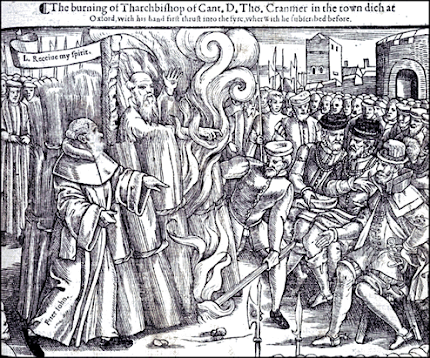
The burning of Tharchbishop of Cant. D. Tho. Cranmer in the town dich at Oxford, with his hand first thrust into the fyre, wherwith he subscribed before. [Click on the picture to see Cranmer's last words.]
Showing posts with label Irrationalism. Show all posts
Showing posts with label Irrationalism. Show all posts
Thursday, March 13, 2014


Sunday, February 16, 2014
Van Til's Modalistic View of the Godhead
"You
openly declare that the immutable will of God is to be known, but you
forbid the knowledge of His immutable prescience. Do you believe that
He foreknows against His will, or that He wills in ignorance? If then,
He foreknows, willing, His will is eternal and immovable, because His
nature is so: and, if He wills, foreknowing, His knowledge is eternal
and immovable, because His nature is so." --Martin Luther's logical response to Erasmus' semi-pelagianism.
Almost everything Scott Clark writes is in adherence to the now dead pope of Van Tilian "Reformed" theology:
Of course, Arminian theology is irrational, just like Van Til. After all, who needs to reconcile God's foreknowledge with God's absolute sovereignty, omnipotence, and omnipresence? How is it that God can be immutable in His Tri-personal nature and yet there could be an irrational ignorance of what He has decreed to come to pass in the future? The Van Tilian mantra is that everyone who disagrees with them is a "rationalist," be it the Arminians or classical Calvinists. Of course, R. Scott Clark cannot decide if Calvinists are rationalists or hyper-Calvinists. Anyone who disagrees with the Westminster Seminary California faculty just has to be either a rationalist or a hyper-Calvinist or both. Even Martin Luther was a "rationalist" by Scott Clark's standards. That's because Luther solved the problem of God's immutability, sovereignty, and foreknowledge:
I guess Luther was prying into the secret mind of God by using logic to deduce from the Scriptures that free will does not exist? The fact of the matter is that Scott Clark's irrationalism has more in common with Arminianism and modern Lutheranism than with the classical Reformed view or with the logic employed by Luther. Without logic and the law of contradiction every epistemology ultimately leads to skepticism. R. Scott Clark's irrationalism is a tacit approval of Arminian irrationalism. Moreover, Martin Luther's denunciation of semi-pelagianism by his use of the law of contradiction and logic is a prime example of why R. Scott Clark is an irrationalist. Anyone who can logically refute Van Til's multiple contradictions and antinomies just has to be a "rationalist."
A prime example of Van Til's irrationalism is when he confuses common language references to God by the singular pronoun "He" with the credal formulations based in Scripture that God is actually a tri-personal being who exists in one nature. One Van Tilian accuses the traditional doctrine of the Trinity of making God's nature "impersonal." Please note the comment made by Camden Bucey at the Reformed Forum:
As you can see, Bucey perpetuates the error of Van Til by asserting that the three persons of the one divine nature/ being of God interpenetrate each other. Nothing could be further from the truth since the three persons of the Godhead are absolutely distinct from the other two persons at each and every point. That is what the Scriptures teach and it is what the Athanasian Creed teaches as well. Each of the three persons are fully God/Divine and therefore share that same essence. God is one is one sense (being) and three in another (persons). The personal subsistences do not interprenetrate each other, yet all three are united as One in one divine nature. God is not impersonal since God is tri-personal. God is not separated into three gods, nor is God one Person and three Persons. That would be tri-theism in the first instance and modalism in the second instance. It is true that in common language we often refer to God as "He." However, in general we are referring to God the Father in that instance. (2 Corinthians 13:14).
Furthermore, Van Til's insistence that "all Scripture is apparently paradoxical" is a tacit admission that Van Til thinks that Scripture does not adhere to logic or the law of contradiction. If God does not reveal Scripture through logic, then Scripture itself is illogical and irrational by the standards of Van Til's theology. Who could say that good is evil and evil is good except by the law of contradiction? (Isaiah 5:20). For Van Tilians, anyone who disagrees with them on the basis of logic is a "rationalist." Thus, they have openly rejected the very foundation of the confessional Reformed theology:
Postscript: I forgot to mention that Dr. Gordon H. Clark's definition of a person is the propositions that he thinks. (Proverbs 23:7). So if God is three persons, then it follows that each person of the Godhead thinks certain propositions in common with the other two persons since all three are fully divine and have all the attributes of deity. But, as the Athanasian Creed points out, the three persons of the Godhead likewise think propositions unique to each person. The Father cannot think that He is the Son or the Spirit, etc.
Almost everything Scott Clark writes is in adherence to the now dead pope of Van Tilian "Reformed" theology:
As Remonstrant theology developed, however, its basic nature became clearer and that basic nature was rationalism. Arminius was a rationalist in at least one sense of the word inasmuch as he denied the fundamental Reformed distinction between the intellect of the Creator and the intellect of the creature. For Arminius (as for some rebellious and rationalist Reformed theologians in the 20th century) if we could not know what God knows, the way he knows it, we cannot ultimately know anything.
Why Did Arminianism Win?
Of course, Arminian theology is irrational, just like Van Til. After all, who needs to reconcile God's foreknowledge with God's absolute sovereignty, omnipotence, and omnipresence? How is it that God can be immutable in His Tri-personal nature and yet there could be an irrational ignorance of what He has decreed to come to pass in the future? The Van Tilian mantra is that everyone who disagrees with them is a "rationalist," be it the Arminians or classical Calvinists. Of course, R. Scott Clark cannot decide if Calvinists are rationalists or hyper-Calvinists. Anyone who disagrees with the Westminster Seminary California faculty just has to be either a rationalist or a hyper-Calvinist or both. Even Martin Luther was a "rationalist" by Scott Clark's standards. That's because Luther solved the problem of God's immutability, sovereignty, and foreknowledge:
THIS, therefore, is also essentially necessary and wholesome for Christians to know: That God foreknows nothing by contingency, but that He foresees, purposes, and does all things according to His immutable, eternal, and infallible will. By this thunderbolt, "Free-will" is thrown prostrate, and utterly dashed to pieces. Those, therefore, who would assert "Free-will," must either deny this thunderbolt, or pretend not to see it, or push it from them. But, however, before I establish this point by any arguments of my own, and by the authority of Scripture, I will first set it forth in your words.
Are you not then the person, friend Erasmus, who just now asserted, that God is by nature just, and by nature most merciful? If this be true, does it not follow that He is immutably just and merciful? That, as His nature is not changed to all eternity, so neither His justice nor His mercy? And what is said concerning His justice and His mercy, must be said also concerning His knowledge, His wisdom, His goodness, His will, and His other Attributes. If therefore these things are asserted religiously, piously, and wholesomely concerning God, as you say yourself, what has come to you, that, contrary to your own self, you now assert, that it is irreligious, curious, and vain, to say, that God foreknows of necessity? You openly declare that the immutable will of God is to be known, but you forbid the knowledge of His immutable prescience. Do you believe that He foreknows against His will, or that He wills in ignorance? If then, He foreknows, willing, His will is eternal and immovable, because His nature is so: and, if He wills, foreknowing, His knowledge is eternal and immovable, because His nature is so.
The Sovereignty of God: The Bondage of the Will
I guess Luther was prying into the secret mind of God by using logic to deduce from the Scriptures that free will does not exist? The fact of the matter is that Scott Clark's irrationalism has more in common with Arminianism and modern Lutheranism than with the classical Reformed view or with the logic employed by Luther. Without logic and the law of contradiction every epistemology ultimately leads to skepticism. R. Scott Clark's irrationalism is a tacit approval of Arminian irrationalism. Moreover, Martin Luther's denunciation of semi-pelagianism by his use of the law of contradiction and logic is a prime example of why R. Scott Clark is an irrationalist. Anyone who can logically refute Van Til's multiple contradictions and antinomies just has to be a "rationalist."
A prime example of Van Til's irrationalism is when he confuses common language references to God by the singular pronoun "He" with the credal formulations based in Scripture that God is actually a tri-personal being who exists in one nature. One Van Tilian accuses the traditional doctrine of the Trinity of making God's nature "impersonal." Please note the comment made by Camden Bucey at the Reformed Forum:
Camden Bucey says:
Charlie, let me reiterate that within the Trinity are distinctions without separation. The Father, Son, and Spirit each indwell the Godhead (and hence eachother) fully. They share one divine essence – or nature as you prefer.
The language of “contain” has spatial connotations, and therefore I think the biblical language of “indwelling” is more appropriate. If you don’t find that helpful, another way to phrase the perichoretic relation is to say that there are full and exhaustive yet distinct manners of subsistence. Yet this indwelling, though exhaustive, does not obliterate the personal distinctions. The Father is unbegotten, the Son begotten, and the Spirit proceeds. These are real distinctions that belong to the persons.
I am not confusing the persons and the nature as you claim. Furthermore, this perichoretic formulation avoids the twin heresies of Sabellianism (modalism) and tritheism, which have also been thrown out there.
Let me ask you a question. Are you comfortable with positing an impersonal essence within the Godhead?
As you can see, Bucey perpetuates the error of Van Til by asserting that the three persons of the one divine nature/ being of God interpenetrate each other. Nothing could be further from the truth since the three persons of the Godhead are absolutely distinct from the other two persons at each and every point. That is what the Scriptures teach and it is what the Athanasian Creed teaches as well. Each of the three persons are fully God/Divine and therefore share that same essence. God is one is one sense (being) and three in another (persons). The personal subsistences do not interprenetrate each other, yet all three are united as One in one divine nature. God is not impersonal since God is tri-personal. God is not separated into three gods, nor is God one Person and three Persons. That would be tri-theism in the first instance and modalism in the second instance. It is true that in common language we often refer to God as "He." However, in general we are referring to God the Father in that instance. (2 Corinthians 13:14).
Furthermore, Van Til's insistence that "all Scripture is apparently paradoxical" is a tacit admission that Van Til thinks that Scripture does not adhere to logic or the law of contradiction. If God does not reveal Scripture through logic, then Scripture itself is illogical and irrational by the standards of Van Til's theology. Who could say that good is evil and evil is good except by the law of contradiction? (Isaiah 5:20). For Van Tilians, anyone who disagrees with them on the basis of logic is a "rationalist." Thus, they have openly rejected the very foundation of the confessional Reformed theology:
The whole counsel of God, concerning all things necessary for His own glory, man's salvation, faith and life, is either expressly set down in Scripture, or by good and necessary consequence may be deduced from Scripture: unto which nothing at any time is to be added, whether by new revelations of the Spirit, or traditions of men. WCF 1:6
Westminster Confession of Faith: Chapter 1, Of the Holy Scriptures, Section 6.
Postscript: I forgot to mention that Dr. Gordon H. Clark's definition of a person is the propositions that he thinks. (Proverbs 23:7). So if God is three persons, then it follows that each person of the Godhead thinks certain propositions in common with the other two persons since all three are fully divine and have all the attributes of deity. But, as the Athanasian Creed points out, the three persons of the Godhead likewise think propositions unique to each person. The Father cannot think that He is the Son or the Spirit, etc.
Wednesday, January 29, 2014
Neo-Calvinist Irrationalism: John Robbins' Quote of the Day
| John Robbins |
This hubris, amazingly enough, is presented to the reader as pious humility. Somehow-the reader is asked to believe-it is humble and meek to say that there are irreconcilable truths in the Bible, that George Marston is the most intelligent creature ever made, that logic must be curbed, and that God cannot express himself coherently. Marston’s claim must be recognized for what it actually is: an attack on revelation; on the unity, in errancy, and perspicuity of Scripture; and on the omnipotence of God. God is so hamstrung by Marston’s “qualitative difference” that he is unable to reveal many truths to man in a coherent, non contradictory way. It is no wonder that Reformed churches are virtually impotent in the twentieth century. Their theology is neo-orthodox. They have no sure word from God. They have two words, one contradicting the other. They speak logical nonsense, and deservedly are ignored by the world. Until this anti-theology is repudiated, the impotence of the Reformed churches will continue. - - John Robbins
Saturday, July 27, 2013
Gordon H. Clark Lectures
I found a website where the lectures of Gordon H. Clark are more easily accessed than the listing over at the Trinity Foundation. The link is here: Sermon Network: Gordon H. Clark: Religious Experientialism and Irrationalism.
Wednesday, July 24, 2013
Saturday, July 13, 2013
Theologia Crucis: Mike Horton's Ontological Mess
"I wish to affirm that a satisfactory theory of revelation must involve a
realistic epistemology. By realism in this connection, I mean a theory
that the human mind possesses some truth – not an analogy of the truth,
not a representation of or correspondence to the truth, not a mere hint
of the truth, not a meaningless verbalism about a new species of truth,
but the truth itself." -- Dr. Gordon H. Clark
It is truly ironic when an irrationalist Lutheran calls Mike Horton's view an ontological mess. But at least this demonstrates my point that Horton is incredibly confused and contradicts himself many times over in his systematic theology, The Christian Faith: A Systematic Theology for Pilgrims on the Way. Dr. Jack Kilcrease is no Lutheran lightweight. Although he is a layman, he is an adjunct professor of theology at the Institute for Lutheran Theology and Aquinas College. The lead in of his article is compelling:
Michael Horton (a Reformed theologian and frequent guest on Issues, etc.) has written a systematic theology a while back that received a lot of attention. I read it about a year ago and had some initial technical problems with it (for one thing, it was one of the worst edited books I've ever read. The first footnotes in one chapter read "Ibid."). Through my research into the history of Western and Eastern Christian theology, I've come to appreciate how Horton's basic way of construing human knowledge of God is a complete mess. What he attempts to do is combine Western scholastic approach to the knowledge of God with an Eastern distinction between "essence" and "energies." These are completely contradictory approaches to ontology and the knowledge of God. Below, I will flesh out some of my criticisms.
-- Jack Kilcrease, theologia crucis: Michael Horton's Theological-Ontological Mess
I happen to concur completely with this thesis. Eastern Orthodoxy is blatantly pelagian through and through, yet Horton tries to reconcile the contradiction by way of Van Til's theology of paradox. Ironic, is it not? It should not be surprising to those who follow the theology of Gordon H. Clark to find Van Tilians who are enamored with the mysticism of Eastern Orthodoxy. Dr. Kilcrease makes an excellent point here in that regard:
Gregory of Nyssa emphasized that one couldn't treat the divine essence like this. It was mysterious and essentially unknowable. In his Life of Moses, Gregory described the Christian life metaphorically as being like the ascension of Moses up Mt. Sinai. One enters farther and farther into the darkness of the mountain of God, without ever reaching a knowledge of the divine being in itself. Of course, this certainly served the polemical situation, but the fact of the matter is that it simply created another problem: how do we know anything about God if he is incomprehensible?
Unfortunately, modern Lutherans have fallen into the same trap as the Van Tilians when they deny that Scripture is a logical and a rational revelation from God and that Scripture is univocally the very words of God. Kilcrease has more in common with Horton than would at first appear:
This has epistemological implications: Since God is these things properly and creatures are these things in a derivative manner by similitude to God, God is conceptually knowable by analogy.
Even more unfortunately, Kilcrease sides with Aquinas rather than Augustine's view that Scripture is a reasonable revelation of God and fully comprehensible. Aquinas begins with reason and tries to prove God's existence, and Aquinas is the originator of the theology of Scripture as analogy rather than the very words of God. So it would appear that the rationalism of Aquinas does lead to irrationalism and skepticism just as the late Dr. Gordon H. Clark contended. Of course, Dr. Clark's own theology, often described as presuppositional Scripturalism, also included a healthy dose of Augustinian realism.
For the late Dr. Gordon H. Clark the idea that reason apart from revelation can lead to faith, or that analogy can explain what Scripture teaches, was anathema. His thesis is that rationalism, represented by Thomas Aquinas, leads to skepticism and irrationalism. And judging from the evolution of philosophy from Immanuel Kant to Kierkegaard and the existentialists, this is not a wrong assessment. Even worse, the neo-orthodox theologians thrived on the theology of paradox which they further developed from Kierkegaard and others. Surely those who side with irrationalism should reconsider the words of the late Gordon H. Clark:
In conclusion, I wish to affirm that a satisfactory theory of revelation must involve a realistic epistemology. By realism in this connection, I mean a theory that the human mind possesses some truth – not an analogy of the truth, not a representation of or correspondence to the truth, not a mere hint of the truth, not a meaningless verbalism about a new species of truth, but the truth itself. God has spoken his Word in words, and these words are adequate symbols of the conceptual content. The conceptual content is literally true, and it is the univocal, identical point of coincidence in the knowledge of God and man.
Gordon Clark (2011-07-02T18:48:21+00:00). God's Hammer: The Bible and Its Critics (Gordon Clark) (Kindle Locations 774-779). The Trinity Foundation. Kindle Edition.
Thursday, May 09, 2013
A Short Movie Review: The Life of Pi

Ang Lee's popular movie, The Life of Pi, is popular for a reason. (See: SparkNotes: Life of Pi). It is yet another promotion of irrationalism as "truth". The perennial question through the ages is the same, "What is truth?" Unfortunately, the answer according to this story is that truth is what you want it to be. After a long struggle with many religions, the protagonist in the story, Piscine Molitor Patel (Pi), tries and becomes a follower of three major religions at the same time, namely Hinduism, Roman Catholicism, and Islam. Of course, the fact that all three religions are mutually exclusive of the other two is no problem for Pi.
At the dinner table one evening during a debate with his older brother, Ravi, about his choice of religions, the father intervenes and argues cogently that rationality matters in religious doctrine: one cannot claim to follow three religions since to believe in all three at once is to believe nothing. Of course, the writer of the original novel intends for the audience to take this critique by Pi's father negatively. The mother, the more irrational and emotional one, argues to let the boy decide for himself since he is still finding his way.
The novel is basically a morality tale espousing the virtues of irrationality, shades of gray, and moral relativism. Postmodernism almost always appeals to the emotions rather than to the rational intellect, No matter that the law of contradiction is violated many times over in the narrative.
For those Van Tilians who love to spout off about how truth is two-fold perhaps this is a great movie. After all, we are only creatures and we are not the Creator. Truth from below is always imperfect and analogical. What is truth? (Cf. John 18:38). Existentialism, irrationalism, and neo-orthodoxy all have in common the idea that religion is an opiate of the people which helps to alleviate the sufferings of this life. Religious dogma, however, is not the truth itself but merely an analogy or allegory of the truth. Scripture for the Van Tilian is true but truth becomes something that is in the end undefinable and ambiguous. If truth is merely "inspired myth" as the Van Tilians contend, then the end result is a deterioration of the distinction between different religions:
Since Pi marries The Writer’s preference for the Tiger story with the line, “and so it goes with God,” it’s hard to separate the question entirely from theology. Evidenced by his multi-religion background, Pi does not believe that any of the world’s religions are a one-stop shop for the truth of God – and his goal is not to convert anyone to a specific dogma. Instead, his story is set up to help viewers/readers consider which version of the world they prefer – the one where we make our own way and suffer through the darkness via self-determination, or the one where we are aided by something greater than ourselves (regardless of which version of “God” we may accept). (SparkNotes, page 2).
Of course, Gordon H. Clark contended that the word "religion" is for all practical purposes beyond definition; the reason being that several religions in the world do not believe in a God at all. (MP3 Lecture: Is Christianity a Religion? Part 1, Part 2, Part 3). Truth is relative according to the Van Tilians, who in essence agree with the neo-orthodox view that God is totally transcendent and therefore unknowable. Of course, they will vehemently protest that this is not their view. But the implications are there. Truth for them is analogical and not univocal. Hence, even logic is relative to the creature.
According to the movie, truth is a matter of preference. The supposedly wise sage, Pi, at the end of the movie, asks the writer listening to the story to decide which version of the story he prefers? The whole plot of the movie after the point of a shipwreck with a load of zoo animals is a fantastical tale where Pi is on a lifeboat with a zebra, an orangutan, a hyena, and a bengal tiger. Of course, it turns out that at the end this is merely an allegory for what really happened. The zebra represents a Japanese soldier who has a broken leg, the orangutan is Pi's mother who floats to the lifeboat on a load of bananas, and the hyena is a French cook who is a racist.
The real story is less exciting than the inspired myth of a boy who against all odds survives a shipwreck with a bengal tiger. After the cook kills the wounded Japanese sailor to preserve food and water, he then kills Pi's mother during an argument in which she slaps him. A day later, Pi takes a knife and kills the French cook, who out of guilt gives fight to live. Revenge and self-preservation are the point of the story.
The real story is less exciting than the inspired myth of a boy who against all odds survives a shipwreck with a bengal tiger. After the cook kills the wounded Japanese sailor to preserve food and water, he then kills Pi's mother during an argument in which she slaps him. A day later, Pi takes a knife and kills the French cook, who out of guilt gives fight to live. Revenge and self-preservation are the point of the story.
So, given a choice between the two stories--namely the allegory and the truth--the Japanese investigators and the writer listening to the story both "prefer" the allegory rather than the truth. And, according to the protagonist, Pi, this is the essence of religion and God. We must all learn to retell our story of self-preservation in term of inspired myths, allegories, and existential encounters with mystery. This, according to the unnamed narrator, helps us to sooth our consiences and make peace with ourselves.
Ultimately, Pi agrees with the teachings of his father who said that to believe in all religions at once is to believe nothing. The message of the movie is an atheistic one. The comparative religions approach, as the late Dr. Gordon H. Clark so amply showed, is an empty one and is a total failure. What is worse is that the message of the movie is that morality and the moral law of God does not ultimately exist either. Morality is merely a social convention which can be shaped like a wax nose to fit our circumstances. Truth, right and wrong, and existential interpretations of our life metanarrative is ultimately a matter of personal preference.
How different is the view that God is logical and rational. According to Dr. Gordon H. Clark, the architecture of God's mind is logic. Since we are created in the image and likeness of God, we too are rational and logic souls. When we know something that is true then we know what God knows on that single proposition. All knowledge, according to Dr. Clark, is propositional in nature. Anyone watching the movie, The Life of Pi, can see that when a special and logical revelation in Holy Scripture is denied, then the result is skeptism, irrationalism, unbelief, and nihilistic practical atheism.
According to the metanarrative of existential religion, the idea that life is about self determination is all that matters and the religious myth is simply a crutch to help the unbeliever deal with the cold and hard reality of survival in the real world. Ultimately, the Van Tilian version of neo-Calvinism agrees with this view while pretending to disagree. The self-deception and denial is really a half-truth perpetuated through dissimulation. If truth is different for us and for God, then there is only the truth that the creature makes for himself through his or her own existence. Religion is merely a way to overcome the existential angst all humans suffer in one way or another.
The Life of Pi is an object lesson for Christians. As the late Dr. Clark argued, we must either accept the Bible as our axiomatic starting point, or we end up in irrationalism, skepticism and unbelief. The postmodern view of comparative religions as a way to "experience" God is no answer. It is an avoidance of truth. Scripture alone is the Word of God. (2 Timothy 3:15-17; Psalm 119:160; John 17:17). The Word of God cannot be broken and life is more than living by bread alone. Every Word that God speaks gives us sustenance through life's struggles. (John 10:35; Matthew 4:4).
Subscribe to:
Posts (Atom)

 Posts
Posts


