>

Martyred for the Gospel

Martyred for the Gospel
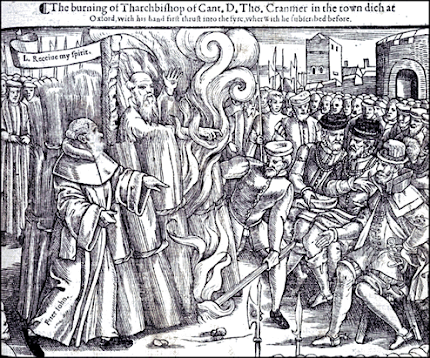
The burning of Tharchbishop of Cant. D. Tho. Cranmer in the town dich at Oxford, with his hand first thrust into the fyre, wherwith he subscribed before. [Click on the picture to see Cranmer's last words.]

Daily Bible Verse

Showing posts with label J. I. Packer. Show all posts

Monday, December 23, 2019

From the Introduction to Packer's and Johnson's Translation of The Bondage of the Will


To become Christian a person must be born again, born into God’s family. We all were “children of wrath, even as others” (Ephesians 2:3), and we had to be reborn as children of God. Obviously this is something a man cannot do. When one is “born of the Spirit” (John 3:6), it is the work of the Spirit. A baby cannot initiate its birth. This is the act of its parents. No baby chooses or decides to be born. This is why the spiritual change from the death of sin to newness of life is pictured as a birth. The picture of resurrection teaches the same lesson. We are raised from the dead, but we do not raise ourselves; it is the act of God. Hence the will of man has nothing to do with this in the least. Arminian dependence on the human will simply makes salvation impossible. Some Arminians may have indeed been saved – by blessed inconsistency. But Arminian preaching, such as that of the evangelist Charles G. Finney, is an unmitigated tragedy. Earlier, as John Wesley sank deeper and deeper into his semi-Romish, anti-Biblical persuasion, George Whitefield wrote a letter of condemnation. It would prove instructive if contemporary Christians, who by and large have never learned the lessons of the Reformation, would read and consider carefully the warnings of the saintly George Whitefield.

Gordon H. Clark. Predestination (Kindle Locations 1334-1343). The Trinity Foundation. Kindle Edition. 


The following quote is from the conclusion of the introduction to J. I. Packer and O. R. Johnston's translation of Martin Luther's treatise, The Bondage of the Will.  However much modern semi-Calvinists try to water down the doctrine of absolute predestination, it is obvious that Luther himself believed that the bondage of the will to sin was in fact God's eternal will.  Luther said that all things happen of necessity, yet modern semi-Calvinists only want to talk about sovereign and eternal decrees of God in terms of unconditional election and neglect the fact that reprobation is also a divine decree that is eternal and irreversible.  Be that as it may, salvation is all of God and all of grace.  

Some of Luther's arguments are hard to follow unless the reader has some background in philosophy, logic, and the doctrinal issues Luther is discussing.  But be aware that Luther, unlike modern Van Tilian Calvinists and irrational Lutherans, did not reject the law of contradiction or systematic and propositional logic in doing theology.  What is interesting is how emphatic Packer and Johnston were at the time of this translation.  Unfortunately, Packer at the least has compromised and now seeks to have ecumenical union with the Roman Catholic Church and he has in reality become a compromiser with high church Anglo-Catholic and semi-Pelagian churchmen in the Anglican Church of North America where Packer is now an ordained minister.  Packer may not be active anymore due to his age.  I am sure he must be in his 90s by now.  The following extended quote was written by Packer and Johnston in conjunction presumably.

V. Conclusion
What is the modern reader to make of THE BONDAGE OF THE WILL?  That it is a brilliant and exhilarating performance, a masterpiece of the controversalist's difficult art, he will no doubt readily admit; but now comes the question, is Luther's case any part of God's truth? and if so, has it a message for Christians to-day?  No doubt the reader will find the way by which Luther leads him to be a strange new road, an approach which in all probability he has never considered, a line of thought which he would normally label 'Calvinistic' and hastily pass by.  This is what Lutheran orthodoxy itself has done (1); and the present-day Evangelical Christian (who has semi-Pelagianism in his blood) will be inclined to do the same.  But both history and Scripture, if allowed to speak, counsel otherwise.
Historically, it is a simple matter of fact that Martin Luther and John Calvin, and, for that matter, Ulrich Zwingli, Martin Bucer, and all the leading Protestant theologians of the first epoch of the Reformation, stood on precisely the same ground here.  [This would include Archbishop Thomas Cranmer, the father of the English Reformation.  Charlie.]  On other points, they had their differences; but in asserting the helplessness of man in sin, and the sovereignty of God in grace, they were entirely at one.  to all of them, these doctrines were the very life-blood of the Christian faith. A modern editor of Luther's great work underscores this fact:  'Whoever puts this book down without having realised that evangelical theology stands or falls with the doctrine of the bondage of the will has read it in vain.' (2)  The doctrine of free justification by faith only, which became the storm-centre of so much controversy during the Reformation period, is often regarded as the heart of the Reformers' theology, but this is hardly accurate.  The truth is that their thinking was really centred upon the contention of Paul, echoed with varying degrees of adequacy by Augustine, and Gottschalk, and Bradwardine, and Wycliffe, that the sinner's entire salvation is by free and sovereign grace only.  The doctrine of justification by faith was important to them because it safeguarded the principle of sovereign grace; but it actually expressed for them only one aspect of this principle, and that not its deepest aspect.  The sovereignty of grace found expression in their thinking at a profounder level still, in the doctrine of monergistic regeneration--the doctrine, that is, that the faith which receives Christ for justification is itself the free gift of a sovereign God, bestowed by spiritual regeneration in the act of effectual calling.  To the Reformers, the crucial question was not simply, whether God justifies believers without works of law.  It was the broader question, whether sinners are wholly helpless in their sin, and whether God is to be thought of as saving them by free, unconditional, invincible grace, not only justifying them for Christ's sake when they come to faith, but also raising them from the death of sin by His quickening Spirit in order to bring them to faith.  Here was the crucial issue;  whether God is the author, not merely of justification, but also of faith; whether, in the last analysis, Chrisitianity is a religion of utter reliance on God for salvation and all things necessary to it, or of self-reliance and self-effort.  'Justification by faith only' is a truth that needs interpretation.  The principle of SOLA FIDE is not rightly understood till it is seen as anchored in the broader principle of SOLA GRATIA.  What is the source and status of faith?  Is it the God-given means whereby the God-given justification is received, or is it a condition of justification which is left to man to fulfil?  Is it a part of God's gift of salvation, or is it man's own contribution to salvation?  Is our salvation wholly of God, or does it ultimately depend on something that we do for ourselves?  Those who say the latter (as Arminians later did) thereby deny man's utter helplessness in sin, and affirm that a form of semi-Pelagianism is true after all.  No wonder, then, that latter Reformed theology condemned Arminianism as being in principle a return to Rome (because in effect it turned faith into a meritorious work) and a betrayal of the Reformation (because it denied the sovereignty of God in saving sinners, which was the deepest religious and theological principle of the Reformers' thought).  Arminianism was, indeed, in Reformed eyes a renunciation of New Testament Christianity in favour of New Testament Judaism; for to rely oneself for faith is no different in principle from relying on oneself for works, and the one is as un-Christian and anti-Christian as the other.  In the light of what Luther says to Erasmus, there is no doubt that he would have endorsed this judgment.
These things need to be pondered by Protestants to-day.  With what right may we call ourselves children of the Reformation?  Much modern Protestantism would neither be owned nor even recognised by the pioneer Reformers.  THE BONDAGE OF THE WILL fairly sets before us what they believed about the salvation of lost mankind.  In the light of it, we are forced to ask whether Protestant Christendom has not tragically sold its birthright between Luther's day and our own.  Has not Protestantism to-day become more Erasmian than Lutheran?  Do we not too often try to minimise and gloss over doctrinal differences for the sake of inter-party peace?  Are we innocent of the doctrinal indifferentism with which Luther charged Erasmus?  Do we still believe that doctrine matters?  Or do we now, with Erasmus, rate a deceptive appearance of unity as of more importance than truth?  Have we not grown used to an Erasmian brand of teaching from our pulpits--a message that rests on the same shallow synergistic conceptions which Luther refuted, picturing God and man approaching each other almost on equal terms, each having his own contribution to make to man's salvation and each depending on the dutiful co-operation of the other for the attainment of that end?--as if God exists for man's convenience, rather than man for God's glory?  Is it not true, conversely, that it is rare to-day to hear the diagnosis of our predicament which Luther--and Scripture--put forward:  that man is hopeless and helpless in sin, fast bound in Satan's slavery, at enmity with God, blind and dead to to the things of the Spirit?  And hence, how rarely do we hear faith spoken of as Scripture depicts it--as it is expressed in the cry of self-commital with which the contrite heart, humbled to see its need and made conscious of its own utter helplessness even to trust, casts itself in the God-given confidence of self-despair upon the mercy of Christ Jesus--'Lord, I believe; help Thou my unbelief!'  Can we deny the essential rightness off Luther's exegesis of the texts?  And if not, dare we ignore the implications of his exegesis?
To accept the principles which Martin Luther vindicates in THE BONDAGE OF THE WILL would certainly involve a mental and spiritual revolution for many Christians at the present time.  It would involve a radically different approach to preaching and the practice of evangelism, and to most other departments of theology and pastoral work as well.  God-centred thinking is out of fashion to-day, and its recovery will involve something of a Copernican revolution in our outlook on many matters.  But ought we to shrink from this?  Do we not stand in urgent need of such teaching as Luther here gives us--teaching which humbles man, strengthens faith, and glorifies God--and is not the contemporary Church weak for the lack of it?  The issue is clear.  We are compelled to ask ourselves:  If the Almighty God if the Bible is to be our God, if the New Testament gospel is to be our message, if Jesus Christ is the same yesterday, to-day and forever--is any other position than Luther's possible?  Are we not in all honesty bound to stand with him in ascribing all might, and majesty, and dominion, and power, and all the glory of our salvation to God alone?  Surely no more important or far-reaching question confronts the church to-day.

Sola fide
Sola gratia
SOLA DEO GLORIA

J. I. Packer and O. R. Johnston, translators.  MARTIN LUTHER ON THE BONDAGE OF THE WILL:  A NEW TRANSLATION OF DE SERVIO ARBITRIO (1525):  MARTIN LUTHER'S REPLY TO ERASMUS OF ROTTERDAM.  (Old Tappan:  Fleming H. Revell, 1957).  Introduction, pp. 57-61.


Sunday, May 11, 2014

The Compromise of Dr. J. I. Packer: ECT


I cannot fully endorse the ministry which produced this sermon.  However, their website appears to be Calvinist.  They also advocate the evangelization and conversion of Roman Catholics.  (See:  CWRC).

Saturday, March 17, 2012

The Glorious Fault of Angels and of Gods: Ungodly Reflections on Alister Chapman's John Stott - Reformation21

Carl Trueman, professor of church history at Westminster Seminary, Philadelphia, shared this insightful comment:
Three things in particular intrigued me with respect to Chapman's Stott. First, I cannot help but wonder about the move of Packer to Regent College in 1979. Coming at the end of a decade of doctrinal disaster for Anglicanism, the move seems more than just the result of a good offer of employment. Packer had fallen out with the non-conformist wing of British evangelicalism through his disagreement with Lloyd-Jones on evangelical union and then his ecumenical alliance with Anglo-Catholics such as E L Mascall. Yet Stott's Anglicanism was scarcely more conducive to Packer: Stott's suspicion of systematic theology, his increasing interest in social activism, his closer links to the Anglican Establishment and his personal ambition all suggest that he would not have been particularly enamoured of Packer's vision for the church. I once heard a leading Anglican evangelical theologian say that Packer went to Canada because there was nowhere in Britain where he could turn. Reading between the lines of Chapman's book, I find such a view quite plausible.
Note carefully the British understatement. Maybe this ousting of Packer is also why he has taken up with the Anglo-Papists? To read more, click here:


The Glorious Fault of Angels and of Gods: Ungodly Reflections on Alister Chapman's John Stott - Reformation21

Tuesday, March 13, 2012

Carl Trueman: The Failure of J. I. Packer

Interestingly enough I am not the only critic of James I. Packer. Carl Trueman politely lays out his critique of Packer. My complaint about Packer is that he claims to be Reformed but runs around in packs of Tractarian wolves. How do I know this? Well the fact that he pushed the Evangelicals and Catholics Together and the Manhattan Declaration agendas is indication enough.


Thursday, March 11, 2010

Sunday, June 14, 2009

James I. Packer's Last Crusade Revisited


This video was taken in Orlando, Florida on February 13, 2009 at the Wycliffe Hall/Reformed Theological Seminary lectures. Dr. James I. Packer is not only a good speaker but he has an excellent sense of humor. I do not always agree with Dr. Packer but without a doubt he has a winsome personality. Dr. Richard Turnbull, the principle of Wycliffe Hall at Oxford University is the gentleman who introduced Dr. Packer.

However history judges him Dr. James I. Packer has most certainly left an indelible mark upon the Evangelical church. May God grant us the grace to live for Christ and Christ alone!

Monday, February 16, 2009

James I. Packer's Last Crusade


[Please note that I no longer endorse the "co-belligerence" position. What does Rome have to do with Jerusalem or Canterbury or Geneva?  Also, David Knox is no longer rector at Christ Church as the liberals in the Central Florida Diocese of the Episcopal Church USA decided that he is too Evangelical for their liking.  Please pray for him and his ministry and his family.  2/12/14.  Packer left the Canadian Anglican Church and joined up with the ACNA or Anglican Church in North America.  Charlie.]


Charlie J. Ray with the Anglican Evangelical, J. I. Packer.
On the left:  David Knox, son of D. Broughton Knox.  David is rector at Christ Church, Longwood, Florida.
[Top photo: Charlie J. Ray with James I. Packer. Next: David Knox with his former professor. Bottom: Video interview with James I. Packer]


I recently heard James Packer lecture at the Wycliffe Hall Winter Conference in Orlando, February 12-14, 2009. Packer's last crusade, according to Packer, is to re-emphasize the catechumenate ministry of the church. It is an admirable and lofty goal to put Christian education back in the center of the Christian church, as difficult as that might be. Dr. Packer even mentioned the catechism of Thomas Becon, which was published by the Parker Society and is a classic example of a Reformed and Protestant and Anglican catechumenate ministry. Sadly, these days Christian education, if it exists at all in the church, is superficial. Moreover, Packer contends that catechetical emphases need to be recovered in the ministry of Anglican churches.


While I greatly admire Dr. Packer, I am disappointed that he signed the Evangelicals and Catholics Together document, which is a compromise of the Gospel with a deficient gospel taught by the Roman Catholic Church. In this discussion, he contrasts primary and secondary issues. However, the Gospel is defined by the five solas of the Protestant Reformation: faith alone, grace alone, Scripture alone, Christ alone, glory to God alone. While the universal creeds define what the three major branches of Christianity believe, the second part of the universal faith has to do with soteriology or how we are saved. In other words, Christianity is based on the tri-unity of God but that is not all there is to Christianity. We must also believe the Evangelical faith in order to be saved. Both Anglo-Catholicism and Roman Catholicism teach idolatry through worshiping the bread and wine in the communion rather than viewing them as symbols and tokens of our faith pointing us to faith in Christ. An absolute essential of the Christian faith is that we worship Christ and Christ alone. Justification by faith alone and the substitutionary atonement of Christ on the cross are essentials of the Gospel, not secondary issues as Packer would have us believe. They are indeed primary issues whereby the church either stands or falls. In other words, the homosexuality issue is not the problem. It is a symptom of a greater problem. Anthropocentric or man-centered theology or doctrine always leads to pelagianism which is the earliest form of theological liberalism.


Pelagianism appeals to man's own abilities and man's own inherent righteousness rather than recognizing that we are miserable sinners until God sovereignly bestows His grace upon us to believe. And even then we are still both sinners and saints until Christ completes the work in us at the hour of our death. Any viable theology of the church must be God-centered and Christ-centered rather than man-centered. Dr. Packer has made wonderful contributions to our understanding of the Puritans and to Reformed theology; however, in my opinion, his desire to be irenic and tolerant has led him to compromise too much with Anglo-Catholics in the Anglican Communion and with Roman Catholics at large. I prefer the position of the Sydney Diocese in Australia as it was expressed by Phillip Jensen who said that we are "co-belligerents" with the conservative Anglo-Catholics on the issue of homosexuality. However, Evangelicals and Anglo-Catholics are worlds apart when we examine what the Gospel actually is. Anglo-Catholics in fact have a "deficient gospel," as Phillip Jensen put it.

 At the conference in Orlando, Dr. Packer upheld the Lambeth quadrilateral of 1886-1888 as an organ of unity within Anglicanism. The historical irony here should not be missed. The Chicago-Lambeth quadrilateral was formulated within a decade of the departure of the Reformed Episcopalians from the Protestant Episcopal Church in 1873. The significance of this departure is that the triumphalistic attitude and theology of the Anglo-Catholics could not tolerate the Evangelical party within the Episcopal church and the straw which broke the camel's back was that David Cummins, the assistant bishop in Kentucky, had open communion and shared pulpits with the Presbyterians. At this point the Anglo-Catholics forced the Reformed Episcopalians out of the Protestant Episcopal Church. Nothing has changed much since then except that Evangelicals are still marginalized and barely tolerated by conservative Anglo-Catholics today.


Thus, I for one think it is misleading to uphold the Lambeth quadrilateral as a point of unity, since the "Anglican quadrilateral" was composed and put forward by Anglo-Catholics seeking to further buttress their position against the Evangelicals. Packer also said that the Thirty-nine Articles are a source of unity in the Anglican Communion. However, I must say that I disagree with him here as well for the simple reason that the Thirty-nine Articles of Religion are Protestant and put forward a Reformed and Protestant view of the Christian faith. Anglo-Catholics, on the other hand, re-interpret the Articles to make the Articles fit with their semi-Roman Catholic theology. This is precisely why the Articles are not a point of unity. They are indeed a point of contention and disunity within the Anglican Communion.


Just as Scripture has only one viable interpretation which we must discover by comparing Scripture with Scripture, so the Thirty-nine Articles of Religion have only one plain meaning and it is not the meaning Anglo-Catholics assign to them.  In other words, tradition is not revelation from God on equal par with Holy Scripture as the Anglo-Catholics teach. Anyone who has read the works of Archbishop Thomas Cranmer can discern the intention Cranmer and the other English Reformers had in mind when they composed the Thirty-nine Articles of Religion and the 1552/1662 editions of the Book of Common Prayer and it certainly was not the Anglo-Catholic view. The short of it is that Packer is smoothing over primary issues which are boiling below the surface and eventually that conflict will come to a pressure point. In the question and answer session after lunch on Friday, February 13, 2009 I was able to ask Dr. Packer the following question and you can judge for yourself from his answer:

Moderator: Charlie, you had a question?
Charlie: Ummm... Well, I'm a little bit on the low church side of things and so I hope you'll forgive me for asking a blunt question. But what is your view of the Thirty-nine Articles as a confession of faith? And as you know the Anglo-Catholic and the low church side disagree sometimes on how to interpret the Thirty-nine Articles and I'm wondering how we can walk in unity and yet disagree on some of the interpretation of the Articles? If you would so kind as to comment?
James Packer: Well, I will comment but I will comment briefly because I've been asked to do that. If was going to give an answer which was—how shall I say it?--safeguarded on both sides I would want to come back to them and say, “Specifics please?” Which Articles have you in mind when you say that? And I would grill you about that. However, the short answer is that on the primary matters during dissension between—I've said this before—what's primary and what's secondary. On the primary matters I maintain that there is consensus. It is only on secondary matters that there is disagreement on the exegesis perhaps of certain stratas of sacramental teaching and if you are agreed on what's primary you can think and let think, to use John Wesley's phrase, on what is secondary. End of our answer. Next question please? 

[Note:  I typed this verbatim from a recording I had at the time.  That recording has been lost due to a computer crash.  However, please take my testimony that this is exactly what was said.]
I suppose Packer thinks the five solas of the Reformation are secondary matters of adiaphora?  If so, then his emphasis on Reformed theology and Puritan theology is just a huge misunderstanding?

May God grant us the grace to stand against wiles of the devil which have infiltrated and corrupted Christ's church to one degree or another. May we ever proclaim the propositional truths of Holy Scripture and stand for the Gospel of Jesus Christ and the doctrines of grace.

Soli Deo Gloria!

Charlie

Support Reasonable Christian Ministries with your generous donation.