>

Martyred for the Gospel

Martyred for the Gospel
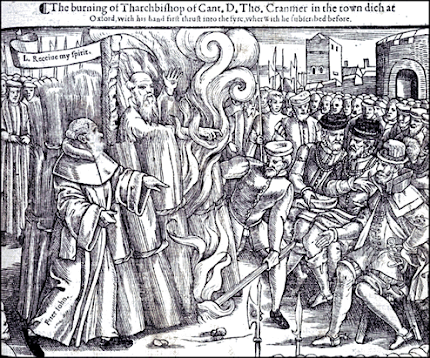
The burning of Tharchbishop of Cant. D. Tho. Cranmer in the town dich at Oxford, with his hand first thrust into the fyre, wherwith he subscribed before. [Click on the picture to see Cranmer's last words.]

Daily Bible Verse

Showing posts with label Law/Gospel. Show all posts

Thursday, May 10, 2012

Is the Megachurch the New Liberalism? Albert Mohler Comments

Albert Mohler rightly points out the doctrinal minimalism of megachurches and the general tendency for Evangelicalism to accomodate itself to the larger culture in order to draw in new members. Serial remarriage is now commonly accepted among Evangelicals due to no fault divorce. Will gay marriage now be accepted by so-called "conservative" Evangelical Christians? It looks that way judging from a recent sermon series by pastor Andy Stanley, the son of Southern Baptist pastor, Dr. Charles Stanley.

God's moral law has no power to save anyone and no one living has any power to obey God's law sufficiently to justify themselves before God.  But is grace a license to sin after conversion?  I doubt that even Martin Luther would have agreed with that view.  Luther did continually emphasize that Christians are no longer under the law or the curse of sin and that those who kept emphasizing law keeping as the basis for salvation were in effect making the sacrifice of Christ void and justifying themselves by their own righteousness.  On the the other hand, the true Christian is justified by Christ and Christ alone.  Luther's emphasis was that correct doctrine comes first and afterwards God will work through grace and the Holy Spirit to help Christians live in accordance with God's law--albeit never for justification or salvation.

Andy Stanley rightly points out that we are still sinners and miserable sinners after conversion.   He fails, however, to distinguish between election and reprobation due to his blatant Arminianism--except for the one point of Calvinism of the perseverance of the saints.  But if Albert Mohler is correct that Andy Stanley is deliberately downplaying homosexuality as a sin while condemning adultery then it is a natural inference to conclude that megachurches are moving toward minimizing homosexuality and fornication as sinful behavior and incompatible with true conversion.   The 39 Articles of Religion expresses the view of Calvin, Luther and Cranmer on this issue:
ALBEIT that good works, which are the fruits of faith and follow after justification, cannot put away our sins and endure the severity of God's judgement, yet are they pleasing and acceptable to God in Christ, and do spring out necessarily of a true and lively faith, insomuch that by them a lively faith may be as evidently known as a tree discerned by the fruit.

Click here to read Dr. Mohler's article:  Is the Megachurch the New Liberalism?

Saturday, March 10, 2012

Reasonable Christian: Charismatics and Pentecostals Jump on Board the New Perspectives Bandwagon: A New Wind of False Doctrine

This is an old post. However, it demonstrates the tendency of sinful men to confuse law with Gospel, justification with sanctification. The Roman Catholic Church teaches that justification is one thing. Justification is both a forensic declaration of "not guilty" and justification is infused into the heart so that the sinner's gas tank is filled up and the sinner is made sinless at the point of baptism. After that point every sin must be confessed to a priest and an appropriate penance assigned. Also, purgatory or punishment is necessary prior to entering heaven. John Piper and others teach that justification by faith is an imputed righteousness. Unfortunately, Piper also undermines assurance because he thinks that our faith must be confirmed at the final judgment. The doctrine of a future vindication is essentially the idea that good works contribute something to our standing before God in the last judgment. The Bible, however, teaches that at the moment of conversion the elect believer is fully justified and therefore fully saved. Everything after that point is a process but the process or the journey is in no way the focus of Christian faith. The cross alone is our objective confidence that God will keep His promises to save His people. (Galatians 6:14; 2 Corinthians 1:20; Romans 4:13, 14)

Click here to read the original article: Reasonable Christian: Charismatics and Pentecostals Jump on Board the New Perspectives Bandwagon: A New Wind of False Doctrine

Thursday, February 09, 2012

The Law Coalition

Darryl Hart speaks out against the Manhattan Declaration: Click here: The Law Coalition


Thursday, February 02, 2012

A Confusion of Sanctification with Justification: Institute for Nouthetic Studies Blog » Blog Archive » On Preaching the Gospel to Yourself

Unfortunately, The Institute for Nouthetics Studies appears to endorse a view of the Gospel that confuses Gospel with Law and that confuses sanctification with justification. Although the article tries to sidestep the issue, the fact that the author of the article thinks "mature" Christians no longer need to look to the cross for their salvation but rather to their own good works shows that he just does not get it. From the beginning to the end of the Christian life we are imperfect in our subjective experience of sanctification. (Philippians 2:12-13; 3:12; 2 Peter 3:18).

I get weary with having to reiterate the Gospel so often on the blog but when obvious errors like these statements by Lou Priolo over at The Institute for Nouthetic Studies blog are made then I feel compelled to respond:


To my way of thinking, the place of the doctrine of justification in the believer’s life is much like the operating system on a computer. I’m a PC guy. My personal computer operates under a Windows operating system. Windows is always up and running, but most of the time, it runs in the background. I don’t see it. I can go for days without looking at it (although I know it is functioning as long as the other programs are operating properly). Occasionally, I have to go to the control panel to troubleshoot a problem, make some minor adjustments, or defrag my hard drive, but I don’t give it another thought because I have faith that it is doing what it is supposed to do. So it is with my justification. It is always up and running.

Well, so far so good. That does not sound so bad, right? The trouble is that Priolo is taking justification for granted. Like most Pharisees he has forgotten that the objective basis for our faith is the cross, the atoning sacrifice of Christ, not our own level of sanctification or goodness.

The trouble is that taking justification for granted and forgetting about it unless and until we fall into a major sin leads to self-righteousness and an attitude of superiority over those who struggle with sins which are more obvious. How can we counsel others if we have become practical Pharisees?

To show that Priolo has this air of superiority it is not necessary to read very far:

But what about the growing number of those who say that we must (or should or ought to) “preach the Gospel to ourselves every day?” If by Gospel they mean the entire ordo-salutis: effectual calling, regeneration, faith, justification, adoption, sanctification,[1] and glorification—the whole enchilada—there is not a problem (other than the fact that the Bible doesn’t exactly command us to do this). But if, like so many seem to be espousing today, they take a reductionist view of the Gospel—reducing it to justification (or to adoption) alone—there is a problem.


So Priolo has a problem with the Gospel! He is basically saying that sanctification is part of the Gospel, which is to confuse the moral law with the Gospel. It is a confusion of sanctification (infused righteousness and subjective in the heart/mind of the believer) with justification (the objective work of Christ in His sinless life and His substitutionary, atoning death on the cross for the elect). Since the Nouthetics site claims to be Reformed in theology I will respond with the view of the Gospel espoused by the Westminster Standards, the Three Forms of Unity, and the Anglican Formularies.

The Westminster Confession defines the Gospel via the distinction between the covenant of works and the covenant of grace:

2. The first covenant made with man was a covenant of works,1 wherein life was promised to Adam, and in him to his posterity,2 upon condition of perfect and personal obedience.3

See also: WLC 20 | WSC 12
--------------------------------------------------------------------------------
1 Gal. 3:12.
2 Rom. 10:5; Rom. 5:12-20.
3 Gen. 2:17; Gal. 3:10.

3. Man, by his fall, having made himself uncapable of life by that covenant, the Lord was pleased to make a second,1 commonly called the Covenant of Grace, whereby He freely offereth unto sinners life and salvation by Jesus Christ, requiring of them faith in Him, that they may be saved;2 and promising to give unto all those that are ordained unto eternal life His Holy Spirit, to make them willing, and able to believe.3

See also: WLC 30 | WSC 20
--------------------------------------------------------------------------------
1 Gal. 3:21; Rom. 8:3; Rom. 3:20,21; Gen. 3:15; Isa. 42:6.
2 Mark 16:15,16; John 3:16; Rom. 10:6,9; Gal. 3:11.
3 Ezek. 36:26,27; John 6:44,45.

4. This covenant of grace is frequently set forth in the Scripture by the name of a Testament, in reference to the death of Jesus Christ the testator, and to the everlasting inheritance, with all things belonging to it, therein bequeathed.
------------------------------------------------------------------------------
1 Heb. 9:15,16,17; Heb. 7:22; Luke 22:20; 1 Cor. 11:25.

Westminster Confession of Faith, Chapter 7

Basically, those who depend on their own works are obligated to keep the law with absolute obedience and to justify themselves by law keeping. That is true of the unconverted and of everyone who names the name of Christ. If works are to justify us, then perfect and absolute obedience is necessary (Matthew 5:17-21, 48; Romans 10:1-6). The trouble is that this is impossible since we have all failed from birth onward. (Romans 3:23; Psalm 51:4-5; Romans 3:10-18).

The ordo salutis or "logical order of salvation" begins with unconditional election, not with sanctification. As Ulrich Zwingli noted, unconditional election shows clearly that salvation is absolutely a gift of God, not something that we "choose" when you boil everything down to the bottom line:

Since Paul wishes to show that God’s election is born of his free purpose, and not from those whom he is about to elect, he says that the free purpose is the cause why all things work for good to those who love God. Nothing is ascribed to man’s merit. For he adds: For whom he foreknew (pronunciavit) he also predestinated to be conformed to the image of his Son, etc. I have translated προέγνω by “pronunciavit,” which word has the same force as if you should say predetermined or foreordained. This is then the apostle’s meaning: I said that all will result in good for those who according to God’s purpose are of the called. This I would have understood thus: God freely with himself settles upon, prejudges and foreordains (for by this word the word for “purposing” is expounded) whom he will, even before they are born. Whom he thus foreordains he marks out beforehand, i. e., destines them to be conformed to the image of his Son. As if he should say: No one can be conformed to Christ unless he has been destined for this. ( On Election, Ulrich Zwingli).
Of course, we are free moral agents and we are fully accountable for our actions and choices. But that does not mean that salvation is ultimately based on us or our choices. No, salvation is predestined from before the foundation of the world and we get no credit for our obedience since even that is a gift of God. (Philippians 2:13; Ephesians 2:8-9).

The Thirty-nine Articles of Religion are the confession of the Anglican Communion--albeit very few actually follow its literal and plain teaching today. The Gospel is stated several times in the Articles:


VII. Of the Old Testament.
THE Old Testament is not contrary to the New; for both in the Old and New Testament everlasting life is offered to mankind by Christ, who is the only Mediator between God and man, being both God and man. Wherefore they are not to be heard which feign that the old fathers did look only for transitory promises. . . . (2 Corthinians 1:20).


XI. Of the Justification of Man.
WE are accounted righteous before God, only for the merit of our Lord and Saviour Jesus Christ by faith, and not for our own works or deservings. Wherefore that we are justified by faith only is a most wholesome doctrine, and very full of comfort; as more largely is expressed in the Homily of Justification.

XII. Of Good Works.
ALBEIT that good works, which are the fruits of faith and follow after justification, cannot put away our sins and endure the severity of God's judgement, yet are they pleasing and acceptable to God in Christ, and do spring out necessarily of a true and lively faith, insomuch that by them a lively faith may be as evidently known as a tree discerned by the fruit.
Obviously, to forget that salvation is a monergistic work of God alone (Soli Gloria Deo!) is to become self-righteous in attitude and in theology (Romans 3:20-22). The Dutch Three Forms of Unity is in agreement with the other two Reformed traditions:
Heidelberg Catechism: Lord's Day 6

Question 18. Who then is that Mediator, who is in one person both very God, and a real righteous man?

Answer: Our Lord Jesus Christ, 5"who of God is made unto us wisdom, and righteousness, and sanctification, and redemption."6

Question 19. Whence knowest thou this?

Answer: From the holy gospel, which God Himself first revealed in Paradise;7 and afterwards published by the patriarchs and prophets,8 and represented by the sacrifices and other ceremonies of the law;9 and lastly, has fulfilled it by His only begotten Son.10
--------------------------------------------------------------------------------
1 Rom. 5:12, 15;
2 1 Pet. 3:18; Isa. 53:11;

3 1 Pet. 3:18 Acts 2:24; Isa. 53:8;

4 1 John 1:2; Jer. 23:6; 2 Tim. 1:10 John 6:51;

5 Matt. 1:23; 1 Tim. 3:16 Luke 2:11;

6 1 Cor. 1:30

7 Gen. 3:15;

8 Gen. 22:17-18; Gen. 28:14; Rom. 1:2; Heb. 1:1; John 5:46;

9 Heb. 10:7-8;

10 Rom. 10:4; Heb. 13:8;
Basically, the Gospel is not about what "we" have done. It is about the finished work of Jesus Christ and what He has done once and for all! (John 19:30; Hebrews 9:24-28).

Click here to read the post by Lou Priolo at: Institute for Nouthetic Studies Blog » Blog Archive » On Preaching the Gospel to Yourself

See also, Jack Miller's excellent response to this issue:

This broad understanding of the gospel is a potential recipe for weakening faith and increasing works-righteousness as one seeks to measure up in thought, word, and deed to "the good news" he is supposed to be exhibiting. It inserts progressive sanctification into the “gospel proper” by considering everything in the Word (promises, laws, threats, admonitions, works) as the good news of the gospel. Certainly we agree it is “good news” that the Spirit is working in us, conforming us to Christ as God predestined. But that is not part of the good news that the New Testament writers proclaimed. (The World's Ruined: The Gospel, Sanctification, and Faith).


Tuesday, January 31, 2012

Mike Horton: What Is the Gospel?


This is an excellent summary of what the Gospel is and of the distinction between Law and Gospel. Give it a listen.

May the peace of God be with you! (Romans 5:1, 2).

Charlie


Tuesday, January 24, 2012

John Calvin on the Law/Gospel Distinction


For when the conscience feels anxious as to how it may have the favor of God, as to the answer it could give, and the confidence it would feel, if brought to his judgment-seat, in such a case the requirements of the law are not to be brought forward, but Christ, who surpasses all the perfection of the law, is alone to be held forth for righteousness.  --John Calvin


The neo-legalists at Westminster Theological Seminary, including Richard Gaffin and Lane Tipton, insist that the assurance of salvation is not in justification by faith alone or in the Gospel of Jesus Christ but in the "mystical union" with Christ.  By this they mean some combination of faith, justification and sanctification together.  They wish then to downplay justification by faith alone so that they can now emphasize holiness and sanctification instead.  But is this the emphasis of John Calvin?  According to the neo-legalists the law/gospel distinction is a Lutheran doctrine and not the doctrine of the Reformed view.  But this idea is wrong on several points.   (Romans 3:20-28; Romans 7:7; Colossians 1:14; Ephesians 1:7; Galatians 2:16, 21).


First of all, to assume that the law/gospel distinction is only a Lutheran doctrine and not the Reformed view assumes that the term "Reformed" is concrete or reified.  Such is not the case since obviously the Zwinglian side of the Reformed camp was not in agreement with the Genevan camp on several points, which in turn necessitated a clarification of the doctrine of union with Christ and how the sacraments fit with the Scriptures in light of faith and being united with Christ by and through the means of faith. 

Since Calvin was the primary author of the Consensus of Tigerinus, it follows that Calvin's doctrine of union with Christ can reasonably be understood from that document.  Calvin clearly does not emphasize holiness above justification by faith alone in the Tigerinus but rather he continually appeals to union with Christ "by faith" which is the reality for which the signs stand.
  Calvin says,

Article 10. The Promise Principally to Be Looked To in the Sacraments.
And it is proper to look not to the bare signs, but rather to the promise thereto annexed. As far, therefore, as our faith in the promise there offered prevails, so far will that virtue and efficacy of which we speak display itself. Thus the substance of water, bread, and wine, by no means offers Christ to us, nor makes us capable of his spiritual gifts. The promise rather is to be looked to, whose office it is to lead us to Christ by the direct way of faith, faith which makes us partakers of Christ.   (Consensus of Tigerinus).


"2. Christian liberty seems to me to consist of three parts. First, the consciences of believers, while seeking the assurance of their justification before God, must rise above the law, and think no more of obtaining justification by it. For while the law, as has already been demonstrated ( [supra] , chap. 17, sec. 1), leaves not one man righteous, we are either excluded from all hope of justification, or we must be loosed from the law, and so loosed as that no account at all shall be taken of works. For he who imagines that in order to obtain justification he must bring any degree of works whatever, cannot fix any mode or limit, but makes himself debtor to the whole law. Therefore, laying aside all mention of the law, and all idea of works, we must in the matter of justification have recourse to the mercy of God only; turning away our regard from ourselves, we must look only to Christ. For the question is, not how we may be righteous, but how, though unworthy and unrighteous, we may be regarded as righteous. If consciences would obtain any assurance of this, they must give no place to the law. Still it cannot be rightly inferred from this that believers have no need of the law. It ceases not to teach, exhort, and urge them to good, although it is not recognized by their consciences before the judgment-seat of God. The two things are very different, and should be well and carefully distinguished. The whole lives of Christians ought to be a kind of aspiration after piety, seeing they are called unto holiness ( [Eph. 1:4] ; [1 Thess. 4:5] ). The office of the law is to excite them to the study of purity and holiness, by reminding them of their duty. For when the conscience feels anxious as to how it may have the favor of God, as to the answer it could give, and the confidence it would feel, if brought to his judgment-seat, in such a case the requirements of the law are not to be brought forward, but Christ, who surpasses all the perfection of the law, is alone to be held forth for righteousness." Institutes Book 3:19:2
--
Reasonable Christian Blog Glory be to the Father, and to the Son : and to the Holy Ghost; Answer. As it was in the beginning, is now, and ever shall be : world without end. Amen. 1662 Book of Common Prayer

Monday, August 22, 2011

Why are they trying to change the doctrine of Penal Substitutionary Atonement - YouTube


What is the Law/Gospel distinction? There are three uses for the moral law: 1) The Law drives us to Christ for mercy. 2) The Law is the basis for keeping the peace in society through judicial and criminal sanctions. 3) The Law tells Christians how they are to glorify God and please God by doing good works. Good works do not earn or merit salvation or justification. We do good works only out of gratitude to Christ for saving us. Only because of faith are we accepted and our good works are only pleasing to God after we have come to Christ through faith.

There are three kinds of law in the Bible: 1) Sacrificial and Ceremonial Law. 2) Judicial/Criminal Law of the OT nation of Israel. 3) The Moral Law. The first two kinds of law are done away with. #1 is no longer necessary since Christ fulfilled all the law and is the end of the law for righteousness. (Romans 10:1-4; Galatians 4:4; Matthew 3:15; Matthew 5:17). Only the moral law is still in effect that is only for sanctification and to show the Christian how he or she is to glorify God and enjoy Him forever.  The judicial laws of the Old Testament nation of Israel passed away with that nation in the dispersion. 

Article VII Of the Old Testament

The Old Testament is not contrary to the New; for both in the Old and New Testament everlasting life is offered to mankind by Christ, who is the only Mediator between God and man, being both God and man. Wherefore they are not to be heard which feign that the old fathers did look only for transitory promises. Although the law given from God by Moses, as touching ceremonies and rites, do not bind Christian men, nor the civil precepts thereof ought of necessity to be received in any commonwealth; yet, notwithstanding, no Christian man whatsoever is free from the obedience of the commandments which are called moral.


Why are they trying to change the doctrine of Penal Substitutionary Atonement - YouTube


Thursday, January 27, 2011

Pyromaniacs: Open Letter to Michael Horton

Unfortunately, some particular Baptists don't think the Law/Gospel distinction is important or that doctrine matters. What really matters is that you have some sort of behavioral change. (See Frank Turk's article at Pyromaniacs: Pyromaniacs: Open Letter to Michael Horton). I guess the morality gospel trumps the Gospel of Jesus every time in the mind of the self-justifying Pharisees. Unfortunately, Frank Turk does not understand the systematic nature of the Reformed confessions and standards as a whole. He would rather proof text out of context and create straw man arguments that prove the Reformed faith is "antinomian". It really goes to show how deeply ingrained the Anabaptist worldview is in the United States. As R. Scott Clark pointed out recently, it is a reflection of a rejection of authority of any kind and an overemphasis on individualism over and above any confessional commitments within a congregational or denominational setting.  (See:  Sister Aimee and the Anabaptist Nation).

What is especially amazing is that Turk thinks the hortatory subjunctive somehow escapes the classification of "Law" as in the Law/Gospel distinction. He says:

The first is a general complaint: I think you fellows have taken the right-minded theological distinction "Law and Gospel" too far; you have made all of human life and God's interactions with man into either an imperative or an indicative — missing the point that some things in life (especially in the Christian life, and in Christian theological anthropology) fall under the subjunctive mood.

For example, Hebrews 12:1 says, "Therefore, since we are surrounded by so great a cloud of witnesses, let us also lay aside every weight, and sin which clings so closely, and let us run with endurance the race that is set before us, looking to Jesus, the founder and perfecter of our faith, who for the joy that was set before him endured the cross, despising the shame, and is seated at the right hand of the throne of God." Now, I realize that the hortatory subjective is a way to "command one's self" as they say, but let's recognize something here: that kind of command is not external or decreed but in fact internal and voluntary, speaking to a willingness and not merely to submission to some exterior force or authority. Here the writer of Hebrews — someone we must agree is not a pelagian or syncretist or closet Roman Catholic or any sort of denier of the Gospel — really says, "somehow we can relate to the life of faith, and relate to Christ himself, and want to do what the faithful have always done."

There is much to be gained from the Law/Gospel, imperative/indicative distinction in Scripture, but not everything is resolved by it. And one of the things which is not resolved by it is what manner of people the Gospel makes us - which is actually part and parcel of the Good News.


There are several problems with Turk's position here. The one that immediately jumps out, however, is his understanding of the subjunctive mood. He seems to not be aware that the hortatory subjunctive is indeed a command as almost every Greek grammar I consulted indicates. It is not a reflexive command back to one's self, as Turk thinks.  Rather it is a command to others.  It's not expressed in the singular but the plural. In other words, the hortatory subjunctive is still an expression of the Moral Law and does not therefore escape the Law and Gospel distinction:


160. The Hortatory Subjunctive. The Subjunctive is used in the first person plural in exhortations, the speaker thus exhorting others to join him in the doing of an action. HA. 866, 1; G. 1344; B. p. 209; WM. p. 355; G.MT. 255, 256.
Heb. 12:1; diV u`pomonh/j tre,cwmen to.n prokei,menon h`mi/n avgw/na, "let us run with patience the race that is set before us."
1 John 4:7; avgaphtoi,( avgapw/men avllh,louj, "beloved, let us love one another."

(See: Syntax of the Moods and Tenses in New Testament Greek, by Ernest De Witt Burton).


What part of "doing an action" does Turk not understand? Anything in Scripture associated with "doing" is "Law". That is not to say that the Reformed position or the Lutheran position is antinomian. It is simply an insistence that justification is always and forever based and founded upon faith alone and not upon any action that we take or "do". Another example of a Greek grammar that says the hortatory subjunctive carries an imperatival force is:

a. Hortatory Subjunctive (a.k.a. Volitive) [let us]

1) Definition

The subjunctive is commonly used to to exhort or command oneself and one’s associates. This use of the subjunctive is used “to urge some one to unite with the speaker in a course of action upon which he has already decided.” Since there is no first person imperative, the hortatory subjunc­tive is used to do roughly the same task. Thus this use of the subjunctive is an exhortation in the "first person plural". The typical translation, rather than "we should" . . . is "let us . . . ."

On five occasions, the first person singular is also used in a hortatory way. The force is akin to asking permission for the verbal action. "Let me" or "per­mit me" brings out its meaning. The key to the singular hortatory usage is the presence of a;fej (“permit” [aorist imperative of avfi,hmi]) or the adverb deu/ro (“come”) preceding the subjunctive.

(See: Greek Grammar Beyond the Basics, by Daniel B. Wallace, p. 464).


You will note that both of the above grammars indicate that the hortatory subjunctive is a command and Wallace further particularizes by telling us that when the verb is used in the first person plural it is a command. This is true because Greek has no other way to express the imperative in the first person since "there is no first person imperative". In short, this is precisely where Frank Turk misses the boat. He proposes a third option to avoid the category of Law, hoping to sidestep the Law/Gospel distinction. Instead he falls into the trap of confusing Law with Gospel. While it is good to avoid antinomianism, the Reformed position is clearly not antinomian simply because it insists on the Law/Gospel distinction.

A further problem with Turk's view is this comment:

. . . but let's recognize something here: that kind of command is not external or decreed but in fact internal and voluntary, speaking to a willingness and not merely to submission to some exterior force or authority.
I guess by that comment that Turk also rejects the doctrine of Sola Scriptura since the Bible is an exterior force or authority that is outside of our inward experience?  This is a perfect example of Anabaptist thinking.  Basically the individual justifies himself through his own experience.  It is subjectivism carried to the extreme.  This sort of thinking is precisely what Michael Horton was refuting in his book, Christless Christianity.  The description below the video at that link says,

Christless Christianity guides the reader to a greater understanding of a big problem within the American religious setting, namely the creeping fog of countless sermons in churches across the country that focus on moralistic concerns and personal transformation rather than the theology of the cross.

I could not agree with Horton's assessment more.  R. Scott Clark talks about this as well in the discussion about Sister Aimee at the Reformed Forum.

Not only is Turk's article a straw man argument against the Reformed position but Turk's understanding of Greek grammar leaves much to be desired. For a better understanding of the Law/Gospel issue you might want to listen to this edition of The White Horse Inn: Law and Gospel. If you doubt that Michael Horton is not an antinomian, you might want to read the Heidelberg Catechism: Lord's Day 32-45. Ironically, Turk claims to be a "reformed" Baptist. I found it amusing that at the bottom of the page there is this disclaimer:


Disclaimer

The opinions expressed in this blog do not necessarily represent the views of all contributors. Each individual is responsible for the facts and opinions contained in his posts. Generally, we agree. But not always.


Unfortunately, having "strong opinions" does not necessarily coincide with having true, right or accurate opinions on the matter. Baptists cannot bind each other's consciences because they do not accept creeds or confessions. It's no wonder that they cannot reach any consensus among themselves. But then, the Reformed denominations cannot enforce their own confessions of faith as the current situation with the Federal Visionists illustrates. And who could forget the divisions within Anglicanism?

[To view the above Greek terms you will need to download and install the Bibleworks Greek fonts.]


Tuesday, January 25, 2011

Getting the Gospel Right: Jonathan Akin


The following is an except from an article by Jonathan Akin, a Baptist.  I'm not sure if Akin claims to be a particular Baptist or a Calvinistic Baptist.  However, this section of his article, "The Gospel in Synchronic and Diachronic Perspective:On the Nature and Implications of the Gospel," jumped out at me:


The gospel is the central message of the Christian faith. Getting the gospel wrong is disastrous. I believe that each of the positions stated above can be wrongly emphasized and cause us to lose sight of what the gospel is! I will take the positions in reverse order. The most disastrous position is the one that sees the gospel as the door or hoop that gets you into the Christian life but does not see the gospel as central to all of the Christian life, something you both continually believe and live. In theological terms, this view sees the importance of the gospel for justification but not for sanctification. This leads some preachers to ignore proclaiming the gospel weekly because they believe the gospel is only for unbelievers and not for believers (or they just tack on an evangelistic appeal at the end of a message for the unbelievers in the crowd). This view separates the gospel from the Christian life by strongly associating it with the praying of a prayer to get in (“accepting the gospel”) and then viewing discipleship as following a list of rules or principles laid down in the Bible after that. This leads to a new form of legalism that is not gospel-centered and can block our lost friends, neighbors, and the nations from hearing the clear message of the gospel. It tends to put the emphasis of the Christian life primarily on what individual believers “do,” and this lends itself to works-based self-righteousness (or sin-based guilt) rather than gospel-driven, continual repentance. This approach leads to divorcing the imperatives of the Bible from the indicatives of the gospel. By following this approach to the gospel, we train our children to be Pharisees who pray like Daniel, love their in-laws like Ruth, are brave like David, etc. They thus come to view the Christian life as a set of rules or principles to follow which are entirely separated from the One who has already acted to rescue a people.1 The Christian life, in this view, is still mainly seen as obeying in order to be accepted rather than acceptance that leads to obedience. This muddying of the gospel has caused many young people to walk away from the church.
1For further examination of this issue, see the following baptist21 blog entry entitled “Preaching the Gospel Every Week.”

To read the entire article, go to the Beginning with Moses blog.  Akin's article originally appeared at the baptist twentyone site.

Footnote:  Apparently, Baptist12.com is indeed a particular Baptist or calvinistic Baptist site: Who We Are


Doctrinal Affirmations

We provide the following doctrinal affirmations as a summary of our convictions. However, in keeping with the introduction to the BF&M 2000 we affirm that “the sole authority for faith and practice among Baptists is the Scriptures of the Old and New Testaments. Confessions are only guides in interpretation, having no authority over the conscience.”


If confessions of faith are not a secondary authority, following the sole authority of Scripture, why bother?  It's contradictory to say that what we believe as a church is not an authority over the conscience, especially when we claim that what we believe is derived from the Holy Scriptures.  Only Scripture is infallible and absolutely binding but that does not mean that the church has no authority at all. (Cf. 39 Articles of Religion, Article 20).
--
Reasonable Christian Blog Glory be to the Father, and to the Son : and to the Holy Ghost; Answer. As it was in the beginning, is now, and ever shall be : world without end. Amen. 1662 Book of Common Prayer

Support Reasonable Christian Ministries with your generous donation.