>

Martyred for the Gospel

Martyred for the Gospel
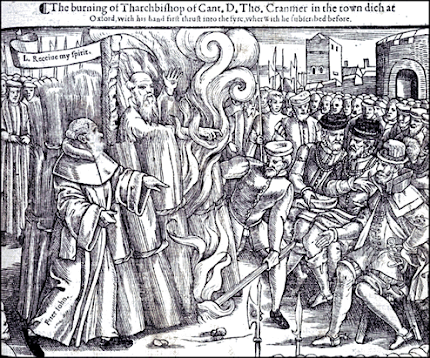
The burning of Tharchbishop of Cant. D. Tho. Cranmer in the town dich at Oxford, with his hand first thrust into the fyre, wherwith he subscribed before. [Click on the picture to see Cranmer's last words.]

Daily Bible Verse

Showing posts with label Thomas Kuhn. Show all posts

Thursday, February 16, 2012

The Contours of a Reprobate Mind « God's Hammer

During my time at the Wesleyan Arminian seminary known as Asbury, I was for a time led into the idea that theistic evolution was the only valid way of dealing with the apparent conflict between faith and science. However, what I was not taking into account is that the theistic evolution theory is based on what can only be called a neo-orthodox framework from a theological perspective and on a logical positivist/empirical philosophy view of science from the other end. What is more to the point, however, is that exalting general revelation (neo-Kuyperians prefer to call this "common grace") above special revelation opens the door to skepticism, agnosticism and even atheism. Gordon H. Clark's critique of the philosophy of science is to be considered here. It might be noted that Thomas Kuhn and Bertrand Russell raised some of the same objections that Clark did.

The bottom line is that either Scripture is propositionally and logically consistent, inerrant, and truthful in historical matters which it records or the flood gates to skepticism are thrown wide open. This might explain why Evangelicalism as a whole is in the straits of heterodoxy.

To read Sean Gerety's comments click here: The Contours of a Reprobate Mind « God's Hammer


Saturday, December 10, 2011

Gordon H. Clark and Philosophy of Science | foxinthevineyard

Of course, Clark is by no means the first to realize these problems. Bertrand Russell did:

“All inductive arguments in the last resort reduce themselves to the following form: ‘If this is true, that is true: now that is true, therefore this is true.” This argument is of course, formally fallacious. Suppose I were to say: “If bread is a stone and stones are nourishing, then this bread will nourish me; now this bread does nourish me; therefore it is a stone, and stones are nourishing.’ If I were to advance such an argument, I should certainly be thought foolish, yet it would not be fundamentally different from the argument upon which all scientific laws are based.” The Scientific Outlook By Bertrand Russell (Publisher: Routledge; New edition (July 18, 2001)


And Karl Popper in Conjectures and Refutations:

“First, although in science we do our best to find the truth, we are conscious of the fact that we can never be sure whether we have got it…. We know that our scientific theories always remain hypotheses…. In science there is no“knowledge” in the sense in which Plato and Aristotle understood the word, in the sense which implies finality; in science, we never have sufficient reason for the belief that we have attained the truth…. Einstein declared that his theory was false: he said that it would be a better approximation to the truth than Newton’s, but he gave reasons why he would not, even if all predictions came out right, regard it as a true theory…. Our attempts to see and to find the truth are not final, but open to improvement;… our knowledge, our doctrine is conjectural;… it consist of guesses, of hypotheses, rather than of final and certain truths.”


See: Gordon H. Clark and Philosophy of Science | foxinthevineyard


Support Reasonable Christian Ministries with your generous donation.