>

Martyred for the Gospel

Martyred for the Gospel
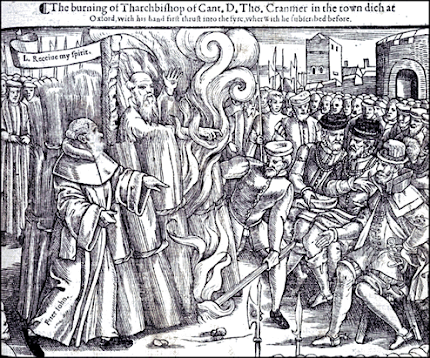
The burning of Tharchbishop of Cant. D. Tho. Cranmer in the town dich at Oxford, with his hand first thrust into the fyre, wherwith he subscribed before. [Click on the picture to see Cranmer's last words.]

Daily Bible Verse

Showing posts with label Apologetics. Show all posts

Tuesday, December 10, 2024

My YouTube Channel: Reasonable Christian

The Bible and the Bible alone is the word of God.  2 Timothy 3:16


I'm not an expert in making and uploading videos.  However, this is my first video uploaded to the Reasonable Christian channel in YouTube:  Reasonable Christian Apologetics channel.
Thursday, May 28, 2020

Common Misconceptions Regarding Gordon H. Clark's Apologetics and His View of History


"Clark seems consistent when arguing that “No event is subject to absolute verification.”, but he follows this by saying that 'Different amounts of evidence can be produced for different events. But there is no compelling logical reason to believe any particular piece of evidence. This is true of the Gospels, as the contemporary theologians persistently proclaim; but it is equally true of Thucydides.'"


Michael Douma


I came across the above quote in a critical review of Dr. Gordon H. Clark's book, Historiography: Secular and Religious, first edition, 1971, (Jefferson: Trinity Foundation, 1991). The article was written by Michael Douma, who is the brother of Dr. Clark's most recent biographer, Doug Douma. In fact, Michael Douma, who is a university professor in historiography and research at Georgetown University, helped to edit Douglas J. Douma's book, The Presbyterian Philosopher: The Authorized Biography of Gordon H. Clark. While there are a few minor points in Doug's book that I think are not necessarily fully clarified, including Clark's view of mental images, this is forgivable due to the fact that philosophy is extremely technical and hard to understand, particularly when it comes to the issue of the philosophy of knowledge or epistemology. In fact, Dr. Clark, in my opinion at least, did not completely reject empiricism as it is commonly understood. Instead his critique was more on a technical and philosophical level. For example, Clark once gave an illustration that the senses could not be trusted because there was a rancher in Texas who drove his car in the lake because he thought the lake was a mirage. On the other hand, if the senses could not be trusted whatsoever no one would dare to drive a car at all.  A further indication of this is that Clark himself owned and operated automobiles during his lifetime.


It is in this regard that I offer a response to the above quote where Michael Douma says that Dr. Clark rejects all history and all historical accounts. In fact, the quote is out of context and proves exactly the opposite. I do not have time to answer all of the objections raised in the article posted on Michael Douma's blog, namely Gordon H. Clark on History, but I will try to hit at least a few of the most glaring mistakes in his assessment.


First of all I will quote Mr. Douma and then the full quote from Dr. Clark in his book. I do not know which edition Douma is quoting from but he gives the citation as page 368. The edition I am using has the quote on page 335 so the other page numbers may not be the same either. However, I will quote a longer portion of the Clark book to show what Clark intended. As Dr. Clark himself once said, it is better to give a long quote than to quote a small portion out of context and give a misleading impression of what the original writer intended to say.

Again, a rationalist like Mises would not argue that we cannot make empirical observations. Mises only argues that empirical observation cannot provide us with the knowledge of laws of cause and effect. Clark, however, mistrusts all empirical knowledge. And this is where Clark’s views on the nature of history become unclear. Whether, in Clark’s view, historians can arrive at any kind of truth or knowledge [if not ultimate truth] through observation, is not clear. He appears inconsistent on this point, when he claims that history has shaped his views. How is it possible to learn political lessons from history, as Clark claims he has (on page 339), if he is a hard skeptic concerning the ability to ascertain any knowledge from empirical methods?

Clark seems consistent when arguing that “No event is subject to absolute verification.”, but he follows this by saying that “Different amounts of evidence can be produced for different events. But there is no compelling logical reason to believe any particular piece of evidence. This is true of the Gospels, as the contemporary theologians persistently proclaim; but it is equally true of Thucydides. “ [368]

If, however, the empirical method is incapable of producing knowledge at all, as Clark seems to claim, how can Clark even speak of “evidence.”? What is historical evidence if not knowledge of some attribute of the past? If we recognize something as evidence, or even admit the existence of evidence, do we not also confirm the existence of some form of empirical knowledge?

Clark seems to say that one can indeed learn from observation, but the act of accepting the truth of testimony (or any historical source) is a matter of faith. [231] He explains that for secular and religious history, interpretations and frameworks are indispensable. [346] By this, he means that we cannot admit, organize, or explain empirical knowledge without pre-suppositions about this knowledge.

Yet, if empirical observations are incapable of providing knowledge, how can Clark make any claims about particular historical events, or takes sides in a historiographical debate as he does on pages 73-74? Is it only a matter of faith that he sides against the historical views of Charles Beard?

Michael Douma,  Ibid.

My first criticism of the review is that Clark is responding to two different issues in this book, primarily problems with secular historiography and secondarily problems with the postmodernist irrationalism of the neo-orthodox theologians in general and Karl Barth in particular. That is very evident in the title of the book.  In other words, Douma is conflating Clark's critique of secular historiography with Clark's critique of postmodernist irrationalism in the form of Karl Barth's neo-orthodoxy.  And in fact, I will demostrate that Douma completely misses Dr. Clark's point in the quote because Clark does not completely dismiss historiography at all.  But more on that after I quote from Clark's book.

Now by way of conclusion to this lengthy volume, and especially as a conclusion to Part Two, I would like to first point out the inferiority of the contemporary theologians in comparison with the secular historiographers.  Many of the latter may be wrong.  Criticism of their positions have been free.  But with the exception of the Marxists the secular historiographers give arguments worth considering and do not pontificate with arbitrary and consistent abandon as the dialectical theologians do.  Not only with arbitrary and inconsistent abandon, but also with an evident ignorance of historiography.  Clark, Ibid., p. 335.

I will give more of the quote but first let me remark here that this quote alone demonstrates that Douma has misunderstood Clark's critique of historiography.  Notice that Clark says that the postmodernist critics of the Bible are completely arbitrary and irrational, while the secular historiographers are often subjective and begin with unproven axioms that they claim to be completely empirical yet historiographers are not irrationalists nor are they capricious and arbitrary in doing their historiographical work.  This shows that contrary to Douma, Clark does not completely dismiss historiography but rather critiques their claim to be completely empirical and objective for the simple reason that everyone, including historiographers, begins with unproven axioms.  That would apply to empiricism as well since human beings must start somewhere and the initial starting point itself is axiomatic, not empirically demonstrable.  Further, following Kant, Clark believes that there are innate categories of the mind that are given by God.  Kant would not have attributed such categories to God since God cannot be known phenomenologically because God is a spirit.  Since God exists only in a noumenal dimension above the phenomenal world nothing can be known about God from below.  While Clark opposes the empiricism of Kant he does not hesitate to borrow from the philosophers and to use their thought for his own purposes.  Kant's use of innate and a priori structures of the mind indicate for Clark that God has created man in His own image and has endowed man with these innate categories of intellectual ability.


Another example of Douma's mistaken view of Clark is that he attributes to Clark the scientific principle of cause and effect.  But Clark agrees with Hume that cause and effect cannot be demonstrated empirically as an endless chain of cause and effect back to a first cause.  Although some limited cause and effect can be observed and utilized in an operationalist view of science, it cannot logically prove that a god or even the God of the Bible is the first cause of everything.  That is because such an endless chain of cause and effect cannot be empirically observed but must instead be logically inferred.  But according to Clark and Hume that inference would be logically fallacious.  Auto mechanics can diagnose and repair automobiles based on a limited understanding of cause and effect but this only works because of a limited observation of specific conditions, not as a general and universal principle that rises to the level of absolute truth.


Additionally, Clark borrows from Hume's definition of a person as a complex of sensations and instead says that a person is defined by the complex of propositions which he thinks.  For Clark the idea that humans are born with a blank slate or tabula rasa is anathema for the simple reason that other animals are not the image of God and no other animal on earth can communicate in rational language, do mathematics, or think logically and rationally.  Clark's redefinition of Hume's empirical views in line with Clark's own Augustinian realist philosophy is nothing short of brilliant.  For Clark man is a spiritual soul created in God's image and inhabiting a body.  The soul lives on after the physical body dies and we know this is true because the Bible says so.  Now if the secularist wishes to criticize Clark for using a circular argument, Clark responds that everyone begins with an unproven starting axiom or a point where his epistemology begins.  Everyone is a fideist of one kind or another.  So why will the secularist criticize the Christian for beginning with the Bible as his or her axiom?


But to further drive home how Douma's remark misses the point I will here quote Clark's full context:

In the second place, these theologians who constantly insist that events recounted in myths, or, better, in sagas, and sometimes called Geschichten,  are unverifiable by the scientific methods of historiography fail to realize that no event is subject to absolute verification.  Different amounts of evidence can be produced for different events.  But there is no compelling logical reason to believe any particular piece of evidence.  This is true of the Gospels, as contemporary theologians persistently proclaim; but it is equally true of Thucydides.  Historiographical theory should apply impartially to both; but the dialectical theologians are unwilling to treat the Bible as they treat other historical books.  They may claim to do so.  They may say that scientific verification assures us of such and such event in the Peloponnesian War, while it leaves us with no information about Jesus.  But this is to apply impossible norms to Genesis and to the Gospels, which no one, including themselves applies to Herodotus and Thucydides.

With respect to the above matters and before the final paragraph of this volume, one other matter should no doubt be disposed of for the sake of historians who may be unfamiliar with philosophical methods and even for the sake of some philosophers who believe that a debate between two positions can be carried on only on the basis of a common area of agreement.  The objection to a presuppositionalist view of history or theology, or anything else, is that "communication," to use a contemporary cliché, requires the contestants to occupy a common ground.  When one historian says, "my framework for history implies that such and such is the significance of this event and that therefore or also this evidence is true," and when another historian says, "my presuppositions imply the reverse of all that," then the objectivist or empiricist is quick to claim that the debate cannot be resolved, for there is nothing to which one man can appeal in his effort to convince the other.  Each has his own presuppositions, and each follows their logical implications.

The situation is even worse and more thoroughgoing in theology than in history.  . . .

Dr. Gordon H. Clark, Ibid. Pp. 335-336. 

The point of this longer quote is to show that the context of Clark's repudiation of the absolute truth of historiography is to show that Douma misappropriates Clark out of context to prove what Clark does not say.  Clark does not out of hand reject historiography completely.  What he does do is show the logical limitations of historiography and expose the fact that there is no such thing as absolutely objective historiography.  When I was in college a professor at the Pentecostal college was working on his Ph.D. in history.  I was offended when he told me that history was subjective and that there were no such thing as objective facts since facts are always interpreted by the biases and presuppositions of the historiographer in question.  He was most likely defending a postmodernist approach to historiography, which Dr. Clark would have found reprehensible I suspect.  On the other hand, Clark was not naive about the subjectivist implications of the philosophy of historiography.


Additionally, I could fact check Michael Douma's other references but I would have to search to compare page numbers since he is apparently using an older edition of the same book, possibly the 1971 edition?  Be that as it may, Clark unashamedly says that only by regeneration will secularists accept the historical accounts of the book of Genesis as literal history.


The only personal solution to this logical impasse is a change of heart on the part of one of the contestants.  Agreement can be obtained only by one party's repudiating his premises and accepting the other's presuppositions.  One of them must be converted.  One must be regenerated.  One must be born again.  And the change is something logic cannot do.  God alone is able.

However, this ultimate confrontation of two antagonistic systems does not always come this clearly to the surface.  No doubt it is always below the surface.

Clark, ibid. P. 337. 

Clark's main complaint in the book is that historiographers cannot even agree among themselves, which in fact demonstrates that historiography is not absolutely objective nor is it absolute knowledge.  For Dr. Clark history can never be absolutely true from an epistemological and philosophical point of view.  But this does not mean that Clark absolutely rejects everyday knowledge which is acquired outside of propositional truth or innate logic.  As stated above, Clark is not a rationalist in the sense of Aristotle, Augustine or Anselm.  Instead, Clark takes the view of the Bible that God is a rational being (John 1:1) and that man is rational because God bestows in man as the image of God the rationality of logic (John 1:9).  The Logos enlightens every man.  Clark accepted other branches of knowledge such as historiography, operational science, mathematics, archaeology and medical science but said that such forms of knowledge never lead to absolute truth because they never arrive at any final conclusions.  Such knowledge is always tentative.


Be that as it may, Clark says that all rational knowledge begins with the knowledge of God revealed in the Bible and that further logical deductions can be made from these revealed propositions about God and the created universe.  For that reason, Clark does not need the confirmation of archaeology or history to believe what the Bible says about geology, geography, or the history recorded in Scripture.  On the other hand, when archaeology or history does confirm that events in the Bible are true, Clark readily accepted such confirmation.  An example that is often cited is when archaeology confirmed the existence of the Hittites, which the higher critics of the Bible had denied even existed.  This one hits home with me because when I was in middle school in the mid-1970s a social studies textbook we used mentioned this very thing, namely that the Bible said the Hittites were a real people and that this was not accepted until archaeology confirmed it.


The Christian worldview therefore has some common ground with secularism but not on the basic presuppositions or the axioms of the secularist and humanist materialist worldview presupposed by empirical science and secular historiography.  Clark's book points out the double standard that these secularists have in regards to the historical documents of the Bible and the historical documents of the ancient Greek philosophers.  How does the secularist know there is no God and that the Bible is not historically accurate?  He cannot know absolutely. 


Relativism can provide no absolute truth.  If there is no logical or rational common ground between different secular philosophers and no common ground between different historiographical methodologies, there surely is no common ground between the Calvinist worldview and a materialistic atheism whether it be Marxism or secular postmodernist approaches to history or the Bible.  The postmodernist theologians disagreements with conservative theologians are even worse than the disagreements between historiographers because their presupposition is that the historical narratives of the Bible are simply inspired myths, stories, fables, legends and sagas.  Be that as it may, neither historiography nor neo-orthodoxy can prove that the Bible is not true.


This is another reason why I also reject the semi-Calvinist doctrine of common grace.  Common grace opens the door to natural theology and the exaltation of natural theology and empiricism above the special revelation of the Bible.  For the Christian the Bible is not to be read as any other ancient document but as the very words of God which are inspired by the Holy Spirit.  While some critical methods can be utilized, these methods are not to be exercised as some external authority over the Bible.  Critical methods of hermeneutics, higher and lower biblical criticism are all in the end fallible and prone to error.  The Bible alone is an inerrant book which is self-authenticating and self-interpreting through the illumination of the Holy Spirit.  The system of propositional truth deduced from the Bible leads to further deductions and propositions that can be part of an even larger system of propositional truth encapsulated within the Christian worldview.  While it is true that even an atheist can understand the logical propositions of the Bible, the difference is that only a regenerate believer can accept as true what the Bible states in rational propositions.  If the Bible says that Solomon was the son of David, even an atheist understands the proposition.  But only a born again Christian believes the historical account of David and Bathsheba and the birth of their son, Solomon, is true.


Charlie J. Ray, M. Div.


Thursday, November 02, 2017

Did Gordon H. Clark Advocate a Common Ground View of Apologetics?


"The Christian worker cannot convince him [the unbeliever] of the truth of the Gospel. He is not supposed to. After we present the Gospel, we then pray that the Holy Ghost will convince him, that God will change his mind, grant him repentance, that God will give him the divine gift of faith, cause him to believe the axioms of Scripture and raise him from the death of sin to a new life in Christ."  

-- Dr. Gordon H. Clark


It has been contended by certain Van Tilian apologists and theologians that Gordon H. Clark said that reason is a common ground between believers and unbelievers.  But I will show in this post that that was not Clark's view at all.  Critics of Clark keep accusing him of rationalism and using other straw man arguments against his position instead of dealing with his actual position.  One article I found from Chalcedon Magazine in 1997 said that Gordon H. Clark was a Cartesian philosopher of all things.  There are so many misrepresentations on the internet in regards to Clark's actual philosophy and theology that it is almost impossible to refute and rebut them all.  Moreover, some of the views being perpetuated online are advocated by self professing admirers and proponents of Clark's dogmatic philosophy.

The article from Chalcedon Magazine in 1997, The Philosophy of Gordon Clark, by Joseph P. Braswell, makes at least three mistakes in regards to Clark's philosophy.  First, the author confuses Clark's view with Alvin Plantinga's foundationalism.  He then goes on to accuse Clark of being a Cartesian philosopher.  I guess if one charge will not stick another one will do just as well.  Of course, Descartes was a rationalist who tried to prove that man exists because of the proposition that "I think therefore I am."  But Gordon H. Clark totally rejected cartesian philosophy.  The same author thinks that Van Til was in agreement with Immanuel Kant's innate knowledge view, which I cannot verify or falsify.  However, I can say that in some ways Clark agreed with Kant in that Clark says that God has created man with certain innate abilities such as the ability to think rationally, to mark time as the passing of one thought to another thought in the mind.  But Clark does not deduce these innate abilities from Kant but from Scripture.  Clark also advocated the view that John 1:9 does not refer to salvation but rather to man as the rational image of God and that Christ in His pre-incarnate person of the divine Logos enlightens every man such that even fallen men can know some truth.  But is this common ground?

Braswell says:
For Clark, logic is the common ground-principle between believers and unbelievers (based on the argument in book gamma of Aristotle’s Metaphysics), but logic needs true premises—premises that are logically primitive, basic beliefs. We must have a source of such incontrovertibly certain truths—foundational truths—if we are to deduce anything by means of logic, since conclusions are only as good as the premises from which they derive. Clark also believes (following Augustine) that the assertion of skepticism is self-refuting and that skepticism is the reductio ad absurdum of any epistemological theory (i.e., any theory that leads to skepticism can be eliminated from further consideration). He thus seeks to eliminate all competition to his axiom by reducing all other epistemological contenders to skepticism. After the field is cleared of rationalism and empiricism, if he can show that the axiom he has proposed succeeds in making some knowledge possible (a set of propositions, however limited in number), he believes he has justified his starting point. The only test of his system of propositions is the logical test of the internal consistency of the system qua a coherent, noncontradictory system.  (Ibid.)

This assessment at first glance sounds like a reasonable summary of Clark's view.  However, the writer seems to think that Clark begins with reason and tries to prove his axiom and justify his view by means of logic.  This is not Clark's view at all.  In fact, Clark begins with Scripture and consistently shows that God's written word is in fact propositional revelation.  If God's written word is not logically consistent, how could we know anything from God at all?  Revelation from God must be intelligible and understandable.  For Clark God does not breathe out lies, contradictions, half truths, or irrationalisms.  (2 Timothy 3:16; Matthew 4:4; 2 Peter 1:19-21).  Basic to all thinking, according to Clark, is the law of contradiction.  If God says yes, it cannot mean no or both yes and no because that would be a contradiction.  If God says, "Do not commit adultery," it cannot mean, "Thou shalt commit adultery."  According to Clark, we know that God is not only logical in the way He thinks but He is Logic.  John 1:1 uses the Greek term Logos, which is defined as rationality.  It seems odd to me that Evangelical Christians today have no problem with the proposition that God is love (1 John 4:7-8) but they seem to have a problem with John's proposition that the Word was God.  (John 1:1).

Clark, while contending that all men are created in God's image and have an innate ability to think logically, recognized that men are fallen in sin and that there is a noetic effect caused by the sinful nature such that men are unable to reason consistently; therefore, they are prone to make errors in logic.  (Romans 1:18-25).

But for Clark truth is systematic because propositions are logically consistent with all the parts of the truth.  Truth exists only in God's mind and if mankind knows anything that is true then God being omnipotent knows that same truth.  In fact, the reversal of the proposition is that if mankind cannot know anything that God knows, it logically follows that man knows nothing that is true, since all truth originates in the mind of God.  God is eternally omniscient and has never learned anything new.  God is the Truth.  (John 17:17).

According to Gordon H. Clark, Christianity is not a religion.  In fact, Christianity is a philosophical and theological worldview that is deduced from the axiom of Scripture.  Clark rejected the proposition that there is common ground with other epistemological systems despite the assertion of his critics to the contrary:

Because this whole subject has so many facets, and because the details are so complex, the conclusion can canvas only one objection. The objection is this. If every system of philosophy derives from its own unique set of axioms, it becomes impossible for those who accept one set of axioms to hold a meaningful discussion with those who hold another set. The two parties to the dispute have nothing in common, and hence, neither has any basis for convincing the other.  This is an ancient, not a recent, objection. It does not require genius to think it up. But though so common, indeed because it is so common, it needs a clear answer. An historical reference will serve as a starting point.

Anselm wanted to appeal to the Jews and Moslems on their own ground without using revelation. “Reason” (in quotation marks) was supposed to be the common ground. But “reason” (in quotation marks) was not clearly defined nor was a common proposition actually identified. But common sense supposes that whenever we try to persuade people of anything, we appeal to what they already believe. But common sense is wrong. This works only on secondary matters and not on all of them. On basic matters no one ever appeals to a common ground between two systems of philosophy.

Take this for example. Can an empiricist, on the basis of sensation, convince me of empiricism when I do not accept sensation? Well, how then may we present the Gospel to an unbeliever? We present the Gospel as fully as possible. We explain to him as many of the historical details as we have time for and as many of the logical connections as our prospect will listen to. But sermons, arguments, and explanations will not convert him. The Christian worker cannot convince him of the truth of the Gospel. He is not supposed to. After we present the Gospel, we then pray that the Holy Ghost will convince him, that God will change his mind, grant him repentance, that God will give him the divine gift of faith, cause him to believe the axioms of Scripture and raise him from the death of sin to a new life in Christ.

[From the transcript of Gordon H. Clark's audio lecture, "How Does Man Know God?"  Posted at the Gordon H. Clark Foundation website.  For the Sermonaudio version of this lecture click here.]

I therefore conclude that Clark did not advocate common ground between the believer and the unbeliever.  In fact, Clark did not try to prove his axiom since axioms cannot be proved in the first place.  By definition axioms are unproven and unprovable starting points.  Since everyone starts with unproven starting points and everyone is a fideist, why criticize the Christian for starting with the axiom of Scripture?   Clark's lecture on Empiricism makes the same point as the above quote.  There is no common ground with other epistemological and philosophical worldviews or systems.

There is another lecture on YouTube by Michael Butler, "Refuting Gordon H. Clark," that criticizes Clark as well.  But I will answer the objections raised in this lecture in a future post.  But, surprisingly, Butler attacks the truthfulness and logical consistency of Scripture and never once mentions the fact that the Westminster Confession of Faith is a logical and propositional system of truth that is logically deduced from Scripture by good and necessary consequence.  (Westminster Confession of Faith 1:6).

I should also point out that Doug Douma and two of his colleagues have done the majority of the footwork to type and post the transcripts of Clark's audio lectures and unpublished papers at the Gordon H. Clark Foundation website, although the site is hosted by Whitefield Seminary and Dr. Kenneth Talbot.  Doug does a blog at:  A Place for Thoughts.


Tuesday, February 10, 2015

Is It Wrong for Christians to Argue? Quote of the Day: Dr. Gordon H. Clark


“But when they did not find them, they dragged Jason and some brethren to the rulers of the city, crying out, “These who have turned the world upside down have come here too.” (Acts 17:6, NKJV) 


In his commentary on the book of Philippians, Dr. Clark said the following in reference to Philippians 1:16, 17, 18:


Verse 16 continues the sentence in verse 15.  [Philippians 1:15, 16].  Those who had been emboldened to preach publicly were divided into two groups.  Some preached from good motives; some did not.  The former loved both Paul and the Gospel.  They knew and were inspired by the fact that Paul was completely devoted to the defense of the Gospel.
The word for defense is apologia: in technical theology, apologetics.  Some misguided Christians today repudiate argumentation.  The New Testament does not.  Not only is apologia in 1 Peter 3:15; it is also in Acts 22:1, 1 Corinthians 9:3, 2 Corinthians 7:11, and Philippians 1:7, as we recently saw.  Mark 9:10 has the disciples "questioning one with another" (suzeteo)--they were acting properly.  In Mark 12:28 a scribe had heard Jesus arguing with the Sadducees.  Acts 6:9 has some people disputing with Stephen and clearly Stephen disputed with them, as 6:10 [Acts 6:10] very forcefully indicates.  Barnabus in Acts 9:29 defends the recently converted Paul by telling the suspicious disciples that Paul disputed against the Grecians.  Well, these verses should be enough to silence those who think that a Christian should not argue.
 Dr. Gordon H. Clark.  Philippians.  (Hobbs:  The Trinity Foundation, 1996).  Page 28.
 See also:  Philippians.

For liberals and those who promote ecumenical reunion above Scriptural truth, arguing and polemics are the unforgivable sin for Christian fellowship.  But the reality is that those who are teaching heresy or those who contend out of selfish ambition are the ones who are creating the divisions.  The faith once delivered to the saints is to be "earnestly" contended for.  (Jude 1:3).

Monday, June 23, 2014

Apologetics and Polemics: W. G. T. Shedd

"When the work of deriving doctrines from Scripture has been done, the theologian must defend them against attacks, answering objections, and maintaining the reasonableness of revealed truth. The elder Protestant divines devoted great attention to this part of theological science, under the title Theologia polemica.12 Here is where religion and philosophy, faith and science meet. Human reason cannot reveal anything, but it can defend what has been revealed."

Shedd, William G. (2011-07-19). Dogmatic Theology (Kindle Locations 1388-1392). P&R Publishing. Kindle Edition.

Friday, November 02, 2012

Ronald Nash: An Evaluation of Evangelicalism


Ronald Nash was a Calvinist and Evangelical Baptist.  He died in 2006 but he was an advocate of presuppositional apologetics and was a fan of Carl F. H. Henry and Gordon H. Clark.  Nash was not perfect by a long shot.  By God's providence I came across this lecture on Evangelicalism that was posted at the Third Millennium website.  He explains why so many Evangelical seminaries and colleges have gone liberal and why others are headed in that direction.  I'm posting the link here:  Evangelicalism.  Unfortunately, it seems that Reformed Theological Seminary has closet liberals teaching on the faculties of the various locations.  Bruce Waltke resigned at RTS in Orlando, Florida because he opted for theistic evolution, which naturally leads to neo-orthodoxy.

The Presbyterian Church in America is now predominated by the church growth and contemporary worship mentality which focuses on experiential pietism rather than on a solid and rational understanding of God's logical revelation in Holy Scripture.  The way things are going the PCA will probably be a full blown liberal denomination in another twenty years.


--
Glory be to the Father, and to the Son : and to the Holy Ghost; As it was in the beginning, is now, and ever shall be : world without end. Amen. Visit 1662 Book of Common Prayer: Daily Prayer and Reasonable Christian Blog

Tuesday, February 07, 2012

Eric Holmberg: I Will Never Vote for a Mormon for President


Although I do not endorse the apologetics ministry that sponsored this video statement, I fully agree with what Eric Holmberg has to say. The Apologeticsgroup.com is a continuationist or charismatic ministry, although they are Reformed in their confession of faith. See: About.


Thursday, January 26, 2012

T. D. Jakes and the Elephant Room Controversy

 "But because I tell the truth, you do not believe Me. Which of you convicts Me of sin? And if I tell the truth, why do you not believe Me? He who is of God hears God’s words; therefore you do not hear, because you are not of God.”" (John 8:45-47, NKJV)


 I posted the following comment over at the Daniel's Place blog.  Daniel is a student at Westminster Seminary, California.  He has been covering the controversy over the invitation extended to the heresiarch T.D. Jakes to speak at The Elephant Room.  You can see Daniel's article by clicking here: News: James MacDonald resigns from TGC .


I agree that inviting T. D. Jakes to the Elephant room is a tacit endorsement of Jakes' theology. But I hate to break this news to you. The fact is the vast majority of Pentecostals and Charismatics these days NO LONGER REGARD ONENESS PENTECOSTAL TEACHING AS HERESY. Excuse me for yelling:) But I think this emphasis needs to be made. Basically, the Charismatic movement is more concerned about spreading Pentecostalism and Charismatic teaching than about correct doctrine on the ESSENTIALS OF THE CHRISTIAN FAITH. For example, The Society for Pentecostal Studies, which publishes a theological journal called, Pneuma, does not require belief in the trinity or triunity of three persons in one divine nature. That can be easily demonstrated in the compromise of their original doctrinal statement here: Wikipedia: The Society for Pentecostal Studies. The short of it is that Pentecostals and Charismatics are compromised from the get go because their emphasis on the "gifts of the Spirit" and the "baptism with the Holy Spirit" trumps the orthodox and essential doctrine of the trinity. I've been saying this for several years now and I'm wondering why so few are listening?

The fact that T.D. Jakes enjoys such mainstream popularity among Charismatics and Pentecostals and on "Christian" TV is proof enough that the movement as a whole is cultic, heterodox, and heretical. Yes, you heard me right.

Another indication of this sort of heterodoxy is the widespread acceptance of the Word of Faith doctrines on health, wealth and prosperity--doctrines which come from Christian Science and New Thought. Included in that package are extremely heretical doctrines on the incarnation of Christ and His deity. Word of Faith teachers say that Christ is not fully God but is simply a "Spirit-filled man". They also teach that Jesus was demonized on the cross and that He suffered for three days in hellfire.

It is beyond my comprehension why anyone who considers themselves Reformed in theological perspective would want to lead others into this heretical and heterodox movement. I'm thinking here of "non-cessationists" like John Piper, Wayne Grudem, Vincent Cheung, Mark Driscoll, Vern Poythress, and others. This wrong emphasis is akin to saying it's ok to be Mormon! In fact, the Word of Faith movement also incorporates some Mormon doctrine since Kenneth Hagin taught that God has a "spiritual" body, i.e. a spiritualized physical body.

I could go on but I'll stop there. The short of it is that I think Evangelicals in general are way too gracious toward Pentecostalism and Charismatic theology because of the fear of losing support.

Sincerely yours in Christ,

Charlie

Addendum:  I know some of you think I am overgeneralizing since some Pentecostal and Charismatic churches take a strong stand against modalism and the Word of Faith movement.  However, to take a strong stand against false teaching while continuing to fellowship with heretics is duplicitous.  This sort of dissimulating compromise reveals that Pentecostals and Charismatics are more concerned with ecumenicalism than with Scriptural truth.  But if the souls of millions of adherents are at stake, why invite false teachers to lead them astray?  That is the question at issue here.  It is impossible to follow false teaching while at the same time following the truth. 


Thursday, November 25, 2010

What_is_Apologetics.mp3 (audio/mpeg Object)

What_is_Apologetics.mp3 (audio/mpeg Object)

Gordon H. Clark's discussion of and definition of apologetics is given in this lecture. The question and answer session at the end of the lecture is extremely interesting, particularly when Clark refutes empiricism and the idea that the five senses can be trusted as a reliable source of propositional truth. His example of the judicial/legal system as being frequently wrong stands out here. If the judicial system can be so often wrong, the implications for empirical science and the philosophy of science are astounding. Thomas Kuhn's book, The Structure of Scientific Revolutions, comes to mind here. Science, according to true believers, is self-correcting. However, as paradigms are continually shifting based on changing empirical evidences, it seems that science along with the legal system is frequently wrong. So what is a reliable source of propositional truth and revelation? Good question! Dr. Clark's lecture will force you to rethink your doctrine of general or natural revelation. Click on the title of this article or click here to listen to this lecture: What is Apologetics?


Wednesday, July 21, 2010

Support Reasonable Christian Ministries with your generous donation.