>

Martyred for the Gospel

Martyred for the Gospel
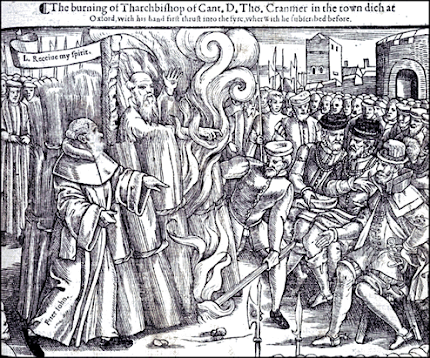
The burning of Tharchbishop of Cant. D. Tho. Cranmer in the town dich at Oxford, with his hand first thrust into the fyre, wherwith he subscribed before. [Click on the picture to see Cranmer's last words.]

Daily Bible Verse

Showing posts with label common ground. Show all posts

Wednesday, January 15, 2025

The Free Offer of the Gospel, Common Grace, and Pragmatic Church Growth: Part 3


2. And not for ours only. He added this for the sake of amplifying, in order that the faithful might be assured that the expiation made by Christ, extends to all who by faith embrace the gospel.

Here a question may be raised, how have the sins of the whole world been expiated? I pass by the dotages of the fanatics, who under this pretence extend salvation to all the reprobate, and therefore to Satan himself. Such a monstrous thing deserves no refutation.  John Calvin’s commentary on 1 John 2:2.


The Free Offer of the Gospel, Common Grace, and Pragmatic Church Growth:  Part 3


In this blog post I will now consider how the free offer of the Gospel and the 19th and 20th century doctrine of common grace is related.  In future posts I will then show how the free offer or well meant offer of the Gospel and common grace have influenced the pragmatic approach to church growth and evangelism.

The most controversial downgrade of Calvinistic Reformed theology since the Protestant Reformation happened in 1924 when the Christian Reformed Church decided that God loves the reprobate, that the reprobate can do civic good, and that there is some hope that those who appear to be reprobate can be persuaded to accept the effectual call of the Gospel.  Of course, modern day semi-Calvinists will tell you that this is only an apparent contradiction or paradox.  The controversy at Kalamazoo, Michigan began when certain moderate theologians in the Christian Reformed Church passed the Three Points of Common Grace at the 1924 General Synod and later excommunicated the conservative Dutch Reformed pastors and theologians who dissented from the compromising document.  The deposed ministers then formed the Protestant Reformed Churches in America.  (See:  The Three Points of Common Grace).

Early on in my theological education I learned that accommodation to the surrounding culture leads to compromise, to theological liberalism and even universalism.  Even the classical Pentecostals at the Assemblies of God Bible college where I did my undergraduate studies warned students about the dangers of theological liberalism.  However, today, semi-Calvinist reformed denominations or churches are telling its laity that there is nothing to see here and that they are actually Evangelicals and conservatives.  Just recently, Dr. Neil Stewart, the senior pastor of First Presbyterian Church, which is part of the Associate Reformed Presbyterian denomination, asserted that this is one of the most conservative denominations in America.  Either Dr. Stewart is ignorant of the controversies going on behind the scenes at the presbytery level and at the denominational seminary and college, i.e. Erskine Theological Seminary, and Erskine College, or Dr. Stewart is deliberately misleading the congregants.  (See:  Dissolution of the Catawba Presbytery;  see also, William B. Evans:  A Change in Ecclesial Affiliation).

If the doctrine of common grace is true, why is it that society is waxing worse and worse and not better and better?  The basic premise of the doctrine of common grace is that God loves the entire human race but has a special love for the elect.  Unfortunately, this leaves the semi-Calvinists open to the charge of elitism.  Calvinists are special, do you not know?  The Bible, on the other hand, says that the entire human race is fallen in Adam and under the wrath of God.  (Romans 1:18-21; Romans 5:12-14).  Such love!  The apparent contradiction or paradox here is that God supposedly loves and desires the salvation of the reprobate; but the reprobate have decided to damn themselves and frustrate God’s desire to save them.  Of course, this would imply that God only reprobates them because He foresaw that they would harden their hearts and refuse to be saved.  But is this not Arminianism?  Does God need to look into the future to learn what will happen in order to make His eternal and timeless decree?

Not only is the culture and society at large getting worse, but it seems to me that Evangelical churches, colleges, and seminaries are on a downward spiral as well.  Church splits and new seminaries and colleges are formed as liberalism arises; Yet, in time these same organizations and denominations tend to drift into liberalism themselves.  Even the terms Evangelical and reformed have been redefined in ways that are foreign to their original meaning.  Even Roman Catholics today claim to be “Evangelical” if they happen to trend toward a more conservative interpretation of Romanism. 

If common grace means that the reprobate can do civil and civic good, why is woke ideology, LGBTQIA+, secular humanism, social justice, and Marxism turning the national morality on its head?  What was once generally considered evil is not called good.  (Isaiah 5:20).  Children from kindergarten age are being nurtured by irrational parents and public school teachers into the ideology of transgenderism and homosexuality.  Criminals are now the victims of society rather than lawbreakers who victimize other citizens.  The progressive left is turning homelessness and crime into virtues of victimhood rather than an undermining of the virtues of individual responsibility and hard work.

Modernism was a dismal failure as a means of ushering in the utopian of a brave new world.  World War I put an end to that fantasy.  We live in a fallen world where moral evil causes crime, wars, and totalitarian regimes.  Yet, the so-called progressive “conservatives” who promote the theology of apparent contradiction tell us that common grace means that the world is getting better.  Some of them are postmillennalists and others are amillennialists.  The amillennialists tend toward a radical separation between the kingdom of God ruled in the ecclesiastical realm and the kingdom of secularism ruled by the civil government.  The postmillennialists tend toward a theonomic view where the civil realm is made better and better through the agency of natural law and the moral law of God.  Both views compromise with the culture in order to achieve the goals of their respective theological agendas.

The problem is that there is no common ground between the Christian worldview and the worldview of secularism and secular humanism.  The world views abortion, homosexuality, and surgical trans-sexuality as morally good.  The world views criminals as victims who have no responsibility for their crimes because of systemic racism, systemic homophobia/transphobia, etc., et. al.  However, the Bible condemns all of these things as violations of God’s moral law.  Natural law is supposed to be deduced from the cultures around the world.  But if this so, why so many different views of what is right and wrong in various nations and societies around the world.  C. S. Lewis used the existence of relativistic moralism as an argument for the existence of a moral God.  However, this, too, seems to be a dismal failure.  Why?  The human mind is corrupted by the noetic effects of sin and idolatry seems to replace the biblical God at every turn.

It would seem ironic, then, that the optimism of Kuyperian common grace would so soon replace modernism just after the first world war.  Common grace, like modernism, has failed miserably at making the world a better place to live for the reprobate and for elect and believing Christians alike. 

The pragmatic church growth is the attempt to use Pelagian and Arminian ways of preaching the Gospel in an attempt to persuade the reprobate which, biblically speaking, cannot be persuaded.  Using the corporate business model of selling the unchurched a felt need, these progressive Evangelicals pretend to preserve their conservative theology while in fact selling out to the culture of woke-ism, behaviorism, and Marxism.  They claim that after these persons are persuaded into joining their churches, that the new members will be transformed by the teaching of the church.  By this means, the progressives hope to reform and transform the culture at large.  The problem is that the teaching remains obscure, equivocal, and ambiguous by hiding behind the theology of paradox.  It fails to transform individuals or society.

Here ends this blog post.  I will explain the historical roots of the church growth movement, Tim Keller’s compromise of the Reformed theology, and how this is producing psychological conversions instead of actual conversions to Calvinist and reformed Christianity in my next post.

You can read my previous posts here:  Part 1, Part 2.

The next post is Part 4.

Saturday, November 04, 2017

Further Remarks on Clark's View of Common Ground


"Note well that this does not say that there is no common ground between a Christian and an unbeliever.  I hold that Christ is the light and logos that lighteth every man that cometh into the world.  I hold that every man is made in the image of God, and that every man has what may conveniently be called an innate idea of God.  All this is common ground between the Christian and the unbeliever."   [Selected Letters].

"Therefore, without in the least denying that sin has affected their volition, it must be asserted that sin has also affected their intellect."  [God's Hammer].

-- Dr. Gordon H. Clark


In my previous post, Did Gordon H. Clark Advocate a Common Ground View of Apologetics?, I stated that it was Gordon H. Clark's view that there is no common ground between the unbeliever and the believer.  However, in my Facebook debate group, Calvinism Defended Against All, Doug Douma posted a comment that quoted from the Selected Letters of Gordon H. Clark where Clark does say that there is at least some common ground between the believer and the unbeliever.  The letter was written to Dr. J. Oliver Buswell in regards to Buswell's review of Clark's book, A Christian Philosophy of Education.  Somehow the quote that Doug posted is not showing in Facebook anymore so I will type out the quote here for the reader:

It is not necessary for you to say that you have not tried to do me any injustice.  I have never detected in you any kind of injustice; and if you are not literally the most just man with whom I have had dealings, at least I have met no man more just.

It amuses me somewhat to compare what you say of my thought with what Dr. Van Til says.  You complain that I do not allow for a "common ground" while Dr. Van Til condemns me because I do.  Probably I suffer from inability to express myself clearly.  And for this reason I think you have done me an injustice unwittingly.  You have every right to argue against my position, and I have enjoyed reading your argument.  But at one point, I must say, you have mistaken my meaning.

On page four you say, "he denies that we have any common ground, in facts or rationality, with unbelievers."  And you quote from page 164 of my book.  But you do not begin your quotation soon enough.  The preceding two sentences are important:  "There is no such thing as a common ground between Christianity and a non-Christian system.  From a world naturalistically conceived, one cannot argue to the God of the Christians."  Note well that this does not say that there is no common ground between a Christian and an unbeliever.  I hold that Christ is the light and logos that lighteth every man that cometh into the world.  [John 1:9]  I hold that every man is made in the image of God, and that every man has what may conveniently be called an innate idea of God.  All this is common ground between the Christian and the unbeliever.  But there is no common ground between Christianity and a non-Christian system.  It seems to me that it is wise to keep distinct what is true about a system and what is true about individual persons.  Systems attain a high degree of consistency; people often do not.  I fear that misapprehension of my meaning has affected several parts of your review.

Dr. Gordon H. Clark.    Clark and His Correspondents:  Selected Letters of Gordon H. Clark.  Compiled by Douglas J. Douma.  Edited by Thomas W. Juodaitis.  (Unicoi:  Trinity Foundation, 2017).  Pp. 127-128. 

I would like to make several comments about this quote.  First, as Dr. Clark himself said, individuals are not always consistent with any particular system of propositional truth, including the Westminster Confession of Faith.  Inductive reasoning can and does often lead to logical fallacies and invalid reasoning.  The fact that all men are created in God's image (John 1:9; Genesis 1:27) does not negate the noetic effects of sin (Romans 1:18-32; Romans 3:10-23; Jeremiah 13:23) and the propensity of individuals to make logical errors in thinking.  (Romans 1:21).  However, if there were no such thing as rationality no one would be able to communicate at all since even languages and grammatical constructions depend on word definitions and logical propositions.  All knowledge is propositional in nature, including the formulation of language.  This is also why the Bible is not an idol composed of paper, leather and ink spots on a page.  It is indeed written on paper and the ink forms letters that together formulate linguistic expressions that form words and sentences that can be understood with the mind.  But every jot and tittle of God's written word forms words with definite definitions and definite propositional revelation such that God's written word can have only one correct meaning in any given verse.

The emphasis is that individuals who are committed to non-Christian systems have no common ground with Christians who accept the system of knowledge revealed in Scripture and from which the Christian makes other deductions by good and necessary consequence.  But that does not mean that all communication between the believer and unbeliever is meaningless conversation.  Even an atheist can understand that the Bible defines a sovereign God but the atheist refuses to believe what he understands the Bible to say about God.  The Arminian understands very well that Calvinism contends for the absolute predestination of all things, including moral evil.  But the Arminian refuses to believe what he understands as the Calvinist exegesis of the Scriptures.  The problem is not understanding the argument but refusing to believe what is understood.  This is why Arminians are so opposed to Christianity as defined by the Calvinist system of dogmatic truth summarized by the Westminster Confession of Faith.  Sadly, today many semi-Arminian Calvinists only believe an edited version of the Westminster Confession.

It goes without saying that the unregenerate elect and the unregenerate reprobate share unbelief.  But at some point God, who has foreordained the election and reprobation of certain and particular individuals whom He knows by name, will cause the arguments used by evangelists and theologians to take effect through the means of God's written word so that the elect will be effectually called to saving faith.  (John 1:12-13; John 3:3-8; John 10:3; 2 Timothy 2:19; Isaiah 55:11-12).

We too should read the Confession. And we should preach it with vigor. Not only have Romanists, modernists, and neo-orthodox departed from the teachings of the Bible, but there are also others, who in spite of professing to adhere to the Scripture, have diverged, sometimes widely, from the truth. There was a Bible professor in a Christian college who taught that man was a sinner, man was in a bad way, man was sick in sin. Now, salvation, so this Bible professor explained it, is like medicine in the drug store; and the sick man ought to drag himself to the store and get the medicine, and be cured. There was also a convinced Presbyterian on this faculty, who taught in accordance with the Westminster Confession.

So evident to the students was the contrast between these two theologies that the President disconnected the Presbyterian from his post.

The Bible and the Confession teach that man is not just sick in sin; he is dead in sin; and salvation rather than being compared with medicine is compared with a resurrection.

Gordon H. Clark. Articles on the Westminster Confession of Faith (Kindle Locations 358-367). Kindle Edition.

The doctrine of total depravity teaches that no part of human nature escapes the devastation of sin, and among the passages on which this doctrine is based are some which describe the effects of sin on human knowledge. For example, when Paul in 1 Timothy 4:2 says that certain apostates have their consciences seared with a hot iron, he must mean not only that they commit wicked acts but also that they think wicked thoughts. Their ability to distinguish right from wrong is impaired, and thus they give heed to seducing spirits and doctrines of devils. Therefore, without in the least denying that sin has affected their volition, it must be asserted that sin has also affected their intellect. And though Paul has in mind a particular class of people, no doubt more wicked than others, yet the similarity of human nature and the nature of sin force the conclusion that the minds of all men, though perhaps not to the same degree, are impaired.

Gordon H. Clark. God's Hammer: The Bible and Its Critics.   (Gordon Clark) (Kindle Locations 575-582). The Trinity Foundation. Kindle Edition.


These noetic effects of sin have been used to support the conclusion that an unregenerate man cannot understand the meaning of any sentence in the Bible. From the assertion “there is none who understands,” it might seem to follow that when the Bible says, “David…took out a stone…and struck the Philistine in his forehead,” an unbeliever could not know what the words mean.

Gordon H. Clark. God's Hammer: The Bible and Its Critics.  (Gordon Clark) (Kindle Locations 590-592). The Trinity Foundation. Kindle Edition.

It should not be concluded, therefore, that Gordon H. Clark agreed with the Three Points of Common Grace or any other system that asserts a common ground between the world's system of knowledge or epistemology and the system of propositional truth summarized by the Westminster Confession of Faith, which Clark says is the best doctrinal and dogmatic system of theology ever deduced from the Bible.  (See Westminster Confession of Faith 1:6).  I say this for the simple reason that Clark completely rejected empirical science as an epistemological system that could produce knowledge or even moral values.  For Clark logical positivism is self refuting because its starting axiom is itself unverifiable or falsifiable by means of a tabula rasa, blank slate, or the five senses.  According to Clark, it is impossible to demonstrate how one could get from sensations to perceptions to mental images.  A second criticism Clark registers is that empirical science commits the fallacy of induction.  Science is always changing and can never arrive at any final truth on anything, most especially when it comes to morality, ethics and values.

This brings me to my objection to certain political philosophies that are derived from secular systems or non-Christian systems of thinking in regards to current controversies in the culture wars and politics.  Let it be said that any political science or philosophy that is deduced from empiricism or the secular sciences is inherently relativistic and therefore non-Christian if not out and out anti-Christian.  This would include any so-called "Christian" libertarianism.  There can be no common ground and no co-belligerence between libertarianism and Christianity for the simple reason that the proponents of the modern libertarian movement are what Gordon H. Clark called contemporary impuritans:

Contemporary Impuritans
.....The central cause of this widespread moral collapse, so it seems to me, is located in the decline of Puritan religion. This returns us to the main theme of religious rather than civil history. When the seminaries and churches declare that God is dead, or when, less extreme, they substitute for the Puritan God of the Ten Commandments a different concept of god, inconsistent with the Ten Commandments, it logically and factually follows that morality is changed, too. A man’s view of morality depends on his view of God or whatever his first principle may be. Different types of theology produce different types of morality.

Dr. Gordon H. Clark.  "The Puritans and Situation Ethics."  Trinity Review.  January/February 1989.  Audio lecture.

The previous lecture began with the moral principles of the Puritans and then contrasted them with our contemporary moral anarchy. It has always been clear that the Puritans derived their ethics from the ten commandments and the God who gave them. What is not always so clear is that competing systems, and even anarchy, must also presuppose or imply a particular theological position. Some systems may deliberately announce a different kind of God and then deduce their ethics from their concept of deity. More frequently, however, a system of ethics is erected on an independent foundation and a type of deity is then manufactured to suit the ethics.

Gordon H. Clark.  "The Decline of Theology in America."  Transcript of audio lecture.  The Gordon H. Clark Foundation.


According to Gordon H. Clark, one cannot get an "ought" from what "is":

The principle by which logical positivism dismisses all metaphysics and all theology as meaningless nonsense is their verification principle. They hold that nothing can be true or even false unless it can be verified or falsified by sensory experience. What is unverifiable is neither true nor false, but completely meaningless. Our objection now is that this verification principle cannot itself be verified, and hence it is meaningless. But if their basic principle is as much nonsense as they think theology is, they have no basic principle on which to impune theology.

The second point, unlike some of these technicalities, is well within the range of the general public. It is derivative and subsidiary, but it is more a matter of daily life. This second point is that empiricism cannot establish any norm of morality. I am not saying that secular morality and Christian morality are different. A recent defense of abortion, a TV interview, was that the government should enforce only rational morality and not revelational morality. My point is that so-­called rational morality does not exist. The reason should be easily understandable.  Empirical philosophy claims to base all its truth on observation. Therefore, any evaluations or moral judgments empiricism makes must be inferred from observations. Now, observations at best can only give statistical information as to what is the case. It can record record how many murders occurred in Philadelphia last month, how many divorces were granted in Washington, and how many cases of arson there were in Boston. But a simple logical principle prevents the empiricist from concluding that murder is unjustifiable. One of the essential requirements for a valid argument is the presence in the premises of every term found in the conclusion. If any term in the conclusion is missing from the premises, the argument is a fallacy. For example, if all cows are wise animals, and if all wise animals are beautiful, it logically follows that all cows arebeautiful. It does not follow that all cows are lame, or that all dogs are beautiful. Neither lame nor dogs are found in the premises. Therefore, they cannot be allowed in the conclusion. The point of this example is that empirical premises contain nothing but statements of empirical facts. They give observational data. They state what is. Hence, nothing but observational data can be put into the conclusion. If the premises state only what is, the conclusion cannot state what ought to be. There is no way of deriving a normative principle form an empirical observation.

Dr. Gordon H. Clark, "Empiricism."  Transcript of audio tapeThe Gordon H. Clark Foundation.  

In opposition to so-called Christian libertarianism, therefore, Clark said that political and judicial law should be deduced from the Christian system of epistemology or special revelation, not any revelation deduced from natural law or reason.  Just as we cannot deduce the Trinity from natural revelation or natural theology so we cannot deduce that fornication, adultery, homosexuality, transgenderism or gambling is sinful from what can be observed in nature or by way of empirical science.  But particularly devastating to the so-called Scripturalists who advocate a judicial morality that is deduced from a secular system of political libertarianism is Clark's remarks in the question and answer session on Puritan ethics:

Moderator: Dr. Clark, should the federal and state governments of the U.S. include the ten commandments in their basic body of ordinances?

Moderator: This is in line with your Puritan ethics, I suppose.

Dr. Clark: If you make the franchise dependent on church membership, it results in great hypocrisy in the church. And it has proved deleterious in the case of the Puritans. Now, what was further in that question?

Moderator: Should we, should the federal and state governments of the U.S. include the ten commandments in their basic body of ordinances?

Dr. Clark: Well, yes I rather suppose so. And in fact it has been done done perhaps not completely. But people who say that you cannot legislate morality and people who say they don’t want Christian morality imposed on them, don’t seem to object to laws against theft.  Particularly if they’re the victims. And the law against theft of course comes from the ten commandments. So those who make these objections are inconsistent. They don’t follow the logic of their principles. I don’t see how they could sustain any laws.

Dr. Gordon H. Clark.  Question and Answers:  A Panel Including Gordon H. Clark.  Transcript of audio tapeThe Gordon H. Clark Foundation.

I could give much more evidence that Clark was opposed to libertarian political philosophy.  He also says that secular humanism has no  basis for morality or ethics for the same reasons that empiricism can produce no morality or values.  Libertarianism is another variety of godless non-Christian systemic anarchy.  In a future post I will examine what Dr. Clark had to say about the civil magistrate and from where governments can legitimately derive their authority.  Unless the government is derived from special revelation from God the end result is tyranny.  This would include all forms of secularism, including libertarianism.  I make no apologies for quoting extensively from Clark's writings and his lectures.  It seems fairly self-evident to me that Scripturalists who endorse secular libertarian political philosophy are out of accord with Clark himself and in fact advocating a contradiction if not outright moral anarchy.  The doctrine of common grace has been rightly said to attribute civic good to the reprobate.  But as with all of the effects of the original sin of Adam, sin has corrupted more than just individuals but sociological systems as well.  Principalities and powers are in operation here.  (Ephesians 3:10; 6:12).

You shall not at all do as we are doing here today-- every man doing whatever is right in his own eyes-- (Deut. 12:8 NKJ)

 In those days there was no king in Israel; everyone did what was right in his own eyes. (Jdg. 17:6 NKJ)

 In those days there was no king in Israel; everyone did what was right in his own eyes. (Jdg. 21:25 NKJ)

The way of a fool is right in his own eyes, But he who heeds counsel is wise. (Prov. 12:15 NKJ)

Every way of a man is right in his own eyes, But the LORD weighs the hearts. (Prov. 21:2 NKJ)


Thursday, November 02, 2017

Did Gordon H. Clark Advocate a Common Ground View of Apologetics?


"The Christian worker cannot convince him [the unbeliever] of the truth of the Gospel. He is not supposed to. After we present the Gospel, we then pray that the Holy Ghost will convince him, that God will change his mind, grant him repentance, that God will give him the divine gift of faith, cause him to believe the axioms of Scripture and raise him from the death of sin to a new life in Christ."  

-- Dr. Gordon H. Clark


It has been contended by certain Van Tilian apologists and theologians that Gordon H. Clark said that reason is a common ground between believers and unbelievers.  But I will show in this post that that was not Clark's view at all.  Critics of Clark keep accusing him of rationalism and using other straw man arguments against his position instead of dealing with his actual position.  One article I found from Chalcedon Magazine in 1997 said that Gordon H. Clark was a Cartesian philosopher of all things.  There are so many misrepresentations on the internet in regards to Clark's actual philosophy and theology that it is almost impossible to refute and rebut them all.  Moreover, some of the views being perpetuated online are advocated by self professing admirers and proponents of Clark's dogmatic philosophy.

The article from Chalcedon Magazine in 1997, The Philosophy of Gordon Clark, by Joseph P. Braswell, makes at least three mistakes in regards to Clark's philosophy.  First, the author confuses Clark's view with Alvin Plantinga's foundationalism.  He then goes on to accuse Clark of being a Cartesian philosopher.  I guess if one charge will not stick another one will do just as well.  Of course, Descartes was a rationalist who tried to prove that man exists because of the proposition that "I think therefore I am."  But Gordon H. Clark totally rejected cartesian philosophy.  The same author thinks that Van Til was in agreement with Immanuel Kant's innate knowledge view, which I cannot verify or falsify.  However, I can say that in some ways Clark agreed with Kant in that Clark says that God has created man with certain innate abilities such as the ability to think rationally, to mark time as the passing of one thought to another thought in the mind.  But Clark does not deduce these innate abilities from Kant but from Scripture.  Clark also advocated the view that John 1:9 does not refer to salvation but rather to man as the rational image of God and that Christ in His pre-incarnate person of the divine Logos enlightens every man such that even fallen men can know some truth.  But is this common ground?

Braswell says:
For Clark, logic is the common ground-principle between believers and unbelievers (based on the argument in book gamma of Aristotle’s Metaphysics), but logic needs true premises—premises that are logically primitive, basic beliefs. We must have a source of such incontrovertibly certain truths—foundational truths—if we are to deduce anything by means of logic, since conclusions are only as good as the premises from which they derive. Clark also believes (following Augustine) that the assertion of skepticism is self-refuting and that skepticism is the reductio ad absurdum of any epistemological theory (i.e., any theory that leads to skepticism can be eliminated from further consideration). He thus seeks to eliminate all competition to his axiom by reducing all other epistemological contenders to skepticism. After the field is cleared of rationalism and empiricism, if he can show that the axiom he has proposed succeeds in making some knowledge possible (a set of propositions, however limited in number), he believes he has justified his starting point. The only test of his system of propositions is the logical test of the internal consistency of the system qua a coherent, noncontradictory system.  (Ibid.)

This assessment at first glance sounds like a reasonable summary of Clark's view.  However, the writer seems to think that Clark begins with reason and tries to prove his axiom and justify his view by means of logic.  This is not Clark's view at all.  In fact, Clark begins with Scripture and consistently shows that God's written word is in fact propositional revelation.  If God's written word is not logically consistent, how could we know anything from God at all?  Revelation from God must be intelligible and understandable.  For Clark God does not breathe out lies, contradictions, half truths, or irrationalisms.  (2 Timothy 3:16; Matthew 4:4; 2 Peter 1:19-21).  Basic to all thinking, according to Clark, is the law of contradiction.  If God says yes, it cannot mean no or both yes and no because that would be a contradiction.  If God says, "Do not commit adultery," it cannot mean, "Thou shalt commit adultery."  According to Clark, we know that God is not only logical in the way He thinks but He is Logic.  John 1:1 uses the Greek term Logos, which is defined as rationality.  It seems odd to me that Evangelical Christians today have no problem with the proposition that God is love (1 John 4:7-8) but they seem to have a problem with John's proposition that the Word was God.  (John 1:1).

Clark, while contending that all men are created in God's image and have an innate ability to think logically, recognized that men are fallen in sin and that there is a noetic effect caused by the sinful nature such that men are unable to reason consistently; therefore, they are prone to make errors in logic.  (Romans 1:18-25).

But for Clark truth is systematic because propositions are logically consistent with all the parts of the truth.  Truth exists only in God's mind and if mankind knows anything that is true then God being omnipotent knows that same truth.  In fact, the reversal of the proposition is that if mankind cannot know anything that God knows, it logically follows that man knows nothing that is true, since all truth originates in the mind of God.  God is eternally omniscient and has never learned anything new.  God is the Truth.  (John 17:17).

According to Gordon H. Clark, Christianity is not a religion.  In fact, Christianity is a philosophical and theological worldview that is deduced from the axiom of Scripture.  Clark rejected the proposition that there is common ground with other epistemological systems despite the assertion of his critics to the contrary:

Because this whole subject has so many facets, and because the details are so complex, the conclusion can canvas only one objection. The objection is this. If every system of philosophy derives from its own unique set of axioms, it becomes impossible for those who accept one set of axioms to hold a meaningful discussion with those who hold another set. The two parties to the dispute have nothing in common, and hence, neither has any basis for convincing the other.  This is an ancient, not a recent, objection. It does not require genius to think it up. But though so common, indeed because it is so common, it needs a clear answer. An historical reference will serve as a starting point.

Anselm wanted to appeal to the Jews and Moslems on their own ground without using revelation. “Reason” (in quotation marks) was supposed to be the common ground. But “reason” (in quotation marks) was not clearly defined nor was a common proposition actually identified. But common sense supposes that whenever we try to persuade people of anything, we appeal to what they already believe. But common sense is wrong. This works only on secondary matters and not on all of them. On basic matters no one ever appeals to a common ground between two systems of philosophy.

Take this for example. Can an empiricist, on the basis of sensation, convince me of empiricism when I do not accept sensation? Well, how then may we present the Gospel to an unbeliever? We present the Gospel as fully as possible. We explain to him as many of the historical details as we have time for and as many of the logical connections as our prospect will listen to. But sermons, arguments, and explanations will not convert him. The Christian worker cannot convince him of the truth of the Gospel. He is not supposed to. After we present the Gospel, we then pray that the Holy Ghost will convince him, that God will change his mind, grant him repentance, that God will give him the divine gift of faith, cause him to believe the axioms of Scripture and raise him from the death of sin to a new life in Christ.

[From the transcript of Gordon H. Clark's audio lecture, "How Does Man Know God?"  Posted at the Gordon H. Clark Foundation website.  For the Sermonaudio version of this lecture click here.]

I therefore conclude that Clark did not advocate common ground between the believer and the unbeliever.  In fact, Clark did not try to prove his axiom since axioms cannot be proved in the first place.  By definition axioms are unproven and unprovable starting points.  Since everyone starts with unproven starting points and everyone is a fideist, why criticize the Christian for starting with the axiom of Scripture?   Clark's lecture on Empiricism makes the same point as the above quote.  There is no common ground with other epistemological and philosophical worldviews or systems.

There is another lecture on YouTube by Michael Butler, "Refuting Gordon H. Clark," that criticizes Clark as well.  But I will answer the objections raised in this lecture in a future post.  But, surprisingly, Butler attacks the truthfulness and logical consistency of Scripture and never once mentions the fact that the Westminster Confession of Faith is a logical and propositional system of truth that is logically deduced from Scripture by good and necessary consequence.  (Westminster Confession of Faith 1:6).

I should also point out that Doug Douma and two of his colleagues have done the majority of the footwork to type and post the transcripts of Clark's audio lectures and unpublished papers at the Gordon H. Clark Foundation website, although the site is hosted by Whitefield Seminary and Dr. Kenneth Talbot.  Doug does a blog at:  A Place for Thoughts.


Support Reasonable Christian Ministries with your generous donation.