>

Martyred for the Gospel

Martyred for the Gospel
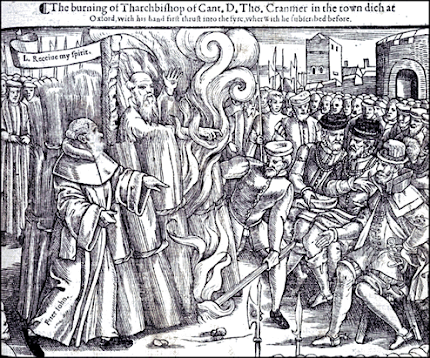
The burning of Tharchbishop of Cant. D. Tho. Cranmer in the town dich at Oxford, with his hand first thrust into the fyre, wherwith he subscribed before. [Click on the picture to see Cranmer's last words.]

Daily Bible Verse

Showing posts with label Liberal Theology. Show all posts

Tuesday, March 25, 2025

Should Women Be Ordained to Ministry? Deacons or Otherwise? Part 3


Should Women Be Ordained to Ministry? Deacons or Otherwise? Part 3


As the twentieth century has seen a great increase in the control that national governments exercise over their citizens, so too with ecclesiastical organizations there is a trend toward centralization, bureaucracy, and an indifference toward inalienable rights.  Well publicized gatherings of Protestant prelates parade in robes, and the press reports the colorful pageantry.  Impressive imitation of popery!  And the same eventual results are to be expected.

God alone is Lord of the conscience, and hath left it free from the doctrines and commandments of men, which are, in anything, contrary to His Word, or beside it, in matters of faith or worship. So that to believe such doctrines, or to obey such commands out of conscience, is to betray true liberty of conscience: and the requiring of an implicit faith, and an absolute and blind obedience, is to destroy liberty of conscience, and reason also.  . . . [WCF 20:2 WCS].

The changing majorities of a Council or General Assembly which push a conjectural translation of the Bible one year and another year issue Sunday School lessons whose conjectures are still worse, may boast that their theology is not static but dynamic.  A different doctrine every decade—while the orthodox fuddy-duddies keep on believing the same thing all the time!

But what moral chaos there is, when the law of God is abandoned for the latest style of unbelief.  It used to be [Albrecht] Ritschl’s value judgments; now it is paradox; next it will be—who can guess?

The law of God is stable because God is unchangeable.  Those who believe God do not need to change their moral principles with the passing years.  Nor will they change their worship, push the Bible to one side, put an altar in the center, pray to the saints and the Virgin, nor . . . engage a troupe of ballet dancers to fill an empty pulpit.

Dr. Gordon H. Clark.  Essays on Ethics and Politics.  John Robbins, ed.  (Jefferson:  Trinity Foundation, 1992).  Pp. 21-22.


I make the above point because it seems that the larger a denomination becomes, the more centralized its ecclesiastical polity becomes.  I am currently attending a new church plant in Lexington, South Carolina.  It is already becoming apparent that the pastor and the elders do not want any sort of dissent as that would cause a problem with “the peace, purity, and prosperity of this congregation as long as” I am “a member of it.”  I am referring to the Associate Reformed Presbyterian Church as a denomination.  The general synod in 1969 made the decision to allow the ordination of women as deacons; however, it was determined that each session or church within the denomination could decide whether or not to ordain women to the church office of the deaconate or deacon.  

This is a strong indication that there are liberals within the denomination who wish to have women ordained to every church office.  [See:  Women in the Life of the Church: A Position Paper Approved by the General Synod of the Associate Reformed Presbyterian Church:   June 2005”.]  I was shocked to see that one of the authors and signatories on this document was Rev. William B. Evans.  Evans recently announced that he was leaving the ARPC and joining the PCUSA.  His reason is detailed in a blog article he posted here:  A Change in Ecclesial Affiliation for the Ecclesial Calvinist!  Obviously, Mr. Evans is one of the liberals whom I mentioned.  He argues in 2005 that the reason for decline in the ARPC is holding true to the fundamentals.  In order for the denomination to grow, it must accommodate to the times and the culture:

By 2010 or so, however, I sensed that the ARP Church had lost its sense of identity and direction.  When I served as Moderator of the ARP General Synod in 2005 I warned the body that a dire situation awaited if the church did not recover a coherent identity and sense of mission.  Serving on the subsequent General Synod Vision and Strategic Planning Committees reinforced the sense that we were wandering in the weeds and on the edge of precipitous decline.  As a church historian I knew the story well—that ARP identity had historically been predicated on certain praxis distinctives (exclusive psalmody, non-instrumental worship, strict Sabbatarianism, and closed communion), and that by the mid-20th century all of that had dissolved and the church was searching for a new identity.  From 2004 until 2012 I had written/edited the ARP Adult Quarterly Sunday-school curriculum, but beginning in 2012 I began to pull back from my denominational involvements to concentrate on scholarly writing and research.

During this time, I also noticed that the ARPC was becoming more rigidly conservative (largely because of the decline of Erskine Theological Seminary and the rising influence of Reformed Theological Seminary in Charlotte, NC) even as I was growing older and a bit more flexible theologically.  A clarifying moment occurred in the last few years when I chaired a Synod committee to study the issue of women serving in the diaconate in the ARPC.  The Committee presented a sensible report noting that the current policy of allowing women in the ARPC to serve as deacons has worked well for decades, that Scripture can reasonably be read either way, and that no one’s conscience is bound by the current policy.  The floor debate on the report was disheartening, and it was evident that a large minority of the court wanted to do away with women on the diaconate completely.  Particularly clarifying for me was an obviously premeditated speech by a younger minister asserting that those in favor of women in the diaconate were capitulating to the feminist and transgender agenda!  No one called him to task, and I realized at that point that the Overton window had shifted to such a point that I was in the wrong church!

It is here that Evans’s theological compromise is revealed openly.  He straightforwardly admits that he has become “more flexible” with age.  Ironically, his views seem to be inflexible when it comes to acknowledging the plain teaching of Scripture, which he claims can be “read either way.”  I am speculating that the sections in the position paper of 2005 dealing with arguments from the other side were all written by Evans because he agrees with them.  The paper quotes Evans as saying:

While traditionalists have often been tolerant of progressive thinking, they themselves are often not tolerated once women’s ordination is instantiated in a denomination.  That has been the trend in the Church of Scotland, the PCUSA and elsewhere.  The pattern here is for conservatives to be grandfathered for a time, but sooner or later ordination requirements are rewritten to include support for women’s ordination.  This is due primarily, not to liberal meanspiritedness, but to the logic of Reformed polity.  The offices of minister and elder are the foundation of the polity, and everybody has to own the polity, to accept the ground rules of the game.   Reformed churches cannot tolerate the presence of those who would challenge, even implicitly, the legitimacy of a large group of officeholders.  (ARPC Position Paper, p. 14).

Ironically, Evans laments the fact that Ligonier Ministries has had a profound effect on the denomination because many of the ministers are coming from Reformed Theological Seminary, Charlotte, North Carolina instead of Erskine Theological Seminary in Due West, South Carolina or the campus in Columbia, South Carolina.

There are other issues with the denomination, including other liberal professors at Eskine University and Erskine Theological Seminary.  The church plants that I have observed in the greater Columbia, South Carolina area have mostly followed the pragmatic approach of the church growth movement rather than the biblical mandate to make disciples.  In short, the Westminster Standards are a mere afterthought, an option.  No need to instruct the congregation in the doctrines of the Bible as summarized by the Westminster Standards.

The late Dr. Gordon H. Clark brought up another issue in regards to the ordination of a young man to the ministry:

In addition to these elements of liberty, which particularly concern us in our individual lives, Christian liberty includes liberty of conscience in the face of tyrannical ecclesiastical organizations.  Some years ago a young man presented himself to a Presbytery for ordination.  As he was known to believe that the boards and agencies of that church were infiltrated with modernism, he was asked if he would support the boards regardless of what they did.  When the young man declined to make any such blind promise, the Presbytery refused to ordain him.  [Clark, p. 21]

The church plant that I am attending in Lexington, South Carolina has a new members class.  I am facing a similar decision.  The last vow of the seven vows requires me to promise “loving obedience” and to submit myself “to the government and discipline of this church, promising to seek the peace, purity, and prosperity of this congregation as long as” I am “a member of it.”  But can I do that?  The appointed pastor of the church plant is Jeff Tell.  He is apparently following the accommodation tactics of church growth pragmatism and the leftist theology of the late Tim Keller among others, including James K.A. Smith.

Moreover, the question of the ordination of women as deacons seems to have an obvious answer when considering that the Bible is the final authority in all matters of belief, doctrine, theology, ethics, morality, worship, and practice.  (2 Timothy 3:16-17; 1 Peter 1:24-25; 2 Peter 1:19-21).  As I mentioned already in the first post, the most plain and perspicuous Scriptures against the ordination of women should apply first.  Without going into extensive and detailed exegesis of the passages, I will now show that women should not be ordained to any church office whatsoever, as ordination in the church is restricted to men only.

First, the final authority must be the Bible, not church synods.  When the doctrinal standards of the Bible and the Westminster Confession of Faith are minimized due to either cultural relativism or ecclesiastical tyranny, it becomes necessary for the laity to stand against such accommodation to culture.  The Bible makes it very clear that the deaconate is restricted to men only, just as the offices of teaching and ruling elders are restricted to men only:

2 A bishop then must be blameless, the husband of one wife, . . . (1 Timothy 3:2 KJV).

12 Let the deacons be the husbands of one wife, . . . (1 Timothy 3:12 KJV)

I should point out that the Bible nowhere makes a distinction between ruling elders, who handle the administration of the church, and teaching elders who handle the preaching of the word and the administration of the two gospel sacraments.  If elders do not teach or preach, following the logic of the liberals, it would seem that the door is wide open for women to become ruling elders as well as deacons.  If any object that the deacons are only to serve tables and not to handle the preaching of the word, it should be pointed out that the deacons in the book of Acts were handpicked by the apostles.  (Acts  6:1-8).  Furthermore, the most prominent deacon mentioned in the pericope is Stephen.  He is said to perform miracles:

And Stephen, full of faith and power, did great wonders and miracles among the people. (Acts 6:8 KJV)

In other words, the office of deacon is more than just visiting widows, doing pastoral visits, or serving communion.  Even then, women should not be serving communion at the Lord’s table.  None of the men chosen by the apostles were women:

And the saying pleased the whole multitude: and they chose Stephen, a man full of faith and of the Holy Ghost, and Philip, and Prochorus, and Nicanor, and Timon, and Parmenas, and Nicolas a proselyte of Antioch: (Acts 6:5 KJV)

The clincher for this argument is that Stephen was stoned after he preached a sermon to the Jews who disagreed with the Gospel message of the apostles:

Then there arose certain of the synagogue, which is called the synagogue of the Libertines, and Cyrenians, and Alexandrians, and of them of Cilicia and of Asia, disputing with Stephen. 10 And they were not able to resist the wisdom and the spirit by which he spake. 11 Then they suborned men, which said, We have heard him speak blasphemous words against Moses, and against God. 12 And they stirred up the people, and the elders, and the scribes, and came upon him, and caught him, and brought him to the council, 13 And set up false witnesses, which said, This man ceaseth not to speak blasphemous words against this holy place, and the law: 14 For we have heard him say, that this Jesus of Nazareth shall destroy this place, and shall change the customs which Moses delivered us. 15 And all that sat in the council, looking stedfastly on him, saw his face as it had been the face of an angel. (Acts 6:9-15 KJV)

After Stephen preached the council condemned him to death by stoning.  (Acts 7:1-8:1).  Saul was there and participated in the council and the stoning of Stephen.  Does this sound like an office for women?  I think not.

As for the other passages of Scripture, most of the women mentioned are spoken of as being in the company of their husbands.  Priscilla and Aquila are emphasized by Pentecostals as a husband and wife team.  (Acts 18:2). But were they?  Pentecostals like to point out that Priscilla is mentioned first in the text.  (Acts 18:18; Romans 16:3).  But in the other occurrences, Aquila is mentioned first.  (Acts 18:2, 26; 1 Corinthians 16:19).  The Pentecostal argument that seems strongest is also weak:

And he began to speak boldly in the synagogue: whom when Aquila and Priscilla had heard, they took him unto them, and expounded unto him the way of God more perfectly. (Acts 18:26 KJV)

This is a one-time occurrence in the Bible.  As one commentator once said, a doctrine that is mentioned only once in the Bible and is contradicted by other verses is probably a weak doctrine.  Of course, how many times does God need to say something for it to be true?

Here ends this post.  In part 4 I will discuss the biblical evidence for Junia being among the apostles.  Also, I will discuss the four prophesying daughters of Philip.

Here are the links to Part 1 and Part 2 of this blog series.

Wednesday, January 15, 2025

The Free Offer of the Gospel, Common Grace, and Pragmatic Church Growth: Part 3


2. And not for ours only. He added this for the sake of amplifying, in order that the faithful might be assured that the expiation made by Christ, extends to all who by faith embrace the gospel.

Here a question may be raised, how have the sins of the whole world been expiated? I pass by the dotages of the fanatics, who under this pretence extend salvation to all the reprobate, and therefore to Satan himself. Such a monstrous thing deserves no refutation.  John Calvin’s commentary on 1 John 2:2.


The Free Offer of the Gospel, Common Grace, and Pragmatic Church Growth:  Part 3


In this blog post I will now consider how the free offer of the Gospel and the 19th and 20th century doctrine of common grace is related.  In future posts I will then show how the free offer or well meant offer of the Gospel and common grace have influenced the pragmatic approach to church growth and evangelism.

The most controversial downgrade of Calvinistic Reformed theology since the Protestant Reformation happened in 1924 when the Christian Reformed Church decided that God loves the reprobate, that the reprobate can do civic good, and that there is some hope that those who appear to be reprobate can be persuaded to accept the effectual call of the Gospel.  Of course, modern day semi-Calvinists will tell you that this is only an apparent contradiction or paradox.  The controversy at Kalamazoo, Michigan began when certain moderate theologians in the Christian Reformed Church passed the Three Points of Common Grace at the 1924 General Synod and later excommunicated the conservative Dutch Reformed pastors and theologians who dissented from the compromising document.  The deposed ministers then formed the Protestant Reformed Churches in America.  (See:  The Three Points of Common Grace).

Early on in my theological education I learned that accommodation to the surrounding culture leads to compromise, to theological liberalism and even universalism.  Even the classical Pentecostals at the Assemblies of God Bible college where I did my undergraduate studies warned students about the dangers of theological liberalism.  However, today, semi-Calvinist reformed denominations or churches are telling its laity that there is nothing to see here and that they are actually Evangelicals and conservatives.  Just recently, Dr. Neil Stewart, the senior pastor of First Presbyterian Church, which is part of the Associate Reformed Presbyterian denomination, asserted that this is one of the most conservative denominations in America.  Either Dr. Stewart is ignorant of the controversies going on behind the scenes at the presbytery level and at the denominational seminary and college, i.e. Erskine Theological Seminary, and Erskine College, or Dr. Stewart is deliberately misleading the congregants.  (See:  Dissolution of the Catawba Presbytery;  see also, William B. Evans:  A Change in Ecclesial Affiliation).

If the doctrine of common grace is true, why is it that society is waxing worse and worse and not better and better?  The basic premise of the doctrine of common grace is that God loves the entire human race but has a special love for the elect.  Unfortunately, this leaves the semi-Calvinists open to the charge of elitism.  Calvinists are special, do you not know?  The Bible, on the other hand, says that the entire human race is fallen in Adam and under the wrath of God.  (Romans 1:18-21; Romans 5:12-14).  Such love!  The apparent contradiction or paradox here is that God supposedly loves and desires the salvation of the reprobate; but the reprobate have decided to damn themselves and frustrate God’s desire to save them.  Of course, this would imply that God only reprobates them because He foresaw that they would harden their hearts and refuse to be saved.  But is this not Arminianism?  Does God need to look into the future to learn what will happen in order to make His eternal and timeless decree?

Not only is the culture and society at large getting worse, but it seems to me that Evangelical churches, colleges, and seminaries are on a downward spiral as well.  Church splits and new seminaries and colleges are formed as liberalism arises; Yet, in time these same organizations and denominations tend to drift into liberalism themselves.  Even the terms Evangelical and reformed have been redefined in ways that are foreign to their original meaning.  Even Roman Catholics today claim to be “Evangelical” if they happen to trend toward a more conservative interpretation of Romanism. 

If common grace means that the reprobate can do civil and civic good, why is woke ideology, LGBTQIA+, secular humanism, social justice, and Marxism turning the national morality on its head?  What was once generally considered evil is not called good.  (Isaiah 5:20).  Children from kindergarten age are being nurtured by irrational parents and public school teachers into the ideology of transgenderism and homosexuality.  Criminals are now the victims of society rather than lawbreakers who victimize other citizens.  The progressive left is turning homelessness and crime into virtues of victimhood rather than an undermining of the virtues of individual responsibility and hard work.

Modernism was a dismal failure as a means of ushering in the utopian of a brave new world.  World War I put an end to that fantasy.  We live in a fallen world where moral evil causes crime, wars, and totalitarian regimes.  Yet, the so-called progressive “conservatives” who promote the theology of apparent contradiction tell us that common grace means that the world is getting better.  Some of them are postmillennalists and others are amillennialists.  The amillennialists tend toward a radical separation between the kingdom of God ruled in the ecclesiastical realm and the kingdom of secularism ruled by the civil government.  The postmillennialists tend toward a theonomic view where the civil realm is made better and better through the agency of natural law and the moral law of God.  Both views compromise with the culture in order to achieve the goals of their respective theological agendas.

The problem is that there is no common ground between the Christian worldview and the worldview of secularism and secular humanism.  The world views abortion, homosexuality, and surgical trans-sexuality as morally good.  The world views criminals as victims who have no responsibility for their crimes because of systemic racism, systemic homophobia/transphobia, etc., et. al.  However, the Bible condemns all of these things as violations of God’s moral law.  Natural law is supposed to be deduced from the cultures around the world.  But if this so, why so many different views of what is right and wrong in various nations and societies around the world.  C. S. Lewis used the existence of relativistic moralism as an argument for the existence of a moral God.  However, this, too, seems to be a dismal failure.  Why?  The human mind is corrupted by the noetic effects of sin and idolatry seems to replace the biblical God at every turn.

It would seem ironic, then, that the optimism of Kuyperian common grace would so soon replace modernism just after the first world war.  Common grace, like modernism, has failed miserably at making the world a better place to live for the reprobate and for elect and believing Christians alike. 

The pragmatic church growth is the attempt to use Pelagian and Arminian ways of preaching the Gospel in an attempt to persuade the reprobate which, biblically speaking, cannot be persuaded.  Using the corporate business model of selling the unchurched a felt need, these progressive Evangelicals pretend to preserve their conservative theology while in fact selling out to the culture of woke-ism, behaviorism, and Marxism.  They claim that after these persons are persuaded into joining their churches, that the new members will be transformed by the teaching of the church.  By this means, the progressives hope to reform and transform the culture at large.  The problem is that the teaching remains obscure, equivocal, and ambiguous by hiding behind the theology of paradox.  It fails to transform individuals or society.

Here ends this blog post.  I will explain the historical roots of the church growth movement, Tim Keller’s compromise of the Reformed theology, and how this is producing psychological conversions instead of actual conversions to Calvinist and reformed Christianity in my next post.

You can read my previous posts here:  Part 1, Part 2.

The next post is Part 4.

Friday, December 13, 2024

A Short-Term Mission Trip to Nicaragua: Part One


"Some suggest that North American Pentecostalism represents an anti-cultural posture arising from an experience of deprivation or marginalization from mainstream culture.1 One response to cultural marginalization is the adoption of conservative politics and the materialistic values of consumer culture. A sense of disenfranchisement often leads to withdrawal from society or to a spiritual triumphalism.2 On the other hand, there are those who argue that Pentecostalism outside North America is developing a “theology of liberation” in response to social issues.3 The latter are described as “progressive Pentecostals” who engage issues of poverty, inequality, and ecology.4 The focus of these Pentecostals, however, is primarily on Africa, Asia, and Latin America, with little discussion about North America."   Paul Wilkinson.  "A Liberating Spirit:  Liberation Theology and the Pentecostal Movement."  The Ecumenist:  A Journal of Theology, Culture, and Society.  Vol. 4.  No. 4.  Fall, 2008.


A Short-Term Mission Trip to Nicaragua:  Part 1


Around 1986 I became a member of First Assembly of God, Wauchula, Florida.  I had been away from God for many years without attending any church on a regular basis.  My earliest memory of attending church, however, was when I was around 8 or 9 years old.  At that time my father was working as a watch and jewelry repairman at Friedman’s Jewelry Store in Anniston, Alabama.  Memories fade over time.  All I can remember is that I, being the eldest child of the family, and my next oldest sibling, Ann, was invited to church by a lady who lived several blocks away from our house on 1216 Jacksonville Street, Weaver, Alabama.  My parents made us children memorize our address and phone number in case we ever got lost or kidnapped.

Anyway, getting back to the story, the lady down the street, was the mother of a girl who rode our school bus.  The girl’s name was Tanya.  The church to which Ann and I were invited was next door to where Tanya and her mother lived.  I had never been to church in my life, but my mother agreed to allow us to go if Tanya’s mother would pick us up.  All I can remember is that Tanya’s mother drove a pretty light blue Ford Thunderbird, probably a 1964 or 1965 model.  Of course, at that time I had no idea about makes and models of cars.  I figured this out years later.

I can vaguely remember seeing on the church sign the name of the church, which was Church of God.   As I said earlier, I had no idea about church denominations at that time, because I was too young.  It turned out as I figured out years later that this particular Church of God was a Pentecostal church and part of the Church of God, Cleveland, Tennessee.  People like to joke about snake handlers and such, but this particular denomination did not and does not handle rattlesnakes, thanks be to God.

As the good Lord would have it, I had some familiarity with the Bible and had read portions of the King James Version New Testament and Psalms.  The Gideons were at that time still allowed to hand out pocket editions of the New Testament and Psalms at the beginning of every school year.  I got my first Gideon’s pocket New Testament and Psalm when I began first grade in Savannah, Georgia.  Shortly after that, we moved to Anniston, Alabama and then Weaver, near Fort McClellan.  I was forced to stop the first grade in Weaver because my birthday was too early in the year.  My mother had to re-register me the next year.

That Sunday morning, my first time ever attending a church service, must have been when I was in third grade or so.  The music was upbeat and we sang from a hymnbook published by the Church of God.  I can remember getting up early on Sunday morning in those years.  The TV we had was a black and white cathode ray tube television.  There were only two or three TV stations we could get and all of them played Gospel quartet groups or Pentecostal or Baptist church services.  The Gospel quartets sang southern Gospel songs, which at the time didn’t interest me that much.

At any rate, when the preacher began to preach, he preached in a singsong fashion, his voice rising and falling in volume and holding a certain cadence.  Later in seminary I learned that this Pentecostal style of preaching originated with black slave preachers who could not read or write.  The slave preacher would have another slave read a portion of Scripture.  The other slave who could read would most likely be a house slave who was taught to read the Bible.  Slave owners, contrary to modern propaganda, did want their slaves to be evangelized as Christians because good virtues and morality come from the moral law of God as it is recorded in the Decalogue or Ten Commandments.  The Pentecostal revival itself began in Los Angeles, California around 1906 when a black holiness preacher named William J. Seymour started a church in an old stable.  The Azusa Street Mission sparked a worldwide Pentecostal revival.  The black tradition of preaching in ways that could be easily understood by illiterate and poorly educated individuals apparently caught on.  To this day most classical Pentecostal churches still preach this way.

I digress too much.  Getting back to the story, that white Pentecostal preacher began to talk about how sinful and rebellious most people are.  He focused on the penalty of sin and how living an immoral life would send you to hell.  Most of the sermon was focused on the law of God and how those who broke God’s commandments were on the road to a terrible place of fire and brimstone.  As the preacher worked himself up, he began to shout louder and louder until every few minutes sweat would break out on his face.  He began to pace back and forth on the small platform.  It was not a large building, and the congregation could not have been more than 20 or 30 persons in all.  I remember the congregation began to shout in agreement with the pastor’s sermon, “Amen, brother!”  And, “Halleluia!  Glory to God!  Thank-you, Jesus!  Preach it, brother!”  The preacher brought out a white handkerchief and waved it around above his head as he preached.  Every now and then he would mop the sweat off his face with it and continue to shout and pace.

The congregation stood up and raised their hands above their heads, shouting in agreement at certain points in the sermon.  Then I noticed that some of them were chanting and singing in some sort of language that I did not understand.  Just prior to the sermon when the minister had accepted prayer requests, the entire congregation began praying together out loud and in these unknown tongues.  It sounded like a cacophony of voices all speaking at once.  This was supposed to represent what had happened on the day of Pentecost in Acts chapter 2.

I later learned that the Church of God and the Assemblies of God differed on this particular practice of praying out loud all at once.  Be that as it may, I do believe that the Church of God still practices this in the smaller rural churches and even in some of the larger classical Pentecostal churches.

I remember feeling moved by the message that the minister was preaching because I had read enough of the four gospels to know that there was a heaven and a hell.  I knew that hell was a terrible place of darkness and flames, weeping and wailing and gnashing of teeth.  But toward the end of the sermon the minister sudden got quieter.  He began to talk about a solution to sin and how our Lord and Savior Jesus Christ had died on the cross and shed His precious blood for sinners like me.  The minister invited everyone to come to the altar or platform and kneel for prayer and to pray for their salvation.  I did not understand much at the time, but I knew enough to know that without Jesus I would be lost and on my way to hell.  So I went forward to be saved.  I knelt with my head bowed and my eyes closed as I held my two hands together in prayer.  I remember that the preacher came down the line praying for sinners and for others to be healed of their sicknesses.  As he came to me, he laid his hands on my head and began to pray in English and in tongues.  I cannot remember exactly what he said.  However, I do remember that it had something to do with praying that God would guide me in my life and lead me to everlasting life.  I felt a chill go from the top of my head to the bottom of my feet as he prayed for me.  After the prayer line was over, the minister invited those who had accepted Christ as their personal Savior to be baptized.  He said that they should speak with him later after the service.

I went home from church that Sunday forever imprinted with the Gospel message.  I asked my mother if I could be baptized, to which she responded that I was not old enough to understand that decision.  I remember begging my father and mother to go to church with us, but they refused.  They both got really angry at times and cursed and took God’s name in vain a lot.  Both of my parents were also smokers.  Although I did not know it at the time, the Church of God, being an offshoot of the Wesleyan holiness movement, preached against smoking cigarettes as a sinful habit.  The holiness churches also emphasized that women should not dress like harlots by wearing too much makeup and jewelry or short dresses.  The women at that time wore their hair long but put it up in buns on the top of their heads, because it was seen as too erotic to let their hair down.  Women were not supposed to cut their hair, while the men were supposed to wear their hair short. 

I cannot say that my life overall changed that much.  However, I was always conscious about cursing.  God was continually on my mind.  I would look up at the stars at night and wonder where all of creation came from.

You are probably wondering what on earth all of this has to do with a short-term mission trip to Nicaragua?  I will get back to that later.  As you can see from the quote above, I am interested in the so-called progressive or liberation movement.  I wanted to share my first encounter with Pentecostalism and how that led up to a mission trip to Nicaragua in April of 1989.  I was at that time a student at Southeastern College of the Assemblies of God, Lakeland, Florida.  The school has since changed its name to Southeastern University to reflect a change from a ministerial college to a liberal arts college.

My story is complicated.  It will take several posts to lay out the groundwork for this series of posts, so please be patient.  I will be writing more in the coming days to reflect on my views on poverty, humble beginnings, and what the biblical focus of Gospel evangelism should be.

Stay Tuned for Part 2

Support Reasonable Christian Ministries with your generous donation.