>

Martyred for the Gospel

Martyred for the Gospel
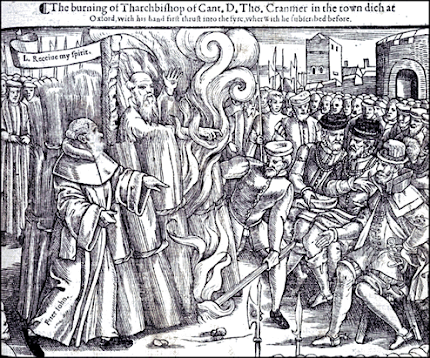
The burning of Tharchbishop of Cant. D. Tho. Cranmer in the town dich at Oxford, with his hand first thrust into the fyre, wherwith he subscribed before. [Click on the picture to see Cranmer's last words.]

Daily Bible Verse

Showing posts with label Hyper-Calvinism. Show all posts

Friday, November 10, 2023

A Brief Response to Scott Clark on Predestination and the Well Meant Offer


Indeed, in the next few lines Calvin says much the same thing: “It is unreasonable that man should scrutinize with impunity those things that the Lord has determined to be hidden in himself.… The secret of his will which he determined to reveal to us, he discovers [discloses] in his Word.”2 It is not only unreasonable to scrutinize the hidden will of God, as Calvin says; it is impossible. Knowledge of predestination is to be sought in God’s revealed will, in the Word, and in the Word alone. Let us not pry elsewhere with that curiosity that Calvin condemns, but let us not neglect to study carefully what God reveals to us and intends that we should study.


Gordon H. Clark. Predestination (Kindle Locations 97-102). The Trinity Foundation. Kindle Edition.


"But I do want to make it clear that while I am no universalist, my own inclination is to emphasize the "wideness in God's mercy" rather than the "small number of the elect" motif that has often dominated the Calvinist outlook."  Richard Mouw.


Further, if God’s will can only be spoken of in one sense, then we would become universalists! Nevertheless, we must deal honestly with God’s Word and recognize that, given the hiddenness of the divine decree, there is a genuine and true sense in which God must be said to will the salvation of all.   R. Scott Clark


A Brief Response to the Theologian of Paradox and Contradiction:  Is Denying Common Grace, the Free Offer and the Well Meant Offer Hyper-Calvinism?


I generally do not waste much time refuting an old strawman fallacy leveled at the apologetics of the late Dr. Gordon H. Clark, the Protestant Reformed Church in America, Dr. David Engelsma, and others who reject the liberal progressives in the mainstream Evangelical and Reformed movement.  Sadly, the most conservative Calvinists and Evangelicals are constantly vilified with abusive ad hominem fallacies, gaslighting, and unjustified polemics by the so-called “tolerant” and confessional Reformed academics.  I speak specifically of Dr. R. Scott Clark, a professor of theological history at Westminster Theological Seminary in Escondido, California.  R. S. Clark recently rehashed a litany of false accusations against those who refuse to accept the theology of paradox which is advocated by the students of the late Dr. Cornelius Van Til and which was advocated by Van Til himself.  You can read his article here:  Hyper-Calvinism, Rationalism, and Anti-Predestinarians.

Scott Clark is the perfect example of what happens when an earlier departure from the biblical and confessional Reformed theology begins to diverge into even greater departures from the system of propositional truth revealed in the Bible.  Dr. Gordon H. Clark traced this theology all the way back to the Romanist theologian, Thomas Aquinas, who proposed a two-fold view of truth, one for God and another humanity.  While it is true that there are differences between how an eternally omniscient, omnipotent, omnipresent, and immutable God knows everything intuitively, and how humans only know discursively and in time, it does not follow that truth changes from the Creator to the creature.  If so, then humans cannot know anything God knows.  But as Dr. Gordon H. Clark once said, does God know that 2 + 2 = 4?  Of course He does know this.  There must be a univocal connection between what God has revealed and what we know of that revelation.  This twofold view of truth, which is being advocated by the students of Cornelius Van Til, actually began with Abraham Kuyper and his influence on the Old Princeton Seminary in New Jersey and on Calvin Seminary in Grand Rapids, Michigan.  Along with that came the new liberalism of neo-orthodoxy and existentialism, which was promoted by Karl Barth, Gerhard Von Rad, Emil Brunner, and others.  These theologians wanted to curb logic and rationality because they did not believe that supernatural revelation could withstand the scrutiny of internal consistency.  Ironically, R. Scott Clark and most of the semi-Calvinists today agree more with the higher and lower liberal critics and the neo-orthodox theologians than with the twentieth century Fundamentalists and Evangelicals of Old Princeton.

Somehow, R. S. Clark believes that we must curb rationality because rationality questions supernatural revelation and attacks the Bible and the Christian worldview.  While it is certainly true that reason divorced from faith and supernaturalism results in natural religion and liberalism, it does not logically follow that philosophy cannot be subservient to Scripture.  Even Richard Muller argues for this magisterial and ministerial use of philosophy in his first volume on the what he calls Reformed dogmatics. 

(See:  Muller, Richard A. Post-Reformation Reformed Dogmatics: The Rise and Development of Reformed Orthodoxy;  Volume 1: Prolegomena to Theology. 2nd ed. Grand Rapids, MI: Baker Academic, 2003. Print.)

R. S. Clark wants to argue that he is not a rationalist because he affirms the theology of paradox as his default go to when confronted with apparent contradictions.  Instead of using the logical propositions in the Bible to solve the apparent antinomies and dilemmas, RSC wants to excuse his inability to reconcile the biblical texts to his cultural concerns and pastoral concerns as they relate to evangelism and pastoral care in the local congregation.  But this is not the approach taken by Jesus and the apostles.  Instead, they faced their opponents head on with Scripture.  However, RSC does not like Sola Scriptura that much either, and anyone who opposes his theology or exegesis of the biblical texts is gaslighted with abusive ad hominem attacks like hyper-Calvinist, biblicist, and rationalist.

Astonishingly, R. S. Clark says that the hyper-Calvinsts have more in common with universalists, presumably Arminian universalism, than with Calvinism:

Ironically, the “evangelical” universalists and the hyper-Calvinists (we should speak of “hyper-predestinarians”) deserve each other. The universalists cannot see how it is that God can freely and genuinely offer the gospel to all unless it is the case that Christ actually died for everyone who ever lived and unless it is that Christ’s death has made it possible for all to be saved if they will only do their part. Methodologically, in both cases, what their nets cannot catch are not butterflies. The limits of their intellect are the limits of what God can or cannot do.

Orthodox, confessional Calvinism does not limit God by the limits of our comprehension. We understand that God transcends our ability to comprehend Him. We may be wrong, but we really do believe that we are following God’s Word when we confess both that God has known his elect from all eternity, and that he reprobates some by passing them by, and that Christ died for those whom the Father gave to him from all eternity (pactum salutis), and that God has ordained that the gospel of free salvation through faith alone (sola fide), by grace alone (sola gratia), in Christ alone (solo Christo) should be preached and offered freely to all as a well-meant offer of the gospel.

But this is his position, not ours.  In fact, Clark openly admits that he cut his teeth in the Universalist and Unitarian church of his upbringing.  He cannot seem to divorce himself from his past and falsely projects his own universalist tendencies upon traditional and classical Calvinists who insist on a strict reading of the Reformed confessions and Calvin himself.  Common grace, which R. S. Clark promotes, is a universalist doctrine which comes amazingly close to the Arminian doctrine of common grace, with the exception that RSC admits that there are two kinds of grace; one kind of grace is special and particular to the elect and the other kind of grace is general and common to both the elect and the reprobate.   But what kind of grace is it that does not save anyone?  It’s not even the Arminian common grace because at least the Arminian common grace makes salvation a contingency.  Semi-Calvinist common grace says that God loves the reprobate, knowing that He will not save them.

Furthermore, Scott Clark conveniently fails to mention that the well meant offer means that God actually desires to save everyone while not decreeing to save everyone.  In the first case, the well meant offer is simply preaching a contingency to humans and telling them that God really does want to save everyone without exception--which is essentially lying to them, because the Bible clearly says that God will not save everyone.  If God is omnipotent, omniscient, and omnipresent, then God should be able to save everyone without exception, which is a universalism that goes well beyond what the Arminians argue for, namely libertarian free will and contingency.  If God is able to save everyone but does not do so, then it cannot be that God both desires or wills to save everyone and yet does not decree or will to save everyone.  And this is precisely the contradiction that RSC does not wish to discuss here.  Instead, he attacks his theological and apologetical opponents with polemics based on his self acknowledged ignorance of what God knows in His archetypal knowledge.

While Clark denies that he is a universalist, other promoters of the well meant offer, the free offer and common grace, such as Richard Mouw, have openly said that they hold out hope that everyone would be saved in the last day.  If this is not univeralism, I do not know what else to call it:

Throughout this discussion I have been rather free in employing the well-worn Calvinist categories of "elect" and "non-elect" or "reprobate." I make no apologies for doing so. The categories are biblical ones. Nevertheless, I do not mean to mean [sic] to imply that I actually have clear notions about how to divide the human race up into these classifications. Here too - even especially here, I am convinced - we mortals stand before a great mystery. But I do want to make it clear that while I am no universalist, my own inclination is to emphasize the "wideness in God's mercy" rather than the "small number of the elect" motif that has often dominated the Calvinist outlook. I take seriously the Bible's vision of the final gathering-in of the elect, of that "great multitude that no one could count, from every nation, from all tribes and peoples and languages," who shout the victory cry, "Salvation belongs to our God who is seated on the throne, and to the Lamb" (Revelation 7:9-10). For all I know - and for all any of us can know - much of what we now think of as common grace may in the end time be revealed to be saving grace.  . . .

Richard J. Mouw. He Shines in All That's Fair: Culture and Common Grace (Kindle Locations 1020-1027). Kindle Edition.

As we can see from the comments of Richard Mouw, the semi-Calvinists affirm Calvinism and then openly deny Calvinism because their theology requires that everything is a mystery and an apparent contradiction or paradox.  How this is different from neo-orthodoxy they are unwilling to explain, because that too would constitute “rationalism”.  Richard Mouw claims that he is not a univeralist, yet if common grace applies to the whole human race from the beginning to the end, then

much of what we now think of as common grace may in the end time be revealed to be saving grace.

Richard J. Mouw. He Shines in All That's Fair: Culture and Common Grace (Kindle Locations 1026-1027). Kindle Edition.

What Mouw is saying is based on a postmillennialist view of eschatology.  However, implicit in his remarks is that the wide road will lead to salvation and the narrow road to damnation, precisely the opposite of what Jesus said (Matthew 7:14).  It is my contention that this is deliberate on their part and a way of hiding what their true beliefs are.  Liberals do not wish to openly admit what they believe privately--much like progressives in the political sphere--so that by the time the churches realize what has happened, it is too late to turn back.  The frog in the kettle analogy comes to mind here.

If God says that not everyone will be saved and that some will go to hell by His predetermined foreknowledge and predestination, does that mean that God somehow wills to save those whom He has not decreed to election, regeneration and ultimate salvation?  Of course not.  But this is where the theology of paradox comes in to rescue the semi-Calvinists from their Arminian accusers.  The semi-Calvinists will agree with the Arminians and the universalists that both are true at the same time and in the same way.  God both desires to save the reprobates who were decreed to reprobation prior to the creation of the world, and God does not will to save them at the same time and in the same way.  This is an outright contradiction, not merely an apparent contradiction or paradox.  Any Arminian can understand that this is a contradiction. 

The Arminian solution to the problem is to make God unable to save and to make salvation merely a possibility left up to partially depraved sinners, who have had libertarian free will restored sufficiently so that the sinner can have enough common grace to make a genuine choice between salvation and damnation.  Of course, this is exactly the same view held by the semi-Calvinists, though they wish to deny it by appealing to a legitimate desire on God’s part to save those who frustrate His desire, even foreknowing that they will not accept the “free” offer.

The problem here is that God’s foreknowledge is perfect, otherwise God would not be omniscient, knowing the exact future as it will inevitably occur in historical time.  The Arminian says that God makes His election decisions based on peering into the future to learn how history will unfold once God set the creation in motion.  This smacks openly of deism whereby God creates and then has no providential control over nature, humanity, or anything else.  As the old saying goes, “Stuff happens.”  But the Arminian view entails that God must be ignorant of the future and therefore He must learn new information in order to decide who to save.  This also leads to the heresy of Open Theism.  Even Arminians once identified Open Theism as a heresy but now it has become popularized by the chief heresiarch of Arminianism, Roger Olson:

Open theism is, in my opinion, although mistaken, closer to the true heart of Arminianism than is Molinism (insofar as it uses middle knowledge to reconcile divine determinism with free will). It ought to be considered a variety of Arminianism just as, say, supralapsarianism is considered a legitimate variety of Calvinism. Calvinism is a diverse tradition.  (Is Open Theism a Type of Arminianism?).

These kinds of heresies and deviations are not just resident with the Arminians.  They exist with the post Reformation dogmatics of the semi-Calvinists as well.  In fact, there is much infighting amongst the followers of Van Til.  John Frame, for example, holds to two different existences of God to try to bridge the gap between God’s transcendence as the Creator and God’s immanence with His creation and His creatures.  Scott Oliphant has proposed using an anology of the incarnation and applying that to the Creator so that He now has this third category of covenantal properties or attributes, which allow for Him to interact with His creation.  And Richard Muller has suggested that the ectypal revelations of God in the form of the written Scriptures are actually derived from the archetypal knowledge of God, which is known only to Himself.  But if what Muller, Oliphant, and Frame says is true, it is yet another mystery or outright contradiction.  I say that because you cannot derive ectypal knowledge from an unknown archetypal knowledge which is accessible only to God Himself.  Even more telling, Muller himself acknowledges that he disagrees with Francis Turretin’s view of the ectypal and archetypal knowledge of God.  For Turretin, the distinction is not an outright contradiction or a paradox, much to the chagrin of the Van Tilians.  Turretin’s view, in fact, seems much more in tune with the late Dr. Gordon H. Clark’s view of univocity between God’s knowledge and man’s knowledge at certain points of convergence. For the irrationalists, as GHC pointed out, there is no contact between two parallel lines and therefore, creatures can know nothing whatsoever that God knows.  Muller, at least, acknowledges that ectypal knowledge is derived from God’s archetypal knowledge, implying that there are points of contact between God’s knowledge and our knowledge, not irrational parallel lines.  I am sure that Muller and the Van Tilians will disagree with my analysis but the implications are there for all to see if you read volume one of his Post-Reformation Dogmatics.

R. Scott Clark cannot understand the apparent contradiction between predestination and the general call of the Gospel, so his response is to contend for an actual contradiction which he calls a paradox.  First of all, a paradox is not an actual contradiction.  Paradoxes have logical solutions; actual contradictions have no solution.  So if God foreknows who will be saved, it is not a contradiction to say that God has never intended to save those whom He has decreed to reprobation prior to creation.  Whether the theologian opts for supralapsarianism or infralapsarianism, the decree is an eternal and timeless decree, not subject to what happens in time.  Therefore, an eternal God could not have an emotional desire to do what He has not predetermined in eternity.  God has no emotions or passions, precisely because God has no body or bodily sensations.  It is inescapable for Scott Clark that predestination ultimately determines who is saved and who is not saved, whether he likes it or not.  Predestination is a central doctrine to the doctrine of God and the trinity.  If God is sovereign, then predestination is an essential attribute of God’s eternal will, His eternal omniscience, and His eternal omnipresence.  

Dr. Gordon H. Clark solved the problem of predestination versus the general call of the Gospel.  However, he is not the first to do so.  There were many of the primary reformers who also solved this problem.  John Calvin’s distinction between remote and proximate causation is just one example.  Scott Clark claims to believe in predestination; but then he sweeps predestination under the rug because he does not want to actually discuss the doctrine or any solutions to the paradox.  This is why Dr. Gordon H. Clark referred to these men as semi-Calvinists.  

R. Scott Clark openly admits that he is neo-orthodox and universalist, in the Arminian sense at least, by his remarks at the end of his article.  He says that there is no point of contact between the written word of God and RS Clark's view of the well meant offer, which is always in the mysteries of God's hidden and archetypal knowledge:

To my hyper-Calvinist friends and correspondents, I was reminded by a post on Reformation Theology by John Samson, of this verse: “Who desires all people to be saved and to come to the knowledge of the truth” (1 Tim 2:4). The English verb “to desire” translates the Greek verb which is usually translated “to will” (θελειν). Against the free or well-meant offer, it has been argued that we cannot speak of God’s will in two aspects or in two ways, that we must speak univocally. Univocity, however, assumes an intersection between the divine and human intellect, and that is, of course, a form of rationalism. It is not Reformed theology, which is premised on the Creator-creature distinction.

Further, if God’s will can only be spoken of in one sense, then we would become universalists! Nevertheless, we must deal honestly with God’s Word and recognize that, given the hiddenness of the divine decree, there is a genuine and true sense in which God must be said to will the salvation of all. It is in light of this sort of biblical language that the Reformed faith has historically taught the substance of what has come to be called the “free” or “well-meant” offer of the gospel.

Ibid., R. Scott Clark. 

There is a reason that R. Scott Clark does not like the doctrine of predestination.  It is because he knows that the well meant offer and the free offer of the Gospel, as defined by RSC and other semi-Calvinists, directly contradicts what the Bible plainly says about predestination.  If God foreknows that particular individuals will not receive regeneration and believe, then obviously election cannot be conditional as the free offer of the Gospel entails.  Election is particular and foreknowledge of who is elect and reprobate is an immutable decree of God (Romans 9:11-13).  Simply because we do not know who is elect or reprobate does not entail that God both decrees particular individuals to election and reprobation, and that God does not decree particular individuals to election and reprobation.  Scott Clark wants there to be contingencies and possibilities in God's immutable mind so that he can preach an Arminian gospel of possibility.  Even the late R. C. Sproul recognized that he could not tell an unbelieving person that Jesus died for their sins.  There is no way to know that unless you're preaching contingencies.  Ironically and paradoxically, it is Scott Clark who is the universalist, and he openly admits that his view is not founded on the Scriptures but in his theology of paradox!

I will be making more remarks on the topic of predestination in the next series of posts.  I am currently reading Richard Muller’s first volume of Post-Reformation Dogmatics.  He apparently thinks that later departures from the earlier positions taken by the initial Protestant Reformers trumps what the first generation Reformers said.  Muller also tries to read his own views into the post-Reformation theologians rather than letting them speak in their own terms.  I have many examples of this, and there is more to follow.

[Postscript:  1 Timothy 2:4 means that God wants to save His elect from every class of mankind, high and low.  It does not literally mean universal salvation for all of mankind as the Arminians, the Unitarian Universalists, and the common grace Semi-Calvinists contend.  The general call of the Gospel does not prove that God literally desires to save everyone head for head, as the purveyors of paradox contend.  Rather, the general call of the Gospel is preached to all indiscriminately because we do not know whom God has individually elected.  He wants us to preach to all so that the elect may be gathered from all nations and classes of men.  The common grace people take this is as a contradiction with no solution.  See Calvin's Commentaries: 

4. Who wishes that all men may be saved. Here follows a confirmation of the second argument; and what is more reasonable than that all our prayers should be in conformity with this decree of God?

And may come to the acknowledgment of the truth. Lastly, he demonstrates that God has at heart the salvation of all, because he invites all to the acknowledgment of his truth. This belongs to that kind of argument in which the cause is proved from the effect; for, if “the gospel is the power of God for salvation to every one that believeth,” (Rom. 1:16,) it is certain that all those to whom the gospel is addressed are invited to the hope of eternal life. In short, as the calling is a proof of the secret election, so they whom God makes partakers of his gospel are admitted by him to possess salvation; because the gospel reveals to us the righteousness of God, which is a sure entrance into life.

Hence we see the childish folly of those who represent this passage to be opposed to predestination. “If God,” say they, “wishes all men indiscriminately to be saved, it is false that some are predestinated by his eternal purpose to salvation, and others to perdition.” They might have had some ground for saying this, if Paul were speaking here about individual men; although even then we should not have wanted the means of replying to their argument; for, although the will of God ought not to be judged from his secret decrees, when he reveals them to us by outward signs, yet it does not therefore follow that he has not determined with himself what he intends to do as to every individual man.

But I say nothing on that subject, because it has nothing to do with this passage; for the Apostle simply means, that there is no people and no rank in the world that is excluded from salvation; because God wishes that the gospel should be proclaimed to all without exception. Now the preaching of the gospel gives life; and hence he justly concludes that God invites all equally to partake salvation. But the present discourse relates to classes of men, and not to individual persons; for his sole object is, to include in this number princes and foreign nations. That God wishes the doctrine of salvation to be enjoyed by them as well as others, is evident from the passages already quoted, and from other passages of a similar nature. Not without good reason was it said, “Now, kings, understand,” and again, in the same Psalm, “I will give thee the Gentiles for an inheritance, and the ends of the earth for a possession.” (Ps. 2:8, 10.)

In a word, Paul intended to shew that it is our duty to consider, not what kind of persons the princes at that time were, but what God wished them to be. Now the duty arising out of that love which we owe to our neighbour is, to be solicitous and to do our endeavour for the salvation of all whom God includes in his calling, and to testify this by godly prayers.

Calvin's commentary on 1 Timothy 2:4.

Calvin, John, and William Pringle. Commentaries on the Epistles to Timothy, Titus, and Philemon. Bellingham, WA: Logos Bible Software, 2010. Print.]


Wednesday, September 04, 2019

A Response to Phil Johnson's Article on Hyper-Calvinism


A Response to Phil Johnson’s Article on Hyper-Calvinism

Although the article by Phil Johnson is an old and dated one, I have decided to respond to it again because it is continually used to attack classical Calvinists who are not hyper-Calvinists at all.  Worse, the opening definition of hyper-Calvinism in the article is a quote from a high church Anglo-Catholic named Peter Toon, who is now deceased but was a priest in the Church of England and then transferred to the Anglican Church in North America.  Right from the get go Phil Johnson gives a wrong definition of hyper-Calvinism based on an equivocal definition.  I should also mention that Johnson himself is supposed to be a Baptist and a Calvinist but he is now working for John MacArthur.  Toon defines hyper-Calvinism this way:

1. [Hyper-Calvinism] is a system of theology framed to exalt the honour and glory of God and does so by acutely minimizing the moral and spiritual responsibility of sinners . . . It emphasizes irresistible grace to such an extent that there appears to be no real need to evangelize; furthermore, Christ may be offered only to the elect. . . .

    2. It is that school of supralapsarian 'five-point' Calvinism [n.b.—a school of supralapsarianism, not supralapsarianism in general] which so stresses the sovereignty of God by over-emphasizing the secret over the revealed will of God and eternity over time, that it minimizes the responsibility of sinners, notably with respect to the denial of the use of the word "offer" in relation to the preaching of the gospel; thus it undermines the universal duty of sinners to believe savingly in the Lord Jesus with the assurance that Christ actually died for them; and it encourages introspection in the search to know whether or not one is elect. [Peter Toon, "Hyper-Calvinism," New Dictionary of Theology (Leicester: IVP, 1988), 324.]
[From:  A Primer on Hyper-Calvinism, by Phil Johnson].

My first objection to this definition is that it sets up a straw man fallacy in the first sentence.  The Bible nowhere minimizes human responsibility and neither does the Westminster Confession or the Belgic Confession.  Both of these confessions teach that sanctification is a necessary response to justification by faith alone and even faith is a gift of God, not something that someone can conjure up by their own moral strength.  Secondly, it is false to assert that Evangelism is unnecessary.  The fact of the matter is that Calvinism makes evangelism essential for two reasons.  The first is that God commands it in Matthew 28:18-20; Mark 16:15-16; Colossians 1:23.  Secondly, the Bible teaches that natural theology and natural revelation provides insufficient information for saving faith.  (Romans 1:18-21; Romans 2:12-16).  And the last sentence in paragraph 1 is an outright deception when Toon asserts that “Christ may be offered only to the elect . . .”  It is impossible to tell an unbeliever that Christ died for them because it might not be true.  If Christ has died for them then the sin of unbelief will be overcome by the irresistible grace of God.  It is not that Calvinists do not preach repentance and the wrath of God to unbelievers.  They certainly do.  But it is also not true that only those who repent are offered Christ.  Even though the general call of the Gospel is preached to all indiscriminately, the fact is that only the elect can respond to the command to repent and believe the Gospel because they alone will be enabled by the monergistic work of God to repent and believe the Gospel.  (Matthew 22:14; John 3:3-8; 1 Peter 1:23; John 1:13; Romans 9:15-16; 1 John 5:1).

In paragraph 2 Toon repeats his accusation that the sovereignty of God makes man not responsible for his sins.  But worse Toon says that in order to “offer” the Gospel or preach the general call of the Gospel the minister must also tell his hearers that they have “the assurance that Christ actually died for them.”  [Ibid.].  This absolutely not what the Bible says at all.  Scripture teaches that Christ died only for the elect and that the atonement is particularly for the elect and the elect only.  To be sure the Westminster Confession of Faith does teach a distinction between the general call of the Gospel and the effectual call of God through the same message.  However, this is not the same thing as defining the free offer as God’s sincere desire to save those for whom Christ did not die and whom God did not unconditionally elect in eternity before creation.

Westminster Confession of Faith:  Chapter VIII.  Of Christ the Mediator.

6.      Although the work of redemption was not actually wrought by Christ till after His incarnation, yet the virtue, efficacy, and benefits thereof were communicated unto the elect, in all ages successively from the beginning of the world, in and by those promises, types, and sacrifices, wherein He was revealed, and signified to be the seed of the woman which should bruise the serpent’s head; and the Lamb slain from the beginning of the world; being yesterday and today the same, and for ever. (Gal. 4:4–5, Gen. 3:15, Rev. 13:8, Heb. 13:8)

The Westminster Confession of Faith. Oak Harbor, WA: Logos Research Systems, Inc., 1996. Print.

Another implication of Toon’s remarks in the dictionary definition of hyper-Calvinism is that men are not responsible to God if double predestination is true.  This could not be further from the truth.  Even the Muslim who is born in Saudi Arabia is without excuse and will be held responsible and accountable for his or her unbelief.  That’s because even if natural revelation is insufficient information for saving faith, it is enough information to leave the unbelieving pagan of foreign lands without excuse.  (Romans 1:18-21).  There are no rights that God owes to fallen humanity because Adam brought the curse on all mankind.  The whole lump is leavened with sin and guilt and we are all guilty of Adam’s first sin as well as our own inherent sinful hearts and our own actual sins.  On all these accounts we are responsible to God and He will judge us on the basis of the covenant of works unless we are born again of the Holy Spirit and effectually called to saving faith.  There are many other examples I could give from Scripture, including Phineas and Hophni but they were warned by their father Eli and still refused to believe because it was God’s purpose to kill them.  (1 Samuel 2:12-25).  The fact of the matter is that Calvinists are much more motivated to evangelize because we know that unless the unbeliever hears the general call of the Gospel he or she cannot receive the effectual call.  We know this because the apostle Paul says so in Romans 10:9-17.

Now as to Toon’s accusation that emphasizing God’s sovereignty encourages introspection to determine whether or not one is elect of God, I think Toon is again creating a straw man to demolish what the Bible and the Westminster Confession of Faith does not teach.  It is surely true that there are many hypocrites in the visible churches.  It is also true that many have a false assurance of salvation because they are living a life that is essentially slavery to sin and licentiousness.  But does this mean that no Christian can attain assurance of salvation?  Certainly not!  Even the apostle Peter says that assurance is attainable: 

Therefore, brethren, be even more diligent to make your call and election sure, for if you do these things you will never stumble; (2 Peter 1:10 NKJV). 

Now to Him who is able to keep you from stumbling, And to present you faultless Before the presence of His glory with exceeding joy, 25 To God our Savior, Who alone is wise, Be glory and majesty, Dominion and power, Both now and forever. Amen. (Jude 1:24-25 NKJV).

Moreover, the entire epistle of 1 John is about sanctification and how loving God means obeying His commandments.  And toward the end of the epistle in 1 John 5:13 we are told that assurance of salvation is the reason that John is writing to the readers:

These things I have written to you who believe in the name of the Son of God, that you may know that you have eternal life, and that you may continue to believe in the name of the Son of God. (1 Jn. 5:13 NKJV).

When I first read Johnson’s article years ago I did not realize all the implications of what he was saying.  But now that I am better informed it is shocking to go back and read his remarks.  He starts off by quoting a known Tractarian, namely Peter Toon.  In his opening paragraph he refers to John Piper and Thomas Schreiner.  Both of these men have been associated with the Federal Vision error and Piper went so far as to invite Doug Wilson to one of his theological conferences.  Typical of semi-Calvinists, Johnson appeals to the doctrine that there are two wills in God’s eternal mind.  These two wills appear to be in direct contradiction to the other because God’s eternal will is immutable and unchangeable while God’s permissive will is a well meant desire to save everyone without exception, including the reprobate.  But does the Bible or the Westminster Confession teach that there are two wills in God?  The answer has to be no.  (Ephesians 1:11; Isaiah 14:24-27; 46:9-11).  In fact, John Calvin did not teach this doctrine and neither did Martin Luther.  Luther makes it very plain that God’s foreknowledge is immutable and that the human will is in bondage to God’s sovereign will:

Sect. IX.—THIS, therefore, is also essentially necessary and wholesome for Christians to know: That God foreknows nothing by contingency, but that He foresees, purposes, and does all things according to His immutable, eternal, and infallible will. By this thunderbolt, “Free-will” is thrown prostrate, and utterly dashed to pieces. Those, therefore, who would assert “Free-will,” must either deny this thunderbolt, or pretend not to see it, or push it from them. But, however, before I establish this point by any arguments of my own, and by the authority of Scripture, I will first set it forth in your words.

Are you not then the person, friend Erasmus, who just now asserted, that God is by nature just, and by nature most merciful? If this be true, does it not follow that He is immutably just and merciful? That, as His nature is not changed to all eternity, so neither His justice nor His mercy? And what is said concerning His justice and His mercy, must be said also concerning His knowledge, His wisdom, His goodness, His will, and His other Attributes. If therefore these things are asserted religiously, piously, and wholesomely concerning God, as you say yourself, what has come to you, that, contrary to your own self, you now assert, that it is irreligious, curious, and vain, to say, that God foreknows of necessity? You openly declare that the immutable will of God is to be known, but you forbid the knowledge of His immutable prescience. Do you believe that He foreknows against His will, or that He wills in ignorance? If then, He foreknows, willing, His will is eternal and immovable, because His nature is so: and, if He wills, foreknowing, His knowledge is eternal and immovable, because His nature is so.

From which it follows unalterably, that all things which we do, although they may appear to us to be done mutably and contingently, and even may be done thus contingently by us, are yet, in reality, done necessarily and immutably, with respect to the will of God. For the will of God is effective and cannot be hindered; because the very power of God is natural to Him, and His wisdom is such that He cannot be deceived. And as His will cannot be hindered, the work itself cannot be hindered from being done in the place, at the time, in the measure, and by whom He foresees and wills.

And John Calvin is crystal clear as well that God has only one immutable and eternal will:

2. God’s will is the rule of righteousness*

To the pious and moderate and those who are mindful that they are men, these statements should be quite sufficient. Yet because these venomous dogs spew out more than one kind of venom against God, we shall answer each individually, as the matter requires.

Foolish men contend with God in many ways, as though they held him liable to their accusations. They first ask, therefore, by what right the Lord becomes angry at his creatures who have not provoked him by any previous offense; for to devote to destruction whomever he pleases is more like the caprice of a tyrant than the lawful sentence of a judge. It therefore seems to them that men have reason to expostulate with God if they are predestined to eternal death solely by his decision, apart from their own merit. If thoughts of this sort ever occur to pious men, they will be sufficiently armed to break their force even by the one consideration that it is very wicked merely to investigate the causes of God’s will. For his will is, and rightly ought to be, the cause of all things that are. For if it has any cause, something must precede it, to which it is, as it were, bound; this is unlawful to imagine. For God’s will is so much the highest rule of righteousness that whatever he wills, by the very fact that he wills it, must be considered righteous. When, therefore, one asks why God has so done, we must reply: because he has willed it.5 But if you proceed further to ask why he so willed, you are seeking something greater and higher than God’s will, which cannot be found. Let men’s rashness, then, restrain itself, and not seek what does not exist, lest perhaps it fail to find what does exist. This bridle, I say, will effectively restrain anyone who wants to ponder in reverence the secrets of his God. Against the boldness of the wicked who are not afraid to curse God openly, the Lord himself will sufficiently defend himself by his righteousness, without our help, when, by depriving their consciences of all evasion, he will convict them and condemn them.

And we do not advocate the fiction of “absolute might”; because this is profane, it ought rightly to be hateful to us. We fancy no lawless god who is a law unto himself. For, as Plato says, men who are troubled with lusts are in need of law; but the will of God is not only free of all fault but is the highest rule of perfection, and even the law of all laws.6 But we deny that he is liable to render an account; we also deny that we are competent judges to pronounce judgment in this cause according to our own understanding. Accordingly, if we attempt more than is permitted, let that threat of the psalm strike us with fear: God will be the victor whenever he is judged by mortal man [Ps. 51:4; cf. 50:6, Vg.].

Calvin, John. Institutes of the Christian Religion & 2. Ed. John T. McNeill. Trans. Ford Lewis Battles. Vol. 1. Louisville, KY: Westminster John Knox Press, 2011. Print. The Library of Christian Classics.

Dr. Gordon H. Clark agreed with Luther and Calvin that all things happen of necessity and that God has only one will.  Clark shocked his detractors by saying that if a man shoots his wife it was God’s will.  This is another reason that Clark was falsely accused of hyper-Calvinism.  But the fact of the matter is that Dr. Clark also recognized that a man is fully accountable to God for what that man does.  As Calvin says above, we must give an account to God and God does not give an account to any creature.  What God does is right because He is God and there is no one to hold God accountable.  Since the law of God is written in man’s heart by way of the image of God it logically follows that man is without excuse.  (Romans 1:18-21; Romans 2:11-16; Genesis 1:26-27, 5:1, 9:6; John 1:9; 1 Corinthians 11:7).  If a man shoots his wife not only will the civil and criminal courts convict him of murder and sentence him to prison or death, but he will also suffer the penalty of hell should he not repent.  Determinism means that the criminal penalties are also God’s will and criminal laws are meant to deter crime, not to excuse the perpetrator as a victim of an unjust social system.  (Genesis 9:6;  Romans 13:1-5).

Continuing with Johnson’s article he defines the word “offer” in a way that is not in agreement with the Westminster Confession of Faith or any other Reformed creed or confession:

Second, take note of the stress the above definition places on hyper-Calvinists' "denial of the use of the word 'offer' in relation to the preaching of the gospel." This is virtually the epitome of the hyper-Calvinist spirit: it is a denial that the gospel message includes any sincere proposal of divine mercy to sinners in general.  (Ibid.).

The first problem with Johnson’s definition is that he gives no scriptural support for his contention that the preaching of the Gospel includes the term “offer” or any reference to any Reformed confession that the term offer is used.  The second problem is that he makes the proposition that the Gospel “is a sincere proposal of divine mercy to sinners in general.”  Framing the issue this way ignores the fact that the Gospel message nowhere promises divine mercy to all sinners without exception.  Jesus certainly did not promise divine mercy to the Pharisees.  He said that they could not believe because they were not His sheep.  (John 10:26-27).  We are not Jesus, obviously.  But even Calvinists today do not tell unbelievers that Jesus died for them or that God sincerely desires to save everyone.  We preach that all who will repent will receive mercy.  But even here we are also not afraid to preach the distinction between the general call of the Gospel and the effectual call of the Gospel which only the elect receive.  (  Matthew 22:14; John 3:3-8; John 6:37-44, 65). 

When the Canons of Dort say that as many as are called are unfeignedly called, the paragraph is in reference to the effectual call, not the general call of the Gospel.  There is no contradiction between the general call and the effectual call because when God calls only the elect are enabled to actually answer the call.   (Canons of Dort, 3rd and 4th Heads of Doctrine, Articles 8-14).   Article 9 specifically denies that it is God’s fault if there are those who refuse to believe the general call of the Gospel.  And Article 12 specifically points out that the effectual call is monergistic and not synergistic so that the will does not cooperate in regeneration whatsoever.  Worse, Article 13 says that moral persuasion and the external call of the Gospel is not what causes the message to be effectual.  This makes one wonder why modern proponents of the free offer put so much emphasis on persuasion, emotional appeals, and equivocation in regards to the doctrines of unconditional election, particular atonement, and irresistible grace?  The bottom line here is that Article 14 makes it impossible to consistently profess to be a Calvinist while preaching a general grace:

ARTICLE 14

Faith is therefore to be considered as the gift of God, not on account of its being offered by God to man, to be accepted or rejected at his pleasure, but because it is in reality conferred upon him, breathed and infused into him; nor even because God bestows the power or ability to believe, and then expects that man should by the exercise of his own free will consent to the terms of salvation and actually believe in Christ, but because He who works in man both to will and to work, and indeed all things in all, produces both the will to believe and the act of believing also.  (Canons of Dort:  3rd and 4th Heads of Doctrine).

Historic Creeds and Confessions. electronic ed. Oak Harbor: Lexham Press, 1997. Print.

These articles alone ought to be enough to silence the critics of classical Calvinists who have been falsely accused of hyper-Calvinism.  The fact that the main definition was written by a semi-pelagian, namely Peter Toon, who falsely claimed to be a Calvinist should raise red flags.  I should also point out to the reader that Peter Toon was a member of the Anglican Church in North America, a decidedly Anglo-Catholic denomination which has little to no tolerance for actual Protestant Evangelicals who believe the five solas of the Protestant Reformation and hold to the 39 Articles of Religion as Protestant and Calvinist confession of faith.  (See also:  The Anglican Way, by Gerald Bray).  Toon is easily proved to be a Tractarian because of his support for the 1928 Book of Common Prayer here in the USA rather than the 1662 Book of Common Prayer which is used by the Church of England.  The 1928 BCP has prayers for the dead among other problems.  (See:  What’s Wrong with the 1928 Book of Common Prayer, by Robin Jordan).  To be sure Johnson should be faithful at least to the 1689 London Baptist Confession of Faith instead of quoting a known Anglo-Catholic.

Johnson only digs himself a deeper hole when he says:

Third, mark the fact that hyper-Calvinism "encourages introspection in the search to know whether or not one is elect." Assurance tends to be elusive for people under the influence of hyper-Calvinist teaching. Therefore, hyper-Calvinism soon degenerates into a cold, lifeless dogma. Hyper-Calvinist churches and denominations tend to become either barren and inert, or militant and elitist (or all of the above).  (Ibid.).

The first problem here is that the Westminster Confession of Faith does not teach that everyone who has saving faith also has assurance of salvation.  This is easy enough to see in chapter XVIII, Of Assurance of Grace and Salvation.  The first section says that there are many who have false assurance and are hypocrites.  I am taking this to mean that the doctrine of once saved always saved produces many hypocrites who are actually libertines or lawless antinomians rather than believers with a true and living faith who are sincerely endeavoring to walk in obedience to Christ as evidence of their love for Him.  Section 3 specifically says that new believers often do not immediately attain assurance of salvation:

3.      This infallible assurance doth not so belong to the essence of faith, but that a true believer may wait long, and conflict with many difficulties, before he be partaker of it: (1 John 5:13, Isa. 50:10, Mark 9:24, Ps. 88, Ps. 77:1–12) yet, being enabled by the Spirit to know the things which are freely given him of God, he may, without extraordinary revelation in the right use of ordinary means, attain thereunto. (1 Cor. 2:12, 1 John 4:13, Heb. 6:11–12, Eph. 3:17) And therefore it is the duty of every one to give all diligence to make his calling and election sure, (2 Pet. 1:10) that thereby his heart may be enlarged in peace and joy in the Holy Ghost, in love and thankfulness to God, and in strength and cheerfulness in the duties of obedience, (Rom. 5:1–2, 5, Rom. 14:17, Rom. 15:13, Eph. 1:3–4, Ps. 4:6–7, Ps. 119:32) the proper fruits of this assurance; so far is it from inclining men to looseness. (1 John 2:1–2, Rom. 6:1–2, Tit. 2:11–12, 14, 2 Cor. 7:1, Rom. 8:1, 12, 1 John 3:2–3, Ps. 130:4, 1 John 1:6–7).

The Westminster Confession of Faith. Oak Harbor, WA: Logos Research Systems, Inc., 1996. Print.

Section 4 says specifically that when a true believer falls into a grievous sin he or she may for a time lose the assurance of salvation.  But notice that this is not based on subjective or mystical introspection but rather on the objective revelation of God’s moral law and the Christian’s duty to keep the moral law as evidence before the visible church that he or she has a valid profession of faith.  (James 2:1-26; 1 John 2:3; 1 John 3:14,18–19,21,24; 1 John 5:13).   Presbyterians do not determine who is actually elect or regenerate as a basis for church membership.  Rather the new convert is interviewed by the pastor and the elders to determine if the person has an adequate understanding of the Gospel and whether or not the person has repented of their sins and believes the Gospel.  Baptists often presume to know that a new convert who has been baptized is actually a regenerate and elect believer.  Only God is omniscient and has absolute knowledge of who belongs to him.  (2 Timothy 2:19).  Church discipline is also a matter of deterrence since those who are in open disobedience and grievous sins are to be excommunicated.  (1 Corinthians 5:1-5).

I do not know what Johnson means by the derogatory remarks about Calvinism being a dead orthodoxy.  This is actually an old accusation that has been continually leveled at the Puritans by Arminians, Anabaptists, and Papists.  But since when is an emotional response necessary for saving faith?  Emotions are sensations of the body and completely unnecessary as confirmation of repentance or even faith.  Emotions are not necessarily a sign of holiness either.  I’m sure that fornicators and adulterers and homosexuals all have emotional attachments but does that make their sin holy?  Worse for Johnson the doctrine of total depravity means that every part of the human nature is corrupted by sin, including the human emotions and the physical body.  And what about militant?  Thinking logically and biblically hardly means a person necessarily becomes militant or polemical.  But were not Jesus and the apostles “militant”?  Jesus even said that we should take the kingdom of heaven by force.  (Matthew 11:12).  I find it even more strange that a professing Calvinist would accuse Calvinists of being “elitists”.  Anyone familiar with the Bible or the Reformed confessional standards knows that the doctrine of original sin means that the whole human race is fallen and no one deserves to be saved.  Salvation is by grace and grace alone.  (Ephesians 2:8-10).  Unbelievers often accuse Christians of all stripes of being holier-than-thou.  But does the accusation make the message a message of self-righteousness rather than a message of sovereign grace?  I do not believe it to be so.  Likewise, just because Arminians accuse Calvinists of elitism does not make the accusation true.  It is in fact just the opposite since Arminians can boast that they believed the Gospel while the next guy did not and both have libertarian free will.  The difference between the two according to Arminianism is that the believer did the right thing and the unbeliever did not do the right thing.   Therefore, the Arminian is an elitist who has something to boast about.  (Ephesians 2:8-9).

Johnson outlines his own definition of hyper-Calvinism in five points toward the end of the article.  A minister from the Protestant Reformed Church in America, Martyn McGeown, has already written an article addressing Johnson’s contentious five points.  Rather than addressing them again myself I refer the reader to McGeown’s remarks in this article:  An Answer to Phil Johnson’s “A Primer on Hyper-Calvinism”.

The reader is also referred to an article I did on my blog last summer:  Hyper-Calvinism, Common Grace, Libertarianism and the Simplicity of God (Part 1) and Part 2.


Wednesday, November 14, 2018

Hyper-Calvinism, Part 2


Hyper-Calvinism, Common Grace, Libertarianism and the Simplicity of God (Part 2)


[See:  Part 1]


Common Grace


The reader will have to forgive me if I take an ad hoc approach to my blog posts as my time is limited and I do work a full time job.  My posts are sometimes sporadic for that reason.  However, at this point I would like to consider the three points of common grace and why I think Herman Hoeksema, David Engelsma and other fine Protestant Reformed theologians have correctly assessed the problem with common grace and why it leads to skepticism and even liberalism.  For one thing, the doctrine of common grace presupposes that all men are basically good except that they are partially depraved due to Adam’s original sin.    Obviously, this undermines the view that humankind or mankind has been totally depraved or totally corrupted by the curse of sin since the rebellion of Adam as the federal head of the human race.  (Romans 5:12-21).  Whenever mankind has tried to use his knowledge it is usually to build idolatrous edifices to reach heaven and to assert his own sovereignty over creation apart from submission to Almighty God.  The biblical example is the tower of Babel but in modern times technology, empirical science, secular philosophy, and political science have all been used to usurp God’s sovereignty and to deny God’s very existence.  (Genesis 11:1-9 KJV; 1 Timothy 6:20 KJV; 2 Timothy 3:7 KJV).


For one thing, common grace undermines the doctrine of total depravity.  Total depravity does not refer to the degree of an individual’s wickedness but to the extent of the corruption of sin in the human nature.  The human nature or being includes the human body and the soul.  Within the soul there are the further distinctions between the volition or will and the intellect and the emotions.  However, the late Dr. Gordon H. Clark would say that the emotions are strictly a result of bodily sensations and would not include the emotions as part of the human soul.  Although I somewhat agree that the body produces emotional reactions and sensations, I do recognize that there is interaction between the soul or heart of man and the physical body and these emotional responses do affect the mind or soul.  Moreover, Clark further contended that since God is a spirit (John 4:24) it logically follows that man is a soul living in a body and that the soul is the image of God, not the human body.  Some have falsely accused Clark of Gnosticism on this account but that does not follow since it is the Bible which says that the soul lives on in a disembodied state after death until the resurrection for the final judgment of both the elect and the reprobate.  (2 Corinthians 5:6-8 KJV).  God does judge what we do in the body and the body is not the source of our sinful corruptions, rather the original sin of Adam brought the curse of total depravity or total inability on man’s soul and the curse of sin is passed on from the souls of Adam and Eve to all their posterity by way of natural generation.  Dr. Clark rejected the view that each soul is created with a sinful corruption by God but rather accepted the traducian view espoused by W. G. T. Shedd in his systematic theology.


. . . the theological argument strongly favors traducianism. The imputation of the first sin of Adam to all his posterity as a culpable act is best explained and defended upon the traducian basis. The Augustinian and Calvinistic anthropologies affirm that the act by which sin came into the world of mankind was a self-determined and guilty act and that it is justly chargeable upon every individual man equally and alike. But this requires that the posterity of Adam and Eve should, in some way or other, participate in it. Participation is the ground of merited imputation, though not of unmerited or gratuitous imputation (Shedd on Rom. 4:3, 8). The posterity could not participate in the first sin in the form of individuals, and hence they must have participated in it in the form of a race. This supposes that the race-form is prior to the individual form, that man first exists as a race or species and in this mode of existence commits a single and common sin. The individual, now a separate and distinct unit, was once a part of a greater whole. Westminster Shorter Catechism Q. 16 asserts the commission of a common sin in the following terms: “All mankind, descending from Adam by ordinary generation, sinned in him and fell with him in his first transgression.” The term mankind denotes here the human nature before it was individualized by propagation. This nature sinned. Human nature existing primarily as a unity in Adam and Eve and this same human nature as subsequently distributed and metamorphosed into the millions of individual men are two modes of the same thing.


Shedd, William G. Dogmatic Theology (Kindle Locations 13910-13921). P&R Publishing. Kindle Edition.


It was also Clark’s contention that even the good that men do is sinful because unbelieving men do nothing they do in order to bring glory to God but to glorify themselves or some other idol.  (Proverbs 21:4).  Even the plowing of the wicked is sin.  This would mean that even the scientific advancements made during the Renaissance and the Protestant Reformation period over against medieval scholasticism was only beneficial insofar as it protected God’s providential plans for the elect within the church and society.  For those who were reprobate God’s providence worked in the opposite direction.  A good example of that is given by Dr. Theodore Letis where he notes that Isaac Newton upon discovering the issues with lower textual criticism rejected trinitarianism and became a Socinian.  [Due to time constraints I neglected to note where the comment occurs but I am almost certain that Letis’s remark is in this video:  The Quest for the Historical Text, the ESV, and the Jesus Seminar.]


Another modern example would be Friedriech Nietzsche, the German philosopher of nihilism.  Nietzshe’s father was a Lutheran minister.  After a severe illness Nietzsche’s father died and the tragedy left Nietzsche questioning his faith.  Later when he decided to accept a call to ministry Nietzsche attended a Lutheran seminary where lower textual criticism was being taught.  The ultimate result was that the assumption of corruptions in the text and that the corruptions were made by those who wished to support orthodoxy led Nietzsche to reject his Christian faith and become an atheist.  From that point on Nietzsche attacked Christianity and Christian morality and ethics mercilessly until he actually went insane.  He could never find a consistent worldview and moral system to replace the apodictic ethical system of the moral law of God in the Holy Scriptures.  He was also the inspiration for Hitler’s eugenics and the extermination of the Jewish “vermin”.  After all, might makes right, according to Nietzsche.  [See:  Genius of the Modern World:  Friedriech Nietzsche.]


To make it more clear, I do not believe that modern scholarship should be accepted by Evangelicals uncritically.  It could be legitimately argued, as the Protestant Reformed brethren do, that common grace opened the door to liberal lower and higher criticism.  I have not read all of Theodore Letis’s book, The Ecclesiastical Text, but he makes a compelling argument that B. B. Warfield helped undermine Old Princeton by accepting the liberal axioms of Westcott and Hort’s science of textual criticism.  I would contend that this could be partly due to the Stone Lectures delivered by Abraham Kuyper at Princeton seminary in 1898.  [You can download a free ebook version in epub or mobi from monergism.com:  Stone Lectures.]  Although Kuyper himself was a presuppositionalist, his lectures lead evidentialists and the common sense philosophers of Princeton to adopt a rationalist and empiricist approach to defending the infallibility and inerrancy of Scripture.  The downside is that Warfield, as noted by Dr. Letis’s book, decided that corruptions had crept into the Bible and corrections needed to be made.  Warfield advocated removing huge portions of Scripture as not in the autographs, including the angel stirring the waters in the pool of Bethesda (John 5:3-4), the woman caught in adultery (John 7:53-8:11), and the resurrection account of Mark’s gospel narrative (Mark 16:9-20).   Warfield reasoned that science alone could prove what was originally in the autographs and it is my opinion that his common sense philosophy, evidentialists apologetics, and his commitment to empiricism as a basis for knowledge predisposed Warfield to question the Scriptures.  Although Warfield set out to answer the more liberal text critics he failed to see that his wholesale adoption of liberal axioms in doing textual critical work would lead to the same skepticism of the radical liberal scholars.  Basically, the Westminster Confession of Faith presupposes that the copies made from the autographs are as fully inspired as the autographs themselves despite their being apographa which mediates the originals.  (See WCF chapter 1).


I am aware of a letter that Letis wrote to Dr. Clark in 1984 that is included in Doug Douma’s anthology of Clark’s letters.  But Clark died in 1985 and may not have answered Letis’s letter.  In that letter Letis acknowledges reading Dr. Clark’s article, “Logical Criticisms of Textual Criticism,”  Trinity Review, January-August, 1984.  It’s not clear to me what Letis’s views were then but obviously he was in agreement with Clark that the eclectic critical approach was not based on the traditional and confessional view of Scripture.


Letis supported the Byzantine ecclesiastical text family of manuscripts but unfortunately did not agree that the autographs were inerrant and says that infallibility did not include inerrancy:

Prior to Warfield’s arrival at Princeton, no Princetonian had attained expert status in the young discipline of New Testament text criticism. Germany was the domain of these studies. It is interesting to note that in the absence of this, the founding professor at Princeton Seminary, Archibald Alexander, felt no compunction about admitting the autographs were not inerrant, noting that it is even possible that some of the autographs, if we had them, might not be altogether free from such errors as arise from the slip of the pen, as the apostles and and [“had”]. amanuensis[-es] who were not inspired. [11] Alexander could afford to admit this error, because for him, as it was for the scholastics to whom he was indebted, the primary locus of authority was the in-hand texts at his disposal. For him there was no radical discontinuity between the lost autographs and the text he had before him. Therefore, if the extant text manifested errors the likelihood was strong that they were there originally.


Letis, Theodore. The Ecclesiastical Text: Criticism, Biblical Authority & the Popular Mind (Kindle Locations 327-336). Just and Sinner Publications. Kindle Edition.


Although I agree with Letis’s critique of Warfield, I completely disagree that the autographs could have contained any errors whatsoever.  As Dr. Clark once said, God does not breathe out errors, mistakes, contradictions, myths, fables, or irrational statements.  The lower text critics start with the axiom that Scripture contains errors and irrational statements that the orthodox scribes tried to fix by harmonization and editing the autographs to make the readings more logical, orthodox, and smooth.  But is it so?  As Dr. Clark pointed out, it is just as likely that the scribes who disagreed with the orthodox position edited out orthodox statements that they viewed as either wrong or corrupt readings.  It could just as well be that the later majority text family preserves the original readings from the autographs and the earlier copies were lost.  The earliest dated manuscripts could just be corrupted and redacted manuscripts done by heretics.

The point I wish to make from the above discussion is that unless the Holy Scriptures are the plenary and verbally inspired or God-breathed words of God (Matthew 4:4) we have no basis for Christian theology as derived from the special revelation of God.  Language is propositional knowledge and God determined to give us knowledge of Himself in written language, not through empirical sensations.

Alvin Plantinga’s Foundationalism


Although I am no professional scholar, I have read widely.  One of the Christian philosophers I read in seminary was Alvin Plantinga.  I use the term Christian loosely here because although Plantinga came from a Christian Reformed Church background his theology is not actually Reformed any longer.  Plantinga taught at Notre Dame in the philosophy department for many years and after his retirement he returned to Calvin College to teach as a professor emeritus.  [See:  Biography:  Closer to Truth].  Admittedly, being a full time worker, I have not had the opportunity to read the extensive works of Plantinga so I will limit myself to what I have learned about his view that belief in God is foundational to human knowledge or properly basic to human knowledge.  This sounds a lot like he is saying that knowledge of God is innate in man as the image of God.  Of course, Plantinga does not consider himself to be an Evangelical Christian so he is free to moderate somewhere inbetween fundamentalism and liberalism—if there is any such thing as halfway between truth and error I suppose you could call it middle ground.  This also brings to mind the logical argument for an excluded middle.  However, knowing Plantinga’s exposure to the doctrine of common grace and the emphasis on the sciences as natural revelation, it should be no surprise that he takes a rationalistic view of epistemology.   Although Plantinga rejects the need for proving God’s existence, he also denies that special revelation in the Bible is the axiom or properly basic place to start in doing apologetics.  However, Plantinga’s view of properly basic beliefs does sound a lot like he holds to an axiomatic view of belief in God as the starting point for Christianity:


But foundationalists hold that some beliefs are not based upon other beliefs. (If you think about it for a second, you can see that this has to be true if we are going to avoid an infinite regress or circular belief sets.) Some beliefs are not based upon other beliefs. They are foundational beliefs, or, as Plantinga calls them, basic beliefs. They are not based on other beliefs.  Micah Cobb, Alvin Plantinga’s “The Reformed Objection to Natural Theology” (Summary).


Although this is not a primary source, I believe Cobb’s description of Plantinga’s position is accurate.  In contrast, Dr. Gordon H. Clark uses the Westminster Confession of Faith as the basis for his view that the beginning axiom of Christianity is Holy Scripture, not God.  Moreover God is a secondary axiom of the Christian faith, not the primary axiom and this is precisely because we could know nothing savingly about God without special revelation in the verbal and plenary inspired words in the Bible in grammatical and propositional form.  Clark would agree that the knowledge of God is innate in man because man is God’s image.  (Genesis 1:27; John 1:9). Clark deduces this from the Bible, however, since all knowledge of God begins with Scripture.  (Matthew 4:4; John 17:17; 2 Timothy 3:16; 2 Peter 1:19-21).  According to Clark, man is the image of God:


The image of God in man is asserted but not precisely explained in Gen. 1:26-27; 5:1; 9:6; I Cor. 11:7, and James 3:9. Something of an explanation comes in Col. 3:10 and Eph. 4:24, where one may infer that the image consists of knowledge or rationality and righteousness or holiness, from which proceeds dominion over the creatures. Romans 8:29 confirms this by describing salvation as a process of conforming the predestined saint to the image of Christ.  Dr. Gordon H. Clark, “Image of God“.


The problem with Plantinga’s view is that he never shows why the Christian belief in God is different from other religions which also have a belief in God or gods.  He also seems to commit the fallacy of induction since absolute truth could never be based on casuistic examples.  Gordon H. Clark, on the other hand, holds the view that knowledge is deductive, not inductive.  Although Clark was accused of neo-Platonic dualism or even gnostic tendencies, the fact is that Clark held to a philosophical view known as Augustinian realism.  That is, in contrast to Plato’s world of ideas, Clark agreed with Augustine’s view that all knowledge is based on logical propositions that are abstractions thought in the mind.  Knowledge must be real because God Himself thinks and is a non-material spiritual being who exists apart from His creation and prior to creation.  (John 4:24).  Man is able to think and do intellectual abstract thinking in logical form because man is the image of God.  Another problem with Plantinga is that he seems to think that contradictory religions all lead to God, which is the natural result of taking the common grace view and is a clear implication of saying that belief in God is properly basic.  If all men have a divine favor with God—albeit a non-saving one—that view ultimately leads to religious pluralism and religious relativism.  Although Plantinga says he is a religious exclusivist, he feels no need to critique the other world religions.  In practice, therefore, Plantinga is not all that exclusivist since he seems to have no problem with not evangelizing the lost and warning them about the judgment to come.  If belief in God is properly basic, which God is properly basic?  The Muslim Allah?  One of the Hindu gods?   How about the Mormon tri-theistic gods?  (Cf. Deuteronomy 6:4; 2 Corinthians 11:3-4; 13:14).  [See:  Pluralism:  A Defense of Religious Exclusivism].  Ironically, those who accuse classical Calvinists of hyper-Calvinism are in fact the very ones who do not reach out to evangelize, persuade, and confront those who have no saving knowledge of the Gospel. 

In the next post I will show that the oxymoron of “reformed” libertarianism is really based on common grace, not a biblical epistemology.  But due to the time restraints  I will return to the issue of foundationalism and reformed libertarianism in the next post.  Please be patient since it takes considerable time and thought to post coherent essays.


Support Reasonable Christian Ministries with your generous donation.