>

Martyred for the Gospel

Martyred for the Gospel
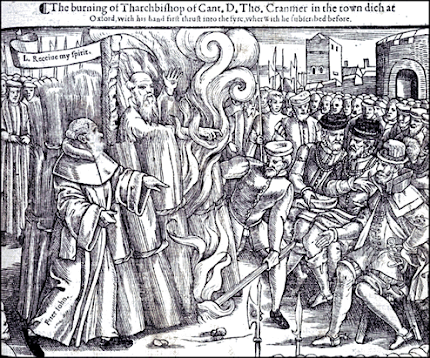
The burning of Tharchbishop of Cant. D. Tho. Cranmer in the town dich at Oxford, with his hand first thrust into the fyre, wherwith he subscribed before. [Click on the picture to see Cranmer's last words.]

Daily Bible Verse

Showing posts with label Libertarian Free Will. Show all posts

Thursday, August 09, 2018

Hyper-Calvinism, Common Grace, Libertarianism and the Simplicity of God (Part 1)


“. . . Do you believe that He foreknows against His will, or that He wills in ignorance? If then, He foreknows, willing, His will is eternal and immovable, because His nature is so: and, if He wills, foreknowing, His knowledge is eternal and immovable, because His nature is so.

From which it follows unalterably, that all things which we do, although they may appear to us to be done mutably and contingently, and even may be done thus contingently by us, are yet, in reality, done necessarily and immutably, with respect to the will of God.  . . .”  Dr. Martin Luther, 16th century father of the Protestant Reformation.


Hyper-Calvinism, Common Grace, Libertarianism and the Simplicity of God  (Part 1).

I know this seems to be a shotgun post meant to cover many topics.  But honestly the attacks on Calvinism as a system of propositional truths deduced from the Bible are coming from many points in the Evangelical world, and surprisingly that would even include some who consider themselves Clarkian Scripturalists.  Amazingly many of those who identify as Clarkian Scripturalists and associate themselves with the Trinity Foundation site are actually pushing the views of the late Dr. John Robbins, who by the way was not a trained theologian or Christian philosopher.  Robbins’s doctorate was earned in economics, not philosophy or Christian theology.  I am and will be forever grateful for the work that the Trinity Foundation has done in publishing Dr. Clark’s books and papers but that does not remove the fact that the ministry of the Trinity Foundation has had some significant departures from Dr. Gordon H. Clark’s theological and philosophical positions, including the idea that Clark was somehow in agreement with the foundationalism of Dr. Alvin Plantinga of the University of Notre Dame.  But I will come back to this later.  For now let me cover a few of my issues with the semi-Arminians.

Hyper-Calvinism

Since in the title I initially mentioned hyper-Calvinism, let me address that one first.  The popular misrepresentation of classical Calvinism as somehow part of a conspiracy called hyper-Calvinism and which started somehow with theologians like John Gill is so pervasive that it is almost impossible to have a rational discussion of the classical position with the vast majority of semi-Arminian Calvinists and neo-Calvinists today.  The most popular website eschewing hyper-Calvinism is one that has been run by Phil Johnson of the Grace to You ministry titled, “A Primer on Hyper-Calvinism,” originally posted in 1998.  Unfortunately, to prove his point, Johnson uses several straw man fallacies and sophistry to achieve his intended rebuttal.  Let’s take a look at that page and give a point by point rebuttal to Johnson’s rebuttal.


In his introduction Johnson misses the point completely by quoting Ezekiel 33:11.  The verse says that God does not desire the death of the wicked in any universal sense.  But what Johnson, the Arminians, and the semi-Arminian Calvinists fail to point out is that the verse is directed to the Old Testament nation of Israel, not to the other pagan nations.  The phrase “house of Israel” is mentioned 146 times in the entire Bible and of those occurrences over 82 of them are in the book of Ezekiel and not once does the term refer to all nations in general but only to the nation of Israel.  Most tellingly the term occurs in the very verse that Johnson contends is a universal “offer” to all the world rather than a specific address to the Old Testament church.  The Old Testament nation of Israel is a type of the visible church and so the promises and the threats addressed to the members of the visible church of the Old Testament do not apply to the pagan nations.  Of all the nations in the Old Testament, Israel alone received the covenant of grace and the promises warranted by that covenant as an outward sign.  (Deuteronomy 7:6-8).  The Bible over and over again demonstrates clearly that God does desire the death of the wicked in particular cases.  This would seem to refute the hypothetical universalism of common grace and the well meant offer advocates.  (1 Samuel 1:3; 2:25; 1 Kings 14:11; 2 Kings 9:10; 1 Peter 2:8; Romans 9:11-13).  Therefore, Ezekiel 33:11 is not a universal declaration that covers both the elect and the reprobate individuals in every nation.  Of course the promises given to Abram in Genesis 15 and 17 do extend the promises to the Gentile nations but with few exceptions that is not fulfilled until the Apostle Paul comes on the scene.  (Romans 11:13; 1 Timothy 2:7; 2 Timothy 1:11).  This does not mean that today we do not give a general call of the Gospel to anyone who will listen even though in the Old Testament dispensation of the eternal covenant of grace there was no general call of the Gospel given to the pagan nations.  (Matthew 28:18-20; Mark 16:15-16).  There are of course individual exceptions like Rahab the harlot and perhaps Jethro, the father-in-law of Moses, Ruth the Moabitess and others.  (See:  Joshua 6:17, 23, 25;  Exodus 18:1-12; Ruth 4:13-22). 


Johnson defines hyper-Calvinism as “ . . . a doctrine that emphasizes divine sovereignty to the exclusion of human responsibility.”  (Primer).  As his starting premise this probably does apply to certain of the Primitive Baptist groups and New Covenant theology groups which advocate an antinomian view that the Christian is under grace but not the moral law.  But it certainly does not apply to either Dr. Gordon H. Clark or those who consistently follow his Scripturalist views on dogmatic theology, though I think maybe John Robbins and certain of the Trinity Foundation advocates tend toward antinomianism.  Clark himself stood for the entire Westminster Confession of Faith as a system of propositional truth that could be harmonized as a whole system, not isolating any of the chapters from the rest of the system.  This is where even seminary educated Clarkians sometimes misunderstand Clark’s position or unintentionally misrepresent Clark.  The best example of this is Doug Douma’s article asking whether or not Clark thought Arminians were outright heretics.  (Clark and the Salvation of Arminians). Of course, in the interest of holding Evangelicals together as Protestants Clark would not condemn Arminians as guilty of adhering to a false religion or being part of a synagogue of Satan.  Although I disagree with Clark on this point, it is understandable that he would want to preserve at least some common ground with other Protestants.  But at the same time Clark did not say that there was a list of essential doctrines--like confessing that Jesus is Lord--which are necessarily salvific.  But Clark was also an outspoken critic of both Arminianism and semi-Arminianism.  In fact, he was so hated by the Arminians and dispensationalists at Wheaton College that he was fired or forced to resign because of it.  Ironically, the main opponent Clark faced at Wheaton was Dr. Henry Thiessen, a dispensationalist who later taught at Dallas Theological Seminary.  Another dispensationalist who was also a Reformed Episcopalian, W. H. Griffith Thomas, helped found Dallas Theological Seminary.   (See:  The Presbyterian Philosopher: The Authorized Biography of Gordon H. Clark, by Doug Douma).


Even more ironically, a Baptist, namely Phil Johnson, quotes an article by a high church Anglo-Catholic cleric, Peter Toon, to define hyper-Calvinism.  It is amazing how quickly baptistic Calvinists fall prey to those who want to draw Protestants back into communion with the Roman Catholic Church.  Peter Toon was part of the Continuing Anglican Movement, which is a modern spinoff of the Oxford Movement or high church Tractarian movement of the 19th century.  The best evidence that Peter Toon was an Anglo-Catholic was his membership in the Prayer Book Society and his support of the 1928 Book of Common Prayer, which is favored by conservative Anglo-Catholics.  The 1928 BCP has prayers for the dead among other things.


Another so-called Calvinist, Dr. J. I. Packer, has an agenda to compromise with Rome as well and has signed the Evangelicals and Catholics Together document, emphasizing sophistry and double talk in order to bring about a false compromise with the Roman Catholic Church.  Packer is also advocating compromise with high church Anglo-Catholics in the Anglican Church in NorthAmerica and their redefinition of the Thirty-nine Articles of Religion, which are clearly Protestant and Calvinist.  But following the Tractarians and the Anglo-Catholicism of John Henry Newman, Edward Pusey and others, Packer thinks that the Thirty-nine Articles of Religion can be interpreted as Roman Catholic and Protestant as a via media.  But that was never Archbishop Thomas Cranmer’s intention whatsoever.  Cranmer advocated the Five Solas of the Protestant Reformation, absolute predestination, and a Zwinglian view of the two Gospel sacraments.  (See: Thirty-nine Articles of Religion, Article 17.  Also see my blog post on Packer’s visit to Orlando, Florida on his last crusade:  Packer’s Last Crusade.)


This connection between self-identifying Calvinistic Baptists and dispensationalists with the Federal Vision movement is apparent especially between John Piper and James White, both of whom do not denounce Douglas Wilson as a heretic for promoting the objective covenant of grace, baptismal regeneration, conditional regeneration, and other doctrines of the Federal Vision heresy.  Piper even invited Wilson to promote his views at Piper’s Desiring God conference a  few years ago.  The connection between the Federal Vision and the Oxford Movement may not be immediately obvious but the emphasis on the visible church, visible signs as actually conveying grace, and the conditional and objective covenant are all in collusion with the papist view, the Tractarian and Ango-Catholic view, and other departures from the Bible and the Reformed confessional standards.  While Johnson may not be officially connected to Piper or White, his writings and public appearances affirm that he is more comfortable with the Arminians, the Federal Visionists, and even the Anglo-Catholics than with fellow Calvinists who uphold the Protestant Reformation and the system of propositional truth in the Bible.  This is a telling indictment of the compromises that many in the Reformed Baptist circles are willing to make.


Rather than go point by point refuting Johnson’s infamous attack on classical Calvinism, I will only briefly consider his objections and point the reader to a more substantial rebuttal written by a minister in the Covenant Reformed Churches in Ireland, Rev. Martyn McGeowen.  McGeown rejects Johnson’s first two points as irrelevant since the classical Calvinists do not reject duty faith or the obligation to believe the command to repent and believe the Gospel.  The first point of Johnson’s five points of hyper-Calvinism is vague and unclear.  


Before Johnson gives his own definition of hyper-Calvinism—a five-point definition, which, if true, would make the PRC and BRF three-point hyper-Calvinists—he quotes a dictionary. Apparently, whoever writes the theological dictionaries rules the theological landscape! However, theological dictionaries do not determine theology. The creeds do! They—not theological dictionaries—were officially adopted by the church.  (An Answer to Phil Johnson's "Primer on Hyper-Calvinism", by Rev. Martyn McGeown.)


McGeown is here absolutely right.  The Reformed standards are not determined by a single person who also happened to be a high church Anglo-Catholic, namely the late Peter Toon.  In fact there is not one shred of evidence that any of the Reformed creeds, confessions, or symbols made the well meant offer a binding doctrine and the same can be said for the free offer of the Gospel and the three points of common grace.  Through a clever bit of sophistry the semi-Arminians claim that the classical Calvinists in the PRCA, the British Reformed Fellowship, and the Covenant Reformed Churches in Ireland all reject the general call of the Gospel.  That is an absolute falsehood and the opponents on the other side should be ashamed of themselves for violating the ninth commandment and bearing false witness.  What is at issue is how the general call is issued and what is the theological language used in such a presentation?  It is wrong to tell an unconverted person that Jesus loves them and died for them on the cross for this can only be said if you are an Arminian or a semi-Pelagian.  Christ died only for the sheep.  Now after conversion it can be said that God loves that person and that Christ died on the cross for them and even then it could be wrong since there is always from a  human point of view the possibility of apostasy.  (1 John 2:19;  Hebrews 6:4-6; 10:26-29).  Since God’s perspective is eternal and timeless it is and was never possible that Judas Iscariot would be saved.  This offends those who reject the doctrine of double predestination and the necessity that God’s foreknowledge and predestination are one and the same thing.  In other words, equal ultimacy and double predestination are one and the same thing.  Further, the doctrine of libertarian free will does not get God off the hook since God would still be the cause of the fall by giving Adam the option to rebel and bring God’s curse on mankind.  Martin Luther’s book, The Bondage of the Will, does not affirm that sin is the cause of man’s loss of free will.  In fact, Luther argues just the opposite.  He said that God’s foreknowledge proves that the fall of Adam was of necessity and that this dashes the doctrine of libertarian free will on the rocks:


Sect. 9.—THIS, therefore, is also essentially necessary and wholesome for Christians to know: That God foreknows nothing by contingency, but that He foresees, purposes, and does all things according to His immutable, eternal, and infallible will. By this thunderbolt, "Free-will" is thrown prostrate, and utterly dashed to pieces. Those, therefore, who would assert "Free-will," must either deny this thunderbolt, or pretend not to see it, or push it from them. But, however, before I establish this point by any arguments of my own, and by the authority of Scripture, I will first set it forth in your words.

Are you not then the person, friend Erasmus, who just now asserted, that God is by nature just, and by nature most merciful? If this be true, does it not follow that He is immutably just and merciful? That, as His nature is not changed to all eternity, so neither His justice nor His mercy? And what is said concerning His justice and His mercy, must be said also concerning His knowledge, His wisdom, His goodness, His will, and His other Attributes. If therefore these things are asserted religiously, piously, and wholesomely concerning God, as you say yourself, what has come to you, that, contrary to your own self, you now assert, that it is irreligious, curious, and vain, to say, that God foreknows of necessity? You openly declare that the immutable will of God is to be known, but you forbid the knowledge of His immutable prescience. Do you believe that He foreknows against His will, or that He wills in ignorance? If then, He foreknows, willing, His will is eternal and immovable, because His nature is so: and, if He wills, foreknowing, His knowledge is eternal and immovable, because His nature is so.

From which it follows unalterably, that all things which we do, although they may appear to us to be done mutably and contingently, and even may be done thus contingently by us, are yet, in reality, done necessarily and immutably, with respect to the will of God. For the will of God is effective and cannot be hindered; because the very power of God is natural to Him, and His wisdom is such that He cannot be deceived. And as His will cannot be hindered, the work itself cannot be hindered from being done in the place, at the time, in the measure, and by whom He foresees and wills. If the will of God were such, that, when the work was done, the work remained but the will ceased, (as is the case with the will of men, which, when the house is built which they wished to build, ceases to will, as though it ended by death) then, indeed, it might be said, that things are done by contingency and mutability. But here, the case is the contrary; the work ceases, and the will remains. So far is it from possibility, that the doing of the work or its remaining, can be said to be from contingency or mutability. But, (that we may not be deceived in terms) being done by contingency, does not, in the Latin language, signify that the work itself which is done is contingent, but that it is done according to a contingent and mutable will—such a will as is not to be found in God! Moreover, a work cannot be called contingent, unless it be done by us unawares, by contingency, and, as it were, by chance; that is, by our will or hand catching at it, as presented by chance, we thinking nothing of it, nor willing any thing about it before.   

(The Bondage of the Will.   Section 9, The Sovereignty of God.  By Martin Luther).


This is at first a confusing piece to read.  But to put it simply let me say that our knowledge from a human perspective is limited to what we can know from one second to the next in the passing of one thought to the next in the mind.  Time is perceived because we have the passing of thoughts discursively in our minds.  But with God who is timeless there is no passing of thoughts from one thought to the next because God is eternally omniscient.  He foreknows the future not as an endless consideration of multiple contingencies and counterfactuals of which He must continually adjust in time.  On the contrary, God is eternally timeless and eternally omniscient because He knows all things at once in a direct and intuitive perspective.  He knows your entire life from beginning to end and whatever happens in your life is foreknown by God because He initiated it all when He created the universe on day one of creation.  As Dr. Gordon H. Clark once said, the first verse in the Bible that alludes to predestination is Genesis 1:1.  In fact, the crowd laughed when he said this in one of his lectures.  God is not subject to contingencies.  So even though God knows all possible outcomes, counterfactuals, and whatever else could influence an outcome of the actions of moral agents or even acts of nature, the one outcome that actualizes in providential time is the only possible outcome from God’s point of view because He eternally foreordained it.  Not only so but even the Westminster Confession of Faith says that in providence God governs all things so that the events that come to pass in time are in accordance with God’s one will and one eternal decree.


  1.      God the great Creator of all things doth uphold, (Heb. 1:3) direct, dispose, and govern all creatures, actions, and things, (Dan. 4:34–35, Ps. 135:6, Acts 17:25–26,28) from the greatest even to the least, (Matt. 10:29–31) by His most wise and holy providence, (Prov. 15:3, Ps. 104:24, Ps. 145:17) according to His infallible foreknowledge, (Acts 15:18, Ps. 94:8–11) and the free and immutable counsel of His own will, (Eph. 1:11) to the praise of the glory of His wisdom, power, justice, goodness, and mercy. (Isa. 63:14, Eph. 3:10, Rom. 9:17, Gen. 45:7, Ps. 145:7)

  2.      Although, in relation to the foreknowledge and decree of God, the first Cause, all things come to pass immutably, and infallibly; (Acts 2:23) yet, by the same providence, He ordereth them to fall out, according to the nature of second causes, either necessarily, freely, or contingently. (Gen. 8:22, Jer. 31:35, Exod. 21:13, Deut. 19:5, I Kings 22:28, 34, Isa. 10:6–7)

  3.      God, in His ordinary providence, maketh use of means, (Acts 27:31, 44, Isa. 55:10–11) yet is free to work without, (Hos. 1:7, Matt. 4:4, Job 34:10) above, (Rom. 9:19–21) and against them, (2 Kings 6:6, Dan. 3:27) at His pleasure.

  4.      The almighty power, unsearchable wisdom, and infinite goodness of God so far manifest themselves in His providence, that it extendeth itself even to the first fall, and all other sins of angels and men; (Rom. 11:32–34, 2 Sam. 24:1, 1 Chron. 21:1, 1 Kings 22:22–23, 1 Chron. 10:4, 13–14, 2 Sam. 16:10, Acts 2:23) and that not by a bare permission, (Acts 14:16) but such as hath joined with it a most wise and powerful bounding, (Ps. 76:10, 2 Kings 19:28) and otherwise ordering, and governing of them, in a manifold dispensation, to His own holy ends; (Gen. 50:20, Isa. 10:6–7, 12) yet so, as the sinfulness thereof proceedeth only from the creature, and not from God, who, being most holy and righteous, neither is nor can be the author or approver of sin. (James 1:13–14, 17, 1 John 2:16, Ps. 50:21) . . . .  (Chapter 4, Of Providence.  The Westminster Confession of Faith. Oak Harbor, WA: Logos Research Systems, Inc., 1996. Print.


Notice that in section 4 that God’s power ensures that whatever He has foreordained happens not by bare permission but that it happens exactly as God planned.  His plan is “joined with” almighty power so that “a most wise and powerful bounding, . . . and otherwise ordering, and governing of them, in a manifold dispensation to His own holy ends; . . .” so that whatever God wills comes to pass just as He intended.  In other words God’s teleological purposes cannot be thwarted because He knows all that will happen from beginning to end and He has predetermined all the secondary causes and contingencies and means to accomplish His eternal plan, purpose and will.  (See Isaiah 14:24; 46:9-11; Deuteronomy 29:29; Job 23:13; Acts 4:28; Proverbs 19:21; Proverbs 21:30; Daniel 4:35).  Those who reject equal ultimacy in the name of preserving human freedom, i.e. libertarian free will as opposed to human volition as a free moral agent, are in fact in opposition to Scripture and the Westminster Confession.  No man’s will is free from sin after the fall and even more to the point, no man’s will is free from God’s eternal will and providence.  God alone has a will free from any determinative contingencies outside Himself.  God is not the author of man’s sins because it is man who sins, not God.  But that does not mean that God is not the remote and ultimate cause of everything.  The Arminian and the Open Theist try to escape the implication that evil is ultimately part of God’s eternal plan and that moral evil by moral agents and natural disasters are both brought to pass by God’s providential governance of every single detail that happens in time.  If God foreordains the movement of the atoms and the most minute workings of nature to even the grandest scale of solar systems and galaxies, it surely is not beyond God’s power to cause Judas Iscariot and Pontius Pilate to bring about the crucifixion of Jesus Christ.   (Acts 4:27-28).

Here ends the first installment.  Look for part 2 in a couple of days.  In the next installment I will delve into the issue of common grace and how that conflicts with special revelation and the doctrine of propositional revelation, plenary verbal inspiration and the doctrine of the absolute infallibility and inerrancy of Holy Scripture.  Also, in reference to these doctrines I will compare and contrast the doctrine of libertarian free will with the political philosophy of libertarian governmental policies and how that cannot be in agreement with Reformed theology as deduced from Scripture and outlined by the Reformed confessions.

Also in future posts to this topic I will consider how the Trinity Foundation and the late Dr. John Robbins significantly differ from Dr. Gordon H. Clark on libertarian politics and on Plantinga's foundationalism.  Clark would have never agreed with foundationalism and in future posts I will compare and contrast Plantinga's views with Clark's view of Scripture as the beginning axiom of Christianity.

Charlie J. Ray, M. Div.


Sunday, November 01, 2015

Quote of the Day: J. H. Thornwell: Insulting God


In conformity with this reasoning, no operations of the Spirit can be justly denominated grace which leave the decision of his destiny in the hands of the sinner.  The agency of God may be carried so far as to make men able to stand, yet, if it depends upon themselves to stand or fall, to use or reject the assistance which is given, there is nothing in such a state to distinguish it from the grossest legalism.  The Spirit is evidently the servant, not the master, of the man; grace obeys but does not reign.  All such schemes, whatever honor they may pretend to ascribe to the Holy Ghost, are insulting to God, since they lay a foundation for boasting in the creature.

J. H. Thornwell.  Sacramental Sorcery:  The Invalidity of Roman Catholic Baptism.  Reprint. (Unicoi:  Trinity Foundation, 2006). P. 128.

Monday, March 11, 2013

More Irrationalism: Society of Evangelical Arminians | A Challenge from Roger Olson for Calvinists

Free will was put forward to relieve God of responsibility for sin. But this it does not do.  -- Gordon H. Clark


I got the following challenge from the Society of Evangelical Arminians blog:
As I read Mark Talbot’s chapter on God and suffering in Suffering and the Sovereignty of God (edited by John Piper and Justin Taylor) a thought occurred to me:  Since most Calvinists are harshly critical of the novel The Shack (which takes a similar approach to theodicy as Greg Boyd in Is God to Blame?) because of its alleged undermining of God’s glory and sovereignty, why don’t they (or one of them) write a similar novel in which God explains to Mack (or someone like him) why his daughter was kidnapped, raped and murdered–and avoid language about God permitting or allowing it (which is really Arminian language)? I challenge a consistent “high Calvinist” such as Piper or Talbot to produce such a novel. I would like to see what the popular Christian reaction would be to what God would have to say about such atrocities in such a novel. Talbot pulls no punches; he says that God foreordains such events and is their ultimate cause; they are willed by God and not merely allowed or permitted by God (although even he occasionally uses such language–as do all Calvinists in my experience). At crucial points he pulls back a little and uses language such as God “governs” such events, but the context makes clear he means God renders them certain because they fit into his plan and purpose and are necessary for the full accomplishment of his will.
I look forward to the publication of such a novel; I think it would go far toward turning people away from Calvinism. 

Roger Olson
Society of Evangelical Arminians | A Challenge from Roger Olson for Calvinists

Unfortunately, most Arminians and probably most Reformed Evangelicals have not heard of the late Gordon H. Clark.  Clark has definitively answered the problem of evil, but more about this later.

Roger Olson, for one thing, is an Open Theist like Gregory Boyd.  They realize that an all powerful God is incompatible with their concept of libertarian free will.  Further, realizing the implications of foreknowledge in God's mind, they decided to depart from the classical Arminian view that God foreknows the future.  For Boyd and Olson, God is ignorant.  That's quite a concession for alleged "Christians" to make.  Where do the concessions to atheists, agnostics and skeptics stop?  Why stop there?  (Romans 9:19-20).

On the one hand, Roger Olson wants to be known as a Reformed Arminian as if Arminianism were some branch of the Reformed or Calvinist family.  Nothing could be further from the truth.  On the other hand, Olson wants Open Theism to be accepted as a branch of Arminian theology--even if it denies that God foreknows the future in every detail.  (See:  Is Open Theism a Type of Arminianism?)  Molinism is a step away from Arminianism because it tries to water down God's knowledge of the future by making his foreknowledge a general view of possibilities and contingencies and the outcomes of all those contingencies.   I guess an omniscient God is continually dependent on alternate endings depending on which choices his creatures make?  Open Theism goes the extra step and completely anthropomorphizes God and makes him into the image of a weak human being who does not know the future any more than we do.  Such a god is not worthy of our worship.  Re-imaging the creator to fit with something more palatable to the creature seems like a good idea at first.  But the implications are that evil exists independently of God's control.  Worse, evil may be God's equal!

Open Theism is therefore just a short step away from atheism.  Why doesn't Olson go whole hog and become an atheist?  What is truly amusing is that Olson tries to claim that Gregory Boyd and Clark Pinnock did not draw from process theology via Alfred North Whitehead.  The kinship between liberalism and Arminianism again rears its ugly head.

What is truly disturbing is that Olson does not realize that Cornelius Van Til actually opened up the doors for the Calvinists to play both sides of the fence.  There are very few Calvinists around today who are faithful to the doctrine of God's absolute sovereignty and determinism.  For Van Til the Bible is not univocal revelation but merely an analogy.  So the doctrine of the free offer and the doctrine of common grace makes it possible for Arminians and Calvinists to have mock fights but actually agree with each other.  God really does want to save the reprobate and every single individual.  The only difference is that the Van Tilians say that God has two wills so they can play off their Arminianism with a pretend determinism that they do not really believe.

This past Sunday I got into a debate with a lay person leading the Sunday school class at Covenant Presbyterian Church, Lakeland, Florida.  The man teaching the class was supposed to be giving Machen's view on Calvinist determinism.  He made the blatant assertion that God is free and man is free.  But he apparently meant the Arminian definition of free will or "libertarian free will."  According to him, man really is free to choose either way, despite God's determinism.  In other words, the deciding factor for this fellow was man's freedom, not God's sovereignty.  And what was the justification given for downplaying God's sovereignty and predeterminism?  According to this fellow determinism is a stumbling block for evangelism.  We could not possibly tell anyone that we believe in double predestination or determinism because that might turn them off.  And, of course, God really wants to save everyone and the only reason he does not do so is that they have free choice and refuse to be saved.  That is the same answer the Arminians give, is it not?  But that is not what the Bible teaches at all, nor is it the teaching of the Westminster Confession or the Larger and Shorter Catechism.

Of course, we are not mere automatons.  We do have genuine moral choices to make, and we are moral agents.  (See:  Westminster Confession of Faith, Chapter 3, Of God's Eternal Decree, Section 1). But to assert that man has true freedom flies in the face of all that the Bible says, all that the Reformed confessions say, and what both Luther and Calvin had to say on the matter.  For Luther, there is no free will even prior to the fall!  I can easily prove that here:

THIS, therefore, is also essentially necessary and wholesome for Christians to know: That God foreknows nothing by contingency, but that He foresees, purposes, and does all things according to His immutable, eternal, and infallible will. By this thunderbolt, "Free-will" is thrown prostrate, and utterly dashed to pieces. Those, therefore, who would assert "Free-will," must either deny this thunderbolt, or pretend not to see it, or push it from them.  (Martin Luther, The Bondage of the Will).
I checked again.  Luther nowhere even mentions the fall of Adam or the bondage of sin here, although he does mention the fall of Adam later in the response to Erasmus.  The point is that the implication here is that Luther saw that even the fall of Adam was not based on "libertarian free will."  No.  If God foreknew that Adam would fall, then even the fall was not a contingency in God's mind but part of God's eternal decree and eternal purpose.  God, for both Luther and Calvin, is immutable and not subject to change.  God cannot be cajoled, manipulated, changed, coerced, or forced to do man's will.   In fact, Open Theism openly says that God changes:

Although many specific outcomes of the future are unknowable, God's foreknowledge of the future includes that which is determined as time progresses often in light of free decisions that have been made and what has been sociologically determined. So God knows everything that has been determined as well as what has not yet been determined but remains open. As such, God is able to anticipate the future, yet remains fluid to respond and react to prayer and decisions made either contrary or advantageous to God's plan or presuppositions.  (From:  Wikipedia:  Open Theism).
Unfortunately for the Open Theists the Reformed confessions have agreed with Scripture where the Scriptures teach that God is immutable:


1.  There is but one only, (Deut. 6:4, 1 Cor. 8:4–6) living, and true God, (1 Thess. 1:9, Jer. 10:10) who is infinite in being and perfection, (Job 11:7–9, Job 26:14) a most pure spirit, (John 4:24) invisible, (1 Tim. 1:17) without body, parts, (Deut. 4:15–16, John 4:24, Luke 24:39) or passions; (Acts 14:11,15) immutable, (James 1:17, Mal. 3:6) immense, (1 Kings 8:27, Jer. 23:23–24) eternal, (Ps. 90:2, 1 Tim. 1:17) incomprehensible, (Ps. 145:3) almighty, (Gen. 17:1, Rev. 4:8) most wise, (Rom. 16:27) most holy, (Isa. 6:3, Rev. 4:8) most free, (Ps. 115:3) most absolute; (Exod. 3:14) working all things according to the counsel of His own immutable and most righteous will, (Eph. 1:11) for His own glory; (Prov. 16:4, Rom. 11:36) most loving, (1 John 4:8,16) gracious, merciful, long-suffering, abundant in goodness and truth, forgiving iniquity, transgression, and sin; (Exod. 34:6–7) the rewarder of them that diligently seek Him; (Heb. 11:6) and withal, most just, and terrible in His judgments, (Neh. 9:32–33) hating all sin, (Ps. 5:5–6) and who will by no means clear the guilty. (Nah. 1:2–3, Exod. 34:7)  WCF, Chapter II, Of God and the Holy Trinity, Section 1.
The Westminster Confession of Faith (Oak Harbor, WA: Logos Research Systems, Inc., 1996).
Notice that the Confession denies that God has a physical body and that God has emotions or "passions".  This seems problematic for the followers of Van Til, although it is most certainly in the Reformed confession.  In short, the Bible has both anthropomorphisms and anthropopathisms, yet God does not literally have hands or feet nor does God literally get jealous experience the human emotion we call "love".  God's love is a different kind of love that might be better expressed as benevolence and even here this is still an anthropopathic expression to help us relate to God.


Ironically, Arminianism is alleged to be the result of rationalism or trying to pry into the secret being of God, who Van Til insisted is unknowable because of the doctrine of incomprehensibility.  However, most Arminians and Van Tilians have more in common with existentialist irrationalism than with reason or logic. 

The late Dr. Gordon H. Clark made it clear that Arminianism's doctrine of free will does not solve the problem of evil.  In fact, if God is able to intervene and does not do so then God is still culpable if one is willing to accuse God of doing wrong:

It might seem that here is the proper place to ask the question, Does man have a free will? Is it true that his choices are not determined by motives, by inducements, or by his settled character? Can a person resist God’s grace and power and make an uncaused decision? However, these questions will not be answered here. They will be discussed later. The next step in the argument is a slightly different one. Let us assume that man’s will is free; let us assume that these questions have been answered in the affirmative; it would still remain to be shown that free will solves the problem of evil. This then is the immediate inquiry. Is the theory of free will, even if true, a satisfactory explanation of evil in a world created by God? Reasons, compelling reasons, will now be given for a negative answer. Even if men were as able to choose good as evil, even if a sinner could choose Christ as easily as he could reject him, it would be totally irrelevant to the fundamental problem. Free will was put forward to relieve God of responsibility for sin. But this it does not do.

Suppose there were a lifeguard stationed on a dangerous beach. In the breakers a boy is being sucked out to sea by the strong undertow. He cannot swim. He will drown without powerful aid. It will have to be powerful, for as drowning sinners do, he will struggle against his rescuer. But the lifeguard simply sits on his high chair and watches him drown. Perhaps he may shout a few words of advice and tell him to exercise his free will. After all, it was of his own free will that the boy went into the surf. The guard did not push him in nor interfere with him in any way. The guard merely permitted him to go in and permitted him to drown. Would an Arminian now conclude that the lifeguard thus escapes culpability? This illustration, with its finite limitations, is damaging enough as it is. It shows that permission of evil as contrasted with positive causality does not relieve a lifeguard from responsibility. Similarly, if God merely permits men to be engulfed in sin of their own free wills, the original objections of Voltaire and Professor Patterson are not thereby met. This is what the Arminian fails to notice. And yet the illustration does not do full justice to the actual situation. For unlike the boy who exists in relative independence of the lifeguard, in actuality God made the boy and the ocean, too. Now, if the guard – who is not a creator at all – is responsible for permitting the boy to drown, even if the boy is supposed to have entered the surf of his own free will, does not God – who made them – appear in a worse light? Surely an omnipotent God could have either made the boy a better swimmer, or made the ocean less rough, or at least have saved him from drowning.

Gordon H. Clark. Religion, Reason and Revelation (Kindle Locations 4582-4604). The Trinity Foundation.
The Open Theists recognize that free will does not absolve God of culpability.  So now, in addition to God's non-intervention the Open Theist must now make God ignorant of the future.  Of course, he is not really ignorant of the future, according to them.  God knows the general future and changes with the choices, prayers, and other contingencies as he goes along.  Saying that God knows the future absolutely, according to Gregory Boyd, is like saying God can make square circles:

Greg Boyd claims that "open theism" is an inappropriate term since the position posits more about the nature of time and reality than it does about God himself. Open theists do not believe that God does not know the future; rather, that the future does not exist to be known by anyone. For the open theist, the future simply has not happened yet, not for anyone, and thus, is unknowable in the common sense. To say that God does not know the future is akin to saying that God does not know about square circles. In this understanding, it could be technically wiser to refer to the view as "open futurism".   (Open Theism).

In other words, for Boyd, it is illogical to affirm both God's sovereignty and man's "libertarian free will."  Apparently, the Van Tilians agree with him.   Boyd goes even beyond this, however.  He says no one knows the future, not even God.  Why?  Because the future has not happened yet.  God is not really God after all.  All those predictions in the Bible were really contingencies and might have never happened.  The cross might have never happened as well.  And one has to wonder why a limited God would need to be appeased for the sins of the human race?  (Romans 5:12-21).

Moreover, Evangelical Calvinists who cater to Arminianism inevitably wind up sacrificing Scripture, the sovereignty of God, the Trinity, and even the full deity of Jesus Christ.  For this reason, I stand firmly with the late Dr. Gordon H. Clark's axiom:  Scripture is the word of God.  Unless we begin with divine revelation and not human reason the result, according to Dr. Clark, is always skepticism.  I tend to agree.

God does not need to be absolved of his culpability, though.  God being God does not need the permission of mere creatures to do what he does.  (Cf.  Romans 3:3-8).  The Scriptures affirm that God is in absolute control over good and evil without becoming himself the author of evil.  (Cf. James 1:13).  Contra Roger Olson, God does not need to answer to atheists, agnostics, Arminians, Open Theists, or even Van Tilians.  (Romans 9:17-23).  God is God and he demands that we worship and glorify him.  (Psalm 22:23).  Nothing God does is evil because by the very nature of the Triune God he is benevolent.   (1 John 4:7-8).

Furthermore, no one who truly reads, understands, and assents to the propositions of the Bible can believe that free will exists.  Why?  Because the Bible flatly denies it:

God is very frequently said to blind and harden the reprobate, and to turn, incline, and influence their hearts, as I have elsewhere more fully stated. But it affords no explication of the nature of this influence to resort to prescience or permission…. For the execution of his judgments, he, by means of Satan, the minister of his wrath, directs their counsels to what he pleases and excites their wills and strengthens their efforts. Thus when Moses relates that Sihon the king would not grant a free passage to the people, because God had “hardened his spirit and made his heart obstinate,” he immediately subjoins the end of God’s design: “That he might deliver him into thy hand.” Since God willed his destruction, the obduration of his heart therefore was the divine preparation for his ruin.[5]

Thus the futility of free will is established. Some other theory must be sought. And in the production of that theory it will become evident that free will is not only futile but false. Certainly, if the Bible is the Word of God, free will is false; for the Bible consistently denies free will.

Gordon H. Clark. Religion, Reason and Revelation (Kindle Locations 4619-4629). The Trinity Foundation.
Footnote #5 above says:

[5]  John Calvin, Institutes of the Christian Religion, III, xxiii, 8; II, iv, 3.

Gordon H. Clark. Religion, Reason and Revelation (Kindle Locations 5382-5383). The Trinity Foundation.
You will need to scroll down to section 8 and section 3 respectively in the links to the Institutes above.  But it is clear that John Calvin unequivocably rejected the idea that evil is a result of God's "permission".  No, God clearly hardens the reprobate for the express purpose of punishing them later.  (Cf. Exodus 4:21; 7:3; 7:13; 9:12; Joshua 11:20; Amos 3:6; Isaiah 45:7; Deuteronomy 2:30; Psalm 105:25).  That Van Tilians are more interested in appeasing unbelievers than in standing on the biblical propositions and on the confessional theology of the Westminster Standards is a glaring mote in their eye.  It in fact feeds into the accusations by Arminians and by Open Theists like Roger Olson, who see their equivocation a mile away.

This Calvinist sees no need to explain away the plain teaching of Holy Scripture.  God is absolutely sovereign, and he will harden whom he will harden and have mercy on whom he will have mercy (Romans 9:18-21).  It is not of man's will that the elect are saved but of God's free and unconditioned choice (John 1:13; Romans 9:16).  There is nothing outside of God that coerces or controls his free decisions and sovereign decrees.  Everything that comes to pass is for his glory.  (Romans 11:36; Ephesians 1:11).


Tuesday, March 20, 2012

Quotes Against Free Will

Psalm 33:10: "He maketh the devices of the people of none effect."
Psalm 81:12: "So I gave them up unto their own hearts’ lust: and they walked in their own counsels."
Proverbs 21:1: "The king’s heart is in the hand of the Lord, as the rivers of water: he turneth it whithersoever he will."
Proverbs 28:26: "He that trusteth in his own heart is a fool."
Ecclesiastes 7:20: "For there is not a just man upon the earth, that doeth good, and sinneth not."
Jeremiah 4:22: "For my people is foolish, they have not known me … they are wise to do evil, but to do good they have no knowledge."
John 1:13: "Which were born, not of blood, nor of the will of the flesh, nor of the will of man, but of God."
John 3:27: "A man can receive nothing, except it be given him from heaven."
John 6:44: "No man can come to me except the Father, which hath sent me, draw him: and I will raise him up at the last day."
John 6:65: "Therefore said I unto you, that no man can come unto me, except it were given unto him of my Father."
John 15:5: "I am the vine, ye are the branches: he that abideth in me, and I in him, the same bringeth forth much fruit; for without me ye can do nothing."
John 15:16: "Ye have not chosen me, but I have chosen you, and ordained you."
Romans 3:10-12: "As it is written, There is none righteous, no, not one: There is no that understandeth, there is none that seeketh after God. They are all gone out of the way, they are together become unprofitable; there is none that doeth good, no, not one."
Romans 5:6: "For when we were yet without strength, in due time Christ died for the ungodly."
Romans 7:18-19: "For I know that in me (that is, in my flesh) dwelleth no good thing: for to will is present with me; but how to perform that which is good I find not. For the good that I would I do not: but the evil which I would not, that I do."
Romans 8:7: "Because the carnal mind is enmity against God: for it is not subject to the law of God, neither indeed can be."
Romans 9:16: "So then it is not of him that willeth, nor of him that runneth, but of God that sheweth mercy."
Romans 10:20: "I was found of them that sought me not."
Ephesians 2:1: "And you hath he quickened, who were dead in trespasses and sins."
Ephesians 2:5: "Even when we were dead in sins, hath he quickened us together with Christ; (by grace ye are saved.)"
Philippians 2:13: "For it is God which worketh in you, both to will and to do of his good pleasure."
Colossians 2:13: "And you, being dead in your sins and the uncircumcision of your flesh, hath he quickened together with him, having forgiven you all trespasses."
Titus 3:3-5: "For we ourselves also were sometimes foolish, disobedient, deceived, serving divers lusts and pleasures, living in malice and envy, hateful, and hating one another. But after that the kindness and love of God our Saviour toward man appeared, Not by works of righteousness which we have done, but according to his mercy he saved us, by the washing of regeneration, and renewing of the Holy Ghost."
2) Before the Reformation
Augustine: "I once laboured hard for the free will of man, until the grace of God at length overcame me."
Bradwardine: "What multitudes, O Lord, do this day join hands with Pelagius in contending for free will and in fighting … free grace."
Waldensians: "Whosoever upholds free-will absolutely denies predestination and the grace of God."
3) Luther
"Free will is an empty term."
"Free-will cannot will good and of necessity serves sin."
"This is plainly to ascribe divinity to ‘free will.’"
“I frankly confess that, for myself, even if it could be, I should not want ‘free-will’ to be given me, nor anything to be left in my own hands to enable me to endeavour after salvation; not merely because in face of so many dangers, and adversities and assaults of devils, I could not stand my ground …; but because even were there no dangers … I should still be forced to labour with no guarantee of success … But now that God has taken my salvation out of the control of my own will, and put it under the control of His, and promised to save me, not according to my working or running, but according to His own grace and mercy, I have the comfortable certainty that He is faithful and will not lie to me, and that He is also great and powerful, so that no devils or opposition can break Him or pluck me from Him. Furthermore, I have the comfortable certainty that I please God, not by reason of the merit of my works, but by reason of His merciful favour promised to me; so that, if I work too little, or badly, He does not impute it to me, but with fatherly compassion pardons me and makes me better. This is the glorying of all the saints in their God” (The Bondage of the Will).

4) Calvin
"The Papists … hold that man, through his own free will, returns to God; and on this point is our greatest contest with them at this day."
"Concerning that this clown babbleth of free will, it is sufficiently rejected throughout the whole scripture."
"Faith is a special gift of God, which proceedeth not from our free will."
"Let that ethical philosophy therefore of free-will be far from a Christian mind."
"No free will of man can resist Him that willeth to save."
5) Reformation Confessions
Thirty-Nine Articles, X:
"The condition of Man after the fall of Adam is such, that he can not turn and prepare himself, by his own natural strength and good works, to faith, and calling upon God. Wherefore we have no power to do good works pleasant and acceptable to God, without the grace of God by Christ preventing us, that we may have a good will, and working with us, when we have that good will."
Heidelberg Catechism, Q. 8: "Are we then so corrupt that we are wholly incapable of doing any good, and inclined to all wickedness? A.  Indeed we are; except we are regenerated by the Spirit of God."
Belgic Confession, XIV:
"… we reject all that is taught repugnant to this, concerning the free will of man, since man is but a slave to sin; and has nothing of himself, unless it is given from heaven. For who may presume to boast, that he of himself can do any good, since Christ saith, No man can come to me, except the Father, which hath sent me, draw him? Who will glory in his own will, who understands, that to be carnally minded is enmity against God? Who can speak of his knowledge, since the natural man receiveth not the things of the spirit of God? In short, who dare suggest any thought, since he knows that we are not sufficient of ourselves to think anything as of ourselves, but that our sufficiency is of God? And therefore what the apostle saith ought justly to be held sure and firm, that God worketh in us both to will and to do of his good pleasure. For there is no will nor understanding, conformable to the divine will and understanding, but what Christ hath wrought in man; which he teaches us, when he saith, Without me ye can do nothing."
Canons of Dordt, III/IV:3:
"Therefore all men are conceived in sin, and by nature children of wrath, incapable of saving good, prone to evil, dead in sin, and in bondage thereto, and without the regenerating grace of the Holy Spirit, they are neither able nor willing to return to God, to reform the depravity of their nature, nor to dispose themselves to reformation."
Westminster Confession, IX – Of Free Will:
Man, in his state of innocency, had freedom and power to will and to do that which is good and well-pleasing to God; but yet mutably, so that he might fall from it. Man, by his fall into a state of sin, hath wholly lost all ability of will to any spiritual good accompanying salvation; so as a natural man, being altogether averse from that good, and dead in sin, is not able, by his own strength, to convert himself, or to prepare himself thereunto. When God converts a sinner, and translates him into the state of grace, he freeth him from his natural bondage under sin, and by his grace alone enables him freely to will and to do that which is spiritually good; yet so as that, by reason of his remaining corruption, he doth not perfectly nor only will that which is good, but doth also will that which is evil. The will of man is made perfectly and immutably free to do good alone in the state of glory only.
6) 16th Century
William Tyndale:
"they go and set up free-will with the heathen philosophers and say that a man’s free will is the cause why God chooseth and not another, contrary to all scriptures."
Robert Ferrar (Welsh Bishop of St. David's martyred in Carmarthen on 30 March, 1555) with ten other reforming ministers:
"... we disallow papistical doctrines of free will, of works of supererogation, of merits, of the necessity of auricular confession, and satisfaction to God-wards."
John Knox:
"… the general consent of all that sect is that God (by his foreknowledge, counsel, and wisdom) has no assured election, neither yet any certain reprobation, but that every man may elect or reprobate himself by his own free will, which he has (say they) to do good or evil … [All these things are] forged by their own brains, and polished by the finest of their wits, when yet in very deed they are but the rotten heresies of … Pelagius, long ago confuted by Augustine …"
John Knox:
"Ye [Anabaptists] be proud contemners of the free grace of God offered to man in Christ Jesus. For with the Pelagians and Papists ye are become teachers of free will, and defenders of your own righteousness" (An Answer to a Great Number of Blasphemous Cavillations Written by an Anabaptist and Adversary to God's Eternal Predestination [London: Thomas Charde, 1591], p. 121).

Jerome Zanchius:
"No free will of the creature can resist the will of God" (quoting Augustine).
7) 17th Century
Henry Ainsworth:
"we grant evil freewill (or freewill to evil) is remaining in all natural men: we believe that freewill to good, is from grace and regeneration."
Daniel Featley:
"many men have too much Free-will, and take to themselves too free liberty now a days to advance and maintain free will."
John Preston:
"not by the power of free will but by the infused grace of His spirit."
Peter Moulin:
"It is proved out of the holy scriptures that an unregenerate man is altogether destitute of the power and liberty of his will, in those things that pertain to faith and salvation."
John Owen:
"the whole Pelagian poison of free-will … a clear exaltation of the old idol free-will into the throne of God … That the decaying estate of Christianity have invented."
John Owen:
Free will is "corrupted nature's deformed darling, the Pallas or beloved self-conception of darkened minds" (Works, vol. 10, p. 150).
William Jenkyn:
"The bending of men's hearts to believe and persevere are the supernatural fruits of God’s eternal decree, and not the natural fruits of man’s depraved and frail free will."
John Trapp: "The friends of free will are the enemies of free grace."
Thomas Watson:
"This crown of free will is fallen from our head" and "If it be God’s purpose that saves then it is not free will."

Francis Turretin:

"The word "freewill" (as also "self-determining power" [autexousiou] used by the Greek Fathers) does not occur in Scripture … I Cor 7:37 does not mean freedom of the will."
8) 18th Century
Matthew Henry:
"The counsels and decrees of God do not truckle to the frail and fickle will of man."
Augustus Toplady:
“A man’s free will cannot cure him even of the toothache, or a sore finger; and yet he madly thinks it is in its power to cure his soul.”
George Whitefield:
"Man is nothing; he hath a free will to go to hell, but none to go to heaven, till God worketh in him" and "you dishonour God by denying election. You plainly make salvation depend, not on God’s ‘free grace’ but on Man’s ‘free will.’"
William Huntington:
"This brought me out of the free-will fog, and truth shone in my heart like a comet … from that moment I waged war against free will."

9) 19th Century
J. N. Darby, early leader of the Plymouth Brethren:
"This re-appearance of the doctrine of freewill serves to support that of the pretension of the natural man to be not irremediably fallen, for this is what such doctrine tends to. All who have never been deeply convicted of sin, all persons in whom this conviction is based on gross external sins, believe more or less in freewill" (Man’s So-called Freewill, p. 1).
10) Charles Spurgeon

"I will go as far as Martin Luther, where he says, ‘If any man ascribes anything of salvation, even the very least thing, to the free will of man, he knows nothing of grace, and he has not learned Jesus Christ rightly.’"
"Free-will doctrine—what does it? It magnifies man into God. It declares God’s purposes a nullity, since they cannot be carried out unless men are willing. It makes God’s will a waiting servant to the will of man, and the whole covenant of grace dependent on human action. Denying election on the ground of injustice, it holds God to be a debtor to sinners." "His will cannot be neutral or ‘free’ to act contrary to his nature."
"Free will has carried many souls to hell, but yet never a soul to heaven."

"I do not come into this pulpit hoping that perhaps somebody will of his own free will return to Christ. My hope lies in another quarter. I hope that my Master will lay hold of some of them and say, 'You are mine, and you shall be mine. I claim you for myself.' My hope arises from the freeness of grace, and not from the freedom of the will."

11) 20th Century
Arthur W. Pink:
"if the will is their servant then it is not sovereign, and if the will is not sovereign, we certainly cannot predicate ‘freedom’ of it."

Louis Berkhof:

"Freedom of the will is a psychological fiction."
John Gerstner:
"We have already shown that there is no such thing as free will. That’s a will-o’-the–wisp. You never make choices without reasons, not as a responsible or a rational person" (A Primer on Free Will, p. 11).
W. E. Best:
"God’s character is maligned by every person who believes in free will."

Gordon H. Clark:
"The Bible consistently denies free will."

R. C. Sproul:
"The neutral view of free will is impossible. It involves choice without desire."
James White: "Then why do you embrace Christ, and your moral Buddhist neighbour across the street does not? Are you smarter than he is? More spiritually sensitive? Better, in any way? What makes you to differ? Is the Holy Spirit working just as hard on him as He did on you? If so, why do you believe, and he does not? No matter how hard you try, you can’t avoid coming to the conclusion that, in a 'free will' system of salvation, those who believe do so because there is something different about them. If the Spirit is bringing equal conviction to bear upon each individual, the only deciding factor, given equality in everything else, is something in the person himself. I believe the only possible difference between the redeemed in heaven and the guilty, condemned, punished sinner in hell is a five-letter word ... It’s called 'grace.'"
Steven Houck:
"This free-willism is a serious error which is contrary to the Holy Scriptures."
Quotes Against Free Will

Support Reasonable Christian Ministries with your generous donation.