>

Martyred for the Gospel

Martyred for the Gospel
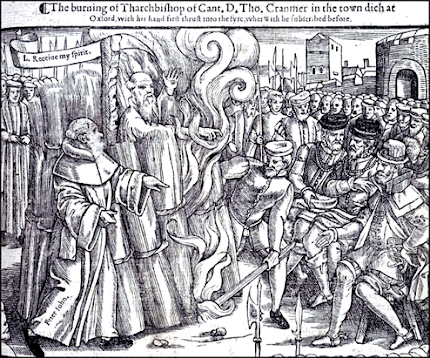
The burning of Tharchbishop of Cant. D. Tho. Cranmer in the town dich at Oxford, with his hand first thrust into the fyre, wherwith he subscribed before. [Click on the picture to see Cranmer's last words.]

Daily Bible Verse

Thursday, January 12, 2012

Did C. S. Lewis Go to Heaven? by John W. Robbins

John W. Robbins wrote a critique of the Evangelical obsession with C. S. Lewis, the British literature professor and author of numerous works of fiction. According to Robbins, Lewis was an Anglo-Catholic, not an Evangelical:
C. S. Lewis(1) was one of the most influential, if not the most influential, Anglican writer of the twentieth century. Any informed Western Christian could not have lived in the middle and latter twentieth century without having encountered Lewis, for he was both prolific and well-publicized. When I was young, I was enamored of Lewis, as, I suppose, many young people are. After his death in November 1963, the C. S. Lewis literary-theological complex developed in the United States, with scores, if not hundreds, of books and thousands of essays about Lewis published, largely by his admirers. His books have sold in the millions, far more after his death than at any time during his life. Despite all this, there has been little critical attention paid to the theological ideas that Lewis actually taught in his books, even by those who call themselves Protestants and Evangelicals. I have given a provocative title to my talk in an attempt to provoke some of these people to think critically about Lewis’ theology.
Click here to read The Trinity Review: Did C.S. Lewis Go to Heaven?

Mike Horton "Dialogues" with Roger Olson on God's Sovereignty and the Problem of Evil

I fail to see how God can foresee what will happen if it is not certain to happen. If it is certain, then God must have determined it.


Part 1


Part 2


Unfortunately, Mike Horton makes a major gaff at around the 41 second mark of Part 2.  Like most neo-Calvinists Horton is too willing to bend over backwards so as not to offend atheists and Arminians and semi-pelagians.  The gaff is when Horton says that God does not "cause" reprobation and the evil choices of men but that God does "cause" the salvation of the elect.  According to Horton, God merely "permits" the damnation of the reprobate.  But this is not the Calvinist position, the position of Scripture, or the position of the Canons of Dort!  Horton's view is illogical, unbiblical, and unconfessional.  Although Scripture teaches free moral agency, it does not teach free will (Romans 9:11-13; John 8:34-44) or "bare permission".  Since Scripture teaches that God does all that He pleases (Psalms 115:3; Daniel 4:35), it follows that even reprobation is God's will.  He works "all things" according to the counsel of His will" (Ephesians 1:11). 

And the Westminster Confession Chapter 3 says that God is not the author of evil but that God is in complete control of even the evil acts of men:
Chapter 3: Of God's Eternal Decree
1. God, from all eternity, did, by the most wise and holy counsel of His own will freely, and unchangeably ordain whatsoever comes to pass:(1) yet so, as thereby neither is God the author of sin,(2) nor is violence offered to the will of the creatures; nor is the liberty or contingency of second causes taken away, but rather established.(3)

1 Ephesians 1:11; Romans 11:33; Hebrews 6:17; Romans 9:15,18.
2 James 1:13,17; 1 John 1:5.
3 Acts 2:23; Matthew 17:12; Acts 4:27, 28; John 19:11; Proverbs 16:33.


Furthermore, the third section of Chapter 3 clearly says that God foreordains reprobation:

3. By the decree of God, for the manifestation of His glory, some men and angels(1) are predestinated unto everlasting life, and others foreordained to everlasting death.(2)

1 1 Timothy 5:21; Matthew 25:41.
2 Romans 9:22, 23; Ephesians 1:5, 6; Proverbs 16:4.
Be that as it may, Horton overlooks the fact that the Canons of Dort, First Head of Doctrine, Article 6 does speak of reprobation as a decree of God:

Article 6
God's Eternal Decree

That some receive the gift of faith from God, and others do not receive it proceeds from God's eternal decree, "For known unto God are all his works from the beginning of the world," (Acts 15:18)."Who worketh all things after the counsel of his will," (Ephesians 1:11).  According to which decree, he graciously softens the hearts of the elect, however obstinate, and inclines them to believe, while he leaves the non-elect in his just judgment to their own wickedness and obduracy. And herein is especially displayed the profound, and merciful, and at the same time the righteous discrimination between men, equally involved in ruin; or that decree of election and reprobation, revealed in the Word of God, which though men of perverse, impure and unstable minds wrest to their own destruction, yet to holy and pious souls affords unspeakable consolation.
Clearly Horton misrepresents what the Canons of Dort teach since Article 6 of the First Head of Doctrine teaches, like the Westminster Confession of Faith, that God decrees both election and reprobation and that this double decree is "revealed in the Word of God."  Horton's tolerant view makes him look silly in the face of Olson's unapologetic and malicious attack against God's justice.  Olson wants to say that God is unloving if He does not give everyone an equal chance to be saved; but anyone observing the problem of evil in the world knows that everyone does not have an equal opportunity since many are born in poverty or in wealth and have not even heard the Gospel.  But what Olson is missing is that God is not obligated to answer the objections of the wicked nor is God obligated to love the wicked and the unlovable.  In fact, the Christian is not obligated to defend God against the calumnious objections of atheists and Arminians.

At this point it seems to me that Martin Luther offers a better answer to Olson's false accusations that a sovereign God must be "a monster" because He is in control of evil in nature and in the moral actions of men and does nothing about it.  The Arminian wants to allow God to permit evil, acknowledging thereby that God foreknows what He can do nothing to change.  In that case, God must not be omnipotent.  And in fact, foreknowledge implies that God has determined the future:

Sect. 9.—THIS, therefore, is also essentially necessary and wholesome for Christians to know: That God foreknows nothing by contingency, but that He foresees, purposes, and does all things according to His immutable, eternal, and infallible will. By this thunderbolt, "Free-will" is thrown prostrate, and utterly dashed to pieces. Those, therefore, who would assert "Free-will," must either deny this thunderbolt, or pretend not to see it, or push it from them. But, however, before I establish this point by any arguments of my own, and by the authority of Scripture, I will first set it forth in your words.


Are you not then the person, friend Erasmus, who just now asserted, that God is by nature just, and by nature most merciful? If this be true, does it not follow that He is immutably just and merciful? That, as His nature is not changed to all eternity, so neither His justice nor His mercy? And what is said concerning His justice and His mercy, must be said also concerning His knowledge, His wisdom, His goodness, His will, and His other Attributes. If therefore these things are asserted religiously, piously, and wholesomely concerning God, as you say yourself, what has come to you, that, contrary to your own self, you now assert, that it is irreligious, curious, and vain, to say, that God foreknows of necessity? You openly declare that the immutable will of God is to be known, but you forbid the knowledge of His immutable prescience. Do you believe that He foreknows against His will, or that He wills in ignorance? If then, He foreknows, willing, His will is eternal and immovable, because His nature is so: and, if He wills, foreknowing, His knowledge is eternal and immovable, because His nature is so.


From which it follows unalterably, that all things which we do, although they may appear to us to be done mutably and contingently, and even may be done thus contingently by us, are yet, in reality, done necessarily and immutably, with respect to the will of God. For the will of God is effective and cannot be hindered; because the very power of God is natural to Him, and His wisdom is such that He cannot be deceived. And as His will cannot be hindered, the work itself cannot be hindered from being done in the place, at the time, in the measure, and by whom He foresees and wills. If the will of God were such, that, when the work was done, the work remained but the will ceased, (as is the case with the will of men, which, when the house is built which they wished to build, ceases to will, as though it ended by death) then, indeed, it might be said, that things are done by contingency and mutability. But here, the case is the contrary; the work ceases, and the will remains. So far is it from possibility, that the doing of the work or its remaining, can be said to be from contingency or mutability. But, (that we may not be deceived in terms) being done by contingency, does not, in the Latin language, signify that the work itself which is done is contingent, but that it is done according to a contingent and mutable will—such a will as is not to be found in God! Moreover, a work cannot be called contingent, unless it be done by us unawares, by contingency, and, as it were, by chance; that is, by our will or hand catching at it, as presented by chance, we thinking nothing of it, nor willing any thing about it before.
Arminianism actually has more in common with deism or with open theism or process theology than with biblical Christianity since for Olson God is not ultimately able to do anything to prevent evil.  Instead evil is a sovereign entity that exists despite the fact that God has unfulfilled wishes to save every person from their own self destruction but is unable to do so.  For Olson a God who is in control of wars and natural disasters is a "monster" since He can prevent such catastrophes but refuses to do so.  So Olson must create of a god of his own imagination who is "loving"  but impotent in the face of natural evils like famines, diseases, earthquakes, tsunamis, meteorites, storms, and other events whereby nature wreaks havoc (Isaiah 45:7; Amos 3:6).  Olson's god is effeminate and cannot do anything to stop evil men from doing evil things to each other and so Olson's answer to the problem of evil is an emasculated god who is no god at all.  Olson's god is merely a god made in man's image.  What good is a "loving" god who is unable to change anything or to intervene supernaturally in order to prevent evil in the first place?

Calvinism, on the other hand, is able to take Scripture at face value and say that God owes no man an answer.  God is sovereign over even the evil actions of men (Daniel 4:34-35; Proverbs 16:4; Proverbs 21:1).  It seems silly for a mere man to accuse God of injustice or of being unloving.  Perhaps Roger Olson needs to read the book of Job one more time? 
Moreover the LORD answered Job, and said: 2 "Shall the one who contends with the Almighty correct Him? He who rebukes God, let him answer it." 3 Then Job answered the LORD and said: 4 "Behold, I am vile; What shall I answer You? I lay my hand over my mouth. 5 Once I have spoken, but I will not answer; Yes, twice, but I will proceed no further." 6 Then the LORD answered Job out of the whirlwind, and said: 7 "Now prepare yourself like a man; I will question you, and you shall answer Me: 8 "Would you indeed annul My judgment? Would you condemn Me that you may be justified? 9 Have you an arm like God? Or can you thunder with a voice like His? 10 Then adorn yourself with majesty and splendor, and array yourself with glory and beauty. 11 Disperse the rage of your wrath; Look on everyone who is proud, and humble him. 12 Look on everyone who is proud, and bring him low; Tread down the wicked in their place. 13 Hide them in the dust together, Bind their faces in hidden darkness. 14 Then I will also confess to you That your own right hand can save you. (Job 40:1-14 NKJ)

For all practical purposes for Olson to say that he is not accusing God of injustice but only of not being a "loving" God is the same thing.  Either way Olson is maliciously attacking the God revealed in Holy Scripture.  Olson's view of God can only be justified by editing out huge portions of Scripture or by outright ignoring the passages which teach that God is an angry and wrathful God who executes judgment upon the wicked (John 3:36) and disciplines His elect children (Proverbs 3:11).  Scripture over and over again says that His creatures must answer to Him.  God does not answer to mankind!  (Romans 3:3-8; Romans 9:20; Isaiah 10:15; Isaiah 45:9; Job 33:13).


Addendum:  See also Article Seventeen of the Thirty-nine Articles of Religion, the confession of faith of the English Reformation.  Article Seventeen teaches double predestination as a decree of God:


Article XVII


Of Predestination and Election

Predestination to life is the everlasting purpose of God, whereby, before the foundations of the world were laid, He hath constantly decreed by His counsel secret to us, to deliver from curse and damnation those whom He hath chosen in Christ out of mankind, and to bring them by Christ to everlasting salvation as vessels made to honour. Wherefore they which be endued with so excellent a benefit of God be called according to God's purpose by His Spirit working in due season; they through grace obey the calling; they be justified freely; they be made sons of God by adoption; they be made like the image of His only-begotten Son Jesus Christ; they walk religiously in good works; and at length by God's mercy they attain to everlasting felicity.

As the godly consideration of Predestination and our Election in Christ is full of sweet, pleasant, and unspeakable comfort to godly persons and such as feel in themselves the working of the Spirit of Christ, mortifying the works of the flesh and their earthly members and drawing up their mind to high and heavenly things, as well because it doth greatly establish and confirm their faith of eternal salvation to be enjoyed through Christ, as because it doth fervently kindle their love towards God: so for curious and carnal persons, lacking the Spirit of Christ, to have continually before their eyes the sentence of God's Predestination is a most dangerous downfall, whereby the devil doth thrust them either into desperation or into wretchlessness of most unclean living no less perilous than desperation.  [Acts 2:23; Acts 4:26-28].

Furthermore, we must receive God's promises in such wise as they be generally set forth in Holy Scripture; and in our doings that will of God is to be followed which we have expressly declared unto us in the word of God.

Wednesday, January 11, 2012

Cessationists in Rebellion: Vincent Cheung's Charismatic Theology


I am pleased to announce that I have been condemned as a "rebel" by yet another Charismatic.  Yes, Vincent Cheung has said in public and in writing that those Christians who do not "practice" or believe in ongoing charismatic gifts today are "in rebellion against God".  You can see the article here:  Cessationism and Speaking in Tongues.  I would suggest that Cheung not try walking on the water over his head unless he can swim.  Click on this link as well:  Cessationism and Rebellion.

Unfortunately, Cheung tries to deflect criticism of his position by claiming that he is neither Reformed nor Charismatic (Cessationism and Speaking in Tongues, p. 2).  I would agree that he is not Reformed; but claiming that he is not Charismatic when practically everything he has written in defense of continuationism is identical to the same tired old arguments put forward by other Arminian and "Reformed" Charismatics is a good indicator that Cheung is simply trying to sidestep the obvious.


Also, he betrays a basic misunderstanding of the doctrine of Sola Scriptura when he out of hand dismisses the theological differences between particular Baptists and confessional Presbyterians:


A person might think that a Christian must either be Baptist or Presbyterian, and if a person affirms Baptist sacraments but Presbyterian government – or any one thing that is supposedly Baptist and another that is supposedly Presbyterian – then he must be wrong, simply on the basis that, according to him, these two categories are incompatible. But this is a poor argument, and does nothing to address whether this person's doctrine is right or wrong. It does, however, tell us that the critic's understanding of the Christian world is limited to a narrow conception of Baptists and Presbyterians. He is like a frog trapped at the bottom of a well, and his idea of the heavens is as small as the opening through which he views the sky. 

The Christian world is very broad. Just because a person believes in the biblical doctrine of predestination does not mean that he learned it from Calvin. Maybe he learned it from Augustine. Maybe he learned it from Hodge, or Shedd, or Berkhof. Maybe he learned it from Vincent Cheung, or you, or your pastor. How about this – maybe he read the Bible himself and learned it there! But…is it possible? Is it possible that a person can read biblical passages and actually learn biblical doctrines?  (Ibid.)

In this quote Cheung reveals his Anabaptist presuppositions.  In other words, Cheung thinks that the doctrine of the priesthood of believers and the right to private interpretation of Scripture means literally that every Christian is a lone ranger and reads the Scriptures in isolation from the church.  This could not be further from the truth.  The Reformed doctrine is not solo Scriptura but Sola Scriptura.  The right to private interpretation means that individuals read the Scriptures together as a church.  Since the Bible must be preached and interpreted there must be a standard by which to judge heresy from truth.  The Protestant Reformers held that standard to be ultimately Scripture alone.  But they realized that there is no perfect interpretation of Scripture.  As such there needed to be a correction to those who twisted the Scriptures to their own destruction (2 Peter 3:15-16).  That standard is the Westminster Confession and the Larger and Shorter Catechism for the English Presbyterian tradition.  For the Dutch Reformed the standard is the Three Forms of Unity and for Reformation Anglicans the standard is the Anglican Formularies (Thirty-nine Articles of Religion, 1662 Book of Common Prayer, and the Ordinal with the Homilies).  While the Reformed symbols or standards of doctrine are always subject to error and correction and that they draw their most certain warrant from Holy Scripture, this does not mean that we can then take the Reformed confessions lightly.  They are authoritative doctrinal statements and to depart from them is serious error.

Cheung, like most Pentecostals and Charismatics, focuses on experience while claiming he is focused on Scripture and reason.  However, the Pentecostal hermeneutic is that experience must be a vital part of exegesis of Scripture.  Thus, for the Pentecostal, only a person who has experienced the baptism with the Holy Spirit can properly understand the Scriptures and the ecstatic revelations made possible by believing the Scriptures.  For the Pentecostal/Charismatic, like the Roman Catholic, Scripture itself is insufficient.  Something extra is necessary for a move from the lower spiritual experience of conversion to a higher experience of total surrender, victory, and the higher life.  Cheung wishes to distance himself from the broader Pentecostal/Charismatic movement by denying that his theology is experiential.  However, in this attempt he only reveals himself to have a greater affinity with experiential religion than with the logical propositions of Holy Scripture and the Reformed confessions.


Roger Stronstad gives an outline of the Pentecostal approach to biblical interpretation in his article, Trends in Pentecostal hermeneutics, Enrichment Journal:


Charles F. Parham: Origins of the “Pragmatic” Hermeneutic

As Martin Luther is the fountainhead of Lutheranism, John Calvin of Reformed Theology, and John Wesley of Methodism, so Charles F. Parham stands as the fountainhead of Pentecostalism. Parham was not the first to speak in tongues. In one sense that honor goes to Miss Agnes N. 0zman.1 In another sense, the birth of the Pentecostal movement is the climax to the growing swell of charismatic experiences among various revival and Apostolic Faith movements.2 What makes Charles F. Parham the father of Pentecostalism, Topeka, Kansas, the locus of Pentecostalism, and Agnes Ozman, the first Pentecostal, is not the uniqueness of this experience, but the new hermeneutical/biblical understanding of this experience.

Charles F. Parham bequeathed to the Pentecostal movement its definitive hermeneutics, and consequently, its definitive theology and apologetics. His contribution arose out of the problem of the interpretation of the second chapter of Acts and his conviction that Christian experience in the 20th century “should tally exactly with the Bible, [but] neither sanctification nor the anointing that abideth … tallied with the 2nd chapter of Acts.”3 Consequently he reports, “I set the students at work studying out diligently what was the Bible evidence of the baptism of the Holy Ghost that we might go before the world with something that was indisputable because it tallied absolutely with the Word.”4 He tells the results of their investigation in the following words: “Leaving the school for three days at this task, I went to Kansas City for three days services. I returned to the school on the morning preceding Watch Night service in the year 1900.

“At about 10:00 o’clock in the morning I rang the bell calling all the students into the Chapel to get their report on the matter in hand. To my astonishment they all had the same story, that while there were different things occurring when the Pentecostal blessing fell, the indisputable proof on each occasion was, that they spoke with other tongues.”5

In Parham’s report we find the essential distinctives of the Pentecostal movement, namely, (1) the conviction that contemporary experience should be identical to apostolic Christianity, (2) the separation of the baptism in the Holy Spirit from sanctification (as Holiness movements had earlier separated it from conversion/incorporation), and (3) that tongues speaking is the indisputable evidence or proof of the baptism in the Holy Spirit.

The discovery that tongues speaking was the indisputable biblical proof of the baptism in the Holy Spirit was confirmed the next day in the experience of one of the students at Bethel Bible School, Agnes Ozman. She testifies: “The spirit of prayer was upon us in the evening. It was nearly seven o’clock on this first of January that it came into my heart to ask Bro. Parham to lay his hands upon me that I might receive the gift of the Holy Spirit. It was as his hands were laid upon my head that the Holy Spirit fell upon me and I began to speak in other tongues, glorifying God. I talked several languages, and it was clearly manifest when a new dialect was spoken.”6

Agnes Ozman was the first one but not the last one to speak in tongues in the Bible school. By January 3, 1901, other students, and soon even Parham himself, had spoken in tongues. When questioned about her experience, Miss Ozman “pointed out to them the Bible references, showing [she] had received the baptism according to Acts 2:4 and 19:1–6.”7

Observing the above  as an accurate description of the classical Pentecostal position we can see the same justification of experience in the Charismatic movement in general and particularly in the so-called "Reformed" Charismatics like Wayne Grudem and Vincent Cheung, although Cheung wants to deflect criticism by denying that he falls into the same category.  The basic premise of Pentecostal and Charismatic theology in general is that Christian experience should reduplicate the experience of first century apostolic Christianity as it is recorded in the Scriptures.  That logical proposition is that Scripture encourages and commands this reduplication.  Obviously Cheung agrees with the "command" to do miracles, speak in tongues, prophesy, predict the future, and have supernatural knowledge--which is impossible through natural means (words of knowledge and words of wisdom).  In short, Cheung, like most Charismatics, believes that the moral law commands modern Christians to "experience" all the gifts, including the active performance of miracles.   The fact that Cheung says that cessationists are "in rebellion against God" is proof enough of this.

Like other Charismatics, Cheung wishes to slip out of the grip of his opponents' critical evaluations of his view.  When pinned down on the fact that no man can do miracles at will he gives duplicitous answers evading the issue:

Do not put out the Spirit's fire; do not treat prophecies with contempt. (1 Thessalonians 5:19-20)

Verses 19-22 discuss the apostolic policy toward prophecy. Paul writes, "Do not treat prophecies with contempt," but he tells the Christians to "test everything."  Cessationism is the false doctrine that the manifestations of miraculous endowments such as those listed in 1 Corinthians 12 have ceased since the days of the apostles and the completion of the Bible. Although there is no biblical evidence for this position, a main motive for this invention is to secure the sufficiency of Scripture and the finality (completion) of Scripture. However, it has been shown that the continuation of miraculous manifestations does not in fact contradict these two doctrines or put them at risk.(1)  Thus cessationism is both unbiblical and unnecessary.

More than that, cessationism is also evil and dangerous. This is because if cessationism is false, then those who advocate this doctrine are preaching rebellion against the Lord.  The Bible commands Christians, "Follow the way of love and eagerly desire spiritual gifts, especially the gift of prophecy" (1 Corinthians 14:1). If cessationism is correct but we do not know it, then we could still safely obey this instruction, although we will not receive what we desire. That is, if prophecy has ceased but I think that it continues, then I could still desire the gift of prophecy in accordance with this command, but I will not receive the gift of prophecy. No harm is done. (2)

On the other hand, since the cessationist teaches that prophecy has ceased, then although the Bible says "desire spiritual gifts," he will not desire spiritual gifts, since the spiritual gifts are no longer in operation, and what gifts people think they have are necessarily false. This also applies to prophecy in particular. So although Paul says, "Do not treat prophecies with contempt," the cessationist must treat all prophecies with contempt, since he believes that prophecy has ceased, so that all prophecies today are false. His view toward prophecy must be "reject everything" instead of "test everything." But again, if cessationism is false, then this person would be preaching rebellion against the biblical commands to desire and test spiritual manifestations.  Since the commands "desire spiritual gifts," "do not treat prophecies with contempt," and "test everything" are revealed by divine and infallible authority, the cessationist must present an infallible argument to render them inapplicable for today. If he cannot provide this but he still advocates cessationism in the face of these explicit biblical commands, then is it not obvious that he has condemned himself before God, even if this person is right that the gifts have ceased? No Christian should dare follow such a person or believe his doctrine. If a person preaches cessationism but cannot prove it – if he cannot provide an infallible argument for it (since the command to desire spiritual manifestations is clear and infallible), then this means that he consciously preaches rebellion against some of the Bible's straightforward commands. Why then, should he not be removed from the ministry or even excommunicated from the church?
Since the arguments for cessationism are forced and feeble, and since the doctrine presents so great a danger, it is best to believe the Bible as it is written, and obey its commands as they are stated – that is, "desire spiritual gifts" and "test everything." This position is faithful to the direct statements of Scripture, but it requires courageous resistance to fallacious arguments, academic bullying, and church traditions.  (Vincent Cheung, Cessationism and Rebellion), page 2).

The logical fallacies of this short quote are so numerous as to require an extensive response.  But before pointing out the errors of Cheung's propositions it is to be noted that Cheung follows the proposition of Charles Parham, namely that our experience should be identical to the experiences of the apostolic church in the first century as it is recorded in Scripture.  That this is a non sequitur should be obvious enough.  Simply because Judas hanged himself according to the Scriptures does not mean that this narrative is the norm for modern Christians.  The old cliche, "Judas hanged himself, go and do likewise," is redundant here but applicable.  The unspoken premise of Cheung's syllogism is that continuationism is a fortiori the only possible exegesis of the Scriptures.  Of course, he does extensive back pedaling to deny this criticism but his use of Occam's razor as a justification for taking the leap of faith is no logical proof that Cheung's presuppositional interpretation of the text as inherently continuationist is actually the case.  Cheung's use of the razor analogy can be easily demonstrated in footnote number 2:

If prophecy has ceased but I think that it continues, I will desire it and fail to receive it, and then it is possible that I think that I have received it (and this is possible because I falsely think that it continues) and proceed to prophesy. This would be a false prophecy. There is indeed harm in this, but the problem is not in thinking that prophecy continues, but in thinking that I have the gift when I do not. So it is a related but separate issue, and it is addressed by Paul's instruction, that is, in testing the alleged prophecy, and not in imposing the unbiblical doctrine of cessationism.   (Ibid., page 2, footnote 2).

The logic of Cheung is speculative at best.  If the cessationist is wrong he is in rebellion against God's moral law.  If the continuationist is wrong he merely makes a sincere mistake but is not in fact in rebellion against God.  For Cheung the Charismatic view can cause harm but it is really not dangerous.   But Cheung's view again assumes that Scripture imposes normative moral commands in all times and at every point in history that the Christian is to practice the apostolic supernatural gifts that were given by God's sovereign providence in the first century church.  For Cheung a synergistic theology following that of the Wesleyan Arminian presuppositions of the holiness theology of Charles Parham and other Pentecostals is immediately evident.  The premise of a synergistic theology is that Christians have an inherent ability to obey a moral command to "seek the gifts", i.e. do the same miraculous and supernatural acts of the first century apostles.  If someone gives a prophecy that adds to Scripture or contradicts Scripture (Proverbs 30:5-6 KJV; Deuteronomy 4:2 KJV; Deuteronomy 12:32 KJV; Revelation 22:7 KJV, Revelation 22:19 KJV), Cheung does not see this as heresy but merely harmful.  Furthermore, simply asserting that someone should raise the dead or heal the sick does not mean that they have the ability to obey that command nor does it obligate God to act in accordance with the Christian's desires to heal the sick, raise the dead, or speak an unknown human language by supernatural means. The creature is not in control of the gifts distributed by the Holy Spirit.  God alone can give supernatural gifts and thus it is up to God whether or not any of these gifts actually happen.  (1 Corinthians 12:11).

It might be that Cheung is the one in rebellion since he is imposing a law or norm that the individual Christian is unable to obey.  Even Gordon H. Clark says that God is the ultimate cause of both good and evil.  Therefore, if God wants a supernatural gift to occur He needs no assistance from the believer.  If God wanted Christians to do miracles He could put that desire in their hearts and then do the miracles since He is God.  However, it is also possible that God could send a spirit of delusion to deceive the haughty and the proud.  He could cause Cheung and others to believe a lie.  If the miracles Cheung is advocating do not occur, that too is God's judgment.  (2 Thessalonians 2:11-12).

Cheung's answer is that the Bible simply says that we are to test the results of such claims:

Inherent in this biblical approach is protection against charismatic fanatics and false miracles. The Bible instructs us to "test everything," and since it is sufficient, it is able to expose counterfeit miracles and false prophecies. The answer is not to assert that the gifts have ceased, but to follow the instructions that the Bible has already given on the subject.  This position, that we should follow what Scripture says, would offer us perfect protection even if cessationism is correct. If prophecy has indeed ceased, then any prophecy today is false. Since the Bible is a sufficient revelation, the information in it will enable us to "test everything," so that any alleged prophecy today will either be tested, and finding it false, it will be condemned, or if the content is such that it is untestable, it will be ignored.  (Ibid., page 3).

Perhaps a better position is to note that not everything commanded in Scripture is normative for today.  When the Bible says that a man cannot have long hair no one today takes that as an absolutely normative command obligating the Christian man today to always have short hair.  (1 Corinthians 11:1-16).  Most women today refuse to attend worship services with their heads covered with a doily.  Are they then in rebellion against God?  Obviously most Christians today would not agree.  Therefore, Cheung's a fortiori assertion that cessationists are in rebellion against God is nothing more than an assumption or presupposition on his part.  Cheung offers nothing more than mere speculation to prove that cessationists are in rebellion.  "If this is true then that is true: now that is true,  therefore this is true" is the same logical fallacy employed by empirical science.  Basically, Cheung's error is asserting the conclusion in his premise.  Quoting the philosopher Bertrand Russell, John W. Robbins exposes this empirical reasoning as fallacious:

One of the problems of science is that it, unlike the Bible, is quite illogical.  In his essay, "Limitations of Scientific Method," the English mathematician, logician, and philosopher Bertand Russell made the following observation: 

All inductive arguments in the last resort reduce themselves to the following form:  "If this is true, then that is true:  now that is true, therefore this is true."  This argument is, of course, formally fallacious.  Suppose I were to say:  "If bread is a stone and stones are nourishing, then this bread will nourish me; now this bread does nourish me; therefore it is a stone, and stones are nourishing."  If I were to advance such an argument, I should certainly be thought foolish, yet it would not be fundamentally different from the argument upon which all scientific laws are based. 

That is to say, all scientific laws are based on fallacious arguments.  [John W. Robbins, Foreward to The Philosophy of Science and Belief in God, by Gordon H. Clark.  (Unicoi:  The Trinity Foundation), p. xi.]
Basically, Cheung's argument is an appeal not to Scripture but to experience subsequent to reading Scripture; that is, continuationism is an experience that Cheung asserts as being justified on the basis of his assumed exegesis of Scripture.  His view is the same as the Charismatic view, namely that experience is necessary for a proper interpretation of the text.  In making this appeal, then, Cheung's experientialism is subject to the same criticism Gordon H. Clark leveled against empirical science.

The truth is no Christian is obligated to believe Charismatic doctrine since such doctrine is eisogeting experience back into the text to make the text say what the Charismatic wants it to say.  The proper approach lets Scripture speak for itself in its own cultural context as it is addressed to its original audience.  Only when this is established can the text be made to properly apply to the Christian today.  Cheung wishes to skip this step and go straight from his own presupposed exegesis to application.   (See:  Interpretation of the Bible).

Contrary to Cheung, Scripture is sufficient for all that a Christian needs to know to be saved (2 Timothy 3:15; Romans 10:4-12).  Simple faith in Christ, His active obedience in living a sinless life, and His objective satisfaction for the sins of His elect on the cross are sufficient for salvation (1 Timothy 2:5-6).  It is not necessary to reconfirm what has already been confirmed by all the miracles of Jesus (Mark 16:20; Hebrews 2:4; Romans 15:18-19).  The same argument applies to the argument that the signs are necessary for edification (Ephesians 4:11-12).  Since Cheung is arguing for ongoing gifts as a "command" of God, the burden of proof is on him to show that his exegesis of Scripture is correct and that it is normative today.  Cheung has done nothing more than make empty assertions based on an unsupported presupposition.  As I have argued in other places, the only miracles the Christian is obligated to believe are those recorded in Scripture (See  Cessationism Versus Continuationism).  Cheung tacitly admits this since he says that everything today is to be tested by Scripture (1 John 4:1; Matthew 7:15; 1 John 2:18; 1 John 2:22; Jeremiah 29:8; 2 Peter 2:1).  How Cheung can say that the Christian who rejects continuationism is in rebellion against the moral law of God is indeed amazing.

Cheung says that it is unnecessary for him to produce any actual miracles or results.  By this dissimulation he wants to assert the bare command without guarantee that the results are obtained or even that the results can be falsified or verified.  Thus, for all practical purposes Cheung's view is irrational.  His premises are wrong and so are his conclusions.


The LIBERATE Conference – Tullian Tchividjian

This conference will be held at Coral Ridge Presbyterian Church, February 23-25. The topic of discussion will be "radical grace". Just how radical grace is in the view of the speakers, which will include Mike Horton and Rod Rosenbladt, remains to be seen. Click here: The LIBERATE Conference – Tullian Tchividjian


Sunday, January 08, 2012

Was C.S. Lewis an Anglo-Catholic? « Johannes Weslianus

Was C.S. Lewis an Anglo-Catholic? « Johannes Weslianus

Dr. Michael Horton - A Mormon President - Listen to Free Online White Horse Inn Christian Radio Broadcasts

On this edition of the program Michael Horton talks with Adam Christing, writer and director of a new documentary about a relatively unknown aspect of the life of Joseph Smith, namely his candidacy for President of the United States. Mike and Adam also discuss the history and theology of Mormonism, as well as some of the political questions that have arisen relating to Mitt Romney's run for office. Are Mormons Christians? Is it okay to vote for a Mormon President? These issues and more will be discussed on this edition of White Horse Inn.

Click here to hear this episode: Dr. Michael Horton - A Mormon President - Listen to Free Online White Horse Inn Christian Radio Broadcasts


Reasonable Christian: The Departure of the Reformed Episcopal Church from Evangelical and Protestant Reformed Theology

Reasonable Christian: The Departure of the Reformed Episcopal Church from Evangelical and Protestant Reformed Theology

Saturday, December 31, 2011

There is no hiding with LSD | Sue Blackmore | Comment is free | guardian.co.uk

Magical thinking and superstitution seems to dominate the postmodern world. With the collapse of modernism and confidence in knowledge as something definite and definable following the Renaissance, postmodernists advocate taking LSD trips to escape reality in order to deal with reality. Such nonsense is similar to getting drunk only to sober up and realize that not only did getting drunk not solve anything but in fact made matters worse.

Having done psychedelic drugs myself in the late 1970's and early 1980's I can tell you that the only insight I gained was that drugs can make you high, make you feel good when you're on a good trip, and that your problems are not solved when you come down. And to top all that off the normal emotions and fears you experience in everyday life are magnified by a thousand or more. Bad trips and overdoses are also a possibility. How do you know how much LSD you're getting? There is no constant dosage nor is there a way to measure what dosage of LSD you're going to receive.

Psychedelic mushrooms can be controlled better since they are handpicked and you can know how many mushrooms you put into the brew. But even here the dosage is unpredictable and overdosing is a real possibility.

The short of it is that those advocating the experimental or even spiritual use of psychedelic drugs are not only advocating breaking the law but they are advocating a dangerous activity that could have devastating and catastrophic results. While mysticism and pagan religion might seem to be the answer, logical and reasonable examination of ineffable experiences are impossible. Therefore to say that ineffable experience somehow contributes to one's mental or spiritual health is irrational at best and superstitious at worst.

The Christian worldview is not one of mysticism or ecstatic visions, although the Bible does record such experiences in the inerrant record of God's revelation to man. The problem is that direct revelation from God to individuals would negate the one revelation that is the infallible and inerrant word of God to man in written form. Mysticism essentially makes revelation from God a moot point since revelation would then be nothing more than some indescribable LSD trip without rational or propositional content. God's objective revelation in the written Scriptures would be unnecessary if direct revelation to individuals were the norm. Individual revelations would be essentially relative to each individual person and there could then be no objective standard for Christian doctrine or for individual belief.

The Word of God makes it clear that Scripture is rational and that God the Son is Himself the very being and essence of logic and reason since He is called the Logos. (See John 1:1 KJV and John 1:1 NA27). Irrationalism and existentialism is the way of paganism and superstition and atheism. It is not part of the Christian worldview at all. The influence of the charismatic movement and pentecostalism coupled with neo-orthodoxy and an attack on the propositional logic of divine revelation in written form has undermined not only the Christian worldview but the very foundations of western civilization. If there is no objective revelation from God to man, then all other forms of knowledge collapses. That would include philosophy, science, the arts, and natural law. Without divine revelation, according to Gordon H. Clark's apologetics, there can be no genuine knowledge at all.

Click here to read the article in question: There is no hiding with LSD | Sue Blackmore | Comment is free | guardian.co.uk


Friday, December 30, 2011

Catholics Come Home? | Christianity Today | A Magazine of Evangelical Conviction

A self professing "Calvinist" Evangelical pastor over at Christianity Today, Chris Castaldo, gives a word of warning to the Inquisitors of the come home to the synagogue of satan campaign:
From this historical example, my encouragement to Catholics pursuing the New Evangelization is to remain positive. While there will necessarily be moments of defining yourself over and against Protestants, don't let this become your modus operandi. Unfortunately, this negative trend seems to have already started in some of the above-mentioned apostolates. Even the Catholics Come Home site, in the "Answering Your Questions" section, has some content that is, shall we say, less than winsome. It's one thing to express disagreement with Protestants; it's quite another to portray them as morons.


Odd, but in this article Castaldo never once mentions the Council of Trent, justification by faith alone or the other four solas of the Protestant Reformation. Of course being a good "ecumenical" Evangelical means not damning your Roman Catholic "brethren" to hell or evangelizing them. But it's quite alright for Roman Catholics to evangelize Protestants. This sort of "tolerant" Evangelicalism is really liberalism and theological relativism in disguise. The Scriptures make it clear that there are more issues than simply Roman Catholic tradition being placed on the same level as biblical revelation. A consistent Calvinism cannot be "Evangelical" in the sense advocated by Chris Castaldo. Like most Evangelicals Castaldo is naive. He thinks that Roman Catholicism is not militant and Castaldo is under the mistaken impression that Roman Catholicism is content with leaving Protestants be. Nothing could be further from the truth.

As anyone who has been following the apologetics ministry of Gerry Matatics. I am not a huge fan of James White of Alpha and Omega Ministries. However, as a calvinistic or particular Baptist White has done a fine job of debating Roman Catholics like Matatics. (See James White Versus Gerry Matatics, Sola Scriptura). Many confused Evangelicals convert to Roman Catholicism because they have not fully understood the authority of Scripture or the real issues. (See Romeward Bound). If the Bible is insufficient in and of itself to reveal enough propositional truths for saving faith, then having another "divine revelation" alongside the Bible as an infallible interpreter of Scripture, namely Roman Catholic tradition, would not solve the problem of insufficiency.  It would follow then that Roman Catholic "revelation" in the form of tradition would require an infallible interpretation and thus requiring an infinite regress of infallible interpretations of the interpretations.

I have to agree with Rome. Protestants who think Roman Catholicism is benign and benevolent toward Protestants and Evangelicals are simply "morons". The fact is Roman Catholicism and Calvinism are diametrically contradictory to one another. A true believer is required to choose sides. Either the believer will side with Scripture or with Rome. There really is no middle ground. In fact, those who consistently follow the teaching of Rome are lost and in need of conversion to the Gospel of Jesus Christ. The Council of Trent officially condemned and anathematized the Gospel as "heresy". Until that changes the theological and philosophical battle between Rome and Geneva/Canterbury/Wittenberg continues.

When the plow boy knows the Scriptures better than the pope it is a sign that Rome is truly apostate. (John 5:39 KJV; John 12:47-48 KJV). The sine qua non of the Gospel is justification by faith alone and salvation by grace alone. In fact, I would say that all five of the solas of the Protestant Reformation are absolutely essential doctrines. Sola Scriptura! Sola Gratia! Sola Fide! Solus Christus! Soli gloria Deo!

Catholics Come Home? | Christianity Today | A Magazine of Evangelical Conviction


Wednesday, December 28, 2011

Martin Luther: Quote of the Day: Against the Anbaptists, Pentecostals and Charismatics

Similarly, some misguided people brag of the spirit of revelation, or of visions and other such monstrous matters, dealing in wonders above their reach. Such people have invented a new cross and new works and dream that by doing them they please God. To be brief, whoever does not know the truth of justification takes away Christ, the mercy-seat, and will have to comprehend God in his majesty by the judgment of reason and pacify him with their own works.

Luther, M. (1998). Galatians. The Crossway classic commentaries (34). Wheaton, Ill.: Crossway Books.

Saturday, December 24, 2011

David Engelsma Says Gordon H. Clark Crossed the Line into Nestorianism


As he is about to state his conclusion, that Jesus is a human person, Clark not only wards off the charge of Nestorianism (the heresy that Christ is two persons, condemned by the church at the Council of Ephesus in A.D. 431 and rejected in the orthodox statement of the incarnation by the Council of Chalcedon in A.D. 451), but also ascribes any such criticism of his, Clark's, doctrine to "unfriendly critics": "Some unfriendly critics will instantly brand the following defense of Christ's humanity as the heresy of Nestorianism" (p. 75). I am a friendly critic. But Clark's doctrine is the boldest, most advanced Nestorianism, suffering, fatally, from the weaknesses because of which the church rejected Nestorianism—its failure to unite the two natures of the Savior and its inability to unify the work of redemption.


Book Reviews

THE INCARNATION, by Gordon H. Clark; The Trinity Foundation, 1988; 91 pp. plus appendixes; $8.95 (Reviewed by the Editor) 


This is a disturbing, and even distressing, book. Gordon H. Clark, renowned champion of Presbyterian orthodoxy, challenges the church's traditional and creedal doctrine of the incarnation, that Jesus is one person and that this person is the divine person of the eternal Son of God. Clark argues that Jesus cannot be a real man like us unless He is a human person. Jesus, therefore, is both a divine person and a human person. John W. Robbins accurately expresses Clark's teaching in the concluding paragraph (written by Robbins because Clark died before completing the book), when he states: 

Jesus Christ was and is both God and man, a divine person and a human person. To deny either is to fall into error. (p. 78) 

Clark is quite willing to criticize both the ecumenical and the Presbyterian creeds, which teach that Jesus has two natures in the unity of the one divine person. The manner of his criticism is cavalier. Having charged a "fatal flaw in the Chalcedonian Symbol," Clark tells us that "its bishop-authors did not explain, and probably did not themselves know the meanings of 'rational soul,''consubstantial,' 'nature,' 'subsistence,' and above all 'person'" (p. 15). He treats the Westminster divines in similar fashion. Writing about the Westminster Confession's doctrine of God's infinity (Clark denies that God is infinite: "the Bible definitely says he is not," p. 60), Clark remarks that these "theologians . . . were not mathematicians and did not know what they were talking about" (p. 58). I am not so sure that the fathers at Chalcedon were such dummies regarding the person and natures of Christ, or that the divines of Westminster, mathematicians or not, were such ignoramuses concerning the infinity of the being of God. I am even less sure that the Spirit of Christ failed to lead the church into all the truth of the person and natures of Christ at Chalcedon, or into the truth of the infinity of the being of God at Dordt and Westminster.

A formidable logician, Clark nevertheless permits himself the logical fallacy of "poisoning the well" at the crucial point in his argument. As he is about to state his conclusion, that Jesus is a human person, Clark not only wards off the charge of Nestorianism (the heresy that Christ is two persons, condemned by the church at the Council of Ephesus in A.D. 431 and rejected in the orthodox statement of the incarnation by the Council of Chalcedon in A.D. 451), but also ascribes any such criticism of his, Clark's, doctrine to "unfriendly critics": "Some unfriendly critics will instantly brand the following defense of Christ's humanity as the heresy of Nestorianism" (p. 75). I am a friendly critic. But Clark's doctrine is the boldest, most advanced Nestorianism, suffering, fatally, from the weaknesses because of which the church rejected Nestorianism—its failure to unite the two natures of the Savior and its inability to unify the work of redemption.

As though it clinches his argument that Christ is also a human person, Clark repeatedly raises the question, "Who suffered and died in the suffering and death of Jesus?" "On the cross Jesus said, 'I thirst.' No trinitarian Person could have said this because the Three Persons are pure incorporeal spirits . . . Who then, or what, thirsted on the cross?" (p. 73). "Let us then take it for granted that God cannot die. Now, if Christ be one divine person, no person was crucified and died. What then died on the cross?" (p. 69) Clark supposes that Chalcedonian orthodoxy has no answer to this question. Clark is mistaken. The answer is, "The person of the eternal Son of God suffered and died in the human nature." This is the wonder of the passion of Jesus Christ. This is also the reason why that suffering is of infinite worth and value, as the Canons of Dordt teach in II/3, 4. On the answer of Clark and Nestorius, that it was the human person of Jesus that suffered, the divine person was not involved, in which case the humanity of Jesus could never have endured the suffering of the infinite wrath of God. Also, even if the human person of Jesus did manage the suffering, that suffering does not have the worth that is necessary to satisfy the justice of God.

Clark also proposes his own, novel, and very peculiar definition of the term that is fundamental to trinitarian and incarnational doctrine, the term "person": 
  
we shall define person as a composite of truths. A bit more exactly. . . the definition must be a composite of propositions (p. 54). 

As three persons, God then is three composites of propositions. On this definition, it is not obvious to me that a compound English sentence is not a person. Besides, since the word "composite" has as its basic meaning 'made up of parts,' Clark's definition seems to carry with it a challenge to the doctrine of the simplicity of God (the teaching that God's Being is not made up of parts).

Preachers and teachers in Reformed circles may well be reminded that the doctrine of the incarnation, like the related doctrine of the trinity, is being reexamined today, not only by the liberal left, but also by the conservative right. The point at which the traditional doctrine is being challenged is that of the full, real humanity of Jesus. This challenge calls for vigorous defense of the creedal doctrine of the church, as well as renewed study of the Scripture's teaching concerning the wonder of the Word's becoming flesh. 

Reformed Anglicanism: Charles Hodge's Bracing and Confessional Letter to Pope Pius IX on Behalf of Presbyterians Declining Attendance at Vatican 1

Phil Veitch has posted a helpful letter from Charles Hodge, professor of Bible and theology at the Old Princeton Seminary, to the pope in 1869. A portion of that letter indicates the issues which still remain between Protestants and Roman Catholics. Many Evangelicals today are moving closer to Rome and further from the Bible and the Scriptures. Hodge's remarks in this quote from the letter should be taken to heart by all who consider themselves Reformed and Anglican:

But although we do not decline your invitation because we are either heretics or schismatics, we are nevertheless debarred from accepting it, because we still hold with ever increasing confidence those principles for which our fathers were excommunicated and pronounced accursed by the Council of Trent, which represented, and still represents, the Church over which you preside.

The most important of those principles are: First, that the Word of God, contained in the Scriptures of the Old and New Testaments, is the only infallible rule of faith and practice. The Council of Trent, however, pronounces Anathema on all who do not receive the teachings of tradition pari pietatis affectu (with equal pious affection) as the Scriptures themselves. This we cannot do without incurring the condemnation which our Lord pronounced on the Pharisees, who made void the Word of God by their traditions (Matt. 15:6).


Click here to read the letter posted over at Reformation Anglicanism: Reformed Anglicanism: Charles Hodge's Bracing and Confessional Letter to Pope Pius IX on Behalf of Presbyterians Declining Attendance at Vatican 1


Vincent Murphy

I would like to recommend the blog of Vincent Murphy, a Reformed and Evangelical Anglican on the other side of the world. He resides in Malaysia and has connections to Sydney Anglicanism. Be sure to visit his blog and read a few of his articles.

Click here to see his blog: Vincent Murphy


Friday, December 23, 2011

The Clark/Van Til Controversy: The Answer to the Complaint of Cornelius Van Til et al Against the Ordination of Gordon H. Clark

The Clark/Van Til Controversy: The Answer to the Complaint of Cornelius Van Til et al Against the Ordination of Gordon H. Clark

Clark's Scripturalism Utilized to Proselytize for Van Tilian Theonomy

It has recently come to my attention that the theonomists are now claiming John Robbins and Gordon H. Clark are in their camp.  Of all the possible irrationalist positions out there I believe this one takes the cake.  That's especially true since The Trinity Foundation has been posting for years against the irrational contradictions inherent in the theonomic position.  See:  Theonomic Schizophrenia.

"But my elder said..." is not an appeal to Scripture but to the authority of apostolic succession.  Scripture alone IS the Word of God.   (2 Timothy 3:15-17 KJV; 2 Peter 1:19-21 KJV; 2 Timothy 2:15 KJV; 2 Peter 3:15-16 NKJV)
--

Reasonable Christian Blog Glory be to the Father, and to the Son : and to the Holy Ghost; Answer. As it was in the beginning, is now, and ever shall be : world without end. Amen. 1662 Book of Common Prayer

Support Reasonable Christian Ministries with your generous donation.