>

Martyred for the Gospel

Martyred for the Gospel
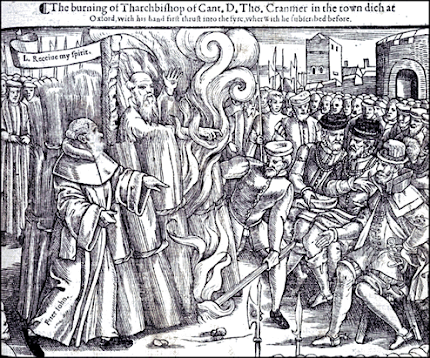
The burning of Tharchbishop of Cant. D. Tho. Cranmer in the town dich at Oxford, with his hand first thrust into the fyre, wherwith he subscribed before. [Click on the picture to see Cranmer's last words.]

Daily Bible Verse

Showing posts with label Michael Horton. Show all posts

Thursday, January 16, 2025

The Free Offer of the Gospel, Common Grace, and Pragmatic Church Growth: Part 4


Woe unto you, scribes and Pharisees, hypocrites! for ye compass sea and land to make one proselyte, and when he is made, ye make him twofold more the child of hell than yourselves. (Matthew 23:15 KJV)

Now the serpent was more subtil than any beast of the field which the LORD God had made. And he said unto the woman, Yea, hath God said, Ye shall not eat of every tree of the garden? (Genesis 3:1 KJV)

“The classical approach judges the validity of any experience on the basis of previously established theological principles. In contrast, Church Growth leans toward a phenomenological approach which holds theological conclusions somewhat more tentatively and is open to revising them when necessary in the light of what is learned through experience.”  C. Peter Wagner 


The Free Offer of the Gospel, Common Grace, and Pragmatic Church Growth:  Part 4


Drawing from my own personal history with the Pentecostal/Charismatic movement in the mid-1980s, I can tell you that the biggest concern for the Pentecostal/Charismatic movement was the growth and spread of the third wave or the Charismatic movement, not classical Pentecostalism.  As I have stated in previous posts, there was a huge split within the Assemblies of God denomination over precisely this distinction between classical Pentecostalism, which emphasized Wesleyan holiness and Christian perfection along with the baptism of the Holy Spirit and the spiritual gifts, and the Charismatic movement, which emphasized the gifts of the Spirit and church growth above all else.  C. Peter Wagner, Charles Kraft, and others associated with Fuller Theological Seminary pushed this sociological and business model of church growth using ecstatic experiences and emotional appeals to recruit naïve converts into the Pentecostal/Charismatic movement.

While I was a student at Asbury Theological Seminary, I was curious enough as a Pentecostal minister to study the church growth model as it was being taught at Asbury.  Although as a student at Southeastern College of the Assemblies of God, Lakeland, Florida--now known as Southeastern University--I was taught the penal substitutionary view of the atonement, the church growth class at Asbury advocated for the governmental theory of the atonement.  But instead of emphasizing the fact that Jesus satisfies the penalty for sin, the professor at that time emphasized the fact that Jesus died on the cross to demonstrate His love for lost persons.  The emphasis is that the atonement satisfies for the sins of all persons, not just the elect.  Thus, the Pentecostals and the Wesleyans will tell you that Jesus died for you because He loves you.  But is it true that Jesus died for everyone who has ever been born and will be born until the parousia or the return of Christ?  Does God really love everyone without exception, good and evil, elect and reprobate?  That seems to be the emphasis of the church growth movement.  I would contend that it is also the emphasis of the neo-Calvinist, neo-reformed movement as it has deviated from the classical Calvinism of the earliest Reformers and of the Westminster divines.  After all, common grace says that God loves the reprobate, although not savingly.  The Old Princeton theologian, Charles Hodge, said that Christ in some sense died for everyone without exception.  According to Hodge, Christ died to purchase common grace for the reprobate and all humanity.

Although tracing the roots of a movement can be open to the genetic fallacy, I think it is a legitimate endeavor to show how the church model began.  The so-called “father” of the church growth movement was missionary to India named Donald McGavran.  McGavran was associated with and supported by the Disciples of Christ, a mainline denomination which has been liberal since at least the modernist controversies of the 1920s.  The basic approach of the Disciples of Christ is no creed but Christ.  In fact, the denomination is even further away from the Churches of Christ and the Christian Church, all being descended from the Cane Ridge Revival of the Second Great Awakening.  At its beginning the movement emphasized the theology of no creed but the Bible.  So, it is a step away from the Bible to say that there is no creed but Christ.  (See:  History of the Disciples of Christ).

Rather than go into the details, of which there are many, I will focus on the basics of the church growth movement.  A critical evaluation of the movement by David J. Valleskey, a Lutheran professor of evangelism is available in PDF format here:  The Church Growth Movement: An Evaluation.  Although the article was written in 1990, it is still pertinent and applicable to today.

Following the principles of the church growth movement and its sociological approach, Tim Keller, a minister in the Presbyterian Church in America, a split from the Presbyterian Church in the United States of America, started a church in New York City.  Keller, allegedly a conservative Presbyterian with a commitment to the Westminster Confession of Faith, the Larger and Shorter Catechisms, did everything possible to distance himself from the biblical standards summarized by the Westminster standards.  In fact, Keller openly denied the doctrine of creation ex nihilo and asserted that God could have created the earth and humanity by way of theistic evolution.  Keller further advocated for the LGBTQIA+ view that sexual orientation is not inherently sinful, but only acting on the allegedly inborn sexual orientation is sinful.  This flies the face of the biblical view that humanity became sinful because of Adam’s original sin and that since the time of Adam’s fall every person on earth is totally corrupt through and through, also known as total depravity.

Keller adopted his own catechism by editing out the controversial doctrines of predestination, unconditional election, special providence, effectual call, and biblical inerrancy.  In fact, the inspiration and inerrancy of the Bible is not even mentioned in Keller’s New City Catechism.  Basically, following the principles of the Disciples of Christ and the Second Great Awakening, Keller decided that Calvinism and the Westminster standards are divisive doctrines that must be avoided in order to facilitate the growth of his church plant.  For Keller the correct way to preach is to appeal to pragmatic applications because secular society and much of Christianity today rejects truth.  People want to know how things “work”.  This is another twist on the church growth principle of appealing to felt needs.  What causes conversions is not biblical truth but how does this apply to me?

We live in a society in which people are skeptical of any kind of truth at all. In contrast to earlier eras, which accepted revealed truth or honored reason and scientific truth, many people today can’t simply receive a set of teachings without seeing how Christianity “works,” how it fleshes out in real life.

 This has implications for all of us. For Christians who are surrounded by today’s secular culture, it is important to hear the preacher dealing winsomely and intelligently with the problems of non-believers on a regular basis. This helps them address their own doubts and is also excellent “training” in sharing their faith. The evangelism programs of earlier eras do not always adequately prepare Christians for dealing with the wide range of intellectual and personal difficulties people have today with the Christian faith.

In a similar way, when the preacher speaks to believers, the non-Christians present come to see how Christianity works in real-life situations. For example, if you are preaching a sermon on the subject of materialism, and you directly apply the gospel to the materialism of Christians, you are doing something that both interests and profits non-Christians. Many listeners will tend to make faith decisions on more pragmatic grounds. Instead of examining the faith in a detached intellectual way, they are more likely to make a faith commitment through a long process of mini-decisions, by “trying it on” and by seeing how it addresses real problems.

Tim Keller.  Preaching in a Secular Culture.”  (See also:  The Gospel Coalition:  Preaching Christ in a Postmodern World).

According to Keller, the way to evangelize is preach the Gospel in a way that appeals to both Christians and non-Christians.  But the problem here is that Keller never defines what he means by the term “the Gospel”.  Does he mean the whole biblical revelation from Genesis to Revelation?  Does he mean the dialectical distinction between law and Gospel as advocated by the dialectical theologians of apparent contradictions and paradox?  Secondly, even granting that Keller means the Bible, why is he focused on what works rather than what is true?  One of the principles of the church growth movement as stated by the charismatic theologian and church growth expert, C. Peter Wagner, is that theology must be adapted to the audience.  That sounds a lot like relativism.  David J. Valleskey makes at least two insightful criticisms of the church growth approach:

We will keep on the right track if we remember two things. First, we need to remember that sociological research and principles do not build the Church. They serve a ministerial, supportive role, not a magisterial role.  Only the Holy Spirit, through the means of grace, builds the Church.

Sociological principles, therefore, must never assume a position of greater importance than the proclamation of the Word and administration of the Sacraments.  Nor dare they even be placed on the same level as Word and Sacrament.  The Church doesn’t grow when proper sociological conditions are met.  The Church doesn’t grow when proper sociological conditions are met and law and gospel are preached.  The Church grows when law and gospel are preached (Isaiah 55:10, 11).  The second thing we need to remember is that the Church Growth Movement tends to ignore the first thing we need to remember. C. Peter Wagner writes,

“Church growth...looks to social sciences as a cognate discipline,” . . . that is, a discipline which is allied with rather than subservient to theology. Wagner actually goes further than that. He says,

The classical approach judges the validity of any experience on the basis of previously established theological principles. In contrast, Church Growth leans toward a phenomenological approach which holds theological conclusions somewhat more tentatively and is open to revising them when necessary in the light of what is learned through experience.

Wagner’s thesis, it would appear, is that if your theology at present doesn’t have room for a factor that causes churches to grow, then it is time to revise your theology. Test by the results rather than by the Scriptures.  

Valleskey, “The Church Growth Movement: An Evaluation”, p. 19.

I am not saying that the classical Lutheran distinction between the moral law of God and the good news of the Gospel is dialectical theology.  However, in the postmodern era, this is often the approach of the neo-Calvinists and the neo-reformed who wish to distance themselves from the unpopular doctrines of double predestination and the distinction between general providence and special providence.  They wish to redesignate the doctrine of general providence as “common grace” and redefine the Gospel in terms of the semi-Calvinist compromise between Pelagianism and the doctrines of sovereign grace.  Tim Keller takes this even further by redefining the biblical standards according to what works.  Pragmatism is not a source for universal and absolute truth.  In fact, it is a compromise with utilitarianism on several levels.  It is basically saying that whatever works is best for the majority of the people affected by pragmatic decisions; in other words, the numerical growth of the confessional churches is profitable both for the congregation and for the denomination at large.  Who could argue that making converts is a bad thing?  The question is to which worldview are you making converts?  To a postmodernist Christianity or to a biblical worldview which is deduced from the infallible and inerrant Scriptures?

A further problem with Keller’s approach is that he presupposes that no one today makes any truth claims.  As the title of the course implies, in a postmodern world, truth changes from one person to the next so that we must accommodate to the relativism of today by appealing to what works rather than what is true.  This is an indirect attack on the Bible which says flatly that the written Word of God is true:  Sanctify them through thy truth: thy word is truth. (John 17:17 KJV).

Pragmatism, according to the late Dr. Gordon H. Clark, was devised by William James and John Dewey.  Dewey and James were also advocates for sociology and the utilitarian ethics which sought for the good of the most people.  In ethical terms, the end justifies the means.  So according to the church growth model, the congregations are growing, it works, and the end result justifies “retelling the Gospel” or relativizing the theology of the Bible to meet felt needs and to show non-Christians that Christianity is pragmatic and works for you in your situation.  This could also be applied to situational ethics.  (See:  Gordon H. Clark.  Pragmatism.”  Posted at the Gordon H. Clark Foundation.

Keller’s approach has no problem with ignoring the confessional standards or even re-interpreting the standards in ways that pragmatically work in the goal of making a congregation grow.  In other words, it is perfectly fine to not tell practicing homosexuals that their thoughts, words and deeds will condemn them on the day of the final judgment.  Instead, the church growth advocate should downplay the final judgment, the moral law of God and simply focus on some positive aspect of Christianity to drawn the homosexual into the body of Christ, even if that person is at first unrepentant.  After all, Presbyterianism acknowledges that the congregation is a mixture of truly regenerate believers and those who are unregenerate.

In times past I spent lots of time listening to The White Horse Inn, hosted at that time by Michael Horton and Rod Rosenblatt.  That podcast has since that time lost many of its listeners.  Horton, who pretended to be an outspoken opponent of the church growth movement, actually advocated for ignoring hypocrisy and unbelief in the congregation rather than arguing for true conversions and progressive sanctification.  For Horton, this evokes implications of the Anabaptist and pietist movements rather than communal covenant theology:

. . . Nevertheless, there was a general tendency among groups [of Anabaptists] . . . to (1) identify the true church exclusively with regenerate believers, (2) emphasize personal holiness (understood as complete separation from the world) rather than preaching and sacrament, as the mark of the church, and (3) display a marked spirit-matter dualism applied to outward forms and ministry of the church as well as the state.

Michael Horton.  The Christian Faith:  A Systematic Theology for Pilgrims On the Way.  (Grand Rapids:  Zondervan, 2011).  P. 748.

I do not object to the distinction between the visible church and the invisible church because this is a distinction taught in the Bible and affirmed by the Westminster Confession of Faith, 1647.   In particular the Larger Catechism says:

WLC 61  Are all they saved who hear the gospel, and live in the church? A. All that hear the gospel, and live in the visible church, are not saved; but they only who are true members of the church invisible.

WLC 62  What is the visible church? A. The visible church is a society made up of all such as in all ages and places of the world do profess the true religion, and of their children.

 (WLC 1:61-63 WCS)

But does this justify Horton’s implied suggestion that prayer, Bible study, catechism, and devotions are irrelevant to what goes on in the main worship services of the church?  Quoting Louis Berkhof, Horton comments:

. . . “The Pietists, on the other hand, manifested a tendency to disregard the visible church, seeking a Church of believers only, showing themselves indifferent to the institutional Church with its mixture of good and evil, and seeking edification in conventicles.”  . . . This is not quite fair.  After all, most pietists did not separate from the established churches, but created a church-within-a-church (ecclesiola in ecclesia).  Nevertheless, by treating the inner ring of the conventicle as the place where genuine discipleship occurs, in contrast to the official ministry of the church, pietism tended to marginalize the importance of that official ministry.  Neither reforming the church nor separating from it, pietism endured the outward forms while locating genuine Christian fellowship and nurture elsewhere.  By identifying the true church with the nucleus within the church that could be recognized as truly regenerate, pietism tended toward an overrealized eschatology, as if the invisible church could become fully visible before the consummation.  Ibid., p. 749.

Horton argues that the goal of the church is not toward true conversion, because that would be Anabaptist or pietist heresy!  Instead, the goal of the church should be to make as many members as possible by way of the outward ministries of preaching and the administration of the sacraments.  Make members and let God sort them out seems to be his theology of evangelism.  Horton downplays discipleship and catechism instruction because that would create an inner circle of pietistic elites.

Tim Keller took this approach to its logical conclusion, namely that truth does not matter.  What matters most is what works.  Ironically, Horton’s radical two kingdoms view of church and state is itself an overrealized eschatology since he does not believe that there will be a literal millennial reign of Christ on the earth.  Instead, he believes in the amillennial view of Christ’s return as indefinite and impending, not imminent.

Here ends part 4.  In part 5 I will continue my critique of the church growth movement and how Tim Keller relativized the doctrinal standards and the Bible to fit with the sociological and pragmatism model for church growth.

The next post is Part 5.

You can follow previous posts on this topic here:  Part 1, Part 2, Part 3.  


Monday, May 02, 2016

Lordship Salvation, John MacArthur, and Zane Hodges


Galatians 2:16–17
(NKJV)

16 knowing that a man is not justified by the works of the law but by faith in Jesus Christ, even we have believed in Christ Jesus, that we might be justified by faith in Christ and not by the works of the law; for by the works of the law no flesh shall be justified. 17 “But if, while we seek to be justified by Christ, we ourselves also are found sinners, is Christ therefore a minister of sin? Certainly not!


Someone asked me a question in regards to a comment posted by David Bishop on Facebook.  The question has to do with what is wrong with the Lordship Salvation view of John MacArthur and the Once Saved Always Saved view of Zane Hodges.  This is David Bishop's comment below:
Via David Bishop

Lordship Salvation was an overreaction to Zane Hodges' Antinomian false gospel. The problem with Lordship Salvation is that it swung too far over into the opposite direction and became a false gospel for all the opposite reasons Zane Hodges' gospel was false. Lordship Salvation so far to the right of Hodges that it became an attempt to redefine faith, repentance and salvation, with the result that it denies the gospel of God's sovereign grace. Zane Hodges was an Arminian theologian and textual critic who defined salvation as coming to believe for one instance in time the singular proposition that "Jesus promised eternal life to all believe in Him." And when I say singular proposition, I literally mean singular proposition. For example, Hodges once gave an illustration in which a man marooned on an island comes across a tiny portion of John 5 in which the only part of the text still legible to him are the words, "Jesus promised eternal life to all who believe in Him." Hodges insisted that if this marooned man believed this one single statement AND NOTHING MORE, then he would be saved. Furthermore, if the marooned man later stopped believing this and started to believe there is no God, or even that Muhammed was God, then he would still saved. Why? Because he had believed for one instance in time. This is why I call Hodges' false gospel, "tattoo Christianity", because Hodges believed that once you got your "tattoo" then that was it, you were going to Heaven. You could go off and become an Atheist, a Buddhist, whatever, and you would still be saved because you had gotten your tattoo. Now, John MacArthur attempted to answer Hodges, but what he answered him with was a Neonomian false gospel every bit as false as Hodges. JMac argued that faith was not just intellectually agreeing with God that all the Biblical propositions about Christ and His crosswork are true, but rather faith is also striving to become less sinful as proof that you have submitted to Christ's Lordship. The basis for his argument was the entirely irrational and self refuting idea that the words "heart" and "mind" as used in the Bible represent two entirely different ways of knowledge and belief. In other words, just like the Danish philosopher who inspired Karl Barth, JMac insisted that a composite of head knowledge plus heart knowledge equals truth knowledge. Neither he, nor Kierkegaard understood that the word "heart" is a polysemy. In other words, it is a word that can be used in many different ways - the heart of the galaxy, the heart of the matter, the heart is an organ, you broke my heart, etc. Imagine, if you will, that we did indeed have a second organ inside our body besides the one in our skull that was capable of knowledge. How would we ever know whether we were only head knowing rather than also head [heart?] knowing? We would need a third organ that could tell the difference. JMac and the Lordship folks today never consider this fact. Instead, they just keep repeating their nonsense and insist anyone who disagrees with them must agree with Hodges. Faith in Scripture simply means to agree with God about what He has said concerning His only begotten Son and His Son's crosswork. Now, lots of people can know what God has said, but only those who have been imputed righteous and have been born of the Spirit will agree with God that what He has said is true. Lordship Salvation flatly rejects this, and this is why I reject Lordship Salvation.

From a Clarkian Scripturalist perspective there are several major problems with Bishop's response, the main one being his view that "head" knowledge and "heart" knowledge are two different ways of knowing.  But the problem here is that the typical definition of "head" knowledge as defined by modern Evangelicals in general is that they mean intellectual knowledge by the term "head knowledge."  They define heart knowledge as a deep felt conviction or an emotional intuition or some other ineffable sensation that cannot be intellectually formulated.  But the Bible never makes such a distinction between the intellect and the heart.  In fact, emotions produce no knowledge.  Emotions are nothing more than bodily sensations, and, therefore, cannot know anything.  The Bible, on the other hand, says that the heart thinks.  (Genesis 6:5; 1 Chronicles 28:9, 29:18; Job 17:11; Proverbs 23:7; Jeremiah 23:20; Daniel 2:30, 7:28; Hebrews 4:12).  In other works, the head, heart, and soul are very much identified as the intellectual seat of consciousness according to the Bible.  This is not to say that the soul has no emotional sensations but overall the Bible represents the heart as the inner soul of man that thinks.  (Proverbs 23:7).  There are exceptions where the Bible says that the heart experiences emotions but Jesus himself said that out of the heart proceeds evil thoughts.  (Matthew 15:19; Mark 7:21).

In regards to the MacArthur and Hodges dispute, I agree somewhat with Bishop's assessment.  But Hodges was not just an Arminian in regards to conversion.  He was also a dispensationalist in his theology, which is another theological system altogether from what the propositions in the Bible would indicate.  MacArthur, although he now identifies as a Calvinist, was at one time also a dispensationalist.  Unfortunately, MacArthur adheres to no detailed Reformed confession of faith such as the London Baptist Confession of Faith, 1689.  For that reason MacArthur has often made serious errors, including confusing justification and sanctification in the first edition of his book, The Gospel According to Jesus.  MacArthur contended in that book that final justification depends on the obedience of the believer and not justification by faith alone.  (See:  The Gospel According to John MacArthur, Trinity Review.  See also:  Justification and Judgment, Trinity Review).  The problem with MacArthur is his continual confusion of justification and sanctification and MacArthur's view of Lordship Salvation is essentially the same thing as the Federal Visionist view that the believer's final justification or vindication depends not just on imputed righteousness but also the works of the believer.  This is the view espoused by John Piper as well in his doctrine of final "vindication" by works.  (See:  John Piper Invites Doug Wilson).

Where I differ with David Bishop above is that he seems to be denying the Reformed confessional view that sanctification is a necessary result of regeneration and saving faith.  The Westminster Confession of Faith 1:6 advocates a system of theology that is logically deduced from the propositions in the Bible.  (See:  The Westminster Confession of Faith and Logic, Trinity Review).

Saving faith is indeed mere intellectual assent.  (See:  Saving Faith:  Trinity Review).  That is, the first thing that happens is an intellectual understanding of the Bible and the Gospel message.  But saving faith is only possible after regeneration or the effectual call.  (John 3:3-8; 6:44, 65).  Understanding what the Bible says and believing what it says are two different things, as most any unbeliever can understand that the Bible says that Christ died on the cross for our sins.  But he refuses to believe what he understands the Bible says because it is foolishness to him.  (1 Corinthians 1:18).

Furthermore, it must not be forgotten that the Westminster Confession has chapters that are numbered in descending order of importance.  The three most important doctrines in the WCF are 1)  Scripture, 2) the Trinity, and 3) Predestination or Of God's Divine Decree.  Saving faith is chapter 14 while regeneration is in chapter 10, justification is in chapter 11, adoption is chapter 12, sanctification is chapter 13, repentance is chapter 15, good works is chapter 16, chapter 17 is perseverance and assurance is chapter 18.  It is good to understand that the Puritan divines at Westminster wanted to emphasize these doctrines as they relate to one another in the system of propositional truth they deduced in summary form from the Scriptures.  Of course all Scripture is God's written word and there could be much more deduced from the Scriptures than what the WCF says (2 Timothy 3:16).  The Reformed confessions, though more thorough than any other confessions of faith today, are only a summary of Scripture in brief.  Christians are obligated to learn as much Scripture as possible and to understand the Scriptures in relationship to all the other Scriptures.  (2 Timothy 2:15; 3:15-17; John 10:35; John 5:39; Acts 17:11).  In short, to isolate saving faith as intellectual assent from everything else the Bible says is wrong.

Moreover, sanctification is a lifelong process of repentance and struggle against sin.  Assurance of salvation comes from God's promises to save His elect, from the eternal predestination of the elect, from eternal justification, and from conversion, justification and sanctification.  (See WCF chapter 18).  True conversion always has the goal of producing justifying faith and a progressive sanctification.  According to Dr. Clark, the effectual call and perseverance of the saints are both monergistic acts of God.  The WCF says the same thing.  (See WCF chapters 10 and 17).  But sanctification and repentance have to do with our will cooperating with God's commands.  Of course, even our synergistic cooperation with God's commands is also caused by God working in us. (Philippians 2:12-13).

I am not sure what Bishop means here:

Now, John MacArthur attempted to answer Hodges, but what he answered him with was a Neonomian false gospel every bit as false as Hodges. JMac argued that faith was not just intellectually agreeing with God that all the Biblical propositions about Christ and His crosswork are true, but rather faith is also striving to become less sinful as proof that you have submitted to Christ's Lordship.

A true and living faith does produce a progress in Christian maturity and a striving to live more and more like Christ:

XII. Of Good Works.
ALBEIT that good works, which are the fruits of faith and follow after justification, cannot put away our sins and endure the severity of God's judgement, yet are they pleasing and acceptable to God in Christ, and do spring out necessarily of a true and lively faith, insomuch that by them a lively faith may be as evidently known as a tree discerned by the fruit.

Thirty-nine Articles of Religion, Article XII.

Bishop's view seems to ignore that sanctification is also a part of the system of theology deduced from Scripture.  The Westminster Confession of Faith makes it clear that the result of saving faith is indeed repentance and sanctification as a matter of cooperation of man's will with God's revealed commands in Scripture.  (Deuteronomy 29:29; Romans 6:1-2; Philippians 2:12-13, 3:10-15).  Only faith can make our good works acceptable to God.  (Hebrews 11:6; Romans 1:17; Habakkuk 2:4).  But this does not mean that we have a license to sin.  (Jude 1:3-5).  The problem with MacArthur is that he confuses justification with sanctification, not that sanctification itself is not a necessary evidence of a valid profession of faith.

Additionally, the neo-orthodox view of Scripture is that Scripture is not literally the words of God but only an analogy or framework of God's revelation since nothing God knows can be known by man and nothing man knows is what God knows.  But does God know that 2 +2 = 4 or that David was the king of Israel?  There are no contradictions in the Bible so there is therefore no contradiction between imputed righteousness and a progressive sanctification.  (Hebrews 6:1-6; Romans 4:1-5; Romans 6:1-2, 12:1-2; Galatians 2:16-17).  I'm not sure how Bishop equates MacArthur's confusion of the head with the heart as some third way of knowing the Scriptures.   However, Dr. Gordon H. Clark clearly says that adding trust to faith or assent is a tautological and circular argument.  Faith, trust and assent are all the same thing and all are an intellectual belief of what is known from the Scriptures.  If the Scriptures are not univocally the words of God, how could anyone believe what God has said?  In other words, if revelation is not communicable from God to man, then the Bible is not God's literal Word.  A reflection or analogy of revelation is not revelation and if the two never meet then the result is the neo-orthodox view of Scripture, which is essentially the view espoused by Westminster Seminary, California and Westminster Seminary, Philadelphia, Pennsylvania.  It is also the view taught by Dr. Michael Horton and Dr. R.  Scott Clark of Westminster Seminary, California.


Saving faith is wrought in the heart and therefore faith itself is not the basis of justification.  Instead, justification is objective and outside of us.  It is the cross work of Christ and his active obedience.  What Christ did in the place of the elect is that He lived a perfectly sinless life by actively obeying God's moral law in every detail and never sinning by omission, commission, or ignorance whatsoever.  Additionally, Christ passively obeyed God by dying for all the sins of all the elect to pay the eternal penalty of God.  The substitutionary atonement of Christ is the basis of our justification, not our faith.

It is therefore imperative that Christians study the Bible in detail and learn as much of Scripture as possible.  A good place to start is with the Westminster Larger Catechism with the proof texts:


Question 68
Are the elect only effectually called?

All the elect, and they only, are effectually called: (Acts 13:48) although others may be, and often are, outwardly called by the ministry of the word, (Matt. 22:14) and have some common operations of the Spirit; (Matt. 7:22, Matt. 13:20–21, Heb. 6:4–6) who, for their willful neglect and contempt of the grace offered to them, being justly left in their unbelief, do never truly come to Jesus Christ. (John 12:38–40, Acts 28:25–27, John 6:64–65, Ps. 81:11–12)


Question 70
What is justification?

Justification is an act of God’ s free grace unto sinners, (Rom. 3:22,24–25, Rom. 4:5) in which he pardoneth all their sins, accepteth and accounteth their persons righteous in his sight; (2 Cor. 5:19,21, Rom. 3:22,24,25,27,28) not for any thing wrought in them, or done by them, (Tit. 3:5,7, Eph. 1:7) but only for the perfect obedience and full satisfaction of Christ, by God imputed to them, (Rom. 5:17–19, Rom. 4:6–8) and received by faith alone. (Acts 10:43, Gal. 2:16, Phil. 3:9)


Question 72
What is justifying faith?

Justifying faith is a saving grace, (Heb. 10:39) wrought in the heart of a sinner by the Spirit (2 Cor. 4:13, Eph. 1:17–19) and word of God, (Rom. 10:14–17) whereby he, being convinced of his sin and misery, and of the disability in himself and all other creatures to recover him out of his lost condition, (Acts 2:37, Acts 16:30, John 16:8–9, Rom. 5:6, Eph. 2:1, Acts 4:12) not only assenteth to the truth of the promise of the gospel, (Eph. 1:13) but received and rested upon Christ and his righteousness, therein held forth, for pardon of sin, (John 1:12, Acts 16:31, Acts 10:43) and for the accepting and accounting of his person righteous in the sight of God for salvation. (Phil. 3:9, Acts 15:11)


Question 73
How doth faith justify a sinner in the sight of God?

Faith justifies a sinner in the sight of God, not because of those other graces which do always accompany it, or of good works that are the fruits of it, (Gal. 3:11, Rom. 3:28) nor as if the grace of faith, or any act thereof, were imputed to him for his justification; (Rom. 4:5, Rom. 10:10) but only as it is an instrument by which he receiveth and applieth Christ and his righteousness. (John 1:12, Phil. 3:9, Gal. 2:16)


Question 75
What is sanctification?

Sanctification is a work of God’ s grace, whereby they whom God hath, before the foundation of the world, chosen to be holy, are in time, through the powerful operation of his Spirit (Eph. 1:4, 1 Cor. 6:11, 2 Thess. 2:13) applying the death and resurrection of Christ unto them, (Rom. 6:4–6) renewed in their whole man after the image of God; (Eph. 4:23–24) having the seeds of repentance unto life, and all other saving graces, put into their hearts, (Acts 11:18, 1 John 3:9) and those graces so stirred up, increased, and strengthened, (Jude 20, Heb. 6:11–12, Eph. 3:16–19, Col. 1:10–11) as that they more and more die unto sin, and rise unto newness of life. (Rom. 6:4,6,14, Gal. 5:24)


Question 77
Wherein do justification and sanctification differ?

Although sanctification be inseparably joined with justification, (1 Cor. 6:11, 1 Cor. 1:30) yet they differ, in that God in justification imputeth the righteousness of Christ; (Rom. 4:6 ,8) in sanctification of his Spirit infuseth grace, and enableth to the exercise thereof; (Ezek. 36:27) in the former, sin is pardoned; (Rom. 3:24–25) in the other, it is subdued: (Rom. 6:6,14) the one doth equally free all believers from the revenging wrath of God, and that perfectly in this life, that they never fall into condemnation (Rom. 8:33–34) the other is neither equal in all, (1 John 2:12–14, Heb. 5:12–14) nor in this life perfect in any, (1 John 1:8,10) but growing up to perfection. (2 Cor. 7:1, Phil. 3:12–14)


The Westminster Larger Catechism: With Scripture Proofs. (Oak Harbor, WA: Logos Research Systems, Inc., 1996).

There could be much more said, but this is my off the cuff response to David Bishop's remarks, which I think were unclear and ambiguous at several points.  Sovereign grace does not mean once saved always saved, as he said.  Bishop is also correct that sovereign grace is not merited or earned by our obedience.  But saving faith does result in a process of growing in knowledge of Scripture, spiritual maturity, and struggling against sin.  (Hebrews 5:12-13; 1 Peter 2:2).   Even the plowing of the wicked is sinful.  (Proverbs 21:4).  But the good works of the elect are acceptable on the basis of their faith and not on the basis of merits.  (Hebrews 11:6).  The perseverance of the saints means they may and often do fall into sin but they are never totally forsaken and God always preserves them in faith and brings them to repentance.  (Jude 1:24-25 KJV; 2 Timothy 1:12 KJV).


[MacArthur was a pastor.  He often spoke ex tempore, so he could have said things that are ambiguous at times about the final judgment.]


Sunday, February 17, 2013

Reasonable Christian: A Critical Review of The Christian Faith: A Systematic Theology for Pilgrims On the Way, Part One

I wrote this review some time ago.  Although I have been accused of not being fair to Horton, I think I've been more than generous.   I will concede, however, that his sections of the book dealing with justification by faith alone are good and worthy of your attention.  The problem with Van Tilians, however, is that their view of revelation as two-fold truth presents problems in that the view of analogy they espouse has more in common with neo-orthodoxy than with the traditional Protestant and Reformed understanding of Scripture as the very words of God.  If at no single point anything in Scripture coincides with what God knows then there is no revelation of what God has said. 

However, if anything we know is true and God knows that same truth, it logically follows that on those single points of truth our knowledge and God's knowledge coincide.  Our knowledge of the propositions God knows is limited to what has been revealed in special revelation in Scripture.  Even here we do not always properly understand the systematic whole and how individual propositions fit within the confessional system of theology we call the Reformed standards.  The fault does not lie with the Scriptures but with our failure to think clearly and logically.

Reasonable Christian: A Critical Review of The Christian Faith: A Systematic Theology for Pilgrims On the Way, Part One

Wednesday, March 21, 2012

Postmodernism Trumps Creation: Girl Scouts troops disband after chapter says it will allow transgendered 7-year-old  - New York Daily News

Leaders of three troops of Girl Scouts quit their posts and disbanded the troops after the organization’s Colorado chapter said it would allow a transgendered 7-year-old to join.
The troop leaders, all affiliated with a Christian school in Louisiana, resigned in protest of the Colorado chapter’s decision to allow participation from any child who identifies as a girl, The Christian Post reported.
Controversy erupted when Felisha Archuleta tried to enroll her son, Bobby Montoya, who identifies as a girl, in a Girl Scouts troop in Denver.  Click here to read the story:  Troops Disband


Is it a surprise to anyone who is a Bible believing Christian that modern man thinks everything is optional, including a person's biological and physical body?  The post-Enlightenment rebellion against reason has reached a new low where nothing is certain, not even one's gender.  Gender, like reality, is merely an illusion of the mind to be changed at will or molded like a ball of wax.  After all, it is feelings that really matter, not facts.

It is this same sort of thinking that guides modern theology, which essentially denies that special revelation can exist except in subjective analogies and relativistic "factual" myths.  Michael Horton's new systematic theology is proof enough of that.  For Horton the Bible is not doctrinal or propositional unless it happens to be convenient for whatever point he wants to make.  Not even the Reformed confessions are about propositional truth for Horton.  Rather it's all an inspiring drama where the believer "feels" God analogically, though nothing univocally true exists.  Truth is ultimately relative and the God who reveals Himself remains hidden.  (See Part One:  Review of The Christian Faith.  See addendum below).

Carried over into the main culture not even science can determine what is obvious to the rest of us.  A baby born with certain biological and physical characteristics, including chromosomes, is not the test of gender.  Rather gender is simply a matter of psychological predetermination.  Or is it?  Now, it would seem, gender is more a matter of choice on the part of a person rather than a matter of God's established creation.  In the beginning God created Adam and Eve as male and female, husband and wife (Genesis 1:1, 26, 27; 2:7, 20-25; 5:1; Matthew 19:4; Mark 10:6)  What we see being pushed as the politically correct propaganda of the day is that individual liberty trumps biblical truth, special revelation and even natural revelation.  Even empirical science must bow to the idol of psychological "feelings" and "emotions" rather than objective truth.

Gordon H. Clark was prophetic when he said that science is only trustworthy in what it can produce practically.  Basically, empirical science is influenced by the subjective presuppositions of those who practice it.  Combine that with postmodernism and it is not hard to see why a postmodern culture defines reality via psychology and sociological presuppositions.  Empiricism, psychology, sociology and every other modern "science" basically sees what it has presupposed it wants to find.  This is why Clark began with Scripture as the ultimate basis for absolute truth in every other area of life.  With the special revelation of God in Holy Scripture all other "sciences" devolve into irrationalism--including Cornelius Van Til's theology of analogy.  Michael Horton's irrational tome, The Christian Faith is just more evidence that theology has become identical with existentialism and psychological feelings rather than propositional truth or absolute truth.  It's all relative.  Or is it?

The culture war is not over.  In fact, it has expanded.  The liberal left and the socialist agenda has taken the game to a new level.  Apparently the game plan is to divide and conquer, take no prisoners.  Sadly even so-called Christian churches, seminaries and leaders have sold out to this same agenda.  It seems to me that Mike Horton is more on the side of the enemy than defending the truth of Scripture, the law/gospel distinction, and propositional truth.


 Girl Scouts troops disband after chapter says it will allow transgendered 7-year-old  - New York Daily News

Addendum:  Horton reveals his prejudice in the postmodernism direction with statements that are explicitly Barthian:

As with all of the divine attributes, it is crucial to avoid two extremes, both of which presuppose a univocal rather than an analogical view of the relation in comparisons between God and human beings.  On one hand, the biblical testimony to a living history with a living God in a covenant with genuine interaction resists all Stoic and Platonic conceptions of a nonrelational and nonpersonal One.  In the unfolding drama there are suits and countersuits, witnesses and counterwitnesses, and God is presented as repenting, relenting, and responding to creatures.  On the other hand, we must always bear in mind that in revealing himself God hides himself.  God explicitly forbids univocal comparisons (Numbers 23:19; 1 Samuel 15:29; Isaiah 44:8, 9; 46:4; Hosea 11:9).   Michael Horton. The Christian Faith: A Systematic Theology for Pilgrims On the Way. (Grand Rapids: Zondervan, 2011), p. 240.

The idea that God "hides" himself even in special revelation comes from the theology of the neo-orthodox theologian, Karl Barth, and not from confessional and Reformed theology.  If there is no univocal truth but only analogies and comparisons that at no point coincide with God's words, thoughts, or absolute truth then the door is wide open to the sort of equivocation we see in the transgender movement.

Charlie

Friday, March 16, 2012

The Continuing Saga of Mike Horton's Systematic Theology: Part Three

For some time now it has been fashionable to deny what is called “propositional revelation”. The term has been coined by those who are opposed to the concept, and by it they appear to mean that revelation is not given to us by God in the form of truths couched in words, or propositions, but that all the revelation that God has given has come to us primarily as acts and events.  Dr. D. Broughton Knox.  (Propositional Revelation:  The Only Revelation).


The Continuing Saga of Mike Horton's Systematic Theology: Part Three


In the last installment I promised to examine Horton's theory of God's graces as His “acts” or “energies”. (See Part One, Part Two, Part Four). He draws this theory from Eastern Orthodoxy, which is itself semi-pelagian. In other words, Horton sees grace as God's “actions” rather than His gifts to us. Although it is true that God does effectually act, providentially guide every single event and human action, it is not true that God is simply what He does. God's predetermined plan or secret decrees matter as well. At this point Horton's presupposed dogma that we must not speak about God's inner being or secret decrees becomes obvious. For Horton God's absolute unknowability extends to propositional truth, special revelation, and any idea of a subjective appropriation of objective, propositional and doctrinal formulations of the truth. For Horton the Van Tilian mantra is stated many times over that God cannot reveal to the creature any univocal truth whatsoever and at no single point does God reveal anything to the creature that is absolutely true. Absolute truth in Horton's opinion is only possible for God in His archetypal knowledge and therefore all truth for the creature is ectypal and analogical. While it is true that the creature cannot intuitively or directly know God due to the Creator/creature distinction, it is questionable to assert that absolute truth is an incommunicable attribute of God. If so, then the implication is that God's written words, the Holy Scriptures, are in fact relative and subjective, not objective.

Unfortunately, this would imply that Scripture is not God's very words to man or God's very thoughts given to man on man's creaturely level. Moreover, this dispute goes all the way back to the Gordon H. Clark and Cornelius Van Til controversy in 1944. (See: The Complaint and The Answer). Horton continually spouts off the Van Tilian dogma of “at no single point” does God's Word coincide with God's univocally given Scriptures. For Horton Scripture is one big metaphor or analogy rather than being the fully inspired words of God given through human agency. This can be demonstrated in several quotes at different points in his book:

“We know God by his works, not in his hidden essence.”

We will return several times to this crucial distinction of Eastern theology between God's essence and energies. As I will argue more fully, Western theology—following Augustine and Aquinas—did not recognize this distinction and insisted that the only reason we do not behold Good in his essence at present is our bodily form. Although the East was as susceptible as the West to the influences of Platonism, its essence-energies distinction reckoned more fully with the Creator-creature difference and often guarded against the pantheistic tendencies evident in Western mysticism. (39)

In this respect, the Reformers reflect the East's emphasis on God's incomprehensibility (in his essence) and God's self-revealing condescension (in his energies). As we know the sun only as we are warmed by its rays, we know God only in his activity toward us, not as he is in himself. (40).

(Mike Horton, The Christian Faith: A Systematic Theology for Christians On the Way, p. 52).


Here is another example of where Horton contradicts himself. He disparages Augustine and Aquinas as too western yet he affirms that the Van Tilian doctrine of analogy as he sees it is drawn from Aquinas:

Following Thomas Aquinas (1225-74), our older theologians therefore argued that human knowledge is analogical rather than either univocal or equivocal (two terms are related analogically when they are similar, univocally when they are identical, and equivocally when they have nothing in common). (45). (P. 54).

It becomes obvious that Horton is hopelessly self contradictory here. He states many times over his bias that God is only known through the big story, the narrative, the historical acts of God, and the “drama” as it unfolds:

A modern myth is that we outgrow stories. When someone asks us to explain who we are, we tell a story. Furthermore, we interpret our personal narratives as part of a larger plot. . . . The Christian answers these big questions by rehearsing the story of the triune God in creation, the fall of creatures he made in his own image, the promise of a redeemer through Israel, and the fulfillment of all types and shadows in the incarnation, life, death, resurrection, ascension, and return of Jesus Christ. The Apostles' and Nicene creeds are not just a list of key doctrines; they are a confession in the form of a story, our shared testimony to the most significant facts of reality. (P. 14).

. . .What we witness in our contemporary Western cultures is not so much a renunciation of metanarratives but the dominance of a new one. . . .

. . . . The Christian faith is, first and foremost, an unfolding drama. Geerhardus Vos observed, “The Bible is not a dogmatic handbook, but a historical book full of dramatic interest.” (8) This story that runs from Genesis to Revelation, centering on Christ, not only richly informs our minds; it captivates the heart and the imagination, animating and motivating our action in the world. (P. 19).

But according to Horton, God cannot reveal himself directly and univocally in words on the creaturely level since words are inherently subjective and “at no single point” does God reveal himself univocally—not even in special revelation:

At no point is goodness exactly the same for God as it is for Sally. The difference is qualitative, not just quantitative; yet there is enough similarity to communicate the point. (P. 55).

Thus, we need not accept the false choice between an encyclopedia of propositions that correspond univocally to God's mind and a merely human testimony to Christ that is related only equivocally to God's Word. (P. 182).

Therefore, creaturely knowledge will always be revealed, dependent, accommodated, ectypal, and analogical rather than coinciding with God's archetypal knowledge at any point. (P. 210).

Ironically, Horton cannot be consistent even here. He repeatedly falls back into appeals to propositional truths as a “direct identification” with God's Word even though he denies that Scripture is directly God's Word. For Horton God's Word is merely a subjective analogy. But in refuting Barth he cannot consistently affirm the Van Tilian theory of analogy:

. . . as we have seen, Barth tends to collapse inspiration into illumination in a single event of revelation in which God addresses an individual personally. The Scriptures are for Barth the normative Christian witness to revelation, but it is difficult to see how in his view the Bible could be more than first among equals—quantitatively but not qualitatively distinct from the church's interpretation. So, in spite of his noble labors to place the church back under the norm of Scripture (Deus dixit! [“God has said!”]), the ontological rationale for doing so remains questionable. Indeed, his refusal of any direct identification of God's Word with creaturely words of Scripture reflects the dualism of “Spirit” and “letter” that we discover in radical Anabaptist, pietist, and Enlightenment thinking. (P. 183).

Try as he might, Horton cannot pull off the magic trick he is attempting here. To assume a mediating position between neo-orthodoxy and conservative Reformed orthodoxy is in effect to concede the point to the liberals, modernists and the neo-orthodox. Basically, for Horton theology is always subjective and relative. This is why he must choose an eclectic approach to systematic theology as a combination of the following:

I. MODELS OF REVELATION
Dulles offers the following models:
  • Model 1: Revelation as Doctrine (God as Teacher)
  • Model 2: Revelation as History (God as Actor)
  • Model 3: Revelation as Inner Experience (God as Guest)
  • Model 4: Revelation as Dialectical Encounter (God as Judge)
  • Model 5: Revelation as New Awareness (God as Poet)

Identifying revelation chiefly (if not exclusively) with true propositions, model 1 is associated with conservative evangelicals and neo-Thomists (2) (P. 113).

This eclectic approach continually uses ad hominem and straw man associations against Horton's perceived theological enemies. For Horton Carl F. H. Henry, Gordon H. Clark, and all Scripturalists are essentially dogmatic, anti-intellectual “biblicists” who have more in common with Roman Catholic “neo-Thomists” than with Van Tilian confessionalism. Ironically, Horton wishes to say that the confessions leave certain questions open and does not require subscription (P. 214). But Horton seems to dogmatically assert that only Van Til's theory of analogy is confessional and Horton himself requires subscription to his irrational contraditions via his semi-neo-orthodox Van Tilian theory of analogy, which is a modern innovative re-interpretation of the Thomist view.

Horton even repeats the error of liberals in saying that a former pope advocated the theory of mechanical dictation as the way God inspired the Bible:

Pope Leo XIII in 1893 went even further by espousing the dictation theory of inspiration, and successive popes during the twentieth century condemned the view that inerrancy was limited to that which is necessary for salvation. (P. 174).

It seems obvious from the statement that Horton does not believe that every word of Scripture is inspired. He confirms this by saying:

With equal clarity, Luther and Calvin can speak of Scripture as free from error. (69). However, it would be anachronistic to put post-Enlightenment questions to pre-Enlightenment figures. The Reformers could simultaneously affirm the inerrancy of Scripture—even to the point of using the unfortunate language of dictation—while pointing out apparent discrepancies in the text. (P. 174).

Basically, for Horton anyone who agrees with the Reformers' unfortunate emphasis on Scripture as the very words of God is a "biblicist" or a "fundamentalist". For Horton only an eclectic assimilation of factors can give any legitimate knowledge of God. He even goes so far as to endorse Donald Bloesch's theology to a degree, even though Bloesch is an outspoken neo-Evangelical advocate of Barthian theology. (Pp. 183-184). Horton disagrees with Bloesch's critique of Warfield but in the end cannot bring himself to divorce himself from Bloesch due to Bloesch's affinity with Van Til's theology:

There have been valiant attempts to reconcile Barth's doctrine of Scripture with the church's traditional view, among which that of Donald Bloesch is especially notable.(104) He allows that Barth's formulation too sharply separated the Word from the words, yet argues that “in his emphasis on the revealing work of the Spirit [Barth] is closer to the intention of the Reformers than is modern fundamentalism in this regard.”(105) Bloesch realizes that Protestant orthodoxy “sought to maintain a dynamic view of both revelation and inspiration” and eschewed fundamentalism's tendency to deny its human aspect.(106) He correctly observes the correlation between fundamentalism's mechanical view and belief in “the univocal language of Scripture concerning God, which contravenes the position of most theological luminaries of the past who held that human language concerning God is either metaphorical or at the most analogical.”(107) (P. 183).

Here we can see Horton's continuing self contradictions. First he tells us that the Reformers “unfortunately” used the terms of “dictation.” He then reverses himself and says the Reformers taught the Van Tilian theory of analogy. This sort of inconsistency is truly amazing. Although Horton claims that revelation comes from outside the believer in the form of an analogy of Scripture and is therefore “objective”, the implication is that this analogy is entirely experiential, existential, subjective and relative. (P. 219). He inconsistently labels the conservative Clarkian view as subjective, inside-out, univocal knowledge. (Ibid.). Nothing could be further from the truth. The fact of the matter is that Gordon H. Clark's view was meant to preserve the objective nature of Scripture while Horton's view endorses the Barthian view by way of dissimulation. If Scripture is not the very words of God—even if organically inspired and not by mechanical dictation as Horton incorrectly attributes to the Clarkian view—then the inference that can be logically drawn is that Scripture is not God's words or Word but merely a vessel of transmission that is existential and subjective. This is the implication of Horton's position despite his denials to the contrary. For Horton the Bible contains God's Word but cannot be directly identified with the very words of the Bible. He only mentions the doctrine of inerrancy as a concession to Old Princeton theology (pp. 176-78) and mentions the Chicago Statement On Biblical Inerrancy only in passing. (P. 184).

Ironically, Donald Bloesch adopted a form of Barth's universalism by asserting the idea that there would be a second chance in hell rather than eternal punishment.  Those who refuse to repent in hell would suffer eternal torment and those who repented would be saved.  But who would be stupid enough to refuse to repent for eternity?  (See:  Is There Salvation After Death?)   Horton would rather endorse Barthianism than to admit that the Bible is univocally the very words and thoughts of God or that propositional truth is the primary means of God's special revelation.  (See also:  Propositional Revelation:  The Only Revelation).

As time is limited, I will pause here and return to this issue in a future post.

Charlie

Addendum:  For further evidence of Horton's eclectic approach I offer this quote from page 87:

This supports my contention in the introduction that theology is the lived, social, and embodied integration of drama (story), doctrine, doxology, and discipleship.  I am suggesting that hearing the covenantal Word of our Lord is the source of that dethronement of the supposedly sovereign self and of the integration that subverts the disintegrating logic of Western dualism and individualism.  [Emphasis in italics in the original text].


Obviously, receiving one's identity from one's God, through a story that one hears, is different from determining one's own identity through idols that the worshiper has created and therefore controls.  (Horton, The Christian Faith, p. 87).


Friday, March 09, 2012

More Problems with Horton's Systematic Theology: Part Two


More Problems with Michael Horton's Systematic Theology

[See also Part Three].

As I noted in part one of this review, I am reading my way through Mike Horton's, The Christian Faith: A Systematic Theology for Pilgrims On the Way, (Grand Rapids: Zondervan, 2011). In part one I noted that instead of starting with the doctrine of Scripture, Horton begins by explaining his epistemological presuppositions regarding the starting point for theology or studying God. Unfortunately, Horton's presupposition begins with a postmodernist, existentialist view of the doctrine of special revelation. For Horton the semi-neo-orthodox theology of “analogy” dominates such that for Horton the Bible is not really God's words but qualitatively different truths for God and man respectively. According to Horton, God cannot reveal propositions to man in any direct way, not even in the Bible. This means effectively that man cannot know truly any propositions from God since propositions for God are known qualitatively in a different way from the propositions known by man. According to the presuppositional theology of Cornelius Van Til, from whom Horton is drawing this theology of Scripture, the Creator/creature or archetypal/ectypal divide is of such a grand divide that at no single point can God reveal anything whatsoever in any univocal way.

Moreover, the practical result of Van Til's theology is that the Bible is not God's very inspired words but rather an analogical representation of God's words in human form. The real position of Mike Horton and other Van Tilians like R. Scott Clark is, for all practical purposes, a view that makes the Bible merely contain God's words in analogical, mystical form but not really God's Word in truth. Truth for Van Til is not absolute but rather a bifurcation of subjective, relativistic truth from the point of view of the creature such that the creature can never truly know even one proposition as God knows that proposition. In other words, God cannot reduce special revelation to a common point of understanding so that at that one point of understanding man can know what God intends to reveal on a creaturely level. In short, the implication of the analogical view is that the Bible is a merely human book. The Bible cannot truly be inspired of God or truly divine because at no single point does God's thoughts coincide with our thoughts—even on a creaturely level. This implies that God cannot know anything from our creaturely perspective, which implies that God is less than omniscient. 

Gordon H. Clark contended that even though God knows everything intuitively without the mediation of human sense perception and that God knows everything there is to know exhaustively and without limit, humans only know what they know via logic and the divine image in man. The image of God in man is intellect and thus the special revelation of God is revealed via the mind, which is synonymous with the “heart” in most places in Scripture. The heart is the totality of the inner being of man, including emotions, will, and the intellect. (See: Genesis 27:21; Exodus 4:21; Deuteronomy 2:30; Joshua 22:5; Job 38:36; Psalm 4:4; 19:14; 77:6; 119:11; Proverbs 2:1, 2; 3:5; Matthew 12:34; 15:19; Mark 11:23; Luke 2:19; Acts 4:32).

The fatal error of Van Til's views, here advocated by Horton, is that man cannot know anything with certainty. Only God knows absolute truth. Therefore, the implication of Horton's view is relativism whether or not he wishes to acknowledge this implication or not. Van Tilians vacillate or equivocate back and forth between fundamentalism when it suits them and neo-orthodoxy when they wish to obfuscate some point of doctrine with which they disagree.

Horton, for all practical purposes, confuses the doctrine of verbal plenary inspiration with the mechanical dictation view. He seems to infer that if anyone believes inspiration extends to every single word of Scripture then necessarily they are advocating the mechanical dictation view and cannot possibly hold to an incarnational or organic model of inspiration:

1. UNDERVALUING THE HUMANITY OF SCRIPTURE: THE DOCTRINE OF TEMPTATION

Similar to the early christological heresy of Doceticsm [sic], which denied the reality of Christ's full humanity, is a well-established historical tendency that one may discern in church history to downplay the humanity of Scripture. Some ancient theologians spoke of the biblical writers as mere “flutes” on which the Spirit played or “secretaries” through whom he dictated his revelation. Such analogies became literal theories in fundamentalism. J. I. Packer refers to the comment of J. W. Burgon: “Every book of it, every chapter of it, every word of it, every syllable of it, every letter of it, is the direct utterance of the Most High.” (16) W.A. Criswell expressed the same view: “Each sentence was dictated by God's Holy Spirit . . . . Everywhere in the Bible we find God speaking. It is God's voice, not man's.” (17) Fundamentalism and Protestant orthodoxy are distinct traditions, and nowhere can this be more clearly seen than in their differing emphases concerning biblical inspiration.

When evaluating the relationship of God's activity and that of creatures in the production of Scripture, the doctrine of analogy already proves its merits. If agency is univocal (the same thing) for God and for creatures, then the question is raised: Who acts more? Is God the author of Romans or is Paul? However, if agency is analogical, then God's activity in producing these texts is qualitatively different from human agency. In this way it may be seen that the role of human authors in producing the Scriptures is entirely their own activity and entirely God's. (Christian Faith, p. 162). [Doceticsm should be spelled as “docetism”].

Moreover, the Scripturalist position is not that "agency" is the same thing for God and for the creature.  The Scripturalist view is that the "proposition" is univocally the same proposition in God's mind and the creature's mind because God has revealed it on the creaturely level via a logical and propositional truth claim.  Furthermore, the sovereignty of God does not deny that God is in absolute control of everything that happens even down to human moral choices.  If so, then the doctrine of inspiration is impossible because God could not literally control what the actual words would be but left that completely up to the human author.  How God controls every word and every moral action without violating the will of free moral agents has not been fully revealed to us in Scripture.  However, that it is true without crossing over into making humans mere automatons is the teaching of Scripture.  (2 Peter 1:19, 20, 21; Hebrews 1:1, 2, 3).

The implication from the quote in Packer's Fundamentalism and the Word of God (Grand Rapids: Eerdmans, 1984) is that the verbal plenary view is the mechanical dictation view and therefore only the concepts and doctrines of the Bible are inspired, not “every word”. Although it is true that not everything recorded in Scripture is meant to be understood as normative or as God speaking a command or promise, everything in Scripture is an infallibly and inerrantly inspired record of even ungodly statements and comments. But according to the Apostle Paul these things are written for us as examples and therefore are still part of the inspired Word of God, contra Mike Horton's view (1 Corinthians 10:6-11). Horton deliberately creates a straw man argument to discredit the Scripturalist view of Gordon H. Clark as if all Clarkians are somehow pejoratively “fundamentalists”. I can only conclude that Horton wishes to lump everyone who disagrees with Van Til's theology as “fundamentalists”.

It is fairly easy to discredit Horton's view since the Chicago Statement On Biblical Inerrancy says that inspiration extends to every word of Scripture without adopting a mechanical dictation view of inspiration:

Article VI

We affirm that the whole of Scripture and all its parts, down to the very words of the original, were given by divine inspiration.


We deny that the inspiration of Scripture can rightly be affirmed of the whole without the parts, or of some parts but not the whole.

It would seem then that either Horton is unaware of what the Chicago Statement says or that he deliberately has created a straw man argument that would seem to bolster his fallacious Van Tilian theology of analogy. In fact, the Chicago Statement says the following which would appear to discredit the semi-neo-orthodox view that Scripture is not the very words of God:


Article IV

We affirm that God who made mankind in His image has used language as a means of revelation.


We deny that human language is so limited by our creatureliness that it is rendered inadequate as a vehicle for divine revelation. We further deny that the corruption of human culture and language through sin has thwarted God's work of inspiration. (Ibid.).

Furthermore, the Chicago Statement On Biblical Inerrancy endorses the doctrine of an incarnational view of inspiration and not a mechanical dictation view, which Horton implies is true of the idea that inspiration extends to every word of Scripture and not just the normative concepts recorded in Scripture:

Article VII

We affirm that inspiration was the work in which God by His Spirit, through human writers, gave us His Word. The origin of Scripture is divine. The mode of divine inspiration remains largely a mystery to us.


We deny that inspiration can be reduced to human insight, or to heightened states of consciousness of any kind.


Article VIII

We affirm that God in His Work of inspiration utilized the distinctive personalities and literary styles of the writers whom He had chosen and prepared.


We deny that God, in causing these writers to use the very words that He chose, overrode their personalities.


Article IX

We affirm that inspiration, though not conferring omniscience, guaranteed true and trustworthy utterance on all matters of which the Biblical authors were moved to speak and write.


We deny that the finitude or fallenness of these writers, by necessity or otherwise, introduced distortion or falsehood into God's Word. (Ibid.).

Obviously, Horton's underhanded attack against the Scripturalist theology of Scripture as extending inspiration down to the very words of Scripture is meant as an ad hominem against those who hold to this view. Horton not only misrepresents Gordon H. Clark and Carl F. H. Henry but he appears to disagree with the Chicago Statement, implying that Horton rejects the affirmations and denials there because they appear to be the work of  “fundamentalists”.

Apparently, Horton takes an ad hoc approach to the doctrine of inspiration. When it suits his purposes he affirms propositional truth claims and inerrancy:

The preservation of human agents from error while their free agency remains intact is already presupposed in a biblical doctrine of God's sovereignty. God restrains sin and error in myriad ways every moment, yet without violence to creatures. . . . .

Given their high view of God's sovereignty in providence, signs of the Bible's humanity and historical conditioning, far from impeding, actually deepened their confidence in the inspiration of Scripture. (Christian Faith, p. 164).

But in another place Horton says that it is impossible that God can directly reveal any propositional truth that is the same for God and for man on man's level:

. . . However, Christianity teaches that because God exists, there is absolute (archetypal) truth, even if our knowledge of that truth is—and remains into eternity—finite, creaturely, and accommodated revelation from God. (Ibid., p. 73).

This is all well and good. However, Horton wishes to say that any idea of a univocal propositional truth at any single point is impossible. For Horton, then “accommodated revelation” excludes revelation on a creaturely level! The doctrine of Gordon H. Clark's Scripturalism is that univocal truth is accommodated to the creaturely level but that it is the exact same thought God inspired and directly mediates to us in fully inspired words—which by the way is not in contradistinction to the Chicago Statement on Biblical Inerrancy! Horton wishes to mediate between “fundamentalism” and “liberalism” but in the end creates a neo-evangelical view that is essentially a mediation between the biblical doctrine of inspiration as understood by classical Reformed theology and the Evangelical movement as a whole and the doctrine of inspiration held by the neo-orthodox theologians that human words cannot possibly be a special and direct revelation from God. I cannot understand how Horton's view is for any practical purpose any different from the view he supposedly rejects:

In many ways, postmodern skepticism about the possibility of language conveying transcendent truth and meaning reflects the exhaustion of modern rationalism, a sense of having had high hopes dashed. If we cannot have absolute (archetypal) knowledge, then we cannot have relative (ectypal) knowledge. If we cannot know as God knows, then we cannot even know as creatures. As a result, in Nietzsche's words, “Interpretation,' the introduction of meaning—not 'explanation' . . . . There are no facts, everything is in flux, incomprehensible, elusive; what is relatively most enduring is—our opinions.” (131) Modern philosophy merely mined Christian doctrines and transformed them into “concepts” and “categories.” In truth, they are merely metaphors. (132) “Truths are illusions which we have forgotten are illusions.” (133) Metaphors do not refer to extralinguistic “reality” but merely to other metaphors. (Ibid., pp. 73-74).


For the record, the following is Gordon H. Clark's view of biblical inspiration. First he quotes from Ed L. Miller's God and Reason (Macmillan, 1972) and then comments himself:

Often associated with the propositional view of revelation is the traditional doctrine of the inspiration of the Scriptures . . . . One view, sometimes called the “dictation” theory, holds that the writers of the Bible were, like typewriters, completely passive or even oblivious to the promptings of the Spirit. . . . This interpretation, or at least one version of it, was emphatically embraced by Pope Leo XIII in his 1893 encyclical Providentissimus Deus. . .

This recognition and account of Dogmatism is on the whole most excellent. At the very least it is an honest acknowledgement that there is and has been such a view held; and this acknowledgment contrasts with the silence of some other authors. The one part of Miller's account that must be emphatically rejected is his statement that the pope emphatically embraced the view that the writers of Scripture were like typewriters, oblivious of their surroundings and condition. Although the author completely misunderstands the pope. Similarly it would be difficult to find a single Protestant theologian who held such a view. If there be one, however, the stenographer or typewriter dictation theory has never been the traditional or majority view. [Gordon H. Clark, Christian Philosophy (Unicoi: Trinity Foundation, 2004), p. 19].

It seems to me that Horton and other Van Tilians have an ax to grind since the most of them never bother to investigate the firsthand sources for Gordon Clark's theology or other theologians like Carl Henry who follow Clark's view of Scripture as the propositional truth claims that bind men's consciences.

Since time is limited here I will take a pause. However, in the next installment I would like to take a look at Horton's adoption of the Eastern Orthodox doctrine of God's “energies”.

See Part Three.

Support Reasonable Christian Ministries with your generous donation.