>

Martyred for the Gospel

Martyred for the Gospel
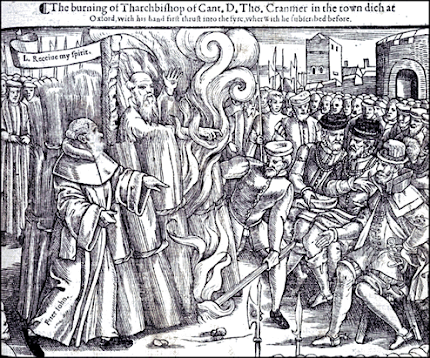
The burning of Tharchbishop of Cant. D. Tho. Cranmer in the town dich at Oxford, with his hand first thrust into the fyre, wherwith he subscribed before. [Click on the picture to see Cranmer's last words.]

Daily Bible Verse

Friday, December 28, 2012

The Trinity Foundation - The Myth of Common Grace

[The following article is from March/April edition of the Trinity Review, 1987.  There is a pdf and a kindle edition of the article available at the Trinity Foundation website here.  It is no surprise that Westminster California is an advocate for the "framework" theory of creation in Genesis 1-2 since that view is essentially in agreement with the neo-orthodox doctrine that the Bible is "inspired myth."  That was also the view of the late Anglo-Catholic, C. S. Lewis.  Lewis is endeared by Evangelicals who seem to be totally unaware of Lewis' actual beliefs.  Charlie J. Ray, M. Div.]

 THE TRINITY REVIEW      For though we walk in the flesh, we do not war according to the flesh, for the weapons of our warfare [are] not fleshly but mighty in God for pulling down strongholds, casting down arguments and every high thing that exalts itself against the knowledge of God, bringing every thought into captivity to the obedience of Christ. And they will be ready to punish all disobedience, when your obedience is fulfilled. March, April 1987 Copyright 2003   John W. Robbins    Post Office Box

Garrett P. Johnson (1987-03-01 00:00:00-05:00). The Trinity Review - 055 - The Myth Of Common Grace (Kindle Locations 1-6). The Trinity Foundation. Kindle Edition.

In 1948 Westminster Seminary professors John Murray and Ned Stonehouse wrote a doctrinal study for the Orthodox Presbyterian Church entitled The Free Offer of the Gospel. The study was published by that church and remains its major teaching on God’s grace in the Gospel. The writing of the study was fueled by a major doctrinal conflict in the OPC between Dr. Gordon H. Clark and the faculty of Westminster Seminary concerning Clark’s fitness for ordination. Cornelius Van Til led the seminary faculty in a Complaint against Clark’s understanding of the Confession of Faith. One of their chief objections concerned Clark’s view of the so-called “sincere offer” of salvation to all men, including the reprobate.

A similar controversy had plagued the Christian Reformed Church during the 1920s, and that controversy originated among the faculty at Calvin Seminary. In 1924 the CRC controversy ended with the exodus of the Calvinists from the Christian Reformed Church under the leadership of Herman Hoeksema, and the formation of a new church, the Protestant Reformed Church. It is worth noting that a number of the Westminster faculty had been members of the Christian Reformed Church, were former professors at Calvin Seminary, and were influenced by the Christian Reformed view of common grace.

In 1945 Herman Hoeksema published a series of editorials on the so-called Clark-Van Til controversy in the Orthodox Presbyterian Church in The Standard Bearer, the magazine of the Protestant Reformed Church. Hoeksema wrote:


”Here, too [on the issue of the sincere offer of the Gospel], the Complaint [against Clark] reveals, more clearly than anywhere else, its distinctly Christian Reformed tendency, particularly its sympathy with the three well-known decrees of the Synod of Kalamazoo, 1924.

”The Complainants put it this way: ‘In the course of Dr. Clark’s examination by Presbytery it became abundantly clear that his rationalism keeps him from doing justice to the precious teaching of Scripture that in the gospel God sincerely offers salvation in Christ to all who hear, reprobate as well as elect, and that he has no pleasure in anyone’s rejecting the offer but, contrariwise, would have all who hear accept it and be saved’ (The Text of a Complaint, 13).”

Hoeksema continued:


”The difference is not that the Complainants insist that the gospel must be preached to all men promiscuously, while Dr. Clark claims that it must be preached only to the elect. That would be quite impossible.... They are agreed that the gospel must be preached to all men.... But the difference between them does concern the contents of the gospel that must be preached promiscuously to all menÖ. It is really not a question to whom one must preach, or how he must preach, but what he must preachÖ. According to the Complainants the preacher is called to proclaim to all his hearers that God sincerely seeks the salvation of them all.... According to Dr. Clark, however, the preacher proclaims to all his hearers promiscuously that God sincerely seeks the salvation of all the elect.... 

”[The Complainants] say that in the preaching of the gospel God sincerely offers salvation in Christ to the reprobate, that He would have them, the reprobate, accept the gospel, and that He would have them be saved. ‘God our Saviour will have all the reprobate to be saved and come unto the knowledge of the truth’ (The Text of a Complaint, 13, 14). And it is with the doctrine of universal salvation in mind that they write: ‘The supreme importance for evangelism of maintaining the Reformed doctrine of the gospel as a universal and sincere offer is self-evident’ (The Text of a Complaint, 14)Ö. Now, you might object, as also Dr. Clark does, that this involves a direct contradiction: God sincerely seeks the salvation of those whom He has from eternity determined not to save. Or: God would have that sinner live whom he does not quicken. Or: God would have the sinner, whom he does not give the faith, to accept the gospel.... You might object that this is not rational. But this objection would be of no avail to persuade the Complainants of their error. They admit that this is irrational. But they do not want to be rational on this point. In fact, if you should insist on being rational in this respect, they would call you a ‘rationalist’, and at once proceed to seek your expulsion from the church as a dangerous heretic. The whole Complaint against Dr. Clark is really concentrated in and based on this one alleged error of his that he claims that the Word of God and the Christian faith are not irrational.... To accuse the Complainants of irrationalism is, therefore, of no avail as far as they are concerned. They openly admit, they are even boasting of, their irrational position. To be irrational is, according to them, the glory of a humble, Christian faith.”1

What Hoeksema justly condemned as irrational was the Complainants’ bold assertion that the Scriptures contain apparent but irreconcilable contradictions. The Complainants wrote: “ ... the Reformed doctrine of the gospel as a universal and sincere offer of salvation is self-evident. Again, we are confronted by a situation that is inadequately described as amazing. Once more there is a problem which has left the greatest theologians of history baffled.... But Dr. Clark asserts unblushingly that for his thinking the difficulty is non-existent.... Dr. Clark has fallen under the spell of rationalism. Rather than subject his reason to the divine Word he insists on logically harmonizing with each other two evident but seemingly contradictory teachings of that Word.... Dr. Clark’s rationalism has resulted in his obscuring ... a truth which constitutes one of the most glorious aspects of the gospel of the grace of God.”2

In The Free Offer of the Gospel (hereafter FOG), authors Murray and Stonehouse assert:


”God himself expresses an ardent desire for the fulfillment of certain things which he has not decreed in his inscrutable counsel to come to pass. This means that there is a will to the realization of what he has not decretively willed, a pleasure towards that which he has not been pleased to decree. This is indeed mysterious....” 3

Had FOG been published in England in the 1640s, Murray and Stonehouse would have been applauded by the Remonstrants and attacked by the great English Puritan John Owen, who wrote,


”They [the Remonstrants] affirm that God is said properly to expect and desire divers things which yet never come to pass. ‘We grant,’ saith Corvinus, ‘that there are desires in God that never are fulfilled,’ Now, surely, to desire what one is sure will never come to pass is not an act regulated by wisdom or counsel; and, therefore, they must grant that before he did not know but perhaps so it might be. ‘God wisheth and desireth some good things, which yet come not to pass,’ say they, in their Confession; whence one of these two things must need follow, -either, first, that there is a great deal of imperfection in his nature, to desire and expect what he knows shall never come to pass; or else he did not know but it might, which overthrows his prescience.” 4

Owen’s argument, of course, does not even consider that there might be contradictions in God’s mind. That “advance” in theology had to await the twentieth century, the neo-orthodox theologians, and their unwitting disciples at Westminster Seminary. If Owen had made his reply to the Complainants in 1944 or to Murray and Stonehouse in1948, he would have been condemned as a “rationalist” and drummed out of the Orthodox Presbyterian Church. Between the seventeenth century and the twentieth, the theologians’ attitude toward logic had changed considerably. It is the modern view of logic that Murray and Stonehouse accept.


Logic and Scripture
Christ and the apostles frequently used logical arguments, sometimes almost formal in arrangement, to silence the Scribes and Pharisees. In Luke 20:1-8 the chief priests, scribes, and elders accosted Christ and asked him, “Tell us, by what authority are you doing these things? Or who is he who gave you this authority?” Christ’s response was to pose a simple dilemma: “I will also ask you one thing, and answer me: The baptism of John-was it from Heaven or was it from men?” Impaled on the horns of the dilemma, the priests, scribes, and elders sought to escape by professing ignorance. Of course, in professing ignorance, they left themselves open to another objection, the same one that Christ made to Nicodemus: “Are you the teacher of Israel and do not know these things?” But Christ did not let the matter end there; he went on to answer their question, though they did not like his answer. In verses 9-19 he tells a parable and then tells them the meaning of Psalm 118:22. Immediately they sought to kill him, but did not do so because they feared the people.

In Luke 20:27-40, Christ destroys the Sadducees by deducing the resurrection from the name of God: “Now even Moses showed in the burning bush passage that the dead are raised, when he called the Lord ‘the God of Abraham, the God of Isaac, and the God of Jacob.’ For he is not the God of the dead but of the living, for all live to him.” In the parallel passage in Mark 12, Christ says-and all who would limit the role of logic in understanding and explaining Scripture should note it well-”Are you not therefore mistaken, because you do not know the Scriptures nor the power of God? ... You therefore are greatly mistaken.” Christ reprimanded the Sadducees for failing to draw the inescapable logical conclusion from the Old Testament premises: All those of whom God is God are living, not dead; God is God of Abraham, Isaac, and Jacob; therefore Abraham, Isaac, and Jacob are living.

Likewise, the epistles of Paul are packed with logical arguments defending the faith. In Galatians 3:16, Paul deduces from the singular word seed the fulfillment of the Abrahamic covenant in Christ. This in turn has further implications found in verses 26-29: the spiritual identity of Old and New Testament believers.

In Romans 4, Paul denies that Abraham was justified by works and argues that justification is by faith alone, a conclusion he draws from Genesis 15:6 and Psalm 32:1, 2. In Romans 9:6-13 Paul deduces God’s eternal love for the elect and hatred for the reprobate from Genesis 21:12; 18:1,14; 25:23; and Malachi 1:2, 3. Thus when seminary professors attack logic, they betray their ignorance of Scripture or their unbelief of the Word of God.

In 1944 the leading Complainant against Clark’s use of logic was Dr. Cornelius Van Til. To this day, Dr. Van Til remains a leading proponent of the doctrine that Scripture contains irreconcilable paradoxes. He asserts:
”There are those who have denied common grace. They have argued that God cannot have any attitude of favor ... to such as are the ‘vessels of wrath.’ But to reason thus is to make logic rule over Scripture. Against both Hoeksema and Schilder, I have contended that we must think more concretely and analogically than they did.... All the truths of the Christian religion have of necessity the appearance of being contradictory.... We do not fear to accept that which has the appearance of being contradictory.... In the case of common grace, as in the case of every other biblical doctrine, we should seek to take all the factors of Scripture teaching and bind them together into systematic relations with one another as far as we can. But we do not expect to have a logically deducible relationship between one doctrine and another. We expect to have only an analogical system.” 5
One should immediately recognize Van Til’s rejection of the Westminster Confession’s claim to be a logically deducible system of truth: “The whole counsel of God ...is either expressly set down in Scripture or by good and necessary consequence may be deduced from Scripture.” The great Princeton theologian, Benjamin Warfield, clarified the attitude of the Westminster divines toward Scripture and logic in his book, The Westminster Assembly and Its Work:
”It must be observed, however, that the teachings and prescriptions of Scripture are not confined by the Confession to what is ‘expressly set down in Scripture.’ Men are required to believe and to obey not only what is ‘expressly set down in Scripture,’ but also what ‘by good and necessary consequence may be deduced from Scripture.’ This is the strenuous and universal contention of the Reformed theology against Socinians and Arminians, who desired to confine the authority of Scripture to its literal asseverations; and it involves a characteristic honoring of reason as the instrument for the ascertainment of truth. We must depend on our human faculties to ascertain what Scripture says; we cannot suddenly abnegate them and refuse their guidance in determining what Scripture means. This is not, of course, to make reason the ground of the authority of inferred doctrines and duties. Reason is the instrument of discovery of all doctrines and duties, whether ‘expressly set down in Scripture’ or ‘by good and necessary consequence deduced from Scripture’: but their authority, when once discovered, is derived from God, who reveals and prescribes them in Scripture, either by literal assertion or by necessary implication.... It is the Reformed contention, reflected here by the Confession, that the sense of Scripture is Scripture, and that men are bound by its whole sense in all its implications. The reemergence in recent controversies of the plea that the authority of Scripture is to be confined to its expressed declarations, and that human logic is not to be trusted in divine things, is, therefore, a direct denial of a fundamental position of Reformed theology, explicitly affirmed in the Confession, as well as an abnegation of fundamental reason, which would not only render thinking in a system impossible, but would discredit at a stroke many of the fundamentals of the faith, such e.g. as the doctrine of the Trinity, and would logically involve the denial of the authority of all doctrine whatsoever, since no single doctrine of whatever simplicity can be ascertained from Scripture except by the use of the processes of the understanding.... [T]he recent plea against the use of human logic in determining doctrine has been most sharply put forward in order to justify the rejection of a doctrine which is explicitly taught, and that repeatedly, in the very letter of Scripture; if the plea is valid at all, it destroys at once our confidence in all doctrines, no one of which is ascertained or formulated without the aid of human logic.” 6
In contrast to this Scriptural view, Van Til denies the possibility of a deductive system and asserts that the “analogical truths” we have all appear to be contradictory. Apart from this unscriptural denial of the role of logic and the perspicuity of Scripture, one must ask the question: What is the meaning of a “system” of non- deducible paradoxes?

Although Westminster Seminary’s apologetics professor John Frame endorses Van Tilianism, he presents an excellent analysis of Van Til’s proposal: “ ... the necessity of formulating doctrines in ‘apparently contradictory’ ways certainly increases the difficulty of developing a ‘system of doctrine,’ especially a system such as Van Til himself advocates.... How may it be shown that one doctrine ‘requires’ another, when our paradoxical formulations fail even to show how the two are compatible? His stress on apparent contradiction, though it does not render Christianity irrational or illogical, does seem at least to make very difficult if not impossible the task of the systematic theologian.” 7

Mr. Frame should understand that Van Til’s views do make Christianity irrational and illogical. They are incompatible with systematic theology. More fundamentally, Van Tilianism, in the words of Warfield, “logically involves the denial of the authority of all doctrine whatsoever.” To accept Van Tilianism is to reject, implicitly, the whole of Christianity. The two are not logically compatible. Therefore, we conclude that the Complainants’ charge of “rationalism” against Clark was founded upon an unscriptural and anti-Confessional rejection of logic and constitutes an inexcusable attack upon one of the central teachings of the Reformation: Scripture interprets Scripture.

Some Great Theologians
During the Clark-Van Til controversy in the OPC, the Complainants alleged that there are other mysterious paradoxes in the Bible besides common grace and reprobation. They sought to discredit Clark by claiming that these paradoxes had left the greatest theologians of history baffled. They quoted from Berkhof, Calvin, Vos, A. A. Hodge, and Abraham Kuyper to support their position; but their quotations do not support their position. The reader is encouraged to study Hoeksema’s discussion of these quotations published in The Standard Bearer [now in the book, The Clark-Van Til Controversy].
One must keep in mind that Clark was accused of rationalism not because of the particular solutions he offered for the alleged paradoxes, or at least not primarily for that reason, but because he attempted to find solutions. It was indeed amazing that a group of theologians would actually accuse a brother theologian of heresy because he tried to solve theological problems. Hoeksema’s comments are pertinent:
”No theologian has ever proceeded from the assumption of the Complainants. Dogmatics is a system of truth elicited from Scripture. And exegesis always applied the rule of the regula Scripturae, which means that throughout the Bible there runs a consistent line of thought, in the light of which the darker and more difficult passages must be interpreted. The Complainants virtually deny this....” 8
John Owen’s comments quoted previously revealed the Complainants’ leanings toward Remonstrant doctrine. But both the Christian Reformed and the Orthodox Presbyterian doctrines of common grace are more specifically similar to the seventeenth-century heresies of the School of Saumur, France, under Cameron and his pupils, Amyraldus and Testardus. A. A. Hodge described these “novelties”:
”Their own system was generally styled Universalismus Hypotheticus, an hypothetic or conditional universalism. They taught that there were two wills or purposes in God in respect to man’s salvation. The one will is a purpose to provide, at the cost of the sacrifice of his own Son, salvation for each and every human being without exception if they believe-a condition foreknown to be universally and certainly impossible. The other will is an absolute purpose, depending only upon his own sovereign good pleasure, to secure the certain salvation of a definite number....

”This view represents God as loving the non-elect sufficiently to give them his Son to die for them, but not loving them enough to give them faith and repentance.... It represents God as willing at the same time that all men be saved and that only the elect be saved. It denies, in opposition to the Arminian, that any of God’s decrees are conditioned upon the self-determined will of the creature, and yet puts into the mouths of confessed Calvinists the very catch-words of the Arminian system, such as universal grace, the conditional will of God, universal redemption, etc.

”The language of Amyraldus, the ‘Marrow Men’, Baxter, Wardlaw, Richards, and Brown is now used to cover much more serious departures from the truth. All really consistent Calvinists ought to have learned by now [1867] that the original position of the great writers and confessions of the Reformed Churches have only been confused, and neither improved, strengthened nor illustrated, by all the talk with which the Church has ... been distracted as to the ‘double will’ of God, or the ‘double reference’ of the Atonement. If men will be consistent in their adherence to these ‘Novelties’, they must become Arminians. If they would hold consistently to the essential principles of Calvinism, they must discard the ‘Novelties’.” 9
Both the Complainants and the Amyraldians assert a “double will” in God, and Hodge’s warning is just as relevant today as it was over a hundred years ago.
Proponents of common or universal grace have appealed to the Dutch Reformed theologian, Abraham Kuyper, as a proponent of their view. The Protestant Reformed historian and theologian, David Engelsma, corrects this error:
”It is widely assumed that the well-meant gospel offer, or free offer, has strong backing in the Dutch Reformed theologian, Abraham Kuyper.... This assumption is false.... [I]t is not true that Kuyper held the doctrine of the well-meant offer-not even in De Gemeene Gratie; on the contrary, he was an avowed foe of the theology of the offer.... Kuyper’s common grace had nothing to do with this universal grace. The common grace of Kuyper was merely a favor of God that gives the world ‘the temporal blessings’ of rain, sunshine, health, and riches, and that restrains corruption in the world so that the world can produce good culture. It was not a grace that aimed at the salvation of the reprobate, a grace that was expressed in a well-meaning offer of Christ, or a grace that was grounded in a universal atonement....
”Kuyper feared-prophetically, as history shows! -that misuse would be made of [his] doctrine of common grace, ‘as if saving grace were meant by it’, with the result that ‘the firm foundation that grace [genade] is particular would again be dislodged’....
”An outstanding and very clear instance of the fatal development of common grace into universal, saving grace is the first point of the doctrine of common grace adopted by the Christian Reformed Church in 1924....
”One finds on every hand that men ground their teaching of a grace of God for all in the preaching, i.e., the well-meant offer, in God’s common grace, thus transforming common (non-saving) grace into the universal (saving) grace of historic Romanism and Arminianism. In doing this, they are deaf to Kuyper’s pleas not to make this mistake....
”The Orthodox Presbyterian theologians, Murray and Stonehouse, are guilty of this....
”Kuyper [was] encouraged to defend particular grace by the fact that ‘in earlier, and spiritually better, ages, I would have found plenty of allies’. He points to a ‘cloud of witnesses’ which did not know a grace which is not particular. This cloud of witnesses includes Augustine, Calvin, Peter Martyr, Rivet, Voetius, Witsius, Beza, Zanchius, Gomarus, Turretin, and many others.... The teaching of ‘universal or common grace’, on the other hand, which is the ‘doctrine of Rome, the Socinians, the Mennonites, the Arminians, and the Quakers, crept into the Reformed Churches from without, especially through Amyraut and the Saumur school.’” 10
If Kuyper and Hodge were disturbed by the widespread influence of common grace in the last century, is it any wonder that Clark and Hoeksema were forced to separate from such a fierce and firmly implanted error seventy-five years later?

The Exegesis of Scripture
Anyone who proposes a theological doctrine must support his claim from Scripture. In the opinion of Cornelius Van Til, “The most important thing to be said about John Murray is that he was, above all else, a great exegete of the Word of God.” 11 We shall see.

In FOG Murray exegeted several passages of Scripture in support of his peculiar view that “God himself expresses an ardent desire for the fulfillment of certain things which he has not decreed in his inscrutable counsel to come to pass” and that “there is in God a benevolent loving kindness towards the repentance and salvation of even those whom he has not decreed to save.... [T]he grace offered is nothing less than salvation in its richness and fullness. The love or lovingkindness that lies back of that offer is not anything less; it is the will to that salvation.” 12 The passages Murray appeals to are Matthew 5:44-48; Acts 14:17; Deuteronomy 5:29; 32:29; Psalm 81:13ff; Isaiah 48:18; Matthew 23:37; Luke 13:34; Ezekiel 18:23, 32; 33:11; Isaiah 45:22; and 2 Peter 3:9.
Matthew 5:44-48
Murray himself admits that “This passage does not indeed deal with the overtures of grace in the gospel.... What bearing this [passage] may have upon the grace of God manifested in the free offer of the gospel to all without distinction remains to be seen.” 13

Unfortunately the bearing of this passage upon the free offer of the Gospel is not made clear in FOG. At the end of their essay, Murray and Stonehouse do conclude, however, that “our provisional inference on the basis of Matthew 5:44-48 is borne out by the other passages. The full and free offer of the gospel is a grace bestowed upon all.... The grace offered is nothing less than salvation in its richness and fullness. The love or lovingkindness that lies back of that offer is not anything less; it is the will to that salvation.” 14

This sort of exegesis, as we shall see shortly, rests upon a most peculiar hermeneutical principle: Passages of Scripture which do not support common saving grace demonstrate common saving grace in a passage that, by the exegete’s own admission, does not deal with saving grace. Perhaps this is an example of the sort of non-deducible “analogical truth” that Van Til has praised and recommended. But let us proceed to those other passages on which Murray and Stone house rest their case.

2 Peter 3:9
The Lord is not slack concerning his promise, as some count slackness, but is longsuffering toward us, not willing that any should perish but that all should come to repentance.

Let us compare Murray’s exegesis of this verse with Francis Turretin’s, John Owen’s, John Gill’s, and Gordon Clark’s:

Murray:
”God does not wish that any men should perish. His wish is rather that all should enter upon life eternal by coming to repentance. The language in this part of the verse is so absolute that it is highly unnatural to envisage Peter as meaning merely that God does not wish that any believers should perish.... The language of the clauses, then, most naturally refers to mankind as a whole.... It does not view men either as elect or as reprobate.” 15
Turretin:
”The will of God here spoken of ‘should not be extended further than to the elect and believers, for whose sake God puts off the consummation of ages, until their number shall be completed.’ This is evident from ‘the pronoun us which precedes, with sufficient clearness designating the elect and believers, as elsewhere more than once, and to explain which he adds, not willing that any, that is, of us, should perish.’”16
Owen:
”’The will of God,’ say some, ‘for the salvation of all, is here set down both negatively, that he would not have any perish, and positively, that he would have all come to repentance....’ Many words need not be spent in answer to this objection, wrested from the misunderstanding and palpable corrupting of the sense of the words of the apostle. That indefinite and general expressions are to be interpreted in an answerable proportion to the things whereof they are affirmed, is a rule in the opening of the Scripture.... Will not common sense teach us that us is to be repeated in both the following clauses, to make them up complete and full,-namely, ‘Not willing that any of us should perish, but that all of us should come to repentance’? ... Now, truly, to argue that because God would have none of those to perish, but all of them to come to repentance, therefore he hath the same will and mind towards all and every one in the world (even those to whom he never makes known his will, nor ever calls to repentance, if they never once hear of his way of salvation), comes not much short of extreme madness and folly ... I shall not need add any thing concerning the contradictions and inextricable difficulties wherewith the opposite interpretation is accompanied.... The text is clear, that it is all and only the elect whom he would not have to perish.” 17
Gill:
”It is not true that God is not willing any one individual of the human race should perish, since he has made and appointed the wicked for the day of evil, even ungodly men, who are fore-ordained to this condemnation, such as are vessels of wrath fitted for destruction; yea, there are some to whom God sends strong delusions, that they may believe a lie, that they all might be damned.... Nor is it his will that all men, in this large sense, should come to repentance, since he withholds from many both the means and grace of repentance....” 18
Clark:
”Arminians have used the verse in defense of their theory of universal atonement. They believe that God willed to save every human being without exception and that something beyond his control happened so as to defeat his eternal purpose. The doctrine of universal redemption is not only refuted by Scripture generally, but the passage in question makes nonsense on such a view.... Peter is telling us that Christ’s return awaits the repentance of certain people. Now, if Christ’s return awaited the repentance of every individual without exception, Christ would never return. This is no new interpretation. The Similitudes viii, xi,1, in the Shepherd of Hermas (c. A.D. 130-150), ... says, ‘But the Lord, being long-suffering, wishes [thelei] those who were called [ten klesin ten genomenen] through his Son to be saved.’ ... It is the called or elect whom God wills to save.” 19
Murray’s interpretation of 2 Peter 3:9 conflicts with the rest of Scripture. He arrogantly refuses to let his understanding of the passage be governed by the principle that all the parts of Scripture agree with one another. He implicitly denies, as the Confession that he professed to believe asserts, that one of the marks of Scripture is the “consent of all the parts.”

Ezekiel 18:23, 32; 33:11
”Do I have any pleasure at all that the wicked should die,” says the Lord God, “and not that he should turn from his ways and live? ... For I have no pleasure in the death of one who dies,” says the Lord God. “Therefore turn and live! ... I have no pleasure in the death of the wicked, but that the wicked turn from this way and live. Turn, turn from your evil ways! For why should you die, O house of Israel?”

Murray:
”It does not appear to us in the least justifiable to limit the reference of these passages to any one class of wicked persons.... It is absolutely and universally true that God does not delight in or desire the death of a wicked person ... This [‘turn ye, turn ye from your evil ways’] is a command that applies to all men without any discrimination or exception. It expresses therefore the will of God to repentance.... God does not will that any should die....There is the delight or pleasure or desire that it should come to be, even if the actual occurrence should never take place.... In terms of his decretive will it must be said that God absolutely decrees the eternal death of some wicked and, in that sense, is absolutely pleased so to decree. But in the text it is the will of God’s benevolence ... that is stated, not the will of God’s decree....” 20
Calvin:
”If it is equally in God’s power to convert men as well as to create them, it follows that the reprobate are not converted, because God does not wish their conversion; for if he wished it he could do it: and hence it appears that he does not wish it.” 21
Turretin:
”Although God declares that he ‘does not will the death of the wicked, but that he turn from his way and live,’ it does not follow that he has willed and planned from eternity the conversion and life of everyone, [even] subject to any condition, for ... it is certain that this refers to God’s will as commanding, not to the will of his good pleasure....” 22
Gill:
”The expostulation, Why will ye die? is not made with all men; nor can it be proved that it was made with an who were not eventually saved, but with the house of Israel, who were called the children and people of God; and therefore cannot disprove any act of preterition passing on others, nor be an impeachment of the truth and sincerity of God. Besides, the death expostulated about is not an eternal, but a temporal one, or what concerned their temporal affairs, and civil condition, and circumstances of life....” 23
Clark:
Ezekiel 18 presents several difficulties. Verses2, 4, and 20 could in isolation be taken as contradictory of Romans 5:12-21.... Another difficulty, one that occurs in several books of the Bible, including Romans 2:10, 14, 25, occurs in Ezekiel 18:19, 21, 22, 27, 28, 31. These verses, in both books, sound as if some men could merit God’s justification on the basis of their own works of righteousness. But the context in Romans and Galatians and elsewhere teaches justification by faith alone. Now, if these contexts so completely alter the superficial meaning of the verses in question, one must be prepared to alter the Arminian interpretation of verses 23 and 32.... Therefore the contiguous verses in Ezekiel, the context of the book as a whole, and the references in the New Testament indicate that God has no pleasure in the death of Israel....Ezekiel 33 contains similar statements, which must be given the same interpretation.” 24
If the Complainants were correct in thinking that Clark was heretical for attempting to apply logic to Scripture, Calvin and Turretin must be heretics as well. Calvin’s argument makes a very neat syllogism: All that God wishes he does; God does not convert the reprobate; therefore, God wishes not to convert the reprobate.

A further comment needs to be made. In their exegesis of this passage and several others, Murray and Stonehouse violate one of the laws of logic repeatedly by making inferences from imperative sentences. Luther condemned such elementary blunders with these words: “By the words of the law man is admonished and taught, not what he can do, but what he ought to do. How is it that you theologians are twice as stupid as schoolboys, in that as soon as you get hold of a single imperative verb you infer an indicative meaning... ?” 25

Deuteronomy 5:29; 32:29; Psalm 81:13; Isaiah 48:18
”Oh, that they had such a heart in them that they would fear me and always keep all my commandments, that it might be well with them and with their children forever....Oh, that they were wise, that they understood this, that they would consider their latter end! ... Oh, that my people would listen to me, that Israel would walk in my ways! ...Oh, that you had heeded my commandments!”
Murray:
”[H]ere we have the expression of [God’s] earnest desire or wish or will that the people of Israel were of a heart to fear him and keep all his commandments always.... [T]herefore we have an instance of desire on the part of God for the fulfillment of that which he had not decreed, in other words, a will on the part of God to that which he had not decretively willed.” 26
Gill:
”[T]hese words do not express God’s desire of their[Israel’s] eternal salvation, but only of their temporal good and welfare ...” 27
Owen:
”[I]n all these expostulations there is no mention of any ransom given or atonement made for them that perish... but they are all about temporal mercies, with the outward means of grace.... [T]here are no such expostulations here expressed, nor can any be found holding out the purposes and intention of God in Christ towards them that perish. Secondly, ... all these places urged ... are spoken to and of those that enjoyed the means of grace, who ... were a very small portion of all men; so that from what is said to them nothing can be concluded of the mind and purpose of God towards all others.... Fifthly, that desires and wishing should properly be ascribed unto God is exceedingly opposite to his all-sufficiency and the perfection of his nature; they are no more in him than he hath eyes, ears, and hands.” 28
This last comment of Owen’s points up the defective view of God held by Murray and Stonehouse. Some people are confused by the anthropomorphisms in Scripture: They think that God actually has hands, arms, eyes, and wings. Others, like Murray and Stonehouse, are confused by the anthropopathisms of Scripture: They think that God actually has emotions and passions, which he suffers. In fact, half of FOG is given over to attempting to prove not only that God has desires, but that he has unfulfilled desires, desires that he knows will never be fulfilled. God, according to Murray and Stonehouse, is a pathetic victim of unrequited love. This is not the sort of God described in chapter 2 of the Westminster Confession of Faith.

Matthew 23:37; Luke 13:34
”O, Jerusalem, Jerusalem, the one who kills the prophets and stones those who are sent to her! How often I wanted to gather your children together, as a hen gathers her chicks under her wings, but you were not willing.”
Murray:
”In this passage there should be no dispute ...[W]e have the most emphatic declaration on the part of Christ of his having yearned for the conversion and salvation of the people of Jerusalem.” 29
Calvin:
”By these words, Christ shows more clearly what good reason he had for indignation, that Jerusalem, which God had chosen to be his sacred ... abode, not only had shown itself to be unworthy of so great an honour, but ...had long been accustomed to suck the blood of the prophets. Christ therefore utters a pathetic exclamation at a sight so monstrous ... Christ does not reproach them with merely one or another murder, but says that this custom was ...deeply rooted.... This is expressive of indignation rather than compassion.” 30
Gill:
”That the gathering here spoken of does not design a gathering of the Jews to Christ internally, by the Spirit and grace of God; but a gathering of them to him internally [externally?], by and under the ministry of the word, to hear him preach.... [I]n order to set aside and overthrow the doctrines of election, reprobation, and particular redemption, it should be proved that Christ, as God, would have gathered, not Jerusalem and the inhabitants thereof only, but all mankind, even such as are not eventually saved, and that in a spiritual saving way and manner to himself, of which there is not the least intimation in this text.”31
Acts 14:17

Murray:
”This text does not express as much as those considered already [Matthew 5:44-48].” 32
Since, by Murray’s own admission, Matthew 5:44-48”does not indeed deal with the overtures of grace in the gospel,” need we say more? Only this: Murray’s principal principle of hermeneutics seems to be the ten leaky buckets theory. That theory holds that while a passage may not be relevant to a certain doctrine, by putting several such irrelevant passages together, the doctrine is established. This principle doesn’t hold water, and Murray leaks.

Isaiah 45:22
Look to me, and be saved, all you ends of the Earth!

Murray:
”This text expresses then the will of God in the matter of the call, invitation, appeal, and command of the gospel, namely, the will that all should turn to him and be saved. What God wills in this sense he is certainly pleased to will. If it is his pleasure to will that all repent and be saved, it is surely his pleasure that all repent and be saved.... [H]e declares unequivocally that it is his will and, impliedly, his pleasure that all turn and be saved.” 33
It must be expected that those who despise logic should make silly blunders like that above. Notice the word impliedly. Murray is obviously making a logical inference. But is the inference valid? His argument is this: Since God has commanded all men to repent, he has willed that all men should repent. It simply does not follow. The whole is a logical fallacy. Perhaps the reader will see this better if we apply it to Abraham: If God commands Abraham to kill Isaac, then it is God’s pleasure that Isaac be killed. Of course, it never was God’s pleasure that Isaac be killed, as we are told. Murray again makes an invalid inference from an imperative verb. Dr. Murray should have scowled less and studied logic more.

In addition to avoiding logical blunders, theologians should strive to use precise language. Murray’s exegesis relies on an ambiguity in the word will. Will can mean either command or decree. It is God’s will (command) that murder not be committed, and it is his will (decree) that Jesus should be murdered. There is no contradiction in this statement once one sorts out the two meanings of the word will in Scripture. But Murray would have us believe that God wills and not wills murder-and salvation-in a similar sense. He fails repeatedly to distinguish between God’s decree and God’s command. That is why his use of the word impliedly fails in this passage. God is commanding all the ends of the Earth to look to him and be saved. He is not wishing, still less decreeing. God is unequivocal, but Murray is not.

Conclusion
The reader may wonder what all this has to do with “practical” Christianity. It has the most serious implications. The inherent contradictions in Van Tilianism generally and in FOG in particular thwart the preaching of the Gospel. The content of the Gospel is itself confused: Did Christ die for all men, does he wish the salvation of all men, or did he die only for his people and actually accomplish their salvation? If the Bible teaches ideas that cannot be reconciled with each other, if all the teaching of the Bible is apparently contradictory, then no one, including the preacher, has the foggiest idea what the Bible says. The result is an increasing indifference to theology and doctrine and a growing interest in other sorts of religiosity. Intellectual Christianity, already abandoned in most denominations, is being rapidly replaced by activist, aesthetic, and experiential religion in the Orthodox Presbyterian Church as well.

Saving grace is not common. It is particular. Sin is common. For forty years the Orthodox Presbyterian Church has been confused about this matter. Perhaps there are some within it who will choose Paul, Calvin, Luther, Turretin, Hodge, Warfield, Owen, Gill, Kuyper, Hoeksema, and Clark rather than Murray, Stonehouse, and Van Til. If so, they had better do it quickly, for the deadly effects of irrationalism have already seriously eroded the foundations of that church.

Notes
1. The Standard Bearer, June 1, 1945, 384-386. These editorials have been reprinted and are available from The Trinity Foundation in the book The Clark-Van Til Controversy.
2. Text of a Complaint, Minutes of the Twelfth General Assembly of the Orthodox Presbyterian Church, 29.
3. The Free Offer of the Gospel, no city, no publisher, no date, 26.
4. The Works of John Owen, volume 10. The Banner of Truth Trust, 1967, 25.
5. Cornelius Van Til, Common Grace and the Gospel, Presbyterian and Reformed Publishing Company, 1973, 165-166.
6. Benjamin B. Warfield, The Westminster Assembly and Its Work, Mack Publishing Company, 1972, 226-227.
7. John Frame, “The Problem of Theological Paradox,” in Foundations of Christian Scholarship, Gary North, ed. Ross House Books, 1976, 310.
8. Herman Hoeksema, The Clark-Van Til Controversy.
9. Archibald A. Hodge, The Atonement.. Evangelical Press, 1974,375-378.
10. David Engelsma, Hypercalvinism and the Call of the Gospel. Reformed Free Publishing Association, 1980, 109-115.
11. Quoted in Iain H. Murray, The Life of John Murray. The Banner of Truth Trust, 1984, 93.
12. FOG, 26, 27.
13. FOG, 5, 7.
14. FOG, 27.
15. FOG, 24.
16. Francis Turretin, Institutio Theologiae Elencticae, as quoted by David Engelsma, Hypercalvinism, 96.
17. John Owen, 348-349.
18. John Gill, The Cause of God and Truth. Baker Book House, 1980, 62-63.
19. Gordon H. Clark, I & II Peter. Presbyterian and Reformed Publishing Co., 1980, 71.
20. FOG, 14-19.
21. John Calvin, Commentary on Ezekiel. Baker Book House, 1979, 248.
22. Francis Turretin, Institutio Theologiae Elencticae, in Reformed Dogmatics, John W. Beardslee, ed. Baker Book House, 1977, 437.
23. John Gill, The Cause of God and Truth, 24.
24. Gordon H. Clark, Predestination in the Old Testament. Presbyterian and Reformed Publishing Co., 1978, 41-42.
25. Martin Luther, The Bondage of the Will. James Clarke and Company, 1957, 151.
26. FOG, 8-9.
27. John Gill, The Cause of God and Truth, 5.
28. John Owen, Hypercalvinism, 400-401.
29. FOG, 10-11.
30. John Calvin, Commentary, volume 17, 105-106.
31. John Gill, The Cause of God and Truth, 29. Gill’s exegesis of the verse is unsurpassed but too lengthy to quote here. He explains how commentators have seen both indignation and compassion in it.
32. FOG, 8.
33. FOG, 20-21.
March/April 1987


The Trinity Foundation - The Myth of Common Grace

Sunday, December 23, 2012

The Free Offer of the Gospel | R. Scott Clark

"In reply the Presbytery wishes to suggest that if man does not know at least one truth that God knows, if man's knowledge and God's knowledge do not coincide in at least one detail, then man knows nothing at all." -- 1944 Philadelphia Presbytery of the Orthodox Presbyterian Church.


Dr. R. Scott Clark persists in misrepresenting the late Dr. Gordon H. Clark as a "rationalist" and a "hyper-Calvinist."  In a posted article he says:


Given the necessary chasm between God and the creature, as taught by Calvin and defended so ably and so long by Cornelius van Til, God must accommodate himself to his creatures. This accommodated revelation of God’s mind and will is ectyptal theology (theologia ectypa). It is based upon God’s self-understanding, but not identical with it. Ectypal theology, as the adjective suggests, is a reflection of the archetypal theology. It is true, but it is accommodated to human creature.

It would appear that neither the Hyper-Calvinists nor the Open-Theists have understood or accounted for this distinction. All revelation is necessarily an accommodation. It is not as if, sometimes we have direct, unmediated access to God and at other times we do not.   The Free Offer of the Gospel | R. Scott Clark

It would appear that Dr. R. Scott Clark is ignorant of The Answer given to these charges by the Presbytery of Philadelphia when it responded to Ned Stonehouse and Dr. Cornelius Van Til.  That response cleared Dr. Gordon H. Clark of the charge of rationalism.  Yet Scott Clark continues to post straw man arguments against G. H. Clark.  If these men had bothered reading G. H. Clark's numerous books they would clearly see that G. H. Clark rejected rationalism outright many times over.

First of all, the charge that G. H. Clark said that ectypal knowledge is equal to archetypal knowledge or the incomprehensibility of God is patently false.  What Gordon H. Clark said was that the accommodated revelation of God to our level is univocally the very words of God.  Simply because this revelation is accommodated to the creature does not make it less than God's very words revealed in logical and rational propositions.  The dispute is over the claim that "at no single point" does God's knowledge and our knowledge coincide, not even in the Bible.  If that claim is true then it implies the neo-orthodox position.  I suspect that Dr. R. Scott Clark and Mike Horton believe in theistic evolution due to the framework theory of Genesis 1-2.   Basically, if you buy the idea that Genesis 1-11 is "inspired myth" then you can appeal to a modified form of Thomas Aquinas' theory of analogy to justify your capitulation to what can only be called neo-orthodoxy. 

What is amazing is that the neo-Calvinists like R. Scott Clark, Mike Horton, and Scott Oliphant keep repeating the same charges leveled against the late Dr. Gordon H. Clark while ignoring that The Answer rejects their view and approves of Dr. Gordon H. Clark's view.  G. H. Clark was not a rationalist:

What Dr. Clark said was that though God's knowledge of a truth is different from man's knowledge of the same truth, it is none the less the same truth that they both know; if indeed man knows anything. The Complaint avers that it is a prerequisite of ministerial good standing to believe that God's knowledge and man's knowledge do not “coincide at any single point” (P. 5, 3; O. 21). It tries to set up as a test of orthodoxy the denial that man knows even one truth God knows. If therefore God knows that two times two are four, and that Christ died for our sins, man cannot know these propositions. Man and God, according to the Complaint, cannot know the same truth, because God's knowledge and man's knowledge do not “coincide at any single point.” And this view the Complainants are attempting to make a test of orthodoxy. In reply the Presbytery wishes to suggest that if man does not know at least one truth that God knows, if man's knowledge and God's knowledge do not coincide in at least one detail, then man knows nothing at all. God knows all truth, and if man's mind cannot grasp even one truth, then man's mind grasps no truth. Far from being a test of orthodoxy this test imposed by the Complaint is nothing else than skepticism and irrationalism.   (The Answer:  On Incomprehensibility, Part Six).

The smoke screen for closet liberals is to raise a fuss against "fundamentalists, rationalists, and hyper-Calvinists" to disguise their own departure into liberalism.  Dr. Bruce Waltke resigned from Reformed Theological Seminary in Orlando, Florida because he believes in theistic evolution.  His justification for that view is "common grace."  After all, "science" is equal to Scripture, is it not?  Dr. R. Scott Clark is guilty of what I call the QIRU or the Quest for Illegitimate Religious Uncertainty.

To read Dr. R. Scott Clark's empty charges against those who stand with classical Reformed theology click here:  The Free Offer of the Gospel | R. Scott Clark

Addendum:  R. S. Clark tries to say that G. H. Clark and other "fundamentalists" who reject the theory of analogy somehow endorse anthropomorphism and anthropopathism as part of their position:
Sometimes this accommodation is intensified by the use of anthropomorphism (the application of human behavior to God) or anthropopathism (the application of human emotion to God). Thus, in Scripture, God is sometimes said to have eyes (Zech 2:8) or to travel (Gen 20:3) or to repent (Gen 6:6–7). This sort of language has always been interpreted by the catholic Church to be metaphoric or symbolic not because of pagan a priori notions of God, but because of clear Biblical propositions about God which have been used to interpret the narratives in which God reveals himself anthropomorphically. For example, Scripture teaches clearly that God does not change (Mal 3:6) or repent (Numbers 23:19). Therefore, on the analogy of Scripture and by the analogy of the faith, such clear propositions must interpret what are obviously more difficult passages which seem to ascribe human qualities to God. To do otherwise is to reduce the God of Scripture to an incompetent and worse to an idol.  (Ibid.)
Not once in any of the writings or audio lectures that I know of did Gordon H. Clark ever deny that there are anthropomorphisms and anthropopathisms in Scripture.  However, Scott Clark has confused categories.  Simply because Scripture contains anthropomorphisms and anthropopathisms does not make all of Scripture an "analogy."  Is all of Scripture an anthropomorphism or an anthropopathism?  I think not.  Confusing the particulars with the whole is a serious logical fallacy.  Moreover, Gordon Clark was taken to task by The Complaint for his denial that God has any emotions whatsoever:

First of all, Dr. Clark specifically states (p. 16) that the statement of the Westminster Confession that “God is without . . . passions” means that God is lacking in feeling and emotion. Although he objects to a definition of feeling or emotion which would make those words mean anything different from “passions”, he does not make provision for any other faculty in God's nature which would be non-intellectual and non-volitional. 

*****

What, in the first place, is the Reformed teaching about the aspects of God's nature, or, if you will, the faculties which reside in God? That God has knowledge and will is agreed by all. The questions that must concern us are two: Does God have what may properly be called “emotions”? and, what is the relation between God's faculties?


If we assign to the word “emotion” an a priori definition which in the nature of the case identifies emotion with “passions”, it would obviously be denying our standards to say that God has emotions (Westminster Confession, II, 1). God does not change; there is no shadow of turning in him; he is not a man that he should repent; he is immutable. Certainly, also, God does not share certain of the qualities which we call “emotions”, such as fear, longing, and surprise. If we are to speak of feelings or emotions in God at all, we must confine ourselves to his attributes which are sometimes summed up under the word “benevolence”: love, goodness, mercy, and grace. Even here, we must be careful to defend the immutable self-determination of God. But the question still remains, can these be identified with, or associated with, the idea of “emotion” or “feeling”? Obviously, we define those words in their narrow but perfectly good colloquial sense as something which arouses the will and thus determines action. In fine, is there any quality or faculty in God which is neither intellectual nor volitional, and which underlies or accompanies volitional activity? That question, in similar words, Dr. Clark studiously avoided answering (p. 16).
******

Although love may, perhaps, be volitional, it must involve feeling or emotion—not in the sense of passions, passivity, or change, but feeling in some sense akin to those which we have, which determine our will and action. It is necessary to deny external determination in God's pity, compassion, jealousy, hatred, love, and “repentance”; but it is difficult to see how internal determined feelings can be eliminated.


(The Complaint).
I find it amusing that Dr. R. Scott Clark is accusing Gordon H. Clark and the Scripturalists of idolatry when in fact the followers of Cornelius Van Til were the ones who were advocating that God has emotions in the conflict of  1944.  Apparently, the Van Tilians were "prying into God's secret being" by asserting that God has emotions.  By R. Scott Clark's own admission that view is idolatry.  Gordon H. Clark and his supporters answered the charge this way:

The final reference to this subject is (P. 9, 2-3; O. 36), “A recollection of Dr. Clark's forthright denial of anything that might be called 'emotion' in God, cited above, will thus impress us that he not only does violence to the Scriptural and Reformed doctrine . . .” Dr. Clark never made any “forthright denial of anything that might be called 'emotion' in God.” Love or wrath “might be called an emotion.” Dr. Clark did not deny love and wrath to God. He holds that while some people might call God's love and wrath emotions, it is better to classify them as volitions. In this Dr. Clark is accord with a large section of the history of theology, and even of literary usage. As an example of literature (not of Reformed theology), it is possible to cite Pascal on page 24 of Everyman's translation: “It is natural for the mind to believe, and for the will to love.” As an example of Calvinistic thought these phrases of Augustus Toplady are appropriate (Complete Works, 1869, pp. 106, 107, and 687): God “is not, for instance, irascible and appeasable; liable to the emotions of joy and sorrow; or in any respect passive.” “When love is predicated of God, we do not mean that he is possessed of it as a passion or affection. . . . Love, therefore, when attributed to him signifies . . . his everlasting will, purpose, and determination to deliver, bless and save his people.”  (On Intellect, Will, and Emotion:  The Answer).

What is truly amazing to me is when a professor of historical theology makes a straw man accusation against Scripturalism when in fact it is his own faction that was promoting anthropopathism, which is clearly idolatry.


Charlie


The Definition of Chalcedon in English, Greek, and Latin


The following is from the Christian Classics Ethereal Library.  The Definition of Chalcedon of A.D. 451 is given in English, Greek, and Latin.  This is the orthodox creed which defined how Jesus Christ could be both God and man incarnate.  While it is not a perfect confession or creed, it does help to reveal heresy when someone obviously rejects either the full humanity of Jesus or His complete deity.  Please note that any idea that the human nature is not "personal" is in effect to endorse Apollinarianism to one degree or another.  The Definition rules out Apollinarianism when it says that Jesus had a "reasonable soul".  In Greek this is "ἐκ ψυχῆς λογικῆς."
  

 English Translation

 We, then, following the holy Fathers, all with one consent, teach men to confess one and the same Son, our Lord Jesus Christ, the same perfect in Godhead and also perfect in manhood; truly God and truly man, of a reasonable [rational] soul72 and body; consubstantial [coessential]73 with the Father according to the Godhead, and consubstantial with us according to the Manhood; in all things like unto us, without sin; begotten before all ages of the Father according to the Godhead, and in these latter days, for us and for our salvation, born of the Virgin Mary, the Mother of God, according to the Manhood;74 one and the same Christ, Son, Lord, Only-begotten, to be acknowledged in two natures,75 inconfusedly, unchangeably,76 indivisibly, inseparably;77 the distinction of natures being by no means taken away by the union, but rather the property of each nature being preserved, and concurring in one Person and one Subsistence, not parted or divided into two persons, but one and the same Son, and only begotten, God the Word, the Lord Jesus Christ, as the prophets from the beginning [have declared] concerning him, and the Lord Jesus Christ himself has taught us, and the Creed of the holy Fathers has handed down to us.


Greek Translation

 Ἑπόμενοι τοίνυν τοῖς ἁγίοις πατράσιν ἕνα καὶ τὸν αὐτὸν ὁμολογεῖν υἱὸν τὸν κύριον ἡμῶν Ἰησοῦν Χριστὸν συμφώνως ἅπαντες ἐκδιδάσκομεν, τέλειον τὸν αὐτὸν ἐν θεότητι καὶ τέλειον τὸν αὐτὸν ἐν ἀνθρωπότητι, θεὸν ἀληθῶς καὶ ἄνθρωπον ἀληθῶς τὸν αὐτὸν, ἐκ ψυχῆς λογικῆς 65 καὶ σώματος, ὁμοούσιον 66 τῷ πατρὶ κατὰ τὴν θεότητα, καὶ ὁμοούσιον 67 τὸν αὐτὸν ἡμῖν κατὰ τὴν ἀνθρωπότητα, κατὰ πάντα ὅμοιον ἡμῖν χωρὶς ἁμαρτίας· πρὸ αἰώνων μὲν ἐκ τοῦ πατρὸς γεννηθέντα κατὰ τὴν θεότητα, ἐπ᾽ ἐσχάτων δὲ τῶν ἡμερῶν τὸν αὐτὸν δἰ ἡμᾶς καὶ διὰ τὴν ἡμετέραν σωτηρίαν ἐκ Μαρίας τῆς παρθένου τῆς θεοτόκου κατὰ τὴν ἀνθρωπότητα ,68 ἕνα καὶ τὸν αὐτὸν Χριστόν, υἱόν, κύριον, μονογενῆ, ἐκ δύο φύσεων [ἐν δύο φύσεσιν] ,69 ἀσυγχύτως, ἀτρέπτως ,70 ἀδιαιρέτως, ἀχωρίστως 71 γνωριζόμενον· οὐδαμοῦ τῆς τῶν φύσεων διαφορᾶς ἀνῃρημένης διὰ τὴν ἕνωσιν, σωζομένης δὲ μᾶλλον τῆς ἰδιότητος ἑκατέρας φύσεως καὶ εἰς ἓν πρόσωπον καὶ μίαν ὑπὸστασιν συντρεχούσης, οὐκ εἰς δύο πρόσωπα μεριζόμενον ἢ διαιρούμενον, ἀλλ᾽ ἕνα καὶ τὸν αὐτὸν υἱὸν καὶ μονογενῆ, θεὸν λόγον, κύριον Ἰησοῦν Χριστόν· καθάπερ ἄνωθεν οἱ προφῆται περὶ αὐτοῦ καὶ αὐτὸς ἡμᾶς ὁ κύριος Ιησοῦς Χριστὸς ἐξεπαίδευσε καὶ τὸ τῶν πατέρων ἡμῖν καραδέδωκε σύμβολον.


Latin Translation


SYMBOLUM CHALCEDONENSE. VERSIO LATINA.

Sequentes igitur sanctos patres, unum eundemque confiteri Filium et Dominum nostrum Jesum Christum consonanter omnes docemus, eundem perfectum in deitate et eundem perfectum in humanitate; Deum verum et hominem verum eundem ex anima rationali et corpore; consubstantialem Patri secundum deitatem, consubstantialem nobis eundem secundum humanitatem; 'per omnia nobis similem, absque peccato' (Heb. iv.): ante secula quidem de Patre genitum secundum deitatem; in novissimis autem diebus eundem propter nos et propter nostram salutem ex Maria virgine, Dei genitrice secundum humanitatem; unum eundemque Christum, filium, Dominum, unigenitum, in duabus naturis inconfuse, immutabiliter, indivise, inseperabiliter agnoscendum: nusquam sublata differentia naturarum propter unitionem, magisque salva proprietate utriusque naturæ, et in unam personam atque subsistentiam concurrente: non in duos personas partitum aut divisum, sed unum eundemque Filium et unigenitum, Deum verbum, Dominum Jesum Christum; sicut ante prophetæ de eo et ipse nos Jesus Christus erudivit et patrum nobis symbolum tradidit.

Click here to see the original post at the CCEL website:  Definition of Chalcedon, A.D. 451. 

Archbishop Peter Jensen’s Christmas message 2012 : Anglican Church League, Sydney, Australia


Archbishop Peter Jensen’s Christmas message 2012 : Anglican Church League, Sydney, Australia

Saturday, December 22, 2012

Gordon H. Clark: Truth Exists Only in Systematic Form

"Disjointed propositions can hardly be called true; truth can only exist in systematic form."  -- Dr. Gordon H. Clark


Recently I have been studying for my professional educator's certification through an alternate route to teaching in the public school system.  Much to the credit of the current philosophy of education there is now an emphasis on higher order thinking skills and logical processing of information rather than simply regurgitating facts, dates and rote memorization.  Not that the latter skills are unimportant but merely reciting information is not the same thing as understanding, comprehension and genuine learning.  Of course, as an Evangelical and Reformed Christian and an Anglican I have problems with other presuppositions in the philosophical approach to public education.  

That being said, the following quote from Dr. Gordon H. Clark supports the view that higher order thinking skills is an essential part of learning and education:

Results and Methods

When the opposition between truth and falsity is taken as fixed, or even if truth is considered to have evolved to a given point, there is a tendency to see the significance of philosophy in the results so laboriously achieved.  And in ordinary prefaces, perhaps in ordinary systems, these results are contrasted with the results of other authors.  College students in particular think they have learned philosophy when they can state these results:  such as, Aristotle said the world was finite; Plotinus put a One above the Intelligible World; Descartes argued, Cogito ergo sum.  If they write them down correctly, they think they should get a good grade.  That these propositions should be supported by reasoning hardly occurs to them.  What is worse, instructors sometimes obscure the reasoning by using the twentieth-century pedagogical stupidity of so-called objective examinations.  In reality all this sort of thing is an attempt to combine the appearance of being in earnest with an actual neglect of the subject matter.  These results by themselves are not philosophy.  Common unreflective opinion usually distinguishes between the method and the content of the positive sciences; but in philosophy no such separation is possible.  The conclusions arrived at are meaningless apart from a knowledge of the process by which they were obtained.  Disjointed propositions can hardly be called true; truth can only exist in systematic form.  

Gordon H. Clark.  Thales to Dewey:  A History of Philosophy:  An Entertaining and Enlightening Survey of the World's Great Thought.  Reprint, 1980.  (Grand Rapids:  Baker, 1957).  P. 443.
Dr. Clark was quick to point out in his theological lectures and books that Calvinism is not a disjointed hodgepodge of pick and choose proof texts.  Rather, Calvinism is a complete systematic exposition of the basics of biblical theology drawn from the Holy Scriptures.  The Reformed confessions are by no means an exhaustive exposition of all the particulars of Reformed theology, but they do stand as a basic systematic summary of the most important points of the doctrines of sovereign grace.  Of course, Dr. Clark also said that proof texting is something everyone does, including liberals.  In and of itself, proof texting is not bad.  It is when proof texting is misused or out of context that problems arise.

I have to wonder why more pastors in Reformed congregations do not take seriously the challenge of Christian education?  After all, what is the point of having an educated minister who is prepared for pastoral ministry if he is keeping his congregants ignorant rather than instructing them in biblical theology, systematic theology and Reformed confessional theology?  Christian education must be more than dumbing down everything to a few rote recitals of key Bible verses and a few quotes from the Shorter Catechism.  No, true understanding comes from synthesizing and processing the propositional truths of Scripture and the systematic outline of those truths in the Reformed confessions and catechisms.  In short, it is the duty of the minister not to just give memorable one-liners from the pulpit but to teach higher order thinking skills through expository preaching from the Scriptures and the Reformed catechisms. 

It is also the duty of the pastor to encourage Christian education through attendance in Sunday school where the leaders have been taught how to do basic exegesis.  These leaders should have an adequate understanding of Scripture and the Reformed confessions in systematic form.  In other words, if there is no higher order thinking going on in the sermons or in the Sunday school, the pastor is not doing his job, nor is anyone being properly discipled in the Christian faith as a total worldview and as a systematic understanding of the Scriptures.  Even a plow boy can understand the Bible if someone shows him how to read it as a whole.

The Return of The Heidelcast (Sort of) | Heidelblog

It is a mystery to me why Dr. R. Scott Clark deleted the original Heidelblog and Heidelcast to begin with.  However, it looks like he's restoring the audio files.  Although I have some serious disagreements with Mike Horton and Scott Clark, they do have valid contributions to make in the realm of covenantal theology, the law/gospel distinction, and Reformed theology in general.  

However, I do have serious problems with their view of the inspiration and inerrancy of Scripture as being merely analogy rather than the univocal, plenary, verbal revelation of God in propositional form.  If Scripture at "no single point" coincides with God's verbal revelation or God's knowledge, then it logically implies that Scripture is not divine revelation but only a shadow of it.  If, on the other hand, Scripture is literally the very words of God, then it would behoove us to take seriously what God's Word says.

Click here to see Scott Clark's comments about the restoration of the Heidelcast:  The Return of The Heidelcast (Sort of) | Heidelblog

Dr. Mark Thompson: Changes | Theological Theology

I first became aware of the Sydney Anglicans when I visited and decided to join Christ Church Longwood, an Episcopal congregation in Longwood, Florida.  The pastor or rector of Christ Church is David Paul Knox, the son of the late D. Broughton Knox, who was the principal of Moore Theological College.  Dr. Mark Thompson of the Theological Theology blog has been appointed as the new principal of Moore Theological College.  May God grant him the grace to stand for the Protestant, Reformed, Anglican and Evangelical focus which the college has to this date upheld.

Dr. Thompson will be busy with his new duties, and he says that his blogging activities may become more infrequent than before.  Although I disagree with his somewhat Amyraldian view of the atonement and his advocacy of common grace and the free offer of the Gospel, Dr. Thompson is a solid Anglican Evangelical.

Anyone who lives in the Orlando, Florida area should visit Christ Church Longwood and hear the preaching of David Knox.  He is a good friend of mine who has done many things to help me along with my ministry, including allowing me to preach several times from the pulpit and to teach a Sunday school class for several months; the teaching I did was a series on the 39 Articles of Religion.

Click here to read Dr. Thompson's commentary on his new appointment:  Changes | Theological Theology

Friday, December 21, 2012

What Are the Deuterocanonical Books?

Although I am not sure of the particular brand of Anglicanism espoused by the author of this article, his views expressed here is not outside the boundaries of either Reformed Anglicanism or Presbyterianism since even the King James Version and the Geneva Bible both included the deuterocanonical books in a separate section either at the end of the canonical Old Testament books or after the New Testament book of Revelation.   Article 6 of the 39 Articles clearly sides with Jerome and Anathansius in including these books as sources of information about customs and history but not as sources for biblical teaching.

What are the Deuterocanonical Books?

Thursday, December 20, 2012

Hiltz calls on ABC-d to say ‘no’ to the ACNA : Anglican Church League, Sydney, Australia

Hiltz calls on ABC-d to say ‘no’ to the ACNA : Anglican Church League, Sydney, Australia

Tony Dungy and Abe Brown Prison Crusade, Hardee Correctional Insitution, 2010

Coach Tony Dungy has preached in our little town. Of course, he had a captive audience. I have done my share of prison ministry, since I was a prison chaplain at North Florida Reception Center, Lake Butler, Florida from 1996 to 1999.  Also, I have done many prison evangelism "crusades" like this one. I did a couple of Abe Brown crusades when I was a new believer in the late 1980s. Also, Abe Brown Prison Crusade came to Lake Butler a few times.

I especially like Coach Dungy's closing remarks about giving these men another chance.  If a criminal history excludes a man from any sort of meaningful employment, what are his options if he wants to serve God and live a life of obedience and good citizenship here on earth?  (Romans 13:1-10).

Watch this to get an idea of what prison ministry is like:


`Or when did we see You sick, or in prison, and come to You?' 40 "And the King will answer and say to them,`Assuredly, I say to you, inasmuch as you did it to one of the least of these My brethren, you did it to Me.' (Matthew 25:39-40 NKJ)


Tony Dungy's Visit - Hardee Correctional Institution, Bowling Green, Florida - YouTube

Wednesday, December 19, 2012

The Reformed View of Sanctification: Is It Arminian?


"As, however, the effects produced transcend the efficiency of our fallen nature, and are due to the agency of the Spirit, sanctification does not cease to be supernatural, or a work of grace, because the soul is active and cooperating in the process."  -- Charles Hodge, Systematic Theology. 


There seems to be some confusion about whether or not the Reformed position advocates a "synergistic" view of sanctification. This is a complicated question to answer and the many directions the response could go would lead to an extended article. Be that as it may, I did survey a few systematic theology texts from the Reformed tradition, including Louis Berkhof's fine work.


Although I disagree with the terminology used, it would appear that a great many Reformed theologians advocate the view that sanctification is "synergistic" and that the converted elect individual "cooperates" with the grace of God in the process of growth in Christ, faith, knowledge, and practical holiness.  I should also point out that all of these theologians, including Berkhof, are careful to refute the idea that sanctification is mere moralism or simply the result of human efforts, personal strivings, or changing oneself.  Rather the Reformed position is that sanctification is a supernatural gift and work of God.  It is literally God working in the believer by His grace.  The point of saying that sanctification requires cooperation is not to assert Pelagianism or Arminianism but to emphasize that, as free moral agents, born again Christians are fully accountable and responsible for the choices they make in the Christian life.  Charles Hodge exemplifies this view here:


It is a Supernatural Work.

    In representing, in accordance with Scripture, sanctification as a supernatural work, or as a work of grace, the Church intends to deny the Pelagian or Rationalistic doctrine which confounds it with mere moral reformation. It not unfrequently happens that men who have been immoral in their lives, change their whole course of living. They become outwardly correct in their deportment, temperate, pure, honest, and benevolent. This is a great and praiseworthy change. It is in a high degree beneficial to the subject of it, and to all with whom he is connected. It may be produced by different causes, by the force of conscience and by a regard for the authority of God and a dread of his disapprobation, or by a regard to the good opinion of men, or by the mere force of an enlightened regard to one's own interest. But whatever may be the proximate cause of such reformation, it falls very far short of sanctification. The two things differ in nature as much as a clean heart from clean clothes. Such external reformation may leave a man's inward character in the sight of God unchanged. He may remain destitute of love to God, of faith in Christ, and of all holy exercises or affections. 

    Nor is sanctification to be confounded with the effects of moral culture or discipline. It is very possible, as experience proves, by careful moral training, by keeping the young from all contaminating influences, and by bringing them under the forming influences of right principles and good associates, to preserve them from much of the evil of the world, and to render them like the young man in the Gospel whom Jesus loved. Such training is not to be undervalued. It is enjoined in the Word of God. It cannot, however, change the nature. It cannot impart life. A faultless statue fashioned out of pure marble in all its beauty, is far below a living man. 

    The word supernatural, as before said, is used in two senses. First, for that which is above nature, and by nature is meant everything out of God. An effect, therefore, is said to be supernatural, in the production of which nature exercises no efficiency. But secondly, the word is often used to mark the distinction between the providential efficiency of God operating according to fixed laws, and the voluntary agency of the Holy Spirit. The Bible makes a wide distinction between the providence of God and the operations of his grace. The difference between the two is, in some respects, analogous to that between the efficiency of a law, or of a uniformly acting force, and the agency of a person. The one is ordered, the other is exercised from time to time, the Spirit distributing his gifts to every one severally as He wills. In the providential agency of God, the effects produced never transcend the power of second causes as upheld and guided by Him; whereas the effects produced by the Spirit do transcend the power of second causes. The effect is due neither to the power of the truth, nor to that of the rational subject in whom the effect is produced. It is due to the power of God over and above the power of the second causes concerned. The effects of grace, or fruits of the Spirit, are above the sphere of the natural; they belong to the supernatural. The mere power of truth, argument, motive, persuasion, or eloquence cannot produce repentance, faith, or holiness of heart and life. Nor can these effects be produced by the power of the will, or by all the resources of man, however protracted or skilful in their application. They are the gifts of God, the fruits of the Spirit. Paul may plant and Apollos water, but it is God who gives the increase. 

    In this latter sense of the word supernatural, the cooperation of second causes is not excluded. When Christ opened the eyes of the blind no second cause interposed between his volition and the effect. But men work out their own salvation, while it is God who worketh in them to will and to do, according to his own good pleasure. In the work of regeneration, the soul is passive. It cannot cooperate in the communication of spiritual life. But in conversion, repentance, faith, and growth in grace, all its powers are called into exercise. As, however, the effects produced transcend the efficiency of our fallen nature, and are due to the agency of the Spirit, sanctification does not cease to be supernatural, or a work of grace, because the soul is active and cooperating in the process.

Charles Hodge - Soteriology - Part 3 - Chapter 18 - Sanctification

I conclude, therefore, that those who accuse Reformed theologians of Arminianism when they emphasize our cooperation in the process of sanctification are perhaps using melodramatic exaggeration to create a straw man argument.  Charles Hodge could hardly be called  an Arminian.  Explained in this way, the doctrine of God's absolute providence and predestination in His decrees is not refuted but simply explicated in a way that does not remove human accountability.  Compatibilism is not Arminianism.  On the contrary, compatibilism is a legitimate way of explaining the relationship between God's sovereignty and human responsibility, whether we are speaking about the reprobate or the elect.  I myself lean toward a more hard determinist view but that would not refute the idea that human agents are fully accountable for their own moral choices.


Given the extended explanations given in most of the Reformed systematic theologies I consulted, I conclude that this is not Arminianism injected into the Reformed view.  I say that because of the many qualifications and distinctions offered.  The Westminster Shorter Catechism says:

35. What is sanctification?
Answer: Sanctification is the work of God's free grace,1 whereby we are renewed in the whole man after the image of God,2 and are enabled more and more to die unto sin, and live unto righteousness.3
See also: WCF 13.1 | WLC 75

1 2 Thess. 2:13
2 Eph. 4:23,24
3 Rom. 6:4,6; Rom. 8:1

Addendum:  The reason this is not Arminianism is that Hodge's definition of supernatural does not exclude the "cooperation of second causes" with the supernatural gift of God which transcends the mere "natural" powers of the human will.  This is also in line with the Westminster Confession:

Chapter 3: Of God's Eternal Decree
1. God, from all eternity, did, by the most wise and holy counsel of His own will freely, and unchangeably ordain whatsoever comes to pass:1 yet so, as thereby neither is God the author of sin,2 nor is violence offered to the will of the creatures; nor is the liberty or contingency of second causes taken away, but rather established.3
See also: WLC 12 | WSC 7

2. Although, in relation to the foreknowledge and decree of God, the first cause, all things come to pass immutably, and infallibly;1 yet, by the same providence, He ordereth them to fall out according to the nature of second causes, either necessarily, freely, or contingently.2


Westminster Shorter Catechism: 

11. What are the works of providence?
Answer: God's works of providence are his most holy,1 wise,2 and powerful preserving3 and governing all his creatures, and all their actions.4
See also: WCF 5.1 | WLC 18


Tuesday, December 18, 2012

The Second Sunday in Advent: Two Weeks Ago

The Second Sunday in Advent.
The Collect.
BLESSED Lord, who hast caused all holy Scriptures to be written for our learning; Grant that we may in such wise hear them, read, mark, learn, and inwardly digest them, that by patience and comfort of thy holy Word, we may embrace, and ever hold fast, the blessed hope of everlasting life, which thou hast given us in our Saviour Jesus Christ. Amen.

The Collect from the First Sunday in Advent is to be repeated every day, with the other Collects in Advent, until Christmas-Eve.

Lee Gatiss Audio: Westminster Conference in London

The following is from the EVNews website.  Lee Gatiss is an Anglican Reformed minister and the new head of Church Society:
Last week there was some controversy surrounding the talk Lee Gatiss, Director of Church Society, gave at the puritan Westminster Conference in London, on the subject of the Great Ejection of the Puritans from the Church of England. Click here for audio of the 48 minute talk so you can see what all the fuss was about!

Click here for Lee's blog post (on 'Meet the Puritans' website), where Lee deals with some of the reaction following his talk.
Lee is more ecumenical within Anglicanism and Evangelicalism than I would be comfortable with myself.  However, he is solidly Reformed in his own theology and has written several books and papers on the English Reformation and the later ministry of Augustus Toplady that are worthy of your consideration.

Click here to see the original post: EV News :: 1662 and all that : Lee Gatiss Westminster Conference talk

Charlie

Addendum:  Since I could barely find the link for the audio of Lee Gatiss' talk I am posting it here to make it easier for you:  Lee Gatiss: Westminster Conference

Sunday, December 16, 2012

Testamentum Imperium

I have been invited to do an article defending the doctrine of eternal security or the perseverance of the saints in this theological journal:  Testamentum Imperium. Your prayers would be sincerely appreciated. 

In Christ, 

Charlie

Self-righteousness

There was a time in my life when I could not imagine those who profess the Christian faith, and who confess the historic Reformed creeds, being part of something like the Salem witch trials or a lynching, or some other unspeakable atrocity. But I can now. There is no violence, no cruelty, so severe as that which is excited by the delusion of self-righteousness. In places where the truth is most closely imitated, self righteousness is particularly virulent, and the purer the strain, the more merciless is the one who is energized by it.

Those who hated and murdered the Lord were professors of orthodoxy who espoused election and taught the need for forgiveness and divine grace. By their fidelity, or professed fidelity, to the Mosiac law, they knew well the need for the confession and forgiveness of sins, and also they saw themselves as having been chosen, not because they were the greatest of nations, but in spite of the fact they were the least.

Nevertheless, their profession of belief in divine grace and their formal humility was appropriated by a self-righteous motive, with the result that God's revelation of righteousness in His Son was seen by them to be the supreme threat to their very existence.

Nothing has changed. People are the same.  --  John Pedersen, Facebook comment.

Saturday, December 15, 2012

The Recent School Shooting: Calvin's Calvinism - "A Defence of the Secret Providence of God" - Section III


"God's purpose is, by the wicked acts of men, to chastise some and to exercise the patience of others." -- John Calvin


Is God the author of sin and the evil acts of men?  Of course not.  But calumniators mendaciously attack the Scriptural doctrine of God's absolute sovereignty over even the evil acts of men.  If God is not in control of all that happens, then these stupid fools make both God and His elect subject to the attacks of evil doers and of Satan Himself--and there is nothing God can do about it if we take them at their word.  But God is not the primary cause of evil choices by men and demons.  He may be the "ultimate" cause of all that happens but free moral agents are not absolved from their own choices.  

Furthermore, God brings His own purposes to pass out of the many evil acts that happen in the world.  (Romans 8:28-32).  Calvin's remarks in Calvin's Calvinism and the Institutes of the Christian Religion  (Book I, Chapter 18:1-4) are pertinent to the recent shooting at an elementary school in Connecticut:

Let readers consider also, if they please, what I have written in my Commentary on the Second Chapter of the Acts of the Apostles. [Cf. Acts 2:23; Acts 4:27, 28] Men (I have there shown), when they commit theft or murder, sin against God because they are thieves and murderers, and because, in their theft and in their murder, there is wicked design. But God, who makes sovereign use of their wickedness, stands in an infinitely different, and in an all-high position above all men, and acts, and things. And the objects and ends of God are infinitely different from, and higher than, those of men. God's purpose is, by the wicked acts of men, to chastise some and to exercise the patience of others. Hence, in all these His uses of the evil doings of men, God never deviates in the remotest degree from His own nature; that is, from His own infinitely perfect rectitude. If, then, an evil deed is thus to be estimated according to its end and object, it is fully manifest that God is not, nor can be, the author of sin!  Calvin's Calvinism - "A Defence of the Secret Providence of God" - Section III

While we might not understand why God ordains such horrific events, it is beyond blasphemy of the Holy Spirit to accuse God of injustice in anything He does.  (Psalms 115:3).  We can only trust that God can and will bring good from the same evil acts that evil men meant for evil .  It is beyond all doubt that God will bring glory to Himself.  (Genesis 50:20; Psalm 76:10; Revelation 15:4).

God's peace be with all who believe the Gospel,

Charlie

Romans 5:1, 2; Romans 8:1, 2

"Common Grace Considered": Final Remarks and Final Article (59)

Professor Herman Hanko:

Referring to the Protestant Reformed Churches as a denomination that denies the free offer, the author describes their position as somewhere between hyper-Calvinism and orthodox Calvinism. This is stated as a fact without any proof, and the assumption is, of course, that those who hold to a gracious gospel offer are the true Calvinists.

What is worse, the author in claiming that a gracious gospel offer is Calvinistic implies that Calvin himself taught this doctrine. We have examined this question before and will not repeat what was said; but the fact remains that such as make this claim ought, for the sake of honesty, to explain Calvin’s position as outlined in his “Treatise on the Eternal Predestination of God,” published in the book, Calvin’s Calvinism. In this book, Calvin specifically repudiates everything those who hold to a gracious gospel offer teach.   "Common Grace Considered": Final Remarks and Final Article (59)
Although I have a few disagreements with the Protestant Reformed Churches, I agree fully with their rejection of the doctrines of common grace and the free offer.  While the neo-Calvinists and the Van Tilians love to use dirty words like "rationalists" and "fundamentalists" and derogatory remarks like "prying into God's secret being," they themselves seem to know other things that "pry" into God's secret being.  They seem to "know," for example, what God "desires" in His secret being.  I wonder how?  The fact is, the only way we know anything about God is by the propositional truth claims made in Holy Scripture and this necessitates careful exegesis, not reading modern sentiments against God's sovereignty back into the text.  That is the "rationalistic" approach of the Arminians and semi-pelagians, not the approach of Luther or Calvin.

Charlie

Thursday, December 13, 2012

Two Rod Rosenbladt Quotes That Changed My Life | Mockingbird


I got the following quote from the Mockingbird website.  The Cathedral Church of the Advent is not my view of a "Reformed" Anglican church but these kinds of quotes give me hope that the Anglo-Papists and the ordainers of women have not completely taken over the Anglican world:
In the end, God will assign one of two grades, 0 or 100, he does not grade on the curve and he will not hear our excuses. Those who have perfectly lived the law in thought, word and deed will be counted as righteous. Others like myself will be utterly doomed, check mate. Of course, Paul said earlier that “there is no one righteous, not even one”. None of us can place our hope in the law.

Now what does it all mean?

You and I as Adam’s children not only are ungodly, not only infected from top to bottom with sin—we can’t fix ourselves. Now this is difficult to say in our postmodern American society. It’s counter-cultural. We believe we can fix anything, even ourselves: Positive thinking, a couple of self-help courses, and all will be fine. But the Bible, especially Romans 3 says we’re wrong. I stand guilty before God and there’s nothing I can do to change that. My sentence is a just one and it is death.


Two Rod Rosenbladt Quotes That Changed My Life | Mockingbird

1662 Book of Common Prayer: Daily Prayer: Morning Prayer: December 13th

Due to popular demand I have decided to try to keep up with the devotional posts in my other blog,  1662 Book of Common Prayer: Daily Prayer.   For those of you who have never read through the morning and evening prayers in the 1662 Book of Common Prayer, I think you might find comfort and edification in knowing that God is sovereign.  

In addition, the lectionary reads through the entire Old Testament in one year, including the Apocrypha.  The Apocrypha were originally a part of both the Geneva Bible and the King James Authorized Version.  The New Testament books are read in one year and the Psalter is read through in its entirety once per month.  The catch is that you will need to read both the morning and evening prayer services daily to keep up with it all.  This takes a bit of discipline to accomplish.  I find it difficult to do every day myself.  However, even if you only read the morning and evening prayers once or twice a week you are getting a good cross section of Scripture readings.  The 1662 Lectionary includes readings from entire chapters of the Old Testament and New Testament, not just selected pericopes.  

In short, the cut and paste lectionaries or Readers Digest approach to lectionary readings adopted by most congregations and churches today was not the common practice in previous ages.  Something has been lost in our high tech world where everyone is in a hurry and modern media has shortened the attention span of the average person.  Would that we could all sit back with a hot cup of coffee and savor the reading of the King James Bible and the 1662 Book of Common Prayer!  

Many people complain that they are unable to understand King James English or Elizabethan English.  These same people probably have never read Shakespeare or Chaucer either.  Canterbury Tales was one of my favorite historical readings when I did my high school Enlish classes.  Basically, if you want to know more about American and British culture and where we came from you are obligated to familiarize yourself with the King James Bible and the 1662 Book of Common Prayer.  Both of these books helped to standardize written and spoken English and their impact on spoken English today is still evident to anyone who has read them.

Has no one ever heard the expression, "Lord have mercy!"?  That pithy exclamation comes from the Book of Common Prayer in the Morning and Evening Prayer services and in Holy Communion:  "Lord have mercy upon us."

You can read this morning's prayer service by clicking here:  1662 Book of Common Prayer: Daily Prayer: Morning Prayer: December 13th

Wednesday, December 12, 2012

Saturday, December 08, 2012

The Anglican Doctrine of Baptism, by Lee Gatiss

Lee Gatiss:

My personal experience of having such honest conversations is that it can create greater interest in the gospel amongst non-church-attending, unbelieving parents who have a vague sense that they should bring their child to God but no real understanding of why. Once I was privileged to bring a new father to Christ himself first, and baptise him, before later baptising his daughter who he had originally come to see me about. He was struck by my explanation of the seriousness of what he was asking for and realised he needed to know more about Christianity. On another occasion, a father decided after much thought that he could not take part in his child’s baptism service because he realised after the weeks of preparation that he was not right with God and could not sincerely say what he was required to say publicly. This opened up more valuable evangelistic conversations. Bishop Colin Buchanan rightly suggests that “If we grant baptism on request, we trivialise the Lord’s provision, lead parents into declarations which mean nothing to them, and often precipitate a reaction against infant baptism by strong believers whom we thus lose to Anabaptists.” [27] It is certainly true that if we become mere dispensers of indiscriminate, unexplained baptisms we are missing out on the gospel opportunities which such baptism enquiries can open up, failing in our duties before God even while we attempt perhaps to be obedient to the letter of canon law.


Issue 63 Article 4 - The Anglican Doctrine of Baptism - Affinity

Aristotle, Thomas Aquinas, & Empiricism/Evidentialism, etc. | Faith Alone

Can you trust your senses? Maybe not!

Aristotle, Thomas Aquinas, & Empiricism/Evidentialism, etc. | Faith Alone

Thursday, December 06, 2012

More of Calvin Against God's "Sincere" Desire to Save All Men Without Exception

Calvin clearly says that the Gentiles were excluded from salvation until the coming of Christ:
I will content myself, therefore, with one example only. God willed not that the doctrine of the Gospel should be preached unto the Gentiles, and He withheld it from them even until the coming of Christ. And therefore it is, that the apostle calls the Gospel "the mystery that was hidden from ages;" nay, that was unknown to the angels themselves in heaven (Colossians 1:26; 1 Peter 1:12).  -- John Calvin, Calvin's Calvinism.
Although there are notable exceptions such as Rahab the harlot, the general and normative principle is that salvation in the Old Testament came only through God's covenant of grace with Abraham and through the later nation of Israel.  (Genesis 17:5; Genesis 32:28;  Deuteronomy 9:4-6; Acts 4:10, 12; John 14:6).  God desires to save His elect and no one else.  (Ephesians 1:4-5, 10, 11; Ephesians 2:8-10).

Click here to see the context of the above quote:  Calvin's Calvinism - "A Defence of the Secret Providence of God" - Section II

Tuesday, December 04, 2012

Political Propaganda and Its Effects: Same-Sex Marriage Ten Years On: Lessons from Canada

The following article from the Aquila Report shows that the two kingdoms theology of Michael Horton, R. Scott Clark, and other so-called "Reformed" theologians is really a subtle form of endorsing the theonomic left in the political realm:
The Impact on Human Rights The formal effect of the judicial decisions (and subsequent legislation) establishing same-sex civil marriage in Canada was simply that persons of the same-sex could now have the government recognize their relationships as marriages. But the legal and cultural effect was much broader. What transpired was the adoption of a new orthodoxy: that same-sex relationships are, in every way, the equivalent of traditional marriage, and that same-sex marriage must therefore be treated identically to traditional marriage in law and public life. A corollary is that anyone who rejects the new orthodoxy must be acting on the basis of bigotry and animus toward gays and lesbians. Any statement of disagreement with same-sex civil marriage is thus considered a straightforward manifestation of hatred toward a minority sexual group. Any reasoned explanation (for example, those that were offered in legal arguments that same-sex marriage is incompatible with a conception of marriage that responds to the needs of the children of the marriage for stability, fidelity, and permanence—what is sometimes called the conjugal conception of marriage), is dismissed right away as mere pretext. When one understands opposition to same-sex marriage as a manifestation of sheer bigotry and hatred, it becomes very hard to tolerate continued dissent. Thus it was in Canada that the terms of participation in public life changed very quickly. Civil marriage commissioners were the first to feel the hard edge of the new orthodoxy; several provinces refused to allow commissioners a right of conscience to refuse to preside over same-sex weddings, and demanded their resignations. At the same time, religious organizations, such as the Knights of Columbus, were fined for refusing to rent their facilities for post-wedding celebrations.  Same-Sex Marriage Ten Years On: Lessons from Canada
In short, there is no such thing as  "neutral" or "amoral" government.  Those who would radically divorce the Christian or the Christian churches from any voice in the political process are in effect endorsing godless atheism and humanistic secularism.  Although it is true that the Christian churches' primary mission is to preach the law and the Gospel and to make disciples, it is not true that the church not called to be the moral conscience of the nation.  Horton and Clark seem to think that endorsing homosexuality in the secular government is irrelevant to the church.  The fact is, however, is that here is only one source of truth, namely God.  God's divine revelation in the Bible is the final rule for faith and practice.  That rule is revealed in God's moral law.  If the Christian is compelled to love his neighbor, that would mean protecting his neighbor from false teaching--even if that false teaching is taking place in the propaganda of the government, in the media, and in the public education system. 

Moreover, endorsing sin has social and societal consequences, which consequences have a devastating effect on church disciple and the mission of the church in regards to Christian education and evangelism.  Make no mistake about it here.  The world is influencing the church and when the church does nothing to speak out publicly against these intrusions into the sphere of religion by the state, then the result can only be the oppression and persecution of Christians and the church.  The result is also a weakening of the resolve of conservative churches so that they too will become  moral relativists and compromisers.

Calvin Asserts that God "Hates" the Reprobate

But it is evident that all men lost in Adam eternal life, and that, therefore, the adoption of God is an act of special grace; whence it will follow that all those are the rather hated of God who are thus estranged and alienated from Him. -- John Calvin, Calvin's Calvinism.


But as for you, you brawl against God Himself with all impiety and profanity, as "being less merciful than a wolf," because (according to your opinion) He has so little considered the good and happiness of His offspring! Now, before the saying of Christ--"that God, because He is good, acts more kindly towards His children than men do, who are evil" (Matt. vii. 11)--can be called in to favour your opinions and arguments, you must prove that all men are equally the children of God. But it is evident that all men lost in Adam eternal life, and that, therefore, the adoption of God is an act of special grace; whence it will follow that all those are the rather hated of God who are thus estranged and alienated from Him. All the testimonies of the Scripture which you cite are mere javelins, hurled at random by the hand of a madman, as where you quote that word, "And God saw everything that He had made, and behold it was very good" (Gen. 1. 31). For from this text you conclude that man was also "very good." And from this you next infer that God was unjust in creating that which was "good" to perdition.

 Calvin's Calvinism - "A Defense of the Secret Providence of God" - Section II

Christological Controversies: Is Jesus Christ Omnipresent?

Someone over at Facebook posted a link to a new book, the title of which is, "The Omnipresence of Jesus."  The book is written by Theodore Zachariades.  I do not know Mr. Zachariades but I did read somewhere online that he is a calvinistic Baptist.

At any rate, I had a few words with Mr. Zachariades in Facebook over the controversial nature of his book title.  After that exchange he agreed to send me a copy of the book to review for the blog.  I will be reading and reviewing the book after I receive it in the mail.

Someone else asked me about how Hebrews 13:8 relates to the issue and this is the response I posted at Facebook after the thread was closed:


Alan, Hebrews 13:8?  I don't believe I mentioned that verse.  However, the Definition of Chalcedon 451 A.D. makes it clear that the monophysite or Eutychian error is a heresy.  Jesus Christ is one person according to Chalcedon.  The Apollonarian error was that the human soul was replaced by the second Person of the Godhead, the divine Logos.  The orthodox view and the Scriptural view is that Jesus Christ is fully human.  That means that in the incarnation the body and soul of Jesus is the same as ours with the exception that He committed no sins.  The doctrine of the hypostatic union rejects the idea that Jesus is a mixture of God and man in one nature.  Neither are the two natures separated but parallel in Jesus.  They are perfectly united in the one person of Jesus Christ such that He has a fully human soul and at the same time He is the fully divine person of the Logos, perfectly united, not mixed or confused together, nor separated.  

In short, the divine attributes are not communicated to the human nature.  We do not worship the physical image of Jesus Christ or His human nature.  We worship the person of Christ who is the divine Logos, the second person of the Godhead.  The Lutherans say that the divine nature is communicated to the human nature so that it is omnipresent and in that way the real body and blood of Christ is in the bread and wine at the administration of the sacrament of the Lord's Supper.  The Reformed view disagrees because the body of Christ is not omnipresent but is locally present in heaven at the Father's right hand.

The Anglo-Catholics and the Roman Catholics go even further by asserting that the body and blood of Christ are to be worshipped.  That's why at their communion services you see them lifting up the wafer and bowing down to it as an idol.  It is blatantly idolatrous to worship the bread and wine as if they were God rather than creatures or created things.

So in answer to your question, Hebrews 13:8 does not say that Jesus in His human nature was omnipresent, omnipotent, or omniscient.  The context is in reference to the Lord and all the promises of the covenant of grace revealed in the Old Testament, Genesis 17.  The Lord never breaks His promises to His elect.  The man, Jesus Christ, is not eternally pre-existent.  The incarnation took place at a specific date and time in history.  Technically speaking then, the "lamb slain before the foundation of the world" (Revelation 13:8) refers to God's decree of redemption prior to creation, not that Jesus was literally already slain.  The same exegetical principle applies to the incarnation and references to the divine nature or deity of Christ as in Hebrews 13:8.  That verse does not refer to the human nature as "immutable".  It is a reference to His divine nature, which is indeed immutable.  God's promises in the covenant of grace are trustworthy because of who the triune and personal God is and because of His immutability.  He can swear by no one and nothing greater than Himself.  (Hebrews 6:13; Luke 1:73; Luke 1:68-79).

There is an excellent sermon on these issues at Sermon Audio by Dr. Robert L. Reymond called, "Demolishing the Stronghold of a False Christology."

Sunday, December 02, 2012

Calvin Approves of "Occasionalism"

That Providence, therefore, which we ascribe to God, pertains as much to His operating hands as to His observing eyes. When, therefore, God is said to rule the world by His Providence, we do not merely mean that He maintains and preserves that order of nature which He had originally purposed in Himself, but that He holds and continues a peculiar care of every single creature that He has created. And true and certain is the fact, that as it was the wonderful wisdom of God that originally made the world, and disposed it in its present beautiful order, so, unless the omnipotent power of God, ever present, sustained it thus created and disposed it, it could not continue in its designed order and form one hour.  -- John Calvin

Calvin's Calvinism - "Defence of the Secret Providence of God" - Introduction

God's Sovereignty Over Evil

Often in reading John Calvin I come across unfamiliar words like "cavil" or "cavils."  Exactly what is a "cavil" anyway?  In the context of Calvin's Insitutes and Calvin's Calvinism a "cavil" is a trivial objection to the plain teaching of Holy Scripture on the issues of sovereign grace, unconditional election and absolute predestination.  Denying God's providence by appealing to general guidance of history over against God's being in control of all the details of history is a "cavil".  Denying that God controls the future but only "foreknows" the future is a "cavil."  Obviously, if God foreknew that Hitler would commit genocide against 6 millon Jews and millions of other ethnic minorities, saying that God merely "foreknew" this would happen does not resolve the dilemma of the problem of evil.  If God is omnipotent, then God is well able to prevent such atrocities.  Saying that God stood back and did nothing but merely "foreknew" this would happen does not remove the fact that ultimately the buck stops with God.  (Deuteronomy 29:29; Romans 11:33-36).

Logically, the only acceptable answer to this question is that God is perfectly just in permitting evil.  Nothing God does, including the decree to permit atrocities and evil acts of men and nations, is wrong.  To accuse the Creator of evil is to commit idolatry since we are mere creatures.  (Romans 9:19-22; Romans 3:3-8).  There is no law to which God is accountable since He is the source of the moral law and He is by nature holy, just, and perfect.  (Isaiah 45:7; Amos 3:6; Isaiah 46:9-11; Isaiah 14:24; Romans 9:11-23).

Charlie

Support Reasonable Christian Ministries with your generous donation.