>

Martyred for the Gospel

Martyred for the Gospel
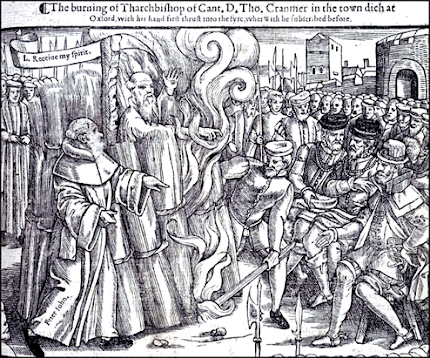
The burning of Tharchbishop of Cant. D. Tho. Cranmer in the town dich at Oxford, with his hand first thrust into the fyre, wherwith he subscribed before. [Click on the picture to see Cranmer's last words.]

Daily Bible Verse

Thursday, February 09, 2012

George Conger Raises David Virtue's Dander

I do not generally read VirtueOnline because of its blatantly Anglo-Catholic bias.  However, I was amused by this piece that David Virtue posted attacking George Conger's articles on the current situation with the Anglican Mission in America and the Rwandan house of bishops.  Ironically, George Conger is an "orthodox" and "conservative" Anglo-Catholic who chose to remain within The Episcopal Church and work for reform.  As most readers of my blog know, I do not consider Anglo-Catholics to be truly converted to the Christian faith.  That would include "orthodox" Anglo-Catholics.  I was banned from posting comments at VirtueOnline for stating my position in a polemical manner.  Polemics seems to be the only way that these papist ecumenicalists get the message.  (Jude 1:3-4)

Robin Jordan of the Anglicans Ablaze blog attended, Moving Forward Together, the recent meeting between the Rwanda bishops, conservative AMiA congregational leaders, and the archbishop of the Anglican Church in North America, Robert Duncan, who is also an avowed Anglo-Catholic.  Robin hoped to persuade the more Evangelical and Reformed members of the AMiA to consider joining together in a new Reformed and Evangelical association of Anglicans.  Whether or not that happens is unclear, although Robin said that the Reformed leaning Anglicans he spoke with at the conference were not convinced that there is no place for them in the Anglican Church in North America.  The naivete of Evangelicals is truly astounding.  They do not seem to realize that the borg mentality of Anglo-Papists is that they are welcome so long as they keep the Gospel under wraps and go along with the false gospel of the Anglo-Papists.  That is assuming, of course, that these Evangelical Anglicans actually do understand the Gospel.  The irony here is that Duncan was there to persuade the AMiA to go with the ACNA, while Archbishop Rwaje of the Anglican Church in Rwanda was there to try to bring about reconciliation between the AMiA and the Rwandan house of bishops.

I am unsure of exactly how Reformed and Evangelical the Rwanda Anglicans are.  However, it would appear that they are not nearly as high church as the ACNA.  Robin Jordan has been blogging for some time now about how Anglo-Catholic the doctrine and canons of the ACNA are.  Most recently his critique of the new prayer book to be produced by the ACNA has been most insightful:  ACNA:  Theological Guiding Lens

David Virtue seems to think that Chuck Murphy and John Rodgers of the AMiA will be able work out a deal where the AMiA can join with the ACNA by this June.  The more the merrier I suppose.

Click here to see the original article at VirtueOnline:  George Conger Raises David Virtue's Dander

Addendum:  Robin Jordan corrected my comment above.  He said that it was never his intention to proselytize anyone but rather was there to report on the situation and see what kinds of responses he would get from the more Evangelical side of the aisle.
--
Reasonable Christian Blog Glory be to the Father, and to the Son : and to the Holy Ghost; Answer. As it was in the beginning, is now, and ever shall be : world without end. Amen. 1662 Book of Common Prayer

Wednesday, February 08, 2012

Horton and Tipton Talk: Justification and Union with Christ - Reformed Forum

This is a further discussion on the issue of justification by faith alone as the focus of the Gospel, versus the doctrine of union with Christ as the focus of Reformed theology as Tipton contends. However, Tipton overlooks the fact that union with Christ is by the means or instrument of faith, which faith is a living faith by which imputed justification is applied by God Himself to His elect. Dr. Horton participates by phone in this program.

Click here to see the Reformed Forum site and hear the episode: Justification and Union with Christ - Reformed Forum


Tuesday, February 07, 2012

The Politics of the Kingdom, by Edmund P. Clowney


Darryl G. Hart kindly provided this link to an article published in the Westminster Theological Journal in 1979. It is an article by Edmund P. Clowney which outlines briefly the doctrine of the two kingdoms, namely the kingdom of God and the kingdom of the world. The introduction points to the main concern. What is the church to do about environmental, political and social problems?

“THE PROBLEM THAT IS POSED for us today (in the relation of theology and politics) comes from the fact that theology does not appear to be comprehensive any longer. Starting with theology it becomes difficult to construct any theory of society whatever.”1 The remark with which LaĆ«nnec Hurbon introduces his study of the work of Ernst Bloch has immediate appeal. Has not Christian theology limited itself to a private religion of personal devotion? What meaning can such religion have for a world sweeping to destruction in a flood of catastrophic social and environmental problems?

Perhaps that rhetorical question might receive a surprising answer from places where the flood has struck. Personal religion gains new meaning in the Gulag Archipelago.


The read the rest of the article in PDF format, click here: The Politics of the Kingdom


Darryl Hart: Escondido Theology Before Escondido

Darryl Hart has posted an article about John Frame's new book. Here is the lead in:

In his new book, John Frame argues that two-kingdom theologians represent a novel development in the history of Reformed theology. In his introduction, he goes out of his way to explain that Escondido theologians reject Christendom. But this rejection creates a problem for 2k because the theologians of the sixteenth and seventeenth centuries taught that the magistrate had a duty to enforce the entire Decalague [sic]. “The two kingdoms view,” Frame writes, “goes beyond the Reformation theology in important ways. Indeed, except for the law/gospel dichotomy, its distinctive positions are American, not European.” (Frame also acknowledges that the roots of two kingdom theology are in Augustine’s City of God and Luther’s On Civil Authority. Go figure.) In fact, Frame goes out of his way to locate Meredith Kline as the source of these views.


To read the rest of the article click here: Escondido Theology Before Escondido


David Van Drunen Rejoinder


In a response to a negative review of his book, Living in God’s Two Kingdoms: A Biblical Vision for Christianity and Culture, David Van Drunen said:

The first is that though Scripture provides guidance for thinking and acting in all areas of life, for most academic subjects Scripture provides only general guidance. The Bible sets certain parameters for approaching the various disciplines, but it does not give us specific or exhaustive information about, say, chemistry or literature or economics. To delve deeply into these subjects requires investigation of the world around us (natural revelation) and a measure of wisdom and good judgment. I imagine that Dordt College professors would agree with this claim, and implement it in their classrooms all the time. My writing on education is not a screed against Christian education, as Zylstra suggests, but wrestles with the implications of facts like this. It is something that every Christian teacher and scholar must take into account.


If only some of the Anabaptist fanatics who "claim" to be Clarkian could understand this. Gordon H. Clark himself said that the Westminster Confession is the best expression of the Christian faith in systematic form. (Christian Philosophy, p. 122). The Bible is not an exhaustive commentary on music, the arts, science, mathematics or even modern judicial law. It is a textbook on God's revealed will and dogmatic doctrine that is specific to saving faith and other issues. Scripture only indirectly speaks to matters of general revelation or natural revelation and "natural" law. Inferring more than the Bible actually says about formal logic and other philosophical issues falls as much into the category of general or natural revelation as does science. If only Baptists and non-cessationists were more logical they would be confessionally reformed and covenantal.

As much as I agree with Clark's Scripturalism, it seems to me that some Clarkians have forgotten the distinction between special revelation and general revelation. Scripture is indeed a set of propositional truth claims set forth in logical form. However, logic, strictly speaking, is a philosophical concept and therefore falls into the category of natural revelation, as does the many inferences drawn from Scripture by Clarkians in the areas of government, politics, and the sciences. Clark himself debunked the various secular theories of philosophy and said that only presupposing Scripture gives philosophy any credibility whatsoever.

One Baptist who "claims" to be "Clarkian" or Scripturalist recently said that a man can infallibly know all the logical propositions in the Scriptures. That must be a tall order. I cannot even remember all of the commandments, much less all the promises in Scripture--and I sure do not claim to know even a majority of the doctrinal propositions in the Scriptures. I do hope I have a firm grasp on the essential propositions, though. Jesus Christ is both God and man in one person. That much I know Scripture teaches. (John 1:1, 18; 2 John 1:7-11).

Unfortunately, Gordon H. Clark insisted at the end of his life that Jesus was two persons. That sort of irrational reasoning is self-contradictory in my opinion. (1 Timothy 2:5; 1 Timothy 3:16; John 1:1,14,18; Titus 2:13; John 20:28; Matthew 16:16). Not even Clark infallibly knew all the propositions God knows. Nor did Clark know all the propositions of the Scriptures. Obviously Clark thought he erred earlier in his career when he affirmed the Reformed confessional view that Christ is one person and two beings/natures, one being divine and the other being human, perfectly united but not mixed or confused or separated. Some Clarkians love to pretend that the noetic effects of sin do not affect the intellect. But that is not what Clark taught either. What he said was that knowledge itself is objective and one does not need to be a regenerate Christian to understand a particular proposition made by Scripture, such as David was the king of Israel. How that translates to an infallible knowledge of all the propositions of the Scriptures I have no idea.

Article II, Of the Word, or Son of God, which was made very man

The Son, which is the Word of the Father, begotten from everlasting of the Father, the very and eternal God, and of one substance with the Father, took man's nature in the womb of the blessed Virgin, of her substance: so that two whole and perfect natures, that is to say, the Godhead and manhood, were joined together in one person, never to be divided, whereof is one Christ, very God and very man, who truly suffered, was crucified, dead, and buried, to reconcile His Father to us, and to be a sacrifice, not only for original guilt, but also for all actual sins of men.


To read Dr. Van Drunen's rejoinder, click here: Westminster Seminary California


Dr. Robert Godfrey Responds to John Frame's Book: The Escondido Theology

[The following is from the Westminster Theological Seminary, California website.  I trust that you will read John Frame's book along with the writings listed by Dr. Godfrey below.   Charlie.]

Click here to see the original post:  Westminster Seminary California Faculty Response to John Frame

W. Robert Godfrey
All of us on the faculty of Westminster Seminary California are shocked and saddened by John Frame’s book, The Escondido Theology.  Several of us were colleagues with John and several had been his students.  We have appreciated particularly over the years his teaching of the apologetics of Cornelius Van Til, his critique of open theism, and his strong defense of the doctrine of biblical inerrancy.  (The statement of Andrew Sandlin on p. xxxi of this book claiming that John had been a polemicist against inerrancy is surely a mistake.)  We are very troubled, then, to find John so utterly misrepresenting and misstating our views.  We do not wish to engage in a protracted discussion of these things with John, but we do find it necessary to set the record straight.

Perhaps the simplest way to do that is to refer to the thirty-two bullet points with which John has summarized our views at the beginning of the book (pp. xxxvii-xxxix).  He introduces these bullet points by claiming: “Below are some assertions typical of, and widely accepted among, Escondido theologians.  Not all of them make all of these assertions, but all of them regard them with some sympathy” (p,xxxvii).  In response all of us on the WSC faculty wish to state clearly that we reject all of these thirty-two points as a fair or accurate presentation of our views.  We have the most sympathy with the bullet point which says “There is no difference between being biblical and being Reformed” (p. xxxviii). Yet we would state it differently: we are Reformed because we believe that the Bible is most faithfully understood and taught in Reformed Christianity.  In relation to most of John’s bullet points we believe and teach the very opposite of what is attributed to us.  We hope that those interested in our work will read some of the many works written by our faculty and see for themselves the inaccuracy of John’s book.

To see our commitment to applying the Bible in preaching and to a wide range of contemporary issues, we list below a few faculty books which illustrate this commitment:

Dennis Johnson, Him We Proclaim
W. Robert Godfrey, Pleasing God in our Worship
Michael Horton, Law of Perfect Freedom
R. Scott Clark, Recovering the Reformed Confession (with chapters on the application of the second and fourth commandments)
J. V. Fesko, The Fruit of the Spirit Is and The Rule of Love
David VanDrunen, Bioethics and the Christian Life
Audio recordings of the faculty conference on “The Law of God and the Christian” and our most recent conference on "The Unfolding Mystery: Reading and Applying the Bible."

In light of the potential for this book to confuse our friends and the general public, we wish to restate our Doctrinal Commitment (as is stated in our Catalogue), “The Scriptures of the Old and New Testaments, breathed out by the Spirit of God through human authors, are the very Word of God written—the only infallible and inerrant authority for faith and life. The doctrines of the Christian faith, held by orthodox churches throughout the ages, express the central truths concerning the triune God and his works of creation and redemption, particularly as they confess the saving work of Jesus Christ as revealed in Scripture. The Reformed confessions (Westminster Confession and Catechisms, Heidelberg Catechism, Belgic Confession, and the Canons of Dort) are the fullest and most accurate summary of the system of doctrine revealed in Holy Scripture.”

Westminster California has been and remains a confessional school. As a whole our faculty supports and promotes the consensus views of the Reformed community as summarized in the Reformed confessions. These confessions express most precisely our theology.   

If you have questions about this matter, please contact Westminster Seminary California.

--
Reasonable Christian Blog Glory be to the Father, and to the Son : and to the Holy Ghost; Answer. As it was in the beginning, is now, and ever shall be : world without end. Amen. 1662 Book of Common Prayer

The Inspiration of the Bible Is a Sovereign Act of God

The Inspiration of the Bible Is a Sovereign Act of God

Eric Holmberg: I Will Never Vote for a Mormon for President


Although I do not endorse the apologetics ministry that sponsored this video statement, I fully agree with what Eric Holmberg has to say. The Apologeticsgroup.com is a continuationist or charismatic ministry, although they are Reformed in their confession of faith. See: About.


Is God Evil? Carl Beisner

The Reformed answer of Luther, Calvin, the Westminster Divines, and others also denies proposition 3, but on different grounds. They argue that although it would not have been logically impossible for God to create only moral creatures that would never sin, He in fact created a moral world with creatures whose evil He foreordained for His own good purposes—to display His justice in punishing some (Prov. 16:4) and His grace in redeeming and pardoning others (Eph. 1:5–6; 2:7).
Does this mean God justifies His means by His ends? Yes. Is that wicked? No. An end-justifies-the-means ethic is fallacious and therefore wicked for finite men (who can neither control nor know all the results of their choices), but it is perfectly fitting for the infinite God (who both controls and knows all the results of His choices)–and, after all, God being supreme need not justify His choices to anyone:
So then He has mercy on whom He desires, and He hardens whom He desires. You will say to me then, “Why does He still find fault? For who resists His will?” On the contrary, who are you, O man, who answers back to God? The thing molded will not say to the molder, “Why did you make me like this,” will it? Or does not the potter have a right over the clay, to make from the same lump one vessel for honorable use and another for common use? (Rom. 9:15–21).
Does the reality of evil make the existence of the Christian God impossible? No. For good reasons, God created a world that contained evil. For those same reasons, as we have seen, the Christian position does not self-contradict.

From:  How Christians Should Approach the Problem of Evil

--
Reasonable Christian Blog Glory be to the Father, and to the Son : and to the Holy Ghost; Answer. As it was in the beginning, is now, and ever shall be : world without end. Amen. 1662 Book of Common Prayer

Anglicans Ablaze: The ACNA Theological Lens: The Guiding Principles Behind the Proposed ACNA Prayer Book—Part 7

Robin Jordan has done an excellent job of revealing the modern Tractarian biases of the Anglican Church in North America's new prayer book revision committee. Unfortunately, the direction of the ACNA continues to flow against the English Reformation and Biblical Christianity. The misuse of the Anglican Formularies to justify the false religion of Anglo-Catholicism continues to prevail in the ACNA from all appearances. Anglo-Catholicism, like Rome, teaches that tradition is equal to the revelation is Scripture and includes faith plus works for justification and all the idolatries of the Roman Catholics and the Papists. Click here to read Robin Jordan's complete article: Anglicans Ablaze: The ACNA Theological Lens: The Guiding Principles Behind the Proposed ACNA Prayer Book—Part 7


Monday, February 06, 2012

Letter to the Friends of the Reformed Faith concerning the Errors of Norman Shepherd « Johannes Weslianus

Letter to the Friends of the Reformed Faith concerning the Errors of Norman Shepherd « Johannes Weslianus

Dr. Michael Horton - For or Against Calvinism, Part 1 - Listen to Free Online White Horse Inn Christian Radio Broadcasts


Two episodes of The White Horse Inn are absolutely necessary for every Calvinist and Arminian to hear. Part one is Roger Olson's presentation. In this part, Olson admits that if Scripture says something he disagrees with, then it is OK to reinterpret the plain meaning of the text to fit with his rational presuppositions. Passages like Romans 9, Acts 2:23; 4:27-28; 1 Peter 2:8 cannot possibly support the Calvinist view. Why? Because Olson has presupposed that Scripture cannot possibly teach what it "plainly" teaches!

Basically libertarian free will is a compromise with the semi-pelagianism of the Papists and the Eastern Orthodox. Scripture, for the Reformed position, is the final authority, not reason exalted above Scripture. God is absolutely sovereign. Psalm 115:3.

Click here to hear Part 1: Dr. Michael Horton - For or Against Calvinism, Part 1 - Listen to Free Online White Horse Inn Christian Radio Broadcasts

And here to hear Part 2: Dr. Michael Horton - For or Against Calvinism, Part 2 - Listen to Free Online White Horse Inn Christian Radio Broadcasts

Anglicanism and How Many Points?

  Sanctify them in the truth; your word is truth. (John 17:17 ESV)


Recently in reconsidering several issues regarding what constitutes the so-called Reformed center, a term which attempts to reify exactly what Reformed theology is in actuality, I revisited the Riddleblog, a blog owned by Kim Riddlebarger of The White Horse Inn.  Kim is an expert on the issue of eschatology and amillennialism.  I happen to agree with amillennialism since it appears to be the best explanation of the apocalyptic material in the book of Revelation.  However, what particularly caught my attention was Dr. Riddlebarger's refutation of Dr. John MacArthur's dispensational attack on the Reformed faith while at the same time claiming to be a "five point Calvinist".  Dr. Riddlebarger rightly points out that Calvinism is way more than simply the five points of Calvinism.  (See, A Reply to John MacArthur).  Essentially, Dr. Riddlebarger says that Baptists are not Reformed, despite the fact that they may adhere to the five points of Calvinism.  Anyone familiar with the Canons of Dort knows that it is part of the Three Forms of Unity, which would include the Heidelberg Catechism and the Belgic Confession, both of which flatly reject MacArthur's Baptist view of the sacraments, his rejection of covenantal theology, and his premillennial dispensationalism.

Unfortunately,  particular Baptists get many other things wrong as well,  They are particularly prone to associate with Arminian Baptists since being Baptist trumps the Canons of Dort.  So on this aspect Baptists are not really in full agreement with the so-called five points of Calvinism either.  I might add that the Sydney Anglicans are inconsistent here as well since the Synod of Dort equally condemned the view that the atonement is in any sense all universal rather than particular to the elect.

This raises other issues as well.  I should point out here that the so-called "Clarkian apologetics" crowd is not a unified group either.  Many of them are non-cessationists or particular Baptists and outright reject confessional theology, something Gordon H. Clark with which Clark himself would have never agreed.  (See: Scripturalism).  They make this huge leap in logic based on the fact that in Clark's last book, The Incarnation, he repudiated his earlier affirmation of the Westminster Confession's view that Christ is one person but two.  (See: Was Clark a Nestorian?) From that one point many in the so-called "Clarkian" crowd jump to premature Anabaptist conclusions that therefore all confessional theology is up for grabs.  Question everything in creeds and confessions they say.

But that was not the position taken by Clark.  His view was thoroughly confessional and presupposed that the Westminster Standards were the best representation of biblical Christianity.  Although Clark, like all Reformed theologians, affirmed that Scripture is the final authority and that creeds and confessions possibly err, he did not adopt the sort of skepticism toward the creeds and Reformed standards which we see the particular Baptists and non-cessationists taking, particularly those who claim to be Scripturalists in the line of Gordon H. Clark.

In short, it is my contention that non-cessationists, particular Baptists, and others in sympathy with subjective and ecstatic leadings of the Spirit common to the Anabaptist tradition, are not truly Scripturalists at all.  They are a curious offshoot of Clark's Scripturalism.  Furthermore, the principle of Sola Scriptura is not subject to solipsism or hyper-individualism or a rejection of confessional Reformed theology.  (See:  How Many Points?, by Richard Muller).

There are many divisions in the wider Reformed and Protestant tradition.  Theonomy and reconstruction adopt a post millennial view that exalts the law above the Gospel and social transformation above the doctrines of grace.  Baptists reject creeds and confessions and adopt views very similar to the Anabaptists, including a legalistic view of "Lordship salvation".  Ironically, some so-called "Clarkians" like Kenneth Talbot are both Van Tilian and theonomic and Clarkian--as if the two go together???

The Anglican tradition suffers from a similar form of schizophrenic disjunction with the Anglican Formularies.  Ango-Catholicism, Tractarianism, and high church Arminianism are heretical perversions of the English Reformation.  But it is my contention that theonomy, dispensationalism, the Lordship salvation controversy, non-cessationism, future vindication, and assorted other theological errors could be avoided were more pastors, theologians and plow boys familiar with the Reformed standards.  My study of both Scripture and the various Reformed confessions of faith and catechisms has greatly enriched my understanding of theology and the Bible.

While I have a great appreciation for the Scripturalism of Gordon H. Clark and for the work of The Trinity Foundation regarding their stand for the doctrine of justification by faith alone, I do not and cannot adopt an Anabaptist attitude toward the Westminster Standards, the Three Forms of Unity, or the Anglican Formularies.  Unfortunately, the advocates of Clark's Scripturalism these days have little to do with Clark's rejection of the continuation of the gifts of the Spirit or with Clark's own position that the Westminster Standards best represent biblical Christianity:

Definition of Christianity
It is essential therefore to define Christianity more exactly by a specific doctrinal system.  Romanism is not what is meant.  By Christianity we shall mean, to use common names, what is called Calvinism.  Or, to be most specific, the definition of Christianity shall be the articles of the Westminster Confession.   With such a definite basis, it will no longer be necessary to spin dizzily in a whirlpool of equivocal disputation.  Now we can look at what we are talking about.  ["Is Christianity a Religion? in Christian Philosophy, volume 4, The Works of Gordon Haddon Clark, (Unicoi:  Trinity Foundation, 2004), p. 122.]


I would contend that if Anglicans actually believed what the Anglican Formularies teach then there would be much less disputation.  This is also true regarding the those who "claim" to follow the apologetics of Dr. Clark.  If they were confessional presbyterians there would be much less confusion and disputation.  Unfortunately even Sean Gerety is much more willing to compromise confessional Calvinism as it is expressed in the Westminster Standards--for the sake of a facade of unity among Clarkians on other issues like the neo-nestorianism of Clark's final book--than to stand for what Clark himself defined as biblical Christianity:  the articles of The Westminster Confession.

I would contend that for Anglicans biblical Christianity is expressed in the Anglican Formularies, which do teach the five points of Calvinism in incipient form and further developed in the Lambeth Articles of 1595, the Irish Articles, and the Westminster Standards.  While Calvinism is much more than adhering to the five points of Calvinism, Anglicanism is much more than some generic wishy washy Amyraldianism or Arminianism.  It is solidly Augustinian, Reformed, and Calvinist as that is expressed in the Formularies, Lambeth Articles, the Irish Articles, and the Westminster Standards which are drawn from them.

Although it is true that Reformation Anglicans are not Puritans or Presbyterians, it can be said that we have much more in common with the confessional view of Presbyterians or the Dutch Reformed than with particular Baptists--or even with the Clarkian Baptists masquerading under the guise of the "five points".


Sincerely in Christ,


Charlie


Sunday, February 05, 2012

Is Anglo-Catholicism a Via Media? Charles Pettit McIlvaine

Rev. Charles Pettit McIlvaine, Born Again Episcopalian.
[The following quote is from Oxford Divinity Compared with that of the Romish and Anglican Churches, with a Special View to the Illustration of the Doctrine of Justification by Faith, by Charles Pettit McIlvaine.  Click here to see the Google book:  Oxford Divinity Compared.]

"If any  man thirst let him come unto me and drink;" a mode of preaching Christ, that shall ever delight to proclaim to all people a full, perfect and ready salvation to the vilest sinner, whenever, in sickness or health, he turns unto God, truly repenting and believing in Jesus--a salvation which justifies perfectly, and immediately, on the act of a living faith, and which sanctifies perfectly, but progressively, as the necessary fruit of the same faith; a salvation so perfect and free, that, in the words of Hooker, "although in ourselves, we be altogether sinful and unrighteous, yet even that man that is impious in himself, full of iniquity, full of sin, him being found in Christ, through faith, and having his sins remitted through repentance, him God beholdeth with a gracious eye, putteth away his sin by not imputing it, taketh quite away the punishment due thereto by pardoning it, and accepteth him in Jesus Christ, as pefectly righteous as if he had fulfilled all that is commanded him in the Law."  --Charles Pettit McIlvaine.


Chapter II

STATEMENTS PREPARATORY TO THE RIGHT ESTIMATION OF THE OXFORD DOCTRINE OF JUSTIFICATION

Professions of Oxford Divines concerning the conformity of their doctrine with that of the Church of England--Their account of Ultra-Protestantism--Their identity of their system with that of Alexander Knox--The condemnation of the latter, as Romish and dangerous, by certain eminent divines, of diverse schools in the Church of England, before its development, at Oxford, had excited special interest.

Before proceeding any further, it is proper to state that the Divinity which we propose to examine, is loudly proclaimed by its advocates to be the middle path, the Via Media, of the Church of England, "distinct from the by-ways of Ultra-Protestantism on the one side, and neither verging towards, nor losing itself in, Romanism on the other."(1)  The formularies of the Church of England, and the writings of her standard Divines are often and confidently appealed to as exhibiting the precise doctrines of the system.  Now it is the simple question how far these pretensions are true, which we propose to institute.  But in order to estimate this Via Media aright, the first thing is to get a view of the opposing sides between which it proposes to pass.  Of the one side, viz. of Romanism, we are to speak particularly hereafter.  Of the other, ULTRA-PROTESTANTISM, a something which occurs with singular frequency in the works of these writers, what shall we say?  What is Ultra-Protestantism?  We have seen no definition.  But according to the use of Dr. Pusey, and others, the name seems to be applied to whatever is in religion, or relating to it, negatively, or positively, for, or against, only excepting Romanism or Oxfordism; embracing of cause and effect, doctrine and inference; from the case of those clergy of the Church of England, who are, "in the main, orthodox and sound, in spite of the natural tendency of their principles," through Lutheranism and Calvinism, and every grade of unromish dissent and heterodoxy, down to what is considered the result of the common tendency, an entire Rationalism, and Socinianism, ut nec pes, nec caput uni reddatur formae.  One would suppose that a coast so undefined would afford but little guidance in keeping the middle way, except when as mariners, under fear of hidden shoals and currents, on an unseen shore, keep as far away as possible.

Some specimens will help us judge how far the Via Media is really a middle way.

Dr. Pusey describes "a large portion" of the clergy of the Church of England as holding "Justification is not a gift of God through His sacraments, but the result of a certain frame of mind, of a going forth of themselves and resting themselves upon their Saviour; that this is the act whereby they think themselves to have been justified; and so as another would revert to his "baptism and engraffing into Christ, and thus his being in Christ, so do they this act whereby they were justified."  "They sever Justification from Baptism, and make it consist in the act of reliance upon the merits of Christ only; sin, according to them, is forgiven, at once, upon each renewal of this act: and in this they virtually substitute this act for Baptism; a man has no more to do with his past sins than he has with those remitted by baptism;" according to them "when men have been been once brought, in repentance to renounce their sins, and seek reconciliation through the free mercy of Christ--then their sins are done away, they are covered, they can appear no more; the handwriting is blotted out." This "apprehension of Christ's merits is to them a full remission of sins, completely effacing them."  "To revert to past sins is to doubt of Christ's mercy; to bear a painful recollection of it is to be under the bondage of the law; to seek to efface it by repentance is weakness of faith; to do acts of mercy or self-denial, or self-abasement, or to fast with reference to it, is to interfere with 'the freeness and the fulness of the Gospel:'  to insist upon them 'is place repentance in the stead of Christ.'" (2)

It is impossible not to see in this strange caricature, which really applies, in all respects, to no class of the clergy of England, that "the large portion" intended is that which is best known in this country by such names as Robinson, Scott, Venn, the two Milners, Simeon; of whose mode of exhibiting the way of salvation, the writings of such living divines as the present Bishop Wilson, of Calcutta, the two Bishops Sumner, the one of Winchester, the other of Chester, the Rev. G. S. Faber, &c. are fair examples.  True indeed the views of this most honourable and useful body of the English Clergy are very singularly overdrawn; one can hardly recognize them under the strained and warped features for which they are made to be accountable; but without doubt, the Ultra-Protestantism referred to in the above extracts, is intended to be understood as being displayed in the general mode which appears in that class of English divines, of representing "the nature and essence of the medicine whereby Christ cureth our disease, the manner of applying it, and the number and the power of the means."


Of such views, does Dr. Pusey write as follows:  "This abuse of the doctrine of justification by faith sears men's consciences now, as much as the indulgences of the Romish system did before.  It used to be said that 'the Romish was an easy religion to die in,' but even the Romish, in its corruptions, scarely offered terms so easy, at all events made not a boast of the easiness of its terms."  Then follows an evident preference of the Romish system, on the ground that if only "the stale dregs of the system of the ancient Church," it has the dregs--"something of the bitterness of the ancient medicine;" it still teaches men "to make sacrifices for the good of their souls; to accuse and condemn themselves, that so they might find mercy" through Christ--to be "punished in this world, that their souls might be saved in the Day of the Lord."  We are given distinctly to understand that "a large portion" of the English Clergy, is worse than even these stale dregs of the medicine of the ancient Church; because it stifles continually the strong emotions of terror and amazement which God has wrought upon the soul, and by an artificial wrought-up peace, checks the deep and searching agony, whereby God, as in a furnace, purifies the whole man, by the spirit of judgment and the Spirit of burning."  It is "a spurious system, misapplying the promises of the Gospel, usurping the privileges of baptism which it has not to confer, giving peace which it has not to bestow, and going counter to the whole tenor of Scripture, that every man shall be judged according to his works." (3)

The same singularly extravagant and most painful strain of condemnation is found everywhere in Mr. Newman's Lectures on Justification.  The following is a specimen.  He calls the righteousness of Christ imputed to us for Justification as held by the "large portion" of the English Clergy, above referred to, "an unreal righteousness and a real corruption," "bringing us in bondage to shadows"--"another gospel."  "Away then (he says) with this modern, this private, this arbitrary system, which promises liberty conspires against it; which abolishes sacraments; to introduce dead ordinances; and for the real participation of Christ, and justification through His Spirit, would at the very marriage  feast, feed us on shells and husks, who hunger and thirst after righteousness."(4)

It is not the purpose here to say a word, in argument, concerning all these wonderful and melancholy of morbid mind and spiritual discernment.  Whoever has paid any serious attention to the writings of the Clergy, thus professedly displayed, will need no help in estimating the justness of the condemnation.  But where there is no need of argument, there may be propriety in assertion; and sometimes there is a solemn duty in assertion, if only for the purpose of bearing our solemn testimony, whatever it may be worth, to some precious, but despised and reviled portion of the truth as it is in Jesus.  Such testimony, the present writer feels constrained to give, in this place,  after such an afflicting reprobation of what he most solemnly believes to be nothing else than "the glorious Gospel of the blessed God," our Saviour.  Denying entirely the justice of the draft of doctrine laid to the charge of the class of divines professedly described; but perceiving just enough of truth therein to mark distinctly who compose "the large portion" of Clergy whom our Oxford divines have thus represented as teaching for the way of salvation, "another gospel"--a spurious system--"an unreal righteousness and a real corruption,"--worse even than the system of indulgences in the Church of Rome; the author of these pages does earnestly hope that his name may be counted worthy to take part in their condemnation.  If the way here called another gospel, even that of Justification through the obedience and death of Christ, accounted unto us for righteousness, through the instrumental agency of a living faith, be not the only hope of the sinner, then he, for one, has no hope.  He has learned of no other "anchor of the soul sure and steadfast, which entereth to that within the veil."  He does hope that he may ever be identified with that divinity, that way of preaching Christ Jesus the Lord, which instead of a "reserve" in making known the precious doctrine of Atonement, instead of treating salvation by grace, through faith, as "a great secret," and keeping the secret out of the sight of the ungodly for fear of "an indelicate exposure of the sacred mystery," as these writers urge,(5) shall lift up the voice to the perishing and penitent, like the Master and Lord, when to the great multitudes, on the last day of the feast, He cried, "If any  man thirst let him come unto me and drink;" a mode of preaching Christ, that shall ever delight to proclaim to all people a full, perfect and ready salvation to the vilest sinner, whenever, in sickness or health, he turns unto God, truly repenting and believing in Jesus--a salvation which justifies perfectly, and immediately, on the act of a living faith, and which sanctifies perfectly, but progressively, as the necessary fruit of the same faith; a salvation so perfect and free, that, in the words of Hooker, "although in ourselves, we be altogether sinful and unrighteous, yet even that man that is impious in himself, full of iniquity, full of sin, him being found in Christ, through faith, and having his sins remitted through repentance, him God beholdeth with a gracious eye, putteth away his sin by not imputing it, taketh quite away the punishment due thereto by pardoning it, and accepteth him in Jesus Christ, as pefectly righteous as if he had fulfilled all that is commanded him in the Law.  Let it counted folly, or frenzy, or fury, whatsoever; it is our comfort and our wisdom." (6)  So testifies our admirable Hooker--most suredly an Ultra-Protestant, in the matter of Justification,  as branded, as others, with the hot denunication of these Oxford divines.

Click here to see Chapter II of Charles Pettit McIlvaine's book, Oxford Divinity Compared with that of the Romish and Anglican Churches....

[Addendum:  It would appear that the Lordship Salvation view as well as the view of the neo-legalists would be more in line with the Tractarians than with Canterbury or Geneva or Wittenberg on the issue of justification by faith alone.  The neo-legalists would appear to agree with the Tractarians that some sort of good works must be added to faith.  The Reformed view is that justifying faith is a living faith..   Charlie].


Footnotes:

1.  Pusey's Letter, page 14.
2.  Ibid., pp. 74, 8, 54, 5.
3.  Ibid., pp. 56-59.
4.  Lectures on Justification, p. 61.  Extremes meet.  Socinus calls the same doctrine, faeda, execranda, pernitiosa, detestanda.
5.  See No. 80, Tracts for the Times.
6.  Discourse of Justification, Paragraph 6.


--
Reasonable Christian Blog Glory be to the Father, and to the Son : and to the Holy Ghost; Answer. As it was in the beginning, is now, and ever shall be : world without end. Amen. 1662 Book of Common Prayer

Last temptation of Castro: Get Religion, February 4, 2012 « Conger

It looks like Fidel Castro was never singled out for excommunication from the Roman Catholic Church. There was a general excommunication of atheistic communists pronounced in 1962 by Pope John XXIII. Fidel renounced his faith and so excommunicated himself. It seems that Fidel in his old age wants to return to the religion taught to him by the Jesuits who raised him. He even attended mass in 1998 when Pope John Paul II visited Cuba but did not receive the eucharist.

George Conger thinks this is a remarkable story because Fidel will be received back into communion. Presumably this means that Fidel Castro will take the eucharist when Pope Benedict XVI visits Cuba in March. Although the law of God is written in all men's hearts and they feel the guilt of breaking that law, only the Lord Jesus Christ Himself could pay the penalty for even one sin. How confessing sins to a priest, who is a false mediator, and taking an idolatrous communion that worships the communion elements as the literal body and blood of Christ can exonerate a terrible sinner is beyond me. The Bible says that there is only one mediator between God and men, Jesus Christ (1 Timothy 2:5).

The problem today is that due to the influence of Anglo-Catholicism, neo-orthodoxy, and theological liberalism the ecumenical movement has corrupted the Gospel in Evangelical circles. Even Billy Graham, the Baptist evangelist, compromised the Gospel by accepting Roman Catholics and the Eastern Orthodox Church representatives as genuinely converted Christians. Graham invited representatives of those churches to his crusades so that new converts could be directed to Roman Catholic parishes or Eastern Orthodox parishes.  (See:  Are Billy and Franklin Graham Leading Souls to Heaven or Hell?).

If semi-pelagianism and salvation by merits or works is a false religion--and it is--then Fidel's return to the Catholic Church is not a good thing. It is merely returning from atheism to a false religion. There is only one Gospel and that Gospel was officially condemned by the Roman Catholic Church in the canons of the Council of Trent.

To read the rest of the story at George Conger's blog, click here: Last temptation of Castro: Get Religion, February 4, 2012 « Conger


Saturday, February 04, 2012

Quote of the Day: Martin Luther on the Forgiveness of Sins

How are we to obtain remission of sins? Paul answers that the man known as Jesus Christ, the Son of God, has given himself for them. These are excellent and comforting words and promises—namely, that our sins are taken away only by the Son of God delivered up to death. It is with such gunshot and artillery that heathen religions must be destroyed, and all works, merit, and superstitious ceremonies as well. If our sins can be taken away by our own works and merits, why did the Son of God need to be given for them? But since he was given for them, it follows that we cannot put them away by our own works.

Again, this sentence makes it clear that our sins are so great and so invincible that it is impossible for the whole world to atone for even one of them. Surely the greatness of the ransom (namely, Christ the Son of God, who gave himself for our sins) is enough to show that we can neither atone for sin nor have dominion over it. The force and power of sin is made quite clear by these words: who gave himself for our sins. Here we must note the infinite price given for our wickedness, and then it will be clear that its power is so great that it could not be put away by any means except by the Son of God giving himself for it.

Anyone who considers these things properly will understand that this one word sins includes God’s everlasting wrath and the whole kingdom of Satan, and that it is something more horrible than can be expressed; this indeed ought to move us and make us afraid. But too often we are careless and make light of sin, as if it were nothing. Even though it brings with it the sting and remorse of conscience, we think we can get rid of it by some little work or merit.

But this sentence tells us that we are all servants and slaves to sin (compare Romans 7:14). It tells us that sin is a most cruel and mighty tyrant over everyone and cannot be vanquished by the power of any creatures, whether they are angels or human beings, but only by the sovereign and infinite power of Jesus Christ, who gave himself for our sins.

This sentence also gives singular comfort to the consciences of all who are terrified at the greatness of their sins. However invincible a tyrant sin is, Christ has overcome it through his death, and it cannot hurt those who believe in him. If we arm ourselves with this belief and hang on with all our hearts to Christ Jesus, there is light for us, and a sound judgment is given to us, so that we may rightly judge human situations around us. Sin is an invincible tyrant, but what about all who trust in their works to abolish and overcome sin? Here we immediately discern as wicked and pernicious all those sects by which the glory of God and of Christ is defaced and utterly taken away, and by which our own glory is advanced and established.


Luther, M. (1998). Galatians. The Crossway classic commentaries (37–38). Wheaton, Ill.: Crossway Books.

Soli Deo Gloria!!!


--

Reasonable Christian Blog Glory be to the Father, and to the Son : and to the Holy Ghost; Answer. As it was in the beginning, is now, and ever shall be : world without end. Amen. 1662 Book of Common Prayer

Propositional Revelation, the Only Revelation – D.B. Knox : Anglican Church League, Sydney, Australia

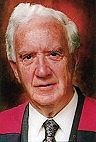
Dr. David Broughton Knox
From all appearances there seems to have been an influence on the Sydney Anglicans regarding Gordon H. Clark's view that Scripture is propositional truth or "propositional revelation". The idea that Scripture is not just a story but logically formulated truth claims which obligate the Christian to believer certain things such as "Christ died for the elect" is expressed in Scriptures such as John 10:11, 15 and John 3:16, 17, 18. The late D. Broughton Knox, a former principal of Moore Theological College in Sydney fully acknowledged the doctrine of the verbal, plenary inspiration of the Holy Scriptures:

THE BIBLICAL VIEW OF REVELATION

The denial of “propositional revelation” is the denial that God reveals Himself to men through the medium of words, that is to say, through meaningful statements and concepts expressed in words; for such is the only sense that can be given to the word “propositional” in this phrase. The denial that revelation is propositional in form, though widespread and repeated nowadays from writer to writer, runs counter to the biblical view of revelation.

The view of the Bible is that revelation is essentially propositional. This may be established in two ways. First, by considering how the Bible describes revelation, and secondly, by examining biblical revelation to see what in fact its nature is.


Click here to read the full article: Propositional Revelation, the Only Revelation – D.B. Knox : Anglican Church League, Sydney, Australia


Thursday, February 02, 2012

Dr. Gerald Bray, Anglican Evangelical Scholar Hired at Knox Theological Seminary

[I just received this e-mail today from Ivey Rose Smith.  It looks like Dr. Gerald Bray will be teaching historical theology and biblical exegesis at Knox Theological Seminary, Fort Lauderdale, Florida.  This could be a good thing judging from the compromises of the seminary on the Federal Vision issue and on the issue of creation by divine fiat.)

5554 N. Federal Highway † Fort Lauderdale, FL 33308 † 954-771-0376
PRESS RELEASE
Media Contact: Ivey Rose Smith

ismith AT knoxseminary DOT edu

Questions: Dr. Warren A. Gage
Dean of Faculty
954-771-0376

FOR IMMEDIATE RELEASE

Dr. Gerald Bray Joins the Faculty at Knox Theological Seminary


FORT LAUDERDALE, FL – 1/31/2012 – The President of Knox Theological Seminary, Dr. Ronald J. Kovack, and the Board of Directors are pleased to announce that Dr. Gerald Bray will be joining the resident faculty as Distinguished Professor of Historical Theology. Dr. Bray’s responsibilities will include teaching the sequence of church history courses to masters-level students and also contributing to the new theological exegesis track in the Doctor of Ministry program, particularly by providing instruction on the use of the history of exegesis.

“Gerald Bray is a scholar of the first order and a committed churchman. He’s knowledgeable about the patristic era and the Reformation era. He is a top-tier historian as well as a faithful theologian. An award-winning author and a master teacher, he will be a wonderful addition to our faculty and a blessing to all our students,” said Dean of Faculty, Dr. Warren A. Gage. Having added Dr. Bruce Waltke in the past two years and the impressive duo of Dr. Jonathan Linebaugh as the new Assistant Professor of New Testament and pastor theologian Dr. Jim Belcher as the Associate Professor of Practical Theology in the past year, Knox Seminary is pleased to add yet another theological gem to the faculty that is committed to the seminary’s core values of training students in the Reformed tradition to be Christ centered, gospel driven, and mission focused.

Dr. Bray holds a B.A. degree from McGill University and an M.Litt. along with a D. Litt. from the University of Paris-Sorbonne. With a vast curriculum vitae, he most recently has been the Research Professor of Divinity at Beeson Divinity School where he has taught church history and theology since 1993. Dr. Bray has also served as director of research for the Latimer Trust, an evangelical think tank in London. He is the most widely renowned evangelical church historian and, specifically, the evangelical expert on the history of biblical exegesis. He authored the first major textbook on the subject as well as edited four volumes on the history of biblical commentary.

A prolific and award-winning author, Dr. Bray’s books include: The Doctrine of God, Creeds, Councils and Christ: Did the early Christians misrepresent Jesus?, The Faith We Confess: An Exposition of the Thirty-Nine Articles, Translating the Bible: From William Tyndale to King James, and Biblical Interpretation: Past and Present (which was a 1997 Book of the Year by Christianity Today).

He is the editor of The Churchman, an Anglican quarterly and academic journal, as well as the Contours of Christian Theology book series for InterVarsity Press. Prior to that, he served as editor for The Anglican Canons 1529–1947 and Tudor Church Reform, which contains the Henrician Canons of 1535 and the Reformatio Legum Ecclesiasticarum, and three volumes in the Ancient Christian Commentary book series on Romans, First and Second Corinthians, and James to Jude. Most recently, he has edited the inaugural volume in the much anticipated Reformation Commentary on Scripture book series on Galatians and Ephesians for InterVarsity Press.

Dr. Bray has a systematic theology forthcoming with Crossway in March 2012: God is Love: A Biblical and Systematic Theology. He is presently preparing a companion volume on historical theology and is engaged in writing and speaking on a variety of theological issues of particular relevance to the contemporary church.

Dr. Bray’s appointment is effective immediately and he has already begun teaching the full church history sequence in one-week intensive courses. Assistant Professor of Systematic Theology, Dr. Michael Allen, said of the hire, “We are thrilled to have all our masters-level students take their church history courses with this leading evangelical historical theologian, Gerald Bray. Furthermore, we’re excited about Dr. Bray’s role in our newly-shaped Doctor of Ministry concentration in theological exegesis, where his incredible knowledge of the history of exegesis will stoke students’ desires and increase their capacity to learn from the long tradition of faithful Christian Bible reading for the sake of gospel ministry.” Knox is thankful that God continues to bring outstanding faculty selections as they seek to provide solid, Reformed biblical and theological training to men and women seeking ministry preparation.

If you would like more information about Knox Theological Seminary and Dr. Gerald Bray, please visit www.knoxseminary.edu, their official Facebook page, or you can find them on Twitter@knoxseminary.
--

Reasonable Christian Blog Glory be to the Father, and to the Son : and to the Holy Ghost; Answer. As it was in the beginning, is now, and ever shall be : world without end. Amen. 1662 Book of Common Prayer

A Confusion of Sanctification with Justification: Institute for Nouthetic Studies Blog » Blog Archive » On Preaching the Gospel to Yourself

Unfortunately, The Institute for Nouthetics Studies appears to endorse a view of the Gospel that confuses Gospel with Law and that confuses sanctification with justification. Although the article tries to sidestep the issue, the fact that the author of the article thinks "mature" Christians no longer need to look to the cross for their salvation but rather to their own good works shows that he just does not get it. From the beginning to the end of the Christian life we are imperfect in our subjective experience of sanctification. (Philippians 2:12-13; 3:12; 2 Peter 3:18).

I get weary with having to reiterate the Gospel so often on the blog but when obvious errors like these statements by Lou Priolo over at The Institute for Nouthetic Studies blog are made then I feel compelled to respond:


To my way of thinking, the place of the doctrine of justification in the believer’s life is much like the operating system on a computer. I’m a PC guy. My personal computer operates under a Windows operating system. Windows is always up and running, but most of the time, it runs in the background. I don’t see it. I can go for days without looking at it (although I know it is functioning as long as the other programs are operating properly). Occasionally, I have to go to the control panel to troubleshoot a problem, make some minor adjustments, or defrag my hard drive, but I don’t give it another thought because I have faith that it is doing what it is supposed to do. So it is with my justification. It is always up and running.

Well, so far so good. That does not sound so bad, right? The trouble is that Priolo is taking justification for granted. Like most Pharisees he has forgotten that the objective basis for our faith is the cross, the atoning sacrifice of Christ, not our own level of sanctification or goodness.

The trouble is that taking justification for granted and forgetting about it unless and until we fall into a major sin leads to self-righteousness and an attitude of superiority over those who struggle with sins which are more obvious. How can we counsel others if we have become practical Pharisees?

To show that Priolo has this air of superiority it is not necessary to read very far:

But what about the growing number of those who say that we must (or should or ought to) “preach the Gospel to ourselves every day?” If by Gospel they mean the entire ordo-salutis: effectual calling, regeneration, faith, justification, adoption, sanctification,[1] and glorification—the whole enchilada—there is not a problem (other than the fact that the Bible doesn’t exactly command us to do this). But if, like so many seem to be espousing today, they take a reductionist view of the Gospel—reducing it to justification (or to adoption) alone—there is a problem.


So Priolo has a problem with the Gospel! He is basically saying that sanctification is part of the Gospel, which is to confuse the moral law with the Gospel. It is a confusion of sanctification (infused righteousness and subjective in the heart/mind of the believer) with justification (the objective work of Christ in His sinless life and His substitutionary, atoning death on the cross for the elect). Since the Nouthetics site claims to be Reformed in theology I will respond with the view of the Gospel espoused by the Westminster Standards, the Three Forms of Unity, and the Anglican Formularies.

The Westminster Confession defines the Gospel via the distinction between the covenant of works and the covenant of grace:

2. The first covenant made with man was a covenant of works,1 wherein life was promised to Adam, and in him to his posterity,2 upon condition of perfect and personal obedience.3

See also: WLC 20 | WSC 12
--------------------------------------------------------------------------------
1 Gal. 3:12.
2 Rom. 10:5; Rom. 5:12-20.
3 Gen. 2:17; Gal. 3:10.

3. Man, by his fall, having made himself uncapable of life by that covenant, the Lord was pleased to make a second,1 commonly called the Covenant of Grace, whereby He freely offereth unto sinners life and salvation by Jesus Christ, requiring of them faith in Him, that they may be saved;2 and promising to give unto all those that are ordained unto eternal life His Holy Spirit, to make them willing, and able to believe.3

See also: WLC 30 | WSC 20
--------------------------------------------------------------------------------
1 Gal. 3:21; Rom. 8:3; Rom. 3:20,21; Gen. 3:15; Isa. 42:6.
2 Mark 16:15,16; John 3:16; Rom. 10:6,9; Gal. 3:11.
3 Ezek. 36:26,27; John 6:44,45.

4. This covenant of grace is frequently set forth in the Scripture by the name of a Testament, in reference to the death of Jesus Christ the testator, and to the everlasting inheritance, with all things belonging to it, therein bequeathed.
------------------------------------------------------------------------------
1 Heb. 9:15,16,17; Heb. 7:22; Luke 22:20; 1 Cor. 11:25.

Westminster Confession of Faith, Chapter 7

Basically, those who depend on their own works are obligated to keep the law with absolute obedience and to justify themselves by law keeping. That is true of the unconverted and of everyone who names the name of Christ. If works are to justify us, then perfect and absolute obedience is necessary (Matthew 5:17-21, 48; Romans 10:1-6). The trouble is that this is impossible since we have all failed from birth onward. (Romans 3:23; Psalm 51:4-5; Romans 3:10-18).

The ordo salutis or "logical order of salvation" begins with unconditional election, not with sanctification. As Ulrich Zwingli noted, unconditional election shows clearly that salvation is absolutely a gift of God, not something that we "choose" when you boil everything down to the bottom line:

Since Paul wishes to show that God’s election is born of his free purpose, and not from those whom he is about to elect, he says that the free purpose is the cause why all things work for good to those who love God. Nothing is ascribed to man’s merit. For he adds: For whom he foreknew (pronunciavit) he also predestinated to be conformed to the image of his Son, etc. I have translated προέγνω by “pronunciavit,” which word has the same force as if you should say predetermined or foreordained. This is then the apostle’s meaning: I said that all will result in good for those who according to God’s purpose are of the called. This I would have understood thus: God freely with himself settles upon, prejudges and foreordains (for by this word the word for “purposing” is expounded) whom he will, even before they are born. Whom he thus foreordains he marks out beforehand, i. e., destines them to be conformed to the image of his Son. As if he should say: No one can be conformed to Christ unless he has been destined for this. ( On Election, Ulrich Zwingli).
Of course, we are free moral agents and we are fully accountable for our actions and choices. But that does not mean that salvation is ultimately based on us or our choices. No, salvation is predestined from before the foundation of the world and we get no credit for our obedience since even that is a gift of God. (Philippians 2:13; Ephesians 2:8-9).

The Thirty-nine Articles of Religion are the confession of the Anglican Communion--albeit very few actually follow its literal and plain teaching today. The Gospel is stated several times in the Articles:


VII. Of the Old Testament.
THE Old Testament is not contrary to the New; for both in the Old and New Testament everlasting life is offered to mankind by Christ, who is the only Mediator between God and man, being both God and man. Wherefore they are not to be heard which feign that the old fathers did look only for transitory promises. . . . (2 Corthinians 1:20).


XI. Of the Justification of Man.
WE are accounted righteous before God, only for the merit of our Lord and Saviour Jesus Christ by faith, and not for our own works or deservings. Wherefore that we are justified by faith only is a most wholesome doctrine, and very full of comfort; as more largely is expressed in the Homily of Justification.

XII. Of Good Works.
ALBEIT that good works, which are the fruits of faith and follow after justification, cannot put away our sins and endure the severity of God's judgement, yet are they pleasing and acceptable to God in Christ, and do spring out necessarily of a true and lively faith, insomuch that by them a lively faith may be as evidently known as a tree discerned by the fruit.
Obviously, to forget that salvation is a monergistic work of God alone (Soli Gloria Deo!) is to become self-righteous in attitude and in theology (Romans 3:20-22). The Dutch Three Forms of Unity is in agreement with the other two Reformed traditions:
Heidelberg Catechism: Lord's Day 6

Question 18. Who then is that Mediator, who is in one person both very God, and a real righteous man?

Answer: Our Lord Jesus Christ, 5"who of God is made unto us wisdom, and righteousness, and sanctification, and redemption."6

Question 19. Whence knowest thou this?

Answer: From the holy gospel, which God Himself first revealed in Paradise;7 and afterwards published by the patriarchs and prophets,8 and represented by the sacrifices and other ceremonies of the law;9 and lastly, has fulfilled it by His only begotten Son.10
--------------------------------------------------------------------------------
1 Rom. 5:12, 15;
2 1 Pet. 3:18; Isa. 53:11;

3 1 Pet. 3:18 Acts 2:24; Isa. 53:8;

4 1 John 1:2; Jer. 23:6; 2 Tim. 1:10 John 6:51;

5 Matt. 1:23; 1 Tim. 3:16 Luke 2:11;

6 1 Cor. 1:30

7 Gen. 3:15;

8 Gen. 22:17-18; Gen. 28:14; Rom. 1:2; Heb. 1:1; John 5:46;

9 Heb. 10:7-8;

10 Rom. 10:4; Heb. 13:8;
Basically, the Gospel is not about what "we" have done. It is about the finished work of Jesus Christ and what He has done once and for all! (John 19:30; Hebrews 9:24-28).

Click here to read the post by Lou Priolo at: Institute for Nouthetic Studies Blog » Blog Archive » On Preaching the Gospel to Yourself

See also, Jack Miller's excellent response to this issue:

This broad understanding of the gospel is a potential recipe for weakening faith and increasing works-righteousness as one seeks to measure up in thought, word, and deed to "the good news" he is supposed to be exhibiting. It inserts progressive sanctification into the “gospel proper” by considering everything in the Word (promises, laws, threats, admonitions, works) as the good news of the gospel. Certainly we agree it is “good news” that the Spirit is working in us, conforming us to Christ as God predestined. But that is not part of the good news that the New Testament writers proclaimed. (The World's Ruined: The Gospel, Sanctification, and Faith).


Calvinistic Cartoons: Elephant in the Room

Calvinistic Cartoons: Elephant in the Room  Looks like Mark Driscoll and James McDonald have bigger problems than they realize.

EV News :: Don't legalise gay marriage, Archbishop of York warns David Cameron

EV News :: Don't legalise gay marriage, Archbishop of York warns David Cameron

Wednesday, February 01, 2012

Actress' Claim To Be Gay By Choice Riles Activists | Fox News


Well, you know, being politically correct is more important than truth. Ironically, homosexuals and transexuals argue that they have no choice in the matter of their sexual orientation, implying that they have no choice in their sexual behavior either. On the latter point there is much deliberate ambiguity on their part since even homosexuals advocate "safe sex" to prevent the spread of disease.

Of course, the Calvinist view is that gays are both predetermined to be gay and that they choose to be that way. Reprobation (Romans 1:28) is a divine decree from before the foundation of the world (1 Peter 2:8) and yet individuals have free moral agency (Ezekiel 18:23). Thus, homosexuals are right when they claim to be predetermined to their immorality (Leviticus 18:22; Romans 1:26, 27). But Christians are also correct when they say say that homosexuality is a choice. It's a matter of both/and, not either/or. God decrees to permit by secondary causes the immoral acts of evil men but the outcome is rendered absolutely certain since God is in control of all things that come to pass (Ephesians 1:11; Daniel 4:35).

The Westminster Confession of Faith says:

Chapter 3: Of God's Eternal Decree

1. God, from all eternity, did, by the most wise and holy counsel of His own will freely, and unchangeably ordain whatsoever comes to pass:1 yet so, as thereby neither is God the author of sin,2 nor is violence offered to the will of the creatures; nor is the liberty or contingency of second causes taken away, but rather established.3

See also: WLC 12 | WSC 7


--------------------------------------------------------------------------------

1 Eph. 1:11; Rom. 11:33; Heb. 6:17; Rom. 9:15,18.

2 James 1:13,17; 1 John 1:5.

3 Acts 2:23; Matt. 17:12; Acts 4:27,28; John 19:11; Prov. 16:33.

You can read A. A. Hodge's commentary on WCF chapter 3 by clicking here: God's Eternal Decree.

Hodge says:

The Confession in this section teaches that all the decrees of God are unconditional. All who believe in a divine government agree with Calvinists that the decrees of God relating to events produced by necessary causes are unconditional. The only debate relates to those decrees which are concerned with the free actions of men and of angels. The Socinians and Rationalists maintain that God cannot certainly foresee free actions, because from their very nature they are uncertain until they are performed. Arminians admit that he certainly foresees them, but deny that he determines them. Calvinists affirm that he foresees them to be certainly future because he has determined them to be so. The truth of the Calvinist view is proved-

(1) From the fact that, as shown above, the decrees of God determine all classes of events. If every event that comes to pass is foreordained, it is evident that there is nothing left undetermined upon which the decree can be conditioned.

(2) Because the decrees of God are sovereign. This is evident-(a) Because God is the eternal and absolute Creator of all things. All creatures exist, and are what they are, and possess the properties peculiar to them, and act under the very conditions in which they act, because of God's plan. (b) It is directly affirmed in Scripture (Dan. 4:35; Isa. 40:13,14; Rom. 9:15-18; Eph. 1:5).

(3) God's decree includes and determines the means and conditions upon which events depend, as well as the events themselves: "According as he hath chosen us in him before the foundation of the world, that we should be holy" (Eph. 1:4). "By grace are ye saved through faith; and that not of yourselves: it is the gift of God" (Eph. 2:8). "God hath from the beginning chosen you to salvation through sanctification of the Spirit and belief of the truth" (2 Thess. 2:13). In the case of Paul's shipwreck, God first promised Paul absolutely that not a life should be lost (Acts 27:24). But Paul said, verse 31, "Except these abide in the ship, ye cannot be saved."

(4) The Scriptures declare that the salvation of individuals is conditioned upon the personal act of faith, and at the same time that the decree of God with regard to the salvation of individuals rests solely upon "the counsel of his own will," "his own good pleasure." "For the children being not yet born, neither having done any good or evil, that the purpose of God according to election might stand, not of works, but of him that calleth," etc. (Rom. 9:11). "Being predestinated according to the purpose of him who worketh all things after the counsel of his own will" (Eph. 1:11; 1:5; Matt. 11:25,26).

4. The purpose of God is, with reference to all the objects embraced within it, certainly efficacious.

The decree of God is merely a purpose which he executes in his works of creation and providence. When it is said that all the decrees of God are certainly efficacious, it is not meant that they are the proximate causes of events, but that they render, under the subsequent economy of creation and providence, every event embraced in them absolutely certain.


Click here to read the Fox News story: Actress' Claim To Be Gay By Choice Riles Activists | Fox News


The Confession of Faith: A commentary on The Westminster Confession of Faith, by A. A. Hodge

The Confession of Faith: A commentary on The Westminster Confession of Faith, by A. A. Hodge

Support Reasonable Christian Ministries with your generous donation.